Director William Friedkin once obtained the film rights to The Spirit and contacted its creator, Will Eisner, to write the script. Eisner declined but recommended Harlan Ellison, which ended with a script being written and — surprise — Friedkin and Ellison fighting. There was a 1987 made for TV movie and talk of an animated adaption before the property went into development hell.
In 2005, Uslan approached Frank Miller at Eisner’s memorial service in New York City in regards to making this film. The result is similar to Miller’s Sin City films, but there remains an issue. It’s too dark for those that love The Spirit. And anyone who did, well, they’re old now and not the target audience for the movie. As I often wonder when a movie bombs, who was this for?
The Spirit (Gabriel Macht) and The Octopus (Samuel Jackson) are locked in endless combat, as both seem unkillable. The only thing this Spirit loves more than defeating evil are the ladies, whether that’s Ellen Dolan (Sarah Paulson), who keeps him in one piece, or Sand Seref (Eva Mendes). The weird thing is that the character is much closer to P’Gell, but again, only geeks like me are going to care about that.
I like the idea of the Angel of Death (Jaime King) trying to seduce and keep the Spirit, as well as how all the henchmen are the same actor. But man, this movie tried even my patience and I’ve made it through so many rough films. It looks interesting, but has no script or ability to build interest beyond looking like cut scenes from a video game that you’ll never get to play.
It’s a shame, because the potential of a great Spirit movie is out there. This just isn’t it.
Medicine is obviously big on our minds right now, as we confront an epidemic that currently has no cure.
This documentary is pretty interesting to watch while keeping where we are now in mind.
Filmmaker and homeopath Ananda More, Hom, DHMHS has traveled the world to meet with scientists, practitioners and patients to more about homeopathy. While she initially was a skeptic, now she wants to know if its science-based or is an elaborate placebo that impacts millions and endangers lives.
Science believes that homeopathy can’t work because we can’t prove how it works. How did we figure out gravity and electricity back before we could prove it? That’s the problem that Anada presents as she shows how homeopathy is being used to treat cancer in India, support the use of antiretroviral medication for HIV/AIDS in Africa and prevent common epidemics in Cuba.
Can science explain how nature works? How does homeopathy work as well as medicine? Is it better, as often medicine focuses on toxic treatments that can have irreversible or life-threatening side effects? Should the profits of healthcare be people or the company making the cure?
Magic Pills is available on demand.
DISCLAIMER: This movie was sent by its PR company.
Marc Forster has quite the resume beyond making a Bond film, with works like Monster’s Ball, Finding Neverland, Stranger than Fiction, The Kite Runner, World War Z and Christopher Robin.
It’s a film that looks back at early Bond films while making its own way, building on the loss that Bond endured at the end of Casino Royale. It’s also the most violent film of the series, according to a study by the University of Otago in New Zealand.
We start directly after the end of the first film, with Bond taking Mr. White to his boss M. However, White escapes and Bond begins investigating the evil organization Quantum (or Spectre, but the filmmakers didn’t have the rights). Mathieu Amalric plays the villain Dominic Greene, an eco-terrorist who acts as if he is helping the planet.
You can see this movie as really the second part of one story, setting Bond up for his future adventures and showing modern audiences who he is now.
I love how the gun barrel sequence happens at the end of the film, finally showing us that this is Bond. For not being based on an Ian Fleming story, it’s nice knowing that the character seems to be in good hands.
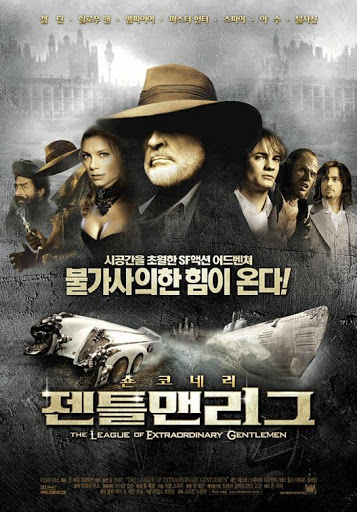
Sean Connery turned down the roles of the Architect in The Matrix films and Gandalf in The Lord of the Rings trilogy. He would have made $450 million off that last role, so that led to him taking this movie, even though he didnt understand the script. But hey — $17 million makes things much simpler, right?
He warred with director Stephen Norrington (Death Machine, Blade), who was uncomfortable with large crews. It makes sense, as Norrington came up from working with special effects on movies like Split Second and Aliens. For what it’s worth, Norrington did not attend the premiere, and when he was asked where the director was, Connery is said to have replied, “Check the local asylum.”
Jason Flemyng, who played Dr. Jekyll in the film, told Empire, “My favorite bust-up was in Venice. The League had to walk from Captain Nemo’s boat down the street, Magnificent Seven-style. At the end of the take, Sean shouted to Norrington, ‘What? You want us to do that again?’ He replied, “For $18 million, I don’t think it’s too much to ask you to walk down a road.” To which Connery’s reply was unprintable.”
Since this film, Norrington has been attached to several projects but hasn’t made another film, claiming that he would never direct again.
Interestingly enough, Larry Cohen and Martin Poll filed a lawsuit against 20th Century Fox, claiming the company had intentionally plagiarized their script Cast of Characters, which the two had pitched to Fox several times. But wait — isn’t this movie based on the Alan Moore and Kevin O’Neill comic book?
Cohen and Poll claimed that the studio bought the rights as a smoke screen, as both their script and the final movie shared public domain characters who did not appear in the comic book series.
The case was settled out of court, a decision Alan Moore told the New York Times was upsetting, as he had “been denied the chance to exonerate himself.” No wonder the guy hates the movies made from his comic books so much.
In 1899, Fantomas (Richard Roxburgh, Van Helsing) and his army have broken into the Bank of England to steal da Vinci’s blueprints of Venice and kidnap several scientists. To figure out what is happening, Allan Quatermain (Connery) is brought back to for a new team of the League of Extraordinary Gentlemen, along with Captain Nemo, vampire Mina Harker (Peta Wilson from the TV version of La Femme Nikita), invisible man Rodney Skinner (the production couldn’t get the rights to the original story, so they made up their own invisible person), Dorian Gray (Stuart Townsend, Queen of the Damned), Tom Sawyer and the twin form of Dr. Henry Jekyll and Edward Hyde.
Whereas the comic showed the league battling Martians and Fu Manchu, instead of the revelation that M — yes, like the Bond films — is also Fantomas and Sherlock Holmes’ archenemy Professor James Moriarty. Like they say, this is loosely based on the source material.
David Hemmings shows up as Ishmael, which is a nice cameo. The effects are big and bold, while the movie sets up a sequel at the end. That never happened — this is another one of those “even though the movie made $179.3 million on a $78 million budget” movies that still isn’t a success. Hollywood math.
The character of Campion Bond, British Intelligence Director — and the ancestor of James Bond — was supposed to appear and be played by Sir Roger Moore. The character was dropped before filming began to be saved for a possible sequel, which was never made.
Despite only a few references to Tom Sawyer in the comic books, the character was added to appeal to young Americans, which upset many fans of the comic, as well as Moore and O’Neill. That said, Mark Twain wrote two little-known sequels to Tom Sawyer, is Jules Verne-like one called Tom Sawyer Abroad and another where he becomes Tom Sawyer, Detective.
O’Neill would later say that he believed this movie failed because it was not respectful of the source material, such as how Allan Quatermain was changed so much and that Mina Murray was marginalized by becoming a vampire.
The Wold Newton family — a literary concept derived from a form of crossover fiction developed by the American science fiction writer Philip Jose Farmer — is a great concept. The comic takes full advantage of this. The movie ended a director’s career and retired Connery from anything other than voice-over work.
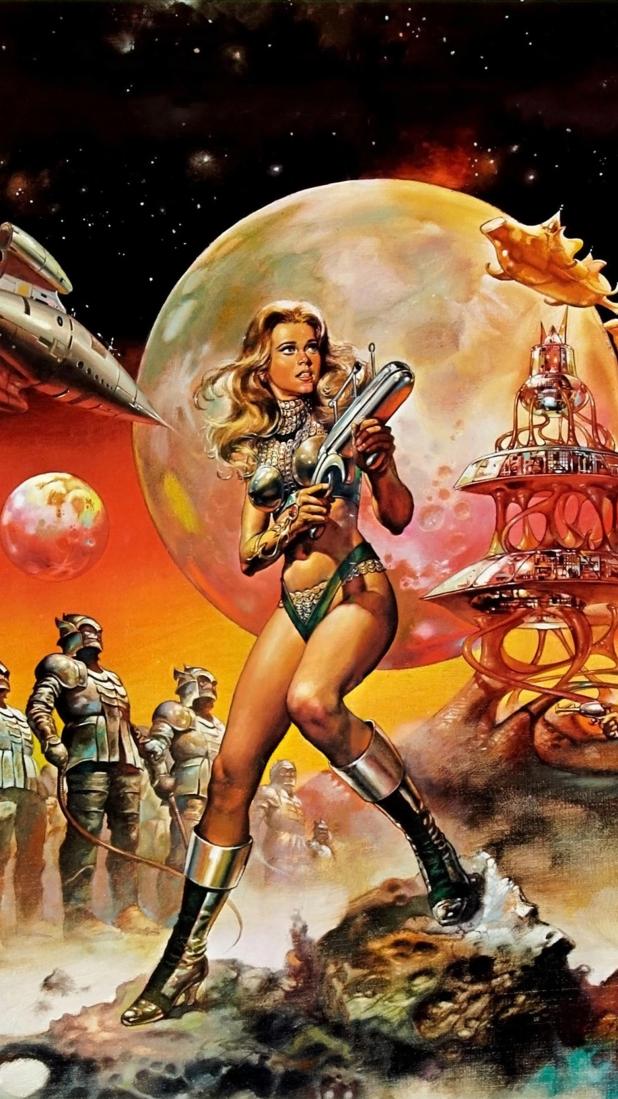
Shot directly after Mario Bava’s Danger: Diabolik, this Roger Vadim-directed movie is based on the comic book of the same name by Jean-Claude Forest. The film stars Vadim’s then-wife Jane Fonda as Barbarella, a United Earth agent sent to find scientist Durand Durand, who has created a weapon that could destroy humanity.
Vadim was hired to direct this film after producer Dino De Laurentiis purchased the rights. This led to Vadim looking to cast several actresses in the title role, including Virna Lisi, Brigitte Bardot (that’s who the character was originally based on) and Sophia Loren before ending up picking his wife.
In case you’re wondering why this movie is such a mess, Charles B. Griffith was the last writer to work on it, saying that he had done uncredited work on the script after fifteen other writers — including Terry Southern — worked on the movie.
This film is packed with fashion, amazing sets — you can credit Bava’s film for some of that, and great characters, like John Phillip Law as Pygar the angel, Anita Pallenberg (Performance) as the Black Queen, Milo O’Shea as Durand-Durand, Marcel Marceau in a rare speaking role as Professor Ping, David Hemmings (Deep Red) as Dildano and even cameos from Fabio Testi and Antonio Sabato (who was originally to play the role that Hemmings ended up doing).
So yeah. This is a gorgeous film that makes no sense whatsoever. Is that such a bad thing?
A sequel was planned with producer Robert Evans called Barbarella Goes Down, but it never happened. Nor did a 1990 remake, a Robert Rodriguez idea or a potential project with Nicolas Winding Refn, who moved on to other projects, saying, “certain things are better left untouched. You don’t need to remake everything.”
AUTHOR’S NOTE: I can’t lie. This is probably my favorite Eurospy movie of all time, if not one of my favorite films ever. It was one of the first movies that we featured on the site, all the way back on July 12, 2017. I consider it the best comic book movie ever made — nothing else comes close. This movie is everything.
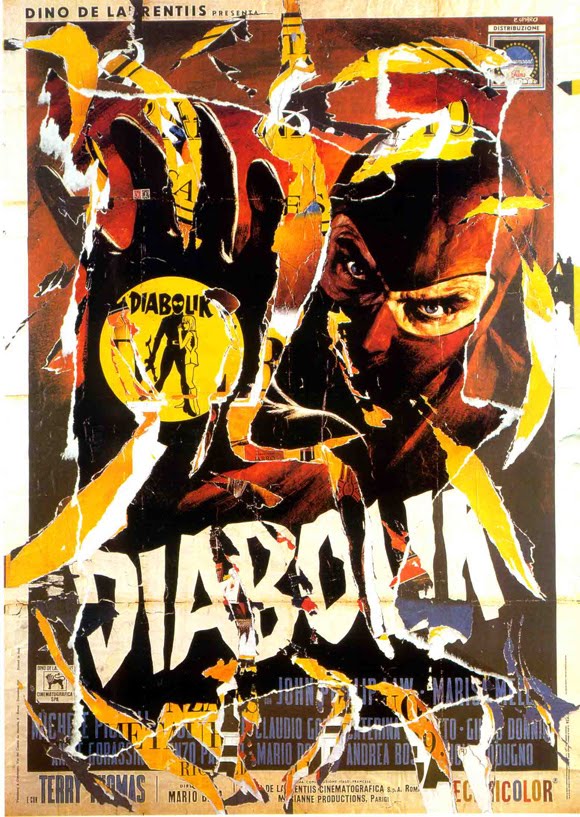
The late 60s pop art/spy fad produced some of my favorite films ever. Sure, they’re very much of their time, but they’re also rich with ideas, sumptuous design and color and great looking men and women risking life and limb to protect (or steal from) the world. From Batman to James Bond to Matt Helm, In Like Flint and Barbarella, there’s a lot to choose from. But for my money, there’s no better choice than Mario Bava’s Danger: Diabolik.
Based on the Italian comic series Diabolik by Angela and Luciana Giussani, this is the tale of a master criminal and thief who confounds the police and the mob at every turn. Along with his girlfriend Eva Kant, they travel the world to try and steal the biggest jewels and treasures.
The original production of this film was — charitably — a mess. Producer Dino De Laurentiis saw the footage that had been already been shot and canceled the film to hire a new director, cast and screenplay. After all, Diabolik was a huge character in his native Italy and there was tons of buzz about the film. Bava was hired to direct with a much lower budget, with any of the more well-known actors taking small roles. Some of the cast and crew came directly from Barbarella, as the film had stalled due to technical issues.
Bava brought along editor Romana Fortini and cinematographer Antonio Rinaldi, who also had success with him on Planet of the Vampires and Kill, Baby, Kill.
Sets were designed by Carlo Rambaldi, who worked with a veritable who’s who of directors — Fellini, Spielberg, Pasolini, Argento, Paul Morrissey, Ridley Scott and so many more. Just a brief overview of his career is awe-inspiring, with everything from the two Andy Warhol horror films to the special effects that nearly landed Lucio Fulci in jail (the dog mutilation scenes were thought to be real) for A Lizard in a Woman’s Skin and Oscars for Alien, E.T. and King Kong.
This is a film of pedigree — with no less a talent than Ennio Morricone providing the soundtrack. From comedy work for films like La Cage aux Folles and Pedro Almodóvar’s Tie Me Up! Tie Me Down! to Sergio Leone’s Dollars Trilogy, Argento’s giallo work, John Carpenter’s The Thing, Tarantino’s The Hateful Eight, Terence Malick’s Days of Heaven, evenButterfly, Exorcist II: The Heretic, Red Sonja and the string section on Morrissey’s song “Dear God Please Help Me” — you’re talking about one of the finest and most diverse sonic artists there is. His score for Danger: Diabolik is playful and will stay in your head for a long time. I often find myself singing it to myself, pretending that I could be a famous thief. Then I realize I have no coordination at all.
The film looks like nothing else — pop art colors, strange sets (no accident, the sets were recycled from the currently in hiatus Barbarella), strong leads and outlandish action. I prefer it to Vadim’s take on comics, but obviously, I’m always going to choose Bava over almost any other director.
Throughout the film, John Phillip Law shines as Diabolik, much more than he would get the chance to as the angel Pygar in the ad nauseam aforementioned Barbarella(I love the film, but it’s a mess that just barely holds together and cannot hold a candle to this work of genius and art). He does so much in the film with just his eyes and laugh. Marisa Mell is the most stylish and sexy woman ever as Eva Kant, whether she’s setting up a crime or rolling around nude on a giant circular bed of money. If you think the Austin Powers movies have ridiculous set pieces, you haven’t seen anything yet. In fact, between this film and the Dr. Goldfoot films, Mike Myers owes the Bava estate some serious money.
Diabolik cheats death throughout, even faking his demise via a technique taught to him by Tibetan monks (no need for Derek Flint’s heart restarting wristwatch here!) and being ejected out of a plane. It’s almost like an old movie serial — with case after case, set up after set up and death trap after death trap. It’s also a ton of fun. Plus, there’s a quick Terry-Thomas cameo as the Minister of Finance that makes me smile every time I watch this.
The film was initially seen as a failure, with a poor box office showing and critical disdain. In the 90s, the Beastie Boys used clips of the film for their song “Body Movin'” and the last episode of the original Mystery Science Theater 3000 riffed on the film. It deserved much better. And thanks to critics finally recognizing the skill of Bava, it gradually has been seen in a whole new light (the breakdown of how the film works so well as a comic translation by Stephen Bissette is worth a watch on the now out of print DVD). And Bava made this film for around $400,000 — well under the budget of (again, I have to mention it) Barbarella.
I can’t see it as anything other than a success. A film that’s all style, with a flashy couple that steals things because — hey, why not? — and battles the mob and the police because — hey, why not? I’ve seen reports that De Laurentiis had budgeted $3 million for this and Bava came in so low, he was offered the chance to do a sequel (this kinda conflicts with other reports that Dino was unhappy with the returns). Bava didn’t want to work with Dino again, even when offered the chance to work on King Kong.
Just watch a few minutes of the film and you’ll realize there has never been anything before or since like it. It’s probably my favorite comic book movie ever — the closest a movie will ever get to simulating the reading experience without slavishly copying panels ala Sin City.
This is finally getting a true release from Shout! Factory after being out of print for so long. I’m going to have to retire my battered bootleg copy of this after years of watching it over and over and, well, over again. Deep deep down indeed.
After Hey There, It’s Yogi Bear!, this was the second Hanna-Barbera motion picture. It’s also the last production of the original Flintstones series, ending it before it would be brought back in the 1970’s.
Special Agent Rock Slag looks exactly like Fred, which means that as soon as they meet in the hospital, Fred takes over the spy work while Rock recovers. This sends Fred and Barney — with family in tow — all around the world. This also raises the question as to why Paris exists in the past and has the exact same architecture as it does today. When it comes to the Flintstones, I try not to think too much.
The one thing that does baffle me is the number of musical numbers in this. I guess that the thought was if Disney did it in a full length, this film should too. The music is the reason why this movie was never released on video in the U.S. until 2008, as Columbia Pictures owned the rights to all of the many songs.
Obviously, this is as much Derek Flint as it is James Bond. It moves quickly and it plenty of fun, despite the strange song where Pebbles sings about going to sleep and the fact that Fred and Barney sing a ditty that pretty much affirms that they are the ones actually married.
AUTHOR’S NOTE: We first wrote about this movie on April 26, 2019. There was a whole series of these films, which combine Eurospy and Batmania action all into one quite silly group of movies. One of the posters for this literally said, “Move over 007.”
You gotta love this Amazon description, which assumes that we know who these fellows are:
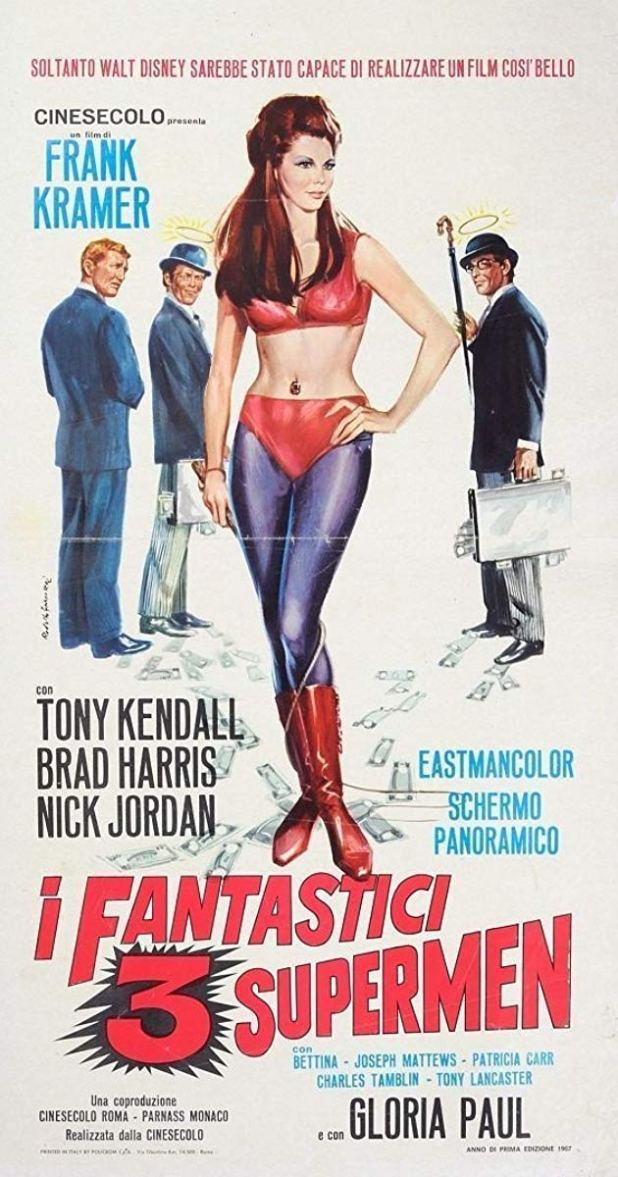
“FBI agent Brad joins Tony and Nick, the seself-styledupermen who battle crime wearing bullet-proof super-suits. They are on a case involving radioactive counterfeit money and people who can be broken down into precious jewels. With some really nice stunts and awesome kung fu, gimmick weapons & gymnastics!”
I mean, I wasn’t interested and then you hit me with gymnastics?
Director Gianfranco Parolini is better known for his Sabata films, as well as God’s Gun. For this movie, he went to Yugoslavia to get the adventures of these three heroes to the big screen. And it wasn’t easy — for one stunt, actor Aldo Canti jumped out of a 20 feet high window, hit a trampoline and then jumped into a truck moving at full speed.
After this movie, the Supermen went around the world: Japan in Three Supermen at Tokyo, Africa in Three Supermen in the Jungle, Hong Kong in the xenophobically titled Supermen Against the Orient, and seemingly have run out of countries, they went back in time to the wild west in The Three Supermen in the West.
Tony is played by Tony Kendall, who is also in The Whip and the Body and The Return of the Blind Dead, as well as the Kommisar X series of films. And Nick, another of the Supermen, was played by actor/stuntman Aldo Canti, a real-life thief with strong mob ties that was released from jail just to appear in this film. He was replaced by Sal Borgese in the other films in this series before coming back for the Turkish co-production Supermenler in 1979.
If you loved the music of the Clash and the Sex Pistols, you loved the movies of Alex Cox. Alex Cox was punk. Alex Cox’s movies were college de rigueur in the ‘80s. No self-respecting lover of punk music and underground film would have a music or movie collection without copies of the VHS and LP soundtracks to Repo Man, Sid and Nancy, and Straight to Hell.
Then Cox went mainstream—as “mainstream” as Cox could be—with Walker, a film about an 1800s American mercenary becoming the president of Nicaragua. But it didn’t have the kitsch-value starring of Joe Strummer of the Clash or Courtney Love, like his punk rock western, Straight to Hell, and we ignored it. And while Alex Cox kept making movies, we, the college-rock crowd grew up, went through marriages and mortgages, births and divorce—and forgot about the films of Alex Cox. (And our Clash and Sex Pistols albums became dust-collecting cardboard tchotchkes).
Cox is the Nicolas Cage and Eric Roberts of directors: he’s either a master of his craft or he’s past-his-prime awful in the eyes of the viewer. Either way, you’re leaving entertained—certainly in the case of Cox’s most recent, previous film: Repo Chick (2009) (yes, it’s a loose sequel-remake of his classic debut). So Cox’s still got it, it’s just that no one sees it. (I wish Cox could have afforded Cage and Roberts to star as Wyatt Earp and Doc Holliday; not that unknown actors Adam Newberry as Earp and Eric Schumacher as Holliday aren’t good in their roles, because both are great in their roles—it’s just my cinematic wanderlust wanting to see a film with Cage and Roberts on the marquee.)
If you know anything at all about the famed gunfight at the O.K. Corral (at least through the back-to-back Kurt Russell and Kevin Costner films Tombstone and Wyatt Earp), and have a passing knowledge of Akira Kurosawa’s oft-pinched Rashomon, then you’re up to speed with Cox’s vision: a reimaging of the Gunfight at the O.K Corral within the multiple-accounts narrative of Kurosawa’s classic.
Oh, right. This is an Alex Cox film. This is Kurosawa: time warped.
Yep, this is a time-traveling sci-fi western mockumentary that, if you know your six degrees of Alex Cox: In addition to producing Cox’s Repo Man, former Monkee Michael Nesmith produced Timerider: The Adventure of Lyle Swann, which concerned a futuristic motocross racer who races through a time-travel device and ends up in the mid-1800s old west. And if you know your time travel comedies: Another ‘70s musical teen idol, David Cassidy, starred as a time traveler intending to speak with America’s founding fathers of 1776—and ended up in the era of disco in Sprit of ’76.
So what we have here is This is Tombstone—sans Nigel Tuffnel and David St. Hubbins—filmed by a group of time-traveling filmmakers who arrive in Tombstone, Arizona, on October 28, 1881, to film the actual gunfight (the Tombstone part). But—damn space-time continuum glitches—they show up a day late. So, to save the project, they decide to stick around and interview the survivors and witnesses (the Rashomon part) to create the definitive document as to what happened. Why didn’t the filmmakers just jump back into their flux capacitor contraption and trip back one more day?
Did I mention this is an Alex Cox film? If they did that, the movie would just be called “Tombstone.” And do we really need another Tombstone movie? No. Do we need an Alex Cox Tombstone movie? Yes.
But why?
What other filmmaker do you know with chutzpah to finish a film with Doc Holliday jumping into an SUV as casually as mounting a horse? Is he a time traveler?
Dude. How many times do I have to say “Did I mention this is an Alex Cox film?” Did you forget he’s the guy who places glowing bright green McGuffins in car trunks and transforms ‘60s Chevy Malibus into flying saucers?
In recent roadhouse showings, Cox appropriately double-billed Tombstone Rashomon with Repo Man. In another showing, he paired his sci-fi western with Dennis Hopper’s surrealist, metafictional western, 1971’s The Last Movie.
Cox’s Walker and Hopper’s The Last Movie are rife with anachronisms. And both filmmakers were criticized as cut-rate Sam Peckinpah imitators. (In Peckinpah’s 1969 western The Wild Bunch, a band of aging outlaws deal with the traditions of the American West disappearing by way of the advancements brought on by the First Industrial Revolution). Hollywood ostracized Hopper after the failure of The Last Movie. Cox was blacklisted by Hollywood after the failure of Walker; so disliked, Cox’s subsequent films struggled to receive distribution in the United States (which is why he we ended up forgetting him).
In Walker, although an 1800s period piece, the characters of the Nicaraguan-set western use automatic rifles, reusable Zippo lighters, and drink from coke bottles; there’s modern cars on the streets and helicopters overhead. (I always felt Cox crafted a homage to the The Firesign Theatre and George Englund’s “electric western,” 1971’s Zachariah—which everyone seems to hate, except me. And that takes us back to Cox’s Straight to Hell.)
In The Last Movie, Hopper plays a stunt coordinator and horse wrangler on a western filmed in a Peruvian village. After the production wraps, he discovers the villagers are “filming” their own movie with “cameras” made of sticks and killing each other by “acting out” the western violence, as they don’t understand the fantasy of moviemaking.
If Kurosawa has access to Doc Brown’s DeLorean, is Tombstone Rashomon a celluloid anachronism he would have made: an amalgamation of 8th century Japan in an American western puzzle, wrapped in a sci-fi enigma?
Toshiro Mifune, Burt Lancaster, Kirk Douglas, Nicolas Cage, and Eric Roberts—and what the hell, Mickey Roarke—starring in a sci-fi version of the Gunfight at the O.K Corral—where fiction and reality are flux capacitor’d? Maybe Akira Kurosawa could double bill that film with his documentary on Alex Cox: Alex Cox: The Last Filmmaker? Why not? Cox made a biographical documentary on the Japanese filmmaker: 1999’s Kurosawa: The Last Emperor.
Cry cinematic ‘havoc!’, and let flux the capacitors of time!
TriCoast Entertainment will release Tombstone Rashomon onto DVD in-store and online April 21 via Best Buy, CC Video, Deep Discount DVD, DVD Planet, Walmart, and Target. You can also pre-order on Amazon. TriCoast will also release the film onto VOD platforms in July 2020. You can learn more about the film on its official Facebook page.
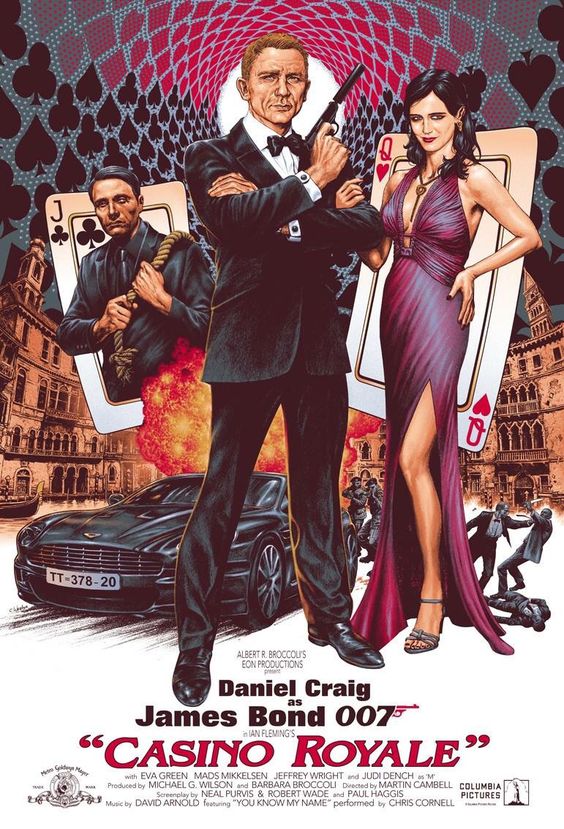
Casino Royale goes back to the beginning, with Daniel Craig playing a rougher and more brusque Bond at the start of his career As for the story, Eon Productions won the rights in 1999 after Sony Pictures Entertainment exchanged them for Metro-Goldwyn-Mayer’s rights to Spider-Man.
How odd that 40 years into Bond, it is he — and not a woman — rising nearly nude from the sea? I still think of Craig as the new Bond, despite him owning the role for nearly 14 years.
In this film, we meet the new Bond, watch as he gains 00 status and then falls for — and loses — Vesper Lynn (Eva Green) as he is on the trail of Le Chiffre (Mads Mikkelsen), a banker to the world’s terrorists.
Bond even goes as far to quit MI6 over love in this movie and pays the price. At the end, he finally says his catchphrase, “The name’s Bond. James Bond,” before coldly dispatching of a villain.
Between the parkour scene and the emphasis on violence over gadgetry, this was a new Bond that was more Jason Bourne than Roger Moore. For a fanbase that was violently opposed to Craig as their hero, things have settled down over time.
This is the first time that the theme of a Bond movie — Chris Cornell’s “You Know My Name” — didn’t appear on the soundtrack. It’s also the only Bond film other than Live and Let Die where Q doesn’t appear.






 B&S About Movies
You must be logged in to post a comment.