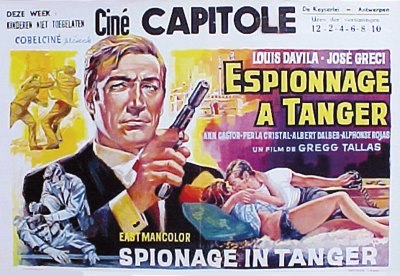
Mike Murphy is Agent S 077, which has absolutely nothing to do with Bond. But you know what’s great about this movie? It’s directed by Greg Tallas, who would someday make The Nightmare Never Ends, which was then edited into Night Train to Terror.
That fact is more interesting than this movie.
Jose Greci, who was the Virgin Mary in Ben-Hur, shows up here in one of her many Eurospy roles (she’s also in Operation Poker, Last Man to Kill and Special Code: Assignment Lost Formula). And hey! It’s Perla Cristal from The Corruption of Chris Miller, Naschy’s The Fury of the Wolfman and Franco’s The Awful Dr. Orloff!
In Europe, this was known as Marc Mato, agente S. 077 and it was a big success. Time has not been kind to this film, however. There’s a laser beam, as there usually is, but I’ve never seen a movie where the hero is saved from a bullet to the chest because that’s where he carries his Bible.
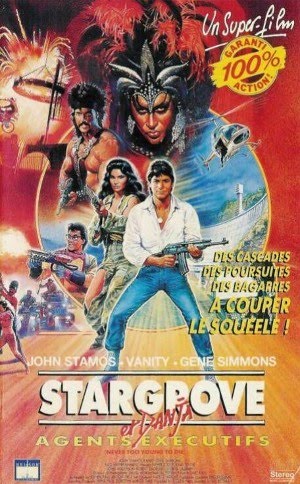
AUTHOR’S NOTE: This review originally ran on November 13, 2017. As part of our month of all things James Bond, I brought it back, did some editing and included some links so that you can stream it for free. It has George Lazenby pretty much playing Bond (Drew Stargrove) and while uneven, is still a fun watch. Enjoy!
I grew up on James Bond. More than that, at a young age, I was obsessed with Bond. One magical Christmas, the only gifts I got were the James Bond role-playing game from Victory Games and all of the expansions. I saw every single one of the movies, even the original Casino Royale and Never Say Never Again, the bootleg Sean Connery film that came out of Kevin McClory’s legal battles with Eon Productions, the Fleming estate and United Artists. I’ve seen every Bond ripoff, from Flint to Matt Helm to Dr. Goldfoot and the Girl Bombs(it helps that Mario Bava directed that one). Post Timothy Dalton, I grew bored with the more realistic Bond and never came back. I grew up with the ridiculous world of Roger Moore.
I get the feeling that plenty of other folks have had similar experiences, thanks to comics like Jimmy’s Bastards and Kingsmen (also a series of movies). And this movie — Never Too Young to Die guest stars the Bond from my favorite of the series, the only appearance of George Lazenby, On Her Majesty’s Secret Service as Drew Stargrove, but we can just pretend he’s James Bond.
Stargrove has a son, Lance. He has a theme song. And he has a mission, to stop psychopathic hermaphroditic gang leader Velvet Von Ragner (Gene Simmons, sure he’s in KISS, but let’s celebrate his ridiculous IMDB page, where he’s either played himself or been in some amazingly insane films, like Trick or Treatand Runaway). But his luck has finally run out. He’s dead and his somewhat estranged son must leave behind his gymnastic days at college to take over his role as the best secret agent in the world.
Lance is played by John Stamos, mostly known for TV’s Full House. This is his star turn, all fresh-faced and ready to break hearts. He’s joined on his mission by Vanity, who may have had a short and sweet film career, but got to be in some incredible stuff, like The Last Dragon, Action Jackson, Tanya’s Island, 52 Pick-Up and Terror Train.
Your ability to enjoy this film depends completely on your ability to enjoy ridiculousness. And facts like this — the nightclub outfit that costume Gene Simmons wears in the nightclub scene is the same one that Lynda Carter wore for her 1980 ENCORE! special, where she sang KISS’ “I Was Made for Loving You.”
Writer Steven Paul also created the Baby Geniuses series and had uncredited help from Lorenzo Semple, Jr. (TV’s Batman, Flash Gordon), which shows. Paul also wrote 1992’s The Double 0 Kid, where Corey Haim dreams of being a secret agent.
Director Gil Bettman produced and directed tons of 80’s TV, like The Fall Guy, Knight Rider and Automan, a one-season wonder that combined police drama with Tron. I may be the only human being to have watched the entire season. His other major movie in 1986 was Crystal Heart, where Tawny Kitaen plays a rock star who falls in love with a boy who lives inside a crystal room because he has an auto-immune deficiency.
This film has an incredibly uneven tone. At times, it’s a family movie. Other scenes, Road Warrior clones are tearing off Vanity’s clothes and threatening to rape her. Sometimes, everything is treated with wacky humor. And then, you see people fall to their deaths and smack into the ground. It’s also a much better movie the more mind-enhancing substances you consume, I figure, as I watched it cold sober and it kind of dragged (no pun intended).
Oh yeah — Lance’s roommate, Cliff, is played by Peter Kwong, who was Rain in Big Trouble in Little China. And because this movie was made in the 1980’s, Robert Englund contractually has to be in it.
“You’d be directing a god damn student film on a fucking iPhone!” — Bob Moseby, producer of (the film within the film) The Sleep Experiment
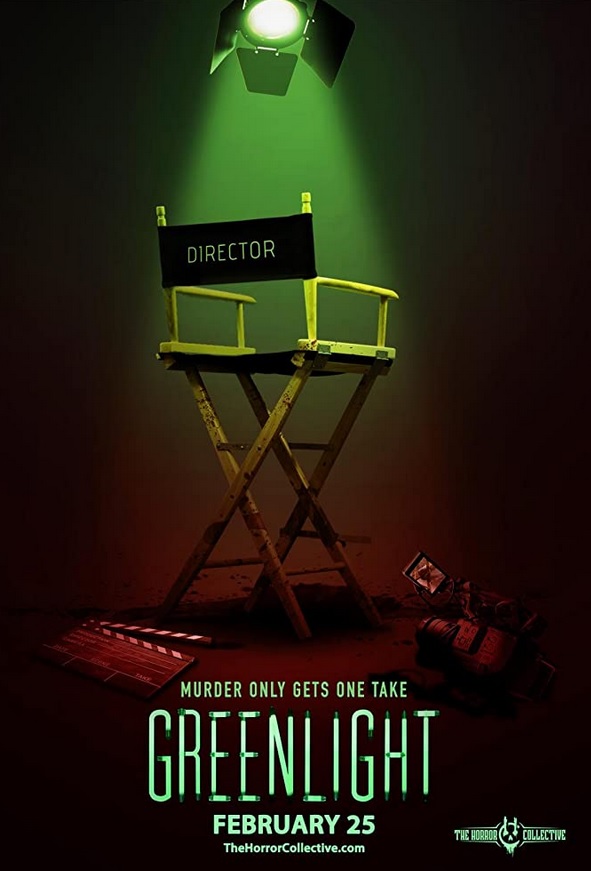
As the diabolical Moseby dug his Norma Desmondesque claws into Jack Archer, the desperate, struggling director chosen as his murderous pasty, I was reminded of poor Jack’s entertainment industry neo-brethren in screenwriter Joe Gillis from Sunset Boulevard (1950), Michelangelo Antonioni’s neo-trapped photographer in Blowup (1966), and Brian DePalma’s Hitchcockian-twisting sound effects technician in Blow Out (1981).
Yes. Although this noir low-budget film from is from a first time director and an unknown screenwriter, Greenlight illuminated with the same excitement I felt when I watched the ‘90s neo-noir trifecta from the genre’s master, John Dahl, with Kill Me Again (1989), Red Rock West (1993), and the crowned jewel, The Last Seduction (1994).
“Horror films don’t win awards, but psychological thrillers do.” — Bob Moseby
Let slip the red herrings and neo-dogs of noir. Get ready for your close up, Mr. Archer.
And so begins Jack Archer’s maddening descent as his Hollywood dreams smudge n’ smear into an ouroboros nightmare when, instead of a Ms. Dietrichson dangling an anklet, our neophyte director is Walter Neff’d by a femme fatale in the form of an attractive, complement-showering actress dangling the old “I know a producer looking for a director” carrot. Oh, Jack. You can’t be that neo-naïve. . . .
And there’s Moseby’s wife, the “star” of the film. And what McGuffin is she hiding?
Then, once the once-great Moseby has his mook on hook, he blackmails Jack into pulling a “Brandon Lee” on one of the actors—as a “marketing gimmick” for the film. Yep, the dead body is already set up. And so is the DNA. But it’s never just about the “gimmick,” is it, Bob?
Screenwriter Patrick Robert Young earned his Final Draft stripes with a pair of damsel in distress flicks for Lifetime: My Teacher, My Obsession (2018, aka Dad Crush)* and Pretty Little Stalker (2019)*. Now we all know that Lifetime’s female demo-skewing thrillers and psycho-chick romps are hit-and-miss, but after watching Young’s superb turn of a phase and multilayered psychological plotting in Greenlight, it seems seeking out those two Lifetime flicks are in order.
Young’s screenplay is wicked smart, rife with fun filmmaking references and horror film nods that, even if you’re not in the industry and just a movie goer (well, streamer these days), you won’t feel left out. He scribed great dialog that displays a bard’s skills for balancing darkness and humor—and that realistic dialog is brought across the finish line by Chase Williamson as Jack Archer and, especially, Chris Browning as the egotistical Bob Moseby: both are absolutely stellar. And lead actors are only as good as their supporting cast—and they deliver as well.
Pulling together the great script and solid cast is Graham Denman, an actor who’s obviously learned his craft across an array of shorts and web series and directing four shorts before being given his Jack Archer-shot at the big time—and Denman nails it. It is my sincere belief that there’s a major studio development team out there watching a copy of Greenlight right now—and they’ve placed Denman on their shortlist as a director to greenlight.
And kudos on the casting, as Denman could have easily gone the put-a-star-name-on-the-box route to put bodies in the seats. He could have easily cast Eric Roberts—who excels at diabolical, ulterior motive characters like the smarmy Bob Moseby (as his work in the radio station-set neo-noir Power 98 and the political-noir Lone Star Deception proves). But Denman opted to give unknown, under-the-radar actors a shot. And it was the right choice.
While under-the-radar, you’ve seen the cast of Greenlight via their starring roles on network TV series and support roles in feature films: Chris Browning appeared as “Gogo” in Sons of Anarchy, along with Will Smith’s Bright, Cowboys & Aliens, Let Me In, and Steven King’s Mercy. Shane Coffey was in Pretty Little Liars, Craig Stark appeared in Quentin Tarantino’s The Hateful Eight, Victor Turpin in Ma, and Chase Williamson made his leading man debut in Don Coscarelli’s John Dies at the End. And you’ve seen Nicole Alexandra Shipley in Guardians of the Galaxy, Caroline Williams in The Texas Chainsaw Massacre 2, and Brian Cousins goes back to our Charles Band VHS rental favorites Mandroid and Invisible: The Chronicles of Benjamin Knight.
A rousing success on the festival circuit, Greenlight was acquired for distribution by The Horror Collective specialty imprint after the film’s world premiere at the Los Angeles Shriekfest Horror Film Festival, where it won a deserving “Best Thriller Feature Film” award and a “Best Male Performance in a Feature Film” win for Chase Williamson. Rolled out on all VOD and digital platforms this past February, you can find Greenlight on Amazon, Google Play, Vudu, and You Tube Movies.
* You can stream Patrick Robert Young’s My Teacher, My Stalker on Amazon, Netflix and Vudu, while Pretty Little Stalker is available on Amazon and Vudu.
You can sample both films with their trailers, below.
Disclaimer: We didn’t receive a screener copy of Greenlight from the PA firm for the film’s distribution company. We discovered this movie all on our own and genuinely loved it.
About the Author: You can read the music and film reviews of R.D Francis on Medium and learn more about his work on Facebook. He also writes for B&S About Movies.
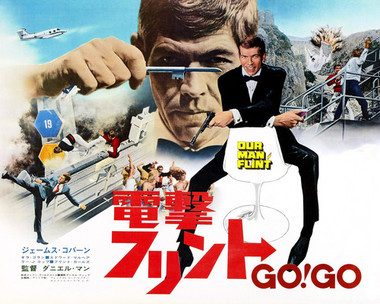
I’m going to be real blunt: I love Derek Flint more than I will ever and could ever love James Bond.
When the army tries to arm Flint, they offer him a Walther PPK and an attache case with a concealed throwing knife. He replies that they are both crude. He even fights Agent 0008, who says that Flint is going up against people more evil than SPECTRE.
Everyone talks about how many women Bond has. Derek Flint has at least four girlfriends at all times. In this film, they’re Leslie (Shelby Grant, The Witchmaker), Anna (Sigrid Valdis, Hilda from Hogan’s Heroes and the second wife of Bob Crane), Gina (Gianna Serra, who was Miss Italy for 1963) and Sakito (Helen Funai, who had a twin sister named Keiko; they often appeared as The Ding-a-ling Sisters because the 1970’s were racist and were also members of Dean Martin’s Golddiggers dance troupe).
Nothing is ever all that serious in these films. And in a life that is gray and dark, they’re the perfect balm for what ails you.
Flint was once a member of Z.O.W.I.E. (Zonal Organization for World Intelligence and Espionage), but he retired so he could get more out of life. But Galaxy — a group of scientists led by Doctor Krupov (Rhys Williams, How Green Was My Valley), Doctor Wu (Peter Brocco, who was in Spartacus and went into ceramics for a living while he was blacklisted in the 50s) and Doctor Schneider (Benson Fong, who started the Ah Fong restaurant chain) — have taken the very scientific tact that governments are ill-fit to rule the world and only reason can lead. So they start controlling the climate and blowing up the world real good, all in the hopes of getting every nation to give up all their nukes.
Yeah — that’s not going to end well.
There’s a bad guy named Hans Gruber years before Die Hard, an explosive jar of cold cream, a search for bouillabaisse, Flint faking his death via a yogic suspended animation state, Edward Mulhare from The Ghost and Mrs. Muir and Knight Rider as a villain, Mr. Whipple, Lee J. Cobb as the put-upon leader of Z.O.W.I.E. named Cramden and The Green Hornet star Van Williams doing a voiceover impression of LBJ.
How much of an influence on Austin Powers is this movie? Well, Cramden’s presidential red phone has a ringtone that shows up in that film, as well as Hudson Hawk, which features Flint himself, James Coburn.
Coburn is the most perfect leading man ever in this film. He’s bemused — as if he’s in on a joke none of us get to hear. Not that he’s above being in this movie; he’s just on a plane beyond it. He trained with Bruce Lee — indeed, he was one of Lee’s pallbearers, saying that the karate star had brought his “physical, spiritual and psychological selves together” in his eulogy. He’s the coolest, smartest and best-looking person in every room; in effect, he is Derek Flint and wholely imbues the role in a way that no other actor could.
How good is he? The scene where Flint relaxes by suspending his body supported by only a chair under his head and another under his feet? That was really something Coburn could do.
The more astute of you — like my friend Mark Rosato — will be able to pick out the USOS Seaview from Voyage to the Bottom of the Sea in this movie. Plenty of the props and costumes from Land of the Giants are in this movie as well. But can you find James Brolin in an early role as a villainous technician? Or hear a young Randy Newman create the song “Galaxy a Go-Go?”
This is a perfect movie. If only all of life could be this good.
At first glance, it’s easy to slag this meta-horror homage to ’80s SOV horror (we discuss that analog genre of VHS-taped films with our review of John Howard’s Spine) as an “amateur film school project.” And, in fact, there are reviews for this inventive amalgamation of the ’80s SOV and ’90s mockumentary and found footage genres that say just that, for this, the writing and directing debut from Jody Barton.
It’s a family affair! The gang’s all here!
Jody Barton is a man of reinvention: he was a civil rights attorney with a burning to desire to work as an actor. So, with the wanderlust of a beat poet, he moved to Los Angeles to work as an actor and filmmaker. And across 30 shorts and indie features (since 2009; including a role in 2019’s Beyond the Law with Steven Seagal), Barton worked his way up to a leading role in Hunting Alice, a currently in-development streaming series.
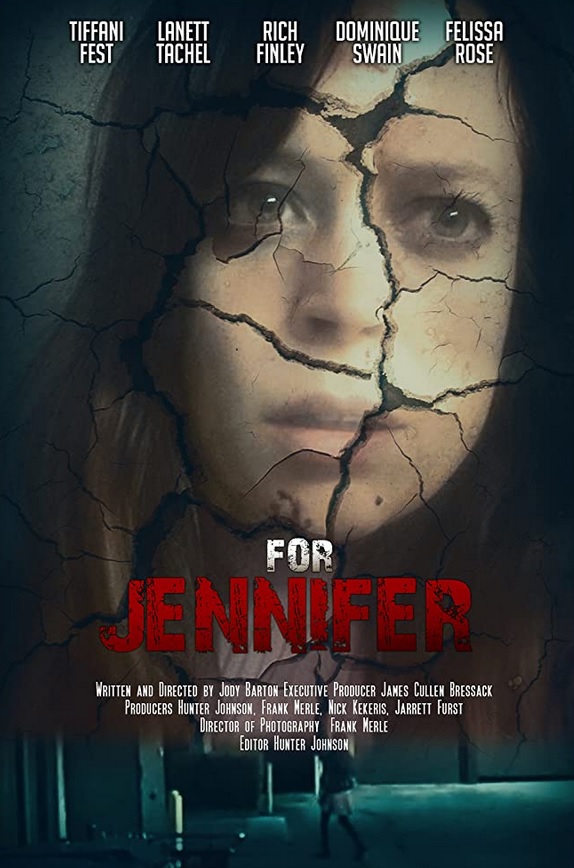
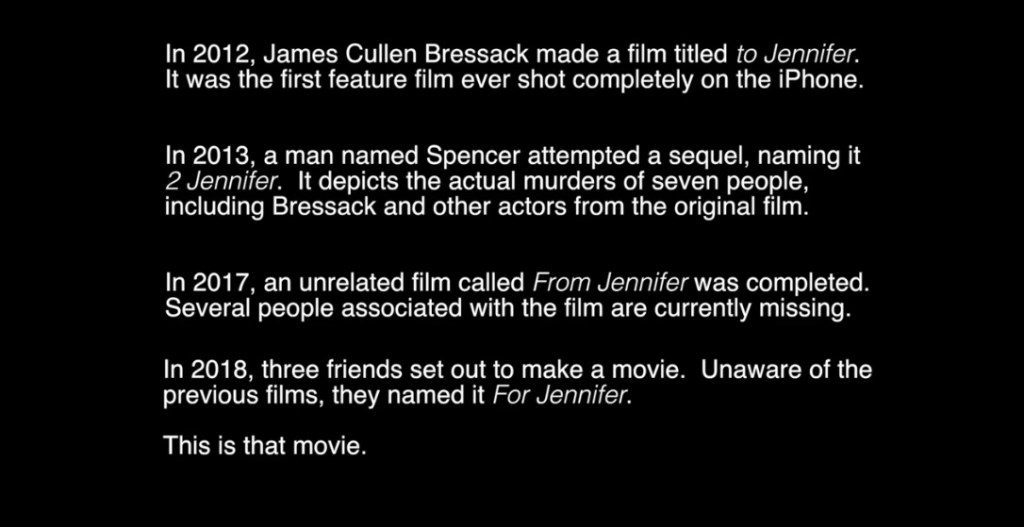
Now Barton’s written and directed his debut feature film, For Jennifer, the fourth film in the SOP series (films in which he also starred) that includes James Cullen Bressack’s (directed Beyond the Law) to Jennifer, Hunter Johnson’s 2Jennifer, and Frank Merle’s standalone film, #From Jennifer.
Bressack initiated the series with the groundbreaking to Jennifer (2013), which he shot entirely on an iPhone 5. The first commercially-released SOP film, it documents the story of a scorned boyfriend who sets out to find and confront Jennifer, his cheating girlfriend—which leads to a bloody climax.
The Felissa Rose (A Nun’s Curse*) starring 2Jennifer takes a film-with-a-film approach: Spencer (the excellent Hunter Johnson), a horror blogger and aspiring filmmaker makes his own film about the Jennifer mystery set forth in to Jennifer—and it becomes a pseudo snuff film (that reminds of Michael Powell’s 1960 classic, Peeping Tom) courtesy of its mentally unstable filmmaker: Bressack and his actors from to Jennifer are the victims.
The standalone—and Tony Todd (Candyman) starring—#For Jennifer concerns an Internet-fame obsessed actress who will achieve fame at any costs and her blood, and of others, spills: the “curse” of Jennifer resulted in the disappearance of those filmmakers.
For Barton’s entry in the franchise, Felissa Rose returns from 2Jennifer as one of the “Jennifers,” and introduces two new characters: Randi, played by Dominque Swain (The 6th Friend, A Husband for Christmas), and another “Jennifer,” Tiffani Fest (Rootwood*; itself a meta-horror).
As a surprise horror-themed birthday celebration for Fest’s horror movie fan and blogger unfolds, one of her gifts—revealed to be from a stalker—is a copy of scenes from the series’ second installment, 2Jennifer—and it leads to her having a car accident. To lift her spirits—and to satiate her curiosity as to who and what happened to Jennifer and where the first two Jennifer films came from—she and her friends decide to shoot their own movie. At that point the meta-venture goes off the rails, with film fantasy blurring with bloody reality, as her life, and of her friends, will suffer the fates depicted in the previous films. And the red herrings are a-flopping: who’s the stalker? The masked guy at the party no one knew? The guy Jennifer hit with her car? Her boyfriend’s creepy buddy Gene? The clerk at the video store?
A Blair Witch vibe? I ain’t hatin’ that vibe.
For Jennifer isn’t a film for those who prefer traditionally-shot films; you’ll critique the cinematography and acting as “bad.” And that’s the point: the movie is shot by horror-blogging aficionados who love horror film—with zero filmmaking skills. And the actors are supposed to “look” like they’re acting: because they’re not “actors.”
In referring back to the ‘80s SOV/Spine analogy: For Jennifer is clearly the better film—and the gold standard (if there is one) for SOP horror—across the disciplines of screenwriting, cinematography, lighting, and acting. Especially screenwriting, courtesy of Barton’s self-deprecation of not only his own film, but the low-budget horror genre in general, when the cackling killer (intentionally overplayed to prove a point) chastises Jennifer for making a boring film with too much talking and that you “need kills” in a horror movie. That’s when For Jennifer film blazes through its third act: everybody dies—via their blood soaked POVs.
To get on board the For Jennifer sequels-narrative, one needs no explanations—as with all of the Halloween remake-reboots on how “this movie connects to that movie via this timeline,” etc. If you didn’t see the first three Jennifers: not a problem. Barton’s smart script pays homage to the predecessor trio while it creates its own standalone narrative—like James Cameron did with the sequel gold standard: Aliens vs. Alien.
If you’re intrigued by metacinema, films that break the fourth wall, and faux-urban legends driven by a “video diary” format colliding with the SOV and found footage genres, you’ll enjoy Jody’s Barton’s debut film that “solves” the Jennifer mystery. For his first time effort—using phones and handicams—it’s a commendable work; he learned the craft well, due to his association with James Cullen Bressack. I look forward to Barton’s accomplishments in a conventional narrative and technical format.
Also equally exciting: Bressack’s follow up to Seagal’s Beyond the Law, Alone, stars Bruce Davison of the ‘70s horror classic, Willard. Currently in post-production, the film concerns a woman’s fight for survival against sex traffickers. And the acting performance of Hunter Johnson, in his brief return here as Spenser, is stellar. His extensive resume is mostly shorts, web series, and indie films—but he’s ready for the mainstream. Somebody book this guy with a guest role on a network series: book him on a Law and Order: SVU (my favorite TV series). And this friggin’ rockabilly rippin’ end credits tune from the Cold Blue Rebels, rules. Hell yeah!
On a release rollout since November 2018, For Jennifer made its online streaming debut on Amazon via JB Films.
* My reviews for Tiffani Fest’s Rootwoodand Felissa Rose’s A Nun’s Curseare coming to B&S About Movies on April 7 and May 5, respectively.
About the Author: You can read the music and film reviews of R.D Francis on Medium and learn more about his work on Facebook. He also writes for B&S About Movies.
Disclaimer: This movie was sent to us by its PR company and, as you know, that has no bearing on our review.
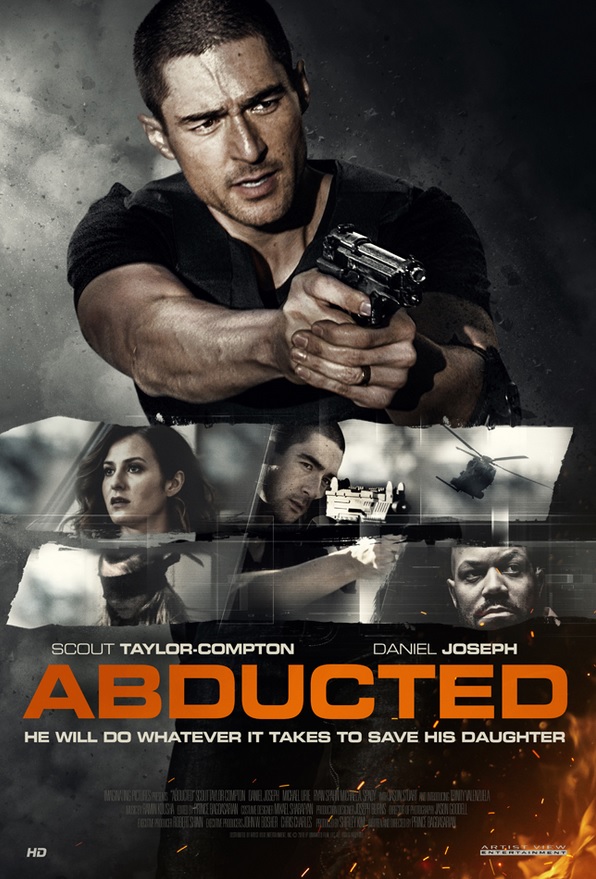
There’s nothing like a free week of Showtime to expose you to a new flick. And having the reliable Scout Taylor-Compton (Rob Zombie’s Halloweenreboots, 2019’s Eternal Code, 2020’s upcoming Getawaystarring Lane Caudell)—if you haven’t figured out by the title—in this abduction thriller, is an added bonus.
I first assumed this was the latest in the long line of writer-director Steven C. Miller’s serviceable action-thrillers packed with morally-screwed characters, such as the Bruce Willis-starringFirst Kill (2017), the Nicolas Cage-starring Arsenal (2018), and the Aaron Eckhart-starringLine of Duty (2019).
Abducted is actually the work—the second film—of a new director on the scene, Prince Bagdasarian, who’s amassed an extensive list of credits as an editor (one of his films is the 2009 Werner Herzog-directed Bad Lieutenant: Port of Call New Orleans starring Nicolas Cage). In 2013, Bagdasarian completed his first feature film, Abstraction, a crime drama revolving around the heist of a million dollar painting, starring Eric Roberts (who just released his own action-thriller, Lone Star Deception).
Still dealing with the death of his wife, U.S. military veteran Dane Hunte (Daniel Joseph) now works as a truck driver to support his young daughter, Eden (the film’s original title was Diverted Eden), while his gay brother-in-law, Todd (LGBT actor Michael Urie from TV’s Ugly Betty), looks after the child.
A violent home invasion—that seems to be connected to Hunte’s military past—at Todd’s house leaves his partner in a coma and Eden kidnapped. In steps the resourceful Detective Fini (Scout Taylor-Compton) assigned to the case. But as is the case with these action-thrillers, the law is useless, so the ex-solider works his shady contacts and stocks his arsenal for a “scorched earth” solution that takes him into the city’s criminal underbelly.
While Taylor-Compton’s name is on the box, this is clearly Daniel Joseph’s show—and he excels in his feature film debut. Taylor-Compton’s casting in the film as its selling point (it made me watch), instead of Bruce Willis or Nicolas Cage, as is the case with most of these direct-to-video potboilers, is appreciated—especially when her ass-kicking, neon-lit club scene unfolds. In addition to having Hunte’s immediate family as a gay couple, kudos also applies to Bagdasarian creating a deaf character in the film for Hunte’s war buddy (who’s involved in the invasion-kidnapping), played by real-life deaf actor Michael Anthony Spady.
While IMDb user-reviews haven’t been kind, I found Abduction to be a wonderful, accidental discovery and a great example that Prince Bagdasarian is a writer and director worth following for his future works: he works his tight budgets with skill. In addition to watching Abduction as a Showtime exclusive (it premiered March 1) on their cable TV platforms, you can watch it on their Showtime Anytime online platform and stream it on Hulu. You can also watch Bagdasarian’s debut, Abstraction, as a free-with-ads stream on TubiTV and watch the trailer on You Tube.
The film’s award wins to date, are:
The People’s Choice Award for “Best Director” at the Hollywood Reel Independent Film Festival.
“Excellence In Film,” “Best Editing Feature,” and “Best Cinematography Feature” at the Action on Film International Film Festival.
“Audience Award” at the ARPA International Film Festival.
“Best Editing” at the Hollywood Reel Independent Film Festival.
Prince Bagdasarian recently announced his third and fourth features have gone into production: Bluebird and Uncontrolled. In his press release, he revealed the plot for Bluebird: Trapped during a bank robbery, a young girl with telekinetic powers evades capture and unleashes havoc against the secret government agency that has seized control of her isolated, small town.
You can learn more about those two films, and more, courtesy of Prince’s interview with Voyage LA Magazine. He previously spoke on the digital pages of Pop Horror. You can follow Prince’s work — with lots of great behind-the-scenes production stills — at PIB Productions Facebook.
Disclaimer: We didn’t receive a screener copy of this film. We discovered it on Showtime all on our own and enjoyed the movie.
About the Author: You can read the music and film reviews of R.D Francis on Medium and learn more about his work on Facebook.He also writes forB&S About Movies.
Two men wanted the rights to the James Bond novels: Harry Saltzman and Albert R. “Cubby” Broccoli. Broccoli wanted to make the films more than Saltzman and while they couldn’t agree on a sale, they would agree to make the films together.
The problem? Many studios felt that the Bond books were too British and too sexual, but United Artists agreed to release their movie, giving it a low budget. As a result, Saltzman and Broccoli created two companies: rightsholding firm Danjaq and Eon Productions, which would actually produce the movies. Their partnership would last until 1975’s The Man With the Golden Gun.
Speaking of bad feelings, the pair wanted to make Thunderball the first Bond film. However, there was an ongoing legal issue between the writer of a screenplay for the film, Kevin McClory, and the book’s author Ian Fleming. Keep this in mind as our Bond Month continues, as while it’s a footnote now, it becomes a major issue later.
The team behind the film decided that Dr. No, the second Bond book, would be the first movie. It made sense — the space race was on.
But first, they needed a director. Several — Guy Green, Val Guest, Guy Hamilton and Ken Hughes — turned down the project before Terence Young came on board. The future director of Inchon and The Klansman realized that in order for the sex and violence of the film to be palatable to a mass audience — and pass the censors — a sense of humor was necessary.
United Artists only gave a million dollars to get the film made, which necessitated plenty of creativity to get all of the bases and special effects into the film.
While original writers Richard Maibaum and Wolf Mankowitz wrote a script that was nowhere near Ian Fleming’s novel — they made Dr. No a monkey — the second draft was better, especially when script doctors Johanna Harwood and thriller writer Berkely Mather entered the project.
So after all that — there was a very important question: who would be James Bond?
Cary Grant was the first choice, but he’d only commit to one movie. Richard Johnson — who would be in plenty of spy movies soon enough — was also considered, as was Parick McGoohan thanks to his performance as Danger Man. Other names bandied about were David Niven (he’d play Bond in 1967’s Casino Royale), Roger Moore (more on him all month long), Stanely Baker, Rex Harrison, James Mason, Steve Reeves and Richard Todd.
There was even a contest to find who Bond would be. A model named Peter Anthony won, but wasn’t up to the task.
Enter Sean Connery, who may have showed up rumpled and unshaved to his interview, but had the right attitude. Director Young would take it upon himself to make Connery into Bond, sending him to his tailor and hairdresser before giving him a crash course in style, manners and the high life.
The visual look of Bond — the stylized title opening, the gun barrel beginning — all start here. It’s a modest film with much bigger goals. This was world-building and sequel making before many even considered what that meant.
The team behind the film also realized that marketing was essential to the film’s success — particularly in America. By late 1961, United Artists sent a boxed set of the books to newspapers, as well as a book explaining the character and, perhaps most importantly, a glamour shot of first Bond girl Ursula Andress.
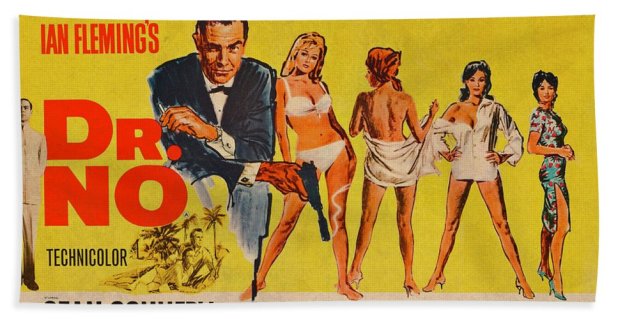
They also made merchandising deals with alcohol, tobacco, automobile and men’s fashion companies, using Fleming’s name and the success of the books to sell the character. And because sex sells, the posters featured Connery surrounded by gorgeous — and near-nude — women.
The results were pretty much an instant success. The films would become a series that nearly 25% of the world’s population has seen. The books became even bigger sellers. And the bikini — which Andress wore so famously — became the swimwear of choice for young women.
James Bond had arrived.
Bond has been called in to learn more about the disappearance of MI6 Jamaican station chief John Strangways and his assistant Mary Trueblood. Signal jamming of Cape Canaveral, the CIA (say hello to Jack Lord as Felix Leiter in the only time he’d play the role) and a bevy of assassins are soon involved.
The series stands out as something different right away, as after Bond escapes a tarantula death trap, he captures, interrogates and cold-bloodedly kills Dr. No’s associate Professor R.J. Dent (Anthony Dawson, who would return as Blofeld in From Russia With Love and Thunderball).
CIA agent Quarrel and Bond make it to the island of Dr. No, which is said to be guarded by a dragon — which is actually a flamethrowing tank. Bond meets Honey West (Andress) and after a battle that takes the life of Quarrel, he and West are taken to meet Dr. No.
As played by Joseph Wiseman (Buck Rogers in the 25th Century, Jaguar Lives!), Dr. Julius No is a Chinese-German supercriminal in the employ of SPECTRE (SPecial Executive for Counter-intelligence, Terrorism, Revenge, and Extortion). Due to radiation poisoning, he’s lost both his hands and has replaced them with robotic versions. He wants Bond to join SPECTRE and help him disrupt an American space launch, but you know exactly what happens next: Bond escapes the last death trap and kills just about everybody so that the free world can remain safe.
Dr. No also sets up Bond’s MI6 team of Miss Moneypenny and Q. Lois Maxwell would play the former role for the first fourteen movies, while Peter Burton would only play Q for this first movie.
Eunice Gayson (The Revenge of Frankenstein) plays Bond’s girlfriend Sylvia Trench, who was supposed to have a much larger role in the films. She was considered lucky by director Young, who cast her.
After seeing the movie for the first time, Ian Fleming summed it up quickly and candidly: “Dreadful. Simply dreadful.”
 B&S About Movies
You must be logged in to post a comment.