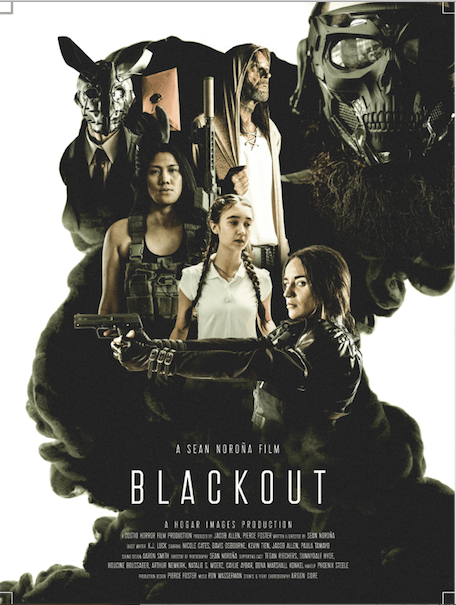
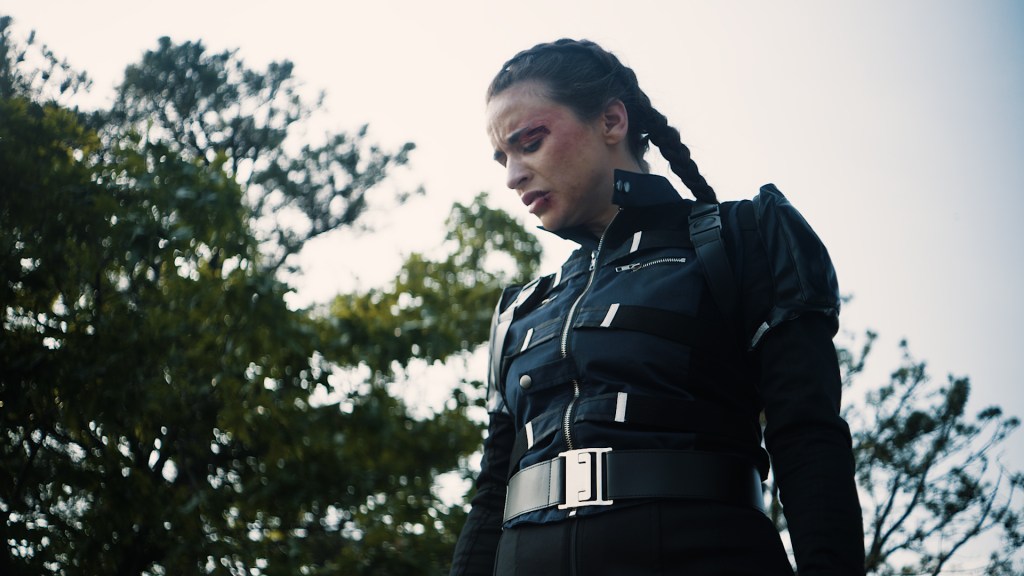
Lara Shultz (Nicole Cates) is a hitwoman with a difference — she suffers from dissociative amnesia. In Director Sean Justin Norona’s action/thriller short Blackout, Shultz goes on an existential journey she didn’t expect to take, but it’s one from which she can never turn back.
Norona, who cowrote the screenplay with Kayla Lucky, packs quite a bit into Blackout’s 19-minutes running time. Along with learning how Lara came to be a killer for hire, plenty of well-choreographed hand-to-hand combat and gunplay are on display. The short offers much more than simply action, though, as it really takes viewers inside the mind of its protagonist.
Cates makes for a strong lead, delivering solid narration and an impressive physical performance. Norona helms the short well. His choreography captures the proceedings nicely and his editing keeps the events flowing at a brisk clip.
Blackout is a super-assassin origin story that works just fine as a complete tale in short-film time, but I think the world building on display here has the potential for a highly intriguing feature film.
Blackoutis currently on the film festival circuit.
I saw the first trailer for this movie and purposefully avoided any other reviews or spoilers, which was difficult, as this seems to be all that Film Twitter is talking about. The idea of the trailer — someone is turning children into people who their parents can’t recognize and need to kill — was intriguing.
So if you want to go into this like I did, spoiler free, stop reading now. I won’t be mad.
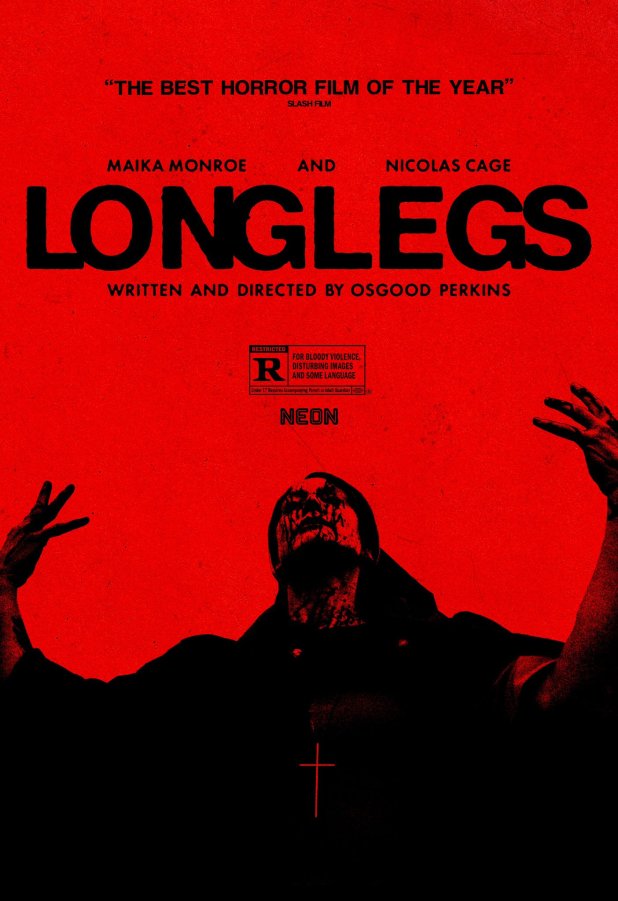
FBI agent Lee Harker (Maika Monroe) is able to find a suspect’s home without any other evidence. This leads to her being tested for psychic abilities and she’s able to divine the truth about half the time, which come to think of it, is a batting average that would get you into the Baseball Hall of Fame.
Her superior officer, Agent Carter (Blair Underwood) assigns her to his most puzzling case. A series of murder suicides have been happening for more than a decade. In each case, the father kills the wife and children and then kills himself. Family annihilators aren’t new. What is is that each crime scene has a letter in code from someone named Longlegs. This handwriting doesn’t match any victim yet there is no evidence that another person was ever in the home.
Each father also had a nine-year-old daughter born on the fourteenth of the month. The murders happened within six days before or after the birthday and form a sigil when laid out on a calendar with only one date missing to finish this occult shape.
The only survivor of Longlegs is Carrie Anne Camera (Kiernan Shipka) and she’s been in a mental home, silent for years. She recognizes Harker and gives her a clue to find her doll, which was an exact duplicate of her at nine along with a metal brain inside that the coroner claims had the voice of his ex-wife.
At this point, the FBI should realize that the killer — who has been sending letters to Harker and even broken into her home once, giving her the clues she needs to decode his language — knows too much about Harker, who already seems brittle and unable to deal with the case. They keep her on, even when they learn that her mother called the police about a man matching the look of Longlegs years ago and that Harker has a Polaroid of the man, which they use to soon arrest him.
Alright: I have to break from the narrative for a second and ask some questions.
Code and cyphers are cool. See Zodiac. See Se7en. See the real life Zodiac Killer.
However, the coded language in this movie is never really referred to again after Harker learns how to decode it. It never breaks anything in the case. It’s just cool.
Polaroids are cool, too. After years of pro wrestlers and strippers being the only ones to use them, they suddenly show up in a plenty of art and movies.
One Polaroid image of a man’s face is in no way enough evidence to find someone — they literally find Longlegs in seconds — much less enough physical evidence to keep him as long as they do.
And anyways, you should probably know that Longlegs is Nicholas Cage and his performance is wonderful but breaks the movie because other than the cinematography, nothing in it is as good as his over the top Tiny Tim in Blood Harvest acting. Then you wonder, why is the killer into T. Rex? Why does he make these dolls, which trust me, is the longest con ever. You have to get a creepy life-sized doll of a girl that looks exactly like her into the home and then have them play with it and then hope that she has a father, as well as being born on the ninth. It’s almost too much work until you get to the reveal.
Ah, the reveal.
Despite being a police procedural up until now, Longlegs has lived in Harker’s mother’s (Alicia Witt) basement and that he’s made her the accomplice, a nun who has never been mentioned in any of the police reports until the third act just lets you know that they make these metal-brained evil American Girl dolls with Satanic magic energy. I have to quote my friend Kris, who said, “Imagine if you watched all of Silence of the Lambs and you learn that Clarice’s mom used to bang it out with Hannibal Lecter.”
All of the metal brains seems Showtime Twin Peaks except that I expect that kind of thing from David Lynch and Twin Peaks is the epitome of horror police procedural and when it makes no sense at all, you demand that from it.
Now imagine investing time into a story and then you get a rug pull like this.
Anyways, in case you didn’t guess when you saw that Harker’s boss has a nine-year-old, you can see where this all ends up. You might think that one of the highest rated FBI agents in the country who has been working on a case for years about a man that kills girls age nine on the fourteenth of the month might have the deductive reasoning skills to figure that perhaps inviting an agent connected to his case is a bad idea, not to mention that maybe — just maybe — he and his family would be targeted.
Whoever did Neon’s marketing for this movie, creating the thebirthdaymurders.net website, the trailers, the 458-666-HELL phone number, the posters, it’s all great. Director Oz Perkins told IndieWire that NEON “really responded strongly to the movie, the raw materials of the movie really excited them, the way it looks, the way it feels, the way it sounds. They asked me early on, ‘Do we have your permission to kind of go nuts?’ And I said, ‘What else are we doing here? Go for it. Do your thing.””
The movie that they’re selling you is artifice. The outside of it looks so pretty, with long shots and takes that go on like a movie from another era, but then you’re reminded that it’s 2024 and most modern horror never sticks the landing. It’s not bad but isn’t it worse to believe that something could be great and it’s just average instead of figuring it’s average and not being disappointed?
For a movie that has been called the Silence of the Lambs for the 2020s, this has none of the actual story that backed up that film. The plot unravels as the holes become apparent with just a moment’s thought. As for the comparisons to Fincher, his iron grip of control and must be perfect realism wouldn’t have the 2007 version of The Price Is Right song play in a movie set in the 90s. Then again, Oregon rarely has lightning and thunder and that looks cool, so it’s in the movie.
I saw this at an Alamo Drafthouse and got trailers for Happy Birthday to Me and Brotherhood of Satan which put me in the headspace that I just might get a movie that I would like. But I’m just left with questions in this one and not the good kind of questions that intrigued me and wish I spent more time in the world of the film. I want things to be better and yes, yet again, I got caught up in the hype. You’d think I’d finally learn by now.
This is a hard movie to review. Possession is one of my favorite movies of all time, a movie that I described by writing “They should attack you. They should change your consciousness. They should take your psyche like a rock tumbler and slam you against the walls over and over until you emerge better.”
It seems like director Razka Robby Ertanto and writers Lele Laila and Andrzej Zulawski have set up an impossible task to remake this movie. Yet Indonesian and world cinema often takes films that have existed before — America does the same — and puts their own spin on the film. Sometimes, it works. Often, it doesn’t.
The title “Official Indonesian Remake” was interesting, because I remember the days that things could just be ripped off and no one knew. But now the internet exists.
The other person who has a huge mountain to climb is Carissa Perusset, who plays Ratna, the Anna (or Helen, right?) of this movie is always going to be compared to Isabelle Adjani, the only actress I know to win Best Actress at Cannes for a movie that ended up on the Video Nasties list. She shares the burden with Sara Fajira, who plays Mita, the actress who gets to re-enact Adjani’s spectacular subway freakout moment. Ah, who knew 2024 would be the year that more than one more would cover Possession? Unlike The First Omen, this one had to have that scene or we’d be upset, like when a band doesn’t play its biggest hit.
If you’re looking for that strange octopus creature that wormed its way between Adjani’s thighs, well, it’s been replaced by a pocong, a ghost that looks like a person wrapped in a funeral cloth. In Islamic funerals, dead bodies must be covered in white fabric tied over the head, under the feet and on the neck, as well as being firmly tied at multiple junctures to maintain its position during the journey to the grave. Upon placement into the grave, it is believed that the knots must be undone or the corpse will animate and haunt friends and family as a pocong.
Faris (Darius Sinathrya) is a soldier who has just returned home. Instead of his wife Ratna reacting with joy, she demands a divorce. She’s been acting strange for some time, a fact that his son Budi (Sultan Hamonangan) can see when he isn’t speaking in the third person, directly to the audience or screaming that both of his parents are demons. Faris has an easy answer, thinking she’s cheating with the movie director she scripts for, Wahyu (Nugie). Or at least that’s what Mita thinks. Then again, she’s always wanted Faris.
This movie is, well, horny. Where the original had sex — cold and horror-filled sex — this is clad in deep reds and mixes giallo-esque danger and furtive alleyway couplings mixed with stab wounds and bodies sailing downward onto cars. By the end of the film, Perusset’s moans have nearly become the soundtrack. Everyone is so overloaded with lust that even the exorcist, Toni (Arswendy Bening Swara) is more interested in making love to the tied up Ratna than saving her.
Żuławski made Possession instead of killing himself after his divorce. I wonder what these filmmakers had in mind, as the original seems to be so effusive that it’s hard to say who is to blame. Here, it’s definitely every man who appears on screen except for Budi, who literally pulls the curtain back at the end, telling us that he’s too young to watch this movie.
The only downer is that this descends into jump scares and possession scenes at the end, forgetting that while the title of the movie does reference that element of the supernatural, it’s truly about the emotional gulf that happens when love goes away.
I don’t regret the time I spent watching this, but it won’t replace the film I already own.
When an old VCR mysteriously shows up at digitizing facility Video Vision, Kibby (Andrea Figliomeni) starts to be affected by it. She’s also in love with a trans man named Gator (Chrystal Peterson) who brought in old VHS tapes of her father’s band destroying computers. But in spite of this new relationship, her body is changing in supernatural and dangerous ways because of this smelly ancient VHS. That’s because Kibby has unlocked the dark dimension of Dr. Analog.
Directed and written by Michael Turney — who played Danny Pennington in Teenage Mutant Ninja Turtles— this movie has characters to fall in love with, like Video Vision owner Rodney (Shelley Valfer), as well as Kibby and Gator. Their relationship feels authentic and there’s an intriguing hook about the way that we move from format to format in the same way that people can transform their bodies based on their true sexuality. In the same way that people wonder why those spend money on physical media when streaming exists, Kibby wonders if she can be with someone whose genitals may not match her needs. She’s lucky that Gator is understanding and patient. And that’s before she starts transforming herself into some analog video cassette monster. Or, as Gator says, “I’ve accepted that I’m male, maybe you should accept the fact that you’re turning into an obsolete entertainment device, all I know is that you’re making my dysmorphia feel normal.”
The social commentary may be a bit ham fisted and look, there’s no way that this is going to make everyone happy. A science fiction film is not the best way to navigate trans relationships or how we see them. Is the movie entertaining? Sure. And as a CIS male, I have no idea how off it is or if I should be offended. More clued in people will tell me that. I liked the ideas in this and isn’t it strange that all these years after Videodrome, we’re still hailing the new flesh?
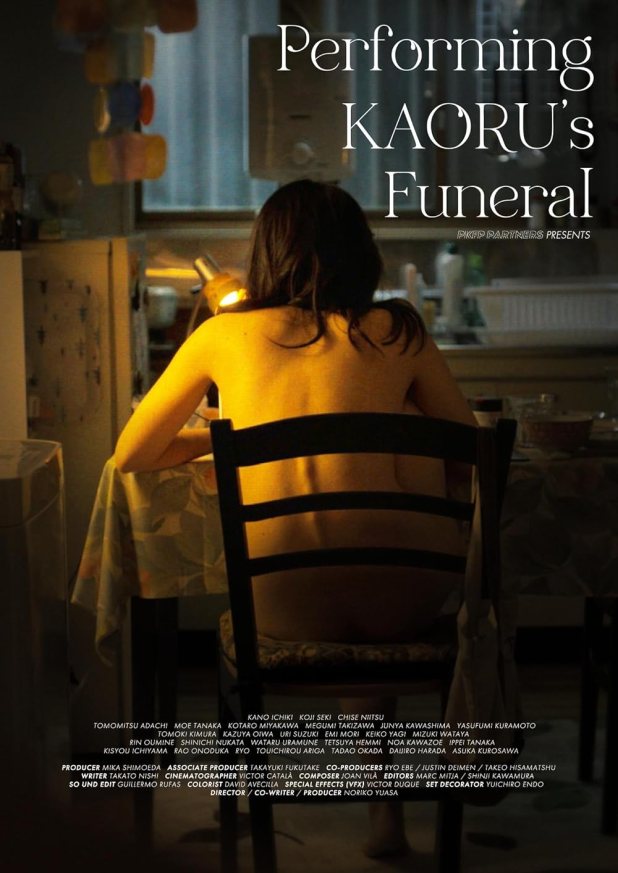
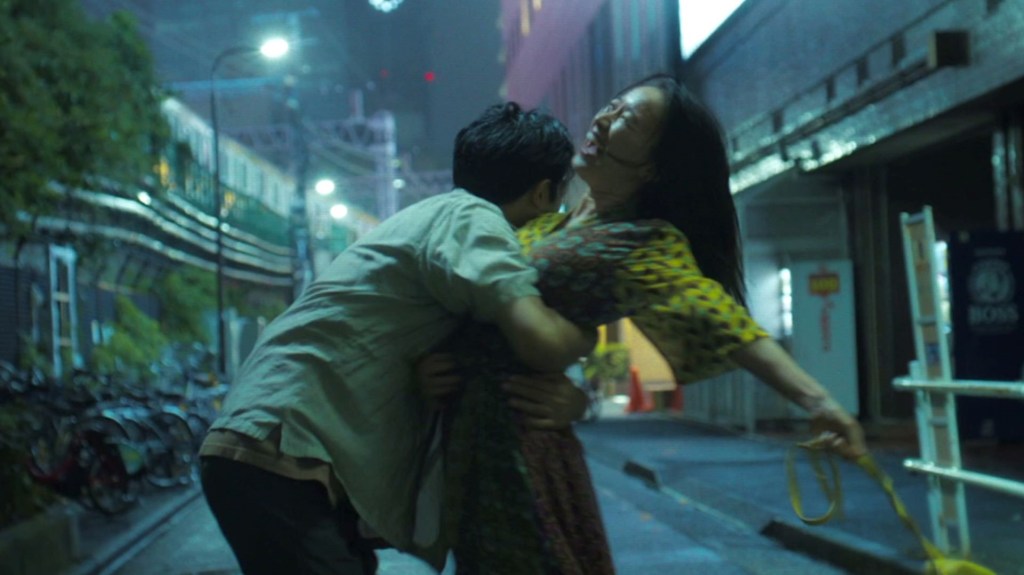
Director Noriko Yuasa’s Japanese feature Performing Kaoru’s Funeral is an engaging look at laying to rest someone who people only thought they knew. Lighthearted, poignant, and with both humorous and jaw-droppingly dramatic moments, the film examines the family members, work associates, and other acquaintances of the enigmatic title character (Kano Ichiki), a screenwriter whose life suddenly ended in an accident.
Kaoru’s will stated that her ex-husband from 10 years earlier, unlucky actor Jun Yokotani (Koji Seki), be the chief mourner at her funeral in the rural village of Okayama, where she grew up. Unsure of what to do while there, he meets a group of people who were close to Kaoru, including her nine-year-old daughter (Chise Niitsu), who doesn’t know who her father is — and she isn’t the only one without that information.
As Performing Kaoru’s Funeral unfolds — with a screenplay by Takato Nishi — its characters and situations provide commentary on different Japanese societal topics including sexism, along with a wry comment on the inability for original films to be greenlighted in Japan. Yuasa paces the film nicely; it breezes along and unveils mysteries, bringing smiles and lumps to the throat in fine fashion, with a stellar ensemble cast, and gorgeous cinematography courtesy of Victor Catalá.
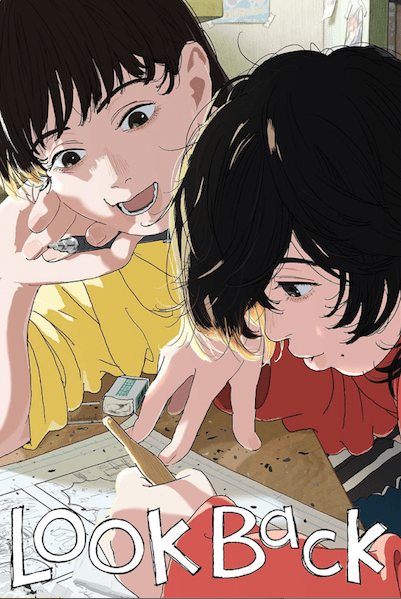
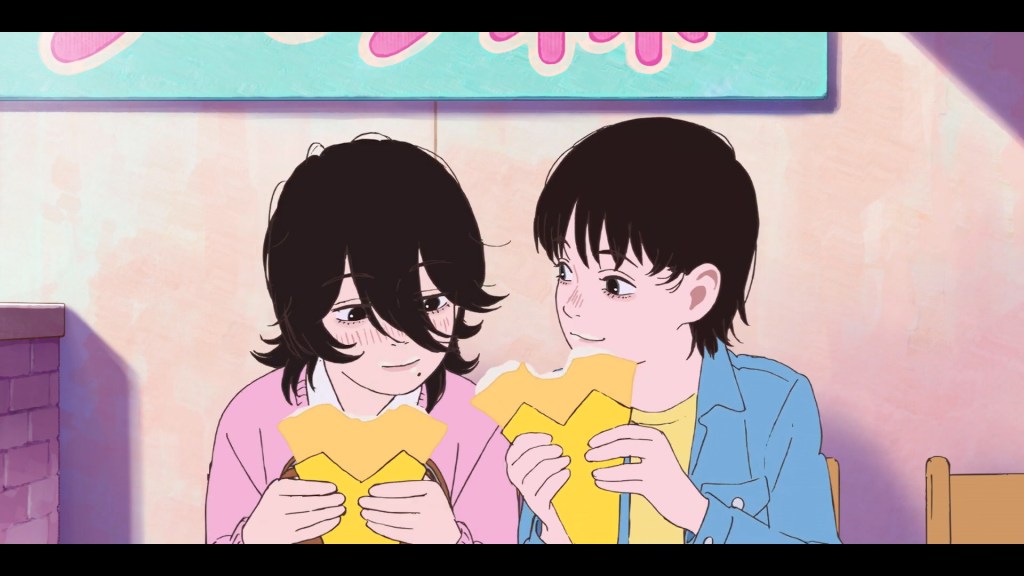
Director Kiyotaka Oshiyama’s anime feature Look Back is a coming-of-age tale that puts its two main characters and viewers alike through the emotional wringer. Fujino (voiced by Yumi Kawai) is a school girl whose manga in her elementary school’s newspaper draws a lot of praise from her fellow students — until it is suddenly overshadowed by the manga drawn by shut-in student Kyomoto (voiced by Mizuki Yoshida). Tasked by her middle school teacher to deliver a graduation document to Kyomoto, Fujino is surprised to learn that the girl is a fan of her work. The two work together as high schoolers and craft award-winning manga, splitting apart when Kyomoto announces that she wants to study art at university rather than continuing their success as a professional team.
There’s much more to matters than what I have described here, and I don’t want to spoil what happens in this fast-paced, poignant feature, so suffice it to say that Look Back, based on the autobiographical manga Chainsaw Man by Tatsuki Fujimoto, delivers shocking tragedy, an alternate reality/”What if?” scenario, and plenty of smiles along with lumps in the throat as the bittersweet drama involving the two unlikely friends unfolds. The animation looks terrific, from scenes early on depicting Fujino’s comedy manga to emotionally heavy portrayals where facial expressions are wonderfully conveyed. The voice acting by the original Japanese cast is also top notch. Oshiyama has crafted a touching anime feature in Look Back that leaves plenty to mull over long after its final frame.
I could write an essay on legendary Japanese actor/director Takeshi “Beat” Takano’s new samurai epic Kubi — in which he, yes, stars and directs — but instead let me tell you succinctly that this film rules!
The cast of characters equals, if not exceeds, those of many of Shakespeare’s plays, and although subtitles helpfully call out the names and positions of characters — rivaling in speed and number those shown in Shin Godzilla of government officials — memorizing who’s who is not a requirement here, because you’ll be too enthralled with the majesty on display to feel confused. Kitano doesn’t skimp on the violence and gore, and believe me, there’s plenty of it, what with all of the double-dealing, double-crossing, intrigue, playing for position, toying with affections, and so on. Takeshi Hamada’s cinematography is absolutely gorgeous, capturing the drama in all of its blood-splattered glory, with beautiful sets and landscapes, to boot.
The plot concerns a battle for feudal power in 16th century Japan, when the evil Lord Nobunaga (Ryo Kase) — you’ll hate him right off the bat, and things only get worse when he is involved — is due for an overthrow. One of his lords, Murashige (Kenichi Endo), fails in an attempted rebellion and escapes. Nobunaga promises his other lords, including Hideyoshi (Kitano) and Mitsuhide (Hidetoshi Nishijima), that whoever brings Murashige to him alive will be the successor to the throne. There are loads of subplots, but I’ll save those for first-time viewers to discover.
If you love samurai epics, Kitano’s marvelously helmed, wonderfully acted, beautifully lensed and scored, and shockingly violent Kubi is must-see viewing. If you love first-rate cinema, you should also consider this a requirement. Kubi has absolutely secured a spot on my list of top favorite films of 2024.
Join CFF as we take a journey into the longer side of short cinema. One of the many joys of presenting our festival in a hybrid format is that it allows us to include so many amazing films that our time limitations during our in-person days wouldn’t allow, and it also gives us the freedom to program more short work with running times 15 minutes and above. It can be challenging for festivals to make longer short films work when space in blocks is limited, and we’re grateful that our two-volume Fun Size Epics block gives us a chance to share an exceptional group of films that pack more world-building and storytelling in their run times than some features can manage.
Dark Mommy (2023): Based on an episode of the Please Leave podcast, this is all about Ben, the only night shift 911 operator in his small town, which mainly means that he deals with prank callers and drunks. However, this is the night that Dark Mommy has arrived and has plans for everyone in town. It all starts with a frightening phone call and gets even more intense.
Directed by Courtney Eck, who wrote this film with James Gannon, this looks stellar. My main issue was the end, as it seems like it jumps from the night of the Dark Mommy rising and then jumps right to the aftermath. It moves so quickly that I had to go back a few times as I was sure I missed something.
Madame Hattori’s Izakaya (2022): Directed and written by Shanna Fujii, this thriller is about a chef and those who are permitted to attend her very private dinners. Shot in Arizona, this film was a collaboration between restaurants, chefs, filmmakers and the Asian community. Featuring food made by chefs Nobuo Fukuda, Paulo Im, Justin Park, Kevin Rosales and Tyka Chheng and shot at Nanaya Japanese Kitchen, this also has nails from Slain Studios and was sponsored by Sapporo and Crescent Crown Distributing.
Fujii had over thirty artists all collaborating on this film and all of the info above wouldn’t mean much if it wasn’t so interesting. And it is. It answers an intriguing question: How can a chef become so well known when she has never eaten food in her life?
The Garden of Edette (2023): In this Creole Southern gothic, Edette (Gwendolyn Fuller Mukes) may be an elderly woman, but she will live forever as long she keeps luring in victims for her flesh-eating garden. Her next victim will be a young girl named Perri (Mandysa Brock), except that Edette finds herself growing closer to her, feeling a kinship. Now, she must choose between betraying her friend and dying alongside her garden. Directed by Guinevere Fey Thomas, who wrote it with Chiara Campelli and Melisande McLaughlin, this looks incredible and tells a unique story that you don’t find all that often in horror. You can learn more at the official site.
Eyes Like Yours (2023): A hospice nurse remembers her long dead mother when she sees the eyes of one of her patients. She becomes devoted to the patient and starts to use her to recreate her mother, at least in her own mind. Directed and written by Gabrielle Chapman, this has excellent acting by Penelope Grover as Dawn, Lex Helgerson as Alison, Lynnsey Lewis as Isla and Ashlee Weber as the idealized version of the mother that the film keeps returning to. So many of the films that I watched this week at CFF dealt with the loss of a parent or trying to recapture their love. Each went in their own direction and this one has an intriguing physical direction.
Volition (2023): After getting kidnapped and taken to a sex trafficking house, Emma (writer Emily James) brings together all the victims of the house, as well as past people who lives have been harmed, to create an escape plan and get revenge. Directed by Ashley George, this film’s villain Christoph (Zachary Grant) is the kind of horrible human being that you can’t wait to see get what they deserve. Good news. This is a short so you don’t have to wait long. For the budget and the running time, this pulls off tension and action well.
INKED (2023): Directed and written by Kelsey Bollig — who also made another short I enjoyed, Kickstart My Heart — INKED is about Dylan (Kaikane, Night of the Bastard), whose father has just died in prison. His friends were angry that she didn’t have a priest at the funeral, but from what she knew of him, she figured he wouldn’t want that. Instead. she honors him with a new tattoo from her friend Bruno (Chris Cortez) using his ashes. Yet that ink sears into her skin, keeping her awake at night and asleep during the day, bathing her dreams in violent red hues and letting something evil loose. The end of this comes suddenly, but I loved this short and it would make for an even better long form feature.
Floater (2023): When their abusive father (Jeffrey Nordling) dies in the bathroom, Phillip (Jacob Wysocki) and Melanie (Darcy Rose Byrnes) both deal with the loss in very different ways. While his sister and mother (Christine Elliott) do their best to deal with their grief, he preserves the last thing that he has of his father, his last bowel movement which is able to speak to him, telling him that he wants to fix things. Phillip locks himself into the bathroom and refuses to allow anyone else in. The first project by director and writer D.M. Harring, this may have some disgusting moments, but its heart understands the pain of grief.
You’ll probably never see another movie where a son builds a memorial to his father and creates a doll out of his feces. That may not sound like a strong review, but it is. This has real emotion inside every second.
Mort (2023): A mortician named Mr. Underwood (Andy Farmer) and his timid new assistant Lane (Josh Bernstein) have to stop the Lancasters, a family that nearly everyone hates and for good reason, from freaking out when their patriarch Mort (Les Lannom) becomes a zombie and walks away. From Pastor Tim (T Brown) farting in people’s faces to the way the entire family behaves, this feels like my hometown. Except for the zombies, but I did grow up next to Evans City Cemetery where Barbara had them coming to get her. Directed and written by Charlie Queen, this is a fun take on the zombie film. Mort even knows how to do the neck bite from Dawn of the Dead.
Up On the Housetop (2023): The Holloway kids — Olivia (Kayla Anderson), Dylan (Samantha Holland), Donnie (Michael Fischer) and Todd (Dakota Millett) — weren’t looking forward to the holidays after the death of their parents. They’re going to hate the season even more now because — spoiler warning — they accidentally murder Santa Claus on Christmas Eve, thinking that he’s a robber. Now, they’re going to be lucky if they survive this Silent Night with deadly reindeer demanding revenge.
Directed by Dakota Millett and Michael Fischer, who wrote it with Laura Herring, this really does have it all. By all, I mean killer reindeer POV camera, baseball bats covered with holiday lights, a Mario Bava-esque image of a roof filled with reindeer and…this really needs to be a full length film. I don’t think I can ask Santa for that.
Robbie Ain’t Right No More (2023): Sarah (Madeleine McGraw, The Black Phone) used to be close to her brother Robbie (Jadon Cal, Last of the Grads). Over dinner and dealing with the loudmouth Andy (Walker Trull), he reveals the scars all over his body from warfare. What no one can see are the scars that exist in his psyche.
Directed and written by Kyle Perritt, who served as a Marine, this soon has the family discussing what’s wrong with Robbie, from his father Vernon (Jason Davis) saying that his son isn’t right no more and his mother Peggy (Emily Deal) feels useless. As for Robbie, he tells his sister that he feels like someone else is driving him now.
This feels like Deathdream and The Guest, which are high compliments. While this short seems to tell the complete story, this has enough power to be its own full-length film. Perritt has plenty of talent and I can’t wait to see what’s next.
I did see some reviews of this that criticized the short for starting in the middle of the story and not explaining what Robbie was like before. To me, that’s what’s thrilling here. We’re thrust in the middle of the story and must figure it out just as Sarah must.
Good Girls Get Fed (2023): Rose (Kelly Lou Dennis), Daffodil (Kayla Klein) and Iris (Paula Velasquez) are trapped inside a windowless room, given silent commands that are written on a wall. If they answer these challenges, they get the food that they need to survive.
The time in captivity may feel like it’s driven them against one another, but they know that if they work together, they can escape. Yet is there something even worse waiting?
Directed by Kelly Lou Dennis, who wrote this short with Kayla Klein and Sarah Rebottaro, this finds whoever is giving the commands to often just be fixated on the male gaze. At other times, it is using what the women have the most trauma with and playing it against them. Even how they’re dressed is a man’s fantasy.
I don’t want to spoil this but the end is total nihilism. Wow.
Lost Boys Pizza (2023): On Halloween, two theater kids head off to dance. As you can tell by the title, they find vampires there. One, a turned enemy from high school distracted with a bloody tampon and then Dracula himself on the dance floor. Directed by Cassie Llanas and written by Tatjana Vujovic, this looks beautiful and would probably be a ton of fun to watch with an audience. As it was, I can only dance so much in my living room before the neighbors start to notice.
The Kindness of Strangers (2023): Stacy (Nell Nakkan) and Anna (Angela Jaymes) are out driving around on a night back home from college. A woman (Tammie Baird) seems to be in shock and they agreed to take her to a hospital. Yet there’s something horribly wrong with her that will change this night for both of them. It’ll also make you question if there is such a thing as a helpful person. Directed by Stu Silverman, who wrote this short with Kathryn Douglas, this is a mean movie that refuses to protect its characters. Well worth watching.
Vespa (2023): When Luiza comes to visit her mother Celia at her new home, something immediately seems off. Could it be V, the new caretaker, the woman who Celia now believes is her daughter? Does it upset Luiza that her mother has always been so cold to her and yet now is so loving to a stranger? Or could V be quite literally be planting seeds that will keep Luiza trapped at home forever and always under loving care that she never wanted? Directed and written by Olívia Ramos, this was an intriguing watch with gorgeous tones and visuals.
The Lonely Portrait (2023): This is a perfect short. An AirBnB guest (Andrew Weir, who wrote the script with director Marc Marashi) guest finds a blank spot on the wall that he soon fills with a strange painting. Every time he steps away, that portrait changes and begins to take things from our world. It’s a gorgeous creation, as it’s a digital painting that was motion tracked into each scene. This is filled with some incredible angles, including one inside the world of the painting. You know where it’s going each step of the way yet when it gets there, it’s so well made that you’ll want to cheer. A triumph.
Carnivora (2024): Ana (Gigi Zumbado) comes home to take care of her grandmother Yaya (Julia Vera), along with Maribel (Carmela Zumbado), who never leaves home and is her caregiver. This leads to the natural argument over Ana being a prodigal sibling or Mari being a martyr for remaining. Their mother has disappeared and no one knows what happened. And that’s because — spoiler warning — Yaya eats people whole and keeps them alive inside her. I feel this movie more than I would like to admit and director Felipe Vargas has created an amazing way to reflect what it’s like to watch a loved one disappear.
Too Slow (2023): An insecure man has fallen for the oldest trick in the book: up high, down low, too slow. This sends him off the deep end, obsessed with getting an apology. Instead, he gets fooled again with the stain on your shirt scam. That’s too much. Now, he loses everything he had and starts becoming the man he hates, buying a Tesla, wearing a wool suit and acting like a complete cryptobro. Everything comes to a head at a birthday party and blood will be spilled. Danielle McRae Spisso and Stephen Vanderpool have crafted something amazing here, a story that we may have all lived yet in a place that goes further than we expect.
You can watch so many of the films at CFF by buying a pass on their website. I’ll be be posting reviews and articles over the next few days, as well as updating my Letterboxd list of watches.
Marissa (Bridget Regan) and Eve (Joanne Kelly) have seemingly been pitted against one another since they were born. Their father, Raymond Hale (Samuel Roukin), was an oppressive collector of art who felt that his life of privilege kept him from his true calling of being an artist. He sword that his daughters would be guided to becoming the best artists who ever lived. To do that, Hale taught them that their pain would guide them to become better at their craft, despite the damage that it would do to their psyches. Marissa became a cold, unfeeling art scenester, using her sister’s art to gain entry into a world that she doesn’t have the talent to survive in. Eve has regressed inward, spending as much of her time as possible inside the family’s crumbling home, the same place where she found her father dead from suicide.
Their relationship is best summed up by a flashback where both paint in front of a waterfall. Their father yells at Marissa, complaining about how she doesn’t seem to care. He then forces Eve to burn her sister’s canvas, intonning, “The seed of creativity is adversity.”
Eve became a prodigy and was known in the art world before puberty.
Marissa was always jealous of her.
And if this seems like an art world version of Whatever Happened to Baby Jane?, the filmmakers should take it as a supreme compliment.
Years later, the sisters come back together as Marissa learns that Eve plans to donate the priceless art that her father owned to a local gallery. It just so happens to belong to the fiancee of the girl’s childhood friend Cormack (Alain Uy), who has also remained in their hometown. Instead of becoming a great painter, he’s content to take care of Eve from afar and have a tattoo shop.
Appearances are reality for many in this film. Marissa is as much a mess as Eve, but she never admits it. Eve may appear like she’s hanging on to life by her fingernails, yet she can feel joy at the opportunity to reconnect with her sister.
Director and writer team Melora Donoghue and Kimberly Stuckwisch have created an entire world populated by characters who live and breathe. Marissa blows into town, seemingly always one step ahead of her sister. Yet Eve, while innocent, is not without guile. I rooted for her in this.
This is quite a movie. I hope it gets the kind of distribution where so many people can watch it.
You can watch this and so many of the films at CFF by buying a pass on their website. I’ll be posting reviews and articles over the next few days, as well as updating my Letterboxd list of watches.
Directed and written by Ludvig Gür, Gudstjänst — which is being released in the U.S. as In the Name of God — is about Theodor (Linus Walhgren), a priest who is often the only person at his masses. The worshippers are dying off and his wife Felicia (Lisa Henni) wonders if they should move on. He’s happy that his mentor Jonas (Thomas Hanzon) has come to town. The problem is that it seems like he may be deranged. After all, he just killed a dove right in front of him and sprayed him with hot blood.
Yet when Felicia collapses and is soon hospitalized, dying from a mysterious ailment, Jonas offers to save her if Theodor follows him just as he did by going into the priesthood. Now, he must accept the true priesthood of God and kill sinners to save his wife’s life.
Jonas has already captured a rapist and all the younger man has to do is snuff out his sinful life. He does. His wife is healed. He becomes known as a faith healer and people come back to the church. His wife is with child. God has a plan.
Yet to make the prayers of his new followers come true, he must keep killing. Because the God who has listened to Theodor is the Old Testament one, the vengeful demander of sacrifice, the God that asked Abraham to murder his own son just to see how far he would go.
This is the very definition of a moral quandary. Isn’t murder a sin? Yet aren’t the people who Theodor is hunting and destroying evil incarnate? Isn’t all this murder making the world a better place? And if he can make miracles happen at the same time, isn’t that God’s will? Can you become addicted to creating magic happen in the lives of those who follow your teachings?
You can watch this and so many of the films at CFF by buying a pass on their website. I’ll be posting reviews and articles over the next few days, as well as updating my Letterboxd list of watches.













 B&S About Movies
You must be logged in to post a comment.