Dead Air (2021)

If you’ve spent any time surfing around the streaming-verse pages of Amazon Prime and other services, then you’re familiar with the resume of Ithaca, New York-based filmmaker Kevin Hicks, who made his feature film writing and directing debut with the mobster comedy Waiting on Alphie (2005), the horror-thriller Paranormal Proof (2010), the horror-mystery Behind the Door (2014), and his most recent effort, the paranormal horror Doppel (2020).

Now Kevin has teamed with his wife Vickie (his writer and co-star; she also wrote Doppel and the currently in-production The Forever Room) for his fifth feature film: one that deals with a haunted, antique ham radio set.
Upon cleaning out the home of his recently deceased mother, William (Kevin Hicks) discovers his late father’s old ham radio set. As he fires up the radio, he begins an over-the-air friendship with Eva (Vicki Hicks). As does William, Eva also deals with dark secrets seeded in a past family trauma. And William comes to discover his connection to Eva goes beyond just an innocent ham radio transmission. And there’s “something” that wants out of that radio set.

As we’ve said many times in our reviews of these up-against-the-budget vanity projects of the streaming-verse that delve into the horror genre: don’t come a knockin’ for an A-24 or Blumhouse horror flick because the shock-scares ain’t a-knockin’. But if you’re into a character-driven supernatural drama that, because of budgetary constraints, goes the dialog route to tell its story, then there’s something here for you to curl up with on Friday evening under your digital device’s glow. So, instead of a mystery novel, why not a mystery movie, for a change?

Kevin and Vickie Hicks are low-budget filmmakers shooting with thin budgets on iPhones and other digital devices; filmmakers that need to be given a wider berth than tmajor and mini-major studio filmmakers — such as TV scribe Gregory Hoblit, with his Dennis Quaid-starring Frequency (2000), to which Dead Air has been compared by streaming-verse commenters. (If you’re not familiar with the Hoblit name: he also gave us the Denzel Washington-starring Fallen (1998) and the 2002 Bruce Willis vehicle, Hart’s War. I’ve seen former in passing on cable; I’ve never seen the latter.)

I’ve watched Frequency in passing on cable several years ago — and a few years after its initial release. So while others opine Dead Air is a “rip off” of that other ham-radio-from-beyond flick, I can’t attest to that fact, as I really don’t recall much of the Dennis Quaid film, other than it also starred Mel Gibson’s “Jesus,” Jim Caviezel, in the controversial Passion of the Christ. Others have cross-referenced the never-heard-of-and-never-seen (at least moi; it was released before B&S About Movies came into being) Canadian thriller The Caller (2011), concerned with an apartment’s “haunted” telephone line. I guess you’d have to be one of that film’s 86 IMDb users to make that critique-connection of The Caller to Dead Air.

Since this is my first Kevin and Vickie Hicks flick, I also can’t attest if Dead Air is an improvement over his earlier works. But as I researched Kevin’s career, I’ve come to learn he’s had a long, successful career in music video and commercial production. And he’s brought those skills to the table, as Dead Air, while not a visually stunning film, is certainly a well-shot film and Kevin and Vicki each bring competent thespian skills to set. The rest of their cast is pretty fine, too, and are certainly above the thespin’ frays of most indie streamers.

Dead Air, a supernatural family-oriented drama, is now available on a number of digital and cable platforms, including Amazon Video and Vudu from Freestyle Digital Media. The studio, run Bryon Allen, who recently launched the black-centric cable network The Grio (it’s airing all of the old ’70s blaxploitation classics), recently picked up an indie-film we really enjoyed, the cat-turns-into-a-human dramedy, Shedding. Another indie we reviewed that was recently picked up for wider distribution by Freestyle is the horror-comedy Hawk & Rev: Vampire Slayers. You can also learn more about the commercial production-to-feature film career of Kevin Hicks at his official website.

Disclaimer: We received a screener from the distributor’s P.R firm. That has no bearing on our review.

About the Author: You can learn more about the writings of R.D Francis on Facebook. He also writes for B&S About Movies and publishes short stories and music reviews on Medium.
Rattlers 2 (2021)

45 years after Rattlers, those same snakes are still slithering around the California desert, ready to bite anyone they get close to all over again.

Don’t worry if you never saw the Harry Novak-produced original. Enough scenes from it are replayed here that you’ll know the story. It’s simple — the flashbacks are shot on film and look beat up and the modern-looking digital footage is the story from today.

Director Dustin Ferguson has a regular cast that he turns to in film after film and many of them show up here, like Mel Novak as Commissioner Lewis, Brinke Stevens (yes, that Brinke Stevens!) as Rebecca, the always fabulous Dawna Lee Heising as Lindsay, Jennifer Nangle (Malvolia herself!) as Sally, Shawn C. Phillips, Julie Anne Prescott, Peter Stickles and more.

Writers Josh Price and Lee Turner have done a nice job of reminding audiences of the original film — or filling in the blanks if they haven’t seen it — while moving things forward.

If anything, I wish that the film relied less on the original film and that the ending didn’t feel so rushed. But that’s fine — Ferguson seems to be learning with each film and I’m always interested in seeing anything that he makes when it crosses my path.

You can get this on demand from SoCal Cinema Studios or grab the DVD from Kunaki.

DISCLAIMER: We were provided with a review copy of this film, but that did not impact our review.

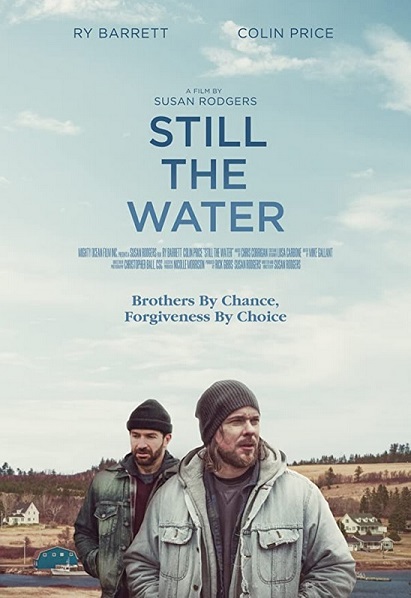
Still the Water (2021)

The ecosystems of islands, by nature, are self-sufficient biological communities that, sans the intrusion of man’s foolish nature, can survive and thrive for an eternity. Man, on the other hand, is not an island; man is a social animal that withers and dies in their Don Quixote quest for independence. Autonomy doesn’t grant self-worth, but self-loathing.

And the Brothers McAuley of Prince Edward Island — the eldest Nicky, the troubled middle child Jordie, and the cooler-passionate youngest Noah — are about to learn a geographical lesson in futility.

The not-so-Musketeers are led by the bullish Nicky, a man-child who hasn’t learned the craft of thinking before he lets his tempers flare. Jordie is a semi-pro hockey star who runs from life’s responsibilities for the ice and comes to discover the “lone wolf” approach to life simply doesn’t work. Noah, for the most part, escaped his father Doug’s alcoholism to mature into a somewhat well-adjusted, approachable free spirit. When Jordie’s propensity in taking out his frustrations on the ice result in his being kicked off his team for fighting, he has no place to go other than home. And while forgiveness lingers in the mists, family resentments towards the hell the now-recovered father Doug’s drinking brewed, lies within the fogs of the past.

This powerful, dramatic feature-film debut regarding the trials and tribulations of family from from writer-director Susan Rogers encapsulates her passions for her Malpeque Bay, Prince Edward Island home; an adoration encapsulated by Cinematographer Christopher Ball (Black Swan; second unit on Aquaman, multiple episodes of SyFy’s Haven). Courtesy of Ball’s experienced eye for crafting shots for his first-time director, Roger’s debut film accomplishes what most movies do not: create a character out of a location.

There’s an err in screenwriting where neophyte writers are of the opinion that characters (if properly written, aren’t “characters” with “motivation”; they’re people with emotions) must speak by words; forgetting that we, as people, communicate silently 70 to 93 percent of the time via facial expressions and body language. A character in a screenplay is a person who drives a plot and inspires other characters, in the effort to create drama. Locations — even objects with a close connection to a person — that inspire and influence characters and drive the plot, also work as “characters” (that’s my opinion and I am sticking to it). Susan Rogers, through her usage of the history and beauty of Prince Edward Island, understands this little-used fact of screenwriting to make the island sing its siren song to the McAuley brothers.

A lesser writer would have had the patriarch-father die and, through a will or some type of legal or heirloom McGuffin, put the three brothers into a cross-country road movie-to-catharsis. We’ve been there on that expanse of asphalt and done that white line fever, ad nauseam. Roger’s debut is a road movie without the road trope; a film where man learns to function as part of an island’s ecosystem and learns how self-sufficiency comes from the reliance of the other and each other.

After completing a successful theatrical and streaming-run in its native Canada, Still the Water is fresh off an equally successful series of U.S. festival showings. It is now available as a free-with-ads stream in North American courtesy of Indie Rights Movies on Tubi TV.

Other recent releases from the Indie Rights Films catalog we’ve reviewed include A Band of Rogues, Banging Lanie, Blood from Stone, The Brink (Edge of Extinction), Chasing the Rain, Double Riddle, The Girls of Summer, Gozo, Loqueesha, and Making Time.

About the Author: You can learn more about the writings of R.D Francis on Facebook. He also writes for B&S About Movies and publishes short stories and music reviews on Medium.
Disclaimer: We did not receive a review request for this film from its director, distributor, or P.R firm. We discovered the trailer on social media, were intrigued by the film, and we truly enjoyed the film.

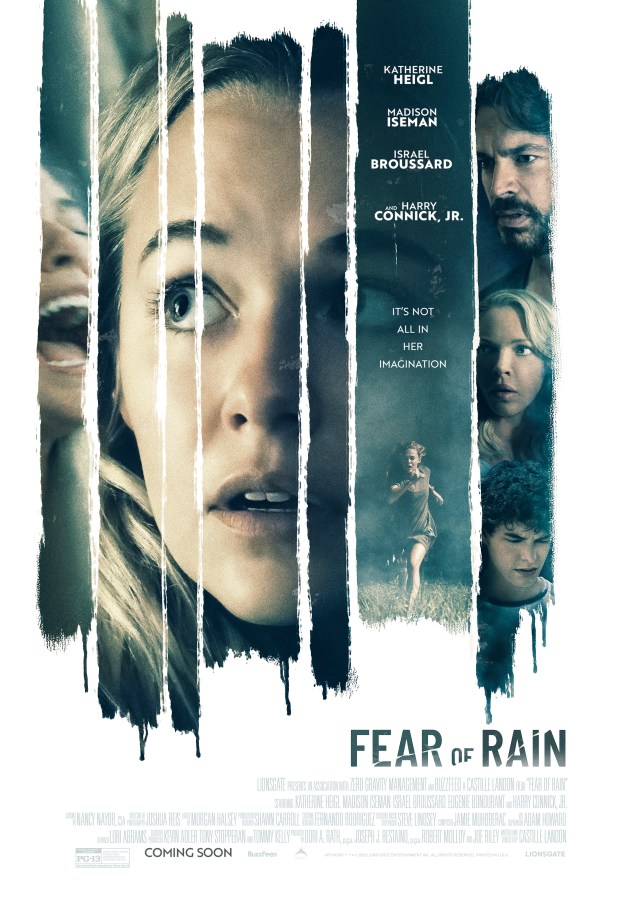
Fear of Rain (2021)

Filmed under the title I Saw a Man with Yellow Eyes — yes, there’s a bit of a giallo in this — Fear of Rain sat was released in theaters — the ones still open — last week and then went straight to video — yes, they still sell DVDs — and streaming.

Written and directed by Castille Landon, this is the story of Rain Burroughs (Madison Iseman, Tales of HalloweenAnnabelle Comes Home), a young girl with vivid memories of being chased through the woods by a killer. She wakes in an emergency room with her parents (Katherine Heigl — who is still in movies — and Harry Connick Jr.) and from that moment forward, everything may or may not be real, including love interest Caleb (Israel Broussard, Happy Death Day) and the child being hidden in the attic of her next-door neighbor and teacher Dani McConnell (Eugenie Bondurant).

The movie spends most of its time — perhaps too much of it — on Castille’s trials in school and in starting to romance Caleb to the point that it never builds McConnell into anything more than a cipher. That said, using the mental illness of the lead to make her an unreliable narrator works for the movie, even if some moments, like the evil version of herself showing up in a mirror, falls into tropes that the movie struggles and mostly succeeds to overcome.

Between the dollhouses of McConnell — again, never really explained or explored — and the fact that more than one of the characters in the movie may be living in our heroine’s head, this movie does have that one foot in the world of the murder thriller, but never takes the full leap into being fully strange. And that’s fine — this is meant for a younger audience and not the devotees of Martino, Argento, Lenzi and Lado. It certainly kept my attention for its running time, which is a testament that few modern movies are able to claim.

Stealing School (2021)

“Like many immigrant children, I was raised to believe that the prestigiousness of a person’s career directly correlated with how good of a person they were, morally speaking. I was also raised to believe that no such prestigious career would be attainable without first paying for the privilege of a university education. Finally, I was told that my own race and appearance would have no effect on my future prospects in life, or on how people treated me here in Canada. At some point during my life, I realized these were all lies. This film is about my revelation at the bold hypocrisy that pervades throughout the esteemed institution of higher education, and indeed perhaps all western institutions held in high regard.”
— Director Li Dong, from the film’s press kit

Any aspiring writer and director who receives an anointing from acclaimed German director Werner Herzog goes to the top of the streaming list of the B&S About Movies’ review stacks. If you read our “Klaus Kinski vs. Werner Herzog Night” Drive-In Friday featurette, you know how we feel about Herzog in these wilds of Allegheny Country.

The creative tales of lawyer-cum-filmmaker Li Dong, who made his feature film debut as a screenwriter with the Canadian feature drama Samanthology (2019), began on the campus of Nova Scotia’s Dalhousie University, where he graduated in 2006 with honours in English and history, and then went on to graduate from Dalhousie Law School. After law school, Li satiated his love of poker as a professional player prior to being selected by Oscar-nominated Werner Herzog for his “Rogue Film School” project. After directing episodes of the Canadian TV drama Model Minority, Li Dong’s now made his feature film debut, as both the writer and director, with this timely exploration of systematic racism — which he experienced growing up in Toronto.

However, despite the suggested heaviness of the material, Stealing School is, instead of a serious drama, an absurdist social satire. It’s a dark comedy that, instead of pointing fingers, offer solutions regarding sociopolitical issues, racial and gender inequalities, and the unilateral powers giving to school administrators of prestigious universities (and the nepotism of our employers in the real world).

Li Dong’s work also questions the value of liberal arts degrees in the real world (April thinks the class, which she’s accused of cheating, is beneath her) — a world now overwhelmed (and ever changing) by globalization and technology — and the resulting anxieties and fears inflicted on the futures of an institution’s students by the world’s archaic social views. As did Italian filmmaker Michelangelo Antonioni’s early ’60s explorations of regarding the alienation of the self in the modern world, Li Dong offers solutions to the development of our neuroses that result from our failure to adapt to our changing environs. While lacking the ubiquitous dead body (but filled with its share of Gogolian dead souls), Stealing School unfolds as a pseudo-film noir rife with analogously James M. Cain-twisted characters driven by ulterior motives and changing allegiances — whose own corruption and egotism becomes their moral and professional undoing.

We come to meet April (Celine Tsai; the Canadian TV series Rising Suns and the Hallmark Channel entry Christmas by Chance), an Asian-Canadian tech prodigy (sent to Toronto from China by her parents) accused of plagiarism by Keith, her humanities teaching assistant (Jonathan Keltz; got his start on Degrassi: The Next Generation and starred as Jake Steinberg on HBO’s Entourage), which jeopardizes her graduation from a prestigious Toronto university. Once friends, their relationship is, at best, acrimonious.

Meanwhile, a newly appointed faculty administrator wants to sweep it under the rug, lest the bad publicity derails her career. Another professor deciding April’s fate deals with clouded judgement as result of a personal grudge against April’s professor. And that professor, in turn, fears April’s fate will expose his infidelities with a student. And the student newspaper-journalism student? He’s looking for a resume-building “scoop” to start his career, so he works the racism angle to his advantage, even going as far as leaking information to off-campus publications.

Is April innocent . . . or did she actually cheat and frame others for her cheating scam. Or is she being railroaded — or not — for others’ personal gains. And what secrets about the racial and professional biases of her professors will come to light. What is the true meaning of accusing another of “guilt” and leaving them fighting for their “innocence” when it can expose an accuser’s own skeletons? For on this university campus, the halls of right and wrong are a murky maze of double-standard corridors . . . with the accuser and the accused ending their journey at a bus stop sharing a cigarette. Which is the martyr and which is the saint. Who is the sociopath let loose on the world to destroy more lives in their quest for professional admiration?

Or is it a shackle?

While Li Dong is obviously a writer and director of extinction, he’s still an indie director scratching and surviving in a streaming verse overflowing with other indie filmmakers in need of funding. And when you’re up against the budget: you write what you know around sets you know can secure. As result of his academic endeavors, Li Dong intelligently handles the poignant material in a budget efficient, subtle manner. In more a established director’s hands backed by a major studio, Stealing School, which also works as a courtroom drama (a university tribunal seated by three professors, with a teaching assistant as the prosecutor and student advisor (a law major) as the defense attorney), could have easily turned into a bloated production filled with matured Disney actors — when it doesn’t have to be bloated. Sometimes, simpler is beter, as “simple” can still convey complex subject matter (and it runs a tight 74-minutes).

In the film’s press materials, Li Dong stated that, despite the film’s potentially weighty subject matter, his first and foremost aim was to create a fun and entertaining film.

He did.

Stealing School rises proudly over the usual indie-streaming norms we experience at B&S About Movies. In fact, when considering the film is lead by a strong, female protagonist-cum-her own antagonist, the film would fit nicely into the female-driven programming blocks of the U.S.-based Lifetime Channel — but Stealing School also rises proudly over the quality of that channel’s “damsel-in-distress” telefilms. The cast of unknown actors are skilled in their roles, Li Dong’s non-linear (which turns off the many; but not me) script is followed with ease, and his camera work is engagingly well-shot.

I look forward to what the Werner Herzog-inspired Li Dong can accomplish with a larger budget on his future feature-film projects.

After its successful premiere at the Napa Valley Film Festival in 2019, Stealing School was released by Game Theory in June of 2020 on the iTunes platform in its native Canada. It becomes available across multiple streaming platforms in the U.S. courtesy Vertical Entertainment on February 26, 2021. You can follow the film on Instagram.

We previously reviewed the 2019 Vertical release, Portal.

Disclaimer: We received a screener for this film. That has no bearing on our review. Film still, theatrical one-sheet, and trailer courtesy of Vertical Entertainment.

About the Author: You can learn more about the writings of R.D Francis on Facebook. He also writes for B&S About Movies and publishes short stories and music reviews on Medium.

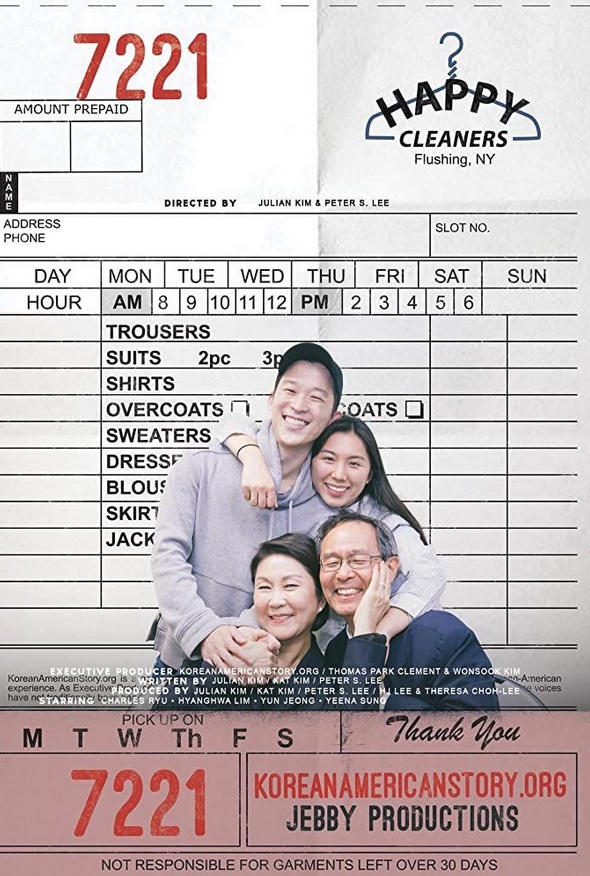
Happy Cleaners (2021)

“Have you ever wondered if our family is blessed or cursed?”
— Kevin Choi

Being a third or longer-generation child in the U.S. is sometimes hard enough: but be a child of immigrant parents steeped in the ways of the old country. My pop’s parents came here from Europe and his dad, my grandfather, never got on board with the “wild life” of Americans. The stories my father told me of him and his father’s battles over the “old” vs. “the new” were many and shaped the values I hold today. The most eye-opening aspect of Happy Cleaners: regardless of your family’s origin of birth, as much as we are different is how much we are the same; the same in our trials, tribulations, and values.

And I am reminded that a skin cell is just that: a cell filled with melanin.

One day, as a young man, as I conducted business at — ironically enough — a dry cleaner as I picked up my suits and pressed shirts, I noticed a person come to stand next to me at the counter. His hands, which met at the wrist with a long-sleeve business shirt, were albino-to-translucent (not white). When I lifted my head to greet the man, he was an African-American. At the time, I was aware of the skin condition know as vitiligo, as result of Michael Jackson’s affliction, but never experienced it close and personal: it was an eye-opening experience for me. At that moment, I realized that we are all the same, inside and out: the only difference between us is the pigmentation in our skin cells (we are all translucent-equal at our base). After that, the loves and joy, the trials and tribulations, the disappoints and triumphs we experience are all the same. We walk the same road, together, and our goals are all the same: for the Earth really is a single, perfect sphere.

So goes the plight of Korean-American Kevin Choi. His mother and father (the fantastic Hyang-hwa Lim Charles Ryu) struggle to instill traditional homeland values in their American-born children Kevin and Hyunny (the equally stellar Yun Jeong and Yeena Sung) tempted-influenced by all that western culture has to offer. Their parents operate a struggling dry cleaning business in Flushing, Queens, with the hope their strict values and hard work will inspire their children: they instead succeed in pushing their children away. And with that, the children struggle with the dichotomy of their lives: Why did their parents make the personal sacrifices to give their children a better life in America, only to caution and forbid their children the ways of American life. Does family loyalty go to the point where the children must carry on a family business — along with their family’s debts. Does one give up their dreams (in Kevin’s case, moving to Los Angeles) for family?

Happy Cleaners is the dual feature film writing and directing debut by New York City born-and-bred Korean-American animator and documentary-reality television editor Julian Kim and Peter S. Lee; the filmmaking duo previously worked on — along with actor Yun Jeong (here, as Kevin, in his leading man debut) — on the dramatic short, Call Taxi (2016). Well-received on the festival circuit, winning an “Audience Award for Best Narrative” at the 2019 CAAMFest and “Emerging Filmmaker Award” at the VC FilmFest at the Los Angeles Asian Pacific Film Festival, the film is now available across all domestic streaming platforms.

In a Hallmark and Lifetime drama-glut cableverse that’s nullified the family drama genre at the theatrical level, Happy Cleaners is a film that reminds us that poignant family dramas (Robert Redford’s 1980 directorial debut Ordinary People comes to mind) can still be brought to theater screens to inspire our intellects and stir our souls. In a current Hollywood obsessed with tentpole movies and explosive popcorn balls of the comic book (Wonder Woman 1984 is now out in theaters) and Micheal Bay variety (his latest Transformers flick is in pre-production), it’s nice to see filmmakers with a desire to bring family dramas to the screen. Hopefully, Hollywood will remember Kim and Lee come the 2021 award season.

You can enjoy this U.S.-shot, English-language film (with occasion English-Korean subtitles) courtesy of Korean American Story.org via all the usual online streaming platforms. The mission of the non-profit organization is to capture, create, preserve and share the stories of the Korean American experience by supporting and promoting storytelling in all forms that explore and reflect the ever evolving Korean American story. KAS seeks to be an inclusive hub that bridges gaps between communities and desires to instill cultural awareness and pride among the Korean American community.

And with films like Happy Cleaners, they’ve succeed. And we look forward to their next production.

About the Author: You can learn more about the writings of R.D Francis on Facebook. He also writes for B&S About Movies and publishes short stories and music reviews on Medium.
Sex, Drugs & Bicycles (2021)

This is a film that takes a look at Holland — its director Jonathan Blank also made 1994’s Sex, Drugs & Democracy — to ask a very important question: Is having month-long double paid vacations, no fear of homelessness and universal healthcare the nightmare we’ve been warned about?

The country may be best known for its windmills and tulips — and let’s face it, the red light districts and legal marijuana — but the it also leads the world when it comes to free speech, animal rights, LGBTQI equality and, perhaps surprisingly, the economy and life indexes.

As America struggles to understand universal health care, this film shows how this country has figured out how to cover everyone while even paying for transgender medical procedures and sex care for the disabled.

It doesn’t shy away from the problems that this country has endured, but this is a really eye opening look at how other countries have solved issues that we face every day. One way that they do so is by highly taxing those in the highest brackets, while not allowing the CEOs of companies to pay themselves more than their prime minister. Yet they lead the world in studies of the best places to own a business and overall gross domestic product.

No place is perfect and Hollan has a history of slavery and holidays that still have no real issue with blackface — but there are some systems worth studying. This would be a good start for anyone looking to learn more. I certainly discovered so much in my watch, which moved quickly thanks to the director’s flair for storytelling and mixing in animation along with live action interviews.

Sex, Drugs & Bicycles will air as part of PBS’ Link Voices series on February 26th. You can learn more on the official site.

Donna: Stronger Than Pretty (2021)

Across three decades, Donna (Kate Amundsen) is trying to live up to the traditions and expectations of her Italian family while striving for the American Dream.

Directed by Jaret Martino, who co-wrote along with DonnaMarie Martino and Pat Branch, this is the story of a woman escaping domestic violence and discovering the inner strength to start her life over again.

Yes, DonnaMarie is Jaret’s mother and this is her story. Co-writer Branch said, “My first words to Donna were, “I’m not here to judge your choices. I just want to tell your story as authentically as I can.” She allowed me into the deepest, darkest, most intimate corners of her psyche and I tried to exploit that privilege without sensationalizing it.”

This is not always an easy watch, but a sober reminder of what life is like for so many women. It took a lot of bravery — and no small amount of talent — to bring it to the screen.

Donna: Stronger Than Pretty premieres on all major streaming platforms February 23 from Gravitas Ventures. You can learn more at the official site.

Black Beach (2021)

Author’s Note: Due to the somewhat controversial subject matter of this film — political intrigue in a West Africa country by white businessmen — please note this is a film review that addresses the creative art of filmmaking only. This review is not a political dissertation in support of or in contradiction of any sociopolitical belief system and is not intended to incense any reader regarding race, social or free speech/opinion issues. This review was written to expose a film that attempts to help the viewer reach an understanding regarding the universal ills of corruption in our world.

“Mama never thought you were a bad person. She just thought you brought bad luck.”
— Ada to Carlos

Carlos and Susan (real life acting couple Raúl Arévalo and Melina Matthews) reside in Brussels, Belgium, where Carlos is an expectant father — his wife is eight months pregnant — and a corporate lawyer for the Euro-division of a U.S. oil company. His mother, Elena, works as a diplomat at the United Nations (when we first meet the couple, Carlos’s mother is the guest of honor at — an exquisitely-shot — U.N. award dinner). Both live with the hopes that their current, upper-class life of luxury will only grow as Carlos vies for a full-associates position with the corporation and relocate his soon-to-be-expanded family to New York City.

Of course, the catch, i.e, blackmail, to securing the promotion is for Carlos to travel to a remote, West African island country off the coast of the Republic of Ghana. His “mission” is to negotiate the release of Steve Campbell, an American oil engineer, who’s been kidnapped by a rebel insurgent, Calixto Batete (Madrid, Spain-born and New York-trained Jimmy Castro) — who’s a former friend of Carlos.

Forced into using an old friend against the island nation’s democratically-corrupt government? To save a deal for drilling rights on a newly discovered, large oil deposit? Yeah, this isn’t going to go all to film noir hell-in-a-hand-basket.

To earn the release of Campbell, Carlos enlists another old friend and colleague, Alejandra, and her girlfriend Eva. Through them he discovers that Calixto married Carlos’s ex-girlfriend, Ada, and their son, Cal Jr., is the thought-to-be-aborted son of Carlos. Amidst Carlos’s skeletons falling out of the closet, he comes to discover the kidnapping plot is a scam designed to retrieve damning documents regarding the oil company’s clandestine operations with the county’s corrupt president, who’s aligned with the terrorist organization MIA, which lead to a genocide of the island’s citizens, the Zandes.

Complicating matters is that he must travel to Black Beach, where the rebels are holding the kidnapped Ada. (The film’s title is a reference to the volcanic-deposited black sand beaches along the African coast; however, here, it is a reference to the prison where Ada is being held; think U.S. unacknowledged “black site/black operation.”) And once Carlos discovers the critical documents (at about the one hour fifteen minute mark), the film goes dark, as Carlos is on the run across Zandes’ lands and the government’s armies callously mow down citizens with a machine-gunned equipped helicopter; the Zandees fight back with machetes and rocket launchers — and it’s bloody and gruesome.

Black Beach is a world where everyone is corrupt: the oil company, the African government, and the United Nations . . . and everyone’s souls. And you feel the poverty and fears faced by the West African peoples.

As with any James M. Cain or Dashiell Hammett tale of yore, all of the noir (yes, intricate) plot corkscrew markers of blackmail, greed, moral corruption, love, lust, and violence are in check. And the exotic, unfamiliar West African locations raise the proceedings above the noir ante norms. I was almost worried we were going to be racing around the streets of Brussels (been there, done that) or New York (not again). So it was nice that the narrative shifted to West Africa for a nice, visual (and very well-shot) change of pace.

These qualities, however, are overlooked as result of many critics-in-the-negative perturbed over the “white savior” aspect of the narrative (?), and reading-in a now de rigueur “white privilege” sub-plot argument where none is needed nor the point of the film; it’s just a retro-film noir piece. Another issue reviewers have is that a black child comes into the care of a white-Hispanic family. Perhaps if a better-known star, like Liam Neeson (Raúl Arévalo reminds me of Sean Penn, but no one is casting Sean in films anytime soon), would make things more palpable, as the familiar allows for an easier digestion of a film.

Others, if not put off by the race-bend of the material, find the plot “confusing” and “long.” Well, again . . . Black Beach, while more-akin to Neeson’s aging-action star films — only with less blow-up, bullet-holed action — is actually a more-twisty noir. But I don’t blame those detractors, I get it. I know, from my own fandom experiences of attempting to expose friends to the film noir genre (I’ve had them tell me, flat out, Double Indemnity, “sucks,” for example), a twist of Cain sours most cups of green tea. (Yes, and I’ve had friends squish their faces when they see me drink green tea . . . “Eww, it’s so bitter, etc.” And so it goes.)

The only downside (for moi) is the film’s length pushing just 10-minutes short of the two-hour mark — thus this film is a takes-it-time slow burn (as a good noir should; if you want quick and easy, watch a U.S. soap opera or cop procedural drama). But Black Beach is, while a Spanish-Belgium made film, no different than any U.S. major studio film that deals in political intrigue. Streaming commenters have taken the film’s subtitles on the Spanish/Euro prints and English dub on the U.S. prints to task as being “out-of-sync,” which made the film a wee difficult to follow. I watched the subtitled version — and skimmed the English dub — and I found no issues in those areas: I followed the film quite clearly.

However, those qualms in no way detract from the quality brought to the screen by Estaban Crespo and his cast of actors (I really like Jimmy Castro in this; his Calixto honestly communicates a loyalty to his country and people). Its multiple award nods in cinematography, editing, and sound are well-warranted. And the acting’s fine, too.

After writing and directing seven shorts, Crespo made his feature film debut with the romantic drama Amar (2017), based on his 2005 short of the same name. Black Beach is his first, widest-exposure and internationally-distributed feature, which shot in Madrid, Spain, Gran Canaria, Canary Islands, Spain (The Clash of the Titans and Jesús Franco’s Mansion of the Living Dead were shot there), Brussels, Belgium, and the West African Republic of Ghana.

Disclaimer: We did not receive a screener or review request. We discovered the trailer and streamed it from Netflix on our own. That has no bearing on our review. And we truly enjoyed the movie, film noir detractors, be damned.

About the Author: You can learn more about the writings of R.D Francis on Facebook. He also writes for B&S About Movies and publishes short stories and music reviews on Medium.
The Astrology of Pandemics (2021)

I love getting movies to review, because so many of them are films I’d never watch on my own. Case in point, this movie, which describes why the COVID-19 pandemic occurred based on astrological charts.

Even if you don’t know a thing about astrology — I don’t — you’ll learn a fair amount in this about how past pandemics follow the same paths of the planets as our experiences over the last year. In short — pandemics happen when Pluto interacts with eclipses, Saturn and Jupiter. Oh Pluto, are you made that you’re no longer a planet?

This is just as much a talking slide show as it is a documentary, but I have to confess that I found it all really interesting.

You can learn more at the official site of the film’s writer and director, Nicholas Snyder.

You can watch this on Amazon Prime.