Tales from the Crypt S6 E15: You, Murderer (1995)

Directed by Robert Zemeckis and written A L Katz and Gilbert Adler, this episode is about criminal Lou Spinelli (Robert Sacchi) has gotten plastic surgery from Dr. Oscar Charles (John Lithgow) to look like Humphrey Bogart and has gone legitimate. He’s fallen in love with his assistant Erica (Sherilyn Fenn), but when his ex-wife Betty (Isabella Rossellini) comes back, things get bad all over again.

“Hello. How are you? I’m Fearest Gump. Hi. Care for a shock-olate? You sure? Mummy always said: “Life is like a box of shock-olates. You never know what you’re gonna get. Sometimes you get a fudge-scream, sometimes you get no-guts.” Know what else mummy said? She said: “Scary is as scary does.” Which brings to mind the man in tonight’s terror tale. He’s just dying to get out of the mess he’s in… literally! It’s a little piece of horrid candy I call: “You, Murderer.””

This episode has early CGI to add Bogart’s face.

There are a lot of twists and turns here and Zemeckis comes back from producing to direct an episode as season 6 comes to an end. There are so many twists and turns with Lou comatose and perhaps dead for so much of it.

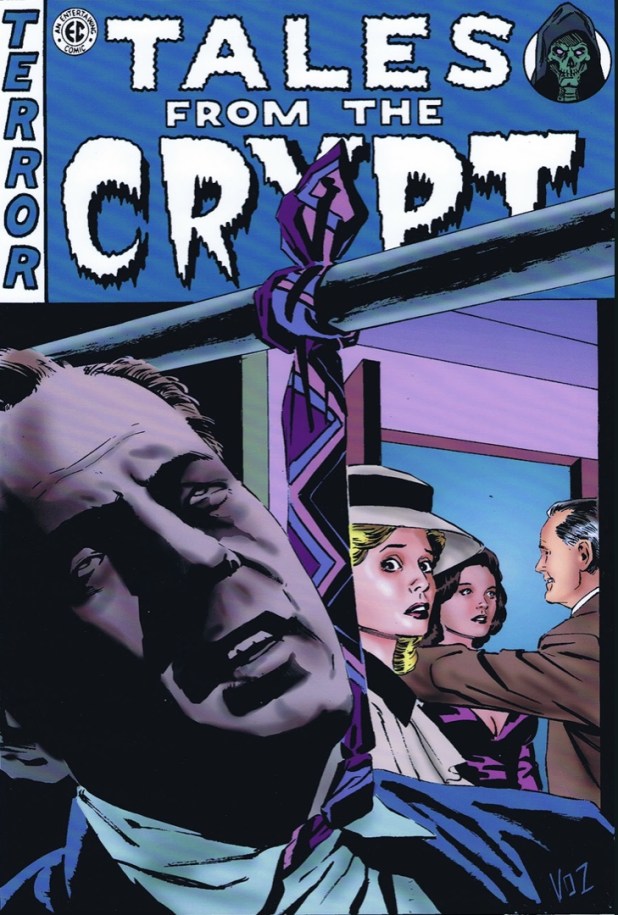
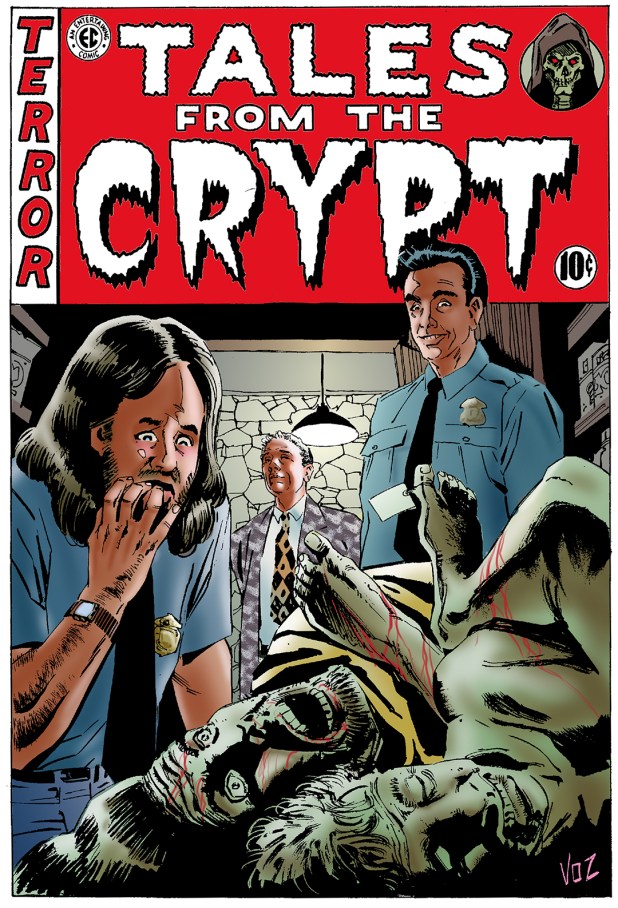
This story comes from Shock SuspenStories #14. It was written by Otto Binder with and drawn by Bernie Krigstein.

Tales from the Crypt S6 E14: 99 and 44/100 Percent Pure Horror (1995)

Luden Sandelton (Bruce Davison) makes soap for a living as the CEO of Dermasmooth. When the new campaign — created by his wife Willa (Cristi Conaway), who has also been cheating on him — fails, he has to fire her. That doesn’t go over well. Yet even after he’s killed, Luden has a way of coming back up the drain, so to speak.

“Greetings hack and field fans! I hope you’re in the mood for a little fiendly competition. It’s that time of fear again. The annual All Crypt Die Cathalon! I’ve been working out like crazy to get ready. This year I’m really going for the cold. Kind of like the woman in tonight’s tale. It’s a putrid portrait of an up-and-coming young artist that’s sure to leave a nasty taste on your palette. I call it “99 & 44/100% Pure Horror.””

The title for this one comes from the old Ivory Soap advertising slogan that their soap is 99 and 44/100 percent pure. In the 70s, Marilyn Chambers — before acting in Beyond the Green Door — was a model on a box of this soap, which was quite ironic once she became famous.

This was directed and written by Rodman Flenderm, who also made The UnbornLeprechaun 2 and Idle Hands. He also directed “Food for Thought” in season 5.

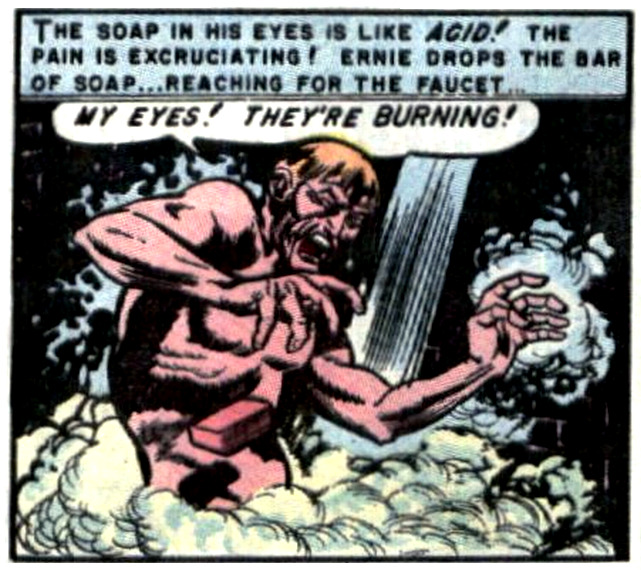
This episode is based on “99 44/100% Pure Horror!” from Vault of Horror #23. It was written by Al Feldstein and William Gaines and drawn by Jack Davis. In that story, a man kills his boss and takes over his job. He hides the body in the soap itself, which ends up causing his demise.

ARROW VIDEO 4K UHD RELEASE: The Addiction (1995)

Directed by Abel Ferrara and written by Nicholas St. John, who worked on nine movies with Ferrara, this black-and-white film has Kathleen Conklin (Lili Taylor) get bitten by Casanova (Annabella Sciorra) and become a vampire, an addict, or both.

Ferrara made this as a metaphor for drug addiction as he had been on heroin for years and has Kathleen, after hitting bottom at an orgy of death and blood drinking, accepting that she is powerless and needs God as she’s reborn and visits her own grave.

Taylor is incredible and the visuals are so bleak. As always, New York City feels like the end of the world in a Ferrara movie. It also has Christopher Walken, Edie Falco, Jamel Simmonz from the Flatlinerz, Fredro Starr from Onyx and Michael Imperioli in the cast. While some may see it as an arty film filled with pretense, I’d remind them that Ferrera comes from the grindhouse and knows how to use horror to tell a story about something real.

The Arrow Video 4K UHD release of The Addiction has a brand new 4K restoration from the original camera negative by Arrow Films. There are also extras that include a commentary by director Abel Ferrara, moderated by critic and biographer Brad Stevens; Talking with the Vampires, a 2018 documentary about the film featuring actors Christopher Walken and Lili Taylor, composer Joe Delia, cinematographer Ken Kelsch and Ferrara himself; interviews with Ferrara and Stevens; a feature on the editing; a trailer; an image gallery; a reversible sleeve featuring original and newly commissioned artwork by Peter Strain and an illustrated collector’s booklet featuring writing on the film by critic Michael Ewins and an interview with Ferrara by Paul Duane.

You can buy it from MVD on 4K UHD or Blu-ray.

Tales from the Crypt S6 E13: Comes the Dawn (1995)

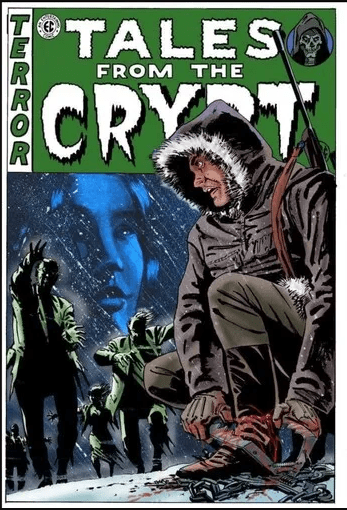
Colonel Parker (Michael Ironside) and Sergeant Burrows (Bruce Payne) are two veterans who have come to the Alaskan wilderness to hunt, guided by Jeri Drumbeater (Vivian Wu). But these two have a dark past and some evil reasons for being on the hunt.

“Ah. Oh, hello, creeps! It’s your old pal, the big scare-huna, enjoying a little surf and sand. Hey, babe, want me to rub a little sun tan lotion on you? Mm. Boy, do I love the beach. Hey, hey, hey, hey! Hey, you, watch it! Boy, I hate getting sand kicked in my face. I’m not your average 98-pound weakling, you know. For one thing, I don’t weigh that much. I tell you kiddies, I’m going to get that guy! Which brings to mind the two men in tonight’s terror tale. They’re on a little shriek and destroy mission of their own, in a nasty undertaking I call “Comes the Dawn.””

What Jeri doesn’t know is that they’ve already killed her ex-girlfriend, Mona (Susan Tyrrell), who tried to turn them in to the police for being poachers. But what they don’t know is that Jeri is a zombie, killed in Desert Storm by an artillery strike called in by Parker. She’s been waiting for him for years, living among the vampires that make Alaska their home.

This episode was directed by John Herzfeld, who directed and wrote 2 Days In the Valley. It was written by Scott Nimerfro, who also wrote ten other episodes.

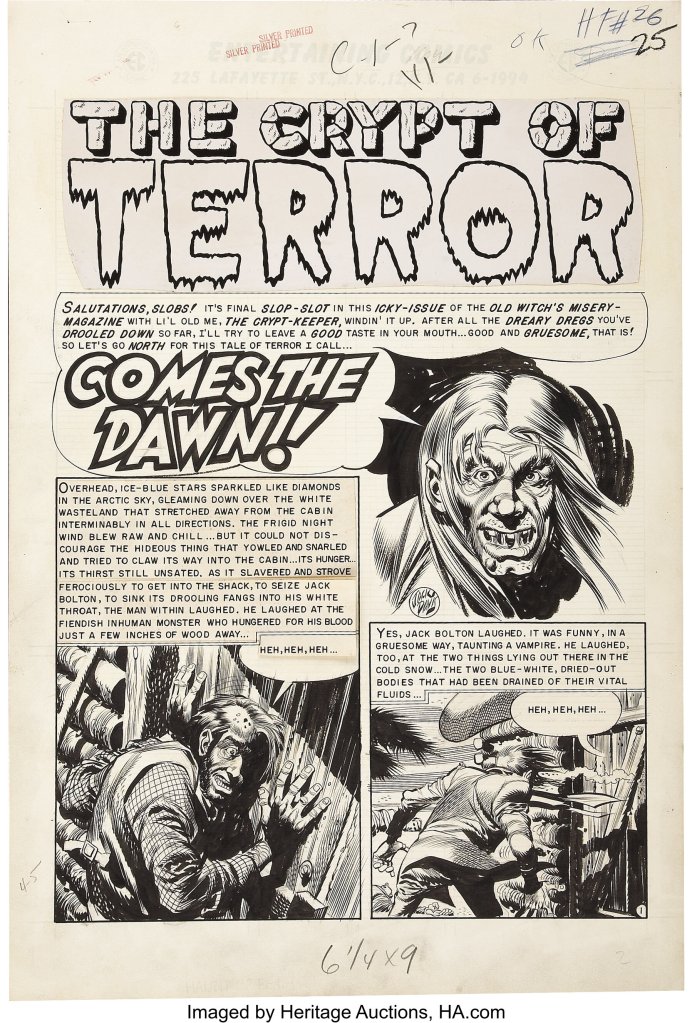
It’s based on “Comes the Dawn!” from Haunt of Fear #26, which Otto Binder wrote and Jack Davis drew. The synopsis is close: “A man barricades himself in an Arctic cabin to hide from the vampire outside…but there’s no daylight.”

Tales from the Crypt S6 E12: Doctor of Horror (1995)

Directed and written by Larry Wilson (BeetlejuiceThe Little Vampire), this episode has Charlie (Travis Tritt) and Richard (Hank Azaria) working the night shift as security guards who get mixed up with the body stealing Dr. Orloff (Austin Pendleton). The lesson in this episode is to never murder a friend for a mad scientist.

“Yeah, kids these days with their long hair. You can’t even tell the boils from the ghouls. And when they do want a cut, they go to one of those fancy salons like Jose Slay-ber or Videad Sassoon. It’s enough to make you terror your hair out. Hmm. I guess that towel was a little too hot. Still, I think it’s a good look for you. Once it’s groan out, I’m sure you’ll love it. Which brings to mind the young men in tonight’s terror tale. They’re about to try a new scare style as well, in a delightful little die-job I call “Doctor of Horror.””

Ben Stein shows up as the bad boss and while this doesn’t have much of a story, it does have some gore. Sometimes, that’s enough.

This was based on “Doctor of Horror” from Vault of Horror #13. It was written by Al Feldstein and William Gaines and drawn by Graham Engels. It’s a different story, as Professor LeMonet digging up corpses to get more students into his class. By the end, though, he’s gotten greedy and starts paying criminals to murder people instead of waiting for bodies to expire.

Mr. Stitch (1995)

Subject 3 (Wil Wheaton) has been made by Dr. Rue Wakeman (Rutger Hauer) from the bodies of several people as part of some wild experiment. He’s given a Bible to read and names himself Lazarus, has dreams of his past bodies that he tries to explain to Dr. Elizabeth English (Nia Peeples) and wonders why he has so many of the thoughts of Dr. Frederick Texarian (Ron Perlman).

Directed and written by Roger Avary, this was a SyFy pilot that became a TV movie for the channel. It wasn’t without issues, as Hauer threw away the script and refused to do any scenes from it, improvising all of his dialogue. This meant that Avary had to rewrite his movie to match whatever Hauer did. Avary told Entertainment Weekly, “Mr. Stitch was a nightmare to make. Nobody ever knew the movie Rutger was making. I collaborated with him as much as any human should allow himself to.”

What ended up in the movie is pretty good, thanks to Tom Savini effects, Ron Jeremy as a cop (it was the 90s) and Taylor Negron making me miss how he could take any film and make it better.

You can watch this on YouTube.

Private Obsession (1995)

In Italy, when erotic thrillers became big sellers on cable and video, old masters came back, like Martino and Mattei, to make Giallo movies that were softcore or adult thrillers or whatever title people wanted to sell them as. And in America, I wondered, why didn’t the names of the past come back? Brad Sykes recommended this one to me. As the credits started, Lee Frost’s name came up, and I instantly jumped from my chair and fell to the ground like an old person who needed a Life Alert. Rolling around and yelling as I struggled to get up from the weight of my office chair, I started laughing like a lunatic.

Fuck yes, Lee Frost!

Like the Italian masters — lunatics — I worship, Lee Frost used a ton of names, like David Kayne, R.L. Frost, F.C. Perl, Elov Peterson, Les Emerson, Carl Borch, Leoni Valenti, no, and so many more. He started with sexploitation like Surftide 77 and the baffling in a good way The House on Bare Mountain before going deep into roughies like The DefilersThe Pick-Up and The Animal, as well as American mondos like Mondo Bizarro, Mondo Freudo and The Forbidden.

Just like Italian exploitation fiends who jumped from trend to trend depending on what was hot, Frost made Westerns (Hot SpurThe Scavengers), biker films (Chrome and Hot Leather), occult movies (Witchcraft ’70), horror (The Thing with Two Heads), hicksploitation (Dixie Dynamite), Naziploitation (Love Camp 7), blacksploitation (The Black Gestapo) and porn. Yeah, you knew that was coming. But Frost made A Climax of Blue Power, the kind of adult movie that looked at porno chic and said, “What if we made something that upsets everyone that sees it?”

Somewhere in here, Frost had the time to write Race With the Devil.

How can we make this better for me? What if it were an Emanuelle — well, Emanuelle Griffith — movie? And what if Shannon Whirry played the role?

She’s a supermodel, yes, just like so many of the many Emanuelles that we have come to love. She’s also a female empowerment person who gives TED talks to other women about how men have to give up their control of the world, saying, “Good morning, ladies, and welcome to a man’s world!”

This enrages Richard Tate (Michael Christian, oh wow, Eddie from Poor Pretty Eddie), who kidnaps her and forces her to be debased. Detective Sam Weston (Bo Svenson) is looking for her, as is Sergeant Jim Lytel (Tony Burton, Apollo Creed’s trainer). Along the way, Rip Taylor plays a travel agent, Francine York is the leader of the feminist club that has Emanuelle speak, Whirry has to cover herself in butter to get through a dog door naked and then decides to drink water out of a toilet. It’s like Lee Frost hadn’t made a movie in more than a decade, because that’s true, and he decided to get it all out of his system because this was the last movie he’d make.

Yes, a captive Whirry, forced to eat fancy meal while watching a stalker on a monitor, long monologues from both leads and the kind of quality that lands a movie on a video store shelf with masking tape and a magic marker warning you that you have to be 18. And even if you are, you should watch this in the shower to save time because of how many times you’ll need a shower.

What would make it the absolute number one and the best? What if Lee Frost has a cameo? There’s also a song called “Feminazi March,” written by Frost, which combines sexploitation and Nazis, two things he definitely got boners over.

I don’t know who this movie is for other than me, but for all my complaints that erotic thrillers aren’t out on DVD, MVD has you covered. You can get this from them, along with the Julie Strain movie Midnight Confessions.

Jade (1995)

Jade brings together the Dracula and Frankenstein of sleaze, as Robert Evans produces and Joe Eszterhas writes with William Friedkin there to direct — and change the script so many times that Eszterhas needed a $4 million payoff from Paramount to keep his name on the movie. Friedkin later claimed he let everyone down on this movie, including his wife, producer Sherry Lansing. As for what the actors thought, Michael Biehn noted, “I didn’t realize until the read-through that I was the bad guy in it.”

It’s also one of the last roles that Linda Fiorentino would take on, finally ending her on-screen career in 2009, a star with such promise after The Last Seduction. Was it that she was hard to work with? Did Kevin Smith sabotage her career after Dogma was challenging to make? And did people think she was Bridget, her The Last Seduction character?

When asked by Roger Ebert why she always played terrible girls, she replied, “I have this terminal condition called bitchiness, right?” She continued, “Maybe others see what I don’t necessarily see in myself. And a lot of it in Hollywood concerns what you look like. I’m dark, my eyes are dark, and my voice is deep, and how the hell could I play a Meg Ryan role, the way I look.” But then again, she also dated Hollywood fixer and private investigator Anthony Pellicano and FBI agent Mark Rossini, which was rumored to be her using favors to aid in the defense of her actual boyfriend, Pellicano. Was life imitating art imitating life? Rossini used government computers to get case info for Pellicano’s lawyers, which meant he eventually pleaded guilty to illegally accessing FBI computers and was quit/fired from the Bureau. But hey, Linda Fiorentino.

Back to that Ebert interview. It’s intriguing how she pushed for more from this movie: When we were doing Jade, the way Joe Eszterhas wrote the sex scenes was so dated and boring, and I just thought, I can’t do this. And there was a lot of nudity, and I thought, we’ve gotta come up with something a little more interesting to keep me going here. So I did a little random research, you know, and I asked a couple of women I had known who had affairs with men who were very powerful – and invariably those men in powerful positions wanted to be dominated by the woman at the end of the day. They wanted to be the submissive party in the sex act, and it correlated with the level of power. Maybe men with no power want to dominate their women. I just thought, well, this is interesting. And it’s the same for women: Women want to be the dominant party because that’s their fantasy, and the male fantasy is to be the submissive party. And so we got into that in Jade.”

As for her male counterpart in this movie, David Caruso left NYPD Blue after the show’s second season because he wanted a film career. Critics and the media were ready to attack him for that hubris, especially after his first post-TV film, Kiss of Death, also bombed.

And when it comes to Eszterhas, after making $3 million for Basic Instinct, he was due for a fall, which was either going to be this movie, SliverShowgirls or all three. He got $1.5 million for this (and $4 million for his next film One Night Stand).

Friedkin was also struggling, as his last two movies were the three demoness movies The Guardian and Blue Chips. In his book The Friedkin Connection, he said that this movie had “a terrific cast—a wonderful script. Great locations. How could it miss?”

Caruso is Assistant District Attorney David Corelli, who visits the murder scene of Kyle Medford, a wealthy businessman who set up several rich and powerful men like Governor Lew Edwards (Richard Crenna) with gorgeous women, including Patrice Jacinto (Angie Everhart). Corelli is told by Edwards and his henchman Bill Barret (Holt McCallany, who most people know from being on Mindhunter, but come on, he got laid and paid as Sam Whitemoon in Creepshow 2) never to let this info out, seeing as how his brakes are soon cut, that’s to be considered a warning.

The seductress who gets the most requests goes by the name of Jade. Seeing as how Anna Katrina Maxwell-Gavin’s (Fiorentino) prints show up on the ancient hatchet — yes, that kind of murder weapon points to this being a Giallo — that killed Medford, it seems like perhaps she could be Jade. She once dated Corelli before marrying his fellow DA, Matt Gavin (Chazz Palminteri). Medford’s safe is filled with sex toys, drugs, videotapes and, oh yeah, bags filled with pubes. But back to those videotapes. Anna Katrina is one of them.

It also seems like she may have killed Patrice, but her husband cuts the interrogation short. Why would she be on those tapes? Well, didn’t he have his affairs? Of course, the governor sends his men, which also includes bad cops Bob Hargrove (Michael Biehn) and Pat Callendar (David Hunt), to kill Allison, who gets saved by Corelli — who was nearly seduced by her — and Gavin — who wanted to kill Corelli for perhaps sleeping with his wife. But all along, it had been Gavin who killed Medford to keep the secrets he and his wife keep, telling her to introduce him to Jade the next time they make love.

Biehn would say of the film. “It was like a jumbled mess. And the movie came out a mess, too. It had great people on it, though. So a great cast, great director… everything but a script.”

Then again, how many giallo makes no sense at all?

But this has an incredible car chase, murder set pieces straight out of Italy, lush production values, a gorgeous heroine/antagonist/who knows in Fiorentino, and they threw a lot of money at this movie to make something that Sergio Martino did for about a tenth of the cost. Plus, there is a moment where Angie Everhardt gets run over by a car not once but twice. Plus, a scene of a naked Palminteri crawling around and begging for Jade to re-enact the movie poster on their bed. 

In his book Hollywood Animal, Eszterhas said, “In the week after he was found not guilty and got out of jail, O.J. Simpson went to see two movies. Showgirls and Jade.”

That says something, right?

Several other cuts of this movie exist, including a European cut with more explicit sex scenes—yes, it’s possible—and a director’s cut with a different ending, 12 minutes more story and, yes, lots more carnal moments.

I will never forget this movie for another, as Cal tells Andy when he talks to women to be like David Caruso in Jade. Always keep asking questions. Be calm and kind of be a dick.

Sources

Fiorentino Finds Good Ways to Be Bad | Interviews | Roger Ebert. https://www.rogerebert.com/interviews/fiorentino-finds-good-ways-to-be-bad

Michael Biehn on The Victim, William Friedkin, and his favorite antagonist role. https://www.avclub.com/michael-biehn-on-the-victim-william-friedkin-and-his-1798233922

ARROW 4K UHD AND BLU RAY RELEASE: The Mexico Trilogy: El Mariachi, Desperado & Once Upon A Time In Mexico (1992, 1995, 2003)

Robert Rodriguez’s 1993 debut El Mariachi was filmed for only $7,000 and has a naive young musician being caught in a deadly case of mistaken identity. It made the director’s career and allowed him to expand the universe in two sequels, which are featured on this Arrow Video box set.

El Mariachi (1992): Made for $7,225,  the original goal for this movie was a Mexico home video release. Columbia Pictures liked the film and bought the American distribution rights, putting $200,000 into the budget to transfer the print to film, remix the sound, and market the film.

El Mariachi (Carlos Gallardo) has come to a border town to be a performer like his father. His guitar case holds, well, a guitar. The problem is that it gets confused with the guitar case full of gun carried by Azul (Reinol Martínez), who is coming to kill a drug lord named Moco (Peter Marquardt).

The guitar player has fallen for the gorgeous Dominó (Consuelo Gómez), a bartender and lover of Moco, who herself is in love with Azul. The multiple twists and identity issues will bring all of them together, ending in blood and bullets.

El Mariachi has been deemed “culturally, historically, or aesthetically significant” by the United States Library of Congress and selected for preservation in the National Film Registry, who said that it “helped usher in the independent movie boom of the early 1990s.” I love how they describe the way that Rodriguez was able to combine genres to create his movie, saying that it merged “the narcotraficante film, a Mexican police genre, and the transnational warrior-action film, itself rooted in Hollywood Westerns.”

It was only the start of the creator’s career.

Desperado (1995): Steve Buscemi tells the story of El Mariachi in a bar, about how a musician with a guitar case filled with guns was out for revenge before waking up the person he’s been telling everyone about. He has a target for revenge, Bucho (Joaquim de Almeida), who he blames for killing his lover.

Helped by a bookstore owner named Carolina (Salma Hayek), but is nearly killed by Navajas (Danny Trejos), a hitman sent by the Columbians who is soon accidentally killed by Bucho’s men. El Mariachi, in love with Carolina and wanting to protect her, calls in his friends Campa (original El Mariachi Carlos Gallardo) and Quino (Albert Michel Jr.), who kill most of Bucho’s henchmen before discovering that the drug dealer and El Mariachi are brothers.

He gives the dark hero a choice: he can live, if he allows the bad guy to kill his lover. Of course that’s not going to happen.

With small roles for Quentin Tarantino and Cheech Marin, this movie had critic Janet Maslin writing, “Overdependence on violence also marginalizes Desperado as a gun-slinging novelty item, instead of the broader effort toward which this talented young director might have aspired.” A lot of people were upset about the violence and thought it was keeping Rodriguez from being the success that he could be.

As for fans of action movies, they had found the perfect union of modern movies and Italian Western sensibilities in Rodriguez. He still did it on a budget — a thousand times what he spent the first time, but less than Hollywood usually spends — which led Banderas to say, “It was crazy. We did a movie with practically no money. We did a movie with $3 million. For an action movie, that’s practically nothing. There was a guy in the movie, a stunt guy, that I kill, like, nine times. I killed the guy with beard, without a beard, with a mustache, with blond hair, with glasses, without glasses. I mean, I think the guy who made the most money in the movie, was the stunt guy.”

Once Upon a Time In Mexico (2003): A lot has happened since the last movie. El Mariachi (Antonio Banderas) and his wife Carolina (Salma Hayek) had a battle against General Emiliano Marquez (Gerardo Vigil) that ended up with him eventually killing her and their daughter. Now, Marquez is working for drug boss Armando Barillo (Willem Dafoe) to kill the President of Mexico.

CIA officer Sheldon Jeffrey Sands (Johnny Depp) gets El Mariachi and FBI agent Jorge Ramirez (Rubén Blades), whose partner Archuleta was killed by Barillo, along with AFN operative Ajedrez (Eva Mendez) to stop the drug kingpin.

There’s also a plan to use Billy Chambers’ (Mickey Rourke) chihuahua to record Barillo, Danny Trejo as another henchman in a Rodriguez movie, El Mariachi’s friends Lorenzo (Enrique Iglesias) and Fideo (Marco Leonardi) coming to help, Sands having his eyes drilled out but still being a killing machine and Rodriguez making his version of The Good, The Bad and The Ugly, which upset some as El Mariachi becomes a minor character in a movie most figured would make him the star.

Roger Ebert understood, as he said, “Like Leone’s movie, the Rodriguez epic is more interested in the moment, in great shots, in surprises and ironic reversals and closeups of sweaty faces, than in a coherent story.”

It’s a big mess, but I mean that in the greatest of ways. It’s also the first of many movies that Rodriguez shot digitally, which allowed him to do things on budget despite the challenges of trying to get so many FX shots and even not having real guns for the first two weeks of shooting.

The Arrow Video set includes high definition blu ray presentations of all three films and a 4K UHD version of Desperado. It has an illustrated collector’s booklet featuring new writing by Carlos Aguilar and Nicholas Clement, reversible sleeves featuring original and newly commissioned artwork by Paul Shipper, double sided posters featuring original and newly commissioned artwork by Paul Shipper and a collectible poster featuring Robert Rodriguez’s original poster concept for El Mariachi.

El Mariachi has commentary and a new interview with Rodriguez; an interview with Carlos Gallardo; The Music of El Mariachi, a newly produced featurette on the music in the film, featuring interviews with composers Eric Guthrie, Chris Knudson, Alvaro Rodriguez and Marc Trujillo; Ten Minute Film School; Bedhead, a short from the director; the trailer and a TV commercials.

Desperado has commentary and a new interview with Rodriguez; Rodriguez; interviews with producer Bill Borden, stunt coordinator Steve Davison and special effects coordinator Bob Shelley; Game Changer, a newly filmed appreciation by filmmaker Gareth Evans (The Raid: Redemption); Ten More Minutes: Anatomy of a Shootout, an archive featurette narrated by Rodriguez; a textless opening and trailers.

Once Upon a Time In Mexico has commentary and a new interview with Rodriguez, an interview with visual effects editor Ethan Maniquis; deleted scenes; Ten Minute Flick School, Inside Troublemaker Studios, Ten Minute Cooking School, Film is Dead: An Evening with Robert Rodriguez, a presentation by the director given in 2003; features on the Mariachi’s arc and KNB FX and trailers.

You can get this from MVD.

RETURN OF KAIJU DAY: Godzilla vs. Destoroyah (1995)

I’ve put off watching this for years — 28 of them! — because I knew how it would impact me.

This is it. This is the end of Godzilla, as there’s no escape from death for any of us. The only question is whether it will come at the ends of the new and unstoppable kaiju Destroyah, which has come from the Oxygen Destroyer that has stopped Godzilla before, or from the fact that inside the creature’s heart, Godzilla has a nuclear reactor that is melting down.

The twenty-second film in the series and the seventh and final in the Heisei era, this is also the last movie for actress Momoko Kōchi, producer Tomoyuki Tanaka and composer Akira Ifukube.

So much of this is a callback to the first movie, starting with hearing the roar before the title.

Miki Saegusa (Megumi Odaka, who is in six of the Heisei era films) of the United Nations Godzilla Countermeasures Center (UNGCC) has been tracking Godzilla and Little Godzilla since SpaceGodzilla was destroyed. She finds out that a volcanically triggered uranium deposit has caused Godzilla to go into meltdown and when his temperature reaches 1,200 °C, he will explode and melt the Earth with him.

The UNGCC finds a college student named Kenkichi Yamane (Yasufumi Hayashi), the grandson of Dr. Kyohei Yamane, the inventor of the Oxygen Destroyer. They use the Super X III to cool Godzilla for as long as they can. At the same time, crustaceans mutated by the Oxygen Destroyer rise and start to kill people before joining into one kaiju form known as Destroyah.

Miki uses Little Godzilla to fight the monster in the hopes that Godzilla will save him and die a valiant death in battle before blowing up. Instead, the child-like Godzilla is killed by Destroyah’s Micro-Oxygen beam as the kaiju final boss enters its perfect form.

As the scientists try to stop Godzilla, it mutates into a meltdown form, looking as if its covered with lava. It tears Destroyah apart, who is stopped by the UNGCC from flying away. Then, the various weapons fire on Godzilla, who slowly melts away, leaving Tokyo irradiated for the rest of time. Or so we would believe, until it suddenly goes away and the smaller Godzilla is reborn as the new King of the Monsters, signifying a new era.

Ifukube, when composing this, said he wrote the final song “as if he were writing the theme to his own death.”

This would have been it for Godzilla, but Hollywood started making new movies and that’s how we got to where we are. Did this movie make me cry? Oh man, you know it. You can make fun of these dumb movies with their rubber suits, but if you grew up with Godzilla and had such a worship of him in your young years, seeing him as someone who could defend you when things were dark, then even in your old age, the close of this film is beyond emotional. You are watching a best friend die.