Junesploitation: Miami Supercops (1985)

June 7: Junesploitation’s topic of the day — as suggested by F This Movie— is Buddy Cops! We’re excited to tackle a different genre every day, so check back and see what’s next.

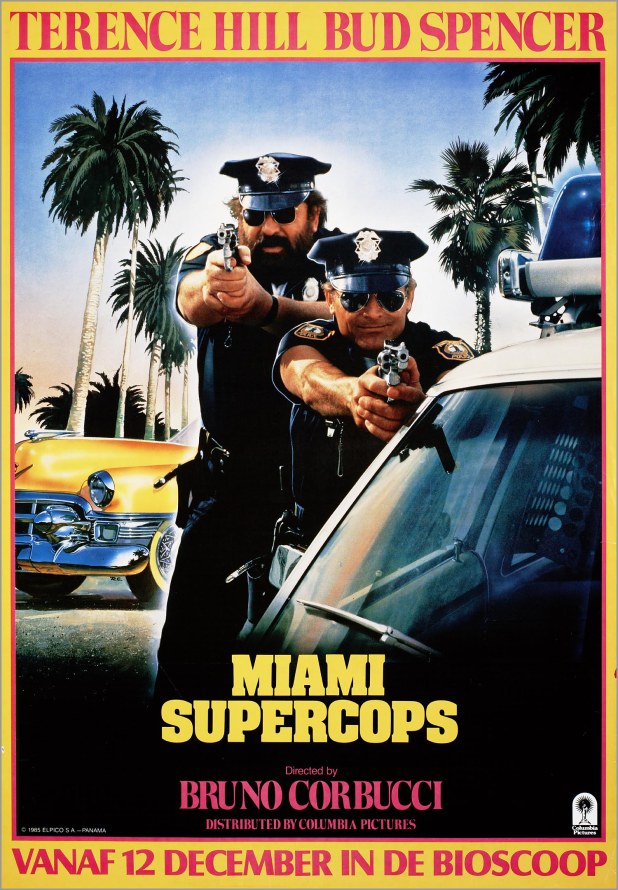
Seven years ago, after a daring bank robbery in Detroit, FBI agents Doug Bennett (Terence Hill) and Steve Forest (Bud Spencer) were only able to arrest one of the three criminals, Joe Garret (Richard Liberty, yes, Dr. Logan from Day of the Dead). They never found the other two thieves or the $20 million they stole. And as soon as Garret gets out of jail, he shows up in Miami and even sooner is dead. Doug has stayed an agent, but Steve is now a flight instructor. This is the chance to solve the one case that they never did, so they disguise themselves as police officers and go to Miami. Well, Doug wants to solve the case. Steve wants left alone, but Doug tells him their old boss Tanney (C.B. Seay) has been killed. It’s a lie just to get him to go.

Miami Supercops is the last non-Western that Hill and Spencer would be in together — 1994’s Troublemakers is their last movie — and it’s an attempt to stay current and be like Miami Vice while reminding their fans of 1977’s Crime Busters. But yeah — Miami Vice — and we all know how much Italians not only love to rip off pop culture but to go to Florida to make movies. This doesn’t have as much of the humor as their past films and way more guns than slaps. Oh yeah — this also has some Beverly Hills Cop in it and has the 80s synth that you want it to have as a soundtrack (Carmelo and Michelangelo La Bionda, who also did the Antonio Margheriti movie Virtual Weapon that teams up Hill with Marvin Hagler, Who Finds a Friend Finds a Treasure and Super Fuzz, are the composers).

Bruno Corbucci made the journey from writing two of the most violent Westerns ever — Django and The Great Silence to name two — for his brother Sergio and ended up making movies like this, Aladdin and multiple movies with Tomas Milan playing Inspector Nico Giraldi. He wrote this movie with Luciano Vincenzoni, who also was the writer for Raw DealOrcaA Quiet Place In the Country and The Good, The Bad and The Ugly.

I kind of like the character of Annabelle, a larger woman played by Rhonda Lunstedt, who was a pro bodybuilder and one of the touring American Gladiators. Her only other acting role is in an episode of Miami Vice — that came in good here, you know? — and in Sergio Martino’s wild Uppercut Man, a movie I keep trying to get people to watch. Italian-American character actor Buffy Dee is also in this. You may remember him as Barney the club owner in Mako, the Jaws of Death. He was also in Nightmare Beach, the Hill and Spencer movie Go For It and Lady Ice.

My goal is to watch all the Hill and Spencer movies, as they always fill me with joy. Also: There’s a new video game, Slaps and Beans 2, that is somehow available in the U.S. I feel like it’s been made only for me.

You can watch this on YouTube.

APRIL MOVIE THON 3: Poison Ivy (1985)

April 30: Teen Movie Hell — Mike McPadden’s other book. List here.

Airing on NBC on February 10, 1985, between when Michael J. Fox was a star on Family Ties and then a huge star after Back to the FuturePoison Ivy was directed by Larry Elikann (who did eighteen ABC Afterschool Specials) and written by Bennett Tramer, who wrote Without Warning and would go on after this to create Saved By the Bell.

If you enjoyed High School U.S.A., well, this will be something else you will probably get into, as Fox and his love interest, Nancy McKeon, were in both and were also NBC stars. Fox is Dennis Baxter, the Bill Murray of this and McKeon is Rhonda Malone, who is studying to be a psychologist. There’s also a Color War — yes, this movie is Meatballs — and it has Robert Klein as the owner of the camp, Cary Guffey from Close Encounters of the Third Kind as a kid that wants to escape camp, Adam Baldwin as one of the bad guys, Joe Wright from Silver Bullet as a camper who runs scams and flams,  Thomas Nowell (who was in Friday the 13th Part VI: Jason Lives) as a young writer with a crush on Rhonda and Matthew Shugailo as a chubby kid who uses humor to get through the summer’s hijinks.

Oh yeah — Fox and McKeon met on the set of High School U.S.A. and dated for three years.

You can watch this on YouTube.

APRIL MOVIE THON 3: Return to Oz (1985)

April 24: Think of the Children — Pick a movie that was controversial for how potentially damaging that it would be to the children who are our future.

In 1954, Walt Disney Productions bought the film rights to thirteen of L. Frank Baum’s Oz books — all of the remaining books other than The Wizard of Oz — for their TV series DisneylandThe Rainbow Road to Oz was planned and it would have featured many of the Mouseketeers, including Darlene Gillespie as Dorothy Gale, Annette Funicello as Princess Ozma, Bobby Burgess as the Scarecrow, Jimmie Dodd as the Cowardly Lion, Doreen Tracey as the Patchwork Girl, Tommy Kirk as the son of the Wicked Witch of the West and Kevin Corcoran.

The songs “Patches,””The Oz-Kan Hop” and “The Rainbow Road to Oz” were previewed on September 11, 1957 on the Disneyland show’s fourth anniversary. A few months later, the project was cancelled, either because Walt Disney was unhappy with it, the actors couldn’t carry a real movie or the budget had grown too large. The rest of the songs would finally be part of the 1969 Disneyland Records album The Cowardly Lion of Oz.

Roger Ebert called William Murch “the most respected film editor and sound designer in the modern cinema.” After working on the sound of movies such as THX-1138The Godfather and American Graffiti, he edited The Conversation and Apocalypse Now (he also won an Oscar for the sound mix) before suggesting that Disney make their Oz movie in 1980. As they were about to lose the rights, Disney took him up on his offer and selected him to direct and write along with Gill Dennis.

It would be the only movie Murch ever directed (he did do one episode of Star Wars: The Clone Wars, “The General”) as he would go back to editing, working on The Unbearable Lightness of Being and the restoration of Touch of Evil. He also won Oscars for sound and editing for The English Patient and editing for JuliaCold MountainThe Godfather Part III and Ghost.

Murch based this movie on the second and third Oz books, The Marvelous Land of Oz and Ozma of Oz, along with elements of the book and stage play of  Tik-Tok of Oz. He also used parts of the book Wisconsin Death Trip — yes, this gets that dark — and went as far away from the original movie as he could. The main goal was to be more faithful to the books than the 1939 movie which is why this is a cult film and not a success.

It was not an easy film to make.

Filming was to be shot 75% on location but a switch in Disney leadership led to the budget — which had already gone from $20 to $28 million — pushed the movie to Elstree Studios and the Salisbury Plain, where temperatures were so cold that lead actress Fairuza Balk would cry from the cold but never complain.

At some point, original cameraman Freddie Francis quit, frustrated by working with Murch.

A few weeks later, Disney was unhappy with the footage they had seen and fired Murch, who said that he felt “…what the soul feels after it’s left the body after a car accident — pain but tremendous relief.”

Then his friends Steven Spielberg, George Lucas and Francis Ford Coppola spoke up for him and informed Disney that they wouldn’t be all that friendly with the studio if Murch couldn’t finish his movie. Lucas also promised that he would replace Murch if the director had any problems.

Dorothy Gale (Balk was picked from thousands of actresses and said even getting to audition for the movie was a huge deal) has been taken to a sanitarium by  Aunt Em (Piper Laurie, yes, Carrie‘s mother was Auntie Em) and Uncle Henry (Matt Clark) because she won’t stop talking about Oz. If you had been to Oz and it was in color and you lived in black and white and had friends like a talking lion and fought winged monkeys, would you ever stop? But to stop her from her delusions — or reality, as it were — Dr. Worley (Nicol Williamson, Merlin from Excalibur) and Nurse Wilson (Jean Marsh, the co-creator of Upstairs, Downstairs) plan on sending Dorothy to electroshock therapy.

This movie already upset me as Toto runs out to join Dorothy as she’s taken away and she silently mouths the words “Go home. Please go home.” He howls in abject sadness.

Lightning takes out the power and a young girl helps Dorothy escape down a river, where Dorothy floats away on a chicken coop. She wakes up in Oz with a chicken named Billina (Mak Wilson, voiced by Denise Bryer) who can talk. They learn that the Yellow Brick Road has been destroyed and all her friends the Tin Man (Deep Roy!), the Cowardly Lion (Johann Kraus from Hellboy II: The Golden Army) have been transformed into stone. She’s attacked by The Wheelers, but saved by Tik-Tok (played by Michael Sundin and Tim Rose — who was Howard the Duck and Admiral Ackbar — as well as being voiced by Sean Barrett, whose voice is also in Labyrinth and The Dark Crystal) — a mechanical man — who told her that the King of Oz, the Scarecrow, had told him to wait for her.

They go to Princess Mombi (also Marsh), who collects peoples’ heads. They barely escape and discover that the Nome King (also Williamson) has taken the Scarecrow (Justin Case). As they ran through the Deadly Desert, they meet a new friend in Jack Pumpkinhead (played by Stewart Harvey-Wilson, voiced by Brian Henson) and the Gump (played by Stephen Norrington — the directed of Death MachineBlade and The League of Extraordinary Gentlemen — and voiced by Lyle Conway, who designed the Blob effects in The Blob), whose head is used to fly them to the mountain of the Nome King, where the big bad transforms everyone but Dorothy into ornaments. She saves everyone by guessing that they are all the green ornaments, then gets her ruby slippers back — MGM owned the rights to those and they aren’t in the original story, but Disney wanted them and paid huge for it — and wishes everyone back to Oz.

Everyone from Oz wants Dorothy to rule their world, but she wants to go home. She meets the rightful ruler, Princess Ozma (Emma Ridley), who was the girl who helped her to escape. As she goes back to Oz, Auntie Em tells her that the mental ward burned down and only Worley died while his nurse was jailed for their horrible operations on young women. When she gets to her room, she can see Ozma and Billina in her mirror.

Harlan Ellison said, ““It ain’t Judy Garland. It ain’t hip-hop. But it’s in the tradition of the original Oz books.”

Neil Gaiman, years before he wrote Sandman, reviewed the movie for Imagine magazine and said that it was “Terrifying and visionary, funny and exciting, Return to Oz is one of the very best fantasy films I’ve ever seen.”

Other critics — and audiences — were not as kind. It’s a movie that none were prepared for, thinking it would have the same wonder as the movie they had seen on TV so many times without knowing the original stories.

The film wasn’t a financial success. But it was nominated for a Best Visual Effects Academy Award but lost to Cocoon. The nomination was given to Claymation master Will Vinton, Ian Wingrove, Zoran Perisic and Michael Lloyd.

As for those books, they were created by L. Frank Baum and illustrator W. W. Denslow. Two years after The Wonderful Wizard of Oz was published, a stage play — The Wizard of Oz: Fred R. Hamlin’s Musical Extravaganza — was a big success. Baum wanted to make another play and wrote the book The Marvelous Land of Oz and a stage adaption, The Woggle-Bug. Actors David C. Montgomery and Fred Stone, who played the Tin Man and Scarecrow, had become big stars and didn’t want to appear in a new play while still in the original. They were not in the second play and critics thought that the author was ripping himself off. The play flopped before it even got to Broadway.

Baum and Denslow tried a new story with Dot and Tot of Merryland, which was not popular and caused the break-up of their partnership. Baum would work with John R. Neill after but never liked his artwork and was angry when the artist  published The Oz Toy Book: Cut-outs for the Kiddies without asking.

Throughout his career, Baum would try to write new books — such as The Life and Adventures of Santa Claus, which was made into a special by Rankin-Bass and Queen Zixi of Ix, which was made as a movie by the Oz Film Manufacturing Company — fail and say that children demanded new Oz books. He also claimed that he had discovered an island in California where he was going to live and have a theme park, but after The Woggle-Bug was a bomb, he never spoke of it again.

Baum loved theater for his entire life and often threw money into it, losing big time. One of biggest failures would be The Fairylogue and Radio-Plays, a combination film, slideshow, live play and spoken word travelogue of Oz by Baum. He lost so much money that he had to sell the royalties to many of his books to the M.A. Donahue Company, who in turn published cheap copies and took out ads saying that their books were better than his new ones. He declared bankruptcy but before that, he gave his wife most of property to his wife Maud, which saved much of their money.

He even started a film company, the aforementioned The Oz Film Manufacturing Company. They made four shorts — A Box of BanditsThe Country Circus, The Magic Bon Bons and In Dreamy Jungleland — and released four films, The Patchwork Girl of Oz, The Magic Cloak of Oz and His Majesty, the Scarecrow of Oz. and The Last Egyptian. One film was announced, The Gray Nun of Belgium, and may have never been released.

The Patchwork Girl of Oz was a major failure as well. It poisoned the box office for any Oz films to follow and even caused The Oz Film Manufacturing Company to change its name to Dramatic Feature Films. One of the few good things is that it was where producer/director Hal Roach and comedian Harold Lloyd met, starting a team that would work together for many years.

It took until 1925 before anyone would try to make another Oz movie. Larry Semon directed, wrote, produced and starred as a farmhand and the Scarecrow in The Wizard of Oz. That movie is so different from the book that the Tin Man betrays Dorothy. It also starred Dorothy Dwan, Semon’s fiancee, as Dorothy, making it a vanity project. Sadly, it failed as well. Chadwick Pictures, who produced the movie, went bankrupt and its released handled by Monogram after. As for Semon, he never recovered and died three years later. Variety said of his take on The Wizard of Oz, “This screen disaster caused Mr. Semon no end of worry and repeated efforts to recoup only added to his discomfiture. Last March he filed a voluntary petition in bankruptcy, listing debts at nearly $500,000. Ceaseless worry undermined his health making him an easy victim of pneumonia.”

$500,000 in 1928 is $91 million today.

It’s crazy because we always think that The Wizard of Oz is such a major success, but the truth is that even the 1939 movie was a box office bomb. It earned $2,048,000 in the U.S. and $969,000 worldwide, which ended up losing MGM$1,145,000. It wasn’t a financial success until it was re-released in 1949.

The Wiz also lost $10 million nearly forty years later.

I tell you about all this failure to say that everyone who calls Return to Oz a bomb and a failure has to realize that it shares that legacy with nearly every other Oz movie. It was brave enough to be different and unexpected and therefore, paid the price of years of being a punchline.

I’d never watched it until now as a result and was so surprised by how much I loved it.

In 2013, Disney tried again and the Sam Raimi-directed Oz the Great and Powerful ended up being a success.

I’ll get around to watching that some day.
April Ghouls Drive-In Monster-Rama 2024 Primer: The Return of the Living Dead (1985)

April Ghouls Drive-In Monster-Rama is back at The Riverside Drive-In Theatre in Vandergrift, PA on April 26 and 27, 2024. Admission is still only $15 per person each night (children 12 and under free with adult) and overnight camping is available (breakfast included) for an additional $15 per person. You can buy tickets at the show but get there early and learn more here.

The features for Friday, April 26 are The Return of the Living Dead, the new Blue Underground 4K print of Deathdream, Messiah of Evil and The Children.

Saturday, April 27 has Killer Klowns from Outer SpaceEscape from New York, Starcrash and Galaxy of Terror.

Return of the Living Dead (1985): If you ever wondered where the fact that zombies like brains come from, look no further. This is the film that did it.

July 3, 1984. Louisville, Kentucky. The Uneeda Medical Supply company. Frank (James Karen, Poltergeist) is showing off all of the strangeness within the warehouse to new employee Freddy (Thom Mathews, Jason Lives: Friday the 13th Part VI). There are all manner of body parts, skeletons from an Indian skeleton farm, half dogs and drums containing the leftovers of a military experiment gone wrong, the kind of horrifying thing that they would make a movie about. A movie like, say, Night of the Living Dead. The problem is, Frank accidentally releases the gas in one of the tanks and reanimates corpses and bodies and half dogs throughout the warehouse.

A quick call to the owner, Burt (Clu Gulager, The Initiation) provides only minor help. Trying to figure out how to control the situation and keep his business out of trouble, the three men hack a walking corpse to bits. But it just won’t die — the movies lie! Even a shot to the brain can’t stop the living dead. They turn to Ernie (Don Calfa, Weekend at Bernie’s), a mortician friend, to burn the bodies — which releases the reanimation process into the open air and the graveyard next door.

I never realized in all the times I’ve watched his that Ernie is supposed to be a Nazi in hiding. Now that I see the clues (he listens to the German Afrika Corps march song “Panzer rollen in Afrika vor” on his Walkman while embalming bodies, he carries a German Walther P38, has a photo of Eva Braun and refers to the rain coming down like “Ein Betrunken Soldat” (German for “a drunken soldier”), it makes a lot of sense. Director and screenwriter Dan O’Bannon confirms this theory on the DVD commentary.

Meanwhile, Freddy’s friends learn about his new job from Tina, his girlfriend. There’s Spider, Scuz, Suicide (Mark Venturini, Friday the 13th: A New Beginning), Casey (Jewel Shepard, Raw Force), Chuck and, most importantly, Trash (Linnea Quigley in the role of her career). The scene where she announces that the worst way to die would be for “a bunch of old men to get around me and start biting and eating me alive. First, they would tear off my clothes…” is one of the silliest and goofiest excuses to have nudity in a movie, but it works.

As her friends blast 45 Grave and watch Tina disrobe on top of the grave of Archibald Leach (Cary Grant’s real name), Tina looks for Freddy. However, she’s been found by Tarman, the half-melted corpse in the barrel that started this whole mess. And it doesn’t get any better, with zombies calling in paramedics to die (“Send more brains!”) and even the police getting destroyed by the undead. And if you think the military is going to do anything other than nuke the town to hide the truth, then you’ve never seen a zombie film before.

This is a movie unafraid to feature shocks and laughs in the same frame. It comes from the writing team of John Russo and Russell Streiner, two of the names behind the original Night of the Living Dead. When Russo and George Romero went their separate ways, Russo got the rights to the name “Living Dead” while Romero would be allowed to make sequels. The original plan was for Tobe Hooper to direct this movie, but he would go on to make Lifeforce. Screenwriter Dan O’Bannon (Dark StarAlienLifeforceTotal Recall and the Alejandro Jodorowsky chose to supervise special effects when he tried to make Dune) agreed to direct, but only if he could rewrite the movie so that it wasn’t seen as a ripoff of Romero’s film.

This is a film packed with in-jokes, like how Freddy’s jacket says FUCK YOU on the back of it and has a totally different jacket for the edited version that says TELEVISION VERSION on it. And there are even more little MAD Magazine-style bits throughout, like the hidden message on the eye test poster in Burt’s office.

I can’t hide how much I love this movie. From the production designs to William Stout to the special effects work (including puppeteer Allan Trautman as Tarman), this movie moves fast, takes no prisoners and continues to surprise me. I always find something new with every viewing.

FVI WEEK: City Limits (1985)

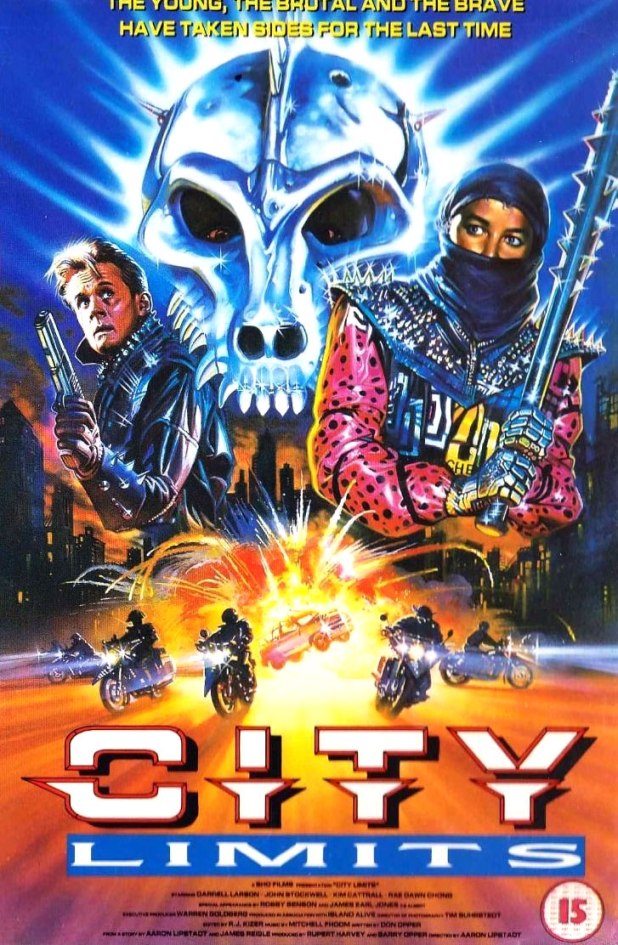
A plague killed most of the grown-ups and the world is filled with orphans. Some adults did live, like Albert (James Earl Jones). He raises Lee (John Stockwell) who grows up and heads out to L.A. to join the Clippers, who are led by Mick (Darrell Larson) and his second in command Whitey (John Diehl). They refuse to let him in. When they send him away with Yogi (Rae Dawn Chong), he defends her from the DAs, another gang, and breaks the no guns rule. It’s decided that instead of giving him to Ray (Danny De La Paz), that troop’s boss, he will fight their best soldier one on one. Lee defeats the female DA and joins the gang.

There’s also a worker from a corporation named Sunya named Wickings (Kim Cattrall) who wants the gangs to work to make the city livable. There’s also some intrigue with Whitey being killed by DAs Bolo (Norbert Weisser) and Carver (Robby Benson).

Of course, by the end, everyone goes back to Albert’s farm, Lee and Wickings fall in love and everyone battles the corporation. Even at the end of the world, biker gangs learn to work together, making their own company and taking over Los Angeles for their own needs.

Director Aaron Lipstadt also made Android. When this played Mystery Science Theater, the title for the film is red text displayed on a black background. At least the end — unlike every FVI movie on the show — uses footage from the movie it is on.

You can watch this on YouTube.

FVI WEEK: Torchlight (1985)

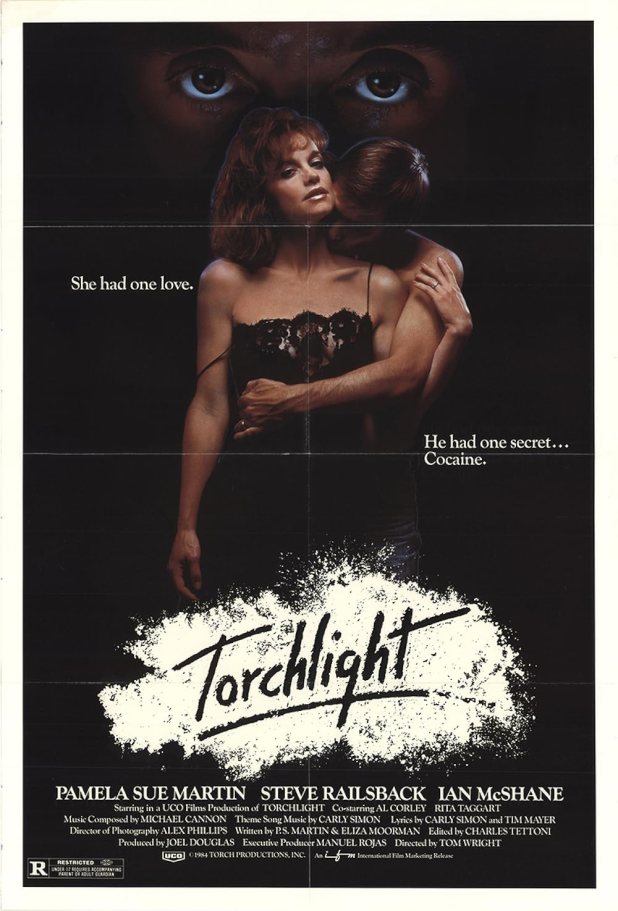
Just how into cocaine do Lillian Weller (Pamela Sue Martin) and Jake Gregory (Steve Railsback) get in this movie? Well, it was also released as Cocaine Paradise.

It’s also the first movie I’ve ever seen where a guy pierces a girl’s ears while they have sex.

Directed by Thomas J. Wright (not only did he direct No Holds Barred but he painted all of the Night Gallery paintings) and written by Martin and Eliza Moorman, Where it shines is that Ian McShane is incredible as Sidney, the drug dealer who helps make all of this addiction happen. Well, she introduces Jake to drugs and he takes it too far, freebasing and finally living in his car. She’s an addict as well but the truth is that she can handle her drugs.

I guess movies like this have had an effect on me because I always think, “I shouldn’t do coke because Steve Railsback — man, his name even sounds like drugs — got all messed up in Torchlight.”

You can watch this on YouTube.

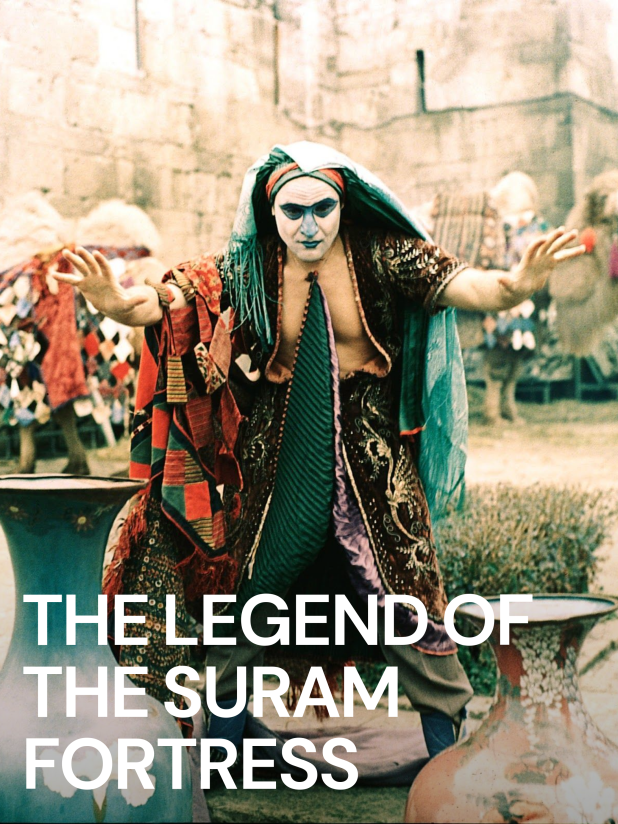
The Legend of the Suram Fortress (1985)

I’ve never seen a movie that looks like The Legend of the Suram Fortress.

Directed by Georgian SSR-born Soviet-Armenian director Sergei Parajanov and Georgian actor Dodo Abashidze, this was the first movie that Parajanov had made in 15 years after being censored by Russia and 4 years in jail for “lewd acts and bribery.” That’s because he was bisexual and he was sentenced to five years in a hard labor camp despite a letter from Andrei Tarkovsky to the Central Committee of the Communist Party of Ukraine, which stated, “In the last ten years Sergei Parajanov has made only two films: Shadows of Our Forgotten Ancestors and The Colour of Pomegranates. They have influenced cinema first in Ukraine, second in this country as a whole, and third in the world at large. Artistically, there are few people in the entire world who could replace Paradanov. He is guilty – guilty of his solitude. We are guilty of not thinking of him daily and of failing to discover the significance of a master.” The letter was also signed by Robert De Niro, Francis Ford Coppola, Martin Scorsese, Leonid Gaidai, Eldar Ryazanov, Yves Saint Laurent, Marcello Mastroianni, Françoise Sagan, Jean-Luc Godard, François Truffaut, Luis Buñuel, Federico Fellini, Michelangelo Antonioni, Andrei Tarkovsky and Mikhail Vartanov.

This is not the first tragedy in his life, he was married to a Muslim woman who converted to Eastern Orthodox Christianity for him. Her relatives saw this as blasphemy and killed her. Knowing this will make this movie even richer for you, as he lived the pain that his characters do.

Much like The Color of Pomegranates, this film uses tableaux — a static scene containing one or more stationary actors who poses with props and scenery, combining theater and visual art to tell the story — to create a surreal effect as it moves from dramatic image to image, filled with actors who each speak their part within these pieces of motion art.

This is an adaption of a traditional Georgian folk story of Durmishkhan, who has been freed by his master and now wants to buy the freedom of his lover Vardo. He is told another story by a merchant who lost his mother because of the cruel nature of his master. He killed that man and became a Muslim to escape the law.

Durmishkhan works for this man and marries a woman and has a son named Zurab. As his boss retires, he gives the business to him and converts again, this time to being Christian and dreams of the Muslims killing him for his crime.

Vardo becomes a fortune teller who is called upon when the Muslims invade their country. Despite all their efforts, the Suram Fortress is falling. She fortells that a blue-eyed young man from the countryside must be walled inside the fortress alive and it will stand. The bou who she be her son, Zurad, volunteers and gives his life to save the country and Christianity.

The band Voidcraft used this movie for one of their videos, “The Vertical Mammal.”

The Legend of the Suram Fortress feels like a movie that was made before cameras were invented, if that makes sense, something captured through time and delivered to us in the future. Filmed in the grassy scenery of Georgia with all actors facing the camera as we study the frame for its many meanings. It’s presented plainly but holds many secrets, literally the most pure expression of the secret and the occult.

You can watch this on YouTube.

La Gabbia (1985)

La Gabbia (The Trap) is based on a story called L’Occhio, which was written by filmmaker Francesco Barilli (The Perfume of the Lady In BlackHotel Fear), who was trying to direct the movie himself. He couldn’t get producers to pay for the film unless Shelley Winters was in the lead. He sold the idea to Giuseppe Patroni Griffi, who also made Identikit.

The screenplay was written by Concha Hombria, Roberto Leoni and Alberto Silvestri, along with Lucio Fulci, who didn’t direct as he was coming back from hepatitis.

Barilli is quoted in Troy Howarth’s Splintered Visions: Lucio Fulci and his Films as saying, “Lets’ talk frankly here, that movie sucks…” Fulci used profanity when asked about Griffi, who he felt stole his chance to direct this movie. He ended up directing The Devil’s Honey, which is pretty much what this movie could have been.

That said, this does have an Ennio Morricone score, so that helps.

Michael Parker (Tony Musante) is an American in Italy who is dating Hélène (Florinda Bolkan). 15 years ago, he dated Marie (Laura Antonelli), who has finally found him again. Amazingly, she’s his girlfriend’s landlady. What are the chances? He thinks they can just have a quick affair, but she won’t let him go. In fact, she puts him in a cage. And to make things even weirder, her daughter Jacqueline (Blanca Marsillach) soon falls in love with him.

When Hélène returns, she can no longer find him. She’s used to him wandering from woman to woman, but he always comes back. As for Marie, Michael once taught her the ways of love and then left. She never found a man who satisfied her in the same way and now, she refuses to even let him go to the bathroom outside of her sight. Also: Jacqueline could be his daughter.

Made in the brief time before giallo would become the erotic thriller, this has Michael being held so close to his girlfriend, finally paying for his years of seducing women and leaving them alone. Of course, I would rather have seen what Fulci had done with this movie. Or Barilli, come to think of it.

You can watch this on YouTube.

The Strangeness (1985)

It doesn’t matter if a mine has gold in it. If it closed because a supernatural force killed everyone that went into it, perhaps you don’t need to reopen it. Well, there wouldn’t be a movie if this didn’t happen and The Strangeness, shot on 16mm with real stop-motion animation, is the result.

You can say that this movie drags — and it does — but it also has a monster that eats people and dissolves them with acidic spit and then pukes them up. It leaves behind messy corpses that are crawling with maggots, so you know, don’t eat during this.

Director Melanie Anne Phillips — who used the name David Michael Hillman — wrote this with Chris Huntley, who plays one of the trapped people in the mine and also did the special effects.

The beginning of the movie was shot without permission at a real mine called The Red Rover. About a month after, real-life miners hired to see if the mine was worth reopening entered and went further in than the film crew had. They all died. Not from being devoured and thrown up by a monster that looks like a woman’s secret garden filled with tentacles and slime, mind you, but from poison gas exposure. The rest of the movie was shot in Phillips’ grandparents’ garage using tin foil painted black for the walls of the mine.

You can watch this on YouTube.

The Life and Adventures of Santa Claus (1985)

The last Animagic movie by Rankin/Bass Production, this is based on The Life and Adventures of Santa Claus by L. Frank Baum and is not tied to any of the continuity of the other Rankin/Bass specials such as Rudolph the Red-Nosed ReindeerFrosty the SnowmanSanta Claus Is Comin’ to TownFrosty’s Winter WonderlandRudolph’s Shiny New Year and Rudolph and Frosty’s Christmas in July.

I can only imagine how this movie — made in the middle of the Satanic Panic — went over. It starts with the Great Ak telling the Immortals the story of Santa Claus so that they will keep him alive forever. Yes, Claus was once an abandoned baby given to the lioness Shiegra before he was stolen by a wood nymph named Necile.

In the world of humans, Claus tries to spread joy but has to battle the dark Awgwas who make children do bad things. Eventually, the Angwas attack Santa so many times that the Immortals get involved and destroy them, even telling Santa that they have perished. This is a show for kids. To bring that point home, this ends with Santa on his deathbed, asking his friends to decorate a tree to remember him, just as the Immortals decide to allow him to join them.

Baum introduced the Forest of Burzee in his short story”The Runaway Shadows or A Trick of Jack Frost” before using in The Life & Adventures of Santa Claus, “A Kidnapped Santa Claus,” “Nelebel’s Fairyland” and Queen Zixi of Ix. Burzee is in the same universe as Oz. Some examples include Queen Zurline of the Wood Nymphs and Queens Lulea and Lurline of the Fairies probably all being the same person and in The Magic Cloak of Oz, embassies between these universes are created and Santa becomes the ambassador to Oz.

It may also freak you out when you realize that most of the cast of this comes from Thundercats, so yes, Santa has the same voice as Mumm-Ra — Earl Hammond — possibly the most Satanic of all 80s cartoon characters.

Common Sense Media said, “Of possible concern for the youngest viewers are the several mentions that Santa’s going to be visited by the spirit of death, some mildly scary monsters and a sad scene in which Santa talks about his mortality fading and that he wants decorating Christmas trees to be a kind of memorial to him. Fantasy violence includes a battle with magical powers to defeat the monsters once and for all. The ending is happy and safe, but be prepared to offer reassurance and answer questions about death and immortality.”

Who is going to do that for me?