EDITOR’S NOTE: Once Upon a Spy was on the CBS Late Movie on January 22 and October 15, 1987 and March 8 and August 2, 1988.
Jack Chenault is a computer genius whom the government wants to be a spy. You and I recognize that he’s Ted Danson and that seems silly to make him James Bond. Maybe with the help of Agent Paige Tannehill (Mandy Pepperidge), he can defeat mad scientist Marcus Valorium (Christopher Lee never says no), who has a motorized wheelchair of death, complete with rocket launchers. He also has a shrinking ray.
Director Ivan Nagy may be best known for his association with Heidi Fleiss. Still, he also directed Mind Over Murder, Captain America II: Death Too Soon , and Skinner, which is a notable achievement. He later, after the scandal, moved on to make nearly adult films, including All Nude Athena, Trailer Trash Teri, Izzy Sleeze’s Casting Couch Cuties, Touch Me, and Wild Desire.
This was written by Jimmy Sangster, so it has that going for it.
There is a universe where Dansen is not known as Sam Malone, but as Jack Chenault.
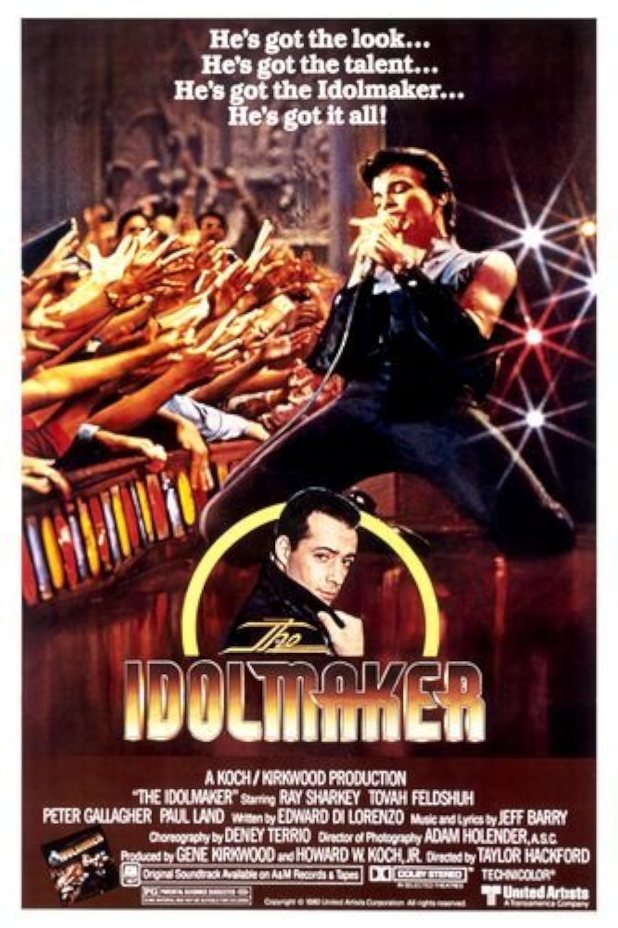
EDITOR’S NOTE: The Idolmaker was on the CBS Late Movie on January 31, 1986.
Based on the life of rock promoter/producer Bob Marcucci, whose discoveries included Frankie Avalon and Fabian and who served as a technical advisor for the production, this is the story of Vincent “Vinnie” Vacarri (Ray Sharkey), Gino “G.G.” Pilato (Joe Panoliano) and Tomaso “Tommy Dee” DeLorusso (Paul Land) as they navigate the world of music.
Vinnie ends up being the boss, running a record label through the times of payola and teen magazines, getting involved with an editor named Brenda (Tovah Feldshuh). As Tommy gets too big and starts ignoring his advice, he grooms Guido Bevaloqua (Peter Gallagher), a busboy at his family’s restaurant, into becoming Caesare, the kind of singer whose audiences run onstage and tear his clothes off. He begins dating a reporter, Ellen Fields (Maureen McCormick), but soon everyone abandons Vinnie, and he has to return to the pasta restaurant, singing at night in small clubs while the acts he helped make become stars.
Fabian Forte filed a lawsuit against the film, alleging defamation and invasion of privacy. He had been managed by Marcucci and could be seen as the character of Caesare. Fabian said that the film made him look like “a totally manufactured singer, a mere pretty face without any singing ability or acting talent.” This was settled out of court, with Fabian, his wife, and family receiving public apologies in The Hollywood Reporter and Variety, as well as the full ownership of the film being transferred to Marcucci. If you watched it on the CBS Late Movie, you were giving Fabian money.
So if you didn’t get it:
Vincent ‘Vinnie’ Vacarri is Marcucci.
Tommy Dee is Frankie Avalon.
Guido Bevaloqua is based on Fabian.
Brenda Roberts is based on Marcucci’s real-life assistant, Rona Barrett.
Director — and co-writer with Edward Di Lorenzo — Taylor Hackford also directed The Devil’s Advocate, Dolores Claiborne, An Officer and a Gentleman, Against All Odds, and the video for Lionel Richie’s “Say You, Say Me.”
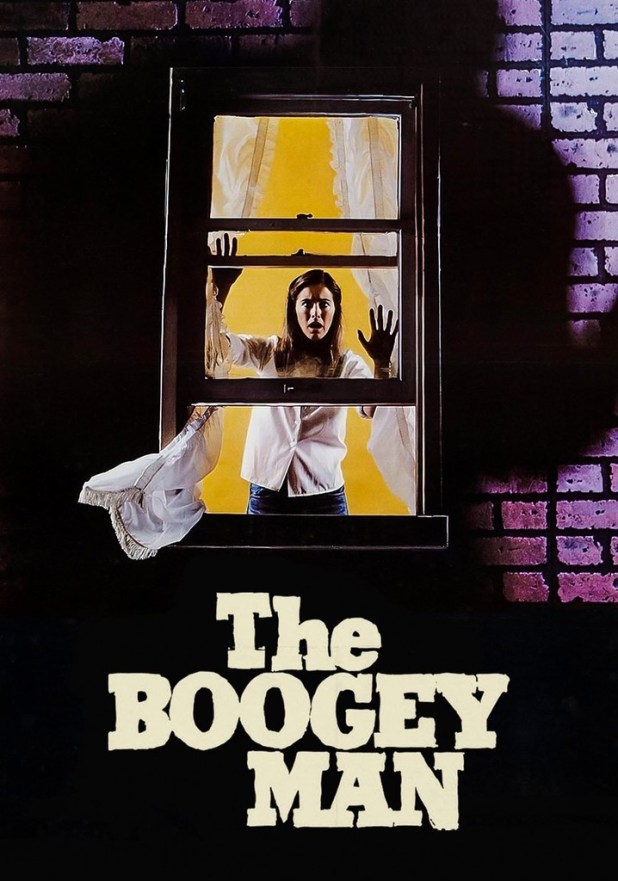
When Willy and Lacey were kids, they watched their mom and her boyfriend, who wore her stockings on his face, make out. Their mother was so upset that she sent Lacey to her room and tied Willy to his bed. It didn’t work, though. Willy would get out and stab the guy to death with a giant knife in front of a mirror. And that’s only the first few minutes of this one!
Now we’re in the present, and Lacey (Suzanna Love, who was married to the film’s director, Ulli Lommel, and appears in all the sequels) is married with a young son, living with her aunt, uncle, and Willy (Nicholas Love, Suzanna’s real-life brother) on a farm. Willy’s never gotten over killing a man, so he doesn’t talk and often steals knives.
Over dinner, Lacey announces that their mother wants to see them one last time before she dies. Willy burns their letter, and this starts off a series of dreams where she is tied to a bed and nearly stabbed, which makes her husband send her to a shrink.
And that shrink? Skinny Dracula himself, John Carradine, who shot everything in one day. He tells them that they must face their fears and return to their childhood home. As they look at the house, we see the dead boyfriend reflected in the mirror he died in front of. Lacey goes shithouse and smashes it, which is totally not what you should do. Nor should you take those pieces and try and fix the mirror. Mirrors are cheap. Go to Wal-Mart. Buy a new and uncursed mirror.
The pieces left behind start to glow red and kill everyone in the house after Lacey and Jake leave. Speaking of mirrors, Willy hates them. One of them made him strangle a girl, so he paints them all black.
The shards of glass start doing evil things, like levitating pitchforks, ripping off Lacey’s shirt and impaling young lovers with a screwdriver. I was cool with the shards of glass until then. You’ve taken it too far, shards of glass! I guess we can blame them for the aunt and uncle dying, too, right? In 1980, Jake decides to bring in a priest to fix everything. This causes Lacey to get possessed by a mirror shard and attack everyone. She kills the priest, too, but not before he removes the mirror’s control over her.
That’s when the best solution comes up — let’s just throw the mirror in a well. This releases all of the souls, with Lacey, Willy and her son exiting a graveyard. Oh, no — a piece of the mirror is on her son’s shoe!
I was wondering where many of the plot points of this movie would go, and they often get lost, as if this were a foreign film. But it isn’t! So, I did some research on the director, Ulli Lommel.
Lommel had one crazy career, starting with appearing in Russ Meyer’s Fanny Hill, then acting in Fassbinder’s surreal western film Whitey (as well as several other of the director’s films). Moving to the U.S. in 1977, Lommel became connected to Andy Warhol, who was involved in his films, including Cocaine Cowboys and Blank Generation, a movie that starred Richard Hell and was filmed at CBGB.
Seriously — a movie that rips off Halloween, The Amityville Horrorand Argento lighting while feeling like more than two movies mashed up into one that also features a girl cutting her own throat with scissors, a child getting his neck broken, and a priest getting his face melted? The acting is horrible — but are you here for that? Nope. You want to get freaked out when people’s eyes get replaced with a piece of a mirror.
Part of me wants to make fun of this movie. But another part of me wants to protect it from mean people who say things like it lacks attention to detail. Or the fact that none of its characters appear to be actual human beings. And the camera angles are more reminiscent of Dad not knowing how to use the video camera than art. But yet, I love this. I want to love it more, but I love what it can be more than what it is.
The Boogeyman was followed by two sequels that utilize footage — a lot of footage — from the original.
June 16: Junesploitation’s topic of the day — as suggested by F This Movie— is ‘80s Comedy!
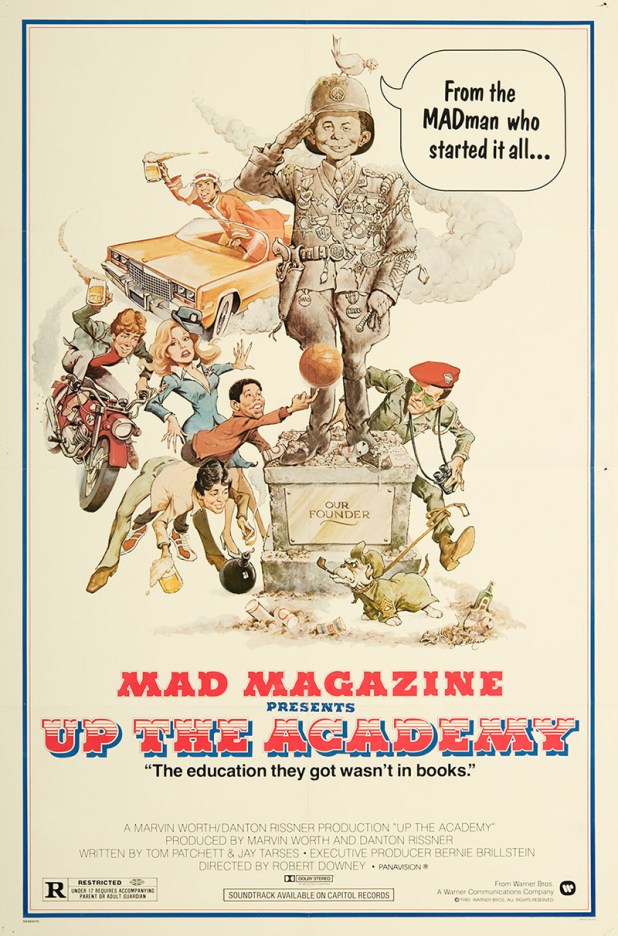
In 1980, 8-year-old Sam was all in on MAD Magazine—every issue. It’s how I saw so many R-rated movies, as I couldn’t go to the theater but could read them as redone by Mort Drucker. Imagine my joy when the Usual Gang of Idiots decided to make a movie, just like those new kids, the National Lampoon.
A note: MAD has the humor of old school Jewish comedy, teaching me words like schmuck while the Lampoon was rich kids who went to an Ivy League school and did drugs. Also: Oversimplification can be funny.
Publisher William Gaines — yes, the same guy who did Tales from the Crypt — told The Comics Journal, “What happened is that we had a contract with Warner Brothers to put out a MAD movie. It’s like four years old now. They came up with a script that we didn’t like, and then they came up with a script using our scriptwriters that they didn’t like, but meanwhile they threw this script onto our desk … Although there were many things in it that I thought were offensive and should be removed, generally, I liked the script. And I thought, “Well, in addition to a MAD movie, there’s nothing wrong with having something like Lampoon did with Animal House.” Animal House was “Lampoon Presents” and really had nothing to do with the magazine; it was just using their name, and it was a good movie, and it was very successful, and it made Lampoon a lot of money. I guess. So we were going to do the same thing. “MAD Magazine Completely Disassociates Itself from Up the Academy“. But that was too long for them; they couldn’t think in that many words. They put the damn thing out without all the deletions they had promised to make, which means they’re liars. I’m talking about one of my sister companies [laughter] … And there we were connected with it, and there wasn’t much we could do about it. I paid Warner Bros. 30 grand to take MAD‘s name off for television. So, for $30,000, we got out of being associated with it on Home Box Office. It won’t say “MAD Magazine Presents,” and Alfred E. Neuman won’t be in it. And it was well worth $30,000.”
It is quite like many other sex comedies that came after the men of Delta House. Chooch (Ralph Macchio) is the youngest son of an organized crime family; El-Hashid “Hash” Amier Jr. (Tommy Citera) is the son of an oil sheik; Eisenhower “Ike” MacArthur (Wendell Brown) is the son of a faith healer who keeps marrying young wives and Hash keeps schtupping them (see, I did learn from MAD!). Oliver Holt (Hutch Parker) has a governor for a father and just wants to sleep with his girlfriend Candy (Stacy Nelkin, who is Ellie Grimbridge, and if you get that, welcome to the site), except his father doesn’t want a teen pregnancy getting in the way of his re-election.
Chooch wants to go straight, so enter new recruit, Rodney Ververgaert (Harry Teinowitz), who likes to make things explode.
They’re all being brutalized by Major Vaughn Liceman (Ron Leibman, the Emmy and Tony-winning actor who asked for his name to be removed from this movie; he was also married to Linda Lavin and Jessica Walter, which is pretty good when you think about it), your typical bad guy in a teen sex comedy.
Candy ends up getting sent to military school as well, so Liceman sets the couple up and takes pictures of them in the act while demanding that he gets to sleep with Candy to protect Oliver’s father’s election. There’s also a snobs vs. slobs soccer game, Tom Poston playing the most stereotypical mincing gay character ever, Antonio “Huggy Bear” Fargas as a coach, and the mind-blowing Barbara Bach, Lady Starke as Bliss, the teacher every boy in school wants.
Also, it’s not good. It’s aggressively bad.
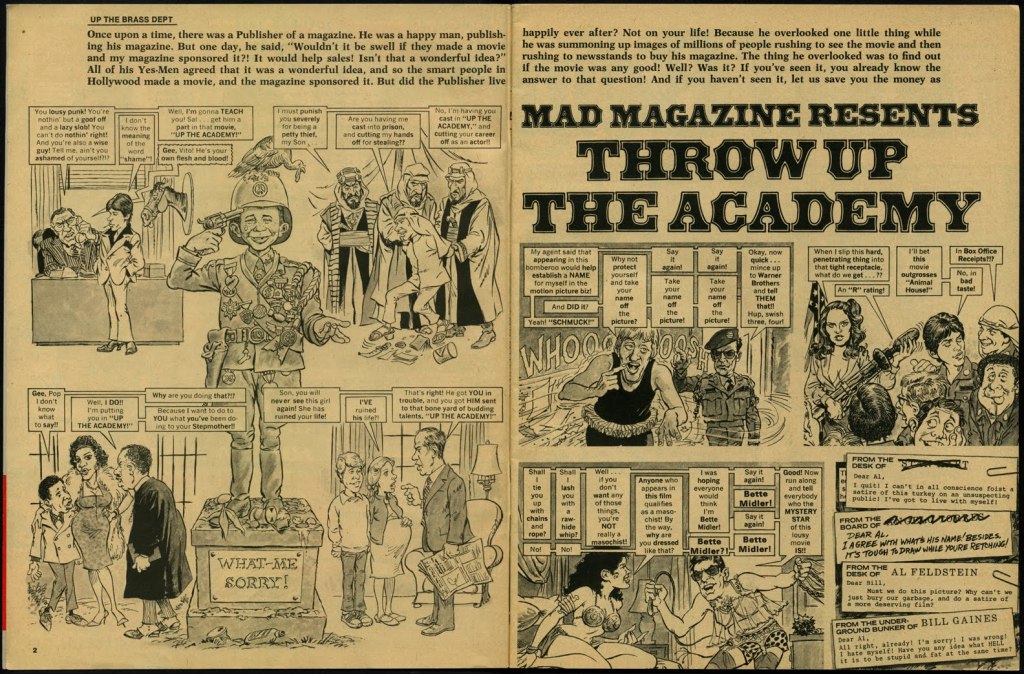
Directed by Robert Downey Sr., who said it was “one of the worst fucking things in history,” and written by Tom Patchett and Jay Tarses, it was so bad that MAD skipped a letters column to present MAD Magazine Resents Throw Up the Academy, which called out Leibman taking his name off the movie, the fact that actors had to have been pubished by being in it and just two pages of the writers, artists and editors being so mad about the movie that they all quit.
Here’s just a sample of this hit piece:
“Once upon a time, there was a Publisher of a magazine. He was a happy man, publishing his magazine. But one day, he said, “Wouldn’t it be swell if they made a movie and my magazine sponsored it?! It would help sales! Isn’t that a wonderful idea?” All of his Yes-Men agreed that it was a wonderful idea, and so the smart people in Hollywood made a movie, and the magazine sponsored it. But did the Publisher live happily ever after? Not on your life! He overlooked one little thing while summoning images of millions of people rushing to see the movie and then rushing to newsstands to buy his magazine. The thing he overlooked was to find out if the movie was any good! Well? Was it? If you’ve seen it, you already know the answer to that question!”
I had never seen a magazine hype something and then apologize. It really was a big deal to my young brain.
It also has a terrifying real-life Alfred E. Newman, designed by Rick Baker. I can only compare this, as the end of the movie, to taking a painful shit and then wiping, only to find blood all over the toilet paper.
Yes, Rev. MacArthur, Ike’s dad, is played by King Coleman, the man who sang “(Do The) Mashed Potatoes.”
At least the soundtrack is good, filled with stuff like The Stooges’ “Gimme Danger” and “Night Theme,” Blondie’s “One Way Or Another” and “X Offender,” The Kinks’ “Yes Sir, No Sir,” Lou Reed’s “Street Hassle,” The Modern Lovers’ “Roadrunner,” David Johansen’s “Girls,” Nick Lowe’s “Heart of the City” and Cheap Trick’s “Surrender.” There’s no reason to have that many great songs in a film this fecund.
Architect Larry Andrews and his new wife, Barbara (horror movie super couple John Saxon and Linda Day George; if these two ever had a child, it would either be a demon or a gleaming golden angel), have moved to a small island off the coast of the Philippines. Del (former minor league baseball player Michael Dante; he’s also in The Farmer and was introduced to acting by John Wayne), Larry’s business partner, had promised them a brand new condo. Instead, they’re moving into Casa Fortuna, the haunted former home of Esteban and Alma Martín (Janice Lynde), who died after a fight started by Alma’s obsession with the occult.
Within what seems like minutes, next door neighbors and psychic surgery experts Dr. Solomon (David Opatoshu) and his wife Leia (Anna Marisse) warn Larry that Alma wants his young bride’s body for her own. At the same time, Barbara is luring Del into the home with promises of sex and then shoving him off the balcony.
You know what this movie needs? An exorcism. Well, it gets it.
Herb Freed is kind of a forgotten king. I mean, the dude made Haunts, Graduation Day and Tomboy, which are three other movies I watch all the time. He wrote the script with producer David Baughn and Paul Ross.
Bruno Mattei. Claudio Fragrasso. This was the sequel to Libidomania,or as the Italians called it, Sesso perverso. This was to be directed by Joe D’Amato and edited by Bruno, but he demanded that if he was forced to work on a mondo — so they say — he had to direct it. I imagine Joe just laughed and nodded, then went off and made ten movies in three days.
This time, the movie explores the world of adult films, but as you’d expect with a mondo, it’s all fake. Fake couples telling fake stories about their fake lives, then women eat ice cream in dirty ways, and the movie spends too much time exploring the deviant practice of homosexuality, which, come on, this is 1980, guys. It’s not even remotely deviant. Does it sell pictures any longer?
Speaking of mondo and fake, the end has reporters saving one of their own, a half-nude woman, from a woman who has already had a meal of her husband, who is now a rotten corpse covered by maggots because look, if we Italians love anything more than sex, violence and fake foreign footage, it’s either real animal violence or maggots. I’d rather have maggots, and then another native is castrated while the once captive reporter does a striptease.
Italian adult star Guia Lauri Filzi (who was uncredited and yet played a very memorable role in Emanuelle In America as the actress in the snuff film) and Maurizio Tanfani (Sex of the Witch, Mattei’s AD on The Other Hell) appear, and if you find the right version—look, 20 people or so have even cared about this on Letterboxd, so probably not—there are inserts.
The first time I saw The Apple, I was in the throes of losing my job, starting a new company and feeling lost. This movie not only made me feel like I could go on but also inspired me to start writing more about films and why they mattered to me.
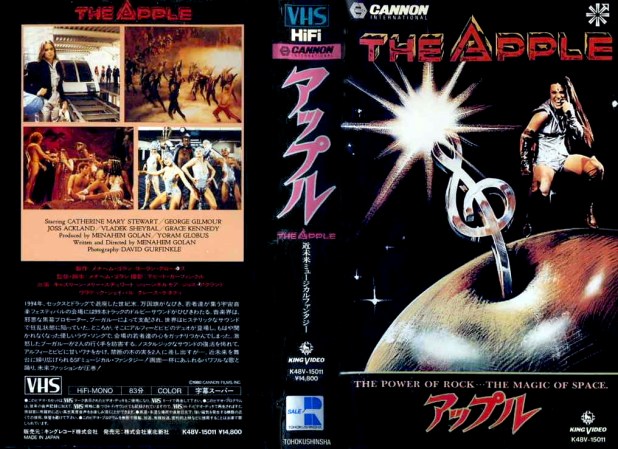
You know how everyone thinks Cannon put out some completely crazy movies? If you haven’t seen The Apple (also known as Star Rock), you haven’t seen their full power. Directed by Menahem Golan, this slice of sheer madness is a movie I use to test the resolve of anyone brave enough to watch movies with me.
The genesis of this film begins in 1975. Israeli rock producer Coby Recht was signed to Barclay Records and began to feel distrustful of show business. He worked this into a story with his wife, Iris Yotvat, and brought it to the attention of his longtime friend Menahem. After hearing the demos for the song, the producer/director instructed Recht to go to Los Angeles immediately. They were making the movie.
Yotvat said, “That was marvelous. That was just fantastic to think that it was going to be a movie all of a sudden. It was just amazing.”
It wasn’t going to stay that way.
Recht and Yotvat lived in a villa that Menahem provided, writing six screenplay drafts in three weeks. As those drafts progressed, the story became more comical and less Orwellian. Soon, things were getting corny, out of touch and out of date. If you’ve seen any of the movies that Golan was involved in, you can see how that might be true.
After auditioning thousands of hopefuls, Recht settled on Catherine Marie Stoutdatedhe lead role of Bibi. Who is a singer. Not a dancer, like Stewart. He figured she could learn, but the producers decided to have her voice dubbed.
Tensions only got worse once filming began, as what started as a $4 million movie turned into $10 million and then more. Editor Alain Jakubowicz claimed that Golan shot around a million feet of footage, with six cameras covering every dance number, up to a four-hour rough cut.
The movie got way bigger than its scriptwriters intended. Shooting in West Berlin lasted forever, with a five-day covering opening number, the song “Speed” being filmed at the Metropol nightclub (which held the world record for the biggest indoor laser show), and some scenes were actually shot inside a gas chamber that had killed people during World War II.
Nigel Lythgoe, who later was a big part of American Idol, choreographed the film, saying that some days were “really, really depressing” and others “very, very stressful.” The cast and crew hated the script, but here they were, making the film.
Menahem and Recht’s battles soon got worse. The writer felt he should be in London mixing the songs (the sessions had more than 200 artists involved), but Menahem demanded that he show up at the shoot. The first day he was there, he witnessed the uncut version “Paradise Day” which featured fifteen dinosaurs and a tiger that broke free and escaped. This scene also contained elephants getting their trunks stuck in the set, actors collapsing while wearing a t,oo hot brontosaurus costume and a set that made it near impossible for people to dance on and cameras to move around. Removing this scene makes the Biblical end of the movie come out of nowhere. That’s right. None of this is in the film.
nearlyerine Marie Stewart has stated that nonfor e of this rattled Menahem. In fact, he was convinced that The Apple was going to be embraced: “Menahem was very passionate about what he was doing. He had very lofty ideas about the project. He thought this was going to break him into the American film industry. It had, you know, all the elements that he thought were necessary at that time. It was the early eighties and there were a lot of musicals. And Menahe,m thought that was his ticket into the American film industry.”
So what happened?
The plot is basically Adam and Eve meets Faust. Bibi (Stewart) and Alphie (Georgmeetmour) are contestants in the 1994 Worldvision Song Festival. They’re talented but easily defeated by the machinations of Mr. Boogalow (Vladek Sheybal, Kronsteen in From Russian With Love) and BIM (Boogalow International Music).
The evil leader soon signs the duo but they soon fall victim to the darkness of show business. Bibi is caught up in the drugs and sex and glamour, while Alphie is beaten by cops and nearly dies to save her. He also lives with a woman who is either his mother, lover, or landlady, and no one ever explains to us.
Eventually, they escape and live as hippies, having a child. Mr. Boogalow finds them and claims that Bibi owes him $10 million, but soon God, known here as Mr. Topps (Joss Ackland, The House That Dripped Blood, Bill & Ted’s Bogus Journey), takes them away in his Rolls-Royce and the Rapture occurs.
There are numerous scenes where people put stickers, called BIM Marks, all over their faces. Everyone has camel toe. And the movie is nearly 100% disco.
The movie premiered at the 1980 Montreal World Film Festival. To say it did not go well is an understatement.
Attendees hated the film so much that they launched giveaway records of the soundtrack at the screen. Menahem was so devastated that he almost jumped off his hotel balcony before being saved by his business partner, Yoram Globus. A similar scene happened at the film’s second premiere at the Paramount Theater in Hollywood.
The director said, “It’s impossible that I’m so wrong about it. I cannot be that wrong about the movie. They just don’t understand what I was trying to do.”
I get it, Menahem. You were just trying to get people to understand the power of love and music and being hippies a full decade after any of that mattered. You didn’t care if anyone else got it. You had a vision. And we’re not talking about any of those critics today. No, we’re talking about you. We’re talking about The Apple.
This is a movie that wears its heart messily all over its spandex crotch. The songs are ridiculous. The dancing is, at times, poor. The story makes no sense at all. You’re lucky to sit and witness it. I can’t even tell you how many times I’ve watched it!
BONUS! You can hear Becca and me talk all about The Apple on our podcast.
April 10: Seagal vs. Von Sydow—One is a laughable martial artist, and the other is a beloved acting legend. You choose whose movie you watch; it’s both of their birthdays.
Based on The Unsleeping Eye by David G. Compton, Death Watch imagines a future world where illness has been eliminated. Well, all except for Katherine Mortenhoe (Romy Schneider), who is dying of some mysterious sickness and has agreed to allow her death to be filmed by the NTV network and their boss, Vincent Ferriman (Harry Dean Stanton). She gives the money to her husband and goes on the run.
That’s when she meets Roddy (Harvey Keitel), a cameraman whose eyes are replaced by cameras. She has no idea that this man is filming her and he’s given up his future — he’ll go blind if he is in darkness for any length of time, even sleep, and must shine a light into his eyes every 15 minutes — to make sure the public gets to watch her expire.
Katharine wants to see her first husband, Gerald (Max Von Sydow) one more time before she dies. She asks Roddy to get her makeup in town, and while there, he sees a commercial for the TV show he’s been filming, Death Watch. He loses his sanity and his flashlight, eventually going blind and confessing to Katharine what he’s been doing.
The truth is that the network has made all of this up. Katharine isn’t dying, and the pills she’s been given make her sick. She’s convinced that her death is coming, so she overdoses at Gerald’s house just in time for Vincent to show up.
In the world that he creates in this film, everything has become boring. Machines create all of the art while man numbs himself with drugs. This is our world. Add in a police state, protestors paid to hold up signs without caring for the cause, and a heroine who decides to control her own fate rather than be controlled by the media, and you get a movie that feels more of our time than a future story. If anything, it feels too real.
No, this is not Eugenie (AKA Philosophy in the Bedroom). It’s also not Eugénie de Sade (AKA DeSade 2000). This is 1980’s Eugenie (Historia de una perversión), but yes, it’s another Jess Franco movie. It is a remake of the 1970 movie listed above and is also known as Erotismo. Franco danced with this subject many times, also making How to Seduce a Virgin.
Alberto de Rosa (Antonio Mayans, a Franco stock member) wants the young Eugenie (Katja Bienert, El tesoro de la diosa blanca), so he gets his sister Alba (Mabel Escano) to help by seducing her father and talking him into letting brother and sister take his daughter for, well, you can only guess.
Bienert is fine in this, but she’s also dealing with Maria Rohm and Soledad Miranda to live up to in Franco’s first two attempts. That’s not fair to her to be compared to them. She was also underage when this was made, which is something that would never happen today or at least we’d like to believe that.
This also has Lina Romay barking and behaving like a dog, so there’s that.
In Germany, most of the plot and character pieces are thrown away to make way for inserts from Triangle of Venus. For these Teutonic perverts, Jess Franco was simply not dirty enough.
Despite being approached several times with New York Times reporter Gerald Walker’s 1970 novel Cruising, William Friedkin (The Exorcist, Sorcerer and perhaps not as successfully, Jade) wasn’t interested. He changed his mind after an unsolved series of murders in New York’s leather bars.
Articles by Village Voice journalist Arthur Bell and NYPD officer Randy Jurgensen helped inform this film. The latter went into the same deep cover as this film’s protagonist, Steve Burns. Then, Friedkin learned that Paul Bateson, a doctor’s assistant who appeared in The Exorcist, had been implicated in the crimes while serving a sentence for another murder.
Friedkin did some of his research for the film by attending gay bars dressed in only a jockstrap, but by the time the movie began filming, he had been barred from two of the most oversized bars, the Mine Shaft and Eagle’s Nest, due to the controversy surrounding the movie.
Much like The New York Ripper and God Told Me To, this movie feels like one set at the end of the world — New York City near the close of the 20th century. Someone is picking up gay men, murdering them and leaving their body parts in the Hudson.
Officer Steve Burns (Al Pacino)—exactly the type of man the killer has been after—is on the case. Captain Edelson (Paul Sorvino) has assigned him to infiltrate the foreign world of S&M and leather bars. However, as the case progresses, he loses himself and his relationship with Nancy (Karen Allen).
Soon, he learns of just how brutal the NYPD is to gay men — even if they’re just suspects. And he finds himself growing closer to his neighbor Ted (Don Scardino, Squirm).
By the end, nothing is truly clear. While the killer may be Stuart Richards, a schizophrenic who attacks Burns with a knife in Morningside Park, it could also be Ted’s angry boyfriend Gregory (James Remar). After all, Ted’s mutilated body is discovered while Stuart is in custody. Or the real killer is still out there — perhaps he’s even a patrol cop (Joe Spinell). The truth is never told.
Spinell is incredible in this, which is no surprise. He used his real life for inspiration, as there’s a line about his wife, Jean Jennings, leaving him and moving to Florida with his daughter. His wife had just done exactly that before this movie was shot.
The actual version of this movie may never be released. Friedkin claims it took fifty rounds to get the MPAA to award the film an R rating. Over 40 minutes of footage was cut, which consisted of time spent in gay bars. The director claims that these scenes showed “the most graphic homosexuality with Pacino watching and with the intimation that he may have been participating.”
This footage also creates another suspect — Burns himself may have become a killer.
When Friedkin sought to restore the missing footage for the film’s DVD release, he discovered that United Artists no longer had it and may have even destroyed all the cut footage.
In 2013, James Franco and Travis Mathews released Interior. Leather Bar is a metafictionalized account of the two filmmakers’ attempts to recreate the lost 40 minutes of Cruising.
There’s a disclaimer at the start that says, “This film is not intended as an indictment of the homosexual world. It is set in one small segment of that world, which is not meant to be representative of the whole.” Years later, Friedkin would claim that MPAA and United Artists required this, hoping that it would absolve them of the controversy that had been all over this production.
That’s because protests had started at the urging of gay journalist Arthur Bell, the aforementioned Village Voice writer whose series of articles on the Doodler’s killing of gay men inspired this movie. There were numerous disruptions to the filming, as protesters blasted music and loud noises at all filming locations, leading to hours of ADR to fix the ruined dialogue.
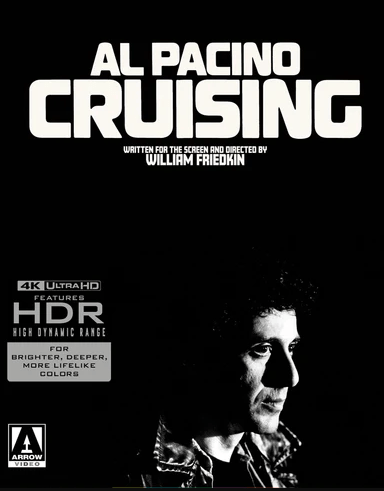
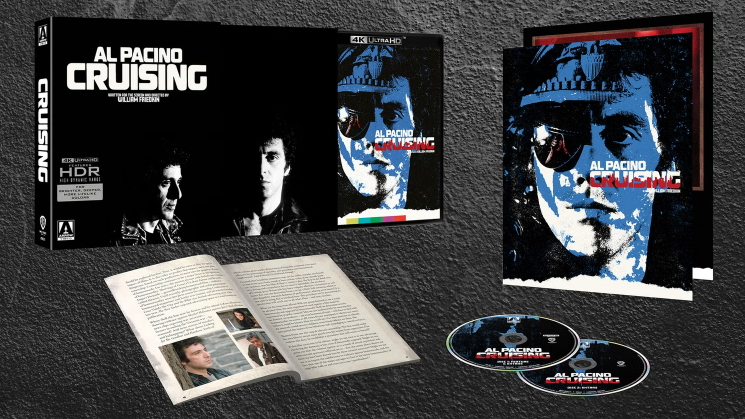
The Arrow Video 4K UHD release of Cruising features a brand-new restoration from a 4K scan of the original camera negative, supervised and approved by writer-director William Friedkin. It also includes a Friedkin-approved newly remastered 5.1 DTS-HD Master Audio mix of the film. The release also includes archival featurettes and two commentaries by Friedkin.
There’s also new commentary featuring the original musicians involved with the soundtrack; Heavy Leather, an alternate musical score by Pentagram Home Video; deleted scenes and alternative footage; on-set audio featuring the club scenes and protest coverage; censored material reels; a theatrical trailer, teasers and TV commercials; interviews with Karen Allen, film consultant and former police detective Randy Jurgensen, editor Bud S. Smith, Jay Acovone, Mike Starr, Mark Zecca and Wally Wallace, former manager of the Mineshaft; Breaking the Codes, a visual essay surrounding the hanky-codes featuring actor and writer David McGillivray; Stop the Movie, a short film by Jim Hubbard capturing the Cruising protests; archival featurettes; William Friedkin’s BeyondFest 2022 Q&A at the American Cinematheque and an extensive image gallery featuring international promotional material, on-set sketches, and more.
It also has a 120-page perfect-bound collector’s book featuring articles from The Village Voice and The New York Times, essays from the film’s extras cast, an introduction from William Friedkin and an archive interview with Al Pacino. The set is enclosed in a reversible sleeve featuring original and newly commissioned artwork by Sister Hyde.



 B&S About Movies
You must be logged in to post a comment.