SHAWGUST: The Brave Archer 2 (1978)

Other than replacing Tien Niu with Niu Niu in the role of Huang Rong, Keung Hon taking over the role of Liang Ziweng and Norman Chu becoming Yao, the sequel to The Brave Archer keeps much of the same cast and feel as it continues to adapt Louis Cha’s The Legend of the Condor Heroes.

Huang Rong has been taken hostage by Ouyang Feng (Wang Lung-wei) who ransoms her for the Nine Yin Manual that is protected by heroic Guo Jing (Alexander Fu Sheng), who works with Hong Qigong (Ku Feng) to give the villain an incomplete version of the book. When he practices the forms in it, it drives him insane as they aren’t correct. He challenges the two, but is hurt and Guo Jing and Hong Qigong escape. However, Hong Qigong is injured and gives Huang Rong his weapon, the Dog Beating Staff, handing over his leadership of the Beggars’ Sect as well. But when she loses the staff to Yang Kang (Li Yi-Min), it causes a battle between several of the different sects trying to gain power, including the Tsuen Jen Taoists, the Iron Palm Clan and the Beggars’ Clan.

This is a movie that demands attention, as there are about twenty or so lead characters — or so it seems — and everyone has a conflict and story of their own. Director Chang Cheh believed that his versions of these stories weren’t as good as the novels that they came from. For Western audiences, it may be difficult to jump in and follow so much of what is going on. However, I have been enjoying their scope and trying to keep up as well as I can, despite language and culture barriers. It helps that when there is action, it’s thrilling and that the heroes are so likeable.

SHAWGUST: The Chinese Boxer (1978)

Written, starring and directed by Jimmy Wang Yu, The Chinese Boxer moved martial arts films away from fantasy and weapons into a world where one man and his fists could do plenty of damage. He was a martial arts superstar in Hong Kong before even Bruce Lee and this movie proves exactly why. I’ve honestly never seen a bloodier hand to hand combat film, as nearly every punch sends mouthfuls of blood everywhere when they’re not blasting people through walls.

Diao (Hsiung Chao, Five Fingers of Death) was thrown out of the kung fu temple and spent years learning judo, defeating each of the students of the school upon his return until the master defeats him. Not being a man of honor, he sends for Japanese karate mercenaries, who are also defeated, until he sends samurai who not only destroy the school and murder all of the kung fu students and the master but also have the gall to take over the town and make it a city of sin.

Lei Ming (Jimmy Wang Yu) has survived, however, and he’s willing to do anything and everything to take his town back. You may think you’ve seen this before — and you have — but that’s because every other movie like this came after. A training sequence, much less one where the hero punches his hands into burning sand to toughen them? Yep. A room full of men with weapons and one unarmed hero? Here. A man fighting for the honor of his dead master? This is where it all began at least in film form.

There’s also the bad guy KItashima (Lo Lieh, nearly a Shaw Brothers supervillain) who can chop tables in two and provides a more than perfect secondary villain for our hero to fight. And it all looks astounding, because it shares a cinematographer — Hua Shan — with one of the most kinetic and strange movies that Shaw Brothers put out, The Super Infra-Man. Just one look at the fight in the snow and you’ll know that this is a movie to be studied just as much as it was stolen from.

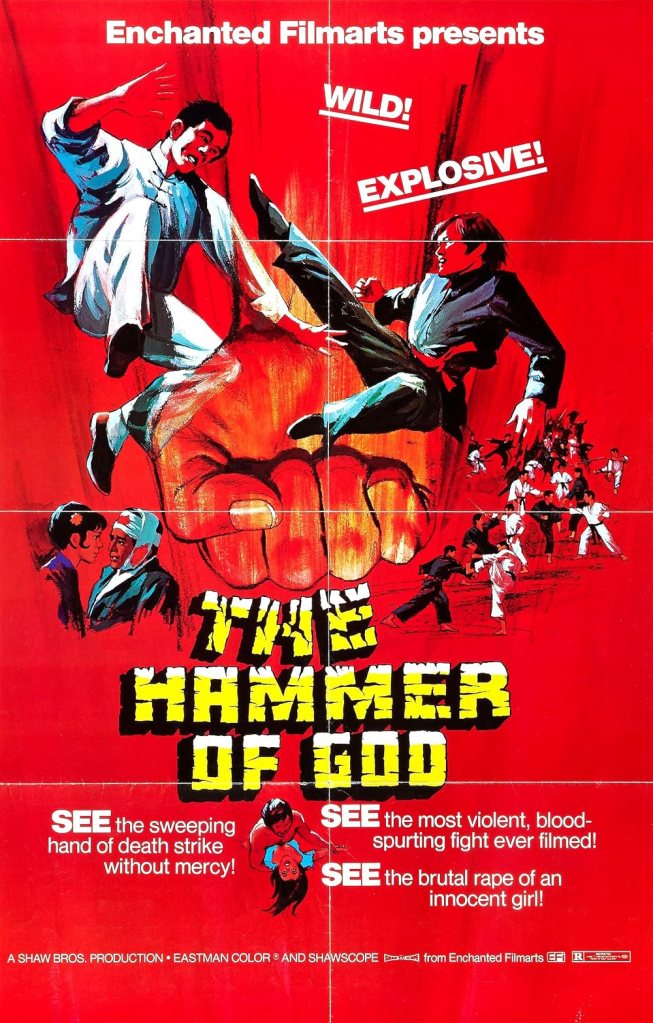
This was released in the U.S. as The Hammer of God.

The Sizzlin’ Something Weird Summer Challenge 2024: Disco Lady (1978)

Rene Bond week (August 11 – 17) Rene Bond could brighten up even the most dreary productions, and she was in plenty of them. In the early adult scene she was one of the better actors, particularly when it came to comedy, though she could squeeze into some leather and throw the whips around when the role called for it. Bond appeared in somewhere near 100 films, thanks to her affable professionalism she worked with many filmmakers multiple times and regularly performed with her boyfriend Ric Lutze. Her career received an enhancement when she became one of the first stars to get a boobjob. She retired from film in the late-70s just as the porno chic era was dying down, but before the video era. You can find her in a ton of SWV titles, so take yer pick!

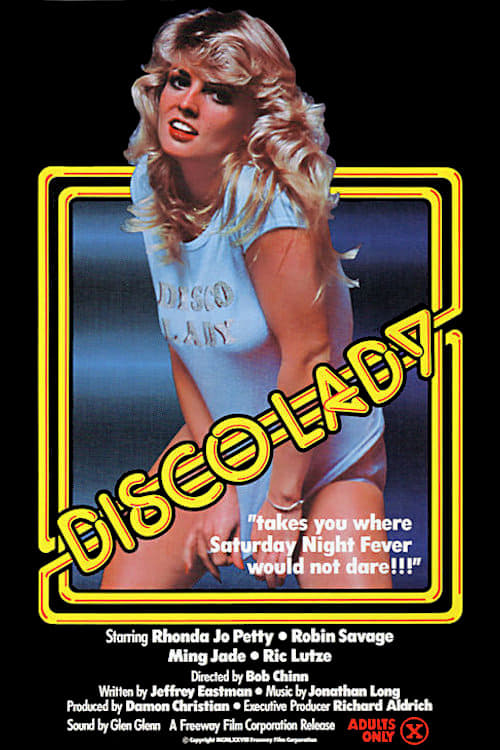
Directed by Bob Chinn (who directed John Holmes in several of the Johnny Wadd movies and Rick Fuente and Lee Stone in the Nick Grande films) and written by Jeffrey Eastman and Darrel Cash, this is not about a person but a place, a club called the Disco Lady. It’s New Year’s Eve and Scorpio Sound (Ken Scudder) is playing the records while everyone gets together to dance. Little of it sounds like the disco of 1978 and instead sounds very AM radio of 1978.

We have an hour to get into what happens.

It’s all rather unconnected, as a hitchhiker named Carla (Rhonda Jo Petty in her first film; she looks a lot like Farrah Fawcett and as you can imagine, this was very important in 1978) meets a drug dealer named the Candyman (Alan Colberg) and gets pimped out. Then, there’s a couple — Rick (Ric Lutze) and Rick’s wife (Robin Savage) and yes, the movie gives her no name, so that should tell you how much it is concerned with relationships — celebrating an anniversary before he dirty talks her in a way that seems like he’s a bit too into it. And ah, there’s Sherry (Ming Jade) and Angie (Angel Ducharme) arriving just as Johnny (Rob Rose) and Tony (Mike Ranger) walk in.

New year’s is a time for people to remember why they love one another, plan for the next trip around the sun and kiss at midnight. But here, in a movie shot in the back of a bowling alley that doubled on the weekend as a club, this take on Saturday Night Fever — well, outside of the fact that all disco to some people was that movie — has couples falling to pieces. Rick gets to the club and in seconds is making out with a waitress (Tiffany Ladd) and comically — and perhaps unintentionally — getting his medallion all over her body. What do you expect when you’re having sex in a squalid back room, on a pallet covered by a sleeping bag in a room full of Coca-Cola?

Rick didn’t even want to be here! Just listen to — or read — this dialogue.

Rick’s Wife: Will you take me dancing tonight?

Rick: What? Not tonight, homey! The Sugar Bowl’s on TV tonight!

Rick’s Wife: Come on honey, it’s New Year’s Eve and we haven’t been out in a long time…

Rick: Oh I know that, but honey I gotta see Alabama.

Rick’s Wife: Come on Rick, it’ll be fun.

Rick: Oh I don’t want to honey. It’s Bear Bryant’s last season and everything else. Aww, then tomorrow the games…

The end of this movie broke my brain, however. Another angry husband, upset that his wife is intending to cheat just like he did, is coming to the club and he’s angry. We see all of the many couples and people we’ve met throughout, including a guy who everyone calls Peter Frampton who triumphantly gets into the Disco Lady. And then, that husband bursts in and the screen slows to slow motion and then even slower, grinding, as we hear him fire his gun. People scream, the folks we’d just witnessed copulating are either killed or maimed or scarred for life by a night that was just supposed to be spent gyrating under the reflective ball or, at best, doing blow in the bathroom and having furtive sex in a storage closet. And now, they’re gone. The screaming keeps overloading the soundtrack, the grainy freeze frame starting to bend and twist and turn and the yelling and terror is still here, as the slow motion keeps ticking by, slower than it ever has before. There’s blood on the dance floor, even if the budget didn’t allow for it.

This absolute void of an ending redeems everything we’ve seen before except for the too short appearance of Rene Bond dancing the night away in potentially her last filmed appearance. She doesn’t have sex, she doesn’t get naked, she’s hotter than everything around her, the law of the invisible proving itself as it always does.

As Marlena Shaw sang, “Well, I can say goodbye in the cold morning light. But I can’t watch love die in the warmth of the night.” Man, I love when adult films fully forget that they’re created to get people aroused and instead seek to utterly destroy them.
SHAWGUST: The Avenging Eagle (1978)

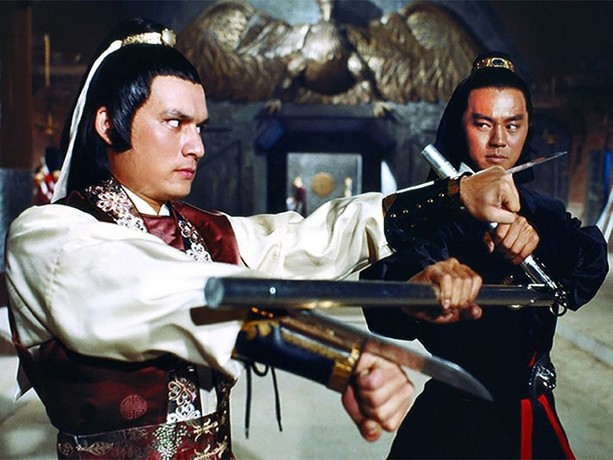
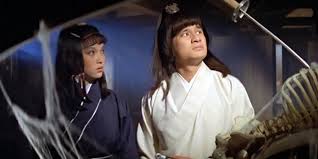
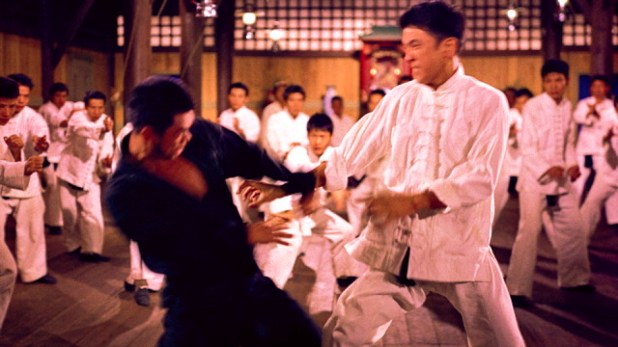
Eagle Chief Yoh Xi-Hung (Ku Feng) leads Iron Boat Clan, a gang made up of orphans that he has raised to be his personal army — Eagles — of killers. His toughest “son” is Chik Ming-sing (Ti Lung), who loves combat. After being injured by Golden Spear Tao De-biu, he nearly dies and is nursed back to health by the family of lawman Wang An. Now, Chik Ming-sing sees that the life he has known since he was a child is a lie. He deserves love and to have a family.

Of course, the Iron Boat Clan then kills Wang An and Chik Ming-sing is targeted by them. As he wanders, he meets wrist knife fighting master Cheuk Yi-fan (Alexander Fu), who wants to destroy the Iron Boat Clan for killing his wife and children. He suspects Chik Ming-sing, but they make a good team as they both starts to fight back against the gang. Things take a turn when Chik Ming-sing reveals that he killed a man’s wife years ago — guess who? — and wants to be killed by that man to atone for his crime.

Of course our heroes get their revenge, even if Yoh Xi-Hung attempts to turn them against one another. The end, however, is still surprising and poignant, as our heroes are honor bound and have a path that they must follow. The last fight is astounding and both lead characters are so worthy of a movie on their own. Together, this is perfect.

Directed by Chung Sun, this movie knocked me out. Everyone’s weapons, from Yoh Xi-Hung’s claws and Chik Ming-sing’s staff to Cheuk Yi-fan’s wrist blades are so unique to each character and perfectly used. I can’t wait to watch this again.

This was remade in 1993 as The 13 Cold-Blooded Eagles.

The Sizzlin’ Something Weird Summer Challenge 2024: Let Me Die a Woman (1977)

Doris Wishman week (July 21 – 27) Doris made the loopiest of movies. A self-proclaimed prude who made nudist camp movies, her filmography is filled with contradictions. When she tried to be mean spirited with something like Bad Girls Go To Hell there was always an undercurrent of silliness and fun, but when she tried to be silly and fun in things like Keyholes Are For Peeping there was an underlying seediness and grime that couldn’t be wiped off. It’s hard not to love her!  

I’ll go anywhere Doris Wishman wants to take me.

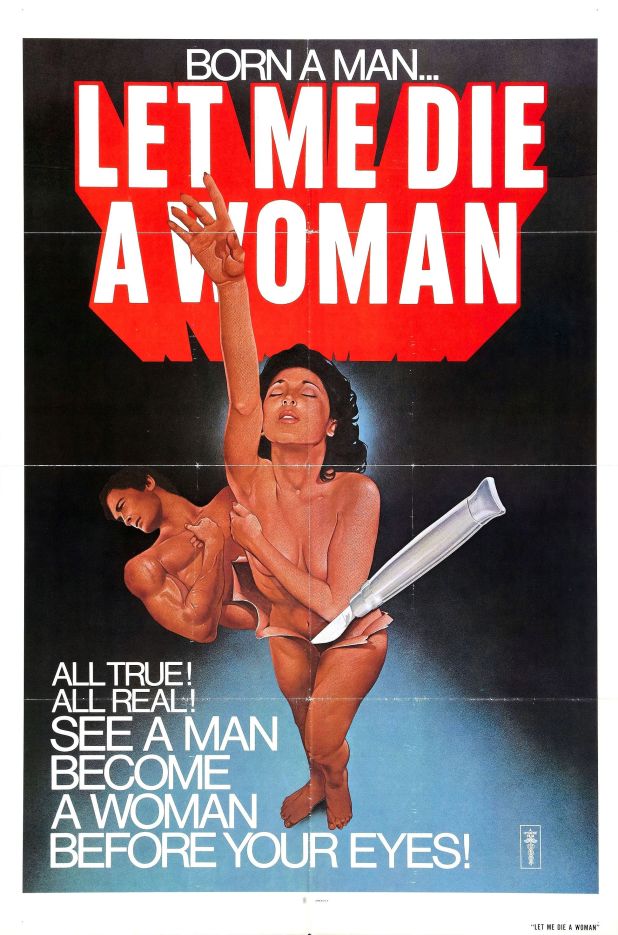
Doris is able to be so many directors in her approach and yet remain herself. Here, she’s in the worlds of Ed Wood and Kroger Babb, making a movie that says that it wants to educate you, but really wants to show you graphic surgery of a man’s penis being sliced into a vagina in full detail. In fact, this same footage was used for the South Park episode “Mr. Garrison’s Fancy New Vagina.”

It features Dr. Leo Wollman, founder of the Harry Benjamin International Gender Dysphoria Association, now the World Professional Association for Transgender Health, which wrote its first Standards of Care for transgender health care. He was also the science and medicine advisor for this movie. You also get interviews and moments with other transgender individuals, include Deborah Hartin, who transitioned in 1970 and became one of the first divorces due to transitioning. She also sued the New York City Department of Health and Mental Hygiene for refusing to update her sex designation on her birth certificate.

Wishman started filming this in 1971 and debated titles like Adam or Eve and Strange/Her. Then she found Leslie, an attractive trans person who would provide the main interview in this film, yet seems to hate nearly every other trans person she’s ever met, even comparing herself at one point to Anita Bryant. This movie has a total Yin/Yang-ness to it; for every positive thing, there’s something truly deranged or negative. You get Dr. Wollman leading a support group in the same movie where there’s a re-enactment where a trans woman can’t wait for her new vagina to heal, so she sleeps with a cab driver and sprays blood between her thighs in graphic detail. And oh yeah, the cab driver? That’s Harry Reems sleeping with Arlana Blue, who was also one of the caged victims in Bloodsucking Freaks, the second murder victim in Massage Parlor Murders! and an adult actress who was in Invasion of the Love DronesThe Vixens of Kung Fu and Joe Sarno’s Confessions of a Young American Housewife.

There’s also a moment where a man uses a sharp blade and a hammer to attempt to remove his member, while you watch. And yes, that is Vanessa Del Rio and if you picked that up without IMDB, I’d shake your hand, but neither of us wants to know where our hands have been for so many years. And that john who gets picked up in the park? That’s Richard Towers, who used the name Greg Reynolds in Deadly Weapons, Tony Armada in Keyholes Are for Peeping, Joe Powers in Fleshpot on 42nd Street and Gaylord St. James when he played Dr. John Collingwood in Last House On the Left.

This ends with a long chroma key sex scene at the end that feels like the kind of images that Black Sabbath would perform in front of on a European variety show and then we’d watch it ten years later on Headbanger’s Ball.

I have no idea how to rate this movie. As a documentary, it’s not good. As trash, it’s amazing. I also understand that this is — at best — an embarrassing film for the trans community to watch. Yet without movies like this and Glen or Glenda, some audiences would have no experience with this community. Part of me would like to think this film’s heart is in the right place, but then again, this is also a movie padded out with softcore inserts. It really is almost a singular film, in the same way — oxymoron, anyone? — that Goodbye Uncle Tom is also trash yet is a fascinating document of how far you can push it.

I mean — when the weirdest part of your movie isn’t a penis gun that shoots fluid and that’s said to be an actual medical device — you know that this is the kind of thing you have to experience.

You can download this from the Internet Archive.

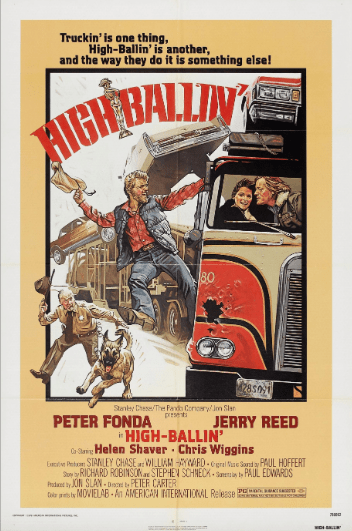
CBS LATE MOVIE MONTH: High Ballin’ (1978)

EDITOR’S NOTE: High Ballin’ was on the CBS Late Movie on May 15, 1981.

“Iron Duke” Boykin (Jerry Reed) is an independent trucker dealing with “King” Carroll (Chris Wiggins) and his gang, led by Harvey (David Ferry), who are trying to get every big rig driver to be part of his company. He’s joined by Rane (Peter Fonda) and Pickup (Helen Shaver) in an attempt to bring whiskey to a labor camp, thereby making enough money to be free of the monopoly.

But when Boykin is shot and Pickup is captured, Rane has to fight the gang with a posse — this movie is pretty much a Western with trucks instead of horses — and go one-on-one with Harvey.

Set in the U.S. but shot in Toronto, this also was released on video as Death Toll, which is a way more serious title.

Director Peter Carter also made Rituals and The Intruder Within, so he’s good in my eyes. It’s written by Paul F. Edwards, Richard Robinson (Kingdom of the Spiders) and Stephen Schneck (Welcome to Blood City). This has an amazing action scene with Rane launching cars off a truck onto the gang chasing Duke, as well as a tire iron fight outside a truck stop. Best of all, this was called Convoy II in some countries.Plus Clint Howard and Michael Ironside! How can you go wrong with all of these elements, as well as Jerry Reed singing the theme song, the same house at the beginning of Smokey and the Bandit in this opening and the stars of Smokey and Easy Rider teaming up?

You can watch this on Tubi.

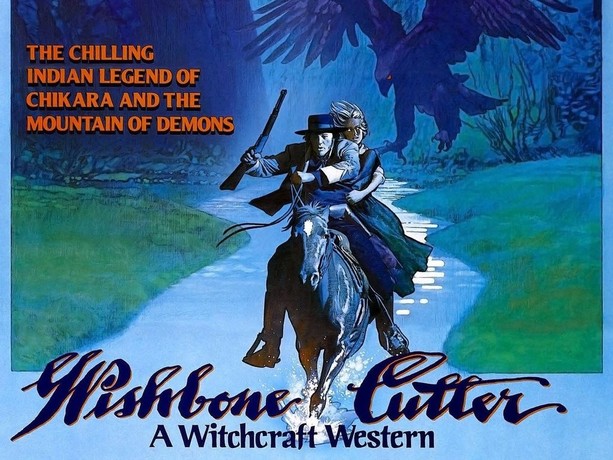
CBS LATE MOVIE MONTH: The Shadow of Chikara (1978)

EDITOR’S NOTE: The Shadow of Chikara was on the CBS Late Movie on May 25 and August 12, 1983. It played as Wishbone Cutter

Earl A. Smith was the writer of The Legend of Boggy Creek and The Town That Dreaded Sundown, but he only directed this one movie.

It’s a Western horror, which is rare, and one that places Confederate soldier Wishbone Cutter (Joe Don Baker, who yes, was a 70s lead and near sex symbol) into a treasure hunt after he learns of a cave filled with diamonds from dying soldier Virgil Caine (Slim Pickens).

Wishbone assembles a team that includes Amos Richmond geologist (Ted Neeley, once Jesus Christ), Native American Half Moon O’Brian (John N. Houck Jr.) and eventually Drusilla Wilcox (Sondra Locke), a woman they find after a massacre. The Arkansas mountain is guarded by a demon bird, so of course everything gets strange by the time they get there. Wishbone is already haunted as his wife Rosalie (Linda Dano, who was on more than 1,300 episodes of Another World) has left him for a Yankee soldier.

Wilcox claims that the men that killed her people were silver naked beings and O’Brian claims that they’re being attacked by demons. The movie never gives in and reveals to you what it’s really all about and for that, I like it even more. It’s also got the same crew that Charles B. Pierce used, so it gets the authentic Arkansas rough feel down right. Even the ending makes little to no sense, but hey, I kind of adore that.

The only downer I’ll reveal is that there’s a lot of real animal abuse in this, as several horses plunge off a cliff and I have no idea if any survived. Just know that going in.

On the positive side, somehow, the filmmakers got The Band to let them use “The Night They Drove Old Dixie Down.”

Also known as The Ballad of Virgil Cane, Thunder MountainWishbone CutterThe Curse of Demon Mountain, Demon Mountain and Shadow Mountain, this is a movie that combines the end of the Western 70s darkness with occult themes and a relentless downer edge. I’d never seen it before and it’s definitely a film I plan on exploring again.

You can watch this on Tubi.

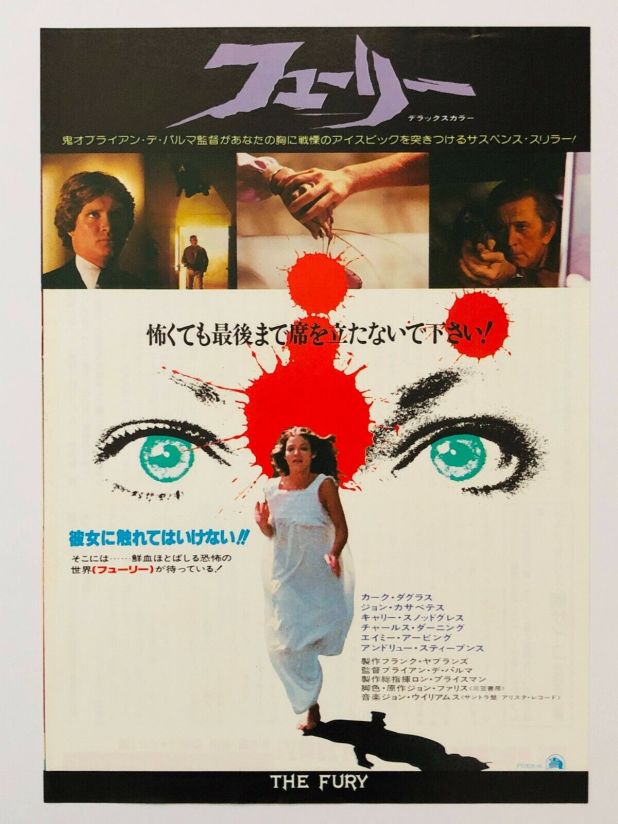
CBS LATE MOVIE MONTH: The Fury (1978)

EDITOR’S NOTE: The Fury was on the CBS Late Movie on September 6, 1985.

Roger Ebert said of this movie, “I’m not quite sure it makes a lot of sense, but that’s the sort of criticism you only make after it’s over. During the movie, too much else is happening.”

Ex-CIA agent Peter Sandza (Kirk Douglas) and his psychic son Robin (Andrew Stevens) meet up with Ben Childress (John Cassavetes), one of Peter’s old spy friends. Peter is leaving the life behind, but Ben is prepared. He stages a terrorist attack that nearly kills his supposed friend and takes his son away.

Across the world, student Gillian Bellaver (Amy Irving) learns that she has powers of her own. She can barely control them, so she goes to the Paragon Institute, a front for the same organization that Childress is running, one that kills parents and takes their psychic teens away to make them into weapons for the U.S. government. Thanks to having a girlfriend (Carrie Snodgress) on the inside, Peter starts to track down his son.

Gillian grows in power and soon meets Robin psychically. Childress determines that she knows too much, so he plans to eliminate her, while Peter plans on following her to find his son. Working with Dr. Susan Charles (Fiona Lewis, between this and Strange Behavior not someone I would trust with my teenage child), they have successfully transformed Robin into a killing machine. That said, he can’t be controlled and his abilities have already caused one mass homicide at a theme park.

As Peter and Gillian break into Childress’ mansion, Robin goes full-on mental and thinks that PSU wants to replace him with Gillian. He kills his handlers and even tries to murder his father, who tries to keep him from falling. When he responds by scratching Peter’s face and causing his own death. Seeing his son dead, the old agent decides life isn’t worth living and he kills himself.

As he lies dying, he gives Gillian all of his power, power she soon uses to cause Childress to bleed from the eyes and then to literally blow up. It’s one of the wildest stunts ever and one that took two tries. De Palma told The Talks, “I had 8 or 9 high-speed cameras and he explodes. He explodes. And the first time we did it, it didn’t work. The body parts didn’t go towards the right cameras and this whole set was covered with blood. And it took us almost a week to get back to do take two.”

How was this achieved? In the same interview, the director said, “Nobody had ever done this before. I had these incredible high-speed cameras that the astronauts use and about three of them jammed because they were going so fast. They were all shooting super, super slow-motion – this is in the ’70s – and then it’s all over and you look around and the set is completely in shambles.”

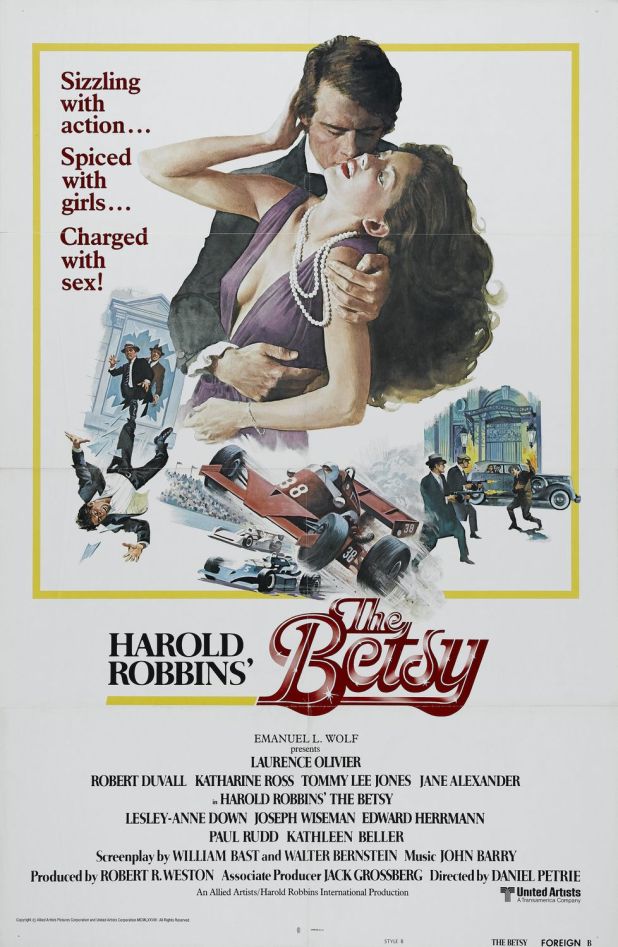
CBS LATE MOVIE MONTH: The Betsy (1978)

EDITOR’S NOTE: The Betsy was on the CBS Late Movie on September 15, 1982.

Based on the Harold Robbins book, directed by Daniel Petrie (Bronco and BillieSix PackFort Apache the Bronx) and written by William Bast and Walter Bernstein, this is the story of Loren Hardeman Sr. (Laurence Olivier) and the car that will bring his company back to glory, named for his great-granddaughter (Kathleen Beller). This goes against what his grandson (Robert Duvall) thinks the company’s future is. It’s also about the loves of race driver Angelo Perino (Tommy Lee Jones) and a special fuel that will power The Betsy.

In The Golden Turkey Awards, Harry and Michael Medved said of this movie: “Another Harold Robbins book bites the dust as a wretched, melodramatic film. Lord Laurence Olivier’s attempt at a Texas twang is a hilarious flop, as is his incestuous relationship with his daughter-in-law, Katharine Ross.”

Jokes on you, Medveds, that’s just cucking your son, not incest. It’s also a scene where the homosexual son of the elder Loren shoots himself in the head while the young version of the grandson Loren watches, then goes upstairs to tell his mom, who has grandpa between her thighs.

That’s Harold Robbins, right?

Well, in the world of this movie, it’s an actual choice between Kathleen Beller and Lesley-Anne Down. Come on, Tommy Lee Jones!

CBS LATE MOVIE MONTH: Patrick (1978)

  • EDITOR’S NOTE: Patrick was on the CBS Late Movie on August 26, 1983 and March 2 and August 9, 1984.

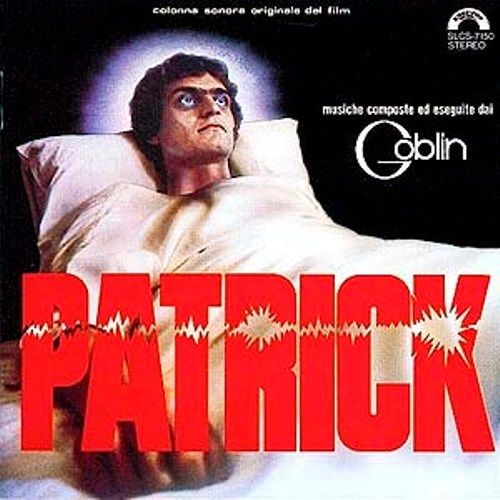
Directed by Richard Franklin (Psycho IIRoad Games) and written by Everett De Roche (Race for the Yankee ZephyrHarlequin), Patrick opened the world to the genre of Ozploitation. While the Australian score was by Brian May, the Italian cut was scored by Goblin. In fact, it did better internationally than in Australia, even if the U.S. version dubbed over all of the accents.

Patrick (Robert Thompson) hasn’t left his hospital bed or closed his eyes in three years. After killing his parents, he’s been in a coma in a private hospital, never keeping the same nurse for long. Now, Kathy Jacquard (Susan Penhaligon) has taken the job, hoping that it will help her finally divorce her husband Ed (Rod Mullinar).

According to Dr. Roget (Robert Helpmann), Patrick is being kept in his care to explore life and death. Never mind that other patients have seen him fly out of his window. He can also kill people from afar, like when he tries to drown Dr. Brian Wright (Bruce Barry) when he tires to pick up Kathy, who he has been communicating with via spitting and spirit typewriting. Strangely, her only ally end up being Matron Cassidy (Julia Blake), the same woman who was tough on her at the beginning of the movie.

Yes, Quentin Tarantino admits that he took the paralyzed in bed spitting scene in Kill Bill Vol. 1 from this movie. He has also said that “Hitchcock was overrated but you know who was better? Richard Franklin.” and stated that Road Games is his favorite Australian movie.

Soon, Patrick is showing her that he can still feel — his erection is how he does it — and that the hospital is trying to kill him with electroshock therapy. By the end of the movie, he’s making her choose between her ex-husband or him as she injects him with potassium chloride and is linked to his mind as he passes on.

Maybe not. After all, he leaps from the bed while dead — a scene that the filmmakers started with and worked backward from, unlike the modern horror movie creators who have no idea how to close their stories — and his eyes reopen after his death.

Two years after this, the Italians made Patrick Still Lives, a truly baffling sequel that took the basic ideas of this movie — the same story, I can admit it — and infused it with near pornographic levels of sex and violence. It’s just as incredible as that sentence makes it sound. There was a remake in 2013 that I need to see but what I wish was filmed was Franklin and De Rouche’s sequel idea, Patrick II: The Man Who Wasn’t There. A religious cult would dig up Patrick and he would be in a coma, at which point he’d start being obsessed about another young lady.

The poster has a great tagline: ”I saw a man upon the stair, I looked again, he wasn’t there. He wasn’t there again today, I wish that man would go away.”