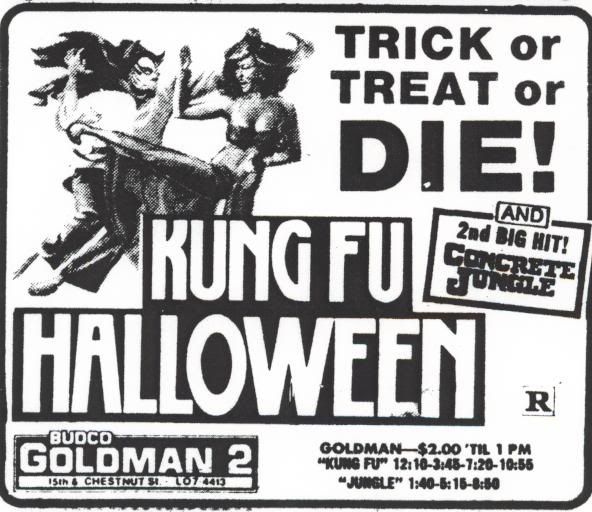
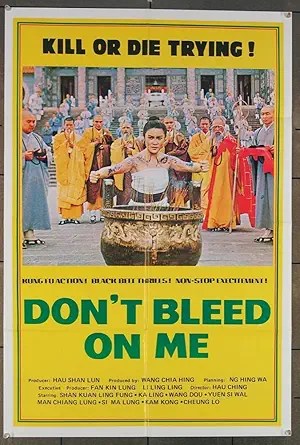
Shi da zhang men chuang Shao Lin (Shi, The Founder and Grandmaster of Shaolin) came to America under a bunch of titles: Fight for Survival, Fight for Shaolin Tamo Mystique, Lady Wu Tang, and Don’t Bleed on Me. And oh yes, the best title of all, Kung Fu Halloween.
Directed and written by Cheng Hou, this begins with ten martial arts masters stealing the books of Shaolin to learn all its secrets. At the same time, Shi Fu Chun (Polly Jean Kwan) has been demanding to be taught at the school and has been refused because she is a woman. A former teacher, Lin Chiu, shows them their lessons and tasks them with getting all ten books back. Along the way, she gets to throw her legs and arms out all stretch-style as if she were Dhalsim. Throw in an all gold monk, goofball helpers, a ton of animal kung fu styles and Shi Fu Chun becoming a man thanks to a style that must be negated with Negative Kung-Fu. The master has forgotten this style, so he fakes his own death, leaving our heroine stuck with a mustache for some of the movie. She also does the “pick up the blazing pot and get the dragon tattoo,” as if she were Caine on Kung-Fu.
There are some negative reviews on this, as it takes some time to get going. Ignore those reviews. This has a tiger man, a happy-laughter ending that turns tragic, and, of course, Polly Jean Kwan being an ass-kicking instrument of martial violence. I really wish that this were ten movies, one for each book, and not just this one movie. If I were a kid, I’d be drawing comic books of this all day in school instead of paying attention. As it is, I’ll be doing the same thing except at work.
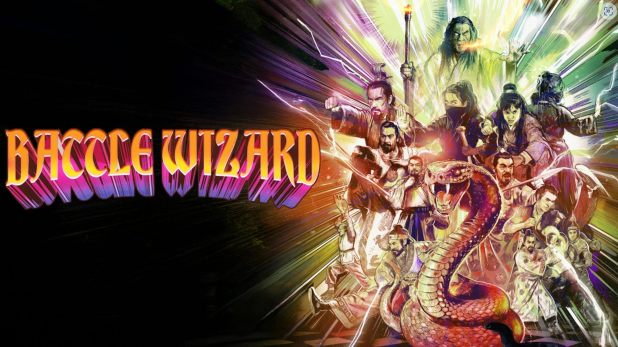
Adapted from Louis Cha’s Demi-Gods and Semi-Devils — the same novel that inspired Sakra — this has just 73 minutes to blow your mind and does it so many times.
Duan Zhengchun (Si Wai) has been caught in the bed of Qin Hongmian (Gam Lau), who he has already made pregnant, and uses his family’s martial arts technique — it’s a laser finger! — to cut off her husband’s legs. Twenty years from now, that man (Shut Chung-Tin) swears he will have revenge.
As fate and this movie would have it, twenty years into the future, we meet Duan’s son, Prince Duan Yu (Danny Lee). He hates violence and has promised to never learn martial arts, but he’s soon in the middle of the martial world, a place where the man his father cucked has a mechanical body with chicken legs and lives in a cave with a mutant, clawed fighting machine of a henchman.
Prince Duan Yu, no fighter yet, is protected by the snake-handling Ling-erh, who paints symbols on snakes and uses them in combat. He also meets a masked witch named Xiang Yaocha, who demands that any man who sees her face must marry her. You just know that our hero will see her naked mug and end up betrothed, but did you guess that she’s his half-sister?
How does one learn to fight in under 73 minutes? First, drink the blood of a large red snake, then swallow a poison frog whole. That’s how you get strong enough to rip the arm off a killer gorilla and go one-on-one with the Poisonous Moths Gang. Imagine Big Trouble In Little China, but with even less worry about making sense.
The Arrow Video release of this film, part of the Shaw Scope Volume 4 set, features a high-definition (1080p) Blu-ray presentation, newly restored in 2K from the original negatives by Arrow Films. It has commentary by Jonathan Clements, author of A Brief History of the Martial Arts. You can get this set from MVD.
Bill from Groovy Doom and Drive-In Asylum always jokes about movies where nothing happens as being his favorite movies. If that’s true, he must absolutely adore this movie.
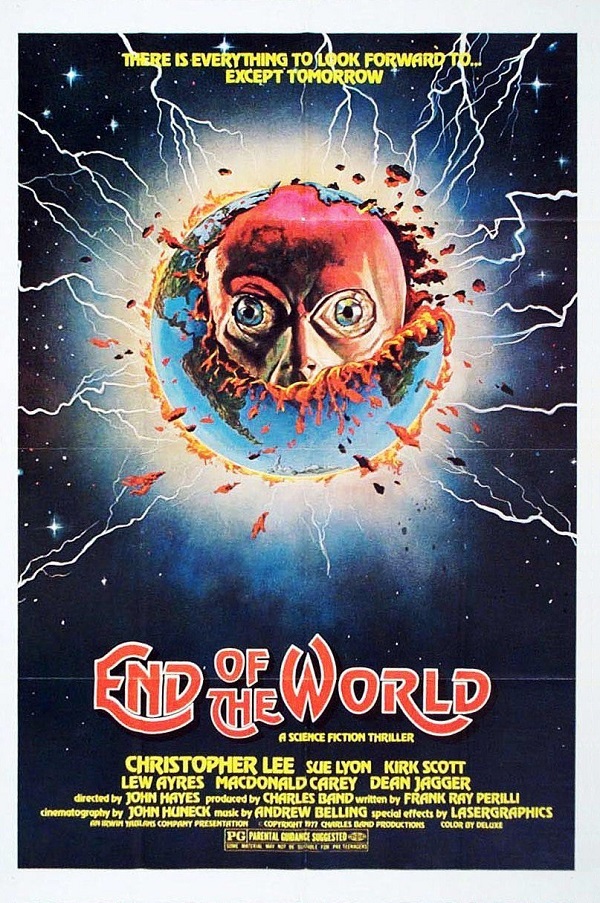
Christopher Lee, the main selling point of this movie, said, “Some of the films I’ve been in I regret making. I got conned into making these pictures in almost every case by people who lied to me. Some years ago, I got a call from my producers saying that they were sending me a script and that five very distinguished American actors were also going to be in the film. Actors like José Ferrer, Dean Jagger, and John Carradine. So I thought “Well, that’s all right by me”. But it turned out it was a complete lie. Appropriately the film was called End Of The World.”
The film opens with a shaken Lee as a Catholic priest trying to get to a phone call. All hell breaks loose and a diner is destroyed, with the owner blinded by coffee before being killed and the pay phone being blown up. Turns out that Father Pergado is due to be replaced by the alien Zindar. Good start. And it was the trailer, filled with science fiction machines and evil nuns that got me interested in this picture!
Professor Andrew Boran discovers radio signals that predict natural disasters. He and his wife investigate, discovering that they come from a convent where aliens have taken over. The aliens want him to join them, as the Earth is too diseased to exist.
The leads are wooden and only seem to want to have sex with one another, yet there are no love scenes. They’re utter failures at being heroic and simply move the plot along to its conclusion, where we learn that the Earth is filled with glitter. It blows up real good!
There are some ridiculous moments, such as Lee’s true form and seeing nuns operate supercomputers. Seriously, if I just read the description of this movie, it’d sound like everything I love. But seeing the execution leaves a lot to be desired.
Each October, the Unsung Horrors podcast does a month of themed movies. This year, they will once again be setting up a fundraiser to benefit Best Friends, which works to save the lives of cats and dogs across America, giving pets second chances and providing them with happy homes.
ABOUT THE AUTHOR: Adam Hursey is a pharmacist specializing in health informatics by day, but his true passion is cinema. His current favorite films are Back to the Future, Stop Making Sense, and In the Mood for Love. He has written articles for Film Eastand The Physical Media Advocate, primarily examining older films through the lens of contemporary perspectives. He is usually found on Letterboxd, where he mainly writes about horror and exploitation films. You can follow him on Letterboxd or Instagram at ashursey.
Today’s theme: Physical Media
We want Dr. Pepper! We want Dr. Pepper! We want Dr. Pepper!
Obnoxious, relentless children are enough to make you literally snatch your wig, grab the longest knife you can find, and chase them around the room. Whether you are feeling some very delayed side effects from some LSD you dropped 10 years ago or not.
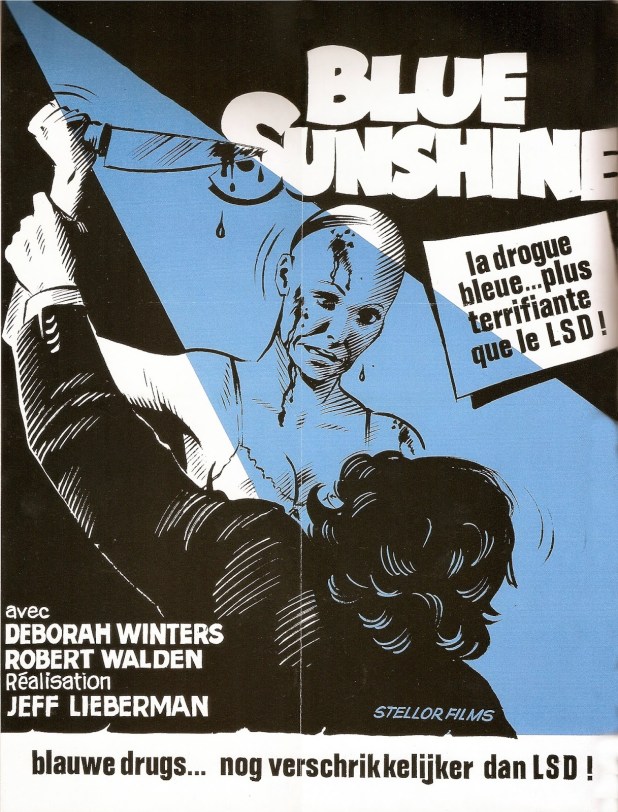
Blue Sunshine has been floating around on my watchlist for a while now. I really had no idea what the plot of this film was though. I only knew the film from the poster—the bald-headed lady standing in front of what appears to be a blue moon. Really no clues are given as to what happens in the film.
As it turns out, Blue Sunshine is closer to a political paranoia conspiracy thriller like Three Days of the Condor than a traditional horror film. A small group of seemingly unrelated people are experiencing hair loss followed by severe homicidal tendencies. Jerry Zipkin (Zalman King—we’ll circle back to him) witnesses an attack by a friend inflicted with this seemingly acute psychosis, but becoming the accused murderer in the process. Out to solve the mystery and prove his own innocence, Jerry discovers that the cause may be linked to an LSD variant named Blue Sunshine that was distributed at Stanford a decade prior.
I cannot say that I’ve ever seen a Zalman King performance before. I definitely know the name for the Red Shoe Diaries series on Showtime back in the 1990s. I cannot say that I watched much of that show (or at least you won’t get me to admit it), but when I saw King’s name appear during the opening credit sequence of Blue Sunshine, I immediately checked my phone to make sure this was the same person.
King has a cinematic presence. He most definitely has cinematic hair. But I cannot think of anyone else like him. Well, I actually did read someone’s review on Letterboxd that compared him to the recurring Red Shoe Diaries actor David Duchovny. That tracks.
Again, Blue Sunshine is not your typical horror film, although there are some horrific things that happen. It feels political due to a main character who is running for Congress, but I did not make any connection to Edward Flemming’s (Mark Goddard) ambitions and his past of LSD hippie. I kind of expected more of a link to his past, but I don’t think he knew what was going on. Honestly, that lack of awareness would suit him well for politics.
There are a couple of aspects of the film that I could not help but comment upon. There is a low-speed car chase involving a Ford Bronco. And, at the end of the film, Flemming is making a campaign speech promising to “Make America Good Again”. He’s going to need to up his game to greatness if he is going to truly succeed. Or maybe just put that Blue Sunshine in the water supply and see what happens.
I watched this one on the Synapse 4K release. Synapse always does a spectacular job in their restorations and releases. They do not release films very often these days, but when they do, I almost always pick them up.
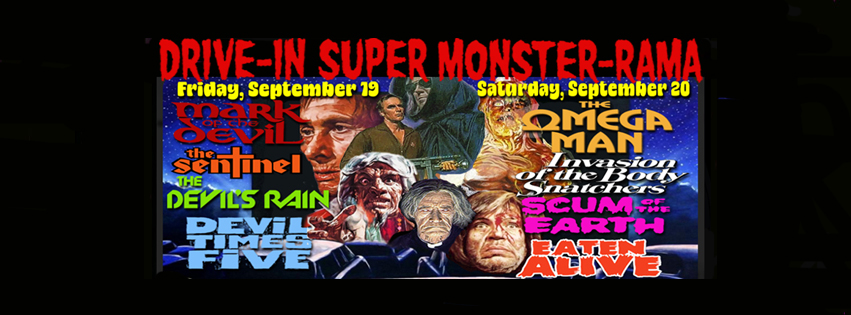
September Drive-In Super Monster-Rama is back at The Riverside Drive-In Theatre, September 19 and 20, 2025. Two big nights with four feature films each night include:
Friday, September 19: Mark of the Devil, The Sentinel, The Devil’s Rain and Devil Times Five
September 20: The Omega Man, Invasion of the Body Snatchers, the Grindhouse Releasing 4K restoration drive-in premiere of S.F. Brownrigg’s Scum of the Earth and Eaten Alive
Admission is $15 per person each night (children 12 and under – accompanied by an adult guardian – are admitted free). Overnight camping is available (breakfast included) for an additional $20 a person per night. Advance online tickets (highly recommended) for both movies and camping here: https://www.riversidedrivein.com/shop/
Tobe Hooper followed up The Texas Chainsaw Massacrewith another film that explored the horror and depravity prevalent in South Texas.
The Texas Chainsaw Massacre co-writer Kim Henkel was inspired by Joe Ball, the Alligator Man, who owned a live alligator attraction in the 1930s. Despite being suspected of several murders, legend had it that Ball would feed the dead women to his alligators. Ball started as a bootlegger before opening his Sociable Inn in Elmendorf, Texas, which was surrounded by a pond where he’d charge people to watch him feed live cats and dogs to them. After former girlfriends, barmaids and even his wife went missing, two policemen tried to question him. He pulled a gun and shot himself — either in the head or the heart. That said, many believe the stories about Joe Ball to be simply Texas folklore. He did exist, though.
Working under the title Death Trap (the film is also known as Horror Hotel and Starlight Slaughter), the entire film was shot on a soundstage, utilizing the Raleigh Studios pool as a swamp. This enabled Hooper to create what he called a “surrealistic, twilight world.” True to form, issues with the producers took him away from the film before the shooting ended, but he had a decent relationship with the actors. Cinematographer Robert Caramico finished directing the film once Hooper left.
This movie starts grimy and stays that way. Buck (Robert Englund in an early role) demands kinky sex from Clara Wood (Robert Collins, Matilda the Hun from Death Race 2000!), who refuses. This scene contains the line, “I’m Buck and I’m here to fuck,” a line that Quentin Tarantino used in Kill Bill.
No one says no in Miss Hattie’s (Carolyn Jones, who is better known as Morticia Addams!) house of women, so Clara is kicked out. One of the girls takes pity and gives her money to stay at the Starlight Hotel, a rundown motel in the swamp. There, she meets the owner, Judd (Neville Brand, famous for playing Al Capone in The Untouchables TV series and The George Raft Story), who we soon learn is a demented sex maniac. He attacks her, chasing her into the swamp, where a Nile crocodile eats her. Yep — don’t get too attached to anyone here. This is very Psycho territory, where bad people meet even worse ends.
A couple soon arrives-aye (Marilyn Burns, The Texas Chainsaw Massacre) and Roy (William Finley, Winslow Leach from Phantom of the Paradise), along with their daughter Angie (Kyle Richards, Lindsey Wallace from HHalloween) and their dog, Snoopy. Don’t get attached to Snoopy, who isn’t long for this world. As Angie finds a dead monkey and screams, the dog runs into the swamp w, here he is eaten. Roy goes to kill the gator, but is stabbed by Judd’s scythe. Then, the insane motel owner ties Faye to the bed and tries to grab Angie, who hides under the porch of the building.
Harvey Wood (Mel Ferrer, The Visitor, The Antichrist and first husband of Audrey Hepburn) arrives with his daughter, Libb, looking for Clara. Sheriff Martin (Stuart Whitman, Guyana: Crime of the Century, The Monster Club, Ruby) helps them as they search for Harvey’s runaway daughter. Libby goes out with the sheriff while Harvey stays back at the hotel. As he finds Faye tied to the bed, he’s also killed by Judd and his scythe.
The sheriff kicks Buck out of the bar — remember him? — and he goes to the Starlight with his underage girlfriend. While they’re having sex, they hear a scream. Buck discovers Faye, but is pushed into the swamp where he is devoured.
Finally, Libby comes back and saves her sister and Angie. Judd goes insane and chases them into the swamp, where he’s eaten by his own gator. Or crocodile — the movie is never sure.
I’ve always joked that Rob Zombie is continually trying to remake The Texas Chainsaw Massacre 2. After watching this, I get the feeling that this is the movie he wants to make. It’s covered in a layer of filth from beginning to end, with characters coming and going, people getting killed horrifically and style triumphing over coherent plot. Even better, there’s a mix of actors that you instantly recognize playing some significant roles, particularly Neville Brand, whose muttering insanity is total perfection. There’s also an excellent electronic score that really sets the mood — even ending in a crash after the final credits.
True to his promise, Hooper delivers a film that feels like a nightmare throughout. Its dream logic makes for an occasionally funny, often grotesque movie that is never boring.
Here’s the episode of the podcast about this movie.
Here’s a drink!
Starlight Slaughter Swamp Water
2 oz. tequilla
3 oz. Midori
.25 oz. blue curacao
3 oz. sour apple pucker
2 oz. sweet and sour mix
3 oz. lemon-lime soda
Add tequila, Midori, sour apple pucker and sweet and sour mix to a shaker filled with ice. Shake it up, then pour into a glass. Pour in lemon-lime soda and top with the blue curacao.
September Drive-In Super Monster-Rama is back at The Riverside Drive-In Theatre, September 19 and 20, 2025. Two big nights with four feature films each night include:
Friday, September 19: Mark of the Devil, The Sentinel, The Devil’s Rain and Devil Times Five
September 20: The Omega Man, Invasion of the Body Snatchers, the Grindhouse Releasing 4K restoration drive-in premiere of S.F. Brownrigg’s Scum of the Earth and Eaten Alive
Admission is $15 per person each night (children 12 and under – accompanied by an adult guardian – are admitted free). Overnight camping is available (breakfast included) for an additional $20 a person per night. Advance online tickets (highly recommended) for both movies and camping here: https://www.riversidedrivein.com/shop/
My teachers and guidance counselors in high school told me, explained to me, screamed at me: “You’ll never learn anything being obsessed with all of these horror movies!”
I would argue that I have learned plenty, and 1977’s The Sentinel would be my doctoral thesis in “I Live My Life by What I Learned from 1970s Satanic Horror Movies.”
Lesson one: All models live dissolute lives and are mere seconds from an outburst; avoidance recommended.
When we meet Alison Parker (Cristina Raines), she’s a busy New York model. She’s gorgeous. And she’s always batshit crazy, suffering strange psychosomatic issues such as night terrors, insomnia and random flashbacks to all of the times she tried to kill herself. After she moves into a spiffy Brooklyn brownstone — because she wants to see if she can live on her own and not with her wealthy boyfriend, Michael (Chris Sarandon, more on him later). Right away, she starts hearing random noises and meeting people who don’t exist.
That all leads to work-related trauma, as she often passes out while modeling and ends up in the hospital. A young, pre-Law and Order Jerry Orbach is having none of her shenanigans, asking if they can just move her and give her clothes to another model.
Oh yeah — she also hated her dad, who just died. Her first suicide attempt came after she walked in on her ancient pa playing with an entire roomful of prostitutes. And it turns out that her boyfriend is being investigated by the police (played by Eli Wallach and a super young Christopher Walken) for killing his wife. Whew! Needless to say, she’s gorgeous but doesn’t have issues. She has subscriptions.
Lesson two: Catholic priests have crazy secrets that will implode your fragile secular mind.
Only one person — supposedly — lives in the building with Alison: Father Halliran (“Skinny Dracula” himself, John Carradine), a priest so blind that his eyes have gone whiter than Emily from The Beyond. All he does is sit in front of his window and stare into the void. Turns out that Alison’s new home is really owned by a secret society of excommunicated Catholic priests — all the cool ones are — and they guard the gateway to Hell. And that gateway? Yeah, it’s right here in the building. And Father Halliran is the Sentinel, the blind guardian of the abyss.
Why is Alison there? They’ve chosen her because with two suicide attempts, she’s the perfect candidate. The only way she can get to Heaven is by becoming the next Sentinel, because Halliran is ready to die, Biggie style.
Lesson three: If you are in a 1970s Satanic horror movie, DO NOT trust old Hollywood stars.
Alison’s neighbors may start off nice, but they’re all demented. Like the two leotard-wearing ladies who invite her for tea, then begin rubbing themselves like some demented exercise video, while Alison just tries to drink her tea. Seriously, this scene — it should be for shock or titillation — but it’s one of the unsexiest, most hilarious, take this movie out of the DVD player moments I’ve witnessed in a long time. Keep in mind — Beverly D’Angelo of the National Lampoon’s Vacation films plays one of them, the other is Sylvia Miles from Midnight Cowboy.
But it’s old Hollywood royalty that you really need to watch out for. Like Ruth Gordon and Ralph Bellamy in Rosemary’s Baby, Burgess Meredith’s Charles Chazen starts nice, but it turns out he leads the minions of Hell. At least he has a cool cat, right? He has an insane birthday party that Alison runs from, finally telling her real estate agent that the people in the building are driving her insane. Again, turns out no one else lives there. No one else but old Hollywood folks is ready, willing and able to help the cause of Satan. Like the aforementioned real estate lady, played by Ava Gardner. Or José Ferrer, wandering around in a red robe. If someone you recognize from a 1940s flick offers you some tannis root, just say no.
Oh! I almost forgot Psycho’s Martin Balsam is in this as Professor Ruzinsky!
Lesson four: If you are the hero or heroine of a 70s Satanic horror movie, you’re fucked.
Lesson five: Never, ever trust Chris Sarandon — not even in the slightest way
Michael tries to help Alison, discovering the big secret of this film. He breaks into a church office and discovers that the moment people with suicide attempts disappear, they show up as priests assigned to this building. What you don’t find out is that he dies — off-camera — and becomes one of the demons who tries to convince Alison to kill herself and bring Helllll to our world. And just why is he a demon? Because, of course, he killed his wife.
But if you’re aware of Mr. Sarandon’s movie history, you shouldn’t be surprised. The guy is Jerry Dandrige from Fright Night, after all, a vampire who literally fucks with Charley Brewster to his face, in front of his mom, before killing and stealing his best friend and having vampire sex with his girlfriend. As if that dick turn wasn’t enough, Prince Humperdink in The Princess Bride spends an entire movie two-facing the titular princess.
Any time I see Chris Sarandon in a movie, I instantly put up my bullshit filter. I will not trust the man — despite the fact that he’s also the voice of Jack Skellington. If you are a character in a 1970s Satanic shockfest, I implore you to do the same.
Lesson Six: Avoid Michael Winner at All Costs.
I’m joking — I actually love a lot of his work despite the slapdash direction and general griminess of it all. His 70s output from Death Wish gradually becomes meaner and darker and stranger, with the exception of Won Ton Ton, the Dog Who Saved Hollywood. And with that movie — and its preponderance of aging Hollywood star cameos — there’s a good chance at least one of them will go all lesson three on you and slice a pentagram into your chest.
He courted controversy (and was more well known as a restaurant critic and England’s rudest man at the end of his life) here by making, well, an artistic choice. Instead of costumed demons, he simply hired real deformed folks to wander around. It’s either pretty unsettling — or totally awesome, depending on your mindset — to see a crazed Burgess Meredith commanding an army of tumored-faced and genetically challenged real folks to help a girl kill herself.
That said, Cristina Raines felt that Winner was a horror to work with. She claims that she was in tears nearly every day on the way to the set and refuses to watch this film, so as not to stir up any bad memories that remain.
If you follow the above rules, one would hope you survive your film plight. That said, the 70s were a horrible time to be alive, so there’s a very real chance that Satan will turn your happy ending into a downer one and we’ll all have to reflect upon it. Oh yeah — and I love this movie, simply because I grew up Catholic and would read The Pittsburgh Catholic to see which films were given the dreaded O rating, which condemned them for being morally offensive. Just look at the notable films so chastised and damned: Pink Flamingos, Dawn of the Dead, Barbarella, Billy Jack, The Wicker Man…so many films to adore!
EXTRA CREDIT ONE
The Sentinel was written by Jeffrey Konvitz, who gifted the world with the teen romp GORP and produced the sequels to BloodsportandCyborg. Speaking of sequels, he wrote one to this movie titled The Guardian (the alternate title was The Apocalypse) and holy shit — I’m just going to share the description verbatim: “She was the Sentinel, the living guardian of the gates of Hell. She was the sole barrier between humanity and the forces of satanic evil pent up since the Fall from Grace. Hers was the most terrible penance of all; chosen for her sins, she had been committed to a living death, a blind nightmare in which the only reality was the reality of her demonic adversary and the awful powers she had been endowed with to constrain Him. Now her penance is nearly up. For Monsignor Franchino, that means the resumption of the most dreadful task the Church has ever bestowed; once again, he, and he alone, must find and commit a new victor over the guardianship, knowing that at every step the powers of evil will battle to pervert the change-over. For the Prince of Darkness, it means a final chance to unleash his minions on the world and begin at last His long-awaited reign of evil. For Mankind it means…The Apocalypse.” I would watch the shit out of that.
EXTRA CREDIT TWO
If you’re looking for a film that hired Dick Smith just so they could push the R rating to the goriest of limits, this is a decent choice. Abusive dad ghosts get their noses shredded, eyes get decimated, blood explodes out of heads…it’s a shame that Smith didn’t get to create the actual demons!
EXTRA CREDIT THREE
Jeff Goldblum, Tom Berenger, and Richard Dreyfuss all appear in this, but blink and you will quite literally miss them.
EXTRA CREDIT FOUR
Michael Winner almost died from eating poisoned oysters, and his estate was questioned upon his death, as it was discovered he was paying for numerous ex-lovers. I think I’d rather watch a movie about his life than any movie he directed.
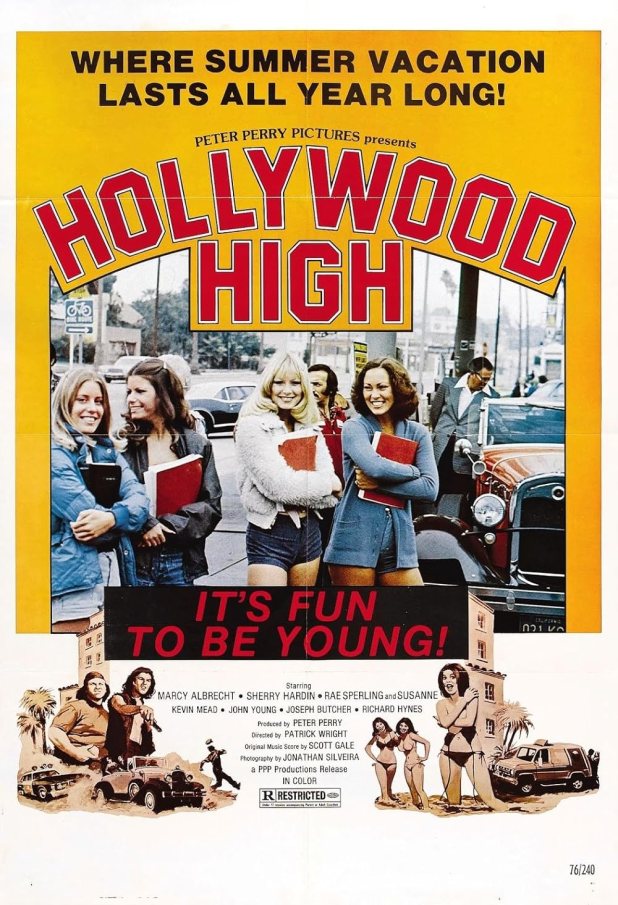
EDITOR’S NOTE: Hollywood High was on USA Up All Night on August 6 and October 7, 1994; May 19 and December 9 and 23, 1995;
“If that’s Charles Bronson, ask him if his tallywacker wants some poontang!”
For that line alone, I stayed with this movie.
Jan (Susanne Severeid, Don’t Answer the Phone) Candy (Sherry Hardin, Ten Violent Women), Monica (Rae Sperling) and Bebe (Marcy Albrecht) spend most of this movie topless and smoking the stickiest of the icky with Frasier Mendoza, hooking up with the Fenz (Kevin Mead; guess who he’s supposed to be) and Buzz (Joseph Butcher, not far removed from playing the latter side of Bigfoot and Wildboy, hanging out with sex symbol of the past June East (yes, Mae West, but played by Marla Winters), having classes with stereotype teachers like the mincing Mr. Flowers (Hy Pyke, Grandpa from Hack-O-Lantern) and the overly horny Miss Crotch (Kress Hytes) when they’re not being chased by a cop, who they eventually hit with a watermelon and take his pants off, revealing that he’s wearing lingerie.
This was directed by Patrick Wright, who often plays the larger truck driver men in movies like this. He also directed a TV movie, Southern Hospitality.
Turner Classic Movies notes the existence of an unrelated 30-minute television pilot, also debuting in 1977, for a prospective series. It had Annie Potts in it and aired as part of NBC’s Comedy Time. There’s also an unrelated sequel.
At least this has a 70s shot of the Cinerama Dome in it. Otherwise, well…
William Girder died in a helicopter crash while scouting locations in 1978. If that hadn’t ended his life, who knows the heights of lunacy he would have achieved?
This had to have been the first movie about the loss of Earth’s ozone layer. Who knew it would drive everyone, including animals, nuts? Certainly not the hikers in this tale who turn against one another and try to survive all of the animal assaults.
Steve Buckner (Christopher George, who is fighting with Michael Pataki and George Eastman for most appearances on this site) has a dozen or so hikers who are about to go to Sugar Meadow for a nature hike, even though Ranger Chico Tucker (former NFL player Walt Barnes) tells him that the animals have been acting strangely.
Along for this nature trail to hell are anthropologist Professor MacGregor (Richard Jaeckel, Grizzly), a married couple named Frank and Mandy Young (Jon Cedar, who in addition to being a recurring Nazi on Hogan’s Heroes was also the co-star, co-screenwriter and associate producer of The Manitou and Susan Backlinie, the first victim in Jaws), rich Shirley Goodwyn (Ruth Roman from The Baby!), her son Johnny, teenage lovers Bob Dennins (Andrew Stevens, who was in the Night Eyes films) and Beth Hughes, a former pro football player dealing with cancer named Roy Moore, a magical Native American guide named Daniel Santee (Michael Ansara, Killer Kane from the 1980’s Buck Rogers series as well as the voice of Mr. Freeze), a television reporter named Terry Marsh (Lynda Day George, always ready to scream “BASTARDS!”) and finally, a frenzied Leslie Neilsen in the role of his career as Paul Jenson, an ad executive who acts like every account guy I’ve ever had to deal with in my 24-year-long ad career.
Before you know it, wolves are attacking people in sleeping bags, vultures circle overhead, hawks knock women off cliffs, Leslie Nielsen goes beyond bonkers and kills a dude with a walking stick and threatens to assault women before wrestling a bear and getting his neck torn out, rats attack the sheriff who decides to eat before trying to figure out how to deal with this emergency, dogs turn on the people they loved, rattlesnakes bite people and the military dons hazmats suits to deal with all of it.
If you haven’t figured it out yet, this movie is stupid. And awesome. It’s stupid awesome. And if you only know Nielsen from his later comedic roles, take a look at him in this movie. I love this movie. I don’t care what you think of me.
Here’s the drink to enjoy while you watch this movie.
Tentacle Painkiller
2 oz. Kraken spiced rum
4 oz. pineapple juice
1 oz. orange juice
1 oz. cream of coconut
Dash of nutmeg
Pinch of salt
Pour rum, pineapple juice, orange juice and cream of coconut into a cocktail shaker with ice. Mix it up.
Pour into a glass filled with ice. Drop in salt to give it the taste of the oceAdd a pinch ofthen top with nutmeg.
You can watch thi,s on Tubi or get the Blu-ray from Severin.
George Armitage wrote Gas-s-s-s, Private Duty Nurses, Night Call Nurses and Vigilante Force before scoring mainstream success with Miami Blues and Grosse Point Blank. He told Film Comment, “I wrote Darktown Strutters in three days, and the script form is all one sentence, the entire script is one sentence.”
While he had wanted to direct this, William Witney ended up making it. Witney was a Hollywood veteran, starting all the way back at Republic, where he worked on movie serials. He worked extensively with Roy Rogers and, at the end of his career, made a few movies with Gene Corman, including I Escaped from Devil’s Island and this movie.
This is less a narrative film and more a collection of hijinks as a gang of black bikers interacts with the police, all until Syreena starts to search for her missing mother, Cinderella. Turns out an evil barbecue chain — with an owner in full Klan regalia — has her.
Trina Parks from Beyond the Valley of the Dolls and Diamonds Are Forever is Syreena, backed up by a cast featuring former Ikette Edna Richardson, Roger E. Mosley (TC from Magnum, P.I.), Stan Shaw (Detective Sapir from The Monster Squad), Alvin Childress (Amos of the Amos ‘n Andy TV show), Zara Cully (Mother Jefferson!) and, this being a Corman family film, Dick Miller.
Get ready for a fairy tale mixed with blaxploitation, basically, with plenty of great tunes from The Dramatics, as well as John Gary Williams and The Newcomers.
And remember: “Any similarity between this true life adventure and the story Cinderella … is bullshit.”
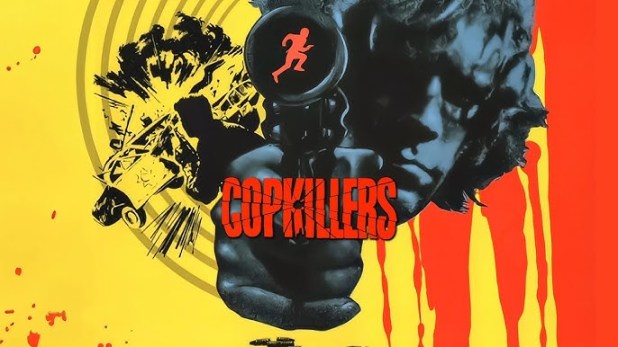
Tucson, Arizona. The insane killer Ray (Jason Williams, Flesh Gordon) and the whiny sad guy Alex (Bill Osco, The Being) get five kilos of cocaine, run into some police, kill those officers — the title is a spoiler — before they steal a frozen lemonade truck, shotgun blast another policeman, murder a gas station worker, ice another guy and kidnap his girl, Karen (Diane Keller, one and done). Then, they hide out in a motel in the hopes that everything blows over.
Alex gives Karen some coke, they ball, then they sell the drugs to Collins (Michael D. White) and his girlfriends Lena (Donna Stubbert) and Becky (Judy Ross) before things go straight to Hell.
Almost everyone other than Flesh Gordon and Bill Osco are one and done, even director Walter R. Cichy. The biggest star out of this movie would be Rick Baker, who went directly from this movie to Star Wars, changing it from a grimy 16mm drive-in film where you can see the crew in the back of the car at one stage.
This cost $50,000, money that was raised by Ted Dye, a Texas-based owner of X-rated theaters looking to make something mainstream. Another reason? Flesh Gordon had been confiscated in a police bust, so its producer, Cichy, needed money. He got Williams to make this. The director of that film, Howard Ziehm, wrote the story for Cop Killers with Osco and Cichy, who finished the screenplay.





 B&S About Movies
You must be logged in to post a comment.