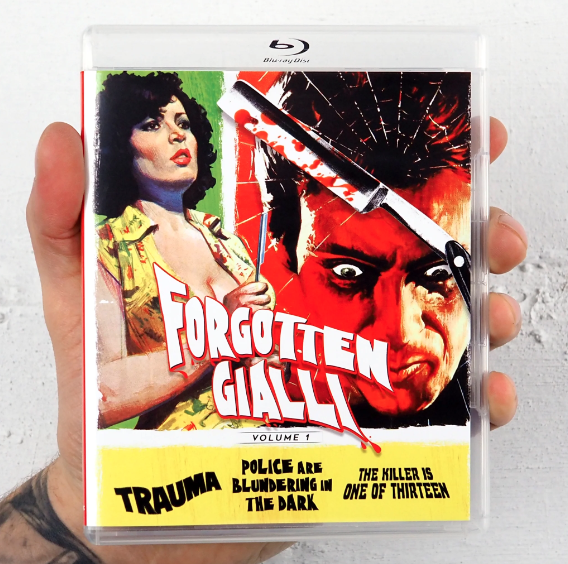
VINEGAR SYNDROME BLU RAY RELEASE: Forgotten Gialli: Volume One

The first in a series from Vinegar Syndrome, these sets allow you to discover three giallo films that have been rare until this release.

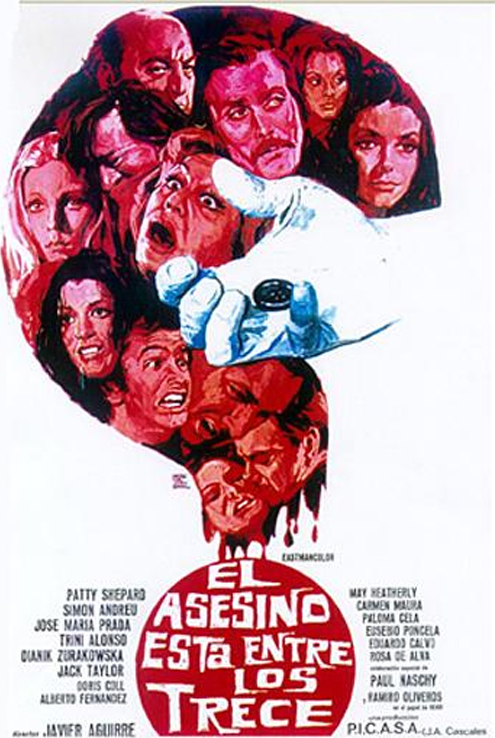
The Killer Is One of 13 (1976): Not a lot of nudity and little blood, this giallo is closer to Agatha Christie than Edward Wallace. That said, it does have Paul Naschy in it and it’s directed by Javier Aguirre, who made Count Dracula’s Great Love.

Patty Shepherd (Edge of the Axe) stars as Lisa, who has gathered twelve of her husband’s closest friends and informs them that she believes that one of them is the killer. That said, there are really seventeen suspects when you add in the butler, chauffeur, maid and gardener.

All the phone lines get cut, people start getting killed off and secrets are revealed. There aren’t many Spanish giallo that I can think of, other than Clockwork TerrorThe House That ScreamedBlue Eyes of the Broken DollThe Corruption of Chris Miller and A Dragonfly for Each Corpse. Come to think of it, I know way more of these movies than I thought I did.

The Police Are Blundering In the Dark (1975): A young nude-model is stabbed to death with a pair of scissors, the third in a series of victims who had all had their photos taken by Parisi, a potentially mentally unhinged individual who claims that his camera can photograph people’s thoughts.

Director and writer Helia Colombo made one giallo and here it is, rarely seen outside of Italy until today. It really has the best title because if you think about it, the police never do a great job in these films.

Now, reporter Giorgio D’Amato meets his friend Enrichetta at the photographer’s villa, but when he arrives, he learns that she’s the model we watched die at the beginning of the movie.

She’d been begged by Parisi — who is in a wheelchair and looks quite frail — to come to speak to him about his magical camera. And just like Clue — you know, but with plenty of graphic murder and no short supply of nudity — we meet the suspects, ranging from Alberto the butler to the photographer’s lesbian wife Eleonora, his niece Sara and the sexed-up maid Lucia, who is the next to be killed.

I have no idea why that camera figures in, but maybe the filmmakers thought that Four Flies On Grey Velvet was going to force everyone to have science fiction photography as part of their plot, so they ripped it off. There’s also little police involvement, but it’s not like there’s an actual rule that giallo titles have to make sense. I prefer when they don’t.

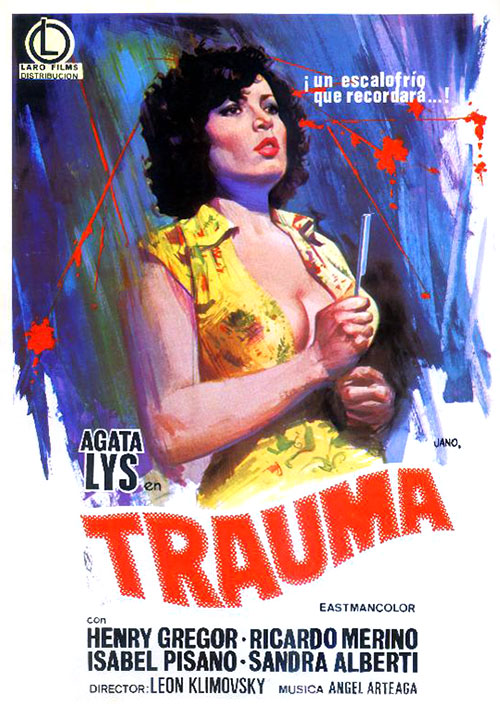
Trauma (1978): This isn’t Red Rings of Fear, a similarly titled 1978 Fabio Testi movie that is also a giallo-type film. Not is it the 1993 Dario Argento movie. Instead, it’s a Spanish film directed by Leon Klimovsky (The Vampires Night OrgyThe People Who Own the Dark).

This is all about a gorgeous inn in the country that seems like the perfect place for Daniel (Heinrich Starhemberg, who was also the executive producer, which means that he gets to be the hero and have a love scene with Lys) to do some writing. However, from the moment he meets Veronica (Ágata Lys), nothing will be as it seems. She’s always taking care of her wheelchair-bound husband who is never seen and who lives in one small room.

All of the other guests are busy making love, which seems to be perfect for the film’s other character, a razor-slashing black-gloved killer. As he kills each couple, whoever they are also gets rid of the luggage of each person, as if they weren’t ever there. One of them is Antonio Mayans, which made me happy to see him.

You can get all three movies on blu ray in a great box set from Vinegar Syndrome.

Cinematic Void January Giallo 2024: Deep Red (1975)

EDITOR’S NOTE: Cinematic Void will be playing this movie on January 6 at 10:00 PM MT at Coolidge Corner Theatre in Brookline, MA. You can get tickets here. For more information, visit Cinematic Void.

Deep Red is one of the few Argento movies that I’ve seen in a theater and the drive-in. It’s not the best film for the fast-moving grindhouse or drive-in, but it is a great film. After all, it started with a 500-page script that even Dario Argento’s family felt was too cryptic and continues with not just one, but two references to American painter Edward Hopper. This isn’t just a movie about murder. This is a movie that transforms murder into art.

We begin at Christmas, as two shadowy figures battle until one of them stabs the other. Screams ring out as a knife drops at the feet of a child.

Fast forward to Rome, as a medium named Helga Ulmann is conducting a lecture about her psychic powers. Within moments, she senses that one of the people in the theater is a killer. Later that night, that killer kicks in her front door and murders her with a meat cleaver (which is probably why this movie got the boring American title of The Hatchet Murders).

British musician Marcus Daly (David Hemmings, BarbarellaBlowup, Harlequin), who fits the giallo mold of the stranger in a strange land thrust into the middle of a series of murders that he must solve, is returning home from drinking with his gay best friend Carlo (Gabriele Lavia, Beyond the DoorInferno) when he sees the murder that we’ve just witnessed from the street. He runs to save Helga, but she’s thrust through the window and her neck is pierced by the broken glass of her window in a kill that has become Argento’s trademark.

As he tells the police what has happened, he notices that a painting on Helga’s wall is gone. That’s when Gianna Brezzzi (Argento’s soon-to-be wife, Dario Nicolodi, who met him during the filming of this movie) takes his photo, which ends up on the cover of the newspaper the very next day.

Unlike most giallo women, Gianna is presented as more competent and even stronger than our hero — she sits high above him in her Fiat 500 and continually bests Marcus every time they arm wrestle. Nicolodi is so perfect in this film that she both breaks and warms your heart at every turn.

Marcus isn’t your typical hero, though. When the killer attacks him, he doesn’t stop them by daring or skill. He locks himself in his study to escape them. He does remember the song the killer played — we also have heard it when Helga is murdered — that psychiatrist (and Helga’s boyfriend) Professor Giordani believes is related to some trauma that motivates the killer.

Feeling guilty that she’s caused the killer to come after Marcus, Gianna relates an urban legend of a haunted house where the sounds of a singing child and screams of murder can be heard. The truth lies in House of the Screaming Child, a book written by Amanda Righetti, which tells the truth of the long-forgotten murder. Marcus and Gianna would learn even more, but the killer beats them to her house and drowns her in a bathtub of scalding hot water (directly influencing the murder of Karen Bailey in Halloween 2). As she dies, the writer leaves a message behind on the wall, which our heroes find. They’ve already assumed the investigation — again, in the giallo tradition — and think the police will assume that Marcus is the murderer, so they don’t report the crime.

Marcus follows the trail of the killer from a picture in the book to the real house, which has been abandoned since 1963. As he searches the home, he uncovers a child’s drawing of a murdered man and a Christmas tree, echoing the flashback that starts the film. Yet when he leaves the room, we see more plaster fall away, revealing a third figure.

Marcus tells his friend Carlos all that he’s learned, but his friend reacts in anger, telling him to stop questioning things and to just leave town with his new girlfriend. At this point, you can start to question Marcus’ ability as a hero — he misses vital clues, he hides instead of fighting and he can’t even tell that someone is in love with him.

Professor Giordani steams up the Righetti murder scene and sees part of the message that she left on the wall. That night, a mechanical doll is set loose in his office as the killer breaks in, smashing his teeth on the mantle and stabbing him in the neck.

Meanwhile, Marcus and Gianna realize that the house has a secret room, with Marcus using a pickaxe to knock down the walls, only to discover a skeleton and Christmas tree. An unseen person knocks our hero out and sets the house on fire, but Gianna is able to save him. As they wait for the police, Marcus sees that the caretaker’s daughter has drawn the little boy with the bloody knife. The little girl explains that she had seen this before at her school.

Marcus finds the painting at the young girl’s school and learns that Carlo painted it. Within moments, his friend turns up, stabs Gianna and holds him at gunpoint. The police arrive and Carlo flees, only to be dragged down the street and his head messily run over by a car.

With Gianna in the hospital and his best friend obviously the murder, Marcus then has the Argento-esque moment of remembering critical evidence: there’s no way Carlo could have killed the psychic, as they were together when they heard her screams. The portrait that he thought was missing from the apartment was a mirror and the image was the killer — who now appears in front of him.

The real killer is Martha (Clara Calamai, who came out of retirement for this role, an actress famous for her telefoni bianchi comedy roles), who killed Carlo’s father in the flashback we’ve seen numerous times after he tried to commit her. She chases Marcus with a meat cleaver, striking him in the shoulder, but he kicks her and her long necklace becomes caught in an elevator which beheads her. The film ends with the reflection of Marcus in the pool of the killer’s blood.

While this film feels long, it has moments of great shock and surprise, such as the two graphic murders that end the film and the clockwork doll. The original cut was even longer, as most US versions remove 22 minutes of footage, including the most graphic violence, any attempts at humor, any romantic scenes between David Hemmings and Daria Nicolodi, and some of the screaming child investigation.

This is also the first film where Argento would work with Goblin. After having scored Argento’s The Five Days — a rare comedy —  Giorgio Gaslini was to provide music for the film. Argento didn’t like what he did and attempted to convince Pink Floyd to be part of the soundtrack. After failing to get them to be part of Deep Red, Goblin leader Claudio Simonetti impressed the director by producing two songs in one night. They’d go on to not only write the music for this film, but also for plenty of future Argento projects.

A trivia note: Argento’s horror film museum and gift shop, Profondo Rosso, is named after the Italian title to this movie.

Deep Red is the bridge between Argento’s animal-themed giallo and supernatural based films. While its pace may seem glacial to modern audiences, it still packs plenty of moments of mayhem that approaches high art.

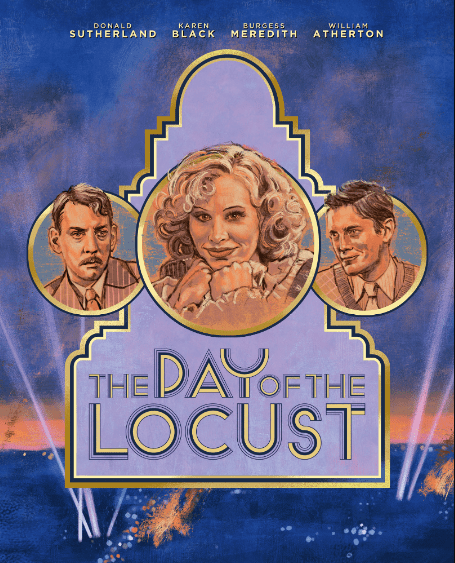
ARROW VIDEO BLU RAY RELEASE: The Day of the Locust (1975)

Somehow, The Day of the Locust is one of the few movies where William Atherton isn’t the villain. Well, he’s not the nicest guy, but he’s not the main heel here, not that anyone is the hero.

Tod is a recent Yale graduate Tod Hackett, who has just come to Hollywood to paint backgrounds in movies. He settles in the falling apart San Bernardino Arms, an apartment building that houses those at the start or the close of their Hollywood dreams.

There’s actress Faye Greener (Karen Black), her dying vaudevillian father Harry (Burgess Meredith), Adore Loomis (Jackie Earle Haley) whose stage mother (Gloria LeRoy) is pushing to be a movie star, the always angry Abe Kusich (Billy Barty) and his girlfriend Mary (Lelia Goldoni) and accountant Homer Simpson (Donald Sutherland). Everyone is in love with Faye but she only wants to settle for a rich man, even if she plays with the hearts of Tod, Homer and stuntmen Earle Shoop (Bo Hopkins) and Miguel (Pepe Serna).

Homer and Faye try to save her father by bringing him to be healed at a church led by Big Sister (Geraldine Page) that is based on the ministry of Aimee Semple McPherson. For a few moments, being in front of the crowd gives him a surge of adrenaline and he’s able to do one of his old routines before dying that night.

Faye moves in with Homer but she tells Tod that it’s a sexless relationship. At a party later, Homer watches helplessly as every man there makes a play for the woman he gives everything to. She screams and calls him a spy and launches a vase at him. Later, Tod catches her making love to Miguel, as does Earle, which leads to a fight.

The film closes as the entire cast is near the premiere of The Buccaneer. Tod tries to speak to Homer who just stares into the void. The only thing that brings him to reality is when Adore throws a rock at his head. He loses his mind and chases the boy through the night, finally catching him and repeatedly stomping him to death as the entire crowd watches. This unleashes a horrific riot that takes over the premiere, thought to be mania over the movie but instead feeling like the end of the world as Tod sees his paintings come to life and chase him into the night. He leaves Hollywood behind and the film closes on his abandoned apartment and Faye crying as she sees the flowers he left inside a crack in the wall.

I didn’t even mention that William Castle is the director of the movie within the movie!

Directed by John Schlesinger (Midnight Cowboy) and written by Waldo Salt (Coming Home) from the book by Nathaniel West, this is one of the most depressing and nihilistic movies that I have ever seen, one that shows that all of these characters are lost, their dreams are meaningless and the moments of connection that they have mean nothing to them other than sheer biological impulses. The only one of them that will be remembered is Homer and that will be as a child murderer.


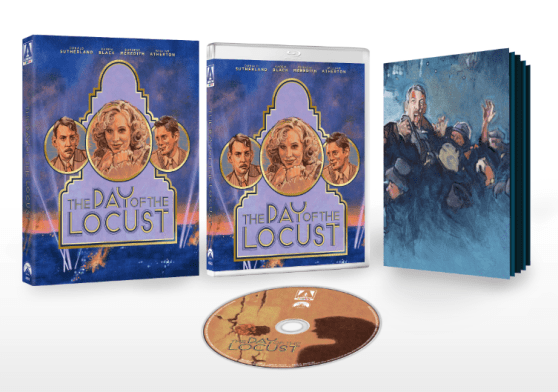
The Arrow Video blu ray of The Day of the Locust has a brand new 2K remaster by Arrow Films from the original negative. Extras include a new oral history audio commentary conducted by writer and film historian Lee Gambin, featuring assistant directors Leslie Asplund and Charles Ziarko, production associate Michael Childers, actors Grainger Hines and Pepe Serna among others; an appreciation of the film by critic Glenn Kenny; a discussion with film historian Elissa Rose; a visual essay on the film’s themes with Gambin and behind the scenes image galleries. It comes inside a reversible sleeve featuring original and newly commissioned artwork by Colin Murdoch and has an illustrated collector’s booklet featuring new writing on the film by Pamela Hutchinson. You can get it from MVD.

The Hand That Feeds the Dead (1975)

Shot in the same time period as Le amanti del mostro — which is also directed by Sergio Garrone —  The Hand That Feeds the Dead combines the ideas of Frankenstein with one of my favorite plots, the intelligent doctor driven to mad things because of love. Also see: Eyes Without a Face, Faceless, Corruption, Mansion of the Doomed and Atom Age Vampire.

Professor Nijinski (Klaus Kinski) was working on skin grafts when a fire in his lab burned the face of his wife Tania (Katia Christine). This inferno also claims the life of the professor’s mentor — and Tania’s father — Doctor Baron Ivan Rassimov and that name has to be a joke, right?

While the mad scientist is using his hunchback assistant Vanya (Erol Taş) to kill women in the village and then use their skin in super gory — thanks Carlo Rambaldi! — surgical scenes that blew my mind. I mean, there are tubes everywhere, small balls filled with blood and machinery that is needlessly — and therefore, totally awesome — complicated.

Also staying in the decaying mansion is Sonia (Stella Calderoni), newlyweds Masha and Alex (Katia Christine and Ayhan Isik) and Katja (Marzia Damon), who is looking for her missing sister. Somehow, in the midst of this surgical gore freakout, there’s also an extended lesbian makeout, which may not make sense until you realize that Garrone also made SS Experiment Camp and the most horror-filled Italian Western there has ever been, Django the Bastard.

This was produced by Turkish Şakir V. Sözen, who cast Ayhan Işık and provided the villa in Istanbul where it was filmed. It was not released in Turkey until 1986 after actor and producer Yilmaz Duru bought it from Sözen and released it as Ölümün Nefesi (Bread of Death).

I absolutely went wild for this movie. Yes, it’s not the greatest Italian horror movie ever, but man, those surgical scenes look great even today when it comes to practical special effects. As always, I also love seeing Kinski and waiting for him to get worked up.

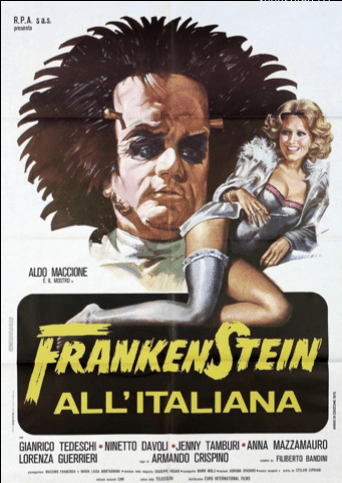
Frankenstein Italian Style (1975)

Frankenstein all’italiana – Prendimi, straziami, che brucio de passion! (Frankenstein Italian Style – Take Me, Torture Me, as I am Burning with Passion!) has Dr. Frankenstein (Gianrico Tedeschi) getting married to the beautiful Janet (Jenny Tamburi, Smile Before DeathThe Psychic). The problem? His creature (Aldo Maccione) is still walking around and attacks the wedding. He breaks into pieces and the doctor decides to make a new creature who soon falls for Janet. And when he tries to get Igor (Ninetto Davoli) to watch her, his assistant also becomes sexually attracted to her.

This was the eighth and final theatrical movie by Armando Crispino, who made dark movies like Autopsy and The Dead Are Alive, which give no hint to the fact that he was going to do a horror comedy. It was written by Massimo Franciosa and Luisa Montagnana (Spasmo).

Also: The Creature has a giant penis. My people, the Italians, seem fascinated by this thought, as it also appears in the more berserk Frankenstein 80


THE MOVIES OF AL ADAMSON: Jessi’s Girls (1975)

Jessica (Sondra Currie) and her new husband Seth Hartwell (Rigg Kennedy) are Mormons on the way to Utah when Frank Brock (Ben Frank) and his men attack. They make him watch each of them have sex with her and shoot them both. He dies, she doesn’t and soon she’s learning how to shoot a gun from Rufe (Rod Cameron) and bringing three female convicts — Kana (Ellyn Stern), Rachel (Jennifer Bishop) and Claire (Regina Carroll) — to get revenge.

I’m always a bit strange about rape revenge movies because to get on the lead’s side, we have to watch them go through hell. This movie does get pretty fun — almost too fun, it has scenes where women have sex so powerful that dying and injured men become healthy — but that seems not from the same movie as the dark opening.

You can watch this on Tubi.

THE MOVIES OF AL ADAMSON: Blazing Stewardesses (1975)

What a mix of ideas!

The sequel to The Naughty Stewardesses, this was supposed to be a 1940s throwback, which is why the Ritz Brothers — well, Harry and Jimmy as Alan had died — as well as Yvonne De Carlo, Don “Red” Barry and Robert Livingston are all in the cast. It was supposed to star the Three Stooges — which would have been Moe Howard, Joe DeRita and Emil Sitka — but Moe was too sick to be able to be in it.

It was going to be called The Jet Set before Blazing Saddles came out and the film became a Western, even if it’s also been released under the titles Cathouse Cowgirls, Texas Layover and The Great Truck Robbery.

At least the girls from the first movie — Debbie (Connie Hoffman), Barbara (Marilyn Joii) and Lori (Regina Carroll) — are back. They take a vacation at the Lucky Dollar Ranch, which is run by Brewster (Livingston), who is also playing the role he had in The Naughty Stewardesses. Masked riders soon appear and attack. There’s also a brothel that’s owned by Honey Morgan (De Carlo).

Would you enjoy watching the Ritz Brothers eat a really big sandwich from an entire movie? Then this is for you. That said, they were really influential among comedians if not successes in Hollywood. They also are in Won Ton Ton, the Dog Who Saved Hollywood.

SUPPORTER DAY: Naked Came the Stranger (1975)

EDITOR’S NOTE: Today’s movie is brought to you by AC Nicholas, who has graciously become a Big B&S’er, a monthly supporter of the site and got to pick an entire week of movies. Would you like to have me write about the movies of your choice? It’s simple!

  1. Go to our Ko-Fi site and donate. There’s no set amount and I won’t tell you what to do. In fact, if you just keep reading for free, we can still be friends.
  2. Join as a monthly member for just $1. That makes you a Little B&S’er.
  3. As a Medium B&S’er at just $3 a month, if you pick a movie or a director, I’ll write about them for you. In fact, I’ll do one for each month you subscribe and even dedicate the post to you.
  4. For $5 a month, you basically get some major power. As a Big B&S’er, I’ll write an entire week on any subject you’d like. How awesome would that be? In fact, I’ll do it for every month you’re a member. Do you think any of your other movie sites will do that for you?

Naked Came the Stranger is based on a hoax.

Mike McGrady was convinced that books had become so dirty — just read Harold Robbins and Jacqueline Susann — that any book could be a best seller if it had sex in it. He recruited nineteen men and five women from Newsday including 1965 Pulitzer Prize winner Gene Goltz, 1970 Pulitzer Prize winner Robert W. Greene and journalist Marilyn Berge. The book, which he edited with Harvey Aronson to ensure that it was not well-written in the least, was written by Penelope Ashe, who would be played by McGrady’s sister-in-law Billie Young.

After selling 20,000 copies, McGrady went on The David Frost Show and told America that it was all a lie. It sold 70,000 more copies after that.

According to The Washington Post, “Mr. McGrady and the other writers had nothing to do with the hardcore film with the same title. They did, however, see the movie at a Times Square theater. During one vivid scene, Aronson told The Charlotte Observer, someone shouted “Author, author! Seventeen of us stood up.”

Working under his Henry Paris name for directing (his middle name and favorite city) and Jake Barnes (the narrator of Hemmingway’s The Sun Also Rises) for writing, Radley Metzger created this adult adaption of the book. Gilly (Darby Lloyd Rains) and Billy (Levi Richards) host a morning show. He’s always been able to sleep around in the marriage — she catches him with their assistant Phyllis (Mary Stuart) — but something has always held her back. This will be the day in which she unleashes herself, even if it keeps ending up in failure.

When she finally gets it together, she has a memorable moment with Marvin (Alan Marlow) in the second floor of a bus in a daring scene shot with no permits, obviously. She also gets Phyllis for herself and even has a classy silent movie black and white love scene with Teddy (Grant Taylor).

If the movie they’re watching in the beginning seems familiar, it’s British freakout Bizarre AKA Secrets of Sex.

SUPPORTER DAY: The Image (1975)

EDITOR’S NOTE: Today’s movie is brought to you by AC Nicholas, who has graciously become a Big B&S’er, a monthly supporter of the site and got to pick an entire week of movies. Would you like to have me write about the movies of your choice? It’s simple!

  1. Go to our Ko-Fi site and donate. There’s no set amount and I won’t tell you what to do. In fact, if you just keep reading for free, we can still be friends.
  2. Join as a monthly member for just $1. That makes you a Little B&S’er.
  3. As a Medium B&S’er at just $3 a month, if you pick a movie or a director, I’ll write about them for you. In fact, I’ll do one for each month you subscribe and even dedicate the post to you.
  4. For $5 a month, you basically get some major power. As a Big B&S’er, I’ll write an entire week on any subject you’d like. How awesome would that be? In fact, I’ll do it for every month you’re a member. Do you think any of your other movie sites will do that for you?

The Image AKA The Punishment of Anne was based on L’Image, a high class dirty book if there ever was one. According to the Rialto Report, it was written by “Jean de Berg, later to be revealed as the pseudonym of Catherine Robbe-Grillet, a mysterious French writer, photographer, and actress of Armenian descent, who was also married to the French writer and filmmaker Alain Robbe-Grillet.”

Broken up into ten chapters, this is the story of Jean (Carl Parker), an older writer who has come to Paris and who soon meets an old friend by the name of Claire (Marilyn Roberts). He’s soon part of her world of BDSM along with her younger partner Anne (Mary Mendum, Metzger’s girlfriend at the time, she would also appear in several Joe Sarno movies).

What’s really interesting in the above-mentioned Rialto Report article is that beyond the interiors being shot in a property owned by Roy Cohn was that none of the leads believe they performed any of the sex in director Radley Metzer’s first hardcore film.

This was way rougher than many were ready for, even in the Golden Age, but it retains its classy feel despite of that. Just like The Score, Metzger shows a side of the bedroom that many even today don’t want to see or even discuss.

MILL CREEK THE SWINGIN’ SEVENTIES: Wanted: Babysitter (1975)

Ann (Sydne Rome, the daughter of an Akron, Ohio plastics manufacturer who went to Europe and became a star in movies like Some Girls Do and Sex With a Smile; she also dated David Bowie for a year, became the face of aerobics in Europe by the 80s and recorded several songs) is an actress having an affair with a wealthy food mogul (Carl Mohner) . He gets rid of her, she stumbles into the street and gets hit by a car.* When she gets back to acting, well, she can’t do nude scenes any more — a fact that enrages actor Stuart Chase (Robert Vaughn) — because the accident so ruined her breasts that she won’t show them.

She and her roommate Michelle (Maria Schneider, yes, the star of Last Tango In Paris) are out of money, so Ann dresses like Michelle to get a job babysitting the son of that very same wealthy food mogul. Then, she, Chase and Vic (Vic Morrow), an ex-stuntman unleash the next part of their plan, where a woman named Lotte (Nadja Tiller) hires Michelle to watch the boy — Boots (John Whittington) — while getting the money. The kid thinks that the brutal Ann is watching him, so he’ll stay quiet, and Michelle has no idea what’s happening.

The plan is, well, kind of dumb but it gets worse when Morrow can’t be controlled and he kills everyone he can while screaming every single line. The ending is confusing, but hey, if you like Rome, Schneider and Morrow, there’s a bit of fun to be had here.

Also known as Scar Tissue and The Raw Edge, this was the last movie that René Clément (The Deadly Trap) would direct. He wrote it with Nicola Badalucco (The Damned), Mark Peploe (The Last Emperor) and Luciano Vincenzoni (For A Few Dollars More).

Don’t have the box set? You can watch this on Tubi.

*Oddly enough, Rome was disfigured in a car crash in 2009 that paralyzed the right side of her face.