FVI WEEK: Mr. Sycamore (1975)

From a story by Robert Ayre and a play by Ketti Frings, this is the tale of John Gwilt (Jason Robards), a postman who decides that he wants to become a tree. He plants himself in his back yard and waits for it to happen while his wife Jane (Sandy Dennis) tries everything she knows to get him to be normal. At the same time, John finds a sympathetic figure in librarian Estelle Benbow (Jean Simmons).

Directed and written by Pancho Kohner, who produced the Bronson movies AssassinationDeath Wish 4Messenger of Death10 to MidnightThe Evil That Men DoSt. Ives, The White Buffalo and  Kinjite, this is definitely a movie of its time.

You can watch this on YouTube.

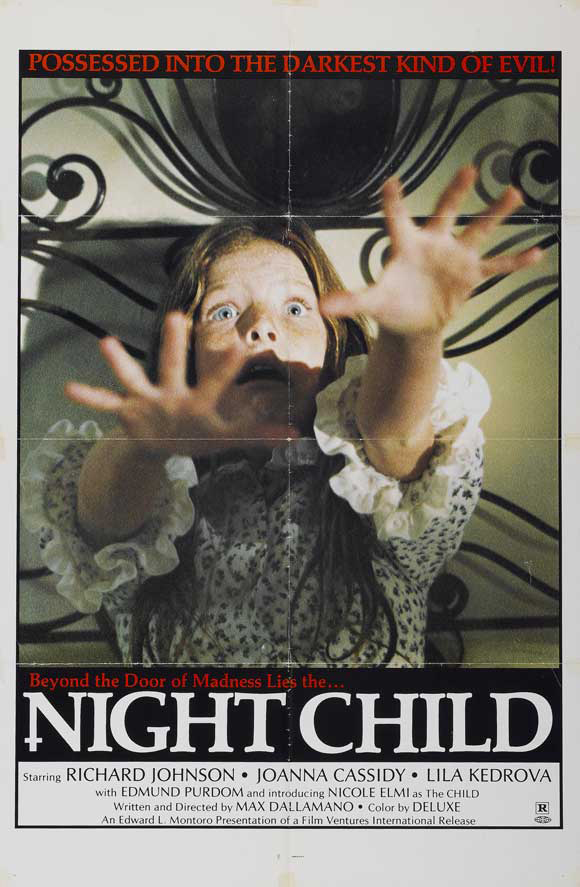
FVI WEEK: The Night Child (1975)

Keep telling yourself: She’s just a child. She’s just a child. She’s just a child. She’s just a child. She’s just a child. She’s just a child.

Also known as The Cursed Medallion, this Italian ripoff was directed by Massimo Dallamano (What Have You Done to Solange?).

Richard Johnson (The Haunting and Dr. Menard from Zombi 2) is a BBC filmmaker working on a documentary about demonic images in paintings. His daughter Emily (Nicoletta Elmi, Who Saw Her Die?Deep Red) is having nightmares about how her mother died in a fire.

Edmund Purdom (2019: After the Fall of New York) advises him to bring his daughter along to Italy for some bonding time, along with their governess Jill, who is love with her boss. But then so is Joanna (Joanna Cassidy, The Glove), the producer of his movie. It also seems like Emily is in love, like real love, with her dad too. Was everyone incestual in 1970’s horror?

Michael meets Contessa Cappelli, an expert on satanic paintings. She warns him not to use a painting in his work. It depicts a child — wearing a medallion just like the one his daughter has been wearing — watching her mother burn. Is it any wonder that demonic possession soon follows?

This movie looks gorgeous. You can see the difference when a real director takes on a ripoff and decides to make it his own movie instead of aping The Exorcist directly.

I’m shocked that more people don’t discuss this film. It really fits into the genre of 70’s occult film quite well.

FVI WEEK: The Immortal Bachelor (1975)

A mezzanotte va la ronda del piacere (At Midnight the Pleasure Patrol Goes) is also known as The Immortal Bachelor, Midnight Pleasures and Midnight Lovers.

Gabriella (Claudia Cardinale, Blonde In Black Leather) is trapped in a loveless marriage to Andrea (Vittorio Gassman) and sees a lot of herself as she sits on the jury for the murder trial of Tina (Monica Vitti), who has killed her husband Gino (Giancarlo Giannini).

Or did she?

As Tina testifies, Gabriella wishes she had the passion in her marriage that Tina seemed to have. And then she learns why Tina and Gino had their last fight. Her new lover was Andrea. Gabriella begs her husband to testify in Tina’s defense but he leaves the country, only for Gino to show up, alive and ready to fight — and make love — to his wife again.

Director Marcello Fondato, who co-wrote this with Francesco Scardamaglia, was one of the writers of Black Sabbath and Blood and Black Lace.

FVI didn’t release this movie in the U.S. until 1980. Cardinale and Vitti are much better in Blonde In Black Leather, which New World released here as Lucky Girls.

Roger Ebert hated this and said, “Faithful readers will recall that I have, in the past, occasionally referred to Idiot Plots. The Immortal Bachelor is a classic Idiot Plot, requiring that everyone in the movie be an idiot. If they weren’t, they’d solve their problems instantly and the movie would be a short subject.”

FVI WEEK: Convoy Buddies (1975)

Also known as Simone e Matteo – Un gioco da ragazzi, Simón y Mateo and Kid Stuff, this stars Antonio Cantafora and Paul L. Smith in one of the series of movies they made trying to imitate Terence Hill and Bud Spencer that includes Carambola!Carambola’s Philosophy: In the Right PocketWe Are No Angels and The Diamond Peddlers.

FVI took it one step further by renaming them in America as Terrance Hall and Bob Spencer. Smith sued, saying The only thing an actor has is his name and if that’s taken away, he has nothing.” That case was Smith v. Montoro, 648 F.2d 602. Smith alleged that he had acted in the leading role and had a contract granting him star billing. However, when the film was distributed in the U.S. by FVI, his name was stripped from the film. The Ninth Circuit federal court of appeals granted Smith standing to sue the filmmakers, but it is unknown how the case was finally settled. Rumors say that he won.

Toby and Butch (Cantafora and Smith) are dumb criminals moving insecticide from Italy to France but in truth, they don’t know that they are smuggling guns. There are also gangsters trying to get the guns but they can’t outfight these two. 

This was directed by Giuliano Carnimeo (Find A Place to Die, the Sartana films) and written by Sergio Bazzini and Tulio Demicheli. The music — which will repeat throughout and get stuck in your head — is by Guido and Maurizio De Angelis, the men who call themselves Oliver Onions.

You can watch this on YouTube.

Istantanea per un delitto (1975)

Luca (Luis La Torre) and Mirna (Erna Schurer, Deported Women of the S.S. Special Section) have broken up and he leaves for the island of Ostuni to recover. But he’s sure she’ll follow him, but he’s wrong, as she’s already moved on. But he soon forgets, as two gorgeous young women, Claudia (Monica Strebel) and Stefania (Lorenza Guerrieri, Naked You Die), are already fighting over him. Luca and Stefania hook up on the beach and she encourages him to fulfill his roughest fantasies, throwing her all over the beach, pinning her with her arms behind her back and even choking her. Then she disappears and he gets blackmailed with the photos that were taken of their violent tryst in the sand. Why is his ex Mirna blackmailing him? What does Claudia know? And where did Stefania go?

Snapshot of a Crime isn’t a giallo that many recall or speak of here in America. It’s structure is a big odd, as it has flashbacks and scenes repeated throughout the movie. Director Ezio Alovisi — working as Arthur Saxon — was making his first movie, so he really went for something perhaps beyond his reach. But you know, we should celebrate that. He took it over from Mario Imperoli, as it was started in 1970 and finished in 1974.

The scenery is gorgeous, the trio of actresses is even more beautiful and this feels like a Lenzi giallo. The best part? The soundtrack by Franco Bixio. I have no idea why more people don’t celebrate his work. He recorded this soundtrack with the British/Italian band The Motowns and it’s a fuzzed out dream.

You can watch this on YouTube.

Las flores del vicio (1975)

The Flowers of Vice is also known as Bloodbath and The Sky Is Falling. It reunited Dennis Hopper and Carroll Baker 18 years after Giant. He plays a drugged out of his mind painter and poet named Chicken and she’s a washed up alcoholic actress who people call Treasure who have both come to a small Spanish town. There’s also a retired British Air Corps captain called Terence (Richard Todd) and his constantly drunk wife Heather (Faith Brook) and a gay man who has seen it all, Allen (Wim Wells, the director’s long-time partner).

Filmed in Mojacar, Almeria, Spain — a small seaside village of Spaniards, British and American expatriates — this movie is filled with menace from the beginning. The town just seems strange, Hopper and his friends feel more dead than alive and there’s a group of hippies that may be gorgeous but who worship the killings of the Manson Family. It’s not like the village was any less strange what with all the animal sacrifices — this may as well be Italian — taking place on Easter weekend. Soon, the foreigners begin to die, one by one, killed by the young people who seemingly will replace them. Maybe, who can say, because this movie feels as if it doesn’t want to tell you any answers and I feel as if I am trying to explain it all by what I have written. It may destroy your patience but I am a huge Hopper and Baker fan, so I was excited to see a movie they did that for so long was impossible to get.

Directed by Silvio Narizzano (Die! Die! My Darling!) and written by Gonzalo Suárez, this ends with — spoiler warning — the villagers trampling a small boy to death. He was the son of Americans who lived in the village. They ran El Saloon and had grown close to the director and crew, so they got their son a role getting killed at the end of an art film.

You can get this as part of the Vinegar Syndrome Villages of the Damned set or watch it on Tubi.

Peccati di gioventù (1975)

So Young, So Lovely, So Vicious… was directed by Silvio Amadio, who also made the giallo movies Assassination In Rome, Amuck!Smile Before Death and Twisted Girls, as well as Il Medium. He also wrote the story with Roberto Natale.

Also known as Sins of Youth, this tells the story of Angela (Gloria Guida, Bollenti spiriti), a young, beautiful and vicious girl who lives to sunbathe, party and spend her father’s money. But then she learns that her daddy (Silvano Tranquilli) has found a new wife, Irene (Dagmar Lassander). They’re even talking marriage, which worries Angela, because Irene seems to have morals. That means that her endless party seems to be coming to an end. But Angela is willing to go as low as it takes to stay her father’s favorite girl.

This is also — also also? — known in Germany as Sun, Sand and Hot Thighs and that makes it seem like a beach sex film. And yes, Guida is naked for most of the movie. But she’s also scheming the whole time, getting Irene to fall in lust with her while someone documents their entire love scene and sends it off to her father. Yet it seems like Irene and Angela are as much alike as they are different; as Jane says in Whatever Happened to Baby Jane?, “Then, you mean, all this time we could’ve been friends?” — but when you feel a love for a father that is beyond what any other woman could know, well, you’ll do anything to stay solitary in his heart.

You can watch this on YouTube.

Cinematic Void January Giallo 2024: Footprints (1975)

EDITOR’S NOTE: Cinematic Void will be playing this film on January 20 at 11:59 PM CT at The Belcourt Theatre in Nashville, TN. You can get tickets here. For more information, visit Cinematic Void.

Alice Cespi (Florinda Bolkan, A Lizard in a Woman’s Skin) watched a strange film in her childhood called “Footprints on the Moon,” where astronauts were stranded on the moon’s surface. Now, as an adult, the only sleep she gets is from tranquilizers and she starts missing days of her life. Get ready for a giallo that skips the fashion and outlandish murders while going straight for pure weirdness.

After losing her job as a translator, Alice find a torn postcard for a resort area called Garma. That’s where she meets a little girl named Paula (Nicoletta Elmi, DemonsA Bay of Blood) who claims that Alice looks exactly like another woman she met named Nicole, who is also at the resort. Slowly but surely, our heroine starts to believe that a huge conspiracy is against her.

This is the last theatrical film of Luigi Bazzoni (he has directed some documentaries and wrote a few films since), who also directed The Fifth Cord. There are only two murders, but don’t let that hold you back. There are also abrupt shifts in color and a slow doomy mood to the entire proceedings. It’s unlike any other giallo I’ve seen and I mean that as a compliment.

Klaus Kinski also shows up as Blackman, the doctor who was behind the experiment that Alice saw as a child. He’s only in the film for a minute or so, but he makes the most of his time, chewing up the scenery as only he can. And cinematographer Vittorio Storaro, beyond working on The Bird with the Crystal Plumage, also was the DP on films like Apocalypse Now, RedsLast Tango in Paris and Dick Tracy.

This isn’t like any of the films that came in the wake of The Bird with the Crystal Plumage and it’s a shame that its director didn’t make more films in the genre.

Here’s are two drinks to enjoy with Footprints.

To the Moon

  • .25 oz. Kaluha
  • .25 oz. Bailey’s Irish Cream
  • .25 oz. amaretto
  • .25 oz. high proof rum
  1. Stir with ice and strain into a chilled shot glass.

Footprints On the Amber Moon

  • 3 oz. whiskey
  • Raw egg
  • Dash of Tobasco
  1. Pour whiskey into a glass, then crack a raw egg and drop into the glass. Don’t break the yoke or the ghost of Klaus Kinski will haunt you.
  2. Add some Tobasco, do a count down and ignite the engines.

VINEGAR SYNDROME BLU RAY RELEASE: Forgotten Gialli: Volume One

The first in a series from Vinegar Syndrome, these sets allow you to discover three giallo films that have been rare until this release.

The Killer Is One of 13 (1976): Not a lot of nudity and little blood, this giallo is closer to Agatha Christie than Edward Wallace. That said, it does have Paul Naschy in it and it’s directed by Javier Aguirre, who made Count Dracula’s Great Love.

Patty Shepherd (Edge of the Axe) stars as Lisa, who has gathered twelve of her husband’s closest friends and informs them that she believes that one of them is the killer. That said, there are really seventeen suspects when you add in the butler, chauffeur, maid and gardener.

All the phone lines get cut, people start getting killed off and secrets are revealed. There aren’t many Spanish giallo that I can think of, other than Clockwork TerrorThe House That ScreamedBlue Eyes of the Broken DollThe Corruption of Chris Miller and A Dragonfly for Each Corpse. Come to think of it, I know way more of these movies than I thought I did.

The Police Are Blundering In the Dark (1975): A young nude-model is stabbed to death with a pair of scissors, the third in a series of victims who had all had their photos taken by Parisi, a potentially mentally unhinged individual who claims that his camera can photograph people’s thoughts.

Director and writer Helia Colombo made one giallo and here it is, rarely seen outside of Italy until today. It really has the best title because if you think about it, the police never do a great job in these films.

Now, reporter Giorgio D’Amato meets his friend Enrichetta at the photographer’s villa, but when he arrives, he learns that she’s the model we watched die at the beginning of the movie.

She’d been begged by Parisi — who is in a wheelchair and looks quite frail — to come to speak to him about his magical camera. And just like Clue — you know, but with plenty of graphic murder and no short supply of nudity — we meet the suspects, ranging from Alberto the butler to the photographer’s lesbian wife Eleonora, his niece Sara and the sexed-up maid Lucia, who is the next to be killed.

I have no idea why that camera figures in, but maybe the filmmakers thought that Four Flies On Grey Velvet was going to force everyone to have science fiction photography as part of their plot, so they ripped it off. There’s also little police involvement, but it’s not like there’s an actual rule that giallo titles have to make sense. I prefer when they don’t.

Trauma (1978): This isn’t Red Rings of Fear, a similarly titled 1978 Fabio Testi movie that is also a giallo-type film. Not is it the 1993 Dario Argento movie. Instead, it’s a Spanish film directed by Leon Klimovsky (The Vampires Night OrgyThe People Who Own the Dark).

This is all about a gorgeous inn in the country that seems like the perfect place for Daniel (Heinrich Starhemberg, who was also the executive producer, which means that he gets to be the hero and have a love scene with Lys) to do some writing. However, from the moment he meets Veronica (Ágata Lys), nothing will be as it seems. She’s always taking care of her wheelchair-bound husband who is never seen and who lives in one small room.

All of the other guests are busy making love, which seems to be perfect for the film’s other character, a razor-slashing black-gloved killer. As he kills each couple, whoever they are also gets rid of the luggage of each person, as if they weren’t ever there. One of them is Antonio Mayans, which made me happy to see him.

You can get all three movies on blu ray in a great box set from Vinegar Syndrome.

Cinematic Void January Giallo 2024: Deep Red (1975)

EDITOR’S NOTE: Cinematic Void will be playing this movie on January 6 at 10:00 PM MT at Coolidge Corner Theatre in Brookline, MA. You can get tickets here. For more information, visit Cinematic Void.

Deep Red is one of the few Argento movies that I’ve seen in a theater and the drive-in. It’s not the best film for the fast-moving grindhouse or drive-in, but it is a great film. After all, it started with a 500-page script that even Dario Argento’s family felt was too cryptic and continues with not just one, but two references to American painter Edward Hopper. This isn’t just a movie about murder. This is a movie that transforms murder into art.

We begin at Christmas, as two shadowy figures battle until one of them stabs the other. Screams ring out as a knife drops at the feet of a child.

Fast forward to Rome, as a medium named Helga Ulmann is conducting a lecture about her psychic powers. Within moments, she senses that one of the people in the theater is a killer. Later that night, that killer kicks in her front door and murders her with a meat cleaver (which is probably why this movie got the boring American title of The Hatchet Murders).

British musician Marcus Daly (David Hemmings, BarbarellaBlowup, Harlequin), who fits the giallo mold of the stranger in a strange land thrust into the middle of a series of murders that he must solve, is returning home from drinking with his gay best friend Carlo (Gabriele Lavia, Beyond the DoorInferno) when he sees the murder that we’ve just witnessed from the street. He runs to save Helga, but she’s thrust through the window and her neck is pierced by the broken glass of her window in a kill that has become Argento’s trademark.

As he tells the police what has happened, he notices that a painting on Helga’s wall is gone. That’s when Gianna Brezzzi (Argento’s soon-to-be wife, Dario Nicolodi, who met him during the filming of this movie) takes his photo, which ends up on the cover of the newspaper the very next day.

Unlike most giallo women, Gianna is presented as more competent and even stronger than our hero — she sits high above him in her Fiat 500 and continually bests Marcus every time they arm wrestle. Nicolodi is so perfect in this film that she both breaks and warms your heart at every turn.

Marcus isn’t your typical hero, though. When the killer attacks him, he doesn’t stop them by daring or skill. He locks himself in his study to escape them. He does remember the song the killer played — we also have heard it when Helga is murdered — that psychiatrist (and Helga’s boyfriend) Professor Giordani believes is related to some trauma that motivates the killer.

Feeling guilty that she’s caused the killer to come after Marcus, Gianna relates an urban legend of a haunted house where the sounds of a singing child and screams of murder can be heard. The truth lies in House of the Screaming Child, a book written by Amanda Righetti, which tells the truth of the long-forgotten murder. Marcus and Gianna would learn even more, but the killer beats them to her house and drowns her in a bathtub of scalding hot water (directly influencing the murder of Karen Bailey in Halloween 2). As she dies, the writer leaves a message behind on the wall, which our heroes find. They’ve already assumed the investigation — again, in the giallo tradition — and think the police will assume that Marcus is the murderer, so they don’t report the crime.

Marcus follows the trail of the killer from a picture in the book to the real house, which has been abandoned since 1963. As he searches the home, he uncovers a child’s drawing of a murdered man and a Christmas tree, echoing the flashback that starts the film. Yet when he leaves the room, we see more plaster fall away, revealing a third figure.

Marcus tells his friend Carlos all that he’s learned, but his friend reacts in anger, telling him to stop questioning things and to just leave town with his new girlfriend. At this point, you can start to question Marcus’ ability as a hero — he misses vital clues, he hides instead of fighting and he can’t even tell that someone is in love with him.

Professor Giordani steams up the Righetti murder scene and sees part of the message that she left on the wall. That night, a mechanical doll is set loose in his office as the killer breaks in, smashing his teeth on the mantle and stabbing him in the neck.

Meanwhile, Marcus and Gianna realize that the house has a secret room, with Marcus using a pickaxe to knock down the walls, only to discover a skeleton and Christmas tree. An unseen person knocks our hero out and sets the house on fire, but Gianna is able to save him. As they wait for the police, Marcus sees that the caretaker’s daughter has drawn the little boy with the bloody knife. The little girl explains that she had seen this before at her school.

Marcus finds the painting at the young girl’s school and learns that Carlo painted it. Within moments, his friend turns up, stabs Gianna and holds him at gunpoint. The police arrive and Carlo flees, only to be dragged down the street and his head messily run over by a car.

With Gianna in the hospital and his best friend obviously the murder, Marcus then has the Argento-esque moment of remembering critical evidence: there’s no way Carlo could have killed the psychic, as they were together when they heard her screams. The portrait that he thought was missing from the apartment was a mirror and the image was the killer — who now appears in front of him.

The real killer is Martha (Clara Calamai, who came out of retirement for this role, an actress famous for her telefoni bianchi comedy roles), who killed Carlo’s father in the flashback we’ve seen numerous times after he tried to commit her. She chases Marcus with a meat cleaver, striking him in the shoulder, but he kicks her and her long necklace becomes caught in an elevator which beheads her. The film ends with the reflection of Marcus in the pool of the killer’s blood.

While this film feels long, it has moments of great shock and surprise, such as the two graphic murders that end the film and the clockwork doll. The original cut was even longer, as most US versions remove 22 minutes of footage, including the most graphic violence, any attempts at humor, any romantic scenes between David Hemmings and Daria Nicolodi, and some of the screaming child investigation.

This is also the first film where Argento would work with Goblin. After having scored Argento’s The Five Days — a rare comedy —  Giorgio Gaslini was to provide music for the film. Argento didn’t like what he did and attempted to convince Pink Floyd to be part of the soundtrack. After failing to get them to be part of Deep Red, Goblin leader Claudio Simonetti impressed the director by producing two songs in one night. They’d go on to not only write the music for this film, but also for plenty of future Argento projects.

A trivia note: Argento’s horror film museum and gift shop, Profondo Rosso, is named after the Italian title to this movie.

Deep Red is the bridge between Argento’s animal-themed giallo and supernatural based films. While its pace may seem glacial to modern audiences, it still packs plenty of moments of mayhem that approaches high art.