WEIRD WEDNESDAY: The True Story of Eskimo Nell (1975)

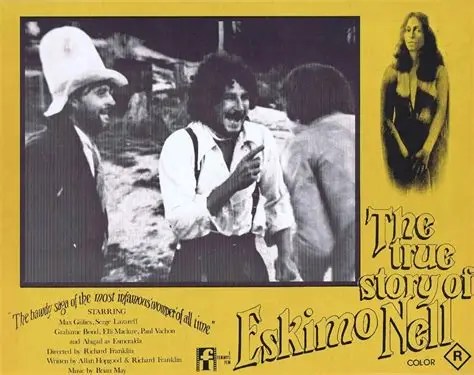
After studying at USC, director Richard Franklin returned to Australia, where he directed four episodes of the Australian police drama Homicide before making this film and Fantasm. Based on the folk poem “The Ballad of Eskimo Nell,” which is about well-endowed Dead-Eye Dick and sidekick Mexican Pete being unable to satisfy sex worker Eskimo Nell, this finds Dead-Eye Dick (Max Gillies) as a common peeper. He discovers a husband about to kill Mexico Pete (Serge Lazareff) for sleeping with his wife, so he saves him, and they head to Alaska to find Nell.

Franklin says it was never his intention to make a sex comedy, as he wanted to make something like Midnight Cowboy. The poem is known only in what Franklin called the English world of Canada, Australia, and England, so it had limited hopes in the U.S. However, as government funds were used to make this movie, a softcore comedy, people were not happy. Franklin said, “The theatres were picketed, and it was actually fairly successful in terms of damaging the picture. I thought it would be great publicity, but the one thing people don’t want to hear is that tax dollars have been wasted. The minute they hear that, they’re less inclined to throw good money after bad, if you see what I mean. So the film was not successful.”

It also didn’t help that a British film based on the same poem, Eskimo Nell, was released at the same time, when it didn’t make it to Australia until 1976, when it was called The Sexy Saga of Naughty Nell and Big Dick.

Or that sex symbol Abigail was upset about being fully frontal in this film. A public rift was reported in the Australian press between Franklin and the singer/actress, with the headline “Movie Producer Abigail: He Used My Body.”

If The Alaska Kid is familiar, it’s because he’s played by pro wrestler Paul “Butcher” Vachon.

ARROW VIDEO SHAW SCOPE VOLUME 4 BOX SET: Black Magic (1975)

In 1974, Shaw Brothers collaborated with Hammer on The Legend of the 7 Golden Vampires. That ignited a desire not only to make martial arts films, but also supernatural ones. And man, as the studio goes on, these movies grow more deranged in the very best of ways.

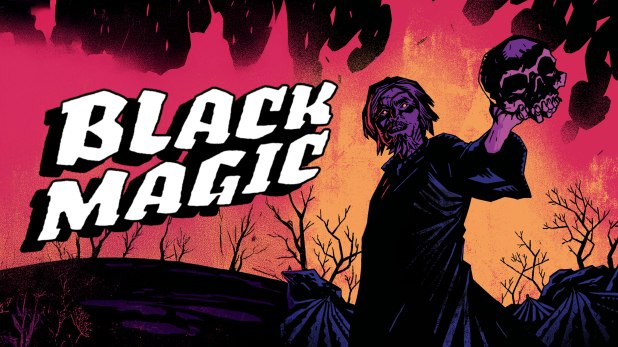
Ho Meng-Hua (The Mighty Peking ManOily Maniac) directed this, and it only hints at how far Hong Kong horror would go. Lang Chia Chieh (Lo Lieh) wants to be with Mrs. Zhou (Tanny Tien Ni), but she’s in love with Xu Nuo (Ti Lung), who only wants to be with the love of his life, Wang Chu Ying (Lili Li Li-li). To win her, Lang Chia Chieh goes to the magician Shan Chen Mi (Ku Feng) and has him cast a spell on Mrs. Zhou. It works, if only for a night, and she soon learns that she, too, can turn to the spirit world to win over the lover she wants.

These magic spells are incredibly organic and gross. Like, you need to cut off someone’s finger and leave it under your intended person’s bed until it turns into a pile of maggots. Or to kill someone, you put worms directly under their skin.

There’s a lot of soap opera in this, but every time you think it’s getting slow, someone gets half-naked or makes a possessed rice ball with blood and breast milk, so you can never say it’s bad. It’s just the first course for how completely out there these movies will get.

The Arrow Video release of this film, part of the Shaw Scope Volume 4 set, has a high definition (1080p) Blu-ray presentation, newly restored in 2K from the original negatives by Arrow Films. It has commentary by critic James Mudge. You can get this set from MVD.

ARROW VIDEO SHAW SCOPE VOLUME 4 BOX SET: Super Inframan (1975)

Inspired by the huge success of the Japanese superhero versus monster fare such as Ultraman and Kamen Rider in Hong Kong, the Shaw Brothers produced the first Chinese superhero in 1975, which they called Infra-Man. However, they pushed the envelope created by the Japanese even further, inventing a world where a school bus can crash, Hong Kong can be destroyed, an earthquake can happen and monsters appear all within the first minute of the film.

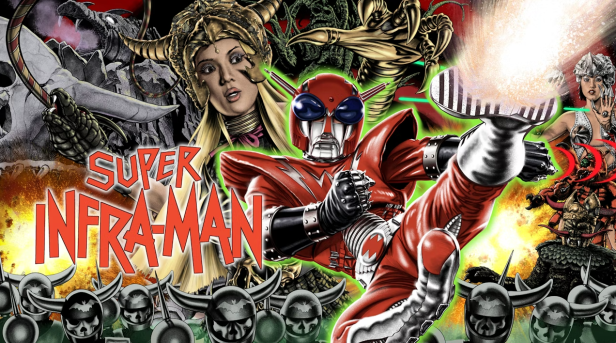
Let me see if I can summarize the blast of pure odd that I just watched at 5 AM: Princess Dragon Mom (known in the original version of this film as Demon Princess Elzebub) is a ten million-year-old mother of monsters who wants to destroy the Earth. She carries around a whip and has a dragon head on her hand, but can also turn into a monster herself. She also has an entire legion of beasts ready to do whatever she asks, like her assistant She-Demon (Witch-Eye in the original), who is an Asian girl with a hand that has an eyeball in the middle of it. Also: both of these ladies wear metallic bikinis with skulls all over them and have several costume changes. They also have an army of cannon fodder dressed in skeletal costumes, which was obviously the influence for the Skeleton Crew in the new episodes of Mystery Science Theater 3000.

They’re battling with Science Headquarters, led by Professor Liu Ying-de. He’s used the BDX Project to transform Lei Ma (Danny Lee, The Killer) into the bionic kung-fu kicking motorcycle riding Infra-Man, who has whatever powers he needs for any situation. He’s also really good at getting tall and stepping on monsters until their green blood pours out. Bruce Lee tribute actor Bruce Le also appears as Lu Xiao-long, another member of the team.

You get all manner of monsters in this one — the Emperor of Doom, the Giant Beetle Monster, an Octopus Mutant, the Driller Beast, a Laser Horn Monster and the Iron Fist Robots. All of them are given to dramatic pronouncements, overacting and blowing up real good.

Believe it or not, Roger Ebert said, “When they stop making movies like Infra-Man, a little light will go out of the world.” Twenty-two years later, he went even further: “I find to my astonishment that I gave Infra-Man only two and a half stars when I reviewed it. That was 22 years ago, but a fellow will remember a lot of things you wouldn’t think he’d remember. I’ll bet a month hasn’t gone by since that I haven’t thought of that film. So, in answer to those correspondents who ask if I have ever changed a rating on a movie: Yes, Infra-Man moves up to three stars.”

He’s right — this movie is completely unhinged, with dragon witch women who threaten to throw little girls down volcanos, blotting out the sun and rocket fists. They should have made five thousand sequels to this.

The Arrow Video release of this film, part of the Shaw Scope Volume 4 set, has a high definition (1080p) Blu-ray presentation, newly restored in 2K from the original negatives by Arrow Films. There’s an option to view the film in its US theatrical version, Infra-man, with lossless “Stereo-Infra-Sound” surround audio. You also get commentary by martial arts cinema experts Frank Djeng and Erik Ko, an interview with Bruce Le, a video essay on Shaws’ tokusatsu films written and narrated by Steven Sloss, theatrical trailers, TV ads and radio commercials. You can get this set from MVD.

VCI BLU RAY RELEASE: Psychonica Collection Volume 1: Delinquent Schoolgirls (1975)

Homosexual fashion designer Bruce Wilson (Stephen Strucker, Johnny the air traffic controller from Airplane!), sexed up Dick Peters (Bob Minor) and Carl C. Clooney (Michael Pataki) escape the insane asylum and work their way into a girls’ school. Still, instead of this being a revengeomatic, it’s a comedy.

The Delinquent School Girls cut of this film missed the first half hour and all of George “Buck” Flower’s scenes that were in the Carnal Madness version. It was also released in the UK as Scrubbers 2 to cash in on the girl school movie Scrubbers and as Sizzlers as part of a double feature with Intimate Games.

Directed by Greg Corarito (who directed The Sadistic Hypnotist and Hard On the Trail, the adult film that sent Lash LaRue on a journey of redemption), who wrote the movie with John Lamb (Mondo KeyholeZodiac Killer), Maurie Smith (who wrote Recruits and Julie Darling), it starts with the men visiting the farm of Earl (George “Buck” Flower) and his wife Ellie (Julie Gant), who ends up in bed with Dick, a former baseball play r. Then, it’s off to the school where the girls end up kicking their asses more often than not, and Pataki gets to show his skill at impressions.

As for the girls, there’s Colleen Brennan (AKA Sharon Kelly, Olga Vault; she’s also in Supervixens and Ilsa She-Wolf of the SS), magazine starlet Roberta Pedon and several attractive actresses who made this their only movie.  Brennan said of this movie, “I always wondered how anybody managed to pull a movie out of that reeking pile of short ends.”

The VCI release of this film has a new commentary track by Rob Kelly, noted film historian, podcaster and artist. There’s also an archival commentary track by actor and stuntman, Bob Minor, as well as a featurette — Cuckoo for Pyschotronica — and a photo and poster gallery. You can get this from MVD.

The Heatwave Lasted Four Days (1975)

ABOUT THE AUTHOR: Exploitation-film historian A.C. Nicholas, who has a sketchy background and hails from parts unknown in Western Pennsylvania, was once a drive-in theater projectionist and disk jockey. In addition to being a writer, editor, podcaster, voice-over artist, and sometime actor and stand-up comedian, he’s a regular guest co-host on the streaming Drive-In Asylum Double Feature and panelist on the Deep Images podcast and has made multiple appearances on Making Tarantino: The Podcast. He also contributes to the Drive-In Asylum fanzine, the B & S About Movies Podcast, and the Horror and Sons website. He currently programs a monthly film series, A.C. Nicholas’s Hidden Gems, at the Babylon Kino in Columbia, South Carolina.

“You got peanut butter on my chocolate! You got chocolate in my peanut butter!” Those of us of a certain age remember those famous lines from the TV commercials for Reese’s candy back in the 1970s. Chocolate and peanut butter, a mash-up made in heaven. There’ve been many movie mash-ups over the years, everything from horror comedies like Shaun of the Dead, westerns with horror elements, like Bone Tomahawk, and romance noirs, like the seriously underrated Thief of Hearts. But the craziest mash-up I’ve ever seen is the Canadian film The Heatwave Lasted Four Days.

Let’s get the plot out of the way before discussing this bizarre melding of two disparate genres. Cliff Reynolds, played by Canadian legend Gordon Pinsent (The Rowdyman, The Shipping News, and Away from Her), is a news cameraman working for CFCF-TV in Montreal. He’s a sleazy lothario given to wearing garish shirts with too many buttons unbuttoned and medallions. I guess I shouldn’t be too hard on his wardrobe choices. We all looked like that back in the 70s. Anyway, one day he’s at the beach getting some footage for a story about the heatwave. But more importantly, he uses the assignment to chat up some cute girls in bikinis. Jerry Cuozzo, a local drug dealer with ties to organized crime, played by yet another Canadian legend, Lawrence Dane (Rituals, Scanners, and Happy Birthday to Me), has just escaped from prison. (He apparently climbed over the wall while awaiting trial. Don’t ask.) He’s spending some time at the beach with his main gal, Barbara, the delectable Alexandra Stewart (The Bride Wore Black, The Uncanny, Emanuelle 3, Phobia, and Bolero). And while we’re playing spot-the-Canuck, beloved Al Waxman (King of Kensington, Cagney and Lacey, Death Weekend, The Class of 1984, and Spasms) shows up as Cliff’s boss. Of course he does.

Here we have the fugitive lounging at the beach while his face is plastered all over TV. Why? Don’t ask. Jerry realizes that Cliff has filmed him in the background, so he and Barbara tell Cliff that they’re having an affair and implore him not to use the footage. Cliff says that he won’t. He goes home to his wife and daughter. There we learn, in short order, that it’s his little girl’s birthday, his wife is fed up with his carousing, and they’re in financial trouble. (The film’s short running time means we get some speedy exposition at the expense of giving the wife a name.) As you can probably guess, Cliff figures out that the guy on the beach was Jerry. Now you can ask: Will he try to use this information to solve his money problems and get in over his head? Will the mob try to rub out Jerry? Will there be a deal to move heroin across the border to the Lower 48, eh? Will there be a few twists? And will Cliff try to bed one of the beach babes? Of course you know the answers to those questions.

OK, that’s the basis of a tidy little film with some vintage footage of Montreal and a nice economy of direction from Douglas Jackson, a stalwart of Canadian TV and a 1970 Oscar nominee for Best Live-Action Short. But you’re thinking that my plot synopsis gives no hint of the mash-up. Well, wait no longer. Here’s the solution to the mystery: The Heatwave Lasted Four Days is a neo-noir and educational film. As Scooby-Doo would say, “Huh???”

This film was a weird experiment of the National Film Board of Canada to teach English as a second language to Francophones in Quebec and to do so in an entertaining, commercial way. There were several films in this “Filmglish” series. So if you think about it, it’s a mash-up within a mash-up. Apparently, no one in the film was to speak with a French accent. Indeed, the only French spoken is in a short scene in a Montreal restaurant. The end credits even list a script language adviser. Incroyable! 

The film had a distribution history that was equally weird. In addition to being shown in Canadian classrooms, it was reportedly the first Canadian TV film purchased by a U.S. network, where it was shown twice on ABC’s Wide World of Entertainment. That was the network’s short-lived late-night offering designed to compete with NBC’s The Tonight Show and The CBS Late Movie. Afterward, the film disappeared for decades. But surprisingly, it popped up this past summer in a special edition Blu-ray from Vinegar Syndrome in conjunction with Canadian International Pictures, a company dedicated to preserving everything from “arthouse to Canuxploitation.” And what an edition it is, with three versions of the film: the 66-minute broadcast version, an extended 72-minute cut, and the classroom Filmglish version in four parts with added recaps and interstitials that run a total of 80 minutes. You also get audio commentary from the great TV-movie historian Amanda Reyes, along with a short comparing the three versions, two shorts and another TV film from director Douglas Jackson, a press gallery, and a poster. That’s a luxurious presentation for a film that until yesterday, I didn’t know existed. Tres incroyable!

If you want to be the geekiest film geek in your circle of film-geek friends, you could dress like they did in Montreal circa 1975, or you could just check out The Heatwave Lasted Four Days. While not a masterpiece, it’s an amazing curio. Here’s hoping for the release of more Canuck telefilms from our friends at Vinegar Syndrome.

2025 Scarecrow Psychotronic Challenge Day 27: Death Is Not the End (1975)

27. TRANCING AND HYPNOTISM: Gold watches ain’t just for retirement.

I’ve been obsessed with this movie for years.

My Drive-In Asylum co-host Bill Van Ryn shared an ad for a movie that I’d never heard of on his Groovy Doom Facebook page, and it immediately piqued my curiosity. What could Death Is Not the End be?

Kinorium says, “The mystery of life eternal is discussed by a number of purported experts in various fields of metaphysical research, as well as individuals who assert that they’ve lived before.”

The AFI Catalog goes a bit deeper, telling us “Reporter Wanda Sue Parrott and an African American laborer named Jarrett X are put into deep hypnotic trances as part of a psychic experiment in past-lives therapy.”

It played at least a few times, if ads are to be believed. The Phoenix, AZ, premiere was on December 8, 1975 — the ad featured in this article — and it also played a year later in Los Angeles on April 11, 1976.

The July 25, 1974 Hollywood Reporter claimed that the film, then known as 75 IT, would premiere at the Atlanta International Film Festival in Georgia on August 16, 1976. Dona Productions took over distribution in 1976, and the film’s title was changed to ‘Death Is Not the End’, a title that hints at the film’s themes of reincarnation and life after death.

Anyways, these are a lot of facts, but there was no chance I was ever going to see this movie.

Or was I?

Imagine my surprise to open my email and see this:

Hi Sam,

We were given a big binder of family stories for Christmas, and in it was a DVD of 75 IT. We already had one, but it got me and my husband googling the movie and we found your blog.

I watched it years ago but am not sure I ever got to the end as it was pretty bad.  I did enjoy the brief shots of my husband as a child at the very beginning.

I’m not sure who has the rights to it now.  Wanda used to stay in touch with Ron Libert but I think they fell out over the publishing of her novel.

Are you still looking to watch it?

It took about six months to arrive. And you know how I work. When I get something I’ve been waiting to see, I tend to sit on it. Like gift cards, I like the idea of having something to look forward to. In this case, the anticipation of finally watching this rare and obscure film was too exciting to rush.

But today would be the day that I would watch this.

75 IT or Death Is Not the End was the work of Elroy Schwartz. The brother of Sherwood Schwartz, he and Austin Kalish wrote the original pilot for Gilligan’s Island, which went unaired until TBS showed it in 1992. He would continue to be a writer on the show along with his brother, Al.

In 2000, the Los Angeles Times reported that Schwartz and Kalish were suing Sherwood, saying, “They charge that the older sibling has been cheating them out of Gilligan’s Island credits and royalties for decades. The dispute apparently began in 1963, when Elroy and Kalish say they wrote most of the pilot show. Sherwood was the producer and, as a favor, they honored his request and listed his name as a co-writer on the script, the suit says. Ever since, they charge, Sherwood has tricked them out of their share of royalties and has controlled the rights to the show, which has made him as rich as, say, Thurston Howell III.”

They’re not exaggerating. In Kalish’s obituary in The Hollywood Reporter, it’s reported that “Years after the show ended, Kalish said documents were uncovered that indicated he should have been entitled to one-quarter ownership of the series, worth about $10 million, but he received nothing.”

In addition to being a writer, Schwartz was a licensed hypnotherapist specializing in past-life regressions. He described this movie as such: “There wasn’t any established script. The movie is a ‘happening’ — a spontaneous filming of a hypnotic regression into reincarnation, and ‘procarnation’ — a look into the subject’s next life.”

According to the article (The Tampa Times from April 4, 1977) posted above, “Elroy Schwartz, stocky, cordial, gregarious, doesn’t look like a Svengali, but, he says, he’s “a hell of a hypnotist.” Schwartz is in town from Los Angeles, where he’s a full-time writer and producer (he’s written for such TV shows as I Love LucyGilligan’s Island and Movie of the Week and a sometime hypnotist who’s delved into uncharted areas of the mind. From these explorations have come both a book, The Silent Sin, and a movie, Death Is Not The End, scheduled for showing Monday night at the Tampa Theatre. His book, written six years ago, deals with a hypnosis subject whom he “regressed,” or took backward in time, over a period of several months, eliciting from her unconscious several past lives she felt she had lived in various reincarnations. In one reincarnation, the subject went through a reenactment of labor pains. For Schwartz, “It triggered something in my mind.” He thought, “If we can go backward in time, why can’t we go forward?” He tucked the thought away for a while, but some time later met Wanda Sue Parrot, a newswoman with the Los Angeles Herald Examiner, and “got good vibes from her.” They started work on regressing, and when he felt she was really in touch with her subconscious, Schwartz asked her to go forward in time to her next life.

He was in for a shock. Wanda was “reborn” as a mutant inhabitant of a world recovering from the near-annihilation of an accidental atomic detonation from China. What had been the United States was now “America’s Islands,” fragmented, with whole sections gone from the map. She lived in “Utah County” in the year 75 I.T., which, the hypnotist found, meant International Time, a time system set up by the “World Tribunal,” which governed what was left of Earth.

From the concept of this horror story emerged the movie, which was filmed live as Schwartz repeatedly put his subject into a trance state under the supervision of a medical doctor.

“It’s not edited except for time,” Schwartz said. “Producers have told me it’s not technically a movie, but it has a tremendous impact. Wherever it’s shown, people thank me. They want to see it again.” For himself, Schwartz “knows what we have is real. Maybe this is a warning; maybe we can stop history if we stop and think what we’re doing.” For now, he’s trying to find practical and creative ways to utilize his gift.”

So let’s get to the movie.

It’s wild: this is relatively low quality, but when you have what may be one of the few copies of a movie in the entire world, you don’t complain.

This film is relatively simple. Schwartz sits in a chair, a shirt unbuttoned to reveal a bare chest, speaking with Wanda Sue Parrot, who wrote for the Los Angeles Herald-Examiner and Chicago Tribune. As Schwartz hypnotizes her, she quickly remembers several of her past lives, including being a woman named Akina in an early civilization. Often, she is unable to communicate with Schwartz because there is no translation for her words or for how she sees things.

She starts as a single-cell organism, then gets brothers and sisters as a cavewoman, as Schwartz tries to get her to speak the language she used. The language can’t be identified as a modern language; it’s very rudimentary. It sounds Native American, which makes sense, as Parrot has Chickasaw and Cherokee ancestry in her family tree. She also wrote under the Native American byline Prairie Flower.

Schwartz then hands her the paper and a marker so she can write. Even though she’s a writer by trade, she struggles with the marker, biting down on a pencil as she creates a triangle. Synth music bubbles as she continues her drawing. In her language, she tells him what the drawing is. Then she says it’s a drawing of creation and how it came to our world. She says there are two sides of God, symbolized by two fish. She refuses to take the pencil out of her mouth so that Schwartz can understand her. He then puts her to sleep so he can get the pencil back, and asks her to wake up; he will be her god Ika. He will talk to her and she will understand him.

“You have been a good person, Akina. You may speak to your god.” Schwartz says. She laughs and says that Ika is invisible. He replies by walking out and coming back, saying that he’s Iko. She holds his hands and smiles, studying his watch, which she smells and tries to bite. She’s also interested in his many rings. “Ahh e tu ah,” she replied. Then says, “Snake.”

He puts her back to sleep.

Akina dies when she goes to see the blue people — is this Yor Hunter from the Future? — and she is crushed. She dies far below her people. Schwartz then counts to three and tells her to feel the pain of Akina as she dies on a bed of stones. Wanda begins to move around in pain, just as she’s told to go to sleep.

What about the blue people? Akina describes the geography of the world she lived in. The blue people raised cattle, sheep, and a bird. Their skin is as dark as ashes, but not black like ashes. A deep color blue like the sky. They were being extincted, and their women were unable to reproduce, having only one child each. Any children they had moved into new territories across the ocean, but their color changed to dark, but not blue, except in cases of…she doesn’t know the word. They had blue black skin, brown black skin. Then she discusses other people, like the Unix, who were the work animals.

Schwartz then tries to learn how the electron that she once was became the identity of a new person and how the soul moves through different bodies through time. We hear her be born and make very realistic noises as if she were a crying infant. He then takes her to the 1600s, where she is a French man. Wanda only speaks English and Spanish, not French, so when she starts to say things in French, it’s surprising.

The film cuts to a couch, where Schwartz meets Jarrett X, a black man wearing a dress shirt covered in dots and white flowers. He quickly is able to get Jarrett to go into a hypnotic state and remember being named Jacob Elliot Nash. After the Civil War, he worked on a farm for Master Hearst, a white man he disliked, who often beat him with whatever he could find. Schwartz tries to take on the voice of Jarrett’s master, yelling at him before learning that the young slave stayed behind on the plantation, bound by the fact that his mother would not leave.

This gets pretty harrowing, as Jarrett is asked to sing at one point and says that he refuses to sing as he no longer believes in God, as what God would allow so much suffering? Schwartz counts to three, snaps his fingers and reminds Jacob of when he was a child and did sing. He then relates a few bars of “Sometimes I Feel Like a Motherless Child.”

Then, the worst memory comes when Jarrett remembers the owner’s son stabbing him with a pitchfork, ending his life. This gets even harder to watch, as we learn that in the past, Jarrett was accused of fooling around with a white woman, which earned him his death. As Schwartz snaps his finger and wakes him up, he quickly seems like a totally different person.

Schwartz relates to Dr. Kent Dallt, Professor of Psychology at UCLA, how he wrote his book on hypnotherapy and reincarnation. As they sit in a field, they discuss how no one seems to believe in previous or future lives. Schwartz relates that even if he had proof that someone was actually alive —a newspaper article or a tombstone —no one would believe it. Skeptics never open their minds to these things.

Dallt brings up From India to the Planet Mars by Theodore Flournoy and Sonu Shamdasani. The book explores Catherine Müller, also known as the medium Hélène Smith, “who claimed to be the reincarnation of Marie Antoinette, of a Hindu princess from fifteenth-century India, and of a regular visitor to Mars, whose landscapes she painted and whose language she appeared to speak fluently.”

Death Is Not the End moves on to the procarnation exercises, which move Wanda to her next life as a blind mutant newly born in Cold Springs, Utah. Seventy-five years after a nuclear accident, which gives this film the name 75 IT, the United States has been divided into the American and Barbara Islands, which are ruled by the World Tribunal of Africa. As America has been decimated by this nuclear event, its people aren’t allowed to celebrate any religion, experiment with any science or even marry one another.

This is all supposed to be happening in the year 2100 or so, Schwartz thinks. All Wanda can say is that it’s the year 75 IT when Wanda’s mutant future form is twenty. She claims that her father was from Philadelphia. Elroy pushes her for more information on the accident, to which she can only reply, “Horrible. Horrible.” He keeps asking, and she tells them that people burned, their skin came off their bodies, their eyeballs fell out, and they still didn’t die.

No one knows why or how the accident happened, which doesn’t help us much. It wasn’t a war, she knows that much, and that it happened in China. Schwartz goes through several cities and asks if they are still around. Miami and Florida have sunken beneath the waves, but Omaha and St. Louis are safe. Most of the towns he throws out, she can’t remember, although she has heard of Birmingham. England is underwater with piranhas, she says, at one point.

The world is governed by the World Tribunal, which has representatives of every nation on Earth. Elroy then asks if she will always be in Cold Springs, but she will go to the University of Heidelberg when she’s 25. Oh yeah — Phoenix is a port now, too.

Throughout the interview, Wanda seems almost upset and struggles to explain herself. Schwartz even chuckles a few times. This makes me drift and see the room he has set up, which is very 1970s, with green shag carpeting, tons of plants, and comfy couches with afghans. It isn’t a place you’d discuss the end of the world.

She claims Kennedy would win the 1980 election, and Elroy quickly moves on. She then took up a lover, Joseph Martin, her lover from Belgium. He taught her how to see, which landed him in jail for treason. While she was blind, she was taught to see with the center of her brain or her third eye. Joseph showed her how to use transmission to see and how to use telepathy to see through his eyes.

There’s a wild moment here where the mutant wakes up in Wanda’s body and can see. She looks like she’s freaking out and then seems elated that she can see. It’s hard to tell if she’s sending messages back in time or speaking through this body. This moves her to tears.

The mutant dies in the year 106 IT. She goes home to Cold Springs to have her baby, the child of a criminal. She goes up the mountain and doesn’t come back. The baby is born. Schwartz wakes her up with a smile.

The end credits claim that the year IT is 2012. It also says that “Two months after the final edit of this film, Dr. Dallet, finding the film personally distubring, shared the Procarnation description of “the accident” with colleagues at the University’s Astronomy and Science departments. Their “concensus of opinion” theory was that “the accident” was probably a Pole Shift — cause by a weight imbalance at the poles due to a melting of the polar ice caps.”

There’s a producer’s note — which makes me wonder if this was planned to be released in 2005, before the 2012 event and in a time when polar shift theory was at its height — that says “In the thirty years since this documentary was filmed, much of the polar ice has melted — and continues to melt at an increasing rate. Thirty years ago, Earth scientists considered the melting of the polar ice as improbable and without precedent.

Death Is Not the End doesn’t feel fake. It feels like people are being captured in moments of hypnosis. Whether they’re guided to feel this way or they’re really sharing moments of their past and future is up to you, the viewer. It feels way too raw to be either improv or scripted.

I can’t even tell you how overjoyed I am to get this movie, and I am beyond thankful that it was sent to me. I wish it had a bigger potential audience than just movie nerds like me, as I can’t even see this being something a boutique label would release. But in a world where we can find everything within seconds online, the fact that some films remain hard to find — and therefore occult — is something that keeps me alive.

As bas as the world seems like it can be, we also live somewhere that the real creator of Gilligan’s Island can make an unseen movie about past and future lives, as well as an end of the world that never came.

Notes on the people who made this:

Richard Michaels directed the film and began his career as a summer assistant to legendary New York sportscaster Marty Glickman before becoming a script supervisor. He also directed episodes of Mr. Deeds Goes to Town and The Odd Couple, and produced Bewitched, a show he would direct for 55 episodes.

That show would change his life, as he and star Elizabeth Montgomery fell in love during the show’s eighth year, breaking up her marriage to William Asher and his to Kristina Hansen. They were together for two and a half years.

The rest of his career was spent in TV, mostly directing TV movies such as The Plutonium Incident and Scared Straight! Another StoryHeart of a Champion: The Ray Mancini StoryLeona Helmsley: The Queen of Mean and many more.

The music comes from Mort Garson, who wrote the song “Our Day Will Come,” which is on the soundtrack of Grease 2More American GraffitiUnder the BoardwalkShagBusterShe’s Out of ControlLove FieldThe Story of Marie and JulienYou Should Have Left and Role Play. He was part of The Zodiac’s Cosmic Sounds, a 1967 concept album released by Elektra Records that had early use of the Moog synthesizer by Paul Beaver (“a Scientologist, a right-wing Republican, unmarried and a bisexual proponent of sexual liberation” who helped build Keith Emerson’s custom polyphonic Moog modular synthesizer, did the sound effects for The Magnetic Monster and composed the score for The Final Programme) with music written by Garson, words by Jacques Wilson and narration by folk musician and Fireside Theater producer Cyrus Faryar, all with instruments played by members of the Wrecking Crew studio collective, such as Emil Richards, Carol Kaye, Hal Blaine, Bud Shank and Mike Melvoin.

Garson was an early adopter of Moog, which makes me like him even if he wrote the theme song for Dondi. He also wrote the song “Beware! The Blob!” for the Larry Hagman-directed sequel and scored René Cardona Jr.’s Treasure of the Amazon, Paul Leder’s Vultures and Juan López Moctezuma’s To Kill a Stranger.

Plus, his song as The Zodiac, “Taurus – The Voluptuary,” also shows up in several gay adult films of the early 70s, including the Satanic-themed Born to Raise Hell, which also uses his songs “Black Mass,” “The Ride of Aida (Voodoo),” “Incubus” and “Solomon’s Rising.”

Garson was also Lucifer, the electronic artist who released Black Mass — also called Black Mass Lucifer — that AllMusic reviewer Paul Simpson says is “a soundtrack-like set of haunting Moog-based pieces which interpret various supernatural and demonic themes.”

Cinematographer Alan Stensvold also shot Bigfoot and Wildboy for The Astral FactorDimension 5Cyborg 2087Thunder Road, and the TV show Dusty’s Trail, where he had to have met Elroy Schwartz, who created the show with his brother Sherwood.

This movie was edited by Joan and Larry Heath. While Joan has no other credits, Larry has an extensive portfolio of work on TV, including 106 episodes of Rhoda, 46 of Simon & Simon, the film Billy Jack and episodes of Gilligan’s Island and Dusty’s Trail, where he also met Schwartz.

Notes on the production and distribution companies:

Schwartz’s Writer’s First only lists this movie and episodes of the show Dusty’s Trail as released productions.

Dona Productions seems made just to distribute this film,

Libert Films International was seemingly was a tax shelter used to distribute films like Rum RunnersAngelaEncounter with the UnknownThe Great MasqueradeMy Brother Has Bad Dreams, Mario Bava’s Roy Colt & Winchester JackThe Devil With Seven FacesNever Too Young to RockWilly & ScratchCharlie Rich: The Silver Fox in ConcertBeyond Belief and Stevie, Samson and Delilah. Ron Libert was the CEO of this company and Apollo Productions and was part of American Pictures Corporation, along with Robert J. Emery, who directed the Claudia Jennings-starring Willy & Scratch.

Cougar Pictures, which picked this up in 1977. also distributed The Flesh of the OrchidStarbird and Sweet WilliamScream, Evelyn, Scream! and another Libert pick-up, Beyond Belief.

UNSUNG HORRORS HORROR GIVES BACK 2025: Lord Shango (1975)

Each October, the Unsung Horrors podcast does a month of themed movies. This year, they will once again be setting up a fundraiser to benefit Best Friends, which works to save the lives of cats and dogs across America, giving pets second chances and providing them with happy homes.

Today’s theme: Birth Year (1975)

ABOUT THE AUTHOR: Adam Hursey is a pharmacist specializing in health informatics by day, but his true passion is cinema. His current favorite films are Back to the FutureStop Making Sense, and In the Mood for Love. He has written articles for Film East and The Physical Media Advocate, primarily examining older films through the lens of contemporary perspectives. He is usually found on Letterboxd, where he mainly writes about horror and exploitation films. You can follow him on Letterboxd or Instagram at ashursey.

Jenny (Marlene Clark from Ganja and Hess) wants to have a baby with boyfriend Memphis (Wally Taylor), so she does what any reasonable woman does when she has reached a point of desperation—she goes to get baptized, turning to God to hopefully fulfill her wish. And just to be extra sure, she takes her grown daughter Billie (Avis McCarther) down to the river to get dunked as well. But Billie’s boyfriend Femi (Bill Overton) follows a different deity, Shango. When Femi prevents Billie’s baptism, the deacons take matters into their own hands, drowning Femi while the congregation watches in horror.

From here, things get even stranger as Billie mourns Femi so hard that she thinks Memphis is Femi back from the dead, and getting pregnant by Memphis, which of course infuriates Jenny (this melodramatic soap opera histrionics is what I love to see in my horror movie). Billie runs away and Jenny turns to the cult of Shango for assistance (you know, since the Christianity experiment did not turn out so well). The battle for Billie’s soul becomes a spiritual conflict that would rival any wizard battle found in a Shaw Brothers film.

Lord Shango might be lacking in traditional horror elements, but supernatural forces are definitely at play here. And there is an interesting look into religion. It might be easy to believe that Jenny turns her back on God after the incident at the baptism, but the truth is Jenny had never actually accepted Christ into her heart. It was all a show in an attempt to manipulate God into giving her what she wanted. It did not work, because Christianity does not work that way. It is not a genie in a bottle. But by embracing a Yoruba, perhaps even a voodoo, religion, you might see some quicker results, albeit not necessarily the results you hoped for or expected. Jenny might get more than she bargained for, but she does not seem to mind.

I’ve seen Lord Shango described as Blaxsploitation. Here is yet another example of a film with an all black cast categorized as such. I love Blaxsploitation films, but Lord Shango does not belong next to Truck Turner. There are really no exploitation themes found here. Just simply a supernatural horror/drama that deserves to be seen by more people. I just would not want viewers to be disappointed if they were expecting something else. It really is closer to Ganja and Hess. A great, if not emotionally draining, potential double feature.

CHILLER THEATER MONTH: Kiss of the Tarantula (1975)

EDITOR’S NOTE: Kiss of the Tarantula was on Chiller Theater on Saturday. November 22, 1980 at 1:00 a.m. and Saturday, August 6, 1983 at 1:00 a.m.

Also known as Death Kisses and Shudder, this gender and species swapped cover version of Willard is all about Susan Bradley, a little girl who can control spiders, which she does to kill her mother — well, she was gonna kill daddy — before taking out anyone else who displeases her. Susan really loves her spiders — to the point that one scene almost suggests that she loves them biblically. Oh 1975, what a magical time you were to be alive.

The big issue is Walter, Susan’s creepy uncle and a dirty cop. He has evidence that his niece has killed at least two people, but he covers it up and even kills to protect her, all so he can get the chance to aardvark with this little arachnophile. Guess what? She’s not a habit of it. Oh yeah — Walter was also sleeping with her mom and helping her plan to murder his own brother. Whew!

You kind of have to love a movie where a little girl kills an entire VW worth of teenagers at the drive-in. This movie checks almost all the boxes for our site: murderous children and animals gone wild. If only there was an acid sequence, a Satanic ritual and George Eastman dressed as a big hairy tarantula.

Writer and producer Daniel Cady would go on from this to write and produce several adult films, such as Soft PlacesReflections and Tomboy under the name William Dancer. He also produced the regional shocker Dream No Evil.m ader Chris Munger would also direct Black Starlet and The Year of the Communes, a documentary narrated by Rod Steiger.

THE IMPORTANT CINEMA CLUB’S SUPER SCARY MOVIE CHALLENGE DAY 9: Cross of the Devil (1975)

October 9. A Horror Film Directed by John Gilling

John Gilling’s first film since leaving Hammer Films in 1967, La Cruz del Diablo was written by Paul Naschy and based on three short stories by Gustavo Adolfo Bécquer. He gave the project to writer Juan Jose Porto, who cut him out, as did Gilling, who didn’t like his acting. He won a lawsuit and his name is on the movie, but he felt that what he wanted to make had been ruined.

Alfred Dawson (Ramiro Oliveros) has been dreaming of the Knights Templar attacking a woman. Is it all the drugs he smokes or is this a vision of his sister Justine being in danger? Well, by the time he arrives in Spain, she’s dead, and now he has to go to the ruins of the Templar castle, which does not seem like a good idea. There, he meets the woman from his dreams, Beatriz (Emma Cohen) and a magic sword.

This doesn’t have the lunacy of a Blind Dead movie, but it does have some drone doom going for it. I wanted to love it, but just liked it. That said, I don’t hate the time I spent watching it.

You can watch this on Tubi.

WEIRD WEDNESDAY: Deliver Us From Evil (1975)

The trailer for this movie claims that it’s “a movie that tells it like it is about blacks. The beautiful blacks. The evil blacks.”

It’s also a movie that’s preaching to its audience about ending the drugs and violence in black communities to the point that it moves from blacksploitation to Godsploitation. It starts with Chris Townes (Renny Roker and yes, he is related to Al) going shithouse in a room full of glass vases and getting sent to a psychiatric ward where he screams at people. When he gets out, he has to deal with the worst white people ever at work and back home with his landlord. Maybe he can get with Mindy (Marie O’Henry), a social worker who he has a crush on. Well, when he drives her home, his maniacal skills behind the wheel show her that yes, Chris is a dangerous human being to be avoided.

Chris needs to get with Mindy, so he decides to start being nice to the wheelchair-bound Little Joe (Danny Martin) to prove how nice a guy he is. But then it is revealed that Mindy is married, and Chris uses Little Joe to meet her friend Kim (Kandi Keath) because this movie flies through character, and at the same time, black on black crime is out of control to the point that it appears in this movie and is moralized over more than a day of Fox News.

But you know, I kind of love this as it ends with Chris looking directly at us, the audience, and demanding that a million black men march on Washington 18 years before that happened. And then this title comes up:

The tagline for this movie was “

Director and writer Horace Jackson had some talent. Sure, this movie is all over the place, but there’s a scene where criminals beat up Mindy that is really artistic. And sadly, it could still be made today and be completely relevant. You could watch this and laugh at how silly and earnest it is, or you could look at it as a filmmaker using all of the tools that he had to get out a message that he believed in.

You can watch this on Tubi.