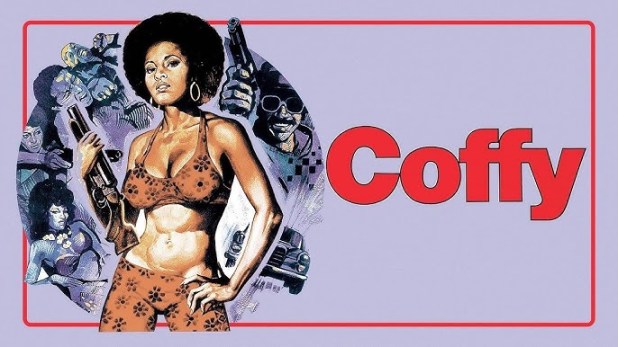
Flower Child Coffin (Pam Grier) is Coffy, who saves lives as an emergency room nurse but also takes them as she gets revenge for her sister Lubelle, murdering the people who got her hooked on heroin. Once her friend Officer Carter (William Elliot) gets crippled by those very same people, she decides to up her need to kill everyone in her way.
She thinks her boyfriend, Howard Brunswick (Booker Bradshaw), is on her side, working to make the community better. But he’s just as bad as her targets, King George (Robert DoQui) and Arturo Vitroni (Alan Arbus). He even tells them that she’s just another whore, sending her to death at the hands of Omar (Sid Haig) before she pulls a weapon out of her hair and stabs him in the throat over and over again.
All that’s left is to, well, kill everyone. Yet Howard almost wins her back. He tells her how they’re going to change the community. And then a white woman asks him to come back to bed. What else can she do but blow his manhood off with a shotgun?
Jack Hill directed and wrote this, and everything he touched — Switchblade Sisters, Spider Baby — became the kind of movies that transcended their drive-in and exploitation beginnings. Coffy isn’t the kind of woman who needs to be rescued; she’s a force of sheer violence, unstoppable even when things look at their worst. By the end, she walks the beachfront alone; you half expect her to walk into the ocean like Godzilla.
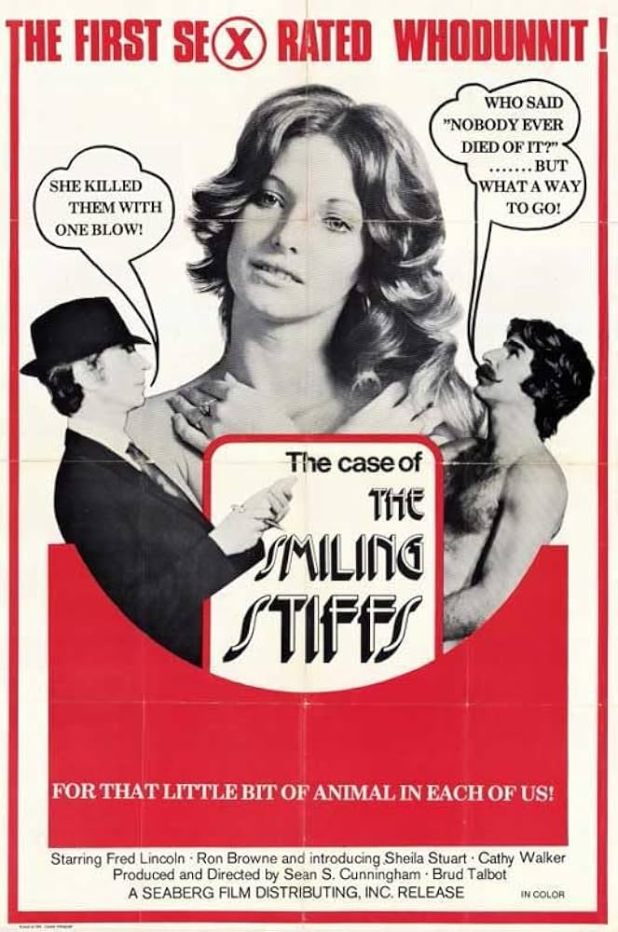
“The First Sex-Rated Whodunit” combines softcore sexual content — appearing as if it were originally shot hardcore with scenes later edited out — with a murder mystery, and possibly even a vampire element. This film, directed by Sean S. Cunningham and Brud Talbot, is also known as Case of the Full Moon Murders. It features many of the same cast and crew from The Last House on the Left. There’s no Wes Craven or David Hess, and for some reason, the production moved to Miami.
The film raises intriguing questions: Is Emma (played by Sheila Stuart) a voyeur, a vampire, or perhaps both? Why are so many men, whom she engages with intimately, found drained of blood and lifeless, yet smiling? Will the Dragnet-style detectives, led by Joe (portrayed by Fred J. Lincoln), manage to solve the case?
The film was such a success in Australia that discussions about a sequel continued as late as 1977.
Possibly inspired by the kidnapping of Barbara Jane Mackle, The Candy Snatchers gets its name because Eddy (Vince Martorano), Jessie (Tiffany Bolling) and Alan (Brad Davis) have kidnapped a young girl named Candy (Susan Sennett) from her Catholic school. They keep her buried alive — with a pipe for air — in a field somewhere in California. Only the autistic Sean Newton (Christopher Trueblood) knows that she’s there, but he’s a little kid who can barely communicate, trapped with parents — Dudley (Jerry Butts) and Audrey (Bonnie Boland) — who seemingly hate him.
Candy will inherit $2 million from her late father when she turns 21. But if she dies before that, her stepfather, Avery (Ben Piazza), gets half, and his wife, Katherine (Dolores Dorn), receives the other. So he doesn’t even tell her that Candy is gone.
Even when presented with a severed ear — the criminals go to a morgue and cut one off a dead body — Avery doesn’t care. He’s already sleeping with an employee, Lisa (Phyllis Major), and doesn’t care that Alan seduces his wife. He cares even less when they kill her.
These horrible people are all determined to destroy one another. I won’t ruin the end of this, only to say that you will have to create your own conclusion to the story.
Bolling hated this, saying to TCM Underground, “I was doing cocaine…and I didn’t really know what I was doing, and I was very angry about the way that my career had gone in the industry…the opportunities that I had and had not been given…. The hardest thing for me, as I look back on it, was I had done a television series, The New People, and so I had a lot of young people who really respected me and… revered me as something of a hero, and then I came out with this stupid Candy Snatchers movie… It was a horrendous experience.”
Director Guerdon Trueblood — that’s his son playing Sean — and co-star Vince Martorano had been best friends at George Washington University in Virginia. They made a bet about who would get into filmmaking first. Trueblood became an in-demand writer for TV series and movies of the week. When he got the job of directing this movie, he asked writer Bryan Gindoff to create the character of Eddy specifically for Martorano, who was working as a commercial fisherman at the time.
William Allen Castleman directed Johnny Firecloud and The Erotic Adventures of Zorro, as well as composed the music for The Swinging Cheerleaders, The Adult Version of Jekyll & Hide, the 1974 The Wrestler, The Big Bird Cage, Trader Hornee, The Ecstasies of Women, Thar She Blows!, Space Thing, Nude Django, The Lustful Turk, The Acid Eaters, Ski on the Wild Side, She Freak, The Defilers, The Devil’s Mistress, Starlet!, Trader Hornee, ‘Gator Bait and At the End of the Rainbow. He also produced 7 Into Snowy and Chorus Call, so he was busy.
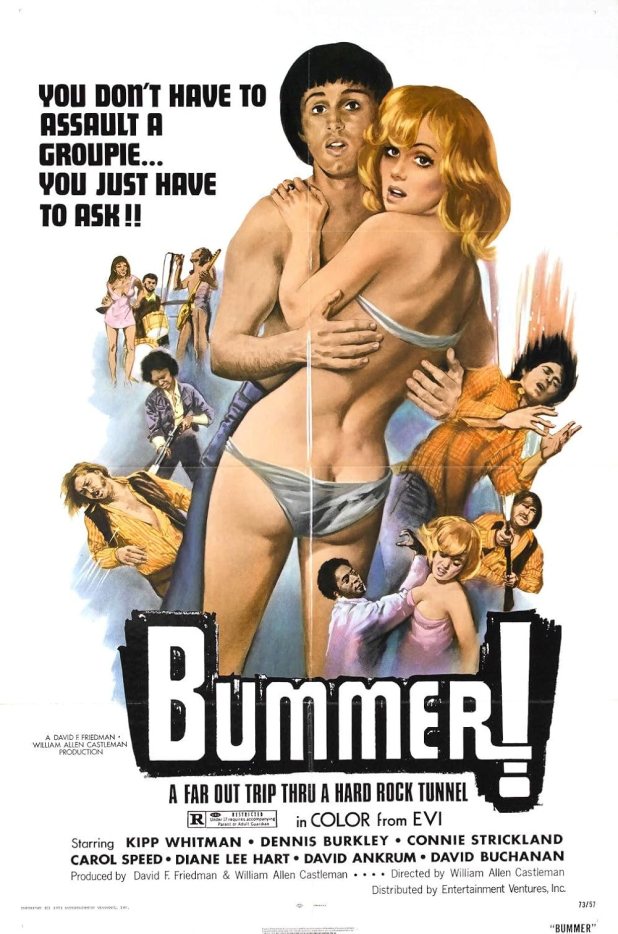
Written by Alvin L. Fast, who also wrote Moonshine Girls, Tom, Eaten Alive, Black Shampoo, Satan’s Cheerleaders and Angels’ Brigade, Bummer is about a rock band called The Group who are, well, out getting groupies. Their bass player, Butts (Dennis Burkley), goes nutzoid and starts killing people. First, he throws two of the girls in a shower and slaps them while calling them pigs. But you know, he owns the touring van. The limit comes when he kills people, starting with a groupie and the lead singer Duke (Kipp Whitman) before the other band aids get their revenge.
One of those girls is Carol Speed from Abby! Other ladies include Connie Strickland (The Centerfold Girls), who plays Barbara, the girlfriend of drummer Gary (David Buchanan); Dolly, who is Diane Lee Hart from The Pom-Pom Girls and Morely, The Group’s manager, who is Leslie McRay (Cleopatra in Death Race 2000).
Shot by Gary Graver, which makes this way better than it should be. It also has one of the most misogynistic taglines ever: ““You don’t have to rape a groupie… You just have to ask!”
David F. Friedman, the other producer, and Bob Cresse show up as cops at the end. As Herman Traeger, Friedman produced Ilsa and he was behind much of the soft core — and some hardcore — exploitation that made up the best of the form. Cresse wrote and produced most of those and shows up in them, often as a love camp commandant or as Granny Good in House On Bare Mountain. Cresse had a reputation for being tough, often carrying guns and with two bodyguards on his payroll. His career ended when he was walking his dog and saw two men beating a woman on Hollywood Boulevard. He pulled out a gun and ordered the men to stop. One of them said he was a cop and shot Cresse before killing his dog. The hospital stay that followed — he had no health insurance — ruined him.
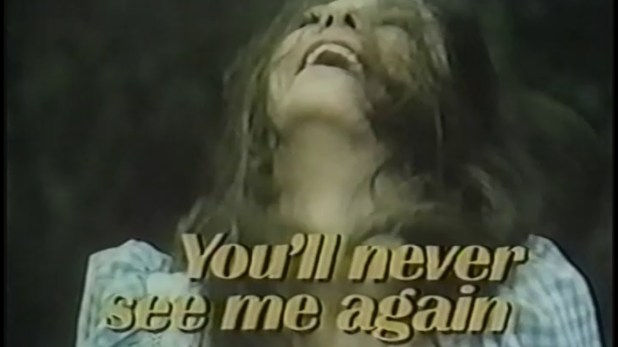
Ned (David Hartman) and Vickie Bliss (Jess Walton) are newlyweds who get into an argument. He shoves her, she leaves, yelling, “You’ll never see me again.” He expects her back that night. She never comes home.
The next day, he goes to see her parents, Will (Ralph Meeker) and Mary Alden (Jane Wyatt). Strangely, he’s never met them before. Yet they can’t answer any of his questions, whether it’s about where their daughter is or about her childhood. Are they even her folks?
The cops start to get the idea that maybe Ned killed his wife. After all, he’s constantly going into a rage. However, the truth is that he blames himself for Vickie leaving. He’s their top suspect, so he has to escape custody and try to find the truth, kind of like he’s trapped in a giallo. The ending? Amazing.
Hartman would go on to host ABC’s morning news show Good Morning America, so for me, he was the man who told me my news before school. It’s disconcerting to see him screaming at people and getting into fights with the police.
In 1986, Juan Luis Buñuel, Luis’ son, directed a UK TV movie based on the same story.
Directed and written by Edward J. Lakso and Herbert L. Strock, Brother On the Run has Billy (Kyle Johnson) and Frank (Gary Rist) on the run — one is black, the other is white — and they hide out after a job gone wrong with Billy’s sister Maud (Gwenn Mitchell), who lives next to Professor Grant (Terry Carter). The title comes from, of course, these brothers on the run despite the teacher trying to help them. He also has sex with two women before he gets to that help.
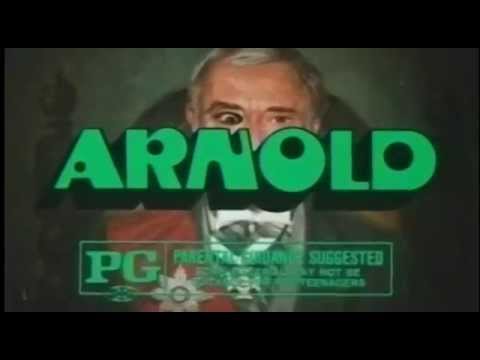
EDITOR’S NOTE: Arnold was on the CBS Late Movie on November 21, 1986 and March 25 and July 29, 1987.
Lord Arnold Dwellyn (Norman Stuart) has just married Karen (Stella Stevens), which would not be all that strange except that, well, he’s dead. He’s not buried, as per his will, if Karen wants to inherit all that he owns, she must never leave his mansion and leave him in state. That doesn’t mean that she’s taking it easy, as she’s been having an affair with Arnold’s brother Robert (Roddy McDowall). And, um, how did Arnold get married when he had a widow, Lady Jocelyn (Shani Wallis)? I guess it really is until death do you part, right?
There’s money hidden in the walls, though, but whenever anyone gets close to it, Arnold has already planned for it, knowing how each person will react and coming up with a death trap created just for them, like some kind of Dr. Phibes without the years of medical school. Only Arnold’s sister Hester (Elsa Lanchester, once a Bride) seems to benefit from all of this, but her luck can’t last.
Shot at the same time as Terror in the Wax Museum with most of the same cast — Lanchester, Wallis, Steven Marlo, Patric Knowles, Shani Ben Wright and Leslie Thompson — this didn’t hit right with me at first. It felt like a long, black out sketch from Night Gallery. Yet the more I think about it, well, I keep thinking about this movie. I mean, what other film finds roles for Victor Buono, Bernard Fox, Farley Granger and Jamie Farr? How many fog machines did it take to make this? And wow, it was produced by Bing Crosby Productions?
Directed by Georg Fenady, who other than this and the aforementioned Terror in the Wax Museummainly worked in TV and written by Jameson Brewer (who did write The Incredible Mr. Limpet) and John Fenton Murray (whose credits include Sid and Marty Krofft shows and Partridge Family 2200 AD), this feels like something made in between episodes of other shows. Yet, it has a weird charm that keeps drawing me back to it. Maybe it’s the Shani Walls theme at the end?
EDITOR’S NOTE: The Devil’s Daughter was on the CBS Late Movie on September 9, 1975 and January 3, 1978.
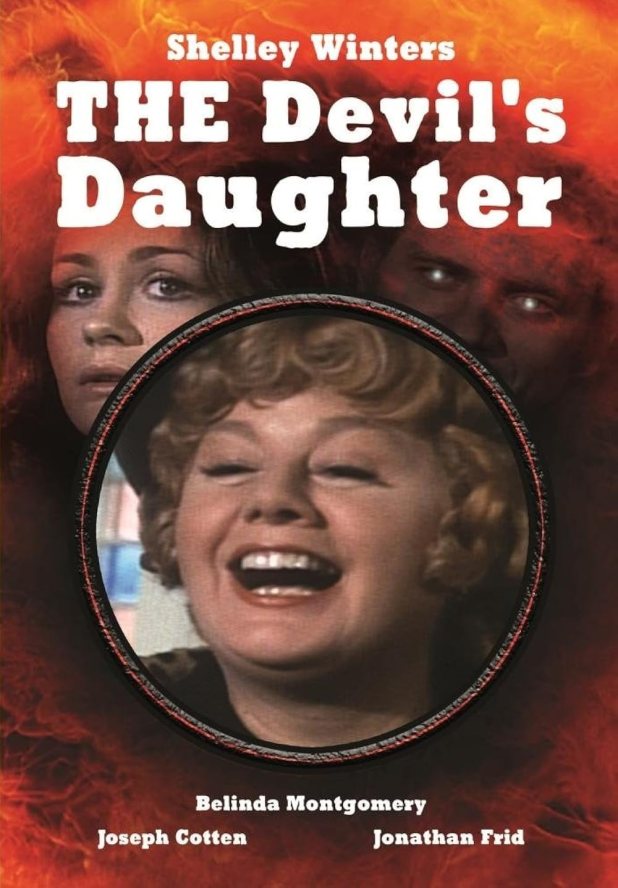
The ABC Movie of the Week for January 9, 1973, The Devil’s Daughter, is very much Rosemary’s Baby, the home edition, and that’s perfectly fine. It captures many of the 1970s occult rules accurately.
It stars Belinda Montgomery (Stone Cold Dead, Silent Madness, Doogie Howser’s mother) as Diane Shaw, a young woman who has just lost her mother, Alice (Diane Ladd). At the funeral, she meets the rich Lilith Malone (Shelley Winters, fulfilling the most essential law of Satanic film, that Old Hollywood wants to eat the young), who was a member of a cult with her mother, one that has been following Diane her entire life, ready for her to marry a demonic prince.
I’ve said it before, and I will say it so many more times, but never come home to settle your parents’ estate after their mysterious death. Bad things always happen. As Diane works to settle down in a new town and work on the estate with Judge Weatherby (Joseph Cotten, yes, more Old Hollywood, a year fresh from Baron Blood). She gets a place to stay with Lilith, who gives her a ring that belonged to her mother. The symbol on this ring is the same one as a painting of Satan above the fireplace in Lilith’s home, as well as her baby book and even her favorite brand of cigarettes. Yes, even in 1973, Satan had a great marketing team. Or perhaps this is all predestined.
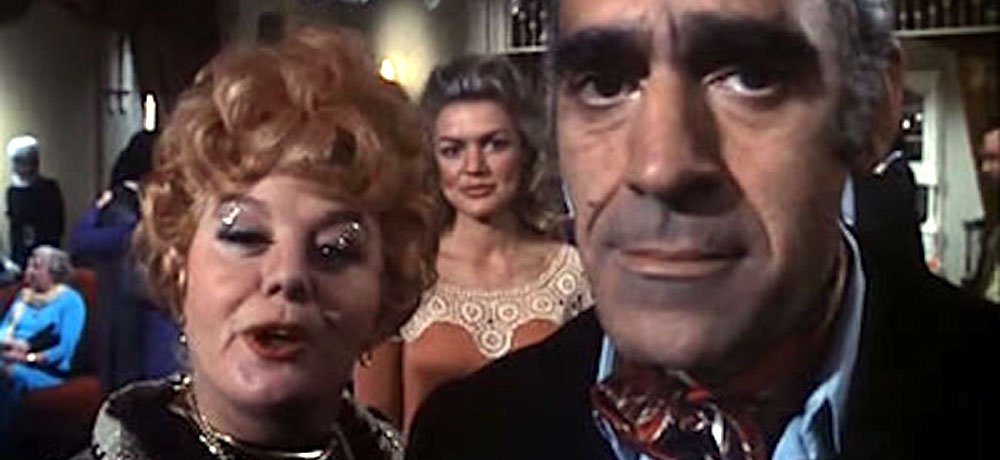
Diane even gets to go to elite parties. That’s not a good thing. There, she learns that she’s the Princess of Darkness who will marry the Demon of Endor. Yes, the place where Ewoks come from. You knew they were nefarious. At that party — shot very much like Rosemary’s Baby — you’ll even see Jonathan Frid from Dark Shadows as the butler, Lucille Benson (who ran the Susan B. Anthony Hotel for Women on Bosom Buddies) and Abe Vigoda as Alikhine, probably named for noted chess player Alexander Alekhine, as these devil worshippers have checkmated poor Diane.
Also, Abe Vigoda is the same age as I am now, and he always looked ancient. Now, I feel quite old.
Diane runs and gets a roommate, Spretty(Barbara Sammeth), who is the sacrifice in this, dying at a horse’s hooves! As much as she tries to avoid Lilith, she can’t escape. Not even when she meets a lovely man named Steve Stone (Robert Foxworth), a stunning architect who soon marries her. But if you know your demonic films, you won’t be shocked to learn that he’s the demon that Wicket W. Warrick prays to every night, the Demon of Endor.
Director Jeannot Szwarc made numerous TV movies and episodes of Night Gallery, as well as directing Jaws 2, Bug, and Santa Claus: The Movie. I love that this was written by Colin Higgins. Yes, the same man who wrote Harold and Maude would go on to direct 9 to 5 and Foul Play.
Do you think your father is terrible? Diane’s dad is Satan. And her husband? He has blank eyes because he has no soul! The best part is the reveal that Satan, who we have seen in shadow and who has crutches, ends up being Joseph Cotten and he has cloven hooves for feet! I’m not sure if I can love a movie as much as Devil’s Daughter.
EDITOR’S NOTE: Linda was on the CBS Late Movie on September 29, 1975, May 24, 1977 and June 12, 1978.
John D. MacDonald had several of his books turned into movies. The Executioners was filmed twice as Cape Fear, Soft Touch inspired Man-Trap, plus the novels Darker Than Amber, The Girl, the Gold Watch & Everything, Condominium and A Flash of Green were all made into movies. Even this story was turned into two TV movies with the second starring Virginia Madsen as Linda.
Linda Reston (Stella Stevens) has a bad marriage with Paul (Ed Nelson, The Devil’s Partner), who is daydreaming of leaving her when she suddenly shoots their friend Anne Braden (Mary-Robin Redd) and turns the gun on Anne’s husband Jeff (John Saxon!) while at the beach. Paul calls the cops and when they arrive, Jeff is alive and the twosome accuses Paul of killing Anne.
As you can tell right away, Linda and Jeff are working together to get rid of their spouses and make a new life for themselves. Luckily, Marshall Journeyman (John McIntire, who replaced both Ward Bond on Wagon Train and Charles Bickford on The Virginian when both of those actors died), an elder lawyer, takes on his case and starts to investigate Linda and Jeff.
Paul sneaks out of his cell and soon learns that his wife has been conspiring with Jeff, which leads Journeyman to get the cops in on a scam to call her and try and get a confession. She’s too tough but man, Jeff folds right away. She tells him he’s spineless and also informs her now ex-husband that she won’t be in jail long.
Stella Stevens is quite wonderful in this. She’s so cold and has everything figured out, yet as she laments, she’s never been able to find a man who isn’t spineless. Her husband can’t even bury a dead animal without having a nervous breakdown, and her lover gets her arrested for murder. I’d love a sequel where we learn how she takes over prison.
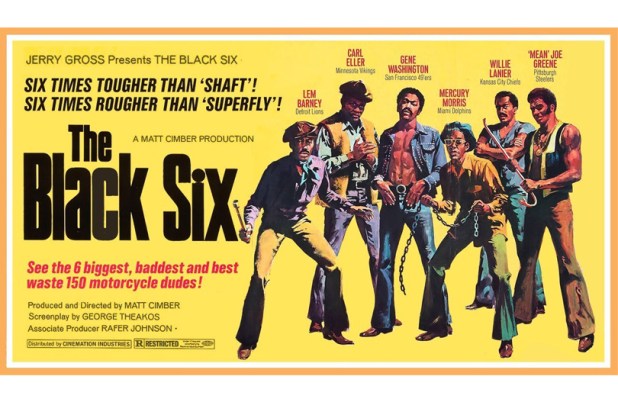
Matt Cimber has pretty much lived a life—he was married to Jayne Mansfield, he created the Gorgeous Ladies of Wrestling, and he directed movies like Butterfly, The Witch Who Came from the Seaand Hundra, amongst others. In 1973, he convinced six currently playing NFL stars to appear in a black version of the biker film. The results? Amazing.
The Black Six is made up of six All-Pro NFL stars:
Gene Washington, San Francisco 49ers (who was also in Cimber’s Lady Cocoa and Airport ’75)
Willie Lanier, Kansas City Chiefs (who is in the NFL Hall of Fame and was named to the NFL 75th Anniversary All-Time Team)
Carl Eller, Minnesota Vikings (an NFL Hall of Famer who went on to found substance abuse clinics)
Mercury Morris, Miami Dolphins (a Pittsburgh native who was drafted to West Texas State, the alma mater of tons of pro wrestlers, including Tully Blanchard, Stan Hansen, Ted DiBiase, Dusty Rhodes and both Funk brothers to name but a few)
Lem Barney, Detroit Lions (an NFL Hall of Famer who sang backup on Marvin Gaye’s “What’s Going On” and played himself in Paper Lion)
Joe Greene, Pittsburgh Steelers (one of my hometown heroes, Greene is probably one of the greatest — if not the greatest — Steelers ever. He appeared in a famous Coke commercial, as well as Fighting Back: The Rocky Bleier Story and Smokey and the Bandit II and is also an NFL Hall of Famer)
Washington already had some acting experience, so he stars as Bubba Daniels, a Vietnam War vet who returns home to find that his brother has been killed by a white supremacist biker gang. Their leader, Thor, is played by Ben Davidson, an avid real-life biker who played for the Oakland Raiders. You can also see him in M*A*S*H*, Conan the Barbarian and as Porter the Bouncer in Behind the Green Door.
Bubba and his gang — the Black Six — decide to avenge that death, which leads to battles with racist townies, uncaring police and Thor’s gang. The final battle ends with Thor blowing up his own bike to kill them all or so it would seem. According to Mercury M, orris’ book Against the Grain, the players protested that ending — guess they didn’t realize that nearly every biker movie ends with the heroes getting killed — so that’s why the movie ends with the title card that says “Honky, look out…Hassle a brother, and the Black 6 will return!”
It’s all pretty depressing stuff, to be honest. But you can say that for nearly all biker and blaxploitation cinema. It’s still amazing to be that at one point, the NFL didn’t have the control that it does today and that six of its biggest stars could go off and make a movie together.


 B&S About Movies
You must be logged in to post a comment.