PURE TERROR MONTH: Frankenstein ’80 (1972)

ABOUT THE AUTHOR: Bill Van Ryn is the man behind the website Groovy Doom and the zine Drive-In Asylum. He’s the inspiration for me to write more about movies.

I’ve seen the movie Frankenstein ’80 a number of times already, and I still can’t point to any reason that it carries this title. If there is an explanation somewhere in the movie, then I missed it about seven times. It’s an Italian film originally released in 1972, and the sole directorial effort from Mario Mancini, better known as a camera operator and/or DP for a number of films, including Mario Bava’s Blood and Black Lace and Black Sabbath

Frankenstein ’80 shows us what we assume to be a descendant of the good doctor operating out of a secret laboratory in his clinic. A rival scientist, Professor Schwartz, has created a serum that prevents the rejection of transplants. Despite the life-changing implications of a substance like this, Schwartz has only made a single bottle of the stuff, which makes it rough when the bottle goes missing, resulting in the death of Schwartz’s latest transplant hopeful.

Of course the bottle has been stolen by Dr. Frankenstein, or rather, Frankenstein’s emissary, a hulking man that Frankenstein calls Mosaic, sewn together from stray body parts. Frankenstein is obsessed with the idea of perfecting Mosaic, and Schwartz’s formula will do nicely in helping achieve this. Dr. Frankie in this movie is played by American actor Gordon Mitchell, a former bodybuilding champ who followed the example of Steve Reeves and other muscleheads like Mickey Hargitay and Brad Harris in forging an acting career in European-lensed movies. He looks a little svelte in this movie for a bodybuilder, so this must have been after his lifting days. The beef in this movie is Mosaic, played by a hulking actor named Xiro Papas (who, rather ironically, died in the year….1980). Mosaic has the nasty habit of rampaging through the local village, murdering random women and making off with one of their internal organs, which he takes back to Frankenstein to use as his own. Frankenstein scolds the creature for these brutal murders the way a parent would scold a child for eating cookies before dinner (“Mosaic, you must stop this killing!”), but he does use the organs after all, which only reinforces Mosaic’s bad behavior. Although we see the monster kill men, we only see him steal organs from women, so there’s no explanation as to where Dr. Frankenstein gets the “gonad” transplant that he uses to increase Mosaic’s sexual potency. Maybe it’s better that way.

Dr. Frankenstein sure is a stupid dick, too, because -duh- this turns the monster into a sexual predator as well. In a movie full of disturbing murders, one of the hardest to watch is a scene where Mosaic rapes a prostitute who seems to be somewhat overwhelmed by the size of his “external organ”, then strangles her during the afterglow. Frankenstein has been trailing Mosaic during this episode, but arrives too late to prevent the murder, ushering Mosaic into his clothes and out of the apartment with barely more than a “naughty, naughty.”

By now you should understand that Frankenstein ‘80 is completely absurd. It actually predates Andy Warhol’s Frankenstein in its blending of broad comedy with visceral horror, and it comes close to matching that film’s gut-churning violence. Mosaic’s murders are sudden and brutal, and they often are prefaced by the victim being kind to him; a female butcher gives him some friendly customer service before he rudely follows her into the freezer and beats her to death with a large femur. Even the hooker is nice to him, sort of, until she gets a good look at him naked and sees that he’s all stitched together. I don’t know if I’d call it camp, it’s not easy to gauge the movie’s own self-awareness since the English audio track is one of those dodgy dub jobs, but some of the scenarios do seem intentionally over the top, such as the subplot of the local law enforcement vainly trying to keep up with Mosaic’s murders. 

What really could have helped Frankenstein ‘80 would have been at least a fraction of Paul Morrissey’s style or wit, not to mention his budget. There are no real serious moments in Frankenstein ‘80, no commentary on the decadence of the wealthy nobility, no pondering of the human condition by considering the liberties taken by these reckless practitioners of so-called medicine, and an almost total lack of suspense. What it does have is sleaze, in great gory buckets, and a disturbing partiality for the brutal murder of beautiful women, who are usually stripped of their clothing before being throttled or clobbered by the hulking monster. Lest we accuse the filmmakers of being sexist, I must point out that male victims suffer greatly as well, including one guy who is killed in a public men’s room. He’s just taking a piss, minding his own business, when Mosaic moves on him like a sex addict in a truck stop – except he doesn’t want to give the guy a quick blowjob in a stall, he takes the guy’s head and smashes it against the tile wall, resulting in an explosion of gore. Now that’s just plain rude.
Toys Are Not for Children (1972)

Man, I would have never survived the 1970’s. It was too full of sin and sleaze, too many drugs, too many cults. I’m reminded of this every single time I watch a piece of cinematic insanity from that most bonkers of all decades.

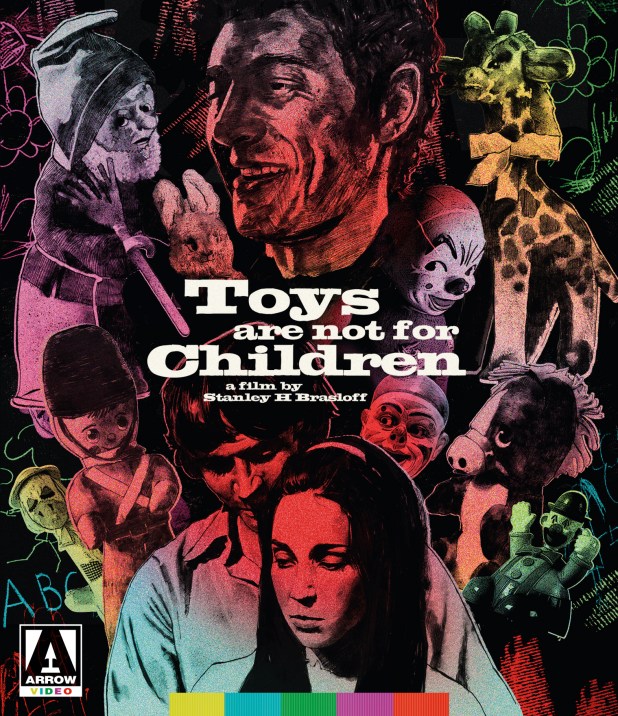
Arrow Video has gifted me with one more reminder of why this was the most dangerous and demented of all eras with Toys Are Not for Children.

What can you say about a movie that starts with a young woman playing under the covers — yes, the dirty side of playing — with a doll that her father sent her for her birthday being interrupted by her mother?

Jamie Goddard is that young girl, emotionally stunted by the loss of her father and unable to embrace her sexuality unless it’s within the world of prostitution and daddy/little girl play. She’s played by Marcia Forbes, a one and done actress who was probably chased away by just how insane this entire film is.

Fran Warren, who plays the role of the mother, was a major recording star in the 40’s and 50’s. Perhaps you know her song “A Sunday Kind of Love” or saw her in Abbott and Costello Meet Captain Kidd. She pretty much abuses her daughter, who only finds joy in the toys from daddy and the ones she sells at a toy store. Then she gets married to Charlie and can’t consummate with him — the pull of daddy is too strong.

So she does what any of us would. She falls in with a lesbian prostitute and her pimp, starts making love to dirty old men and finally gets what she always wanted. The chance to be with — and yes, I mean with in the most perverted sense of the world — her father.

Director/writer Stanley H. Brassloff only would direct one other film, Two Girls for a Madman. After watching this, I need to chase down that movie, too.

Make no mistake, this is the kind of movie that is going to make you sick to your stomach. I kind of like that feeling. You may not. It would pair nicely with The Baby or Private Parts. If you’re the kind of adventurous film watcher that I am, you’re probably beyond excited to hunt this one down.

This new blu ray release also features new audio commentary with Kat Ellinger and Heather Drain, an appreciation of the movie by Nightmare USA author Stephen Thrower, a video essay by Alexandra Heller-Nicholas, the original theme song and trailer and reversible cover art of the original poster and artwork by The Twins of Evil.

You can get this from Arrow Video.

DISCLAIMER: We were sent this movie for review by Arrow Video. That has no impact on our thoughts.

PURE TERROR MONTH: Blood Sabbath (1972)

ABOUT THE AUTHOR: An American living in London, Jennifer Upton is a freelance writer for International publishers Story Terrace and others. In addition, she has a blog where she frequently writes about horror and sci-fi called Womanycom.

2024 update: I was a bit hard on this film the first time I watched and reviewed it. I’ve watched it three times and there’s something dreamlike about it that grows on you. It’s now one of my favorites precisely because of all its flaws.
Blood Sabbath’s Internet Movie Database list of Plot Keywords includes: acoustic guitar, public nudity, walking naked in the woods, bare breasts, foot chase, selling soul and goat. If these ingredients were put together in the right way, it would make an entertaining film. Blood Sabbath (1972) is not that film. It is ambitious but also boring. 

Every director has to start somewhere. Brianne Murphy’s story is more interesting than the film itself. After moving with her family to America, she studied acting in New York. She joined the circus as a trick horse rider and eventually landed in Hollywood where she married low-budget filmmakers Jerry Warren (The Wild Wild World of Batwoman) and Ralph Brooke (Bloodlust!) successively. She eclipsed them both in talent and went on to become an Emmy-award-winning cinematographer on the ‘70s TV shows Wonder Woman, Little House on The Prairie, and Highway to Heaven. In 1980 she became the first female director of photography on a major studio film, Fatso starring Dom DeLouise, directed by Ann Bancroft. 

In 1982 Murphy won the Academy Award for Scientific and Engineering Plaque for the co-design and manufacturing of the MISI Camera Insert Car and Process Trailer. A camera rig that allows driving scenes to be filmed with a towing apparatus – a standard piece of equipment in today’s higher-budget productions. Blood Sabbath (1972) was Brianne Murphy’s only foray into directing. 

The film stars Tony Geary (Luke Spencer of TV’s General Hospital) as a whiney recently discharged (or was he?) Vietnam Vet named David. The film opens with David wandering through the woods of Mexico with nothing but a sleeping bag and acoustic guitar slung over his shoulder. While camping under a tree, he is assaulted by a band of naked American hippie chicks. For most cis-gender heterosexual males, this would be cause for celebration but David inexplicably screams, “Hey! What is this?” and “Christ! Get away from me!” as they tear his pants off. 

After running away from the women and fainting next to a small lake, David is revived by a beautiful water nymph named Yyala (Susan Damante) who speaks to him softly until he passes out again. This time, he is aided by a grizzled old guy name Lonzo (Sam Gilman) who lives in a shack in the woods and survives off the fish in Yyala’s lake. The closest neighbor is a coven of witches who live on a nearby mountain. They are led by Alotta, Queen of the Witches played by Dyanne Thorne. She does indeed have a lotta.

One day, Alotta spies on Yyala and David making out and decides she’d like to have David for herself. She performs candle Magick and tries to cast a love spell on David, to no avail. He is smitten with Yala. Sadly, they can never consummate their love for each other because he is “of the land” with a soul and she is “from the sea” without one. Perhaps the script was written to be filmed by the sea and all the location scout could find was a tiny lake? It’s just one of several inconsistencies throughout the film. 

Now desperate to be rid of his soul, David accompanies Lonzo to the local village’s annual harvest celebration. Their fruitful bounty is not because they’re good farmers. Once a year, the villagers choose a female child to be brought by Lonzo to the witches on the mountain. Alotta, takes the little girl’s soul and inducts her into the coven to grow and up and live among them. In return, Alotta casts a spell to ensure healthy crops for the farmers. 

David stops Lonzo and trades places with this year’s chosen child. Then he can be with Yyala for all eternity. David makes a deal with Alotta that he can be with Yyala with one caveat. If Yyala should ever tire of David and leave him, he must return to Alotta and be her lover instead.

The soul removal ceremony is a success and David and Yyala enjoy a montage of happiness frolicking through the fields over shots of flowers, and groovy flute and synth music. At the next full moon Alotta tricks David into participating in a blood sacrifice and seduces him by appearing to him as Yyala. Then, she plays Yyala, David and Lonzo against each other by telling them each a different story of the evening’s events, causing all manner of mistrust, murder and mayhem.

The film concludes on an interesting albeit confusing note. David vengefully stabs Alotta (not before she takes her clothes off to the sound of cats growling.) As she lay dying, she places her final curse on him that he be killed by his own people. He staggers off into a field, has a ‘Nam flashback and is killed after being run over in a field by the hippies from the beginning of the film. Was David dead all along, killed in Vietnam? It seems so. In the final shot, his spirit swims off into the sunset with Yyala. A happy ending of sorts that likely takes inspiration from the same award-winning 1962 French short film An Occurrence at Owl Creek Bridge. The same film that Jacob’s Ladder (1990) drew from 18 years later. An ambitious idea let down in Blood Sabbath by a slow plot, poor dialogue and bad acting. A good effort, but overall a letdown. Fortunately, Brianne Murphy’s career was not bogged down by the film.

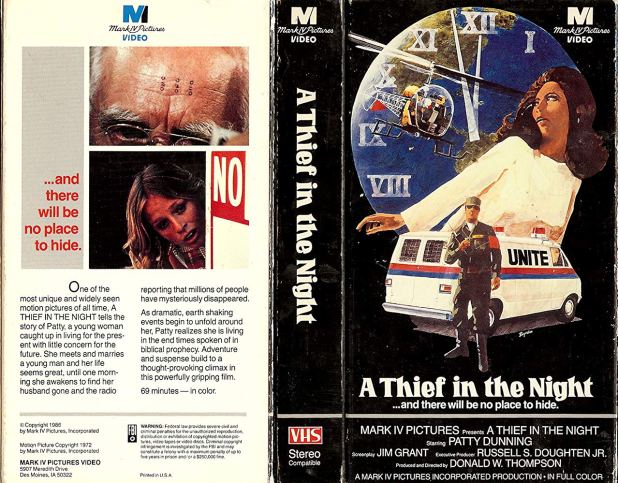
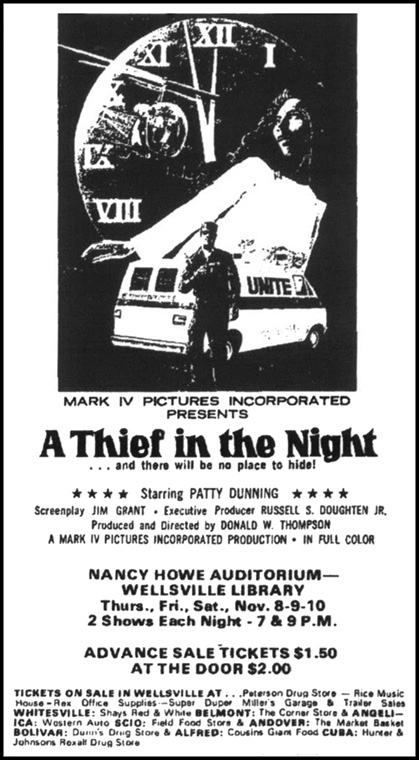
A Thief In the Night (1972)

When I was a kid, my parents went to a lot of religious bookstores for some reason. I was always left to my own devices and would always find my way to the Jack Chick comics and posters on the wall. In the pre-millennium tension world that was the late 1970’s, one movie was always getting shown and that was A Thief In the Night.

This movie is thought to have been seen by an estimated 300 million people and was the pioneer of a whole new genre of Christian film, one that would marry rock music and horror movies to create a film that would, quite frankly, scare you into believing. This isn’t family-friendly evangelic filmmaking. This is punch you in the face and demand you get saved now mania.

Patty Myer wakes up to learn that millions of people have disappeared in the Rapture. Even her family is gone and she’s been left behind. She’s trapped in a world where the United Nations has set up an emergency government system called the United Nations Imperium of Total Emergency (UNITE) and declare that those who do not receive a symbol of identification — yes, the Mark of the Beast — will be arrested.

It didn’t have to be this way for Patty. One of her friends loved Jesus and followed Him. Another friend was bitten by a snake before finding his way. And now, she doesn’t believe in Jesus or the UNITE preachings, so she’s on the run.

Patty is chased by UNITE to a bridge where she falls to her death, but then she awakens only for it to all be a dream. But guess what? The Rapture happens again and her family is all gone again. What happens next? Will she accept the Mark? Will she try to find her way to Heaven? If even a priest will take the Mark, how can a normal person avoid Satan?

There were three other movies in this series — of course we’ll be covering all of them — and they all build on the tension of the end of all things. These things played in libraries and churches and used fear to lead the conversion call at the end. I’ve never understood that, but the majority of humanity leaves me questioning a lot of things.

Theif in the Night 2

All I know is that I spent most of my childhood nights awake in bed worrying about the end of the world. Would I be ready? Would I make it to the Rapture? How would I survive when the rest of my family went to Heaven and I was left alone to battle the forces of the evil ones? I would get the shakes, waking my whole family up screaming in terror.

Did the movie work? According to an interview on a Baptist church website, Heather Hendershoot, associate professor in the media studies department at Queens College, City University of New York said, “I have found that A Thief in the Night is the only evangelical film that viewers cite directly and repeatedly as provoking a conversion experience.”

25 years later, the authors of the Left Behind series of books and films had the same success but on a much more secular level. We’ll never lose our fear of the end times until after they come…and according to scripture, we’ll never know exactly when we’ll all be taken or left behind.

You can watch this for free on Amazon Prime or Archive.org, as well as You Tube via the Christian Movies portal. There’s even an official website if you want to learn more.

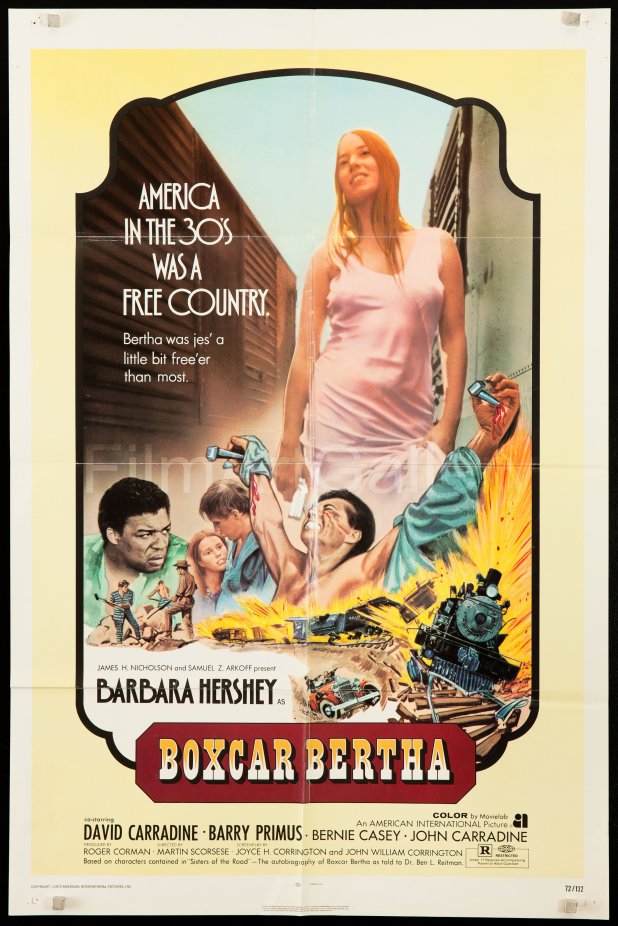
Boxcar Bertha (1972)

In 1967, Martin Scorsese made his first movie, the black and white film I Call First, which was later retitled to Who’s That Knocking at My Door. Originally intended as the first of the director’s semiautobiographical J. R. Trilogy — along with Mean Streets — it was followed by this movie, an adaption of American anarchist Ben L. Reitman’s semi-autobiographical Sister of the Road. Made for Roger Corman, it taught Scorsese that movies could be made cheaply yet still entertain audiences while reinforcing his friend and mentor John Cassavetes’ belief that the auteur should make the movies that he wanted to make, instead of someone else’s projects.

Actually, Cassavetes was pretty blunt. After Scorsese showed him the finished product, the actor embraced him and said, “Marty, you’ve just spent a whole year of your life making a piece of shit. It’s a good picture, but you’re better than the people who make this kind of movie. Don’t get hooked into the exploitation market, just try and do something different.”

Boxcar Bertha Thompson (Barbara Hershey) and “Big” Bill Shelly (David Carradine) are train robbers and lovers embroiled in the plight of railroad workers as they try to unionize. Bertha is implicated in a murder and the two become fugitives.

Bernie Casey shows up as Von Morton and Carradine’s father John is also in this as H. Buckram Sartoris. Seeing as how it was a Corman picture, it wasn’t always intended to be an art project, as the producer wanted another Bloody Mama.

Hershey said that the movie was “a lot of fun even though it’s terribly crippled by Roger Corman and the violence and sex. But between the actors and Marty Scorsese the director, we had a lot of fun. We really had characters down but one tends to not see all that, because you end up seeing all the blood and sex.”

There was a rumor that Roger Corman’s wife Julie Corman had actually obtained the rights to the story from Bertha Thompson herself. The story goes that Corman had tracked her down to a hotel in San Francisco, but the woman wouldn’t let her in. It’s also a great lesson in carnie PR work, as the author explained that there wasn’t ever a real Bertha. In fact, she was a combination of at least three women he knew.

I have to wonder how the Cormans reacted when they finally saw this and all of the violence that was usually so exciting in the early 70’s new Hollywood pictures felt so doomed here.

You can watch this on Amazon Prime.

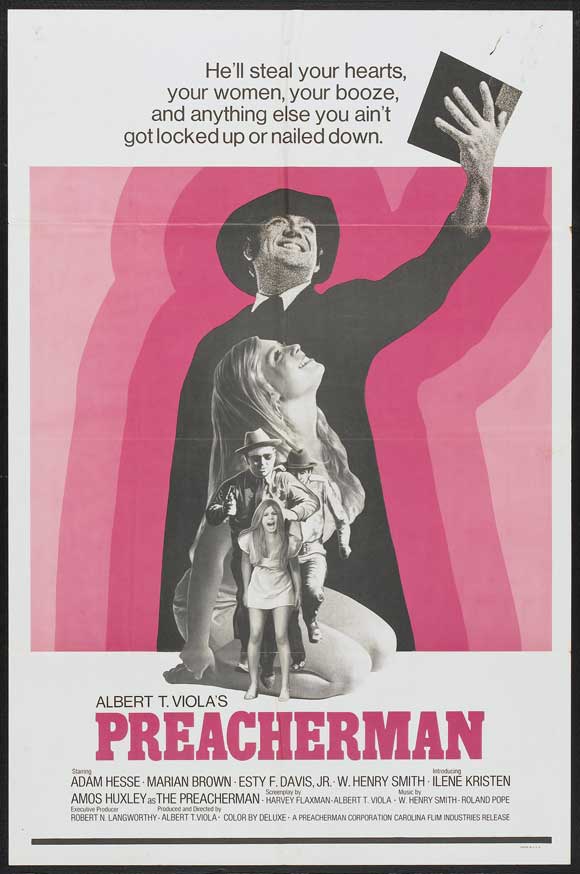
Preacherman (1971)

There’s nothing I hate more than seeing the Troma logo displayed before a movie they only have the rights to. It’s often enough to make me shut a film off, which I did with this one before heading back one more time to try and make it through.

Preacherman was shot entirely on location in Monroe, North Carolina and was produced by a Charlotte, NC production company, Preacherman Corp. Eleven of the seventeen actors in this movie were locals from the Carolinas and most of the crew was from there, too. Outside of star, writer, producer and director Amos Juxley (actually Brooklyn-born Albery T. Viola) and Iilene Kristen, who played Mary Lou and would go on to be on Ryan’s Hope and One Life to Live, not many of them ever acted again.

The Preacherman Amos Huxley loves to get money and make love to young ladies, which runs him afoul of the law in White Oak County. Soon, Amos has escaped yet another series of cops and begins living with the Crabtree family, who are farmers and therefore must have a farmer’s daughter, Mary Lou. He somehow convinces everyone that he’s going to return her virtue and also gets her to believe that the angel Leroy is coming to make her clean again.

The cops are in on the Crabtree’s main crop, which is moonshine, but the Preacherman convinces them to start a new church funded by that demon alcohol. Hijinks, as they say, ensue.

Bill Simpson, who played Sheriff Zero Bull also played Zero in Moonshine Mountain. He also reprised that role in the sequel. Yes, somehow there was a second movie in this series, entitled Preacherman Meets Widderwoman, which never received a national distribution and only played regionally in the South. Screenwriters Joseph Alvarez and W. Henry Smith also penned the hicksploitation-centric romps Trucker’s Woman and Redneck Miller.

You can watch this on Amazon Prime.

J.C. (1972)

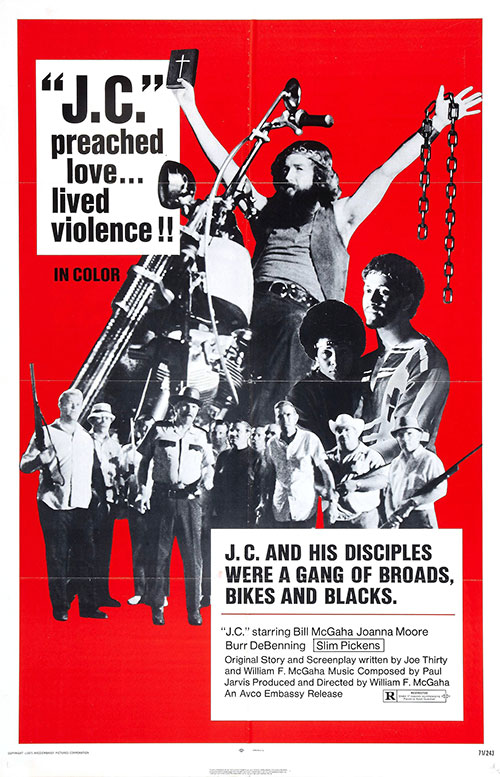
Jesus Christ is born again on Earth. Maybe. Then again, he could also be a biker tripping on acid with a hardcore Southern Baptist preacher daddy. But it doesn’t matter, because he’s got his gang of bikers and he’s taking them on an LSD-fueled pilgrimage to the Promised Land. Oh 1972 — what a magical time you were for completely off the rails movies.

The title doesn’t show up for fifteen minutes and the same guy that wrote and directed this — William F. McGaha — also stars in it. He did the same thing for two other movies, Bad Girls for the Boys and The Speed Lovers.

Somehow, he was able to convince Joana Moore (Touch of Evil), Slim Pickens (the guy rode a nuke into Russia for us, folks) and Burr DeBenning (five years before he’d chase a melting Steve West all over the city).

With a tagline like “J.C. And His Disciples Were A Gang Of Broads, Bikes And Blacks,” how can you really go wrong? Well, the actual film doesn’t live up to the premise, of a biker Jesus changing the world, but on this budget, they were lucky he changed his vestments.

The poster and taglines though? That’s what movies are all about.

Sweet Georgia (1972)

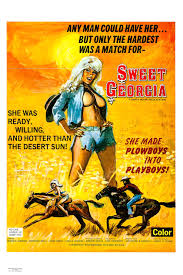
Marsha Jordan (Count YorgaThe Toy Box) is Sweet Georgia, the sexed up wife of rancher Big T (Gene Drew, Truck Stop WomenBobbie Jo and the Outlaw), an abusive drunk who she denies carnal pleasure, instead finding it in the arms of ranchhand Cal and even the arms of her stepdaughter Virginia (Barbara Mills, who also used the stage names Leona Tyler and Barbara Caron for movies like Executive Wives and Fire In Her Bed).

The final straw is when Georgia sleeps with the slow switted Leroy, which leads to her getting trampled by a horse and the farmhand getting stabbed with a pitchform before Cal and Virginia cattle prod the oyster ditch, so to speak. Then, of course, Cal is killed by Big T and we cut to Virginia enjoying herself in a room that is so red lit that it must have been in Mario Bava’s house. In case you think that the once virginal Virginia isn’t going to dance the forbidden polka with her old man, then you haven’t seen a Harry Novak film. Is there a square up reel? Of course there is.

This is another Harry Novak affair. Yes, the producer of such stalwart offerings as Suburban PagansCountry CuzzinsWham! Bam! Thank You, Spaceman!; The Child and   Tanya, perhaps the only sexploitation comedy romp about Patty Hearst. If you think I’m not hunting down that last one right now, you don’t know me all that well.

Should you watch this? Honestly, other than the song that plays throughout the film, there’s not much I can recommend. You’d probaby get more out of it just looking at the poster for an hour.

Daughters of Satan (1972)

John Hollingsworth Morse was a noted film and television director responsible for an eclectic variety of U.S. television series from the 1950s through 1980s, starting with the Star Wars precursor, Rock Jones: Space Ranger, and the still-in-runs Adam-12, The Dukes of Hazzard, and McHale’s Navy. Whenever you watch old World War II film clips—especially the Battle of Normandy—chances are Morse was on the film crew that captured those images.

It was during his time working in U.S. television that Morse met a young actor who recently broke into the business and had a few small roles in a few films and since forgotten U.S. television series. And he saw something special in that actor.

By the late ‘60s, screenwriter John C. Higgins was in the business almost 40 years and ready to retire. He quickly became a go-to talent in the film noir and murder mystery genre (precursors to Italian Giallo), most notably the Spencer Tracy vehicle Murder Man (1935) and The Black Sheep (1956), starring noted Sherlock Holmes actor, Basil Rathbone. Moving into science fiction, Higgins worked on the reimaging-rewrites of Daniel Defoe’s 1719 classic literary tale as Robinson Crusoe on Mars (1964), and an early, shot-in-Philippines Burt Reynolds action film, Impasse (1969).

So, you’ve been cast in your first leading-man role crafted by two respected filmmakers backed by one of the biggest film studios in the world—responsible for The Defiant Ones, High Noon, and 12 Angry Men—United Artists. This film is going to be a box-office smash. Your film is going to be a bigger hit than the film it’s emulating, one that reignited the horror genre: Roman Polanski’s Rosemary’s Baby (1969). You’ll even predate The Exorcist and The Omen. . . .

Not when you’ve stepped into The Twilight Zone. In the plot-twisty Rod Sterling universe, the studio is unimpressed with the lackluster end result of the film.

“What in the hell is this crap?” chomps the film executive on his cigar. “I wanted Rosemary Baby and I got Ed Wood with an oil painting,” storms the executive out of the theatre with Louise, his gum-snapping “secretary” in hip-sashaying pursuit. “I’m going to lunch. And put all of my calls on hold for the rest of the day.”

“Yes, Mr. Weinstein,” high-pitches Louise.

“Kid, you’ve got a lot of nerve pulling that crap, making jokes about me,” Mr. Weinstein snaps at this burgeoning screenwriter. “Your never-was writing career is finished.”

“Gulp,” goes my throat.

“So, Mr. Weinstein, what about—.”

“Thank god we shot on the cheap for slave wages in the Philippines,” the executive grumbles to himself. “Just have them dump it into the Drive-Ins, Louise.”

And with the stroke of a pen, the studio works up some garish artwork and dumps the film into the American Drive-In circuit on a double-bill with another shot-in-Philippines masterpiece: Superbeast (1972).

“What the hell?” shouts Tom Selleck at the first sight of the poster. “This isn’t what . . . the script was . . . but I. . . .”

I know Tom, ain’t it a kick in the head?

What was intended as a Tom Selleck-starring vehicle instead becomes a showcase for Vic Dias, the requisite evil-jolly fat man of Filipino cinema who starred in over 100 films, most notably: the female-in-prison flicks The Big Bird Cage (1972) and Black Mama, White Mama (1973). So with Daughters of Satan and Superbeast, Vic got his first unintended double billing.

So, while Magnum’s future partner and spin-off sidekick, Gerald MacRaney, aped Norman Bates in his first leading-man role in Night of Bloody Horror, ‘ol Tom found himself in what is best described as an extended episode of The Twilight Zone. And to keep things interesting: the filmmakers stunk-up the joint with red herrings by ripping off an Amicus Studio picture, which were rip-offs of Hammer Gothic-mystery tales. And to annoy us: they’ve added a screeching déjà vu soundtrack. Oh, no. This is Night of Bloody Horror all over again; they stole the soundtrack from another sci-fi/horror film. And to really piss us off: they made their pseudo-Spanish Giallo picture in Manila because they were too cheap to shoot in Madrid and let the maestro, Paul Naschy, shoot it.

“Bla, bla, bla. I’m going to the IMDb for a synopsis,” you scoff.

Tom Selleck stars as James Robertson, a Manila-based antiquities dealer who specializes in unusual and unique art works and can’t explain his fascination with an old, gory oil painting depicting a trio of witches being burned at the stake.

“So, can I see the ‘ancient tapestry’ that you think you have?” smarmy Tom says to piss off the curator of Treasures of the Orient and release the curse.

“Oh, most honorable Magnum, let me show you this painting.” 

“What? You’re joking. This is a really shitty knock off of Spanish colonial-era art . . . but that one witch looks like my wife, Chris, who looks like Barra Grant who appeared on episodes of TV’s Gunsmoke and Barnaby Jones,” ponders Tom.

So what do you do, Tom? Get the hell out of the creepy shop and hop the first plane out of Manila?

Yeah, right.

These people are more clueless than the cast of a Paul Naschy movie.

So Chris stops wearing the crucifix Tom gave her for her birthday and, if she’s smart, she’s contemplating divorce because, well, Tom’s “eye” for art obviously ain’t paying the bills. I mean, what’s with the Marsha Brady wardrobe fashioned from of ugly curtains and wallpaper? No wonder Chris is stressed and hallucinating wispy, disembodied voices calling “Damien” to her in bed.

No, wait. That’s The Omen, and it wasn’t even made yet. That’s right; these ghosts are calling out “Christina” to her. So Tom takes down the painting and . . . yeah, right.

“Why are you being so bitchy, more than usual, Chris?” scowls Tom. “And why did you stop wearing the crucifix?”

“Your mother sucks cock in hell,” spews Chris.

“Wow, should I go to the drugstore and get you something for your PMS?” whimpers Tom, wiping away the pea soup from his face. “And sweetie, quit auditioning for that role in The Exorcist. I love you, but it’s not going to happen. You’re not as good Anissa Jones from Family Affair and she didn’t get it. And this film ain’t that good, either.”

“. . . Hey, what’s that fish smell? Tom’s face scrunches. “Who are all these random strangers that suddenly seem to know me? Why are they chasing me in the streets? Who killed the shop keeper that sold me the painting? Who killed my shrink that was well-versed in Filipino folk lore?”

Screenwriters call them “red herrings,” Tom. It has something to do with the painting. Get rid of it.

“Hey, that new friend of my wife’s, she looks like Tani Guthrie from TV’s Adam 12, Cannon, Dragnet, and Emergency who also got kidnapped by a demon-slave cult in The Thirsty Dead that shot down the street from our set—and she looks like one of the witches in the painting.”

Tom, buddy. She is of the witches. Get rid of the painting. Screw Chris. Take it out back and burn the damned thing. Save yourself. She’s not “Chris.”

“No, I like it. It’s kitschy. The fact that the painting’s images mystically change and it seems as if the invisible hand of Satan is ‘painting’ it doesn’t bother me.”

“Tom, your wife, who’s not a dog person, befriended a random dog; the dog hates you—and the very same dog that was in the painting disappeared from the painting,” I yell at the TV. “You’re a friggin’ idiot, Magnum!”

Did Paul Naschy write this movie? Someone call Alaric de Marnac and “morning star” Tom out of his misery.

So, for those of you keeping track: we got two pissed off witches in the revenge-queue. We got the dog. We need one more witch to complete the painting. I wonder who the executioner will be. . . .

“Hey, how come the new housekeeper my wife just hired looks like one of the women in the painting?” says the deserves-a-Gerald MacRaney-cranium-chop victim.

Oh, look she’s brandishing the ostentatious ceremonial dagger—the same prop from the very promising Amando de Ossorio-boob-fest-sacrifice-over-a-bed-of-spikes prologue.

You’re hired. No windows required. Start in the bathrooms.

Then Tom goes outside to check on some strange noises—only to be attacked. Or was he? Oh, shit. It’s that dues ex machina, dream-within-dream-enigma-wrapped-in-a-riddle screenwriter crap again. Hey, be thankful Tom didn’t have a cheap Gerald MacRaney, swirly-spiral optical-effect backdrop to show us he’s going off the deep end. What? No Paul Naschy-cum-George Romero out-of-left-field zombies just for the hell of it?

Come on, Magnum. Get your shit together. Do we need to call Michael Knight to program it into KITT and solve this case? I mean, come on, dude. Look at that painting over there. You’re a dead ringer for the infamous Spanish Inquisition witch hunter, Sir Diego Roberson. Don’t you remember that he gave the ‘ol “Alaric de Marnac”-curse to you and your descendants before you struck the match?

And that, boys and girls, is the story of the painting of the three witches from the infamous 16th century Duarte Coven, who, along with their dog, Nicodemus, the Hound of Hell, were burned at the stake in 1592 in Spain. Why were we in Manila in South East Asia: again, because it was cheaper than shooting in Spain.

“And what’s the moral of the story?” Gabe Kaplan asks the Sweathogs.

“What? Where?” Big Surprise. Bud from Urban Cowboy is stumped. The true sign of an idiot: dump Madolyn Smith for Sissy.

“Ooh! Ooh! Mr. Kotter!” calls out Horseshack, “The moral of the story is that stupid Americans shouldn’t be moving into creepy houses in Manila like some half-assed American-not-yet-made-remake of a J-Horror film shot in an Asian-less Japan with blue eyed-blonde hair American TV actresses.”

“Wow, there, Mr. Kaw-ter. Life sure was rough for future ‘80s TV detectives,” says Freddy “Boom Boom” Washington.

Indeed.

Case solved and class dismissed. Now get the hell out of here and go bother Mr. Woodman. I have more narcissistic articles that I must attend.

About the Author: You can read the music and film reviews of R.D Francis on Medium and learn more about his work on Facebook. He also writes for B&S Movies.

The Other (1972)

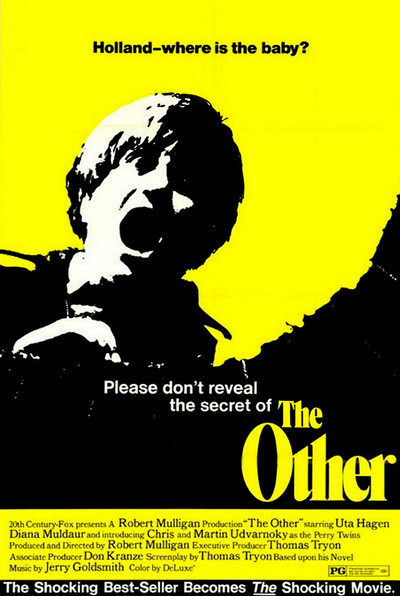
Robert Mulligan is a strange choice to direct a horror movie. He was more well-known for dramas like Summer of ’42Same Time, Next Year and To Kill A Mockinbird. This adaption of the Tom Tryon book was also scripted by the author, who was once an actor before suffering the abuse of Otto Preminger.

This is a movie that I’ve been wanting to see since reading about it in Paperbacks From Hell (writer Grady Hendrix — who created that book with Will Errickson — also wrote this great article all about Tryon), as Tryon is really the forgotten horror writer of the 1970’s.

In the summer of 1935, identical twins Holland and Niles Perry live on their family farm, but all is not well. Their father died in an accident in the apple cellar last year and their mother remains so sad that she rarely leaves her room. While the rest of the family goes about their daily lives, Niles grows closer to Ada (Uta Hagen, who may have only appeared in five films, but was an incredibly influential acting teacher and Broadway star), his Russian grandmother, who has introduced him to the great game, the Perry family’s secret gift of being able to project their mind into other beings.

The twins are pretty mischeivous, as they still play in the apple cellar where their father died. One day, they’re caught there by their cousin Rusell, who also sees that Niles is wearing the ring that was to be buried with his rather. Holland, the older of the two twins, says that the ring passes on to the oldest son, who can do whatever he wants with it. He wants his brother to have it.

Their father’s brother George locks up the cellar, but Holland knows how to sneak in. And to get revenge for Russell’s snitching, he hides a pitchfork inside a haystack. The young boy jumps into it and is killed to the horror of Niles, who must now keep his brother’s secret. This behavior only gets worse when Holland causes a neighbor (Portia Nelson, one of Tryon’s lifelong friends) to have a heart attack after he menaces her with a rat.

The twins’ mother finally learns what is happening and finds the ring inside a tobacco tin, along with a human finger. She demands that Niles tell her how he got it. He says that Holland gave it to him and the evil brother charhes his mother, knocking her down the stairs, rendering her paralyzed.

After the neighbor’s body is found, Ada finds Holland’s harmonica and asks Niles what happened. He lets her know that his brother has been evil all summer. Here’s where the twist comes in — Holland has been dead since he fell down a well on their birthday last March. Right before he died, Niles used the great game to talk to his dead brother, who commanded him to open his coffin, cut off his finger and take the ring.

The old woman now realizes that Niles has kept his brother alive in his mind and has been responsible for everything bad that has happened. Yet she is unable to turn on him and keeps his secret, as long as he never plays the game again.

The only problem is that Niles can’t be stopped. When his sister gives birth to a baby girl (look for a young John Ritter as their father) the Holland side of his personality steals the baby as he is fascinated by the Lindbergh kidnapping. The child is discovered drowned and a mentally challenged farmhand is arrested for the murder. But Ada knows better. She demands that Niles — alone in the apple cellar — screaming for Holland to tell him where the baby — who he loved — went. Ada pours kerosene into the cellar to kill the boy and throws herself into the fire.

Months later, we learn that Niles escaped, as Holland had cut the padlock to the door. With his beloved grandmother dead and his mother basically a vegetable, no one will ever know his secret. Niles is called down to lunch and life goes on.

This is how the theatrical cut ends, but the CBS 1970’s TV version, perhaps wanting the child to pay for his crimes, ends with Niles saying, “Holland, the game’s over. We can’t play the game anymore. But when the sheriff comes, I’ll ask him if we can play it in our new home.” The voiceover is dubbed by a different actor. However, every broadcast and release of the film cut out this voiceover in favor of the original theatrical ending.

Tryon hated this adaption, blaming everyone, incuding himself. “Oh, no. That broke my heart. Jesus. That was very sad,” he said of the finished film. “That picture was ruined in the cutting and the casting…God knows, it was badly cut and faultily directed. Perhaps the whole thing was the rotten screenplay, I don’t know.”

Despite a mild performance at the box office, the film ran on TV throughout the 1970’s. Roger Ebert was a major fan, saying that the film “has been criticized in some quarters because Mulligan made it too beautiful, they say, and too nostalgic. Not at all. His colors are rich and deep and dark, chocolatey browns and bloody reds; they aren’t beautiful but perverse and menacing. And the farm isn’t seen with a warm nostalgia, but with a remembrance that it is haunted.”

I looked for this film for nearly a year until Shudder played it last month, but it’s already gone from the service, back into the mists from whence it came.