EDITOR’S NOTE: This holiday giallo was first on the site many years ago, all the way back on December 16, 2017.
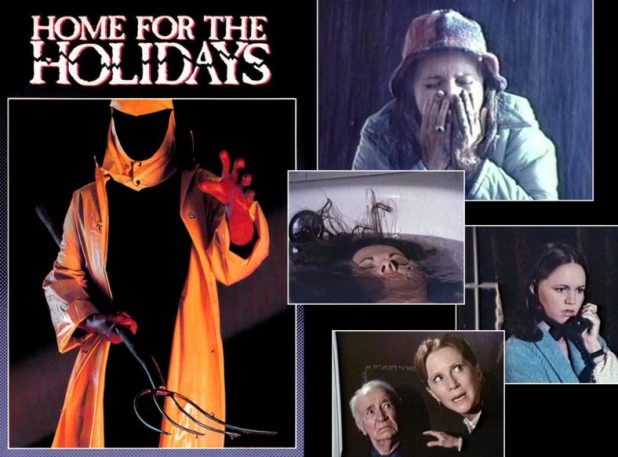
Originally airing on November 28, 1972, this ABC-TV movie was produced by Aaron Spelling and debuted on VHS in 1986. It’s packed with future talent and is at the center of what we love most here: TV movies, Christmas movies and horror.
Benjamin Morgan (Walter Brennan, Rio Bravo) is rich and dying and suspects his wife, Elizabeth (Julie Harris, one of America’s most famous stage actresses), of poisoning him. He sends his oldest daughter, Alex (Eleanor Parker, Eye of the Cat) to find her three sisters and bring them home — the first time they’ve been back since their mother’s suicide.
The three sisters are Freddie (Jessica Walter, Arrested Development), Joanna (Jill Haworth, The Brides of Dracula) and Christine (Sally Field, Steel Magnolias). Their father tells them that they must kill their stepmother before she kills them. At dinner that night, Joanna harangues her stepmother with questions about how her first husband died, while Freddie screams in her room about how their father’s affairs led to their mother killing herself.
This is obviously the holiday get-together everyone hoped for.
Soon after, Joanna tries to leave but is killed by a pitchfork-wielding person in a yellow raincoat. That same killer also drowns Freddie in the bathtub while Elizabeth keeps offering everyone warmed milk and honey. Soon, the phone line gets cut and everyone is trapped with a killer. But who is it?
There are plenty of twists and turns here, as the love between a father and daughter and the love between husband and wife is contested. It’s bloodless, as it’s a TV movie, but it’s also pretty dark, because the 1970’s were the end of the world and the movies made then reflected it. You also get a cast packed with Oscar winners and nominees, all acting within basically one or two rooms, so there’s plenty of emotion and suspense.
Originally airing on December 30, 1970, this episode of Night Gallery starts to get darker than the season has been up to now.
Elaine Latimer (Joanna Pettet, The Evil) has spent her time in a mental hospital dreaming of a country road that leads to the house of her dreams. Pettet is a fixture on this show, also appearing in the stories “The Caterpillar,” “Keep in Touch – We’ll Think of Something” and “The Girl with the Hungry Eyes.” Consider this a short F giallo, as we wonder if Elaine has lost her mind or perhaps she has finally learned where she belongs.
Directed by John Astin, this story was based on an original story by Andre Maurois and the script was written by Serling.
“Certain Shadows On a Wall” brings Agnes Moorehead back to working with Serling, as her character Emma is killed by her brother Stephen (Louis Hayward), yet remains a shadow on the wall watching as her sisters Ann (Grayson Hall) and Rebecca (Rachel Roberts) plan Stephen’s demise.
Directed by Jeff Corey — who is mostly known for acting; he was Zed in Battle Beyond the Stars and was also in Jennifer and The Premonition — this was also a Serling script, this time based on a story by Mary Eleanor Freeman.
While neither story is fully realized, this episode finds the show heading for the twisted tales that make me adore it so much.
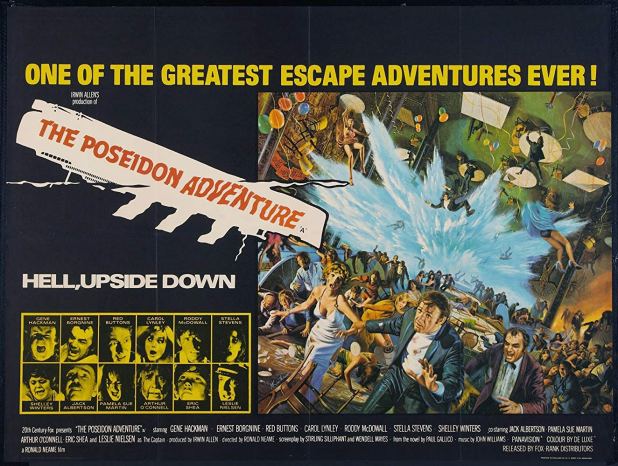
Irwin Allen was the “Master of Disaster,” making this movie, The Towering Inferno, Flood!, Fire!, Hanging By a Thread, The Swarm, Beyond the Poseidon Adventure and When Time Ran Out. When he was asked if he’d ever run out of disasters, he said “No, I’m not going to run out of disasters. Pick up the daily newspaper, which is my best source for crisis stories, and you’ll find 10 or 15 every day. People chase fire engines, flock to car crashes. People thrive on tragedy. It’s unfortunate, but in my case, it’s fortunate. The bigger the tragedy, the bigger the audience.”
Based on The Poseidon Adventure by Paul Gallico, this was directed by Ronald Neame (who also made Meteor) and written by Stirling Silliphant and Wendell Mayes, the movie starts with establishing that the SS Poseidon is not a seaworthy ship. Captain Harrison (Leslie Nielsen) tries to tell the owners and is instead told to just sail faster.
That’s when we get to meet the characters over dinner. There’s Detective Lieutenant Mike Rogo (Ernest Borgnine) and wife Linda (Stella Stevens) who he saved from the streets. Susan (Pamela Sue Martin) and Robin (Eric Shea) who are on their way to see their parents. Reverend Frank Scott (Gene Hackman), who is being punished by the church for his strange views on God only helping those who help themselves. Jewish hardware store owner Manny (Jack Albertson) and Belle Rosen (Shelley Winters), who have never taken a vacation and been hard workers all their lives. Ship singer Nonnie Parry (Carol Lynley), waiter Acres (Roddy McDowall) and hat salesperson James Martin (Red Buttons) are the other survivors who hang on when a tsunami hits the boat, flips it upside down and causes them to go on a long and deadly journey back through the body of the Poseidon.
This won two Oscars — for “The Morning After” and effects — and this led to a big wave — ugh, that pun — of disaster films. None of those have Gene Hackman screaming at God while being burned alive, but that’s the kind of magic you can only pull off once.
Except for the most dangerous sequences, all of the stunts were done by the actors themselves. And for those that love The Love Boat, Borgnine and Winters would play a married couple on an episode but the Pacific Princess did not capsize.
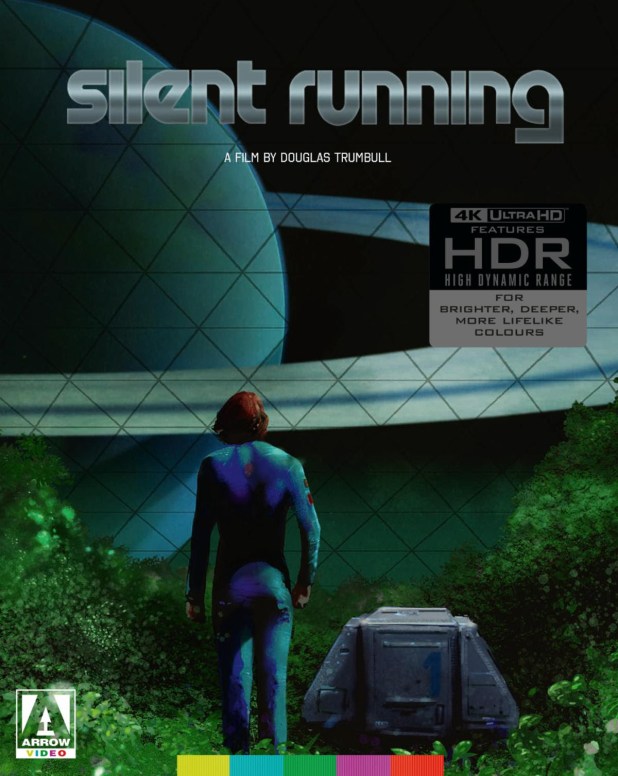
Visual effects pioneer Douglas Trumbull (The Andromeda Strain, Close Encounters of the Third Kind, 2001: A Space Odyssey, Star Trek: The Motion Picture, Blade Runner, The Tree of Life, The Towering Inferno) finally got the chance to direct with this movie and sadly, he didn’t get to capitalize on it
Made for one million dollars, one-tenth the budget of Kubrick’s classic, this movie was helped by all the special effects know-how of Trumbull, who was not originally going to direct it. Lead actor Bruce Dern stated that Trumbull’s creative vision was equal to Alfred Hitchcock, who he had also worked with. And that made the director hot for the briefest of times, as it flopped at the box office.
Trumbull joked “It was just a great experience for me as a filmmaker, but I didn’t know that I was part of an experiment by Universal Studios…to see if it was possible to have a movie survive on word of mouth alone without an advertising campaign.*”
At some point in the future, all that is left of Earth’s ecosystem is floating in space. The crew is ordered to destroy the greenery by the faceless bureaucrats that run what is left of the world and they comply, all save Freeman Lowell (Bruce Dern, The ‘Burbs, Hush…Hush Sweet Charlotte, Coming Home), who has taken three service robots and gone into “silent running” around the rings of Saturn, keeping himself as sane as he can and what is left of Earth’s once lush forests blooming.
Written by Deric Washburn, Michael Cimino (the two would go on to write The Deer Hunter and Cimino would spectacularly self-destruct with Heaven’s Gate) and Steven Bochco (who would go on to create L.A. Law, NYPD Blue, Hill Street Blues and more), this is a quiet tale of a man whose only companions are the industrial droids he renames Huey, Dewey and Louie**.
The effects in this movie are obviously the draw. The ship Valley Forge was reused on the show Battlestar Galactica years later and still held up as a great looking spaceship, even post-Star Wars. And the haunting soundtrack was by Peter Schickele, better known for doing classical music parodies under the name of P.D.Q. Bach.
Without this movie, we’d have no Mystery Science Theater 3000, as the idea of a man lost in space with only robots to talk to resonated with creator Joel Hodgson. And speaking of inspiration, Trumbull was asked by George Lucas to work on this movie, but passed. Lucas asked if he could use a droid in his film inspired by the robots in Silent Running and Trumbull agreed. Six years later, when 20th Century-Fox sued Universal, claiming that Battlestar Galactica was a ripoff of Star Wars, Universal countersued with the theory that Star Wars ripped off Silent Running.
This was a film I searched for most my childhood, as we couldn’t just grab a DVD or stream films back then. I always saw photos of it in Starlog and wondered what the robots would look like when they moved.
The Arrow Video release of this film has everything you ever wanted on this film and more. There’s a new 2K restoration from the original camera negative, approved by Trumbull that was created exclusively for this release. Plus, you get a new commentary track by critics Kim Newman and Barry Forshaw and one from Trumbull and Dern. There are also features with film music historian Jeff Bond on the film’s score, Jon Spira exploring the screenplay and Dern on his work in the movie. Plus, the artwork is by Aric Roper, who did the art for Sleep’s “Dopesmoker” album and an illustrated collector’s booklet featuring writing on the film by Barry Forshaw and Peter Tonguette. You can get it from MVD.
*Actually, this really was part of a Universal Studios experiment to try and recreate Easy Riderby giving a million dollars or less to young filmmakers and letting them have final cut. The other films are Peter Fonda’s The Hired Hand, Hopper’s The Last Movie, Forman’s Taking Off and Lucas’ American Graffiti.
**The three drones were played by four bilateral amputees (Mark Person as Dewey, Cheryl Sparks and Steven Brown (he’s also in the biker mover J.C.) as Huey and Larry Whisenhunt as Louie). That means they are either missing both arms or both legs. This was inspired by sideshow performer Johnny Eck. Also, in Italy, the drones are named after Paperino, Paperone and Paperina (Donald Duck, Uncle Scrooge and Daisy Duck) because the names for Huey, Dewey and Louie in Italy are Quim, Quo and Qua. Therefore, calling them would have sounding like this; “Vieni qui, Qui,” which would be pretty weird, right?
Unfortunately, Trumbull’s directing efforts didn’t fare much better with 1983’s Brainstorm.
EDITOR’S NOTE: This was originally on the site on December 18, 2017 and again on March 2, 2022 to discuss how it was re-released by Cannon as Deathhouse.
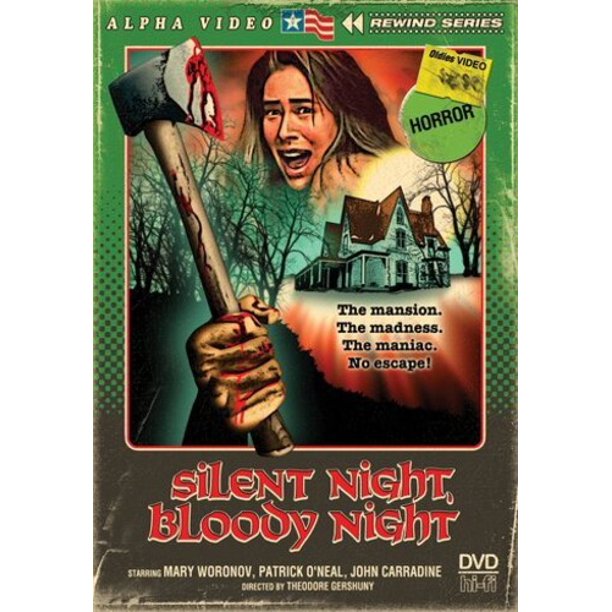
Christmas Eve, 1950: Wilfred Butler runs from his home, on fire, and supposedly dies in the snow.
Christmas Eve, 1970: John Carter (Patrick O’Neal, The Stepford Wives, The Stuff) and his assistant Ingrid arrive in a small Massachusetts town. He meets with the town’s mayor, sheriff and major citizens like Tess Howard and Charlie Towman (John Carradine!), who may have lost his voice to a tracheotomy but not his need to smoke, about selling the Butler mansion as soon as possible. While staying overnight with Ingrid, who is also his mistress, they are both killed by an axe. The killer calls the police and says that they are Marianne.
Tess, the town’s telephone operator, hears the call and drives to the mansion, where she is greeted by Marianne Butler before she is hit in the head with a candle holder. Meanwhile, Sheriff Mason finds that Wilfred’s grave is empty. He is killed and thrown into the empty hole.
Mayor Adams is asked to go to the Butler mansion but leaves his daughter, Diane (Mary Woronov, Death Race 2000, Chelsea Girls) at home. She meets up with a man who claims to be Jeffrey Butler, who has taken the sheriff’s abandoned car. Together, they search for the lawman but can’t find him.
After taking Towman to the mansion, Jeffrey goes back to get Diane. On their way to the mansion, Towman stumbles blindly in front of them and is hit and killed. His eyes had been stabbed out and Diane grows worried about Jeffrey.
Well, fuck me, this movie is also about incest! A diary found at the house reveals that Jeffrey is the son of Wilfred and his daughter, Marianne. Afterward, Wilfred turned the house into an asylum and admitted his own daughter. However, on Christmas Eve 1935, he turned all of the inmates loose. They killed every doctor as well as his daughter. Of note here is that many of the inmates in the flashback are played by former stars of Warhol’s factory, like Ondine, Tally Brown, Kristen Steen and Lewis Love, as well as Flaming Creatures auteur Jack Smith, artist George Trakas and his wife at the time, Susan Rothenberg. Warhol superstar Candy Darling also shows up in the film as a party guest.
Well, it turns out that some of the inmates of the insane asylum ended up being important parts of the town — that’s right, all of the important people John met with in the beginning!
Mayor Adams arrives at the mansion and he and Jeffrey face off, guns drawn, each believing the other is the killer. They kill one another as Marianne shows up, but she is really Wilfred, who is alive. He went after the inmates for their role in the death of his daughter and used his grandson/son/secret shame Jeffrey as a patsy. Diane gets the gun and kills the old man. One year later, the mansion is demolished as she watches.
Director Theodore Gershuny worked on plenty of episodes of Monsters and Tales from the Darkside after this film. He was also married to Woronov. The original title for the film was Night Of The Dark Full Moon and it was also nearly called Zora, which makes little to no sense.
There are some really interesting techniques here, especially in the flashback sequences, which feel like tinted photographs come to life with the saddest version of “Silent Night” ever playing behind the action. I love how experimental and dark these sequences look — they remind me a little of the film Begotten.
This is a dark film for your holiday viewing, so if you want to chase away the family for a while, this is the one to do it.
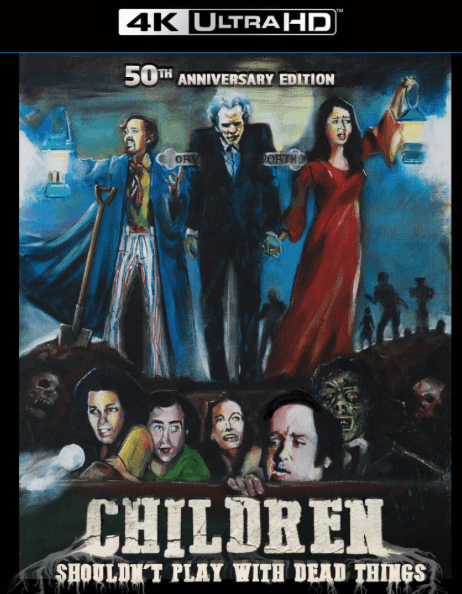
EDITOR’S NOTE: This was originally on the site on August 14, 2018. It’s back — with edits and new writing — because VCI has released the fiftieth anniversary 4K UHD release of this movie. You can get it on UHD, blu ray or DVD from MVD by clicking the line for each format.
Each edition has the following extras: a new introduction and Q&A with Alan Ormsby; a ninety-minute documentary Dreaming of Death: Bob Clark’s Horror Films; a commentary track with Alan Ormsby, Jane Daly and Anya Cronin; a Q&A filmed at. the Los Angeles Grindhouse Festival; an interview with Ken Goch; photo and poster gallery; two music videos by The Deadthings “Dead Girls Don’t Say No” and “Cemetery Mary;” liner notes by Patrick McCabe; the original trailer; radio spots and a slipcover for the initial release.
The same Bob Clark that did Porky’s did A Christmas Story and also made Black Christmas and Deathdream. He even produced the film Moonrunners, which inspired TV’s The Dukes of Hazzard. He also made Turk 182! (if you had HBO back in the day, you saw it), Rhinestone and the Baby Geniuses series. Yep. Bob Clark pretty much did it all. And here’s one more completely great thing he created.
Alan (Alan Ormsby, who would go on to write Deathdream, Deranged, My Bodyguard and direct Popcorn) leads a group of actors who have all gone to an island together for a night of shenanigans. Sure, the island is a cemetery for criminals. And of course, he’s going to do a seance to raise the dead. And while the whole thing is a joke, Alan is genuinely upset that the dead aren’t walking the swamp.
They do find a corpse — Orville — and Alan uses it to continually harass his actors. And the ritual really did work, as the dead begin killing everyone off one by one.
The shift from comedy to drama to horror in this film is startling. The cast is amateur, but the terror feels real. The dread and doom at the end, as the zombies board a boat as the lights of Miami are in the background and atonal music plays are as perfect as film can be.
Clark shot this movie at the same time as Deathdream, using some of the same cast. A surprising moment in the film is that while there are two gay men — and they stereotypically lisp — they play an integral role in the film. That’s pretty incredible for 1972.
EDITOR’S NOTE: This was originally on the site on March 3, 2020.
You have to admire a movie that was originally filmed five years earlier under the titles Armageddon 1975 and Doomsday Plus Seven before the money stopped rolling in. The rights got sold, a new ending was filmed with totally different actors and plenty of padding got thrown in to make this — along with NASA stock footage and special effects taken from other movies.
Hell, the Astra, the main ship in this, changes its look every few minutes.
Original director Herbert J. Leder also made Fiend Without a Face. The fixed up footage came from Lee Sholem, who directed more than 1,300 episodes of television, as well as the movie Superman and the Mole Men.
Ruta Lee, who was one of the Seven Brides for Seven Brothers, stars in this. She’s joined by Mala Powers (who ran the estate of acting teacher Michael Chekov after his death), Grant Williams (The Incredible Shrinking Man), Henry Wilcoxon (the bishop in Caddyshack), former Tarzan Denny Miller, M*A*S*H* star Mike Farrell and Bobby Van, who hosted eight-year-old Sam’s favorite game show, Make Me Laugh.
You think the ending of 2001: A Space Odyssey didn’t make sense? At least it didn’t abruptly end after wiping out most of the cast off-screen and Venusians try to explain the entire movie away via a voice-over.
EDITOR’S NOTE: Thanksgiving is my favorite holiday because the expectations are so low. All you need to do is show up, eat food and fall asleep watching football, which is way less pressure than Christmas. While you lounge, here are some movies to watch and upset your entire family and start the holidays off right.
ABOUT THE AUTHOR: Jennifer Upton is an American (non-werewolf) writer/editor in London. She currently works as a ghostwriter of personal memoirs for Story Terrace London and writes for several blogs on topics as diverse as film history, punk rock, women’s issues, and international politics. For links to her work, please visit https://www.jennuptonwriter.com or send her a Tweet @Jennxldn
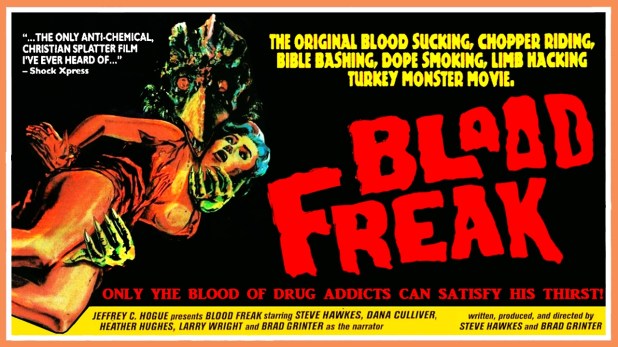
In 2004, I stumbled across a copy of Blood Freak released as a special edition on the Something Weird Video label. I knew nothing about the film before I watched it. 90 minutes later, as the credits rolled, I held up the packaging to the heavens and proclaimed, “Every film I ever watch from this moment forward will be compared to Blood Freak.” Is it good? That depends on your point of view. Do I love it? Absolutely. It is, in this writer’s humble opinion, the best “worst” movie ever made. Not because it’s slow or boring. But because it’s a film that defies all logic. Made equal parts enthusiasm and technical ineptitude in Florida by nudist director Brad F. Grinter on a $25,000 budget, and star Steve Hawkes, it’s positively dripping with WTF moments. Blood Freak exists in a genre all its own somewhere in the center of a “Cult Movie” Venn Diagram featuring Sting of Death, Blood Feast, Reefer Madness, and the collective Christian works of Kirk Cameron.
The plot involves a biker named Herschell (in a nod to fellow Florida filmmaker H.G. Lewis) played by the box-bodied, pompadoured Hawkes himself. Herschell has just finished his service in Vietnam and needs to figure out the rest of his life. After assisting a girl on the Florida turnpike named Angel with her car trouble, she invites him home. There, we find Angel’s polar-opposite younger sister Ann toking up and sniffing poppers with her friends. Ann likes Herschell, who rejects her for an evening at Bible study with Angel and her elderly friend who just happens to need “a husky guy” to help out on his poultry farm. To mellow him out, Ann gives Herschell a laced joint by the pool, causing him to become addicted after one dose. The two quickly fall in stoner love.
Herschell gets a job at the old man’s turkey farm (where the sounds of real turkeys are augmented by human voices gobbling and whistling on the soundtrack) and agrees to eat some experimental samples injected with chemicals. The combination of the spiked weed and the spiked turkey causes him to pass out. He awakens a while later to discover he has transformed into a giant turkey monster. Well, more like a guy with a papier-mâché turkey head and feather scarf, but you get the idea. He’s a mutant game bird dependent on the blood of drug addicts. When he’s not out killing junkies and drinking their blood with his toothy beak, he goes home to Ann and gobbles softly to her about his plight. In response she ponders, “Gosh, Herschell, you sure are ugly. I love you. But if we stay together, what will the children look like?” Then they make sweet, sweet turkey love.
If it sounds insane, it is. It is the only film I’ve ever seen where the director periodically interrupts the proceedings to explain what the hell is going on. It doesn’t help but it sure is entertaining to watch Grinter glance down at his script every few seconds.
Fortunately, Herschell wakes up to discover the entire episode was all a hallucination. It turns out our hero was already addicted to pain killers from injuries sustained in Vietnam. Angel, Ann and the poultry farmer get him the help he needs and he and Ann walk off happily ever after.
Just prior to the conclusion, director Brad Grinter pays his audience one last visit to warn us of the dangers of chemicals in our food. All while chain-smoking and coughing. The message couldn’t be clearer. Grinter knows he’s a hypocrite. It’s an apt description given that he taught filmmaking at the same time he made a literal turkey of a movie comprising underlit, out-of-focus shots. Me? I love turkey. I searched for many years to find a gem worthy of the “Best of the Worst” title. Blood Freak is the reigning Gobbler.
Trivia: Blood Freak is filled with a lot of big cat imagery. Actor Steve Hawkes was rescued by a lion from a fire while shooting a Tarzan film in Europe. He spent the rest of his life rescuing big cats. Steve was the original Tiger King.
EDITOR’S NOTE: This was originally on the site on February 21, 2020.
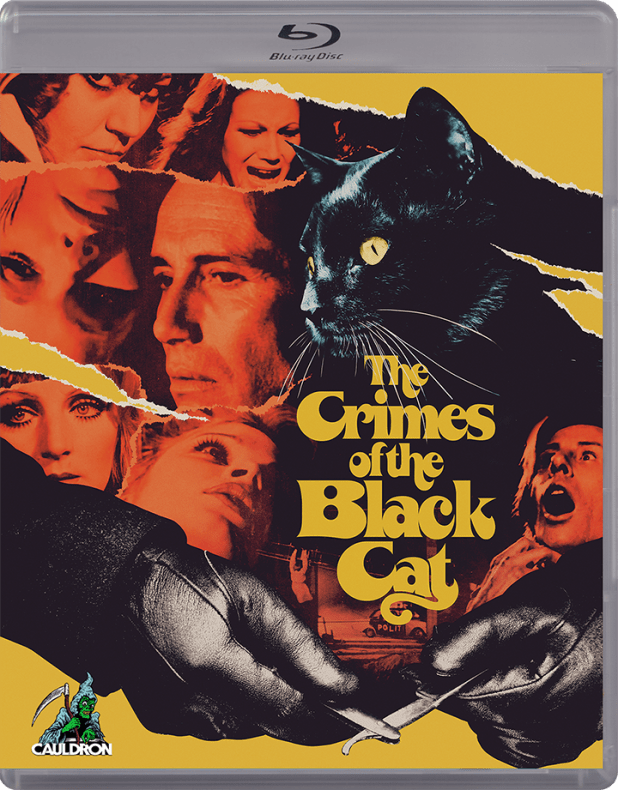
Cauldron Films has released it on blu ray along with several featurettes, such as Remembering Sergio Pastore – Interview with Sara Pastore and Sergio Pastore – Un Ammirevole Indipendente. There are two commentary tracks — one by Troy Howarth and Nathaniel Thompson and the other by the Fragments of Fear podcast — as well as a trailer and image gallery. You can get it from MVD.
Italy and Denmark unite for a film made in the wake of Dario Argento’s landmark The Bird With the Crystal Plumage. Just look — there are crimes right in the title and some vaguely associated animal name! Actually, a black cat does kill some people in this, so the name makes sense.
Originally titled Sette Scialli di Seta Gialla (Seven Shawls of Yellow Silk), this movie was written and directed by Sergio Pastore.
Several fashion models are killed by a murderer — think Blood and Black Lace — by a black cat that has been alerted to them by gifted shawls laced with chemicals. Such a strange way to kill someone, but hey — we’re in the psychosexual world of the giallo, so why worry?
Paola, the first victim, had been dating Peter Oliver (Anthony Steffen, who was Django in Django the Bastard and also shows up in Play Moteland The Night Evelyn Came Out of the Grave), a blind composer who believes that he’s heard the killer. He and his butler (Umberto Raho, Enter the Devil) are on the case, tracking the cat down to its owner, who is killed before she can reveal who has been taking care of her cat.
Much like the aforementioned — and superior — Bava film, Francoise (Sylva Koscina, Steve Reeves’ love interest in Hercules and Hercules Unchained; she’s also in So Sweet, So Dead and Bava’s Lisa and the Devil) was killing the models to cover up another killing. That’s because Paola was sleeping with her husband and certainly had to pay.
So yeah. The movie is a Bava remix with a lead character taken from another giallo, Argento’s The Cat O’Nine Tails. And the killer’s method comes from Bela Lugosi and The Devil Bat. Don’t let all that copy and pasting get in the way of your enjoyment of this movie. It’s still fun — the fashions are inordinately loud, the zooms are wild and the music is out of control. There’s a vicious shower kill than leaves nothing to the imagination. And it’s still better than anything out there today.
ABOUT THE AUTHOR: Jennifer Upton is an American (non-werewolf) writer/editor in London. She currently works as a freelance ghostwriter of personal memoirs and writes for several blogs on topics as diverse as film history, punk rock, women’s issues, and international politics. For links to her work, please visit https://www.jennuptonwriter.com or send her a Tweet @Jennxldn
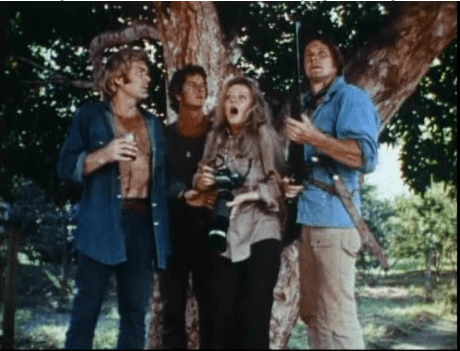
Not to be confused with the killer fish movie, Piranha (1972) the Venezuelan adventure-thriller sometimes known as Piranha, Piranha, or Caribe, stars William Smith and Peter Brown, who previously worked together in the mid-sixties western TV series Laredo.
With a plot reminiscent of The Most Dangerous Game and the later rape-revenge films, Piranha concerns wildlife photographers Art Greene (Tom Simcox) and Terry Greene (Ahna Capri) are traveling through the Amazon region with their American tour guide Jim Pendrake (Peter Brown), when they encounter Caribe (William Smith), a homicidal lunatic who enjoys stalking and hunting human prey. It’s made clear early on in the film that Terry is not a fan of guns. First, she insists they not bring one into the jungle, then she is horrified when Caribe kills animals for no reason. Of course, after Caribe violates her and starts picking members of their party off, she changes her tune. By the film’s conclusion, Terry has had enough of Caribe’s macho bullshit and offs him with…you guessed it…a gun.
I’m not sure if the message is pro-gun or pro-feminist. More than likely, it was neither. The script by Richard Finder (just isn’t that deep as evidenced by the incredibly long motorcycle chase comprises almost one entire act. Script notwithstanding, it’s an entertaining movie and as fine an example of ‘70s “guy cinema” I’ve ever seen. A manly film with manly men doing manly things. They wear matching (and not matching) denim and shirts open to the navel accented with neckerchiefs. Remember those? A stylish way to wick moisture from the muscly necks of guys doing stuff to make them sweat in humid, emerald green jungle environments. They also double as a headband. You might need a shower and a shot of whiskey when it’s over. I know I did.




 B&S About Movies
You must be logged in to post a comment.