EDITOR’S NOTE: Stanley was on Chiller Theater on Saturday, November 6, 1976 at 11:30 p.m. It also aired on April 28, 1979; December 30, 1980 and January 16, 1982.
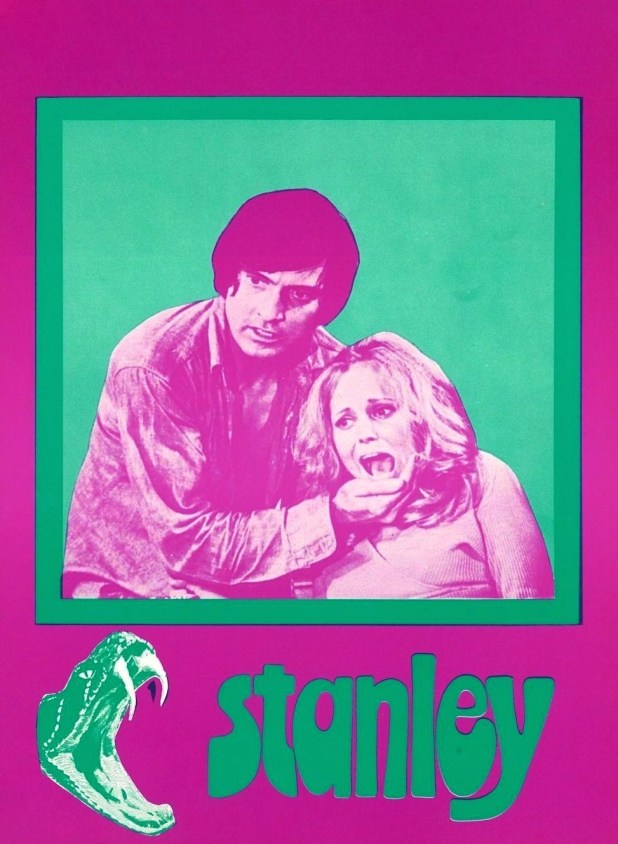
Tim Ochopee (Chris Robinson, who would write, direct and star in 1975’s The Intruder) is a war damaged Seminole just back from Vietnam who wants to live out the rest of his life in the Everglades with his snake Stanley. He didn’t count on Richard Thomkins (Alex Rocco), a maker of leather goods with mob ties, killing his father. Now, all the snakes that Tim has lived with will be the death of everyone who has done him wrong.
Only Grefe could take a ripoff of Willard and somehow make it more disturbing than you’d expect. Yes, this is a movie packed with snakes doing all manner of damage to people and people doing just as horrible things to them, including an exotic dancer playing a geek and biting the head off one on stage as she dances seductively with blood all over her bare chest.
Of course, Tim has to kill everyone in the way and kidnap Thomkin’s daughter Susie (Susan Caroll), but any hope of true love kind of goes the way that you’d expect in a Florida regional horror film that doesn’t stop with just stealing from one film and moves into being a reptile-obsessed Billy Jack.
That said — for a movie so much about protecting snakes, the actual snakes in this movie were defanged and some had their mouths sewn shut. There’s enough human on snake violence in this that you’d expect that it was made in Italy. Grefe still owns the wallet that they made out of the skin of the main snake that played Stanley, which is pretty weird when you dwell on it as much as I have.
Gary Crutcher wanted to do a sequel called Stanley in Miami, but it didn’t happen. He wrote this on two days under the influence of amphetamines, which is the most Florida thing you can say about a movie that is the most Sunshine State movie I’ve seen.
Each October, the Unsung Horrors podcast does a month of themed movies. This year they will once again be setting up a fundraiser to benefit Best Friends, which is working to save the lives of cats and dogs all across America, giving pets second chances and happy homes.
Today’s theme: In Memoriam
Racquel Welch had the kind of power behind her game that when men of my dad’s age would talk about her, they’d get excited or look to see if their wives were listening. Just that name was enough for them all to communally make happy noises and look skyward, as if to thank whatever is waiting for us up there for making something so wonderful.
She died February 15 of this year and I’ve been watching more of her movies.
I always wrote her off as someone getting by on her looks yet I have enjoyed so many of these films.
Written by Ed McBain (who is really Evan Hunter and changed his name from Salvatore Albert Lombino; he wrote the scripts for The Birds, Walk Proud and Strangers When We Meet and had movies made of his novels, including Blackboard Jungle, Mister Buddwing from his book Buddwing, Last Summer,Every Little Crook and Nanny and Lonely Heart from his book Lady, Lady I Did It.
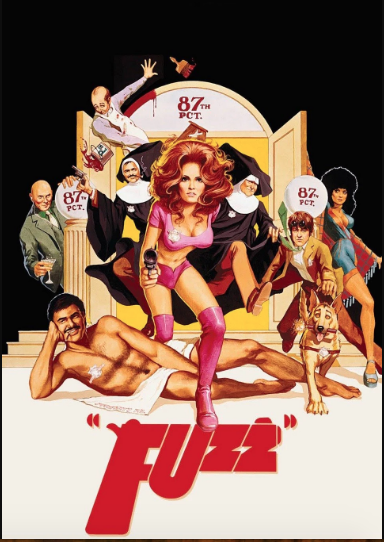
Fuzz comes from one of his 87th Precinct books. Directed by Richard A. Colla and written by the author, it stars Burt Reynolds as Detective Steve Carella. He’s investigating why teenagers are setting unhoused people on fire and nearly dies from one of them doing exactly that to him. There’s also a killer threatening to murder city leaders which has Detectives Kling (Tom Skeritt) and Brown (Jack Weston) looking for whoever grabs the money the caller asked for. They fail twice at this and a commissioner and the deputy mayor are both rubbed out.
Detective Eileen McHenry (Welch) is new to the precinct and set up by Carella and Meyer when she’s looking for a rapist. She’s not in the mood to find their antics funny and that night, when walking through the park, she’s stalked. The detective turns the tables on the rapist and beats him unmerciful and solves the case.
The caller ends up being someone called The Deaf Man (Yul Brynner), so called because, yes, he ahs a hearing aid. He’s one of those unstoppable villains, even getting set on fire by the kids from the beginning and somehow surviving at the credits.
Welch got paid $100,000 for this and was supposed to be in her bra and panties in one scene. It’s not in the movie but it is on the poster, which was painted by Richard Amsel which also has Reynolds in his famous nude pose from Cosmo.
This was a hard movie to find for some time, as a series of copycat crimes — strangely in Boston where the movie is set, even if the 87th Precinct books are in New York City — that had teens setting houseless people on fire. The movie was pulled from airing for most of the 70s.
There are even more movies made of the author’s works than those I listed earlier. The 87th Precinct novels were adapted as the movies Cop Hater, The Mugger, The Pusher, Kurosawa’s High and Love (King’s Ransom is the book it’s based on), Sans mobile apparent, Claude Charbrol’s Blood Relatives and Killer’s Wedge. There was also a TV series in 1961, the TV movie Ed McBain’s 87th Precinct: Lightning and two sequels, Ice and Heatwave. And two of the Columbo TV movies, No Time to Die and Undercover were based on So Long as You Both Shall Live and Jigsaw.
Fuzz is very 1972 in the good and bad ways. But hey, Reynolds says it best.
“It was kind of fuzzy. It was made by one of those hot shot TV directors. I liked working with Jack Weston; it began our relationship. I did like working again with Raquel. And I liked the writer whose book the film was based on, Ed McBain, The 87th Precinct. I’d like to direct one of his books.”
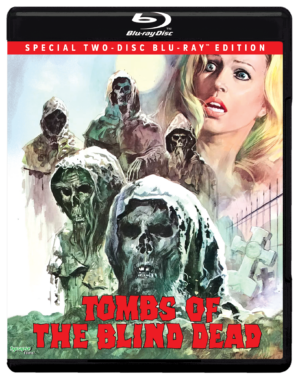
The original Spanish title of this movie is La noche del terror ciego (The Night of the Blind Terror) but it is better known as Tombs of the Blind Dead). Director and writer Amando de Ossorio was inspired by El monte de las ánimas by Spanish romantic writer Gustavo Adolfo Bécquer and Night of the Living Dead to make this. Instead of zombies, these knights from the Easts would come to be known as the Templars, based on the Knights Templar, a Catholic military order who were the most skilled fighting units during the Crusades. The Knights Templar innovated banking and had a form of basic credit which King Philip IV of France took advantage of. Once he was deeply in debt, he began to spread rumors that the Templars spat on the cross, denied Jesus, worshipped either Baphomet or the head of John the Baptist and engaged in homosexual relationships. There was no evidence of this yet the Templars were still tortured, gave enforced confessions and were burnt at the stake.
Their Grand Master Jacques de Molay recanted his confession and when he was burned at the stake, he asked to be turned so he could face the Notre Dame Cathedral and hold his hands together in prayer. As he perished, he said, “Dieu sait qui a tort et a péché. Il va bientôt arriver malheur à ceux qui nous ont condamnés à mort.” which means “God knows who is wrong and has sinned. Soon a calamity will occur to those who have condemned us to death.” His accusers King Philip and Pope Clement would be dead within the year.
In the abandoned medieval town of Berzano, at the border between Spain and Portugal, the Templars were hung and birds pecked their eyes out. Now, they emerge from their graves seeking blood to remain alive now and forever.
Why would you come to such a place, Betty Turner (Lone Fleming)? Why would you bring your new lover Roger Whelan (César Burner), a fact that upsets your college girlfriend Virginia (María Elena Arpón) so much that she leaps from a train and ends up dead at the dusty hands of the Templars? What will it take you to realize that nothing stops the slow moving Templars and that they will destroy everyone that you love and leave you ruined by what you have witnessed?
As much as I adore this movie, I love even more that it was released in the U.S. as Revenge from Planet Ape, removing the Templar flashback and changing the movie to be about a post-apocalyptic future in which the undead are deceased intelligent apes.
The Synapse blu ray release has the original uncut version of the movie in Spanish and hybrid English and Spanish, as well as the U.S. The Blind Dead version. It also has multiple audio commentaries with one by Troy Howarth, one by star Lone Fleming and another by Rod Barnett and Troy Guinn of NaschyCast, a documentary about Spanish zombie movies, the Revenge from Planet Ape opening, a music video, a featurette on Spanish horror, a trailer and an image gallery. You can get it from MVD.
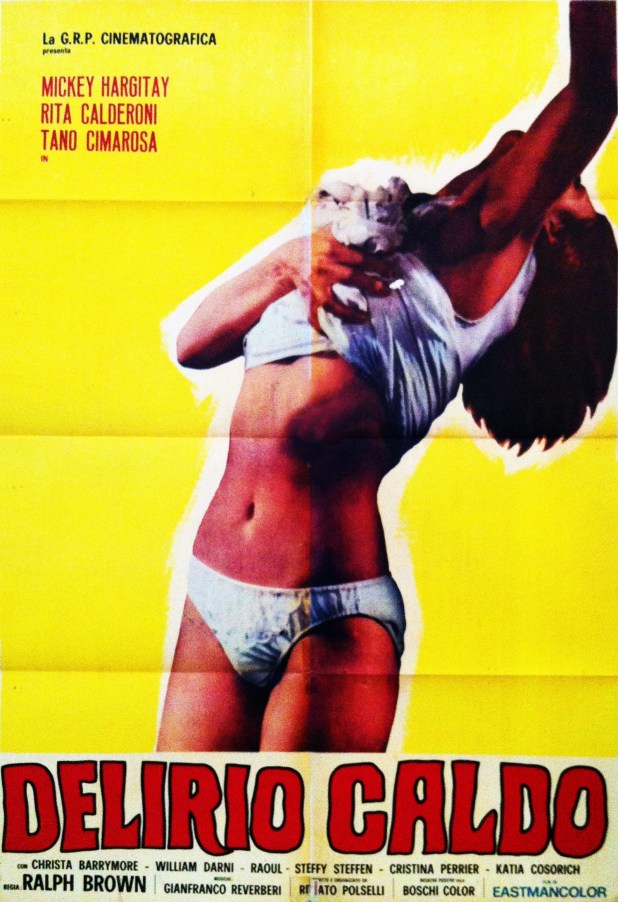
Translating as Hot Delusion or Hot Frenzy,this film was also released as Delirium and has nothing to do with the 1987 giallo DeliriumAKA Photos of Gioia. Instead, it stars one-time Mr. Universe and the former husband of Jayne Mansfield Mickey Hargitay as Dr. Herbert Lyutak, a man who is a psychological consultant to the police and the serial killer they’ve been chasing.
Just when he decides to let his wife Marcia (Rita Calderoni, who was in Nude for Satan and The Amazons) in on the secret, someone starts providing him with alibis and covering up for him, which is good, because Herbert can only perform in the bedroom when he’s beating his wife or murdering other women.
I mean, not good. Good for the story.
There’s also a dream sequence where Marcia and the maid engage in a sapphic encounter while Mickey remains in chains, flipping out and chewing chunks out of scenery that may nearly choke the entire cast. It’s awesome.
The American cut adds in a Vietnam subplot, where Herbert is now a PTSD-damaged ‘Nam vet and Calderoni the field nurse who fell in love with him. It also has two more murders, so there’s that.
Director Renato Polselli has the type of scuzzy credits that mark him as a talent to look into further, like The Vampire and the Ballerina, The Reincarnation of Isabel AKA Black Magic Rites (also starring Hargitay and Calderoni), Revelations of a Psychiatrist on the World of Sexual Perversion and Mania.
There’s a great interview with Polselli by Jay Slater in which he speaks about this film:
“Aristide Massaccesi, Italy’s leading hardcore director, copied much of Polselli’s film for his Buio Omega (1979) – well, it has been said that imitation is the sincerest form of flattery.
Knowing that several Asian markets preferred graphic material, Polselli shot two versions of Delirio caldo. The weaker print, destined for America was further heavily cut by 11 minutes of sex and torture. Also, Polselli re-wrote the narrative and ending so that the film was not as complex as his European edit. The uncut version (which can be found on video cassette in France) features a different conclusion, long scenes of narrative and of course, lots of naked female flesh and striking violence. The spicy ladies in this film are ravishing, no wonder the Italian title translates as Hot Delirium! The actresses (Tano Cimarosa, Krista Barrymore and Katia Cardinali) are stripped of their clothing by their murderer, beaten, masturbated, and finally killed. In one sequence, Hargitay beats his wife with an iron bar, bruising her back in the process, before buggering her with the blunt instrument, a spectacle cut from the American and Dutch videos. Perhaps the strongest scene is where a blonde woman is beaten and then drowned in a bath. Yet again, Polselli twists this sequence by making her beating more severe, followed by scenes of her sucking a truncheon and then having her twat spanked! Apart from the visual differences, the full version shows the woman enjoying her sexual frenzy, while in the American print, she is in fear of her life. “Yeah, that particular scene was one of the strongest in Delirio caldo,” Polselli explains. “I made six films with that particular actress who starred in the very heavy sex scenes. She once asked me to direct her in a hardcore film, but I never got round to making it.”
Even after extensive edits and alterations, the American distributors were unhappy with Delirio caldo. “I found out that I could fool them with the sex scenes by using different camera angles or editing different footage into the film. I thought my European cut was perfect for the Americans who bought the rights. However, they thought it was way too strong for their audience. Now, this is a funny story.” Suddenly, Polselli is bright-eyed and bushy-tailed. “I received a phone call from the American buyers who asked me if I could film a Vietnam sequence and edit it into their release. Yeah, like sure! So I bought 16mm war documentary footage and project it onto a wall in my cellar. I then dressed Hargitay as an American soldier and asked him to stand in front of the wall, except this time he was on location in a bogus Vietnam. Afterwards, I spliced in the new war film and the Americans were delighted.” In the uncut version of Delirio caldo, the eagle-eyed may witness a few shots of Italians trying to imitate English policemen. Apparently, Polselli intended to have the film set in England, but the Americans cut out all references to Blighty.”
Vinegar Syndrome has released this on blu ray, saying that Delirium has to be “considered its director’s crowning achievement and a high point of on-screen perversity in the annals of giallo history.” Along wth a commentary track from film historians Eugenio Ercolani and Troy Howarth, there’s an interview with Polselli, a portrait of his life by his daughter Vanessa, the American edit and more. Get it now from Vinegar Syndrome.
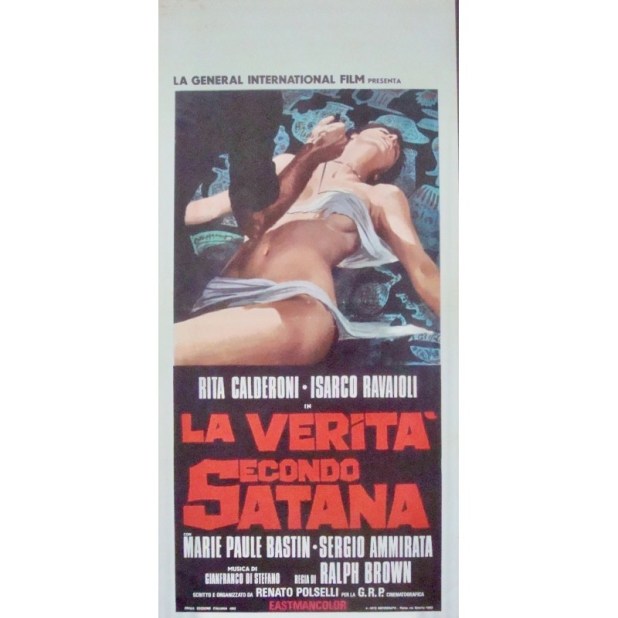
The Truth According to Satann (it was originally released as The Truth According to Satan and this is the censored revised title) is about how Roibert (Isarco Ravaioli) believes that his depression is the result of his constantly on-the-make ex-lover Diana (Rita Calderoni). He tries to shoot himself in a game of Russian Roulette and fails. He also lives when he tries to hang himself when she opens the door, then lays all the blame on her for everything.
This being a movie by Renato Polselli, of course Roibert has interrupted Diana in the midst of her romance/BDSM relationship with Yanita (Marie-Paule Bastin). But this is where Roibert turns the tables, as he strips her and just when you think he’s going to kill her, he stabs himself and makes sure to get her prints all over the knife and his blood all over her.
The movie shifts gears when it turns out that next door neighbor Totoletto (Sergio Ammirata) has seen the entire thing and decides to torture Diana with this knowledge, all while he remains obsessed over his diet of eating two eggs every hour on the hour, quacking like a duck and calling her cabbagehead.
Calderoni is a real trooper in this. Beyond the knife play already mentioned, she’s covered in blood and then showered while fully clothed, then has dogs eat raw meat off of her body. She also has numerous near-mental breakdowns while Polselli edits in scenes of warfare and the origins of how Roibert and Diana got together. He even has Totoletto try and turn Yanita from slave to master, but Diana has too strong of a personality for that.
If I tell you it all ends with red skies and dancing hippies, will it make any more sense?
According to a great interview that Jay Slater did with the director, “Because of the word gospel in the title, La verita’ secondo Satana was instantly accused of blasphemy and its distribution was very limited. Once considered a lost title, Polselli’s film was broadcast on the smallest Italian television networks during the early 80s. To bypass censorship and distribution hassles, Polselli shot three different versions and although the movie was released five times during the 70s, the director added new footage to each print, while deleted certain scenes. The hardest print of La Verita’ secondo Satana features a close-up of the female orgasm. To achieve this, Polselli filmed the actress’s face, body and pubic region in extreme detail as the female orgasm is less evident than the male. Polselli is proud to be one of the first hardcore directors to film such a steamy scene.”
Andy Milligan was a maniac who made movies filled with maniacs. By all reports, he was in the same constant bad mood as nearly every one of his characters, just as willing as them to start screaming no matter what, no matter when. This may have been because he inherited the same bipolar disorder or schizophrenia that his mother had. Forget the words of Stephen King, who said that Andy’s films were made by “morons with movie cameras” and instead, just imagine the chaos of each film’s shoestring budget set with a fastidious Andy melting down and then savor the results.
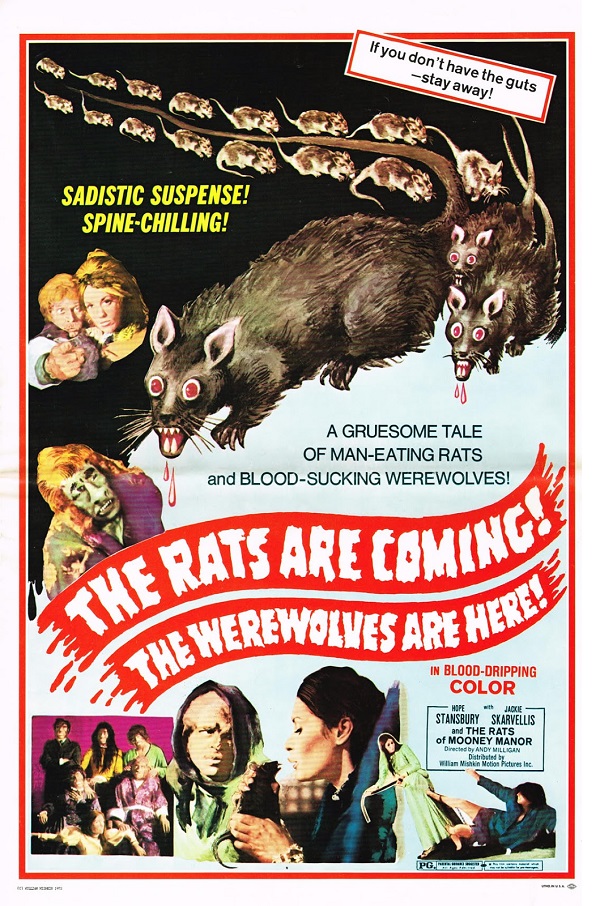
The other thing about the Milligan Cinematic Universe is that often there will be supernatural beings. The Mooneys in this movie are all werewolves who transform once a month on the night of the full moon. Pa (Douglas Phair) has spent nearly all of his near-two hundred years of life trying to cure his family, which includes his caretaker Phoebe (Joan Ogden), the sadistic Monica (Hope Stansbury) who mutilates vermin and Malcolm (Berwick Kaler), who is so far gone that he’s kept locked up.
There’s also Diana (Jackie Skarvellis), who has come back home from medical school along with a new husband named Gerald (Ian Innes). She’s the last hope for the Mooneys, as she is the only one who doesn’t gain fur once a month.
Shot in London — along with The Body Beneath, Bloodthirsty Butchers and The Man with Two Heads — new scenes were added when producer William Mishkin wanted to cash in on the success of Willard. Those scenes — one has Andy in it — were shot in his Staten Island home. Milligan had a hard time getting rid of the rats, even when he tried to give them away to the audience that would come to see this film. He also plays the gunsmith who creates silver bullets and Mr. Micawber, a man who sells flesh-eating rats that have already bitten off one of his arms and a lot of his face.
Despite being set a century before, we can see and hear cars, as well as see electrical outlets, but man, Andy made all the costumes himself by hand and I can just imagine him getting out the patterns and swearing the whole time, shouting about thimbles.
The greatest thing about this movie is the title, which had to lure people in because it’s so good and then people would be confronted by a toxic family just shouting and snipping and screaming and that’s the real movie, not the furry masks or flesh-consuming vermin. That’s what I’m here for.
Here’s a drink recipe to get you through the film.
Red Eyed Black Rat
1/3 cup orange juice
3 oz. dark rum
2 oz. cola
2 maraschino cherries
This one is pretty simple. Pour the juice, rum, then cola over ice and enjoy. For extra fun, drop in the cherries and pretend they’re rat eyes staring at you in the dark of the wasteland.
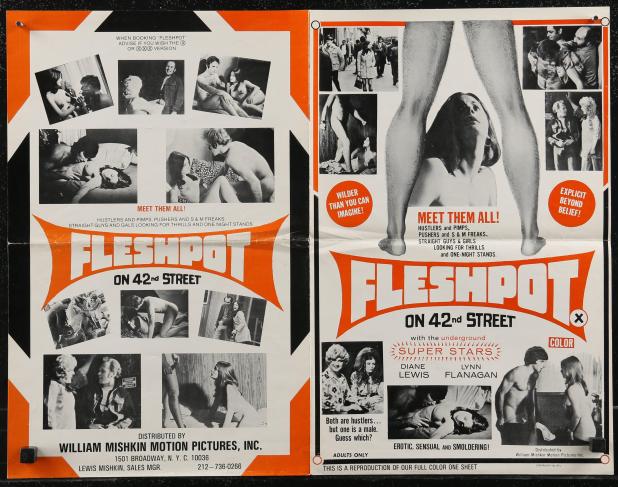
Shot with new permits or budget on the very real streets of New York City, Fleshpot on 42nd Street starts with two sex workers, Dusty Cole (Laura Cannon) and Cherry Lane (Neil Flanagan in drag), trying to make it in the world. But it all gets to be too much for Dusty, who quits the nightlife and tries to move on to the straight life with Bob (Harry Reems!). But as you know — or you should — this is an Andy Milligan movie. Things have a way of not working out.
Once Dusty and Bob hook up, this movie moves from a realistic world where two sex workers rob everyone they can to stay alive while being truly honest with one another about it to another where a man comes in and seemingly saves the day but not caring about his lover’s past.
Maybe that brief respite from a tough world of fighting to stay alive every day is echoed by how Milligan felt, back from London and still making movies for nothing that hardly anyone would see on the rough streets of NYC. But even 42nd Street was about to change, going from simply dangerous in places to absolutely harrowing in the wake of crack by the end of the decade. And even in 1972, the movies playing there went from just plain old exploitation to full penetration.
If you hear some people discuss the films of Milligan, they’re either dismissive or outright mean. I don’t know what they’re looking for, but unlike his horror work, this feels authentic and true. It’s got a downer ending that 1972 Hollywood would have embraced, even if there’s no way they ever could have.
As I was working on Season 2, I totally skipped this episode.
And how could I? It’s one of the most memorable in the entire series.
Anton LaVey specifically called out this episode. But more importantly, whenever people talked about the scariest movies that they had watched, my father always went back to “The Sins of the Fathers.”
“The Sins of the Fathers” was directed by series workhorse Jeannot Szwarc and written by Halsted Welles from a story by Christianna Brand. It stars Geraldine Page as Mrs. Evans, the wife of the Sin Eater of the town of Cwrt y Cadno, Wales. What is a sin eater and his task? Well, they must eat a meal in the company of a dead person, taking on their sins so that the deceased can go to meet God with a clean conscience.
Her husband is too sick to perform the ritual, so her son Ian (Richard Thomas) must go in his place. He fears the pain of accepting all of these sins, much less feasting from the chest of a dead person. But Mrs. Evans and her family have been hungry since the plague has taken Mr. Evans, so she comes up with a plan. Ian will conduct the ritual but hide the food, bringing it home to her family.
Ian barely escapes from the funeral rite and the widow (Barbara Steele!) who wants to watch him conduct the ceremony. The tragedy is that he arrives home to a dead father and must now consume that food — and the food around his lost patriarch — and now take on the sins, the many sins, of the Sin Eater.
Working with art director Joseph Alves, Szwarc pretty much made a legitimate theatrical experience with this short story. NBC wasn’t sure they would even air it, so for once I have to give credit to series producer Jack Laird, who stood behind his talent and pushed for the episode to air. Beyond talent like Page, Thomas and Steele, he also had Michael Dunn as a servant obsessed by the food.
It’s probably the most memorable Night Gallery episode. It has no blood, no special effects and just mood and theatrical acting by all. It just plain works.
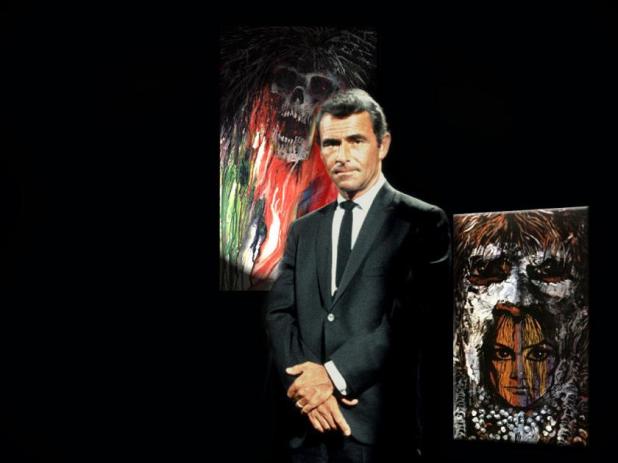
“You Can’t Get Help Like That Anymore” was directed by Jeff Corey and written by Rod Serling. It has quite the cast — Broderick Crawford, Cloris Leachman, Lana Wood, Severn Darden — and a great story. The Fultons (Crawford and Leachman) take their rage out on everyone around them, including their robotic maids, which often come back to the Robot Aids, Inc. storeroom in pieces. Dr. Kessler (Darden) worries that soon the robot help will evolve to the point that they turn the tables on the couple.
He’s right, as Model 931 (Wood) responds to the pinching sexual impropriety and outright physical attacks of the Fultons by decimating them. By the end, the robots have even replaced Kessler with a new model and are quietly sending their models into the suburbs to take over the world.
I love the 1970s future that appears in this story too. The makeup gave the production issues, but you’d never know it, as I really love just about everything in this Serling parable.
Again — apologies for missing this episode. I honestly feel like it’s the best of the entire series, so I appreciate you waiting for it.
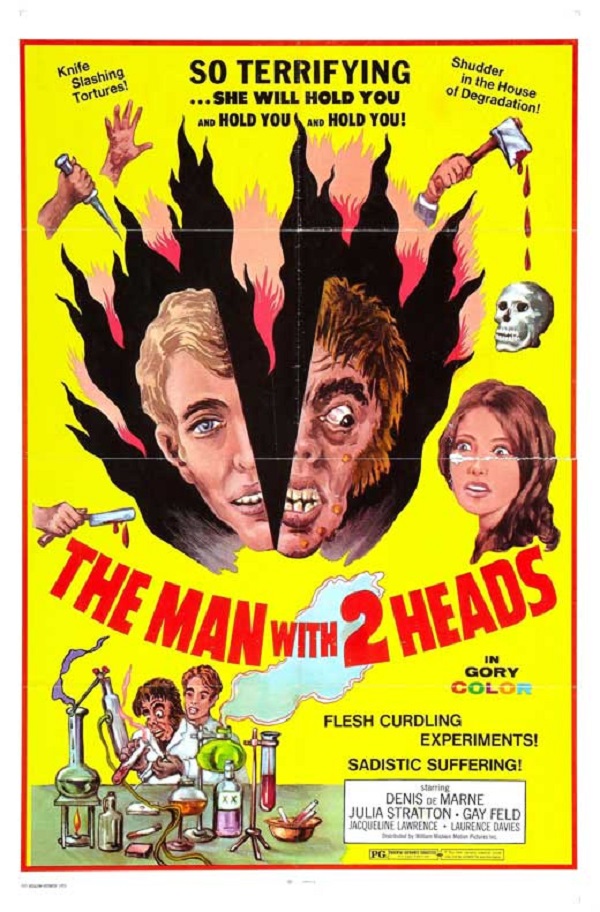
The Amazing Two-Headed Transplant came out in 1971 and The Thing With Two Heads more famously was playing theaters in 1972, but as strange as it is seeing Rosey Grier and Ray Milland share the same body, Andy Milligan can somehow outdo any movie, one or tw0-headed, just by making his normal — well, not really normal — movie.
Don’t be put off by the idea that this is based on a classic book like Robert Louis Stevenson’s Strange Case of Dr. Jekyll and Mri Hyde. It’s still certifiable.
Dr. Jekyll (Dennis DeMarne) has perfected a surgery — well, as much as cracking open a skull and poking a brain can be an operation — that allows him to isolate the evil in the brain. Everyone thinks that this is a ludicrous idea, so he invents a formula that allows someone to become the dark side of their mind. Why would anyone want this? Science is like that. Now, the good doctor becomes Danny Blood, who is everything twisted inside his once medically inclined brain.
Instead of just being with his wife — who definitely wants him — Mary Anne Marsden (Gay Field), Jekyll would rather experiment in the laboratory. His assistant, Jack Smithers (Berwick Kaler), would rather be getting with Jekyll’s sister Carla (Jaqueline Lawrence), so in the middle of their tryst, he gets all the formula’s notes soaked. That means there’s no changing back now.
But does the doctor even want to? I mean, Danny Blood does stuff like force barmaid April Conners (Julia Stratton) to bark like a dog and rides her around quite literally while absolutely shrieking, “You shouldn’t be allowed on the face of this earth! You’re scum! You’re the defecation of the slums of London!”
I mean, if that’s consensual, good for you, Danny Blood. But then he decides that topping ladies isn’t enough. He needs to kill some to get off.
Who loved the fog machine more? Andy Milligan or Lucio Fulci? I mean, my nose is burning just from watching this and it was made fifty years ago. But whatever. Smoke up all the fog, Andy, and let your characters shout at the heavens.
Henry Auden (Leonard Nimoy) is dealing with the loss of his wife, who died after years of a prolonged illness, a time in which he played caregiver. All he can feel is relief, but it’s a strange place to be in, a man who has been more nurse than a husband to a woman who was once his lover.
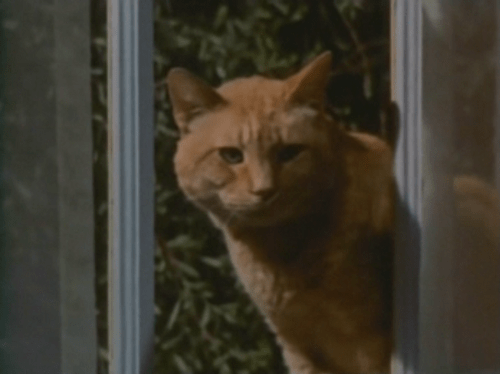
Barbara (Lorraine Gary) is Margaret’s best friend and she’s unconvinced that Henry is grieving enough. She leaves her orange tabby Jennet for company, which he claims he doesn’t need. And then he hears the bell that his wife used to use to summon him.
Now sure that a gigantic cat is loose in his house, Henry starts to sleep at the office. At every turn, his dream of a single life does not appear. The secretary he planned on being with, June (Kathryn Hays), seems to savor the idea that now that he can finally have her, she wants nothing to do with him.
Henry goes home and battles two of the big cats that are loose around his house, but finally realizes that he has to die. He walks to his room and when we see him again, he’s covered in blood and Jennet is licking a red pool in the carpet.
Directed by Gerald Perry Finnerman (the director of photography for sixty episodes of the original Star Trek) and written by David Rayfiel (Lipstick) and based on a short story by Andrea Newman, this is a story that really goes nowhere and has a resolution that makes no sense. It feels like someone just threw together some ideas and hoped that it would make more sense than it does.




 B&S About Movies
You must be logged in to post a comment.