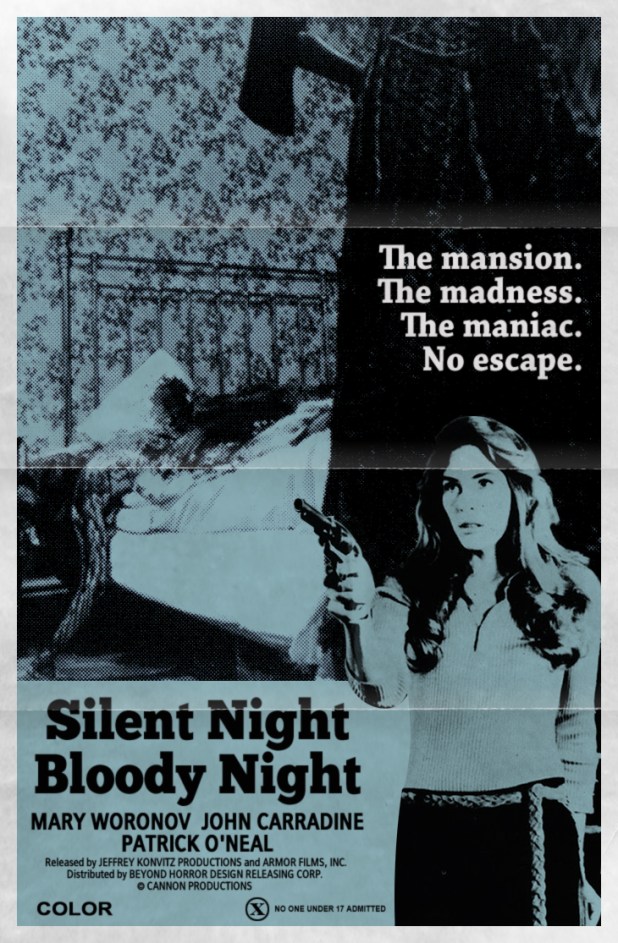
Silent Night, Bloody Night (1972)

Hi EDITOR’S NOTE: When Bill Van Ryn asked me if he could write something for the holidays, I was overjoyed. This is such a gift for all of us. Check out Bill at Groovy Doom and Drive-In Asylum.

Nothing can derail a festive holiday with the relatives like dark family secrets bubbling up to the surface, and there’s likely to be at least one of those loved ones that are downright ornery. This is the case in one of my favorite holiday horror films, the 1972 film most commonly known as Silent Night, Bloody Night. Originally released in 1972 as Dark Night of the Full Moon by the Cannon Group, they reissued it in 1973 with the new title and ad campaign that emphasized the Christmas connection in the story, and it played grindhouses and drive-ins throughout the rest of the 1970s, often as a co-feature to other Cannon releases such as I, Monster, It first appeared on TV in 1974 as a CBS Late Movie, but it also screened on WOR-TV more than a few times, including their beloved Fright Night time slot on Saturday nights, which is where I saw it as a kid. It was resurrected for theatrical release yet again in 1981, The Year of the Slasher, as Death House, or Deathouse as appeared on the title card. I can’t imagine what it felt like to go see this movie in 81 and realize that you’d seen it on TV seven years ago, but nobody should have complained, because seeing it a few times makes the convoluted plot a little more clear. I know that it was very confusing to ten-year-old me watching it on WOR in the middle of the night.

It’s hard to imagine this low key film appearing so often in front of glassy eyed moviegoers and TV-
watching night owls. It’s got a few shocking moments, but it was a weird experience to be confronted with this at 1 in the morning. It’s a murder mystery involving a big old mansion with a sinister past.
Jeffrey Butler, the grandson of the now-deceased proprietor, Wilfred Butler, inherited the house after the death of his grandfather about 20 years prior. Jeffrey intends to sell the place, but when this news get out, an unseen inmate of a local mental hospital breaks out and returns to the house, murdering anyone who dares step inside. The first to go is the lawyer closing the sale of the house, who makes the mistake of sleeping there overnight with his young ladyfriend. Since he’s played by Patrick O’Neal, the moment when they get graphically axed is the Janet Leigh shock of the film.

O’Neal was likely the highest profile in the cast at the time, but there are numerous actors in the film who would later become well-known cult icons. Mary Woronov plays Diane, a young woman from town who happens to be the daughter of the Mayor. She helps Jeffrey unravel the mystery of the house, and all sorts of unsavory history is exhumed while the killer slashes his way through several other cast members. Together they learn that Jeffrey is actually Wilfred Butler’s son AND his grandfather, since Wilfred raped his own daughter, Marianne. The baby was spirited away to another state, while Marianne suffered a psychological breakdown. Rather than institutionalizing her, Wilfred set up his mansion as an insane asylum, where he could keep a close eye on her. Eventually he became disillusioned with her so-called doctors, and turned the violent inmates loose on them, resulting in a Christmas Eve massacre where Marianne herself was killed. Diane doesn’t escape the curse of the mansion either, as she learns some unpleasant information about her own family and her connection to the tragic events.

Director Theodore Gershuny (“Sugar Cookies”) was married to Woronov at the time, and he displays
some style with his camera and his concepts. The most breathtaking and frightening sequence of the
movie is the moment when the inmates of the asylum silently surround the drunken doctors and their party guests before murdering them. This scene is full of Warhol personalities, including Ondine and Candy Darling -although technically her final film, this was actually filmed in 1970 and not released until 72. John Carradine also appears in this, because of course he is in every movie. His character is mute, so we don’t hear his distinctive voice, but he communicates by ringing a bell, as if he’s summoning a missing clerk to a vacant drug store counter.

The holiday imagery is not quite as pronounced as it is in movies like Black Christmas and Silent Night Deadly Night, but we do get some very yuleish (as Barb Coard would say) moments. The characters listen to Christmas carols on the radio, Woronov wraps gifts in front of a fire, and the tone of the film is very wintry. Certain outdoor scenes look as if they were filmed some time after a snowfall began to melt, as portions of the ground seem to have a thin layer of snow and others are muddy. This isn’t the scenic kind of winter, it’s the unpleasant kind that has you tracking mud into the house. Whether or not this was intentional, it takes the romance out of Christmas just a little. And incidentally, it seems as if the Black Christmas game plan of menacing phone calls placed by a killer on Christmas may have been inspired just a little bit by this movie – or perhaps that’s just another Christmas miracle. I love the muted, downbeat atmosphere of Silent Night, Bloody Night a lot, and it does seem to be the movie that knows the most about how family dysfunction can easily lead to an eyeball being gouged out with a wine glass on Christmas Eve. Happy holidays!
THE MOVIES OF AL ADAMSON: Angel’s Wild Women (1971)

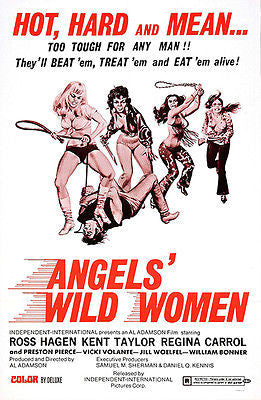
After two men assault one of her girls, Margo (Regina Carrol) finds him and whips him. In between this movie being Screaming Eagles and tough women in foreign prison movies getting hot, this was reshot and re-edited to make it fit into the changing world of exploitation. Another thing that changed was while movies had been shot by Al Adamson at the Spahn Ranch for a while, now the specter of the Manson Family hung over everything. So when cult leader King (William Bonner) makes life tough for the bikers and also controls the ranch’s owner Parker (Kent Taylor), you get taken out of the movie and wonder how much of this is based on things Adamson and his crew actually experienced.

Sam Sherman told Filmfax: “We even had some members of the Manson gang in it, people who had been hanging around. I don’t know if they were killers or not. What happened in this instance was one of those things you can’t imagine or even predict.”

Ross Hagen is the hero, as much as anyone in a biker movie can be the hero, is the lead.

Also known as Commune of Death, a title that leans into the Manson parts of this movie, this is a film that ends with Hagen dropping his motorcycle off a cliff and onto a car, which inexplicably explodes.

THE MOVIES OF AL ADAMSON: Lash of Lust (1972)

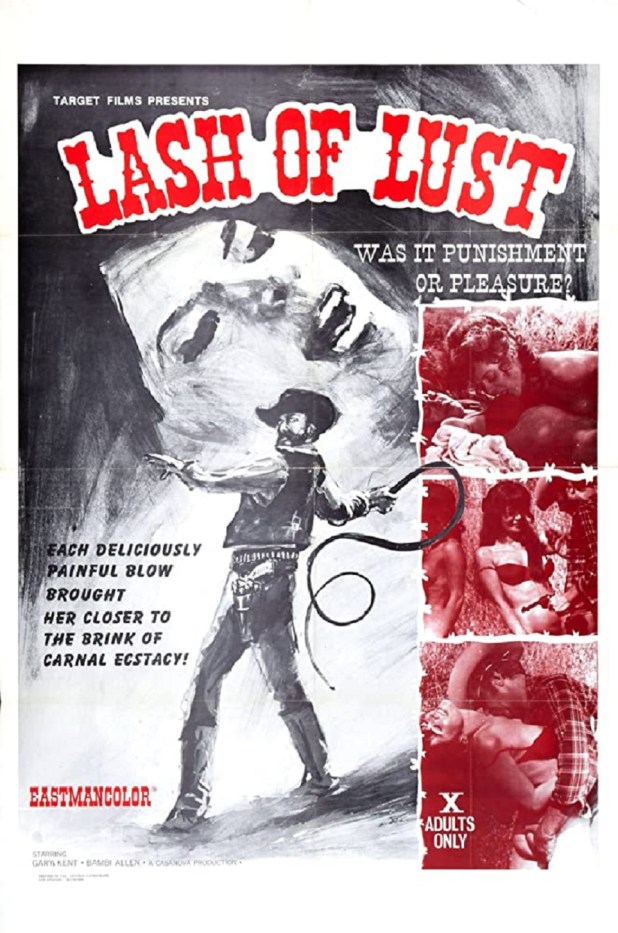
A lost movie from Al Adamson and Sam Sherman, this softcore Western was filmed on Spahn Ranch, the same place where Charles Manson and his Family were living as they attempted to commit Helter Skelter.

The cast has Gary Kent, the stuntman who Danger God was made about, as a prospector; Bambi Allen (who also appeared in adult films as Holly Woodstar; she’s also in Satan’s Sadists and The Bang Bang Gang under the name Chata Cruz) and Rene Bond (one of the first adult stars; mainstream appearances include one of the evil women in Invasion of the Bee GirlsPlease Don’t Eat My Mother! and the TV movie Betrayal) as two kidnapped girls; and for the evil men stealing all these ladies, there’s John “Bud” Cardos, George “Buck” Flower and Eric Stern.

It did play theaters but it just can’t be found. If it were, it would have showed up on Severin’s all-encompassing box set.

MILL CREEK THE SWINGIN’ SEVENTIES: Wacky Taxi (1972)

Pepe “Pepper” Morales (John Astin) already has four kids and another on the way with Maria (Maria Pohji). What better time than now to quit his job at a can company and paint a car so it looks like a taxi and be his own boss?

Directed and written by Alexander Grasshoff — who also made that Fascist warning movie we watched in high school The Wave that no one paid attention to — with directing help by Astin. This is a movie where John Astin beats up an innocent Frank Sinatra Jr., where Alan Sherman gets in the cab and a female soldier is taken to Tijuana for an abortion. In a family movie. Yes, that happened. Avco Embassy released it, so maybe they weren’t used to family audiences.

Don’t have the box set? You can watch this on YouTube.

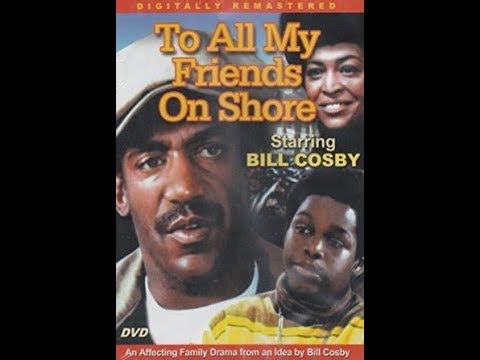
MILL CREEK THE SWINGIN’ SEVENTIES: To All My Friends On Shore (1972)

Blue (Bill Cosby) works as a skycap for an airport and also scrounges for junk he can sell. His wife Serena (Gloria Foster) is a maid and going to school to be a nurse. They’re both working so they can leave the projects and have a better life for their son Vandy (Dennis Hines), who resents the fact that he can’t have fun like his other friends and spend money. Well, when he gets sickle cell anemia, everyone realizes that time may mean as much as dollars.

Directed by Gilbert Cates — the producer of the Academy Awards fourteen times between 1990 and 2008 and was credited with recruiting Billy Crystal, Whoopi Goldberg, David Letterman, Steve Martin, Chris Rock and Jon Stewart to serve as hosts — this was written by Cosby and Allan Sloane.

Cosby and Foster would reunite years later for Leonard Part 6. But that’s another story.

Don’t have the box set? You can watch this on YouTube.

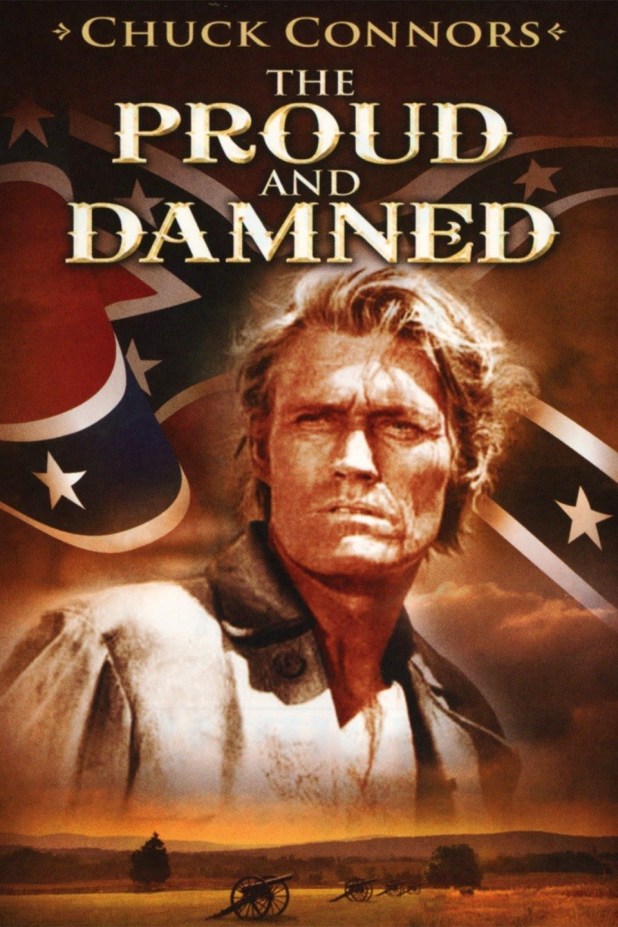
MILL CREEK THE SWINGIN’ SEVENTIES: The Proud and the Damned (1972)

Once Confederate soldiers and now mercenaries, Sgt. Will Hansen (Chuck Connors), Ike (Aron Kincaid), Hank (Henry Caps), Jeb (Smokey Robards), and Billy (Peter Ford) have just come from Texas to Colombia. In hours, they’re captured by General Martinez (Andres Marquis) and forced to join the rebels and report back what they discover from them.

Will also soon meets and falls for a gypsy girl named Mila (Anita Quinn) whose father is so angry about her dating a white man that he cuts off her ear. Will responds by shooting him because the holidays are gonna be weird after this. So because Will gets detained, Martinez finds him and hangs him. Yes, that’s right, the hero of the story dies before the end. The rest of the mercenaries — who never make any money from their soldier work — join the rebels, get revenge and get killed. Except Billy. Because of dumb luck, he fell off his horse and missed the deaths of his friends.

This was directed and written by Ferde Grofé Jr., who also made Hellraiders and Judgement Day. He finished shooting in 1969 and the movie wasn’t released until 1972, so it didn’t seem to work out all that well. At least Cesar Romero got some work.

Don’t have the box set? You can watch this on Tubi.

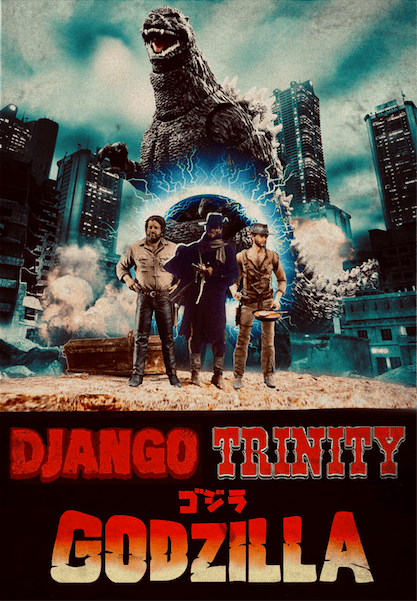
THAN-KAIJU-GIVING: Django And Trinity Against Godzilla (1972)

When a good witch sends Django one hundred years into the future, he has to protect humanity from Godzilla. Yet even his abilities are not enough, so the sorceress sends him assistance in the form of Trinity. Can these two Italian Western heroes stand a chance against the Japanese King of the Monsters?

Edited by Steven Sloss, this fan trailer was edited together from seven different films, with music and sound effects from many others. It also has some original voice acting.

I know this isn’t real but I was so happy after watching this that I decided to share it with all of you.

Spagvemberfest 2023: Two Brothers in Trinity (1972)

Jesse & Lester – Due fratelli in un posto chiamato Trinità (Jesse & Lester – Two Brothers In a Place Called Trinity) starts Richard Harrison as woman-loving, gun shooting Jesse Smith and Donald O’Brien as Lester O’Hara, a God-fearing Mormon. They’re also half brothers who have inherited land from their uncle and must kick gold prospectors off the land. Not just other people who want the gold but rustlers using slaves to get the gold. They also get involved in gambling on boxing, which means that Jesse has to fight in the ring to get their gold back.

Jesse is running from a series of fathers angry that he’s impregnated the daughters and has the dream of opening his own bordello while Lester wants to open a church. These are not mutual goals, but they must work together. Anne Zimmerman also plays Elena Von Schaffer, the love interest of Jesse. She’s also in The Sister of UrsulaCamorra and The Bloodstained Butterfly.

Director Renzo Genta worked with Harrison to write and direct this movie. He’s better known as the writer of movies such as Concorde Affaire ’79Last Cannibal World and Day of Anger.

This is episodic and, as you can imagine, trying to be a Trinity movie. Harrison and O’Brien are good, but they don’t reach their inspirations.

MILL CREEK THE SWINGIN’ SEVENTIES: Fair Play (1972)

Teddy (Phillip Alford) is in Fairplay looking for his uncle F.O. McGill (Paul Ford) who told him he owned a spa. He really owns a saloon and is in the middle of a battle to keep it.

Directed by James A. Sullivan, who edited Manos: The Hands of Fate and directed Night Fright, and written by Garry Carr and Wallace Clyce, who also wrote another young guy in over his head movie, this time with gangsters, called The Pickle Goes In the Middle, this movie is a comedy in the West that takes place in one room and doesn’t have one laugh. It’s painful but we must watch movies that we don’t like to understand the films that we love. There are no peaks without valleys, no joy without pain.

Barbara Hancock, who plays Pearlie Purvis, is in The Night God Screamed and went into craft service after this movie. Richard Webb, who is the preacher, was once Captain Midnight. And Bill McGhee, who plays Jefferson Washington, was Sam in Don’t Look In the Basement. I feel badly for every single one of them for being in this movie. I will not remember you for this. I will remember you for the other movies you were in.

You can watch this on YouTube.

Spagvemberfest 2023: Pancho Villa (1972)

An Italian Spanish co-production, this was directed by Eugenio Martín and produced by Phillip Yordan as part of three movies they’d make together, which also include Bad Man’s River and Horror Express.

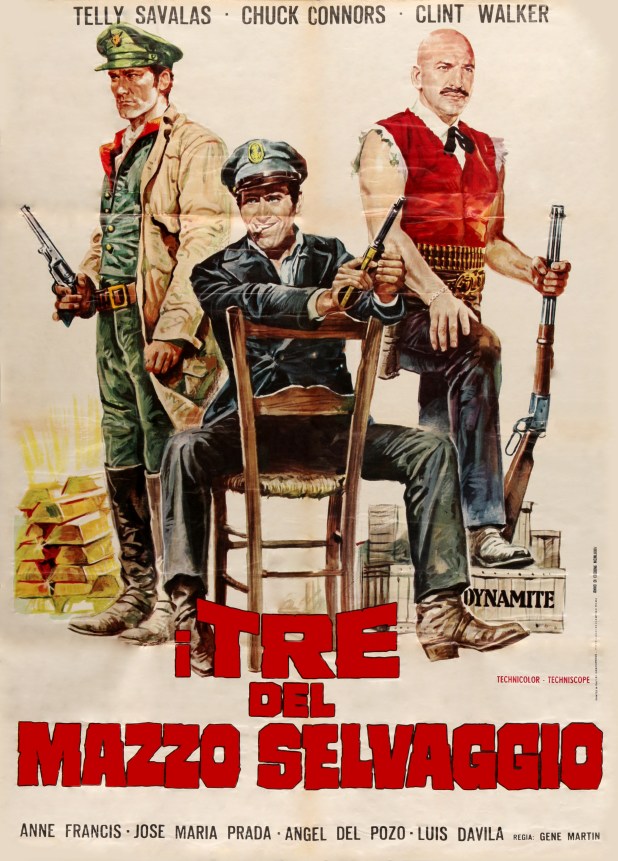
After being double-crossed in an arms deal by a gun merchant McDermott (Luis Dávila) from New Mexico, Mexican revolutionary Pancho Villa (Telly Savalas) and his American lieutenant Scotty (Clint Walker) attack a U.S. Army weapons depot and seize McDermott.

Colonel Wilcox (Chuck Conners) is stationed on the American side of the border and is assigned to rescue the shady McDermott, who is as bad or worse than the Mexican revolutionaries.

In his book Hollywood exile, or, How I learned to love the blacklist: A memoir, producer Bernard Gordon goes into how little Telly Savalas and Clint Walker liked one another. Savalas made attempts to upstage Walker while — unlike their characters in the movie — Anne Francis and Walker got along quite well. Walker was also not far from a near-death experience. The actor Walker skied out of control and had his heart stabbed with a ski poke. He was pronounced dead until a doctor heard a faint sign of life and performed life-saving surgery.

Walker is pretty much Rick Dalton. He was the lead on Cheyenne before getting into Western and war movies. He eventually moved into TV movies, several of which are pretty good, including Killdozer! and Snowbeast.

Pancho Villa even has a song, We All End Up the Same”, which was written by John Cacavas and Don Black and sung by Savalas. This feels very Vietnam-era, in that Connors has a scene where the entire army can’t kill one fly. It ends as all movies should with a train on train head to head crash.

You can watch this on Tubi.