Spagvemberfest 2023: Duck, You Sucker! (1971)

According to Peter Bogdanovich, the original title for this movie — Duck, You Sucker! — was meant by Leone as a close translation of the Italian title Giù la testa, coglione! which means Duck your head, balls!

For some reason, Leone thought that this was a common phrase in America.

That’s why this is also called A Fistful of Dynamite and Once Upon a Time … the Revolution.

In America, a lot of the movie was cut, as it was too violent, profane or politically sensitive. The movie starts with a quote from Mao Zedong that says, “The revolution is not a social dinner, a literary event, a drawing, or an embroidery; it cannot be done with elegance and courtesy. The revolution is an act of violence…” Moments later, a man’s bare ass is on screen.

This was sold in America as a light-hearted follow-up to Leone’s Dollars movies.

It is not.

Juan Miranda (Rod Steiger) leads a gang that is mostly made up of his children, robbing rich people in a train and not part of any revolution at all. John H. Mallory (James Coburn) is an Irish man in Mexico to be a silver prospector. Juan wants him to be part of his crew that robs a bank. John refuses and gets set up as a murderer, so he has to come along.

John is working for Dr. Villega (Romolo Valli) as an explosives expert, something he did as an Irish Republican. They blow up the bank that Juan wanted to rob. It has no cash, instead being used to hold prisoners. This makes Juan a hero of the revolution.

Colonel Günther Reza (Antoine Saint-John) kills nearly everyone, including so many of Juan’s family members, including his dad. He runs into their headquarters and is nearly killed before being captured and sent to a firing squad. John learns that Dr. Villega was tortured and gave them up. This reminds him of how he and his friend Nolan (David Warbeck) had a similar thing happen, as he gave up John to British soldiers. John killed them all and left Ireland. He saves Juan by racing in on his motorcycle, yelling for him to duck and blowing every soldier to chunks.

This is a film of how people see heroes. Juan isn’t someone for the revolution and becomes one. John is someone who believed in a cause and love and now just blows things up. Dr. Villega is destroyed by realizing that he saved himself instead of those he rallied to the cause.

Oh yeah — I know it goes without saying that Morricone’s music is always making these movies epic, but here it is somehow even more glorious.

The end of this destroys me, as John is shot in the back and Juan destroys Reza with bursts from a gigantic gun. It’s not a heroic action like Django but a man in pain just obliterating someone when that’s all he has left. As John lies near death, he remembers when times were different, when he and Nolan were close, when they both loved Coleen (Vivienne Chandler, who is in Hammer’s Lust for a Vampire and Twins of Evil; she was also in Asia’s video for The Smile Has Left Your Eyes” and was rebel pilot Dorovio Bold in Return of the Jedi; she was in a relationship and had a son and daughter with Kate Bush’s brother John Carder Bush and influenced the photos that he did on her album covers. She styled Kate on her artwork for Hounds of Love).

Then everything explodes.

You can watch this on Tubi.
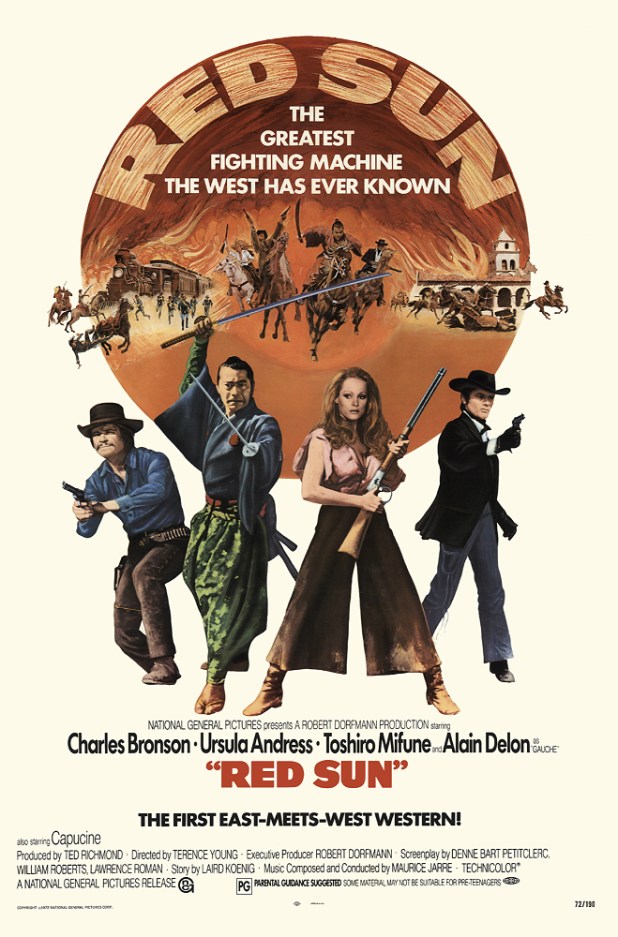
Spagvemberfest 2023: Red Sun (1971)

Look, I know this is directed by the British Terence Young and has a cast that is multinational, but this movie is so great I’m inclined to overlook such things.

It stars one of the Magnificent Seven, Charles Bronson, and one of the Seven Samurai, Toshiro Mifune. At the time, Bronson was a huge deal everywhere but the U.S. In fact, in Japan, he was known as the face of the Mandom cologne (and still is, I have friends who only know him as that) in commercials directed by the man who made Hausu, Nobuhiko Obayashi.

Link Stuart (Bronson) and Gauche (Alain Delon, can this movie have any more suave dudes in it?) have robbed a train of about $400,000. That should be enough to set them up for life, but then they discover that a Japanese ambassador is on his way to Washington to give the President a gold sword. Gauche kills one of the bodyguards and blows up the train car, injuring Link. He’s left for dead but nursed back to help by the Japanese. The surviving bodyguard, Kuroda Jubei (Mifune), takes a blood oath to get the sword back and kill Gauche. Otherwise, both Japanese will have to commit ritual seppuku and kill themselves for their loss of honor. Link is asked to lead Kuroda to Gauche but keeps trying to lose him.

Gauche has killed all of the men and buried the money. So if he dies, Link won’t learn where his rightful stolen money is. Over time, he comes to respect the honor that Kuroda has, a man who feels that he is the last of his time as such things as duty and having a moral code are dying. The plan to get the sword and the money isn’t honorable at all. They kidnap Gauche’s lover Cristina (Ursula Andress) and offer to switch her for what they want. An attack by Commanches delays things, but Cristian soon learns that Gauche isn’t the honorable criminal she thought he was.

By the end, only Gauche, Link, Kuroda and Cristina are left alive. Kuroda realizes that he needs to kill Gauche to get his honor, but Link also needs what is his. That hesitation costs him his life, a fact that places his friend’s need above money, as Link blasts Gauche and promises — and fulfills that promise, even if being caught will see him lynched — to return the sword.

I love this IMDB fact: Mifune entertained the cast and crew throughout the entire production with his refined culinary skills, bringing over a supply of Japanese meats, watercress, seaweed and other ingredients. He would also exchange recipes for French and Italian dishes, including spaghetti.

How amazing is it that this is written by Laird Koenig, the same person who wrote The Little Girl Who Lives Down the Lane?

This movie is pretty much everything I love. The swagger of Bronson, the detached cool of Mifune, the cockiness of Delon and Andress looking incredible even when fighting inside a burning field. Even Cappucine is in it!

You can watch this on Tubi.

UNSUNG HORRORS HORROR GIVES BACK 2023: Web of the Spider (1971)

Each October, the Unsung Horrors podcast does a month of themed movies. This year they will once again be setting up a fundraiser to benefit Best Friends, which is working to save the lives of cats and dogs all across America, giving pets second chances and happy homes.

Today’s theme: Haunted house

After Castle of Blood‘s disappointing box office, Antonio Margheriti felt he could remake the film in color and have it be more successful.

Edgar Allan Poe (Klaus Kinski) is our narrator and Kinski shows up for the beginning and the ending of the movie. He’s interviewed by Alan Foster (Anthony Franciosa), who challenges him as to the truth of his stories. This leads to a bed with Lord Blackwood (Enrico Osterman) about spending a night in his castle, a place where he soon meets Elisabeth (Michèle Mercier, Black Sabbath) and quickly falls into love — and bed — with her before she announces that she’s no longer alive.

There’s also Julia (Karin Field), William Perkins (Silvano Tranquilli) and Elisabeth’s husband,Dr. Carmus (Peter Carsten). The ghosts need his blood to come back to life, but Elisabeth helps him to escape, only for him to impale himself on the gate, dying just as Poe gets there.

I adore that the tagline of this is “Based on Edgar Allan Poe’s Night of the Living Dead.” He did write a poem “Spirits of the Dead” and the 1932 movie The Living Dead was based on Poe’s “The Black Cat” and “The System of Doctor Tarr and Professor Fether” as well as Robert Louis Stevenson’s The Suicide Club. But no, he has nothing to do with Romero’s movie.

I really like the soundtrack by Riz Ortolani but this can’t compare to the black and white — and yes, Barbara Steele appearance — in the original. That said, Kinski is awesome in every second he’s on screen, looking like a complete madman.

CHILLER THEATER MONTH: Lust for a Vampire (1971)

EDITOR’S NOTE: Lust for a Vampire was on Chiller Theater on Saturday, February 5 1977 at 1 a.m. It also was on the show on December 30, 1978. It aired as To Love a Vampire.

After the success of The Vampire Lovers. Tudor Gates was hired to write the sequel, starting with a story he hadn’t finished for Mario Bava all about a girl school serial killer. Jimmy Sangster directed and didn’t like the fact that Hammer wanted a pop song “Strange Love” by Tracy. Also, British censors saw how many lesbian moments were in the first film and made sure even less would show up here.

In the deserted chapel at Castle Karnstein, Count (occultist, conjurer, DJ, sculptor, sheep farmer, writer, ballet dancer, flamenco guitarist and photographer Mike Raven) and Countess Karnstein being their daughter Carmilla (Yutte Stensgaard) back.

Richard LeStrange (Michael Johnson) has come to the area to write a book on vampires and this seems like the right place for it. He’s immediately seduced by Mircalla Herritzen, who is…Carmilla, subverting the lesbian mood of the first movie.

Lots of women lose their lives to the vampire and it all ends in fire, as all Hammer movies must. I like this movie, but I love the first and third movies in the trilogy. This would have been better, I feel, if Peter Cushing was able to be in it, as he was caring for his sick wife, and if Ingrid Pitt was the lead.

You can watch this on Tubi.

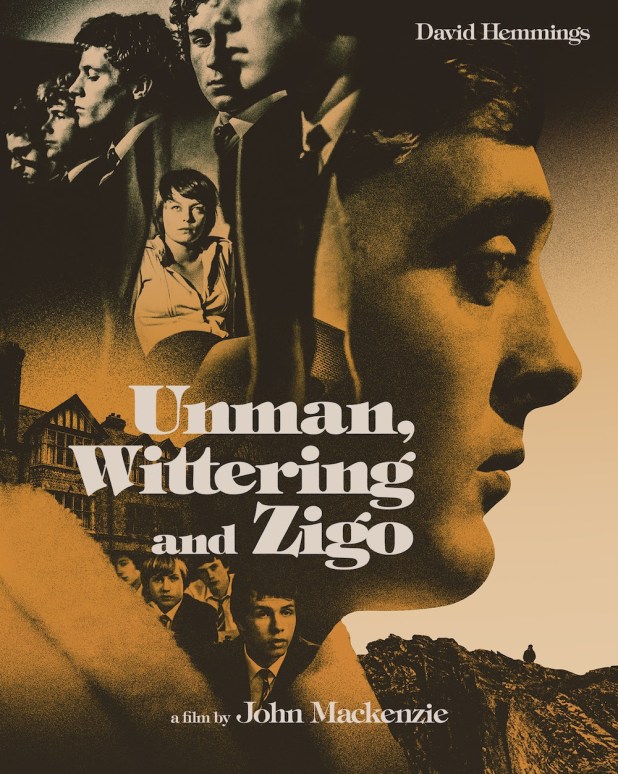
UNSUNG HORRORS HORROR GIVES BACK 2023: Unman, Wittering and Zigo (1971)

Each October, the Unsung Horrors podcast does a month of themed movies. This year they will once again be setting up a fundraiser to benefit Best Friends, which is working to save the lives of cats and dogs all across America, giving pets second chances and happy homes.

Today’s theme: Physical media

John Ebony (David Hemmings, who also produced this) is an idealistic young teacher who arrives at Chantrey School for Boys to fill the shoes of the recently fallen-off a-cliff Pellham. Yet this somewhat of a dream job is anything but, as he lives on the school’s grounds with his wife Sylvia (Carolyn Seymour), who feels trapped. She struggles to fit in with the older wives who have been there for decades, just as John is challenged by the juvenile delinquents he must somehow teach.

Directed by John Mackenzie and written by Simon Raven and based on a radio play by Giles Cooper, this movie gets dark when the boys in his class tell John that they killed the last teacher and they’ll do the same if he doesn’t do exactly what they say. No one believes him, not even his wife.

She makes the mistake of thinking that she can connect with the boys much more than she can with the much older teachers and their wives, even sharing a cigarette with her. Yet she’s defiant in the face of them threatening her with gang rape, which luckily is stopped at the last moment.

I’d never seen this movie, but it really gets across the way that British schools can lead to a legacy of brutal men who do the same thing in real life that they did in class. Seymour is also incredible in this. I’d never seen her in a movie before and now I’m seeking out other roles that she performed in.

The Arrow blu ray release of Unman, Wittering and Zigo contains a new audio commentary by Sean Hogan and Kim Newman; an appreciation by Matthew Sweet; a featurette with several of the cast members looking back at the movie; an original 1958 recording of Giles Cooper’s radio play; a trailer; an image gallery; a double sided fold-out poster featuring original and newly commissioned artwork by Eric Adrian Lee, which also appears as a reversible sleeve and book with writing by Kevin Lyons and Oliver Wake. You can get it from MVD.

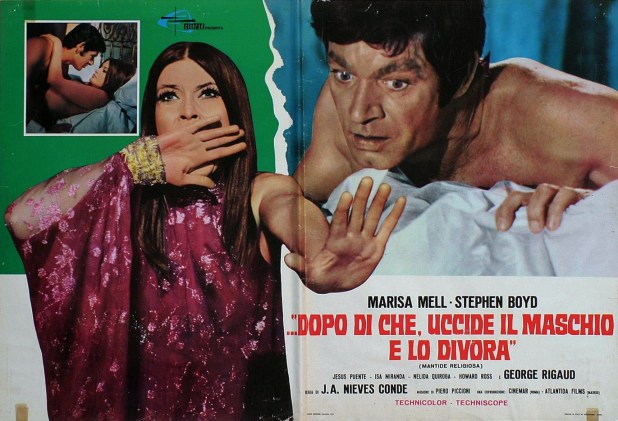
CHILLER THEATER MONTH: Marta (1971)

EDITOR’S NOTE: Marta was first on Chiller Theater on Saturday, May 14, 1977 at 11:30 p.m. It also aired on March 22, 1989 and August 1, 1981. I can’t even imagine what people thought when it was on, as this is one of the strangest movies and one that I absolutely love.

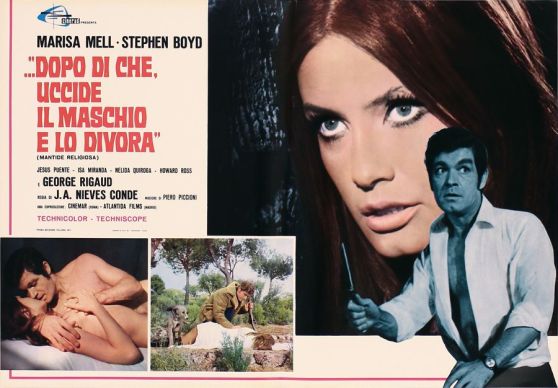
Marisa Mell is the female George Eastman. No, she doesn’t act like a wide-eyed gigantic maniac in every movie. It’s just that no matter what movie she appears in, just her name being in the credits guarantees that I will watch the film.

Also known as …dopo di che, uccide il maschio e lo divora (…After That, It Kills the Male and Devours It), which is one of the best titles ever.

A wealthy landowner named Don Miguel (Stephen Boyd, who was in Ben-Hur) is haunted by his dead mother and missing wife — who may have been murdered — when he meets a gorgeous runaway named Marta (Mell), who may have killed the man who she was running from.

I haven’t seen any of José Antonio Nieves Conde’s films before, but this movie makes me want to watch every single one of them.

The strange thing is that this movie pretty much became true in a way, as Boyd and Mell fell in love, as they made this and The Great Swindle one on top of the other*. Despite Boyd not wanting anything to do with Mell at first — was the man made of stone? — he eventually fell for her and they married in a gypsy ceremony near Madrid, cutting their wrists and sealing their blood. The couple was so possessed by the mystical and sexual desire they felt for one another that they even went to have it exorcized in another ritual.

Boyd had to run from her, as the relationship physically and mentally exhausted him. As for Mell, she’d tell the Akron Beacon Journal that “We both believe in reincarnation, and we realized we’ve already been lovers in three different lifetimes, and in each one I made him suffer terribly.”

In the same year that all this happened, Mell was also dating Pier Luigi Torri, an aristocratic nightclub owner who fled the country after a cocaine scandal. Arrested in London after it was discovered he had a $300 million dollar gold mine and had also scammed a bank, he somehow escaped his jail cell and ran from the police across rooftops, escaping to America for 18 months. Evidently, Mell dated Diabolik in art and in life.

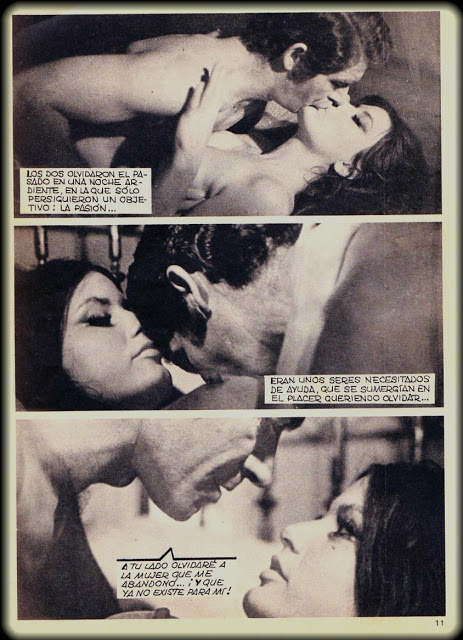
So let’s talk about the Mell relationship in the film instead of reality. She has come to live with Miguel, who collects insects and has two servants who keep things tidy. She enters his life by claiming that she is on the run for a self-defense murder. Miguel decides to protect her from the police because she looks like his wife Pilar (also played by Mell) who has left him or was killed. He’s also tormented by the death of his sainted mother while she may not be who she says that she is.

Oh yeah — and now Marta is acting as Pillar to throw the police off the scent of the man whom she either wants to marry or destroy.

Marta is a gothic-style giallo but is also dreamlike throughout. There’s a continual obsession with placing Mell in front of mirrors. And for someone who was rarely used outside of her sex appeal in films, she absolutely haunting here. Somehow, Spain put this movie forward for Oscar consideration and if I ran those popcorn fart boring awards, I would have given this every single award.

Sure, this movie rips off Hitchcock, but it also wallows in sin, which is what I demand from the giallo that I come to adore. Somehow, someway, this aired on broadcast TV as part of Avco Embassy’s Nightmare Theater package, along with A Bell from Hell, Death Smiles on a Murderer, Maniac MansionNight of the SorcerersFury of the Wolfman, Hatchet for the HoneymoonHorror Rises from the TombDear Dead DelilahDoomwatchWitches MountainThe Mummy’s Revenge and The Witch. Man, how did any of those air on regular TV?

*Credit to the Stephen Boyd Fan Page and Marisa Mell: Her Life and Her Work for this information.

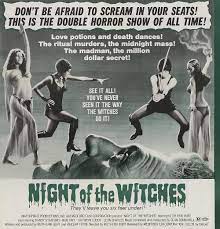
CHILLER THEATER MONTH: Night of the Witches (1971)

EDITOR’S NOTE: Night of the Witches was first on Chiller Theater on Saturday, January 13, 1973 at 1 a.m. It also aired on December 8, 1974; July 17, 1976 and June 11, 1977.

A man pretending to be a preacher (Keith Larsen, who also directed and co-wrote this movie with Vincent Fotre — the English scriptwriter of Baron Blood) is running from the law all through Mexico when he meets an island of witches led by Cassandra (Kathryn Loder, The Big Doll House). He think that they will be easy marks for his abilities, but come on, man. They’re witches.

This movie is more weird than good — yes, that can happen — with the preacher having a chorus on the soundtrack that sings “Amen” to everything he says.

Roxanne Brewer, an adult star, shows up in the cast using the name Susie Edgell. So does Julie Conners from Trader Hornee and Count Yorga, Vampire. The dancing and soundtrack make this, as does the fact that it played double features — “Don’t Be Afraid to Scream in Your Seats! This is the Double Horror Show of All Time!” — with Frankenstein On Campus.

RADIANCE BLU RAY RELEASE: Cosa Nostra: Franco Nero In Three Mafia Tales By Damiano Damiani (1968, 1971, 1975)

Radiance has released this set that has three crime movies starring Franco Nero and directed by Damiano Damiani. As a proud Italian-American, I must remind you that there is no organized crime syndicate known as the Mafia currently active in the United States.

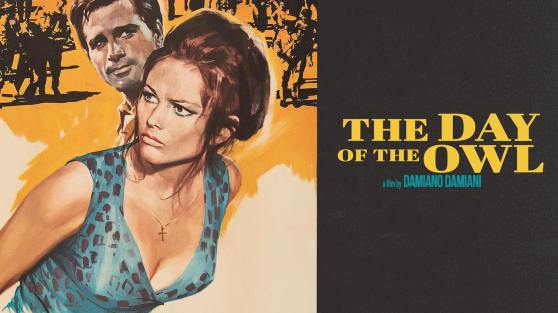
The Day of the Owl: Franco Nero is Captain Bellodi, who starts this investigating the death of truck driver Salvatore Colasberna, a man murdered while delivering cement to a construction project. The only witness may be Rosa Nicolosi (Claudia Cardinale), a woman of somewhat loose morals. Either her husband caught her with Colasberna or the trucker was killed by a corrupt group of manufacturers under the orders of Don Mariano Arena (Lee J. Cobb).

This was one of the first of a wave of organized crime based films. The trend started when the Leonardo Sciascia’s novel To Each His Own was adapted as We Still Kill the Old WayDay of the Owl was based on another Sciascia novel which was the first book he’d written about organized crime in Sicily.

Written by director Damiano Damiani and Ugo Pirro, who also wrote We Still Kill the Old Way, this differs from the book that it’s based on. Piro said, “To me, the book is a hint: I must try and preserve its message by using a different language.”

The Case Is Closed: Forget It: Based on the Leros Pittoni book Tante Sbarre, this has Franco Nero on the wrong side of the law as Vanzi, a man jailed for a hit and run misdemeanor and learning just how bad it is inside Italy’s prison system. That’s because organized crime runs everything even inside.

Vanzi tries not to get involved with the others, but soon is helped by an elderly prisoner by the name of Campoloni (Georges Wilson) and hindered by Biro (John Steiner), a killer who is barely able to keep himself under control. When Vanzi is moved into a cell with Pesenti (Riccardo Cucciolla), he learns that his new roommate is about to testify against Salvatore Rosa (Claudio Nicastro), which gets him killed right in front of Vanzi, who can either get out of prison if he says nothing or die if he reveals that the suicide was truly a murder.

This isn’t like any other role I’ve seen Franco Nero in and the ending is a gut punch. Expected, but still it’s a rough indictment.

How to Kill a Judge: Franco Nero plays filmmaker Giacomo Solaris, whose latest film, Inquest at the Courthouse, is based on the real-life corruption of a judge named Alberto Traini-Luiz (Marco Guglielmi). That movie ends with that man’s ties to organized crime causing him to be killed and when the actual judge seizes the film, he’s killed as well.

Solaris feels that he is responsible, but soon finds himself in a world filled with conspiracy and the murder of everyone close to him, as well as a relationship with the judge’s widow Antonia (Françoise Fabian).

This movie is just as tough on director Damiani, as it was inspired by the actual murder of a judge who he had based a character on in his movie Confessions of a Police Captain.

This set from Radiance has tons of amazing extras to go with the new 2K restorations of the films.

There are new and archival interviews with Nero for all three films, as well as filmmaker and Italian crime cinema expert Mike Malloy discussing The Day of the Owl, a video essay by filmmaker Howard S. Berger looking at actor Lee J. Cobb’s career transition from Hollywood to Italy, an interview with Claudia Cardinale, a making-of for The Case is Closed: Forget It; a visual essay on the career of Damiani Damiani by critic Rachael Nisbet; interview with Alberto Pezzotta, author of Regia Damiano Damiani, who discusses Damiani’s contribution to the crime genre, a new video essay on How to Kill a Judge by filmmaker David Cairns; trailers for all three movies, a reversible sleeve featuring designs based on original posters for each film and — most awesomely, I may add — a limited edition 120-page book featuring new and archival writing on the films by experts on the genre including Andrew Nette, Piero Garofalo, Paul A. J. Lewis , Shelley O’Brien, Nathaniel Thompson, Marco Natoli and Cullen Gallagher.

You can get this incredible set from MVD.

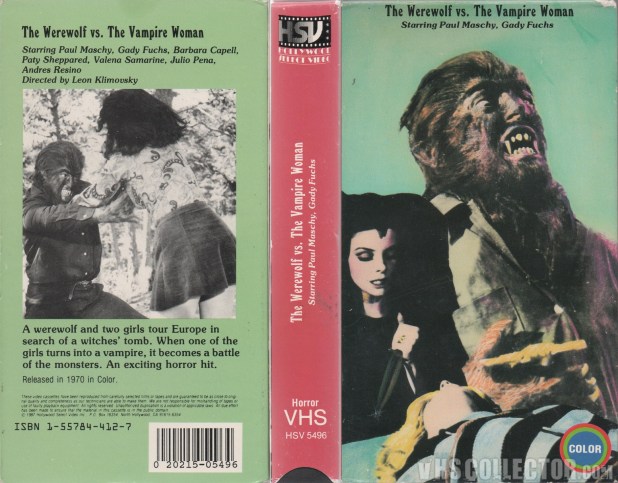
DRIVE-IN MOVIE CLASSICS MONTH: The Werewolf vs. the Vampire Woman (1971)

EDITOR’S NOTE: Thanks to Matthew Hale on Letterboxd, I’ve learned that there are alternate versions of this Mill Creek box set. For the sake of completeness and my obsessive compulsive disorder, here’s this missing movie.

La Noche de Walpurgis (released in the United States as The Werewolf vs. The Vampire Woman and in the UK as both Shadow of the Werewolf and Werewolf Shadow) was the fifth time that Paul Naschy played the doomed lycanthrope Waldemar Daninsky.

Written by Naschy and directed by Leon Klimovsky (The People Who Own the DarkThe Dracula Saga), this film seems like it came from another planet, perhaps because so much of it is in slow motion. It also kicked off a horror craze in Spain that maniacs like me are still enjoying to this day.

After the last film — The Fury of the Wolf Man — Waldemar Daninsky is brought back to life during his autopsy. After all, you don’t remove silver bullets from a werewolf’s heart and expect him to treat you nicely. He kills both for their trouble and runs into the night.

Meanwhile, Elvira and her friend Genevieve are looking for the tomb of Countess Wandessa de Nadasdy. Coincidentally, as these things happen, her grave is near Daninsky’s castle, so our dashing werewolf friend invites them to stay. Within hours, Elvira has bled all over the corpse of the Countess (Patty Shepard, Hannah, Queen of the Vampires), who soon rises and turns both girls into her slaves.

But what of the werewolf, you ask. Don’t worry — he shows up too, after we get our fill of the ladies slow-motion murdering people in the forest. Also, as these things happen, Waldemar must fight the Countess before the only woman who ever loved him, Elvira (Yelena Samarina, The House of 1,000 Dolls) finally kills him again.

There’s also a scene where our furry friend battles a skeleton wearing the robes of a monk in the graveyard. Some claim that this scene inspired Spanish director Amando de Ossorio to write Tombs of the Blind Dead just a few months later.

Daninsky’s lycanthropy is not explained in this one. Was it the bite of a yeti that made him howl at the moon? Is he a college professor or a count? Who cares!

CHILLING CLASSICS MONTH: Snake People (1971)

EDITOR’S NOTE: Thanks to Matthew Hale on Letterboxd, I’ve learned that there are alternate versions of this Mill Creek box set. For the sake of completeness and my obsessive compulsive disorder, here’s this missing movie.

Also known as Isle of the Snake People, the original title of this movie translates as Living Death. It was directed by Juan Ibanez, who also directed star Boris Karloff in The Incredible InvasionHouse of Evil and The Fear Chamber.

Karloff’s box office value led to these movies being financed by Columbia Pictures, which would then distribute them. Karloff received $100,000 per film, which is about $641,000 in today’s money. He rejected the scripts for all four movies, but agreed to make them when Jack Hill — yes, the maker of Spider Baby — rewrote the stories.

Filming was to take place in Mexico City, but Karloff’s emphysema (as well as the fact that he’d already lost a lung to cancer and had pneumonia in the other) would not allow him to work in the city’s altitude. He shot his scenes — with Hill directing — at the Dored Studios in Los Angeles, with additional scenes shot in Mexico with a Karloff stand-in named Jerry Petty.

Captain Labesch has arrived at a far-flung island to stop the voodoo rites being carried out by Damballah (Karloff). He’s warned by local rich white man Carl van Molder (also Karloff) to leave well enough alone. There’s a temperance subplot too, but who cares when Kalea the snake dancer is turning women into zombies that eat policemen?

She is played by Yolanda Montes, who used the stage name Tongolele and was known as The Queen of Tahitian Dances. A vedette in the Mexican cabaret, Tongolele is a potent mix of Swedish and Spanish who was born in Spokane, Washington and continues to be a star in Mexico to this day. She even released an album at one point. I have to say, she looks like she stepped straight out of 2020, with her shaved head and fierce makeup. She’s seriously volcanic, taking over the film from the moment she appears,

Human sacrifice. Dance numbers. Near-psychedelic images. Zombies. Well, as to that latter part of this movie, Night of the Living Dead came out in the years between when this movie was made and when it was released. By that point, this seemed dated. No matter. Watching it today, I was beyond entertained by it.