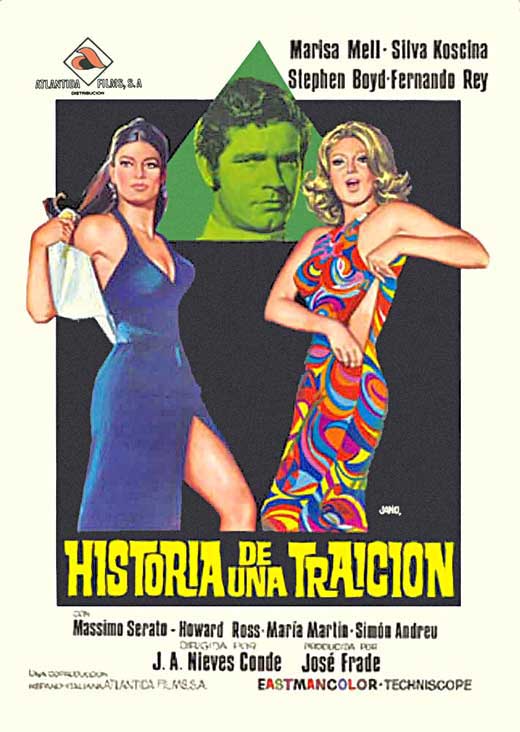
Also known as Historia de una traición (Story of a Betrayal), Nel buio del terrore (In the Darkness of Terror) and Diabolicamente sole con il delitto (Diabolically Alone with the Crime), this was sold in the U.S. as The Great Swindle and the posters hint that it’s similar to The Sting. As you can imagine, outside of having characters using one another for money, it has nothing to do with that movie.
Directed by José Antonio Nieves Conde, who also made Marta a few months earlier with stars Stephen Boyd and Marisa Mell. This was the movie where they began they love affair. In the book Coverlove, Mell said of Boyd, who had avoided her attempts to seduce him the first time they worked together, “He was just so awesome in his passion, his tenderness and his masculinity that I completely lost my head. Finally I asked him the reason why he was now changed so completely after he had been so dismissive before. He was thoughtful, “In the beginning you were too aggressive. I was just at the end of a difficult and desperate love affair. Mentally I was destroyed, and I just wanted to be left alone. I also felt an incredibly dangerous woman in you. To engage with you would mean to never get away from you. That’s why I had completely shut down.””
I’ve mentioned before in the Marta article that their love was so destructive that they needed an exorcism. Mell speaks on this, saying, “Our demon was our passion. We were, as it is in San Vicino custom, made to wear a broad iron ring around the neck. We humbly bowed and prayed. The priest blessed us that we might be “pure.” He celebrated the prescribed ritual for exorcism. It was kind of a supernatural experience. Perhaps you smile today over such hocus-pocus. At that time I felt is was not ridiculous, although I see myself as a clear-headed woman. But my connection to Stephen just had something very mystical, inscrutable in itself, and he felt the same way. Sometimes love is like a deadly disease, sometimes it makes you feel that you are damned for all eternity. Trying to explain the reasons for this is impossible. There are things in our lives that are too high for our philosophy.
Stephen and I returned to Rome, but we did not feel absolved. The demon of passion was still living in us.”
When you watch this movie, know that this drama was going on behind the scenes.
Mell plays Carla, a high class call girl who purrs at one point that she was never made to be anyone’s servant. She finds one of the girls she used to work the street with — back in the old, tougher, darker days — Lola (Sylva Koscina) working as a maid in a hotel she’s staying in. She tells her that she isn’t made for this life and helps to introduce her to the world of being paid by men just for moments of their time.
Her best client is Luis (Fernando Rey), but in the time when she isn’t charging for her love, she starts to develop feelings for a painter named Arturo (Stephen Boyd). In a reverse of their actual relationship, the first evening that he meets her — he’s soaked for being in the rain, she lets him in and he immediately starts drinking her expensive liquor and tries to get in her bed — she rebuffs his advances. A few days later, he saves her from jumping off a cliff and they end up together.
Yet Carla and Lola are more than friends, as they have had a long-time love that is rekindled by finding each other once again. The problem comes when Carla introduces Lola to Luis, who suddenly forgets her. Weeks later, as she’s surrounded by newspapers, Carla learns that Luis died in an airplane crash. And that’s when Lola comes back. Arturo suggests that they frame her for Luis’ death, except that while Lola loves Carla, Arturo soon falls for Lola too. Everybody wants everybody and yet their need for money outweighs everything. Not everyone is going to survive this.
This movie may put some off by the way that it has flashbacks within scenes, but I truly adored every moment of it. Every single room the characters appear in is beyond incredible and I counted more than ten costume changes for Mell in less than twenty minutes. Nearly everyone is impossibly gorgeous and the twists and turns keep you wondering. This is not all that easy of a film to find but it rewards those who seek it.
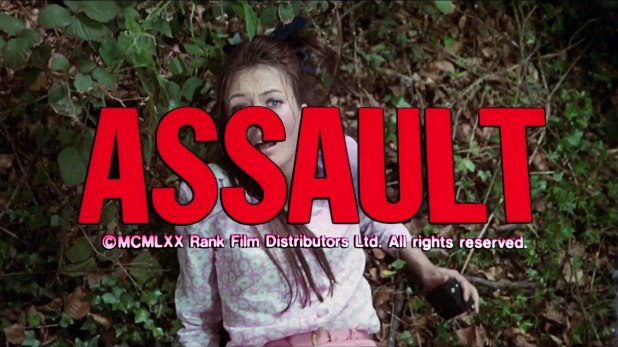
Yes, I know, this isn’t an Italian movie, so some think it can’t be a giallo. It may also be closer to a slasher. But seeing as how Suzy Kendall is in it, let’s consider it.
Also known in the U.S. as the more giallo-feeling title In the Devil’s Garden, this starts as Tessa Hurst (Lesley Anne-Down) being attacked and raped. The act damages her so much that she loses her voice and is placed under the care of Dr. Greg Lomax (James Laurenson).
When a second student named Susan (Anabel Littledale) is assaulted and murdered, art teacher Julie West (Kendall) decides that she will offer herself as bait for the killer with help from a reporter (Freddie Jones). She’s pretty brave, because whoever did it seems to have glowing red eyes and looks like some kind of demonic force as it carries away Susan’s body.
Based on The Ravine by Kendal Young (actually Canadian writer Phyllis Bretty Young), this was directed by Sidney Hayers (Deadly Strangers, Burn Witch Burn) and written by John Kruse. It was produced by Carry On… producer Peter Rogers and the school was also the setting for Carry on Camping.
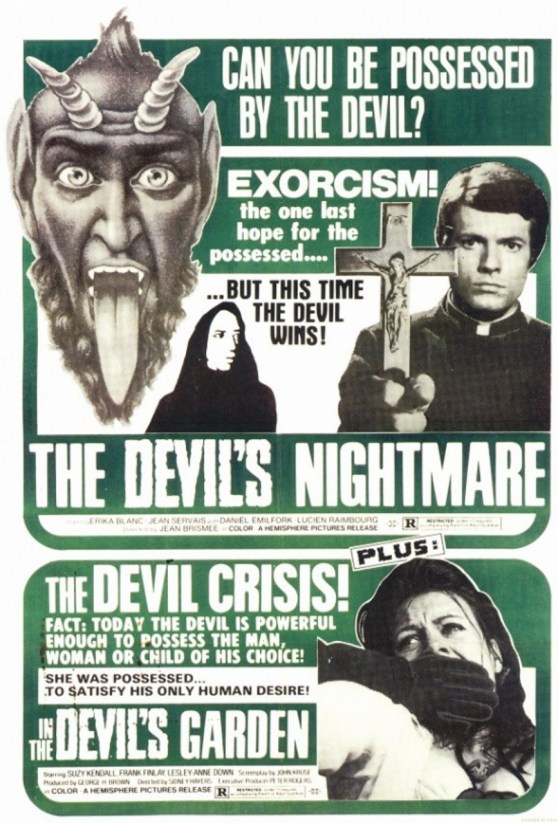
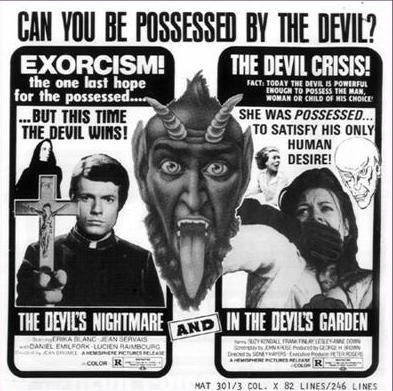
Speaking of alternate titles, when this played in the U.S. as In the Devil’s Garden, it was as part of a double feature with The Devil’s Nightmare and billed as a Devil Double Feature.
When it played on American TV, it was under the title Tower of Terror, which refers to the electrical title where the assaults happen.
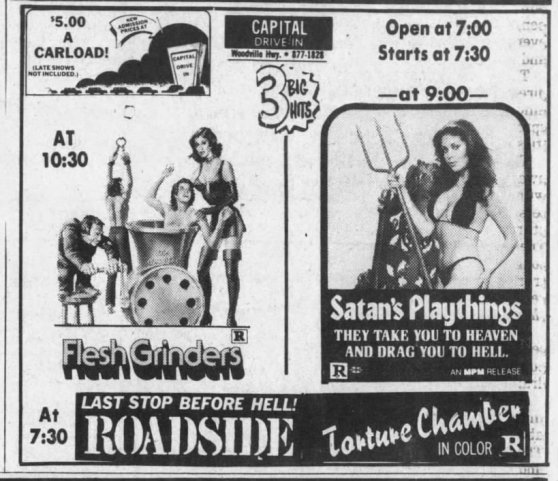
Even stranger, in 1980 — nine years after it was made and years after it aired on TV — it came back to drive-ins as Satan’s Playthings along with an ad campaign that promises three women who are under the thrall of Lucifer.
If that’s not enough, it also played as Molested and The Creepers.
EDITOR’S NOTE: Cinematic Void will be playing this film — my favorite giallo — on January 20 at the Egyptian Theatre in Los Angeles. It will play with Torso and Sergio Martino will be in person. For more information, visit Cinematic Void.
Sergio Martino’s directorial efforts have run the gamut — from straight exploitation (Mondo Sex and Mountain of the Cannibal God, which features Stacy Keach and Ursula Andress, as well as real animal mutilation which we’d never endorse) to horror (Island of the Fishmen, which in addition to starring Barbara Bach and Joseph Cotten, was re-edited by Jim Wynorski and re-entitled Screamers), post-apocalyptic action (2019: After the Fall of New York and Hands of Steel, which is more Terminator rip off than Road Warrior), spaghetti westerns, crime dramas, war films, comedies and even Italian TV, where he’s worked for the last several decades. But this week we’re here to discuss his contributions to the world of giallo.
This is his first effort and the start of the ensemble case in which he’d use in his films. George Hilton would appear in four of his films, Ivan Rassimov in three and one of the queens of the giallo, Edwige Fenech, would star in three (in fact, she was married to Sergio’s brother, the late producer Luciano Martino, at one time).
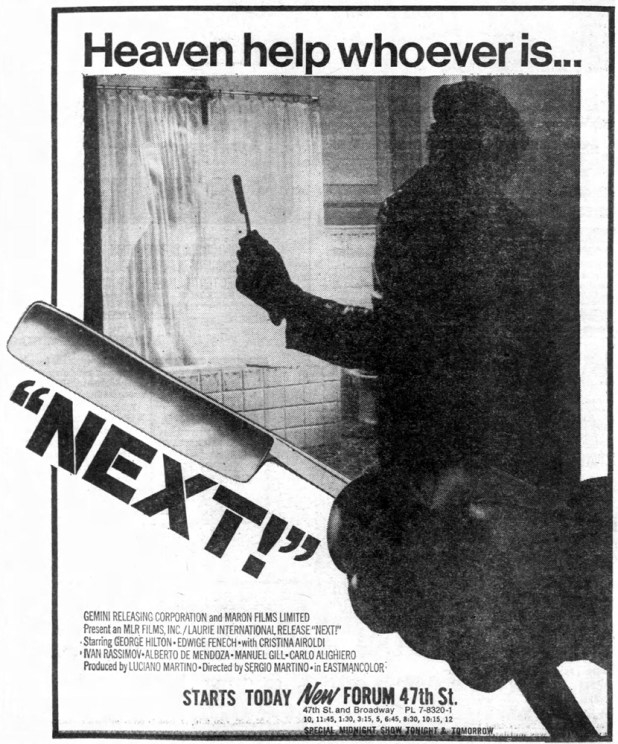
Wondering why this film isn’t just titled The Strange Vice of Mrs. Ward? Turns out a woman named Mrs. Ward sued before the release, claiming that the film would ruin her good reputation, so they changed the title. Yes, Italy, the country where you can make a movie called Zombi 2and have nothing to do with the original film still has legal settlements such as this. You can also find this movie under the titles Blade of the Ripper, Next! and The Next Victim.
Julie Wardh (Fenech) is the wealthy heir to a retailing company. But she’s also a fragile flower, back in Vienna, a city packed with memories and former lovers. She’s married to Neil (Alberto de Mendoza from Horror Express and A Lizard in a Woman’s Skin), a man so wealthy and powerful that he leaves for business the moment they land.
As Julie rides alone in the rain, her car is stopped by the police who are on the hunt for a killer. The sound of the wiper blades reminds her of the last time she was here, recalling a vicious fight between her and a lover who repeatedly slapped her around before they made love in the rain. There’s a gorgeous shot here at the end, where the lovers are to the left of the camera while rain descends on them, almost illuminating them and a sports card pushes into the right foreground. Compared to other giallo which seem content to merely ape Argento or seem like boring police procedurals, Martino aspires to art within his direction (which honestly is why this site is planning on a week of his films).
A green light and honking horns snap Julie from her reverie and she returns to her apartment, where she takes strange notice of a car. Her apartment has been left exactly as it was the last time she was here — it’s a white pop art explosion of metallic, green and blue lines contrasted with oval windows — and just as she’s getting ready to take a bath, the buzzer rings. A dozen roses with a note attached: The worst part of you is the best thing you have and will always be mine – Jean.
We cut to a party, where Caroll (Conchita Airoldi, who would go on to produce Cemetery Man) is trying to hook Julie up with her cousin George (George Hilton, All the Colors of the Dark, The Case of the Bloody Iris) as a catfight between two girls in paper dresses goes down. Tell you what — if I am to learn anything from giallo, it’s that every party in 1970’s Italy was packed with drugs, crazy music and the chance that anything from a fistfight to an orgy could happen at any minute. People had to be exhausted all the time. Jean (Ivan Rassimov from Planet of the Vampires, Your Vice is a Locked Door and Only I Have the Key, Eaten Alive!), the guy who sent the roses and was the man she remembered in the earlier flashback, is there extending a salute. This enrages Julie, who leaves the party, but he follows her into the street. He reminds her that she belongs to him, but she counters that she married Neil to escape him, which is cemented when Neil shows up and punches the dude. Jean just laughs, looking at both of them, knowing that he owns Julie body and soul.
This leads to a flashback where Jean pours champagne all over her, soaking her dress, then smashes the bottle of champagne, showering her in glass shards. He uses what’s left of the bottle to slice up her dress and skin before he takes her. Their coupling is a mix of pleasure and pain, covered in blood, that she had to escape. But did she want to?
So what then is Mrs. Wardh’s strange vice? Is it for men that are bad for her? Is it for pain and dominance? Or some combination of both? As we learn, she’s caught between three men — her husband, whose cool indifference and emotional (and physical) unavailability is just as cruel as her former lover Jean, who owns her to the point that she is nearly his again before Neil showed up to hit him. And the third side of this love rectangle (is there such a thing?) is George, who is the porridge to her Goldilocks — the just right combination of both. Yet there is a fifth side to this — making it a love pentagon (!?!) — with Julie wanting to be a good woman, true to her vows and not to her need to be beaten, bloodied and forced. She is torn between her desire and her need to fit into the moral code of the world. So much of giallo is based on this — created in a country where the Holy Seat of a religious empire sits smack dab in the middle of Rome. Religion and morality nearly shook hands with the sexual revolution and excesses of the pre-AIDS 1970s.
Ah, but let’s not forget that a proper giallo needs a murder, which this film delivers with a quick slash in the shower. That said — what strikes me about Martino is that unlike Argento, he cares more about the story and the characters than creating murder art set pieces. The conversation between Carol and Julie isn’t just words on a page, they’re vital clues into her mental state. Whereas Carol’s casual amorality is revealed, saying that the killer — who we just saw attack the showering girl — is taking out her competition, Julie worries about her values. She married Neil for security and protection, but not the monetary or physical kind. She wanted protection from herself, as she feels that her loss of control and willingness to submit to the violent impulses of men makes her a sinner.
George shows up to meet Julie and get to know her better. He even tells her that he loves to court women when their husbands are around, cuckolding them. Julie claims that that leaves her cold, while Carol claims that she’d bed him, family or not. They decide to go to lunch together, which seems to be more about George staring at Julie than sustenance. Julie demands that George take her to the bus station, but instead he takes her all over the countryside on his motorcycle (What is it with Fenech’s character and dudes that ride bikes? Is it the freedom that it represents?) while he wears white leather fringe, a look that is very 1971. He calls her the moment that she enters the house and she tells him that she likes him way too much, so she can never see him again. Of course, he’s already there and enters the front door before kissing her. She tries to get away, but he keeps telling her that he is in love with her. She begs him to not complicate her life, that she is not the girl he thinks she is. Their kiss is artfully compressed into a second kiss that occurs much later that same day — an intriguing way to show the passage of time and the growth of their relationship.
As they kiss in the dark, a car nearly hits them, which Julie is sure is Jean. She tells him to take her anywhere, which ends up being his apartment. The car returns and its driver watches from the window as Julie and George make love (or, more to the point, she knees him in the crotch while laying upon him, but whatever works for them, I guess).
Later, Julie gets more flowers from an anonymous admirer. Her husband asks who they are from and she wishes aloud that they came from him. There’s another note attached — “Your vice is a locked door and only I have the key.” She tells him that she realizes that diplomats only love other diplomats. He replies that she feels that he has always failed and wronged her. He asks if she is content. “I’m more than content,” comes her reply.
The black gloved killer is watching her and calls her to blackmail her, saying that he will tell her husband. She goes to talk to Carol and claims that it’s Jean. Carol responds that the killer’s last victim was “that whore at the party” and Jean couldn’t be the killer, as he doesn’t go after women like that. Carol embraces free love and says that if Julie is into George, then why should she have to hide it? Also: Carol just walks around her apartment naked (and also has a crazy cover up that is all black with red feathers) and Julie is just fine with it. Carol offers to go to where the blackmailer/killer wants her to drop off the money.
Julie nervously chainsmokes while watching a motorcycle race, a scene intercut with Carol going to meet the killer. To show the escalation of worry, Martino piles on the jump cuts and quick switches between the two women. Whereas Julie is trapped within her worry and the walls of her apartment, the carefree Carol is all alone within a huge park. Alone until the killer reveals himself, slashing her with a straight razor. Again — the killings are rather matter of fact in contrast to the set-ups in this film.
The police get involved, finally investigating Jean. They go to his apartment, which is covered with photos of naked women and exotic animals. Then, they interrogate him with her in attendance. It’s just an excuse for him to keep trying to seduce her and inform the police that Julie has a blood fetish, so she could be the killer, too. George has also been brought in for questioning, to which Jean says, “Now I know why my flowers have no effect on you.”
Neil arrives to take Julie home, but later George says that he wants to speak to her husband and take her away from the city. She says that she has to see this out, she has to discover who killed her best friend when it should have been her.
As Julie returns home, she finds herself in a dark parking garage. The headlines of a car cut into the inky blackness before she is nearly run over. She runs for the elevator, watching for the killer and the numbers of her floor to get closer. Yet the doors open to reveal the killer! Julie runs from him, even attempting to hit him with her car. She barely makes it inside the apartment, screaming at the door. Her husband lets her in but she’s in hysterics. There’s a lot of this scene that feels like it influenced Halloween 2‘s elevator scene. I’m not alone in feeling like that sequel is a giallo. Check out this awesome article from Bill at Groovy Doom to see what I mean.
Neil has had enough and decides to go to Jean’s house and confront him. He tells Julie that he will go alone, but she is afraid and rushes to be with him. They explore his dark house, finally finding Jean’s body in the tub. Julie is overcome and passes out in her husband’s arms. When they get outside, Jean’s car is gone and flowers have been left in the backseat with another poem. Neil throws the flowers down in disgust.
We cut to a dream sequence of George, a laughing Carol and Jean covered in blood, slapping her around. Her husband wakes her up and shows her the photo of the killer. She asks her husband to protect her, but he leaves. She calls and begs George to come get her. He promises to take her to Spain, a place that will make her forget the rest of the world (people continually promise this to Julie, such as Carol’s offer that a place will make her forget she’s on a diet or that an affair will make her forget her sadness).
Neil comes back home to learn that Julie has left. Meanwhile, the killer tries to attack another woman, who unmasks, disarms and stabs him. He makes one last attempt to kill her, but passes out from blood loss.
Meanwhile (!), George and Julie are spearfishing. The camera work here slows down, turning around our lovers (You can’t tell me that DePalma didn’t watch at least a few giallo, even though he claims to have only seen The Bird with the Crystal Plumage and has been dismissive of Argento’s work. Sure, all of his films and giallo betray the and of Hitchcock, but some of these films seem way too close). They discover that the killer has died, but George disappears and someone starts following Julie. She arrives back at their apartment to hear the sound of dripping water. We follow the sound to the bloody curtains of the tub as water and blood spill out. The camera begins to spin back and forth before she sees Jean’s dead body, screams and passes out. George arrives and tries to wake her up, but she’s catatonic. George finds the cause of Julie’s worry — rust had been dripping onto the floor, looking like blood.
Julie awakens and her mood gives way to madness. She’s sure someone is there and yet there is no one. As she realizes this, she attacks a wall and is chloroformed from behind by…Jean! George is rushing a doctor to see her, explaining her vice for blood that excites and repels her at the same time. But Jean is too busy dragging her to the kitchen, where he duct tapes the window shut. He opens a gas line and locks the door (using an ice cube?), leaving her to die. We hear her heart beating out as it’s cut with shots of the doctor and George rushing to her. She makes an attempt to stand but cannot. And it’s too late — Julie is dead.
Neil comes to see the police and blames George for what the police are classifying as a suicide. Jean waits in a secluded area for George, who greets him with a smile. He asks him for the money — turns out that they were in this together. Even after explaining that they both have an alibi, Jean asks again for the money. George shoots him and leaves a gun in his hand, making it look like a suicide.
Turns out that Neil and George were in on this too — Neil has paid off his debts and with Carol gone, George is the only heir to a fortune — much like Hitchcock’s Strangers on a Train. As they drive away laughing, Neil sees Julie on the side of the road and demands that Neil turn around. To their surprise, it is her — followed by the police. A chase leads them off the side of the road to their death. The doctor has saved her life and it seems like he’s fallen for her.
Wow. The Strange Vice of Mrs. Wardh was but the first of Martino’s giallo films, but it’s great. It kept me guessing until the end with none of the b roll travelogue footage and red herrings that plague so many other films in the genre. What a movie to spend the middle of the night into the morning with!
Here’s a drink recipe.
The Strange Cola of Mrs. Wardh (tweaked from this recipe)
1 1/2 oz. J&B Scotch
5 oz. cola
4 dashes Angostura Orange Bitters
An orange wedge
Put on your black leather gloves and use a switchblade to slice an orange wedge.
Fill a tall glass with ice and pour in the J&B and cola.
Add the bitters, then squeeze in the orange juice and use the rest of the wedge for a garnish.
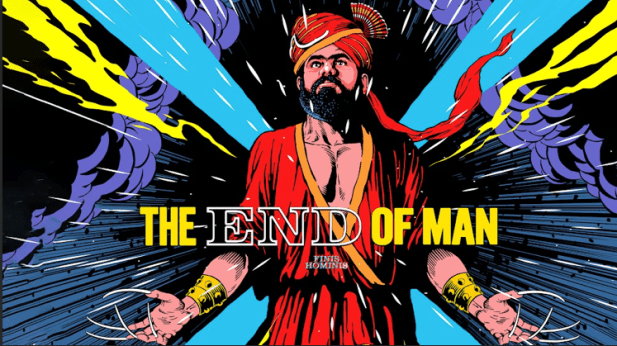
Embracing the socially conscious — yet still exploitative — black humor and tongue in cheek style of the Brazilian Mouth of Garbage Cinema (Boca do Lixo), the man known as Coffin Joe — José Mojica Marins — directed co-wrote (with Rubens Francisco Luchetti) and stars in this story of a man named Finis Hominis who rises naked from the ocean and walks through the streets of the city, changing the world.
After helping a woman in a wheelchair to walk, protecting a woman and her child from a gang and then being given the finest in clothing, he walks to a church where he drinks Holy Water and is proclaimed Finis Hominis, the end of man. He brings the dead back to life, gathers followers and upsets the leaders of the world until he announces that he must return home. And that is an insane asylum. And this has happened before.
A messiah and an insane person may be the same. That seems like what Marins is saying in a film that avoids his traditional horror look, feel and main character and instead, trips out.
Arrow Video’s limited edition collection for Coffin Joe is perfect. The End of Man has commentary with Marins, Paulo Duarte and Carlos Primati in Portuguese with English subtitles. You can get this set from MVD.
Roger Watkins was born in Binghamton, New York and graduated from Oneonta State College in with a Bachelor’s degree in English Literature. He served as an apprentice for Freddie Francis, Otto Preminger and Nicholas Ray. He wrote Mystique for Roberta Findlay and as Richard Mahler, he made Her Name Was Lisa, Midnight Heat, Corruption and American Babylon, movies that were porn but had no interest in getting anyone turned on.
He’s probably best known for his 1973 movie The Last House On Dead End Street, which is also knwon as At the Hour of Our Death, The Fun House and The Cuckoo Clocks of Hell. It’s charitably one of the most mentally deranged movies I’ve seen and I say that with respect. For years, because the movie was made with no real names, rumors were spread that it was a snuff film. In truth, it’s a $3,000 down and dirty movie that really had an $800 budget because Watkins spent most of the money on drugs.
It took until 1989 when Chas Balun revealed that Watkins made the movie. In 2000, Watkins posted on the internet that it was really him and the film was released. The full 175-minute version seems lost forever, even if the story of a Chicago riot and fire destroying the print seems as true as the story that there’s a real murder in the film.
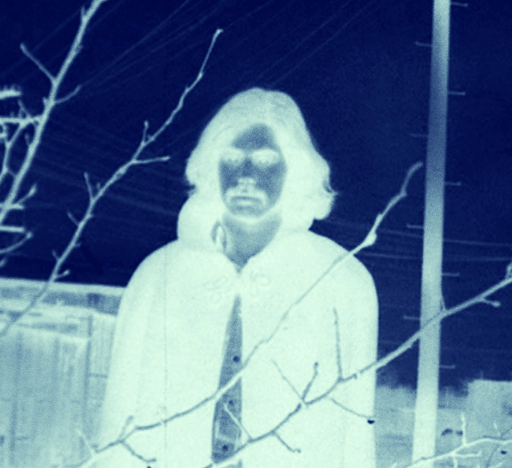
On the 2002 DVD release of the movie, Black Snow and several other Watkins short films appeared. I love that he did commentary over this, calling it “a piece of shit” and that it proved just how easy it was to make avant-garde bullshit. Then again, after he told Nicholas Ray that, the director told him, “Maybe it’s easy for you, Roger.”
It’s basically people walking through the snow and showing their darkness, which must have some kind of message behind it. Except Watkins laughs through the whole thing, which is so strange to me, as I assumed that he was as dark as he is in The Last House On Dead End Street and not someone having fun rewatching a college project.
In 2015, Vinegar Syndrome claimed that they were making a perfect version of The Last House but that seems like it’s never going to happen. The uncut version of the movie is hidden on their release of Corruption, so there’s that.
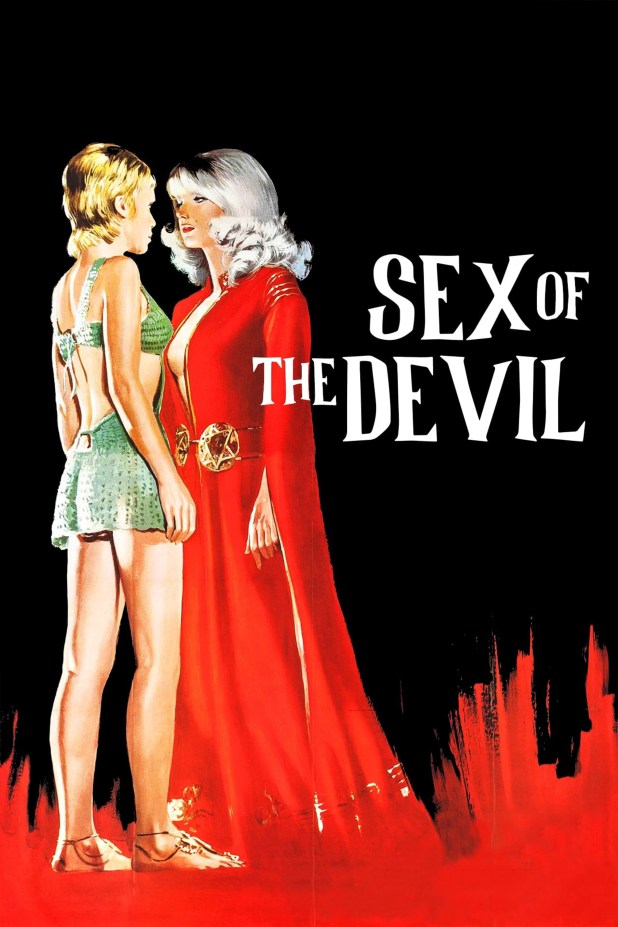
The marriage between Andrea (Rossano Brazzi) and Barbara (Maitena Galli) is near the end, beyond the saving that a vacation to Istanbul can provide. Yet they go anyway, along with his assistant Sylvia (Sylva Koscina), to a villa whose last tenant, a sculptor named Claudine, hung herself. The housekeeper Fatma (Güzin Özipek) keeps secrets, like how she practically worships the dead woman. Speaking of secrets, Sylvia and Barbara have some of their own, as they have begun their own relationship away from the impotent surgeon husband, who is convinced people are trying to kill him. Also, as this is a fantastic, Claudine’s spirit finds her way to Sylvia.
The last part of the title of this movie — Il sesso del diavolo—Trittico — refers to a triptych or threesome. The film is filled with different versions of three together, such as the couple that arrives at the villa, a past indiscretion and maybe even a new one.
Directed by Oscar Brazzi and written by Sergio Civinini and Paolo Giordano, this film gets the most out of its setting, along with a soundtrack by Stelvio Cipriani that takes its inspiration — well, we can just say taglia e incolla — from Iron Butterfly’s “In-A-Gadda-Da-Vida.”
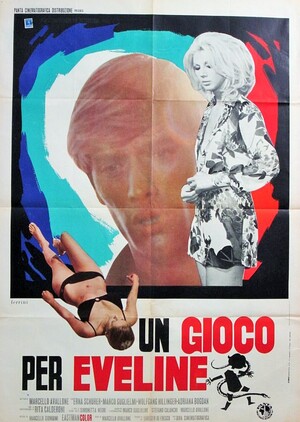
A Game For Eveline has Nathalie (Erna Schurer, Scream of the Demon Lover) and Pierre (Wolfgang Hillinger) arguing over having children when they nearly drive off a cliff. They find their way to the home of Phillipe (Marco Guglielmi) and Minou Giraud (Adriana Bogdan), another couple who are mourning the loss of their daughter Eveline. That night, in bed, Pierre hears the cry of a child and during other times, a doll seems to be moving around from room to room. Phillipe is the only one who can see her and he claims that she’s a ghost while Eveline claims that her daughter is alive and being hidden from her. In the midst of all this weirdness, the hosts seemingly want to keep them there as long as possible and keep trying to sleep with both of their guests.
You might find this boring but I loved the mood. And who can turn away Rita Calderoni when she shows up in a film, this time hiding up a platinum blonde wig, bestill my Italian Gothic loving barely beating right heart. She also looks just like the housekeeper who supposedly died with Eveline. And why is Phillipe kissing her?
The fact that Eveline is playing with a ball is no accident, particualrly after Mario Bava’s Kill, Baby, Kill! and Fellini’s ripoff act in his segment in Spirits of the Dead. Bava himself said, “That ghost child with the bouncing ball… it’s the same ideas as in my film, exactly the same! I later mentioned this to Giulietta Masina (Fellini’s wife) and she just shrugged her shoulders, smiling and said, “Well, you know how Federico is…””
Director Marcello Avallone was also the assistant director of The Horrible Dr. Hichcock and its believed that he directed most of the sexualized foreign scenes. He would go on to make Maya and Specters.
At the end of World War II, Baron von Rhoneberg (Jean Servais) sacrificed his daughter instead of allowing her to live her life under the family curse. That curse? Each first born daughter must become a succubus. Somehow, even though he was a general during the war, he isn’t charged with war crimes — or you know, murder — and his castle is famous enough that it brings a reporter who starts taking photos. He tells her not to, as he lives a hidden life, but she does anyway and is hit with a bolt of lightning out of nowhere that leaves the mark of the devil on her. And oh yeah, she’s dead now.
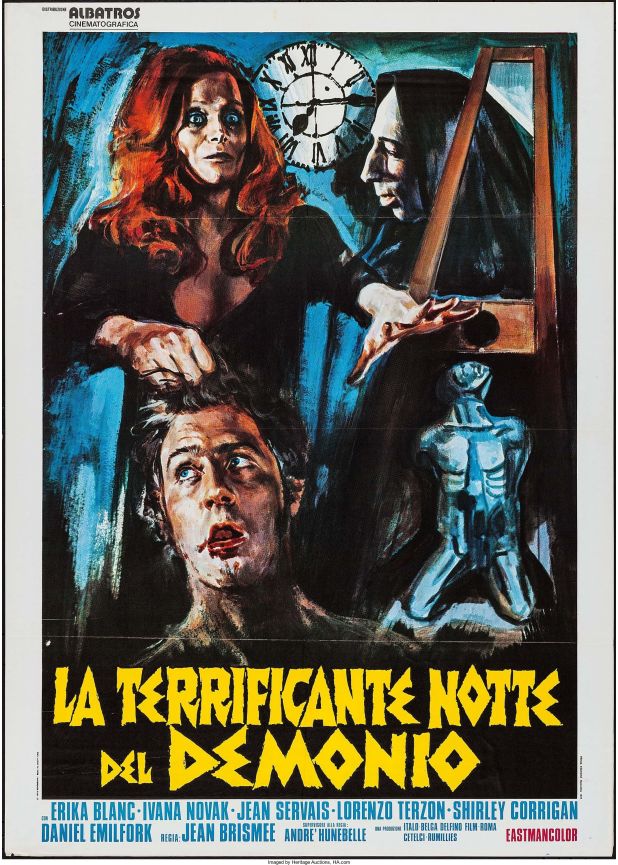
Welcome to The Devil’s Nightmare, which is also called La plus longue nuit du diable (The Devil’s Longest Night) and La terrificante notte del demonio (The Terrifying Night of the Demon). It also has the titles The Devil Walks at Midnight, Succubus, Vampire Playgirls, Satan’s Playthings and Castle of Death. It played U.S. triple bills with In the Devil’s Garden and The Devil’s Wedding Night.
A group of seven tourists — Matt, Nancy, Howard, Corinne, Regine, Mr. Mason and Alvin — are stranded when a flood takes out a bridge. Satan himself — well, they don’t know it yet — directs them to the Baron’s castle, where his servant Hans (Maurice De Groote) gets them rooms for the evening and informs his master that he has guests. The Baron is in the middle of doing some alchemy but still has time for dinner, during which he explains his family curse. When asked if he has a daughter, he answers to the contrary.
Meanwhile, Lisa Muller (Erika Blanc) is another guest and she goes about killing each of the other guests following the rules of the seven deadly sins. Only Alvin, a seminary student, survives her murderous ways. He asks Satan if he can save the souls of everyone else by giving up his own. The devil agrees and everyone is back alive.
The next morning, the Baron reveals to Alvin that he killed his daughter when she was a baby, but the joke is on him. The housekeeper Martha reveals that her daughter is Lisa and that her father is the Baron’s brother, making her the first-born woman of this generation of the von Rhoneberg family. Alvin refuses to believe that Lisa could be a demon and stays with her at the castle as the rest of the group drives off, soon run off the road by a hearse driven by Satan, dooming everyone all over again and getting Alvin’s soul too. He and Lisa smile at each other.
You can read my past review of this that was posted when Mondo Macabro released it and Jenn Upton’s article on the movie as well.
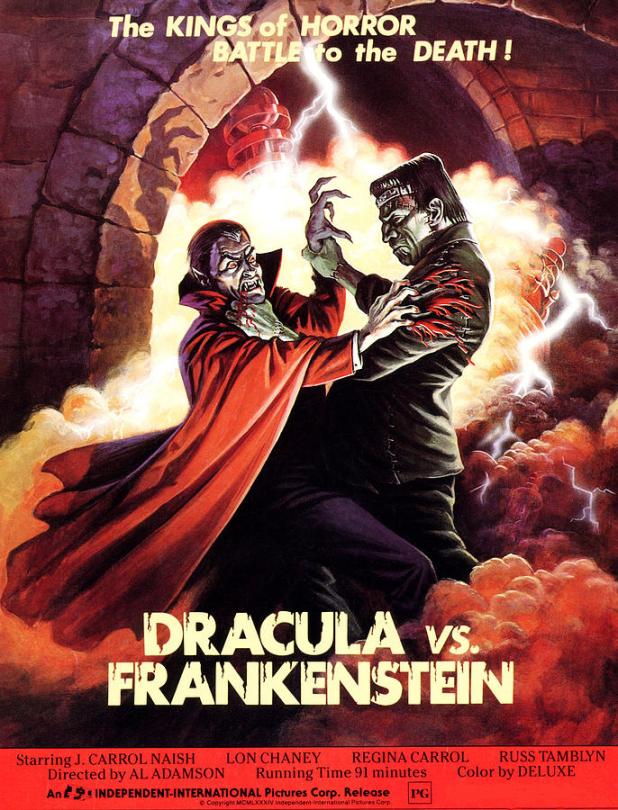
Dracula vs. Frankenstein feels like the most Independent-International movie there is. I have no other way to explain why this movie seems like it came from another reality. It has Dr. Durea (J. Carrol Naish, in his last movie), the last descendent of Dr. Frankenstein, killing women with his assistant Groton (Lon Chaney Jr. in his next to last movie) to try to come up with an elixir that will fix his legs and his henchman’s simple brain. They’re visited by Dracula (Zandor Vorkov, really Raphael Peter Engel, given that name by Forrest J. Ackerman and someone who once ran record stores; according to this interview in Fangoria, he’s wearing a rental cape that was once used by Bela Lugosi) who wants them to finish their cocktail so that it can allow him to walk in the daytime which he feels will make him finally able to take over the world.
The doctor and his assistant decide to set up their lab — using the Kenneth Strickfaden equipment from the Universal films — in a haunted house known as the Creature Emporium. They keep killing women while Dracula is sent after the man who put the doctor in a wheelchair, Beaumont (Forrest J. Ackerman). A biker named Rico (Russ Tamblyn) gets involved and Dracula gets his blood hot over a showgirl by the name of Judith Fontaine (Regina Carroll).
I nearly forgot! Dracula also has the corpse of the Frankenstein Monster, which he took from Oakmoor Cemetery. he’s played by both John Bloom and Shelley Weiss. The goal is to also bring that creature back to life. Graydon Clark is in here as The Strange, a hippie leader, and of course the kids all drop acid.
Judith also learns that the doctor has kept her sister Joanie (Maria Lease) and her friend Samantha (Anne Morrell) nude and trapped between life and death. He’s using a special enzyme in their plasma that comes from the fear before death to create his magical elixir so that he can heal his leg, fix his quiet friend and help Dracula. His hypothesis is that if Judith watches Mike (Anthony Eisley), a hippie that has fallen for her and she for him, die that the enzyme in her blood will be strong enough to complete his work. He sends Grazbo the dwarf (Angelo Rossitto) and Groton after them, but the little guy falls through a trapdoor and onto an axe, Groton gets shot by the cops and he himself falls onto a guillotine which cuts his head off.
But oh Mike, you aren’t safe. Dracula attempts to take Judith and when our hero tries to save her, the vampire blasts him with his ring and turns him into ashes. Now, the fanged Frank Zappa lookalike tries to drink her blood in a desecrated church but the Frankenstein Monster falls in love too and fights Dracula. This sounds like the kind of story an elementary student would make up in class when they should be studying and that’s why I love it. Dracula rips off the creature’s arms and head but gets burned by the sunlight.
Lon Chaney Jr. was in bad shape during this, lying down between takes and not speaking as he barely could be heard. He would speak to Adamson’s father and say things like, “You and I are the only two left. They’re all gone. I want to die now. There’s nothing left for me; I just want to die.”
What makes me love this even more is the theory that this was a sequel to Satan’s Sadists with Russ Tamblyn and the other bikers from that film coming back. Sam Sherman decided to turn it into a horror film and much of the biker footage was cut as a result. Not all of the biker footage could be cut, which is why Tamblyn and his biker gang wander in and out of the movie.
This movie has one of my favorite lines of all time, as Dracula has hypnotized Forrest and is taking him to his doom. He gives him directions as he speaks and I wonder, why doesn’t he just have him drive as he’s already taken over his will? He says, “I am known as the Count of Darkness, the Lord of the Manor of Carpathia. Turn here.”
In 1971, drive-ins across America and the maniacs inside the cars wanted more of the Blood Island movies. But hey — the guys behind them were busy, so Hemisphere said, “What if Al Adamson made a Blood Island ripoff outside of the Philippines?”
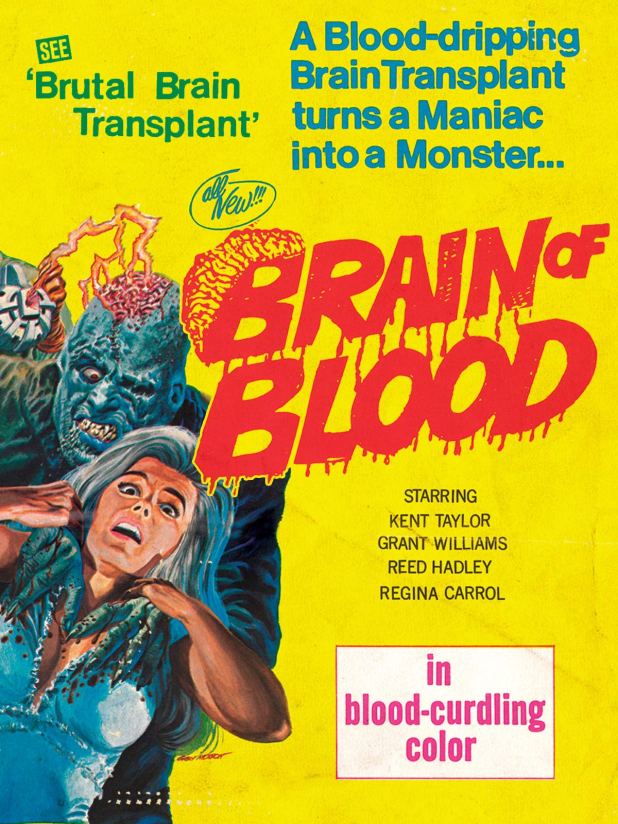
Brain of Blood is the result. The gory, ridiculous and totally awesome result.
Amir (Reed Hadley, one of the actors who played Red Ryder and also someone who narrated Department of Defense films during World War II) is the ruler of Kalid and is dying, but a scientist named Dr. Trenton (Kent Taylor, who shows up in all the Blood Island series) has different plans, thanks to the requisite dwarves and chained up women. Can Amir’s pal Bob (Grant Williams, who starred in The Incredible Shrinking Man, in his last role) and his wife Tracey (Al Adamson’s wife Regina Carrol) save the day?
Angelo Rossitto plays the evil Dorro. This small-sized actor also shows up in Scared to Death, From A Whisper to a Scream, The Trip, Freaks, Galaxina and nearly seventy other films, including a turn as Master in Mad Max Beyond Thunderdome. He’s also on the cover of Tom Waits’ album “Swordfishtrombones.”
John Bloom also shows up, who you may remember as Reaper in The Hills Have Eyes II, as well as playing Frankenstein’s Monster in Adamson’s borderline insane Dracula vs. Frankenstein, the recipient of The Incredible 2-Headed Transplant, Big Foot in Angels’ Wild Women, The Dark in, well, The Dark and appearances in Bachelor Party, The Great Outdoors and Up Your Alley.
You can get the blu ray from Severin. There was also a Cinematic Titanic riffed version of this under the title The Oozing Skull. The title was changed as Sam Sherman was concerned that multiple versions of the film could create marketplace confusion.


 B&S About Movies
You must be logged in to post a comment.