CBS LATE MOVIE MONTH: Brotherhood of the Bell (1970)

EDITOR’S NOTE: The Brotherhood of the Bell was on the CBS Late Movie on August 11 and December 5, 1972 and November 27, 1973.

Director Paul Wendkos (The Mephisto Waltz) was nominated by the Directors Guild of America for “outstanding directorial achievement in television” because of this film. It was written by David Karp, who also wrote the original novel. It had been made once before as an episode of Studio One in 1958.

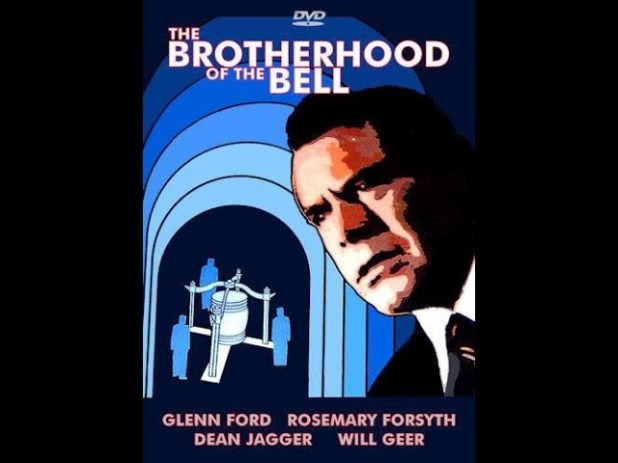
A world premiere CBS Thursday Night Movie on September 17, 1970, this arrived just as the seventies began, a decade packed with conspiracy. Professor Andrew Patterson (Glenn Ford) is back at the College of St. George in San Francisco to watch a young man be initiated into the secret society that he joined there, the Brotherhood of the Bell.

After the ritual, one of the leaders — Chad Harmon (Dean Jagger) — gives Patterson an assignment. Stop Dr. Konstantin Horvathy (Eduard Franz) from accepting a deanship at a college of linguistics so that a brother can take that position. Harmon is to blackmail Horvathy with the names of the people who helped him defect. Patterson wonders if this is legal. He’s told that he should be happy this is all they’re asking of him.

The professor does what he is supposed to do and it causes Horvathy to kill himself. Patterson then does exactly what no brother should do and reveals the truth to his wife Vivian (Rosemary Forsyth) and his father-in-law Harry Masters (Maurice Evans). This causes the Federal Security Services (as conspiracy-filled as this movie is, it doesn’t name the FBI; the agent is played by Dabney Coleman) to get involved and his father-in-law to turn him into the Brotherhood and Patterson’s father Mike (Will Geer) gets ruined in the process, then has a stroke and dies. Patterson also loses his job, gets humiliated on a talk show by Bart Harris (William Conrad) and is at rock bottom when his former boss Dr. Jerry Fielder (William Smithers) and the man he saw initiated Philip Dunning (Robert Pine) both stand up for him.

Obviously, the makers of The Skulls watched this movie.

You can watch this on YouTube.

The Sizzlin’ Something Weird Summer Challenge 2024: The Amazing Transplant (1970)

Doris Wishman week (July 21 – 27) Doris made the loopiest of movies. A self-proclaimed prude who made nudist camp movies, her filmography is filled with contradictions. When she tried to be mean spirited with something like Bad Girls Go To Hell there was always an undercurrent of silliness and fun, but when she tried to be silly and fun in things like Keyholes Are For Peeping there was an underlying seediness and grime that couldn’t be wiped off. It’s hard not to love her!  

I’ve seen some strange movies, but Doris Wishman’s films often feel like they belong to my favorite genre: movies made by beings not from our reality, beamed to us in the hopes that we won’t notice that there isn’t a single moment of normal human behavior in what they have created.

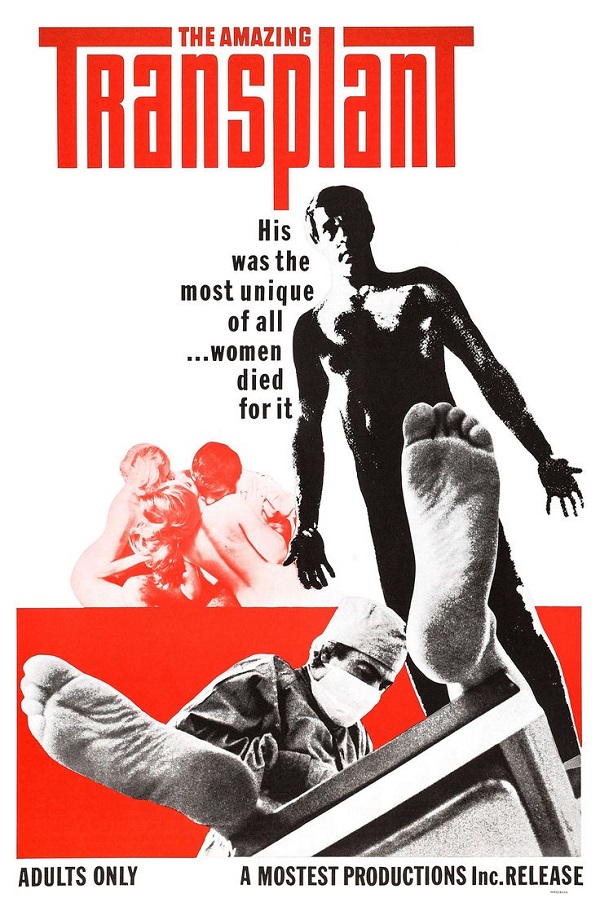
Arthur Barlen (João Fernandes) starts the movie by visiting his ex-girlfriend Mary (Sandy Eden) to propose to her. As she happily celebrates, he catches a vision of her earrings, loses his mind and chokes the life out of her in a way that only appears in roughies. The police are chasing him for the murder, while his mother Ann (Linda Southern, The Headless Eyes, A Night to Dismember) asks her police detective brother-in-law Bill (Larry Hunter) to find her son.

Let me see if I can explain why this happens, if I can do the narrative of this movie justice. Dr. Cyril Meade (Bernard Marcel) treated Arthur because the young man was upset about being a virgin. Dr. Cyril also had an assistant, Felix (Sam Stewart). He loved Felix to the point that he glows when he talks about him. He also introduced Arthur to Felix, who tried to set him up on a double date and ended up having sex with both women (Linda Boyce, The Curse of Her Flesh, and Uta Erickson, The Ultimate Degenerate) at the same time while Arthur helplessly watched. Yet Arthur also loved Felix and once he realized that his friend was dying, he was surprised that Felix wanted to live on, giving Arthur his gigantic penis to replace his micro cock. However, once the surgery — which trust me, if it was a real surgery it would happen every day — is complete, the sight of golden earrings makes Arthur insane with lust and anger.

If that isn’t strange enough, keep in mind that every environment has just a touch of strangeness happen. When we first see Mary, she’s naked and playing a zither, a stringed instrument that looks kind of like a miniature harp. Some of the apartments have paintings that look cursed, another has a moose head, yet another has a gigantic saddle, which causes Bill to ask the owner of the place, “Do you ride horses?” and she nonchalantly says, “It came with the apartment.” An entire wall of riding equipment, like how Ponderosa used to have that crap up on the wall, and she didn’t take it down or redecorate?

Speaking of Bill, he’s just as creepy as his nephew, often eyeing women as they cross and uncross their thighs while telling him of the horrifying assault they have endured at the hands and transplanted wang of his brother’s son.

You know, Wishman also made Let Me Die A Woman and you’d expect this movie to have a gory trouser snake transplant moment, but no. It’s like a lone moment of self-restraint in a movie that starts with black and white images of its protagonist attacking women and has a scene where he attacks a lesbian, causing her to throw up all over the place.

Speaking of that young lady with the saddle on her wall, that’s Ms. Evans. She’s played by Kim Pope, who appeared in many of the Golden Age of adult films like The Passions of CarolWhite Slavery In New York and Deep Sleep, which was the first movie of Alfred Sole. Janet Banzet plays another victim, one who comes on to Arthur in the stairwell before he notices those earrings. Always those earrings. She was also in The Party at Kitty and Stud’s, the movie that started the urban legend of Stallone being in a hardcore movie. Suzzan Landau (Keyholes Are for Peeping) also shows up.

Is this kind of a giallo? Is it a remake of The Hands of Orlac that could only be named The Cock of Orlac? Why is there happy jazz playing over the sexual assaults? How bad can the dubbing get? Why is every home in this movie festooned with bric a brac? Why are there ransom shots of shoes and carpet? Why does a child choir sing along when one of the victims turns Arthur’s attack into lovemaking? How did raincoaters feel when they thought they were getting something to jack off to and were confronted by this blast of dada?

Stranger still, star João Fernandes started his career shooting second unit and acting in adult films — he was given the name Harry Flex by director Gerard Damiano during as he used an Arriflex camera — before being the cinematographer or director of photography of Legacy of SatanDarktown StruttersThe Kirlian WitnessHuman ExperimentsThe ProwlerThe NestingChildren of the CornFriday the 13th: The Final ChapterHollywood Vice Squad and Red Scorpion, In the 1990s, he shot eight episodes and directed three episodes of Walker, Texas Ranger. That may be because after working on Joe Zito’s Norris movies Missing In Action and Invasion U.S.A., he also shot Chuck’s movies Braddock: Missing in Action IIIDelta Force 2: The Colombian ConnectionThe HitmanSidekicksHellboundTop Dog and Forest Warrior.

I have seen so many weird movies. This has moved way to the top of the list of the oddest.

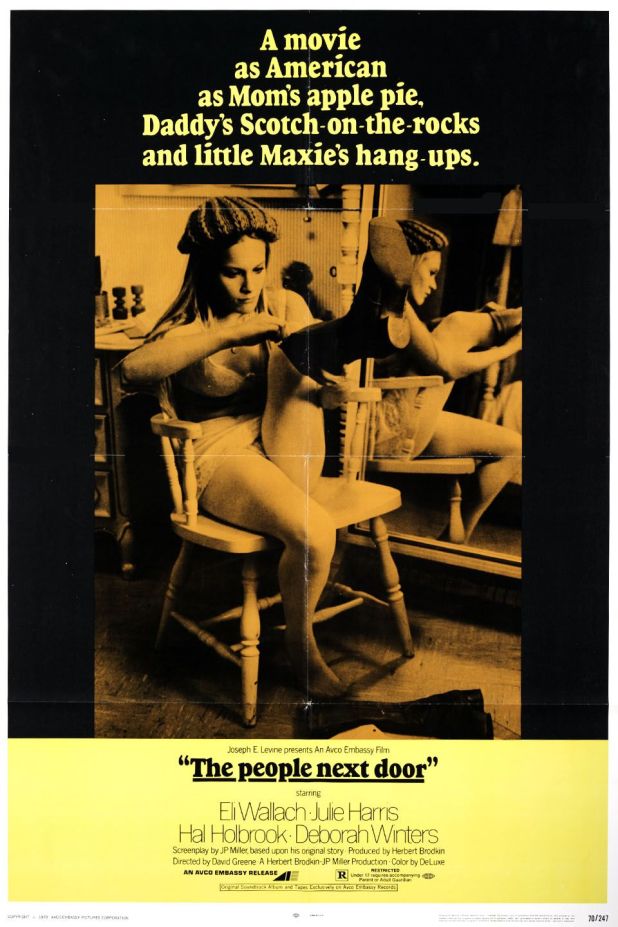
CBS LATE MOVIE MONTH: The People Next Door (1970)

EDITOR’S NOTE: The People Next Door was on the CBS Late Movie on December 28, 1976.

David Greene was behind a lot of my favorite TV movies, like RootsRich ManPoor Man; Madame Sin and the remake of Whatever Happened to Baby Jane? He also made I Start Counting and The Shuttered Room.

Arthur and Gerrie Mason (Eli Wallach and Julie Harris) realize that their marriage isn’t perfect and struggle to fix it as their daughter Maxie fights drug addiction. Arthur catches her in bed with a biker, high on cocaine, and immediately believes that his rock star son Artie (Stephen McHattie) who gave her the drugs, but it turns out that its the nerd next door.

Roger Ebert said that The People Next Door was “the best movie so far about parents, kids and drugs, and probably the best we’re likely to get (considering Hollywood’s recent tendency to exploit the drug culture for “youth movies”).”

This has a decent cast, with Hal Holbrook, Cloris Leachman and Rue McClanahan all showing up, along with Rutanya Alda as a nurse.

It didn’t make me want to stop doing drugs, but your viewing may change your habits.

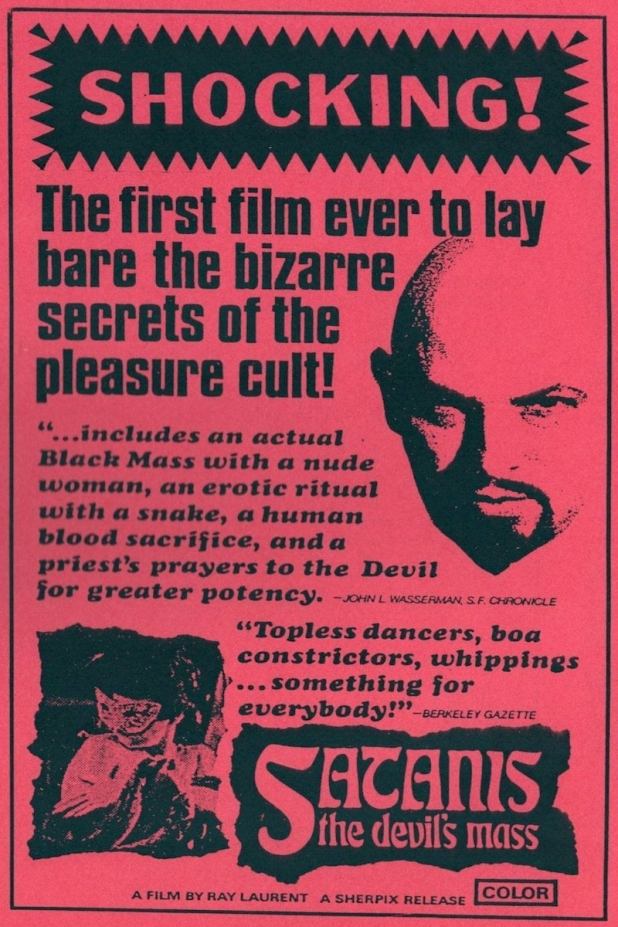
The Sizzlin’ Something Weird Summer Challenge 2024: Satanis: The Devil’s Mass (1970)

This 1970 documentary about Anton LaVey and the Church of Satan that was directed and produced by Ray Laurent, whose only other credits involve editing some films, including one of the Lemon Grove Kids films that Ray Dennis Steckler directed. Within this movie, there’s plenty of ritual footage, as well as interviews with LaVey, his family, church members and then his somewhat annoying neighbors and some priests and Mormon missionaries.

It’s really interesting to see how the people living next to LaVey saw things, less concerned about the people coming in and out than the upkeep and shingles of the Black House. This is a rare opportunity to see actual rituals of the early Church and hear from its members.

Also, the Church is very ahead of the cultural mores of the time — and even today — commenting on how they don’t tolerate homosexuality in the Church of Satan. Instead, they go further: “To tolerate is to infer they are different or less than, we just accept them as normal people because that’s exactly what they are.” Keep in mind this was made in 1970.

“Well, I had a man come to me the other day and he said that it was just terrible, when he joined the Satanic Church, he was masturbating just about every day, and now he’s masturbating two, and sometimes three, times a day, and he’s very happy, much happier than he’s ever been before.” – Anton Lavey

Director Ray Laurent also edited  The Lemon Grove Kids Meet the Monsters and Body Fever and was the editorial consultant on Sappho Darling.

This had an X rating, probably for the nudity in the Black Mass scene.

CBS LATE MOVIE MONTH: Zabriskie Point (1970)

EDITOR’S NOTE: Zabriskie Point was on the CBS Late Movie on August 5, 1977.

Another movie that I only knew as bad because that’s what the Medveds said, it took me nearly forty years from when I first read their books to finally watch this. In The Fifty Worst Films of All Time. they wrote that it was “the worst film ever made by a director of genius.” As always, they were wrong.

Michelangelo Antonioni was known at the time for a trilogy of films — L’Avventura, La Notte and L’Eclisse — as well as Blowup and The Passenger. In 1994, he was given an Honorary Academy Award “in recognition of his place as one of cinema’s master visual stylists” presented by Jack Nicholson.

Zabriskie Point was savaged by critics and performed poorly yet has been re-evaluated today. Antonioni was inspired by an article he read about a young man who stole an aircraft and was killed when he tried to return it. He wrote the first draft and then had Sam Shepard, Franco Rossetti, frequent collaborator Tonino Guerra and Clare Peploe all write drafts. Stars Mark Frechette and Daria Halprin were hired because of an argument Frechette had in a bus station and Halprin’s appearance in the documentary Revolution. Neither had been screen tested.

The film was controversial before it was even shot. Rumors were out that Antonioni would gather 10,000 extras in the desert for a real orgy; instead the scene is highly choreographed with actors from The Open Theatre. Believing this, the United States Department of Justice investigated whether this violated the Mann Act, which forbids taking women across state lines for sexual purposes. No sex was ever filmed and the production was always in one state, California. However, police in Sacramento were waiting to arrest the director and the FBI and Oakland police also were sure that he staged a riot and wanted to arrest him for that.

The only movie that Antonioni made in the U.S., it was seen as “a noble artistic impulse short-circuited in a foreign land” by Vincent Canby, David Fricke wrote that it was “was one of the most extraordinary disasters in modern cinematic history” and Roger Ebert said of the protagonists, “Their voices are empty; they have no resonance as human beings. They don’t play to each other, but to vague narcissistic conceptions of themselves. They wouldn’t even meet were it not for a preposterous Hollywood coincidence.”

During a college strike, Mark leaves, claiming that he is “willing to die, but not of boredom.” As he’s arrested outside, real estate salesman Lee Allen (Rod Taylor) is working on ads for his new Sunny Dunes resort, which will be sold with mannequins instead of humans. Mark gets out of jail and watches a police officer die in another riot — Harrison Ford is briefly in one of these scenes — and runs to an airport where he steals a plane and flies away.

Daria is driving through the desert in a big Buick to meet Lee, who may be her boss or lover. She meets Mark first as he buzzes her car. They walk to Zabriskie Point and make love, along with thousands of others. She begs him not to fly back to L.A., but he does and is killed. She makes it to Lee’s new Sunny Dunes home and she’s not the same person she used to be. Leaving, she imagines that the mansion — which was recreated on a soundstage; Antonioni was amazed by how wasteful American moviemaking was compared to Italy — blows up.

The soundtrack was filled with music of the time, unlike many movies, with songs from Pink Floyd, The Youngbloods, Kaleidoscope, Jerry Garcia, Patti Page, Grateful Dead, the Rolling Stones, John Fahey and a love theme — “So Young” — by Roy Orbison. There was so much music that some never ended up in the movie. Richard Wright of Pink Floyd wrote a song called “The Violent Sequence” for the end of the movie, but Antonioni used a re-recording of the band’s “Careful with That Axe, Eugene”, retitled “Come in Number 51, Your Time Is Up.” Roger Waters said that the suggested song was “too sad” and sounded like church. It was revised by the band and became “Us and Them” on Dark Side of the Moon. Antonioni also visited The Doors while they were recording Morrison Hotel and while the recorded the song “L’America” for this, it went unused.

Frechette lived and died much like his character. He and Halprin also became romantically involved during the film’s long shooting schedule with Mark’s wife consent. After his divorce, Daria didn’t want to live in a commune like Mark so they also broke up. When they were on The Dick Cavett Show, Cavett said that he hadn’t seen the movie. Frechette replied, “Save your money.” Cavett laughed and said, “Well that’s the first time an actor has been on this show to unplug his movie.”

Three years after this movie played theaters, he was imprisoned for his part in a bank robbery in Boston. Two years later, he died in prison when a weightlifting barbell fell on his neck. It’s thought that he was one of several victims of sexual abuse by Rev. Laurence Francis Xavier Brett of the Roman Catholic Diocese of Bridgeport in Connecticut. What a wild life, as he was trying to raise money to make a movie and some think that’s why he was involved in the bank robbery.

Antonioni’s original ending was a shot of an airplane skywriting the phrase “Fuck You, America.” Obviously, that was cut. But this was the first studio film to have the word motherfucker in it.

CBS LATE MOVIE MONTH: Taste the Blood of Dracula (1970)

EDITOR’S NOTE: Taste the Blood of Dracula was on the CBS Late Movie on September 11, 1981.

The fifth Hammer Dracula, this played double features with Crescendo in the UK and Trog in the U.S.*, where it was the top movie of November 1970. It was released the same year as Scars of Dracula.

A man named Weller (Roy Kinnear) watches Dracula die, impaled by a crucifix — so this is an actual direct sequel to Dracula Has Risen from the Grave and not just another story — and takes the vampire’s ring, a cape and cape.

There’s also three businessmen — William Hargood (Geoffrey Keen), Samuel Paxton (Peter Sallis) and Jonathon Secker (John Carson) — who pretend to have a charity yet really just go to brothels. Good work if you can get it. They meet Lord Courtley (Ralph Bates), a man kicked out of his family for celebrating a Black Mass. He tells the three if they really want an experience, they should buy Dracula’s garments from Weller and bring them to him. He mixes their blood in a big glass and asks them to drink. They refuse, he drinks and loses his mind, leading the three to beat him to death. His body then transforms into Dracula (Christopher Lee) who wants revenge for death of his servant.

Dracula then convinces an abused girl named Alice Hargood (Linda Hayden) to kill her father and lure her friends like Lucy Paxton (Isla Blair) to him. It just happens to be no coincidence that she’s engaged to one of the three men’s sons. He also turns that man, Jeremy (Martin Jarvis), into a servant and destroys Lucy.

It takes reconsecrating the church to defeat Dracula, who becomes dust again. Is it too simple to say it? Dust to dust.

Taste the Blood of Dracula would have had Lord Courtley replace Dracula and become a vampire on his own. Warner Brothers refused to release the film without Christopher Lee and that’s how he came back again. That said — this was one of four movies where Lee played Dracula in 1970. The others? Count Dracula, One More Time and Scars of Dracula.

Directed by Peter Sasdy (I Don’t Want to Be Born) and written by Anthony Hinds, this is a rare R-rated Hammer film.

*Trog also played with Dracula A.D. 1972.

CBS LATE MOVIE MONTH: Count Yorga, Vampire (1970)

EDITOR’S NOTE: Count Yorga was on the CBS Late Movie on August 16, 1974 and August 14, 1975.

Directed and written by Bob Kelljan, Count Yorga, Vampire was originally going to be soft core porn movie, The Loves of Count Iorga. In fact, some prints have that title. Robert Quarry, the man who would be Yorga, told producer Michael Macready that he would play the vampire if they turned the story into a non-sexual horror movie.

Donna (Donna Anders) is trying to contact her recently deceased mother via séance by Count Yorga, a mystic who has recently moved to America. Donna becomes hysterical and needs to be calmed by Yorga; afterward she reveals to her friends that Yorga was her mother’s last over and when she died, he demanded that she be buried and not cremated.

Yorga then conducts a campaign of terror, biting Erica (Judy Lang), who goes from party girl to vampire eating her own kitten — don’t worry, it’s just a kitten covered in lasagna — in a matter of hours. Oh yeah — Donna’s mom (Marsha Jordan) is now one of Yorga’s brides and it’s the swinging seventies, so he commands her to make love to one of his other undead women on a cold cemetery slab.

By the end of the film, Yorga and his brides have wiped out just about every one of Donna’s friends and strengthened his hold over her, which extends potentially beyond the grave. Again, it’s the seventies and life is cruel and cheap and happy endings aren’t often found after the New Hollywood. The count is also self aware and watches Countess Dracula.

CBS LATE MOVIE MONTH: RPM (1970)

EDITOR’S NOTE: RPM was on the CBS Late Movie on October 25, 1973 and April 20 and August 31, 1976.

Stanley Kramer called his movies heavy dramas but they’re what are often called message films. A liberal, he brought issues to the public eye through his movies like the dangers of nuclear war (On the Beach), fascism (Judgement at Nuremberg, Ship of Fools), creationism against evolutionism (Inherit the Wind), greed (It’s a Mad, Mad, Mad, Mad World) and racism (The Defiant OnesGuess Who’s Coming to Dinner).

While Pauline Kael saw his movies as “melodramas,” and “irritatingly self-righteous,” she also had to realize that they had “redeeming social importance.”

But in 1970, maybe he was past his expiration date.

Did he feel like Professor F.W.J. “Paco” Perez (Anthony Quinn) does in this movie? For years, Paco has been the radical, the one that stood outside the mainstream. He says at one point that he fought Franco and McCarthy and has learned so much, but the young people don’t want to learn anything. Did Kramer feel that way, an old man in the New Hollywood that was so much more in touch with the youth?

Is Paco just a fifty-year-old fanny chaser, as out of touch with the time as the administration he’s been asked to be a part of?

Radical student activists — Paco is impressed that the blacks and whites have worked together — occupy the administration building with a list of 12 demands. President Tyler (John Zaremba, who spent the 70s and 80s wandering the Earth searching for the best beans for Hills Brothers Cofee) resigns and the Board of Trustees looks at the list that the students have written up of the presidents they would be happy with.

Top on the list? Paco.

It’s after midnight and he’s asleep with his grad student girlfriend Rhoda (Ann-Margret). Yet he’s urged to rush out and fix things. The next day, he starts his new job, showing up on a motorcycle.

Paco reads their demands and many of them, like inner-city scholarships, a college reinvestment program, no military research on campus and adding an African American to the all-white Board of Trustees make sense. But the idea that students can hire and fire faculty doesn’t work for him. He’s already reached the first time where his theory and reality begin to not work together.

With Rossiter (Gary Lockwood) and Steve Dempsey (Paul Dempsey) leading the students, Paco tries to be the person between them and the Board of Trustees. But when Rossiter says that he will destroy all of the campus’ computers, Paco has to make the tough decision to call in the police. They come charging in with tear gas, turning their hero professor into just one of the old people never to be trusted. When the cops round up the students, Rhoda is one of them.

What they don’t know is that Paco has signed off on their bail. Yet he still walks past the crowd and is screamed and booed at. He has learned the hard way that the lessons of books and classrooms often mean little in the real world.

I really liked the songs by Melaine, “We Don’t Know Where We’re Goin’” and “Stop! I Don’t Wanna Hear It Any More,” that were in this. It’s quite preachy, but it also feels like this movie was Kramer attempting to determine where he fit in any longer. Then again, Kramer would say that this was his least favorite film that made the lowest amount of money. The dialogue may get silly sometimes, but that’s because it’s written by Erich Segal, who also did Love Story.

After this movie, however, I understand why my dad and other older male relatives would say Ann-Margaret’s name with the reverence they otherwise reserved for the saints.

You can watch this on Tubi.

Junesploitation: Lola (1970)

June 21: Junesploitation’s topic of the day — as suggested by F This Movie— is AIP! We’re excited to tackle a different genre every day, so check back and see what’s next.

Also released as Twinky and London AffairLola has the kind of story that only a movie made in 1970 could have.

Scott Wardman (Charles Bronson) falls in love — or something — with Sybil Londonderry (Susan George), who also goes by Twinky and Lola. The problem is that he’s 38 and she’s 16. He seemingly knows the age of consent and any guy that can instantly tell you that is a creep.

Then Scott gets busted for being married to a child and forced to leave England. He says, “I make one uncool move with a nutty 16-year-old kid, and suddenly my whole world is turned upside down.” Now this pornographic author has to go back to the United States.

If you think this couldn’t happen, well…

Norman Thaddeus Vane wrote this and its based on his own married to 16 year-old model Sarah Caldwell, who he married when he was also 38. In an interview with the astounding Hidden Films, the writer — and later director — would claim, “There was a reason I wound up marrying Sarah Caldwell (who was 16 at the time and later cast in Mrs. Brown, You’ve Got a Lovely Daughter which Vane scripted; Vane later based the script for Lola on this scandalous marriage). I was a good-looking kid on King’s Road in Chelsea, I had a sports car, I had money, I had a beautiful flat.”

Vane also pretty much explains the plot of this film in that interview: “I met her at a party. She was stunningly beautiful. I had a small flat on King’s Road in Chelsea, and she used to come over secretly on the way back from school, and we used to fuck. And she told her parents that she was seeing me — I was probably about 38 or something—and they were angry. Her father was head of the East India Trading Company. The only way we could see each other was if we got married, and in Scotland, you could get married at 16. So we eloped there. I had been sleeping with a Scottish girl from Glasgow. You had to spend three days in residence in Scotland before you got married, so I asked her if we could use her family’s address and she said yes. Sarah called her parents and said “I’m very sorry to tell you this, but I got married today!” The newspapers wrote columns about her, it was like a front page story, for months afterwards. They called me “The Cad of the Year.””

This entire interview is wild and I urge you to read it, as he claims that director Richard Donner immediately slept with Susan George, that the movie was financed by an Italian baron and Bronson superfan who later committed suicide over Britt Ekland, that Bronson’s wife Jill Ireland wanted to play the teenage girl and that Bronson couldn’t be controlled by Donner and he ruined the movie.

Lola is fascinating because why would Scott and Lola ever get together — well, sex — or stay together? There’s nothing that suggests that they have a single thing in common other than her schoolgirl crush on him and well, yeah, she’s Susan George in 1970, I get that. Yet Bronson comes off as, well, Charles Bronson, a man who speaks little and is quick to violence. Maybe that’s how I see him as I’ve watched so many of his action movies, but when you see the posters and VHS covers for this, you’ll see that I wasn’t the only one who saw Bronson just as a force of violent nature.

Lola ends up getting an apartment for the couple while Scott is in jail over a misunderstanding, then she doesn’t realize that he has a job as a writer and needs to be left alone while he’s working. As a jerk of a writer myself, I get it. She also acts like a kid because she is one. Finally, after running away and coming back, she goes back to England for good.

This is not the last movie that Vane would make that references his life. The Black Room is about how he cheated on his wife in his own black room with Penthouse centerfolds that he met while working at that publication. It remains to be discovered if any of those women were vampires. Vane also made the absolutely baffling Club Life, a movie that I want everyone to watch.

I wonder if Susan George met with her agent and said, “Can I do something not so scuzzy for my next movie, like sleep with a guy twice my age?” And the agent said, “Susan baby, have I got a movie for you. It’s classy. It’s called Straw Dogs.”

You can watch this on Tubi.

SUPPORTER WEEK: Brotherhood of the Bell (1970)

EDITOR’S NOTE: Today’s movie is brought to you by Jason, who made a one-time donation and told me to pick any 70’s TV I wanted. So how about an entire week?

Would you like to have me write about the movies of your choice? It’s simple!

  1. Go to our Ko-Fi site and donate. There’s no set amount and I won’t tell you what to do. In fact, if you just keep reading for free, we can still be friends.
  2. Join as a monthly member for just $1. That makes you a Little B&S’er.
  3. As a Medium B&S’er at just $3 a month, if you pick a movie or a director, I’ll write about them for you. In fact, I’ll do one for each month you subscribe and even dedicate the post to you.
  4. For $5 a month, you basically get some major power. As a Big B&S’er, I’ll write an entire week on any subject you’d like. How awesome would that be? In fact, I’ll do it for every month you’re a member. Do you think any of your other movie sites will do that for you?

Director Paul Wendkos (The Mephisto Waltz) was nominated by the Directors Guild of America for “outstanding directorial achievement in television” because of this film. It was written by David Karp, who also wrote the original novel. It had been made once before as an episode of Studio One in 1958.

A world premiere CBS Thursday Night Movie on September 17, 1970, this arrived just as the seventies began, a decade packed with conspiracy. Professor Andrew Patterson (Glenn Ford) is back at the College of St. George in San Francisco to watch a young man be initiated into the secret society that he joined there, the Brotherhood of the Bell.

After the ritual, one of the leaders — Chad Harmon (Dean Jagger) — gives Patterson an assignment. Stop Dr. Konstantin Horvathy (Eduard Franz) from accepting a deanship at a college of linguistics so that a brother can take that position. Harmon is to blackmail Horvathy with the names of the people who helped him defect. Patterson wonders if this is legal. He’s told that he should be happy this is all they’re asking of him.

The professor does what he is supposed to do and it caused Horvathy to kill himself. Patterson then does exactly what no brother should do and reveals the truth to his wife Vivian (Rosemary Forsyth) and his father-in-law Harry Masters (Maurice Evans). This causes the Federal Security Services (as conspiracy-filled as this movie is, it doesn’t named the FBI; the agent is played by Dabney Coleman) to get involves and his father-in-law to turn him into the Brotherhood and Patterson’s father Mike (Will Geer) gets ruined in the process, then has a stroke and dies. Patterson also loses his job, gets humiliated on a talk show by Bart Harris (William Conrad) and is at rock bottom when his former boss Dr. Jerry Fielder (William Smithers) and the man he saw initiated Philip Dunning (Robert Pine) both stand up for him.

Obviously, the makers of The Skulls watched this movie.

You can watch this on YouTube.