BAVA WEEK: Five Dolls for an August Moon (1970)

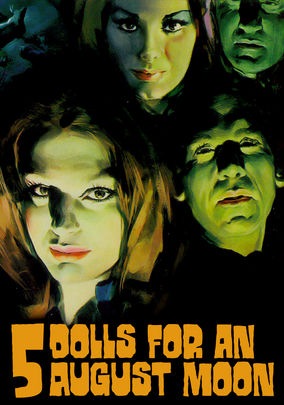
Bava believed this was one of his worst films. It wasn’t released in the U.S. until 2001. And yet, I found plenty to like about this murder-filled affair. It also taught me an important lesson: if you invent a new chemical process, don’t go to a rich industrialist’s vacation island.

George Stark is one of those industrialists and he’s invited a bunch of guests to his private island, including Professor Farrell, who has created an industrial resin. Several of the guests want him to sell it. Here’s where the hijinks ensue.

Stark’s wife Jill is sleeping with Farrell’s wife, Trudy (Ira von Fürstenberg, The Fifth Cord). Stark’s partner Nick treats his wife, Marie (Edwige Fenech!) horribly, but allows her to sleep with Charles, one of the servants. Isabelle (Ely Galleani, A Lizard in a Woman’s Skin) is a teenage girl along for the ride. And Jack and Peggy just seem to get along, unlike everyone else.

The men beg Farrell for his formula, sending away the only way off the island — a motorboat — away until the deal is done. So when Charles is killed, they simply hang him in the freezer until they can get the radio working to call the mainland. As you do.

Then, teenage Isabelle kills Farrell, but the others only know he’s dead. The killings now pick up, with Peggy being shot to death, Marie being stabbed and Jill being electrocuted in the bathtub. One by one, their bodies are added to the freezer.

With Isabelle having gone missing, Stark, Jack, Nick, and Trudy decide to stay in the same room for the night, as one of them has to be the murderer. Nick takes off after an argument and is found dead the next day, so of course, as is custom, he is also added to the freezer.

Stark has a boat, which makes you think he’d be the suspect. But as he comes back to the house, Jack reveals that he has killed everyone else to steal their checks. He kills Stark and meets with Trudy, who was the real boss. She’s got the resin formula. He has the checks. But they’re both out for themselves and end up killing one another. Isabelle makes herself known and takes everything.

That’s not the whole story. Isabelle also shows up to see Farrell in prison. He didn’t die, but had come up with the whole scheme with Trudy. Turns out he wasn’t the good man that he appeared to be and had stolen the formula. He got Isabelle to be part of his plan, but she gave him a drug that would make him appear to be dead, then pushed him out to the sea. Rescuers found him and he was so messed up on the drug that he confessed. She laughs about the whole thing and leaves the prison, finding it all rather funny that he’ll be hung in the morning while she’ll enjoy three million dollars.

There are better Bava films to be found, but there are plenty of twists and turns in this film. It’s certainly entertaining and you know, Edwige Fenech is in it. So there are way worse movies to spend your time with.

Just remember. If you come up with a great formula or steal one, just keep it to yourself. And don’t go on vacation. Stay at work.

UPDATE: You can watch this for free on Amazon Prime.
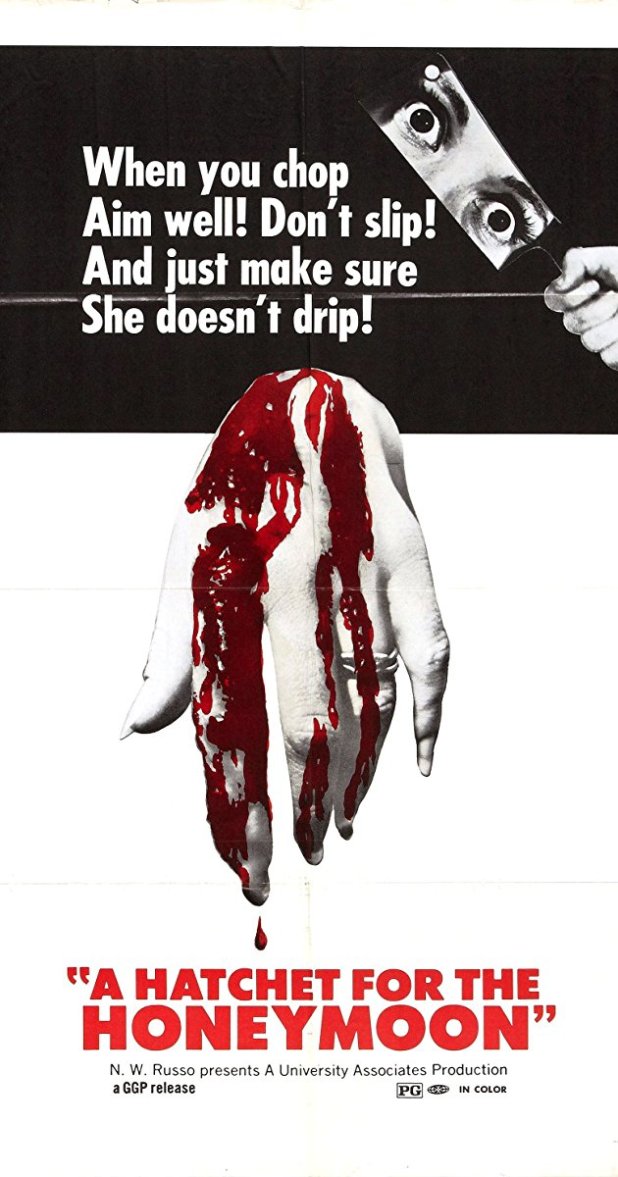
BAVA WEEK: Hatchet for the Honeymoon (1970)

Do you need to love, trust and care about the hero of the movie? Mario Bava is here with Hatchet for the Honeymoon in an attempt to craft a story where the hero is the absolute worst person in the entire film.

Meet John Harrington. He’s 30, runs a bridal dress factory, lives in a gorgeous villa near Paris and kills young women to overcome his impotence and Oedipus complex. His wife, Mildred, refuses to divorce him. And he’s instantly smitten with Helen (Dagmar Lassander, Forbidden Photos of a Lady Above Suspicion, The House by the Cemetery), a young model who has come to replace a missing girl.

Why is she missing? She was one of the models at the salon who John took a liking to, giving her one of his dresses for her wedding. The moment she tried it on, he hacked her up with a meat cleaver, burned her corpse and used it to fertilize the plants in his greenhouse.

Inspector Russell knows that something isn’t quite right. After all, how can six models disappear from the same dress company? If only there was some evidence…

John, however, is falling in love with Helen. And he finally decides to do something about his wife. That something entails him putting on a wedding dress and killing her. But there’s one problem. Here’s where Bava twists the film from giallo into supernatural territory: she won’t stay dead.

While John can’t see or hear his wife, everyone else can. Even after burning her remains and placing them in a handbag, she keeps coming back. He takes the handbag with him to a club, where an attempt to bring another woman home fails when she sees his wife. Beaten by a bouncer and ejected, he cannot even use his charms to win over women. He throws his wife’s ashes into the night, but she remains with him

If John can’t be happy, at least he can murder Helen. He convinces her to wear a wedding dress and tells her that he never wanted to hurt her. She avoids the final blow of his cleaver, which unlocks a flashback where we learned the truth: John loved his mother and that love grew as he became the man of the house after his father’s death. But when she remarried — and started having sex again — he couldn’t take it and murdered her and her new husband. His mind erased the evidence until now.

Helen was an undercover cop all along, leading Inspector Russell and his men back to arrest John. While being transported to prison, he’s happy knowing that his many trials are over. Then, to his horror, he sees the handbag and notices his wife sitting next to him. Now, he’s the only person who can see her. She promised to be with him forever, even in Hell. He goes insane before accepting his fate.

Hatchet for the Honeymoon predates the slasher, yet many of its conventions can be found here and in other early Bava works. This film is a masterwork of both style and substance, with gorgeous fashion, sets and camerawork creating a gorgeous tableau. I love the scene where John uses Bava’s Black Sunday, playing on the TV, as an excuse for the screams that come from his apartment. And as his wife’s blood drips down onto the ground floor, it’s almost as if Bava dares you to empathize with a hero who is completely contemptible. What a predicament to be in!

FeedShark

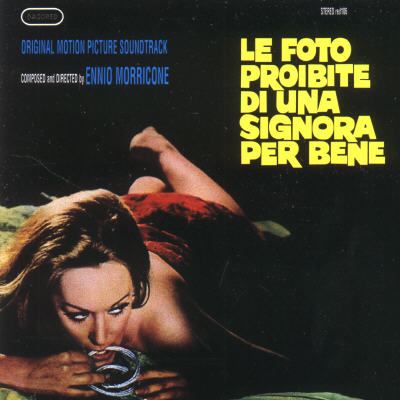
Forbidden Photos of a Lady Above Suspicion (1970)

Minou (Dagmar Lassander, The House by the Cemetery) loves her husband, Peter. But Peter is cold and only really seems to care about work. All she does all day is pine for her husband and take care of a turtle. Yep. You just read that correctly.

One night, a mysterious stranger attacks her, cuts open her clothes and then warns her: her husband is a killer.

The mysterious man is proven correct when a man who owed Peter money shows up dead. He demands that she come to his home, where he blackmails her into sleeping with him. Seeing as how he has recorded their tryst, he now has more material on her.

Even her friend Dominique (Nieves Navarro, All the Colors of the Dark, who was married to the director, Luciano Ercoli) can’t be trusted, as Minou finds photos of the blackmailer in provocative poses in her possession. When she finally gets the police to investigate, the man’s home is empty and Dominique tells the police he never even existed. Oh yeah. Dominique was once Peter’s woman before Minou. So there’s that.

Minou has a nervous breakdown and overdoses on tranquilizers before sobering up and learning that it’s all been a plot against her from the beginning. But come on — if you’ve watched any giallo, you knew that going in.

Despite its lurid title, Forbidden Photos of a Woman Above Suspicion isn’t filled with sex or even all that much violence. It’s more about alcoholism and how women were taught that they had to have the skills to land a man, but not what to do with their lives to make them fulfilled beyond just a relationship.

Director Luciano Ercoli has some gorgeous shots in here that really take advantage of the space age 1960’s aesthetic. And a bossa nova score by Ennio Morricone keeps this film bouncing. It wouldn’t be the first giallo I’d recommend, but it’s not the last, either.

If you have Shudder — and you totally should — you can find this film right here.

FUCKED UP FUTURES: Gas-s-s-s (1970)

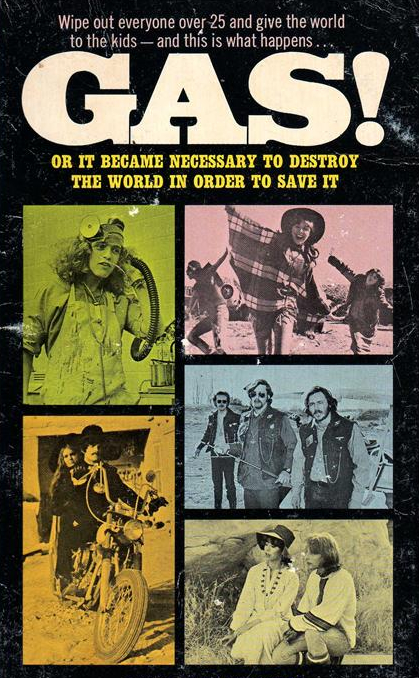
Gas! -Or- It Became Necessary to Destroy the World in Order to Save It would be the last movie that Roger Corman would direct for AIP. And it would be the last film he’d helm for nearly twenty years, too.  Why? Turns out Corman was unhappy to the cuts made to the film (AIP and Corman had a handshake agreement that he would have final cut). In particular, he was enraged that they’d removed what he saw as the end of the movie — a shot where God looked over 300 extras and commented on the action. The shot that he felt was one of the greatest he had made in his life ended up on the cutting room floor.

The film opens with an animated sequence where the end of the world is overseen by a John Wayne-sounding general. The army was in charge of a gas that killed everyone over the age of 25 and it is accidentally released.

Cut to Southern Methodist University, where the news is all over campus. Two hippies, Coel and Cilla, fall in love. As a Nazi-esque police force is running Dallas, they decide to run toward Mexico. On the way, they meet Marissa (Cindy Williams, Shirley from TV’s Laverne & Shirley, as well as The Conversation and American Graffiti), Carlos (Ben Vereen), Hooper (Bud Cort) and Coralee (Talia Shire, billed here as Talia Coppola).

What follows are some stream of consciousness adventures, like a concert at a drive-in where Country Joe and the Fish (Joe’s name here is AM Radio and he can speak with the voice of God, who sounds like an old Jewish man) play, a game of golf with some bikers and some sleeping around but it’s all cool because this is the future of the hippies and everyone is chill with one another.

Finally, they find a peaceful commune, but a football team attacks. God comes to help, everyone is reunited and then a big party happens where everyone gets along. Peace and love, peace and love.

Writer George Armitage had pitched Corman on a film called Carrot Butts, where cartoon characters came to life. They couldn’t get it produced but did get this one off the ground. He went on to write and direct several films, most famously Grosse Pointe BlankVigilante Force and Private Duty Nurses.

There’s even a tribute to Corman’s Edgar Allan Poe movies, as Poe appears riding a motorcycle.

It really shows that Corman was growing tired of the hippie rhetoric and ethos. In the book Roger Corman: Interviews (Conversations with Filmmakers Series), he said,  “I was beginning to get a little disillusioned. I intended that the picture be sympathetic toward our lead gang of kids yet, at the same time, I wanted to show that I was beginning to suspect that all of the ideas being spouted by the counter-culture and all of the dreams were not totally rooted in reality. In the picture, I wanted to literally give youth the world they desired and, then, make a cautionary statement about how youth might not be able to handle it as perfectly as they anticipated.”

This is a film of its time. It’s filled with long shots of riding dune buggies to folk music and lots of earnestness. If Idaho Transfer is the dismal end of idealism, this is its last gasp, struggling for a perfect world, even if the world has to die to get there.

Bizarre (1970)

What happens when you combine British portmanteau films, William S. Burroughs cut-up techniques, 1970’s philosophy, British men’s magazines like Mayfair and throw in a mummy? You get a sheer burst of pure insanity like Bizarre.

Also known as Secrets of Sex, the film starts with the story of a king who found his wife’s lover and trapped him in a chest. This theme of trapping lovers carries on throughout the film.

But never mind all that. Let’s meet our narrator — a mummy voiced by Valentine Dyall (The HauntingBedazzled and the voice of Count Karnstein in Lust for a Vampire). He’s here to tell us all about the battle of the sexes. Just listen to his words, as half-naked women and men fill the screen, one at a time: “Imagine you were making love to this girl. Imagine you were making love to this boy. Imagine you were making love to this girl. Imagine you were making love to this boy. Imagine you were making love to this girl. Imagine you were making love to this boy. Imagine you were making love to this girl. Imagine you were making love to this boy. Imagine you were making love to this girl. Imagine you were making love to this boy. Imagine you were making love to this girl. Imagine you were making love to this boy. Imagine you were making love to this girl. Imagine you were making love to this boy. Imagine this girl was making love to you. Imagine this boy was making love to you. Imagine this girl was making love to you. Imagine this boy was making love to you. Imagine this girl was making love to you. Imagine this boy was making love to you. Imagine this girl was making love to you. Imagine this boy was making love to you. Imagine this girl was making love to you. Imagine this boy was making love to you. Imagine this girl was making love to you. Imagine the consequences.”

We’re then on the front row of this battle, with women in underwear facing off with me grasping machine guns. The women have vegetables thrown at them as the men advance. One of the women, a blonde, stares down the men, who fall to her beauty before she removes a straight razor from between her legs.

Alright — let me be perfectly honest. Your ability to enjoy this film totally depends on the amount of drugs in your system, how late you’re watching it and your tolerance for 1970’s experimental filmmaking. If you’re been reading this site for any length of time, you know that this movie was pretty much made for me and sent forward 47 years into the future.

The vignettes that follow — two female photographers castrating a male model at breakfast, an old man that wants a son, a female burglar being caught by the owner of the house, a nerd trying to get Sue Bond (one of the longest running Benny Hill girls) to have a three-way with him and his lizard, the naked adventures of secret agent Lindy Leigh (a character actually from Mayfair Magazine), an old woman who has trapped men’s souls in flowers, an old man who wants a son from his young wife — don’t follow a true narrative structure all of the time. But that makes sense — one of the uncredited writers of the film, Brion Gysin, is credited with inventing the cut and paste technique, where random words are cut up and rearranged to create a new text. Sure, the Dadaists did this, too. But Burroughs always credits Gysin.

Finally, the armies amassed at the beginning have a big orgy (it’s mostly people rolling around on hay bales more than anything really all that pornographic).

Obviously, this movie was cut up — even after the cut-up technique — by censors. Nine minutes were taken from the UK cut and the re-edited U.S. version, Tales of the Bizarre, has seventeen minutes missing. It’s more bawdy than dirty, like the aforementioned Benny Hill with more bare breasts.

Bizarre was directed by Anthony Balch, a lifelong Bela Lugosi fan (he even met him during a 1950’s tour of the Dracula stage play) and distributor of European art films that he’s retitled with lurid aplomb, including 1971’s Satanic masterpiece of weird Don’t Deliver Us from Evil. He also created the sound version of 1922’s ode to witchcraft Häxan and directed Horror Hospital. By all accounts, Balch was an over the top burst of pure strange, walking all over the furniture and given to public outbursts. He even shows up in a cameo during the closing orgy.

I’m at a loss when it comes to describing this movie. It’s not sexy, in the way that what was once shocking now comes off as charmingly naive. It also wears its influences on its sleeve, displaying hip for 1970 books prominently on scenes, with the camera staring at the covers, as if to shout, “I read the books that I am supposed to!” It’s like a first-year college student with copies of Hermann Hesse, Albert Camus and Carlos Castaneda book all over the place in an attempt to impress whomever stops by their dorm.

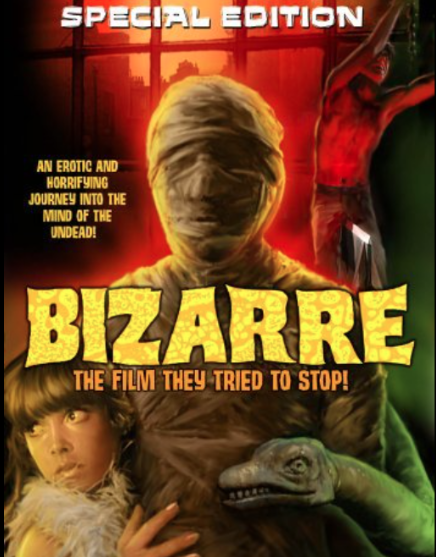
Yet I can’t hate this movie. No, I mean, how can you? A dinosaur spies on a peeping tom. Shots of an airplane are intercut with a sex scene for no good reason. And above all else, a mummy — YES, A MUMMY — tells us all of the secrets of the war between the sexes in the most bored tone possible. Just look at the poster — DEAD FOR 1000 YEARS…HE ROSE FROM THE CRYPT TO REVEAL STRANGE AND SINISTER PASSIONS!