Mill Creek Sci-Fi Invasion:The Girl from Rio (1969)

ABOUT THE AUTHOR: Phil Bailey is a long time photographer and film writer, who doesn’t actually hate everything, but has no fear of being a contrarian.  Follow at Twitter at @stroke_midnight or on Facebook at https://www.facebook.com/philbaileyphoto

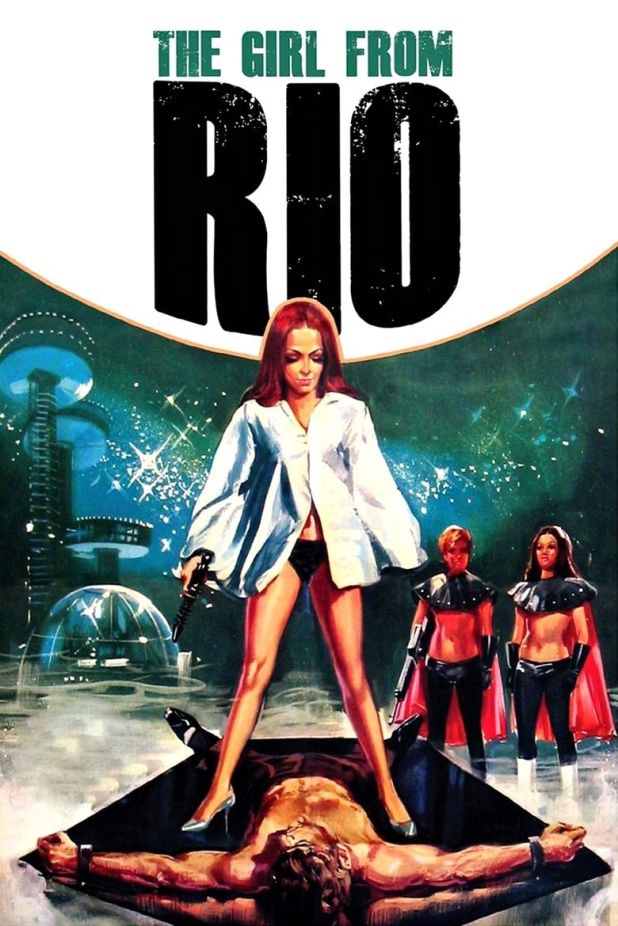
Sumuru, the femme villain bent on world domination, originally created for a BBC radio serial by Fu Manchu creator and author Sax Rohmer. If there is a Sax Rohmer story, then producer Harry Alan Towers must be lurking somewhere nearby. Towers produced a series of Fu Manchu films with Christopher Lee starring as the Chinese scientist bent on world domination and decided to take on Rohmer’s lesser known creation with James Bond girl Shirley Eaton in the lead with The Million Eyes of Sumuru in 1967 and followed it up two years later with The Girl from Rio.

The Girl from Rio was directed by Eurocult legend Jess Franco, sandwiched between his two Fu Manchu films The Blood of Fu Manchu and The Castle of Fu Manchu. This is nowhere as gonzo as his most famous/notorious films, it still boasts some great style and a bevy of beautiful women is all manner of undressed and barely dressed. Shirley Eaton, the blonde who was killed by being painted gold in Goldfinger is Sumuru who doesn’t really do much other than lounge around and look beautiful so Eaton is perfectly cast, but the real stars of the movie are Jess Franco regulars Maria Rohm and Beni Cardoso who just fit better with Franco’s vision (that vision being long legs and bare midriffs) and you can just feel Franco’s energy perk up when they are on screen, especially the impossibly leggy Cardoso as Sumuru’s head torturer/dominatrix Yana Yuma who basically steals the movie.

If you’re waiting fora recap of the plot, forget it, because that’s basically what the director did. Rio suffers from the common ailment of Eurocult films of having simultaneously too much and too little plot, It has so many plot threads that are so underdeveloped you can’t really keep it straight, despite all of the on-screen expository telephone calls. It has something to do with a mobster and a British Lord both vying to plunder Sumuru’s island fortress: Femina. Sumuru’s island fortress comes complete with a torture chamber and an all girl army decked out in pleather halter tops, capes, and go-go boots. There’s a lot of talking, a lot of scantily clad women, just enough nudity to keep the plot moving forward. The whole affair plays out like a super sexy, R rated The Man from U.N.C.L.E episode, which makes sense as the title is an obvious play on The Girl from U.N.C.L.E. tv series.

The Girl from Rio is a trashy if slight Eurocult delight that has loads of stylish eye candy. The trippy Italian comic feel to the scenes on Femina almost make up for how odd and disjointed the rest of the movie is. Structurally the movie is a bit of a mess, obviously stitched together from multiple chunks of footage that never quite convinces you that all of these people are in the same story. All faults aside, the campy, fetishistic delights that Jess Franco indulges in during the Femina sequences are well worth the 90 minutes and make the whole affair worthwhile, if just barely.

Sci-Fi Invasion month: It’s Alive! (1969)

ABOUT THE AUTHOR: JH Rood is from El Paso, Texas. He’s part of Ghoul Inc. Productions, a DIY group who are inspired by Roger Corman, Larry Buchanan, Frank Henenlotter, Herschell Gordon Lewis, Edward D. Wood, Jr., S.F. Brownrigg, Barry Mahon and others. I’m so glad that he took this movie, as I knew he’d not only  tell us about how it got made, but share why it means so much to him.

There’s a legend in these here hills: “When it rains and the sun shines at the same time, The Devil is kissing his wife”. And thus begins the odyssey of It’s Alive! Now, there are two films with that title, and it so happens that they were both directed by guys named Larry. This is not the mutant baby flick from 1974 brought to us by Larry Cohen. This It’s Alive! (yes, the exclamation point belongs there) predates the more well known of the two by 6 years, and was directed by Larry Buchanan. It tells the story of a freshly married couple from New York on a road trip to California, who take a wrong turn down south and run out of gas. They bump into a paleontologist named Wayne Thomas (Tommy Kirk, who appeared in a whole slew of Disney movies back in the day) who tells them there’s a house a few miles down the road with a gas pump, and they could probably find some assistance there. The couple follow his directions and find themselves at the home of an odd fellow named Greely, played by late, great Texas actor Billy Thurman, who was a Buchanan Alum and had appeared in a number of his pictures throughout the 1960’s. Greely lives with his housekeeper, Bella (Annabelle MacAdams, aka Annabelle Weenick, another Buchanan regular) in a large, creepy house in the middle of freakin’ nowhere, and runs a small roadside zoo with coyotes, lizards, snakes and various other indigenous critters. Greely is strange yet friendly at first, and explains to the stranded couple, Norman and Leilla Sterns (played by Corveth Ousterhouse and Shirley Bonne) that his zoo and gas pump were once his livelihood, before they built the new interstate and cut him off from civilization. He mentions his disdain for “The Highway People” and shows some signs of psychosis, but invites the couple inside his home to rest up a bit before the gasoline transport truck shows up to fill his tank and they can go on their merry way. Norman is a curt, rude, stereotypical New Yorker and is about as likable as a painful pimple, while Leilla is genuinely kind and rather naïve. Once inside the ginormous house, they’re introduced to Bella, who comes off as shell shocked, skiddish and mildly terrified, like a frightened dog. It’s apparent that Greely is perhaps not the easiest man to work for. For reasons unknown, Greely excuses himself to go outside and leaves the couple with Bella. While outside, Mr. Thomas shows up to check on the Sterns’. He’s greeted by a smiling Greely, and explains that he’s the one who suggested the couple ask him for help. He pops the hood on the couple’s car and asks Greely to retrieve a screwdriver from his Jeep. Greely happily obliges, but returns with a large, blunt wrench instead, and bashes Thomas over the head. He then drags the unconscious man away.

Back in the house, Bella nervously serves tea, and the stranded couple becomes more agitated with their current situation. A jovial, smiling Greely pops in, and sensing the tension, invites them to pass the time looking at the animals in his zoo. The couple agrees, mostly because they haven’t much else to do, and a caged bobcat probably seems like better company than Bella at this point. They meander their way to the crude wood and chicken wire enclosures and peer in on the poor captive animals. Greely points to the entrance of a cave, and tells Norman and Leilla that within that cave is his “prized possession”. The couple exchange glances, as if telepathically telling each other “eh, what the hell” and follow Greely into the cave. The three meander their way down dark, dank catacombs for what probably felt like an eternity, until they reach a large, dark room. Greely excuses himself to go turn the lights on, but instead pulls a lever that brings down large iron bars, trapping Norman and Leilla inside the cave. Big surprise: Greely is nuts!

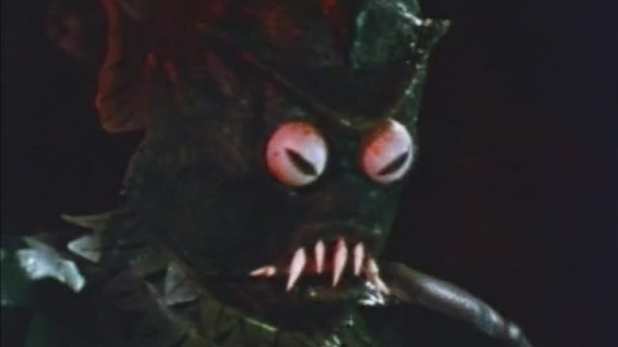
After cackling maniacally and walking away, Greely disappears back to the house to have supper with Bella, leaving Norman and Leilla befuddled and terrified. Luckily, our buddy Wayne is in the cave, too, and after waking up from that nasty bump on the head, the three begin to assess their situation. Bella returns with some food a short time later, and after being pleaded with by the three captives, she tells them that she wants to help them, but she simply can’t. If she upsets Greely, he will feed her to “it”, the “Thing” that Greeley keeps in that cave that has disposed of all the other unfortunate souls who found themselves at his place. Evidently, Greeley isn’t the only monster around here. A short while later, Norman makes his way through the winding passageways of the cavern and awakens the monster! From out of the bubbling water of a hot spring comes a lizard-like creature with a massive overbite and ping-pong balls for eyes, looking like a bargain basement Sleestak. This particular monster getup was actually recycled from a previous Buchanan film, Creature of Destruction. Without going into too much detail and letting any spoilers slip through, we learn a bit more about our boy Greely and his pet
monster and how Bella came to be in Greely’s “employ”, and the whole thing plays out about as predictably as one would expect, though like most Buchanan films, it’s thoroughly entertaining through and through.

When looking at Larry Buchanan’s body of work, the films that tend to stand out, and the films he’s mostly known for, are the ultra-cheesy, made-for-television flicks from Azalea Pictures and American International, of which It’s Alive!  was the last. These films were greenlighted by Sam Arkoff, who was recycling scripts from earlier, successful films that were released theatrically. More often than not, Arkoff would get Buchanan on the phone and say something like “I need this picture made, and I need it done yesterday!”. Larry Buchanan was no stranger to working under pressure and thinking outside the box. Often times, given the extreme time and budget limitations, he would devise ways to get a scene across that was crude but effective, such as smearing petroleum jelly mixed with blue food coloring on a camera lens to create a day-for-night effect. Larry was a real trooper, and put up with things many of his contemporaries wouldn’t. His resiliency could be traced back to his beginnings, which were less than ideal for anyone. Born on the last day of January in 1923 in Lost Prairie, Texas, Larry was orphaned at an early age, and was brought up in a crowded orphan’s home just outside the Dallas metro area. He showed a serious interest in motion pictures at an early age, and was unofficially “adopted” by some of the folks at the Variety Club, a show business club in Dallas. They would give young Larry free passes to the various picture shows around town, and they let him dig through the discarded reels of film that wound up on their cutting room floor. Larry would carefully edit the mish-mash of reels together, and show them to the other kids at the orphanage, using a donated projector. Most of these were industrial films with no sound, so Larry would invent stories to go along with what was happening on the screen and do a live narrative for the other children. After high school, Larry hitchhiked to Los Angeles and managed to get a job at Fox studios briefly, before relocating to New York to join the Army Signal Corps and make military training films. At this time, Larry also began to produce short, one-reel films such as The Cowboy and The Wetback, which caught the attention of the Jamieson Film Company in Dallas, who reached out to Larry and beckoned him back to the Lone Star State. Having just become a father and not wanting to bring up a family in New York, he jumped at the opportunity to return home and make movies, a real win/win for him.

Before cementing his cinematic legacy as a schlockmeister responsible for such film as Curse of the Swamp CreatureMars Need Women and Zontar: The Thing from Venus. Larry had more dramatic aspirations, and it shows in some of his earlier work. Films like High Yellow and Free, White and 21 teetered on blaxploitation, but with more heart, feeling and social conscience. His 1964 film The Trial of Lee Harvey Oswald presented audiences with a controversial yet welcomed “what if” storyline about the man who assassinated President Kennedy getting the trial denied to him by Jack Ruby. All in all, Larry helmed over 40 films during his career, and is today considered the father of the Texas feature film industry. Far from being a household name, his influence has had a ripple effect throughout the world of cinema. That young orphan boy from rural Texas who dreamed of growing up and making motion pictures did just that, and he did it with a fervent zeal. So, when you settle into watch It’s Alive!, or any other Buchanan film, I challenge you to not envision that precocious lad gleefully piecing together random bits of discarded film from the bottom of a trash bin as he concocted wild, imaginative stories to go along with them for nothing more than the entertainment of his peers. Larry is one of those filmmakers I look up to and admire the most, because he could make something from nothing. His films are a middle finger in the face of cinematic pretention and snobbery, simply by existing.
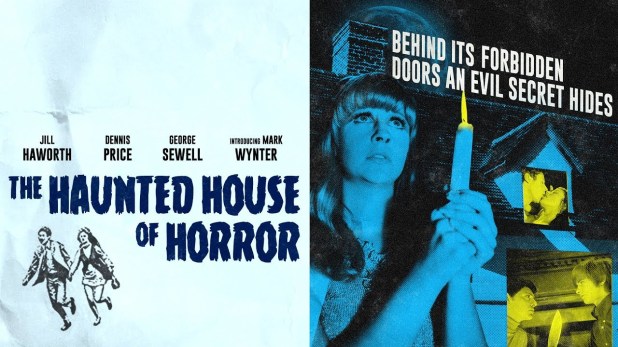
SLASHER MONTH: The Haunted House of Horror (1969)

Also known as Horror House and The Dark, this proto-slasher promised “Behind its forbidden doors an evil secret hides!”

Written and directed by Michael Armstrong, who also made Mark of the Devil and House of the Long Shadows, this takes the traditional night in a haunted house story and turns it on his head. Armstrong originally wrote this when he was just 15 years old before rewriting at the end of the 60’s, saying that he worked to “further developing its darker psycho-sexual themes and sharpening characters and dialogue to reflect the current cynical underbelly beneath the superficial Sixties culture.”

A mix of Tigon and American-International Pictures, the Western side wanted more sex, a role for Boris Karloff (whose bad health switched the role to Dennis Price) and a role for Frankie Avalon, which ruined the chance for Armstrong to cast David Bowie as Richard. The two had worked before on a short film called The Image.

American Chris (Avalon), his girl Sheila (Jill Haworth, Tower of Evil), Gary (British teen idol Mark Wynter), his girl Dorothy (Carol Dilworth, The Trygon Factor), the on-the-make Sylvia (Gina Warwick), Madge (Veronica Doran, Screamtime), Richard (Julian Barnes) and Henry (Robin Stewart) have all left a boring party for a night at a haunted house, trailed by Sylvia’s jealous — and married — ex-boyfriend Paul.

A seance upsets Sylvia, who hitchhikes home, at which point Gary is knifed by someone unseen. As the group all have criminal records, Chris tells them they need to keep this a secret from the police. And even worse, he believes that one of them is the killer.

Sam Arkoff and Jack Nicholson of AIP hated the original cut of the film and added — and subtracted — plenty. What ended up on the screen isn’t all that bad and feels like a rough draft of I Know What You Did Last Summer. And hey — I’m all for Frankie Avalon in slashers (see Blood Song).

You can watch this on YouTube.

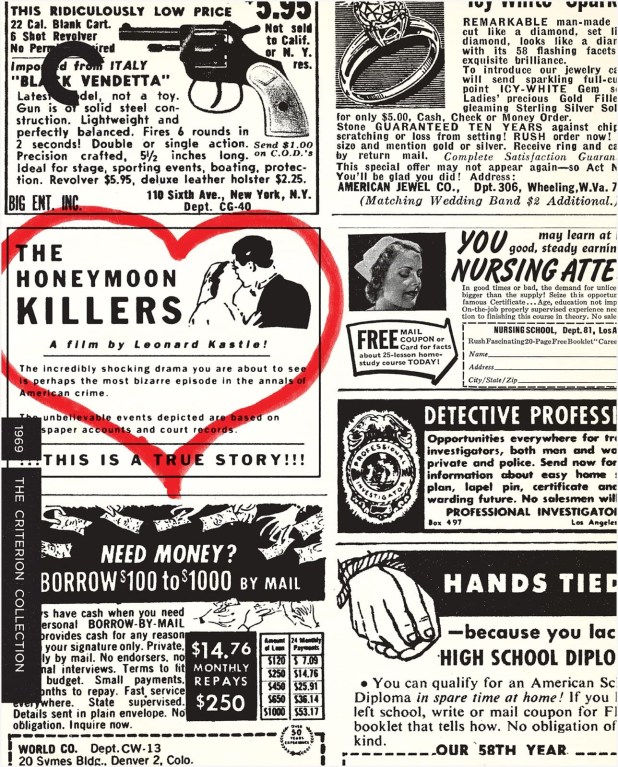
2020 Scarecrow Psychotronic Challenge Day 19: The Honeymoon Killers (1969)

DAY 19. BEYOND THE DARKNESS: Watch one with a love story in it. There’s more than one way to get mushy!

Inspired by the true story of Raymond Fernandez and Martha Beck, the notorious “lonely hearts killers” of the 1940s, The Honeymoon Killers tells the tale with Tony Lo Bianco and Shirley Stoler, in her film debut, as the leads.

Ray starts the film by seducing Martha and stealing money from her, but it turns out that she may be every but his equal, using her wits to help him con and even kill numerous women from lonely hearts ads.

From relationship to relationship, Ray promises to never cheat on Martha, but there’s no way that he can keep up the con. Along the way, every one that crosses their path dies, often horribly.

Originally to be directed by Martin Scorsese, who was fired from the film, it was taken over by writer Leonard Kastle, who only created this one film. Named by François Truffaut as his “favorite American film,” it looks more like a grim documentary than an exploitation film.

American-International Pictures was going to distribute this, even making ad materials, but dropped it due to the film’s “extremely gruesome and misanthropic” tone. Their loss — it’s a work of art.

I’m enthused by the fact that an ad appeared in Variety at some point in the late 70’s announcing a sequel. Although never made, the story would have involved an imagined death row conjugal visit between Ray and Martha , resulting in the prison birth of brother/sister twins who were separated at birth. Years later, the pair meets and becomes adult murderers/lovers, never suspecting that they are siblings. This movie needs to be made.

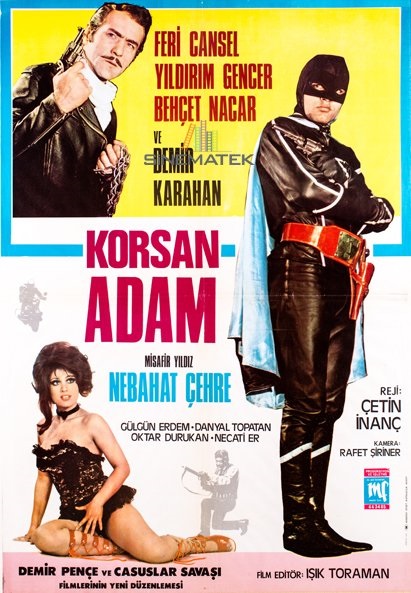
Demir Pençe (Korsan Adam) (1969)

With a title that translates as Iron Claw (Pirate Man), this movie is also called Iron Claw the Pirate and comes from the magical brain of Çetin Inanç. Fantomas — if you’re here worrying about copyrights, you’re in the wrong place — and his goon Bechet goes up against Iron Claw and his Batgirl-esque assistant to keep the villain from invading Turkey.

https://www.youtube.com/watch?v=foUZoD-US4U

Somehow between 1967 and 1969, Turkish filmmakers learned that superhero cinema had moved from 1930’s movie serials to 1960’s Batmania. This feels similar to Yilmaz Atadeniz’s own Casus Kiran, a riff on Spy Smasher, which makes sense as Inanç started as an assistant to Atadeniz.

Much like most Turkish superheroes, Iron Claw is allowed to sleep with all of the evil women he wants and keep his lady Mine. Perhaps even sadder is despite the fact that she is shown to be a capable hero, she’s never given a superhero name of her own. She’s just a nameless helper who dresses in a much sexier version of our hero’s costume. Iron Clawette seems like too easy of a name and look, I spent more time worrying about it than the people who made this movie.

Yildrim Gencer — the man who played Kilink — is also in this as a mustache sporting agent on the side of good.

Beyond the steel fisted Behcet, Fantomas also employs Cancel, who is played by Feri Cansel. If you think, that might be the best villain of all time, let me tell you that he also gets away with things no movie serial villain ever does, like murdering a kindly old professor and then making a sacrifice of that man’s daughter on an altar. Well done, Fantomas!

This is another magical trip to the no limits world of Turkish film, a place where innocent kink exists fist in glove with murderous superheroes and masked villains who get away with it.

You can download this from the Internet Archive.

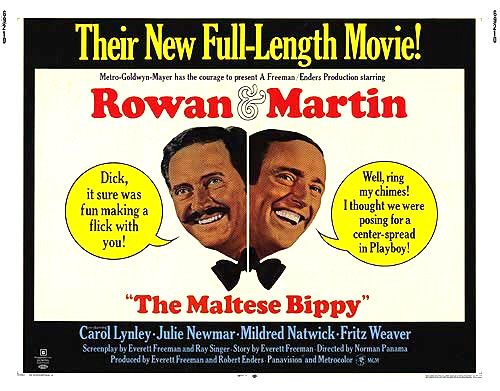
The Maltese Bippy (1969)

As a kid, I was thrilled when Laugh-In came back to TV. I’d read about it—I was already a devotee of pop culture—and was excited to see this stream-of-consciousness show for myself. Yes, it was before the internet when we couldn’t just dial up everything we wanted to see instantly.

It may seem dated today — it has to; it was nearly sixty years ago — but at the center of this mad show were two men: Dan Rowan and Dick Martin. They were the everymen who couldn’t keep the wild energy of the show from bursting through the screen. But they were also fascinating people in their own right, who knew that the show was the star.

Dan Rowan spent his childhood years following his parents from town to town as they performed their carnival dancing act. He was orphaned at 11 and spent four years in an orphanage. By the time he was 18, he hitchhiked to Los Angeles, where he got a job in the Paramount mailroom. Soon, he was the youngest writer on the lot.

During World War II, Rowan was a fighter pilot, winning the Distinguished Flying Cross with Oak Leaf Cluster, the Air Medal and the Purple Heart. He returned from action and formed his comedy duo with Martin. He was married three times—to Miss America 1945 runner-up Phyllis J. Mathis, Australian model Adriana Van Ballegooyen and TV spokeswoman Joanna Young—and retired in the early 1980s. He only returned to help celebrate NBC’s 60th anniversary in 1988 by appearing with his comedy partner.

Dick Martin didn’t serve in the war — tuberculosis kept him from combat — but was a young writer as well, working on the radio show Duffy’s Tavern. He started teaming with Martin in 1952, playing nightclubs, hosting NBC’s Colgate Comedy Hour and appearing in the movie Once Upon a Horse Together. He also played Lucille Ball’s neighbor on The Lucy Show before Laugh-In became a big hit. After his partner retired, Martin was a frequent game show guest and TV show director. He was married to singer Peggy Connelly and Beyond the Valley of the Dolls star Dolly Read twice.

Anyways…The Maltese Bippy.

Sam Smith and Ernest Grey (Rowan and Martin) are the producers of nudie cuties — their latest film is Lunar Lust — and they’re forced out of their office for not paying the rent. Somehow, a G-rated movie in 1969 could concern pornography, and no one cared.

They move into Ernest’s house by the cemetery in Long Island, a place where a mutilated corpse has already been found and a woman is frightened by a howling man. Oh yeah, Ernest is also given to barking like a dog.

Somehow, despite not being successful, Ernest can have a housekeeper (Mildred Natwick, Do Not Fold, Spindle, or Mutilate). He also has two roommates, the bubbly Robin Sherwood (Carol Lynley, The Poseidon Adventure) and Axel (Leon Askin, Hogan’s Heroes), a Swedish violinist.

Meanwhile, the Ravenswoods next door — Mischa (Fritz Weaver, Creepshow), Carlotta (Julie Newmar!) and Helga (Eddra Gale, Fellini’s 8 1/2) — are vampires who want Ernest to join their pack. Sam thinks they should be a variety act, but the truth is that nearly everyone just wants to search for a giant diamond inside the house. (and more to the point, inside the corpse of the home’s original owner).

Hijinks ensue, and everyone but our heroes perish. But that’s not good enough, so they both present their happy endings to the audience and walk into the sunset together.

Look for a pre-Brady Bunch Robert Reed, David Hurst (the head waiter in Hello, Dolly), character actor Dana Eclar, voiceover actor Alan Oppenheimer, Arthur Batanides  (he was Mr. Kirkland in Police Academy 234 and 6), Jennifer Bishop (who was in the William Grefe movies Mako: The Jaws of Death and Impulse, as well as Al Adamson’s Horror of the Blood MonstersJessi’s Girls and The Female Bunch) and Garry Walberg, who played Jack Klugman’s poker buddy Homer “Speed” Deegan on The Odd Couple and his boss Lt. Frank Monahan on Quincy, M.E.

Director Norman Panama wrote White Christmas and 1959’s Li’l Abner. He also directed the Hope and Crosby — with Joan Collins! — film The Road to Hong Kong.

This isn’t a great movie—or even alright—but the TV lover in me appreciated it and found joy in discovering this buried moment in time.

Django the Bastard (1969)

Sergio Garrone made plenty of interesting films, like the George Eastman-starring Western Terrible Day of the Big Gundown, some gothic horrors with Kinski like Lover of the Monster and The Hand That Feeds the Dead and three different Django ripoffs, including A Noose for DjangoKill Django… Kill First and this movie.

This movie is more supernatural than Western, with this version of Django (Anthony Steffen, The Night Evelyn Came Out of Her Grave) a bloody avenger much like Kinski’s character in And God Said to Cain (which I coincidentally watched on the very same day).

Said to have influenced High Plains Drifter, this Django was killed by three Confederate officers who betrayed their own men. He’s dug his way out of the grave and out of the Great Beyond to plant crosses for them before he’s even killed them. Nothing will stop him — I mean, if death couldn’t, what hope do mortal men with their guns?

At the end of the film, the wife of his main villains (played by Rada Rassimov, the sister of steely-eyed giallo king Ivan) says that they have enough money now to live rich and happily ever after. Django replies that he won’t live forever and literally fades away, like the ghost he is. According to this article, she says, “What a lot of dollars, they’ll be enough for a life!” The answer? “I already had a life.” And again — he disappears.

The best part of the Django-named films is when you come across one that’s even better than you expected. This would be one of them.

You can watch this on Tubi.

Ehi Amico…c’è Sabata. Hai Chiuso! (1969)

That title translates as Hey buddy…That’s Sabata. You’re Finished! Gianfranco Parolini had gone from making Eurospy films to If You Meet Sartana Pray for Your Death, which was a success but the series ended up being given to director Giuliano Carnimeo.

Producer Alberto Grimaldi then got in touch with Parolini to make a new series. He had a great actor to star in it, too. Lee Van Cleef, whose work in Leone’s films is the stuff of legend. What may not be known to many is that a car crash in 1958 nearly cost the actor his life and career. He actually went into interior decorating with his second wife before getting back into movies three years later, but any time he rode a horse, he’d always be in great pain. That’s kind of amazing, because for someone so well-known for being a cowboy, he gutted through it to give us all these awesome roles. What can you say for a guy whose tombstone literally says, “Best of the bad?”

Sabata is basically a man who can’t be stopped. He can hit any target and has really no morals, which is a great combination for the Italian West. He carries a four-barreled derringer and a rifle that he uses to wipe out just about everyone he meets.

The one enemy that he doesn’t immediately kill is Banjo (William Berger), who keeps trying to play every side against each other. He also has a great weapon that he hides in the music instrument that lends him his name.

There’s drunk Civil War vet Carrincha, who throws knives at people, and his only friend, a Native American named Alley Cat who can escape anyone and is the master of acrobatics.

The bad guy here is named Stengel, one of the town’s leaders who is robbing the bank to buy a railroad. Sabata learns the secret and has to deal with thugs being sent his way for the rest of the film. Stengel has a dart gun in a cane, which is pretty awesome, and he’s played by Franco Ressel, who was in 121 movies, a resume which includes Hercules the AvengerBlood and Black LacePassword: Kill Agent Gordon, Have a Good Funeral, My Friend… Sartana Will Pay and Naked Girl Killed in the Park.

This movie is a blast — everything great about Sartana but with Lee Van Cleef as the hero instead of Gianni Garko (or George Hilton, George Martin, Jeff Cameron, William Berger, Hunt Powers, Johnny Garko, George Ardisson, Robert Widmark or the lack of anyone playing the role in a movie named Let’s Go And Kill Sartana).

You can watch this on Amazon Prime and Tubi.

Me & Will (1999)

So, did you know . . . sandwiched between the ‘60s original and Phil Pitzer’s 2012 revisiting, Easy Rider: The Ride Back, there was another unofficial “sequel” to Easy Rider, which concentrates on a search for the famed Captain America chopper that appeared in Easy Rider? Never heard of it? It’s okay. No one did.

Be it an unintentional sequel or a loose remake—with a Thelma and Louise twist—of the counter-culture classic Easy Rider, there’s definitely a dash of another late 60’s cinematic classic, Midnight Cowboy, in these engine revs written and directed by its stars, Sherri Rose and Melissa Behr. (Another Easy Rider-inspired biker-epic, the better known Roadside Prophets, made in the early 90’s with John Doe, the bassist and singer from X, and a Beastie Boy, may even come to mind as the story unfolds.)

Told from the point of view of Jane (the “me”), a hard-living aspiring writer, she meets an equally burnt-out artist-cum-party girl named Will in an L.A. drug rehab clinic. After watching a late-night showing of Easy Rider on TV, Jane (Sherri Rose, American Rickshaw) and Will (Melissa Behr, aka “Doll Chick” from Bad Channels and its sequel, Dollman vs. Demonic Toys) decide to make like Wyatt and Billy and break out of rehab to embark on a trip to find the legendary chopper ridden by Peter Fonda—which is rumored to still exist in the city of Willsall, Montana.

As the road trip unfolds, Jane and Will meet the usual cross section of bikers, hippies, burnt-out garage mechanics, psycho waitresses, abused women, and abusive cops—as well as the rock bands Space Age Playboys (yes! Kory Clarke and Warrior Soul!) and Keanu Reeves’s band Dogstar. (I played Dogstar on the radio and went to their shows back in the ’90s; they were a solid indie, alt-rock band and not the “actor-gimmick” they were smarmy-labeled.)

What helps this lost bikers-searching-for-their-souls flick is the cast featuring those actors we care about at B&S About Movies: Seymour Cassel (Trees Lounge), M. Emmet Walsh (Escape from the Planet of the Apes), Steve Railsback (Lifeforce), and Grace Zabriskie (Galaxy of Terror). (Oh, shite: she was also George’s mother-in-law on Seinfeld. Sorry, Sam.) And keep your eyes open for Johnny Whitworth (Empire Records), William E. Wirth (The Lost Boys), and Tracy Lords (Shock ’em Dead).

Oh, and Jane’s boyfriend, Fast Eddie, is Patrick Dempsey (the ’80s cable comedy-classic Can’t Buy Me Love and “McDreamy” from TV’s Grey’s Anatomy). Of course, when Grey’s Anatomy became a ratings juggernaut—and as with Katherine Hegyl’s equally unknown 2006’s Zyzzyx Road—the DVD reissues of Me & Will feature Dempsey front and center—with Rose and Behr kicked to the curb.

In addition to the ‘Playboys and Dogstar appearing on the soundtrack, there’s music by Dwight Yoakam, Josh Clayton, formerly from School of Fish (remembered for their ’90s hit, “Three Strange Days”), in addition to classic tracks by the Doors and a solo-bound Mick Jagger. Matt Sorum of the Cult/Guns n’ Roses scored the film—with a guitar-style that almost leaves it feeling like a Tangerine Dream-scored film (Thief comes to mind, IMO), sans the synths and moogs.

To dismiss Me & Will as a vanity-driven “female Easy Rider” and to be alpha-male ruffled by its “female empowerment” message is a chauvinistic disservice to Sherri Rose and Melissa Behr’s efforts to dissuade the film from disintegrating into a hail of bullets of a gone-wrong crime caper, ala the somewhat similar Don Johnson and Mickey Rourke buddy-biker action flick, Harley Davidson and the Marlboro Man (1991).

Me & Will is a gallant effort; a heart-felt, solid indie-film and Rose and Behr certainly deserved better than their exploitation resumes allow. And kudos to Columbia Pictures giving their blessings and not having the proceedings degrade into the legalese haze of Phil Pitzer’s not-as-bad-as-they-say Easy Rider homage. You can watch Me & Will as a free-with-ads stream on TubiTv or without ads on You Tube.

So, as with Phil Pitzer’s Easy Rider: The Ride Black: Me & Will is an alright effort. So do Sherri Rose and Melissa Behr a solid and support indie film by streaming the ad-stream version on TubiTV, will ya? Other films starring Sherri we’ve reviewed for you to check out include Cy Warrior, Relentless Justice, and Summer Job.

About the Author: You can learn more about the writings of R.D Francis on Facebook. He also writes for B&S About Movies.

Easy Rider: The Ride Back (2012)

So . . . did you you know Easy Rider was followed forty years later by an unofficial sequel? It’s okay. No one does. . . .

The existential subtext and counterculture viewpoints (somewhat) of the original are lost . . . somewhere on a dusty, Baja road in this “sequel” (also working as a prequel) that explores the family history of Peter Fonda’s character Wyatt “Captain America” Williams through the eyes of his older brother, Morgan: a pot-distributing, Vietnam war deserter and custom jewelry-designer (specializing in Maltese crosses; not for the reasons you think, the eventual reveal is a clever trick-of-the-script) living in luxurious solitude on the Pacific coast of Mexico.

The drama and struggles center around Morgan’s cycle-lovin’ family friend, West Coast (Jeff Fahey of The Lawnmower Man, Psycho III), Williams sister Shane (Sheree J. Wilson of TV’s Dallas and as Alex Cahill on Walker, Texas Ranger; she also produces), and her wealthy-hubby (Michael Nouri of Flashdance) as it flashes to and fro from the 1940s to the present, concerned with Wyatt’s brother, Morgan (Phil Pitzer) visiting his dying, disapproving father. So, along with West as his “Billy,” Morgan mounts Wyatt’s Captain American chopper, which he recovered back in ’69 and restored, slaps on his brother’s old leathers, and takes a “ride back” to bury those family demons.

Of course, when it comes to making a sequel, the smart bet is to file legal actions against Bob Rafelson and Bert Schneider, the producers of the original through their Raybert Productions (the force behind The Monkees TV series), to block them from reclaiming their expired film rights. And don’t bring back any of the original’s cast or crew. And cavet those emptor for the ol’ home video bait n’ switch: courtesy of the flashing-back-and-forth, Fahey, Wilson, and Nouri are the marquee-stars, but only here as supporting characters. This show belongs to Phil Pitzer and Chris Engen (as the young, troubled third-brother Virgil; who despite his bigger role, is bumped off the marquee).

So goes this vanity-vision by producer and screenwriter Phil Pitzer, a former lawyer who, with a desire to enter the film industry with a bang, manipulated legal loopholes to get sequel rights. His co-writer and director, Dustin Rikert, fared better: his names pops up as a producer and director on a slew of telefilms broadcast on the Hallmark, Lifetime, and Syfy channels. Their Easy Rider part deux was initially completed in 2009 and appears in filmpedias with that release date; however, by the time it went through the festival circuits and film markets for distribution, it was formally released in 2012.

So, is Easy Rider: The Ride Back the most-unwanted-not-a-sequel since the days of Halloween III: Season of the Witch (which I really like) or House II: The Second Story (which I didn’t) or House III: The Horror Show (which I did, because well, it’s a friggin’ Lance Henriksen and Brion James movie)? And is stuffy ol’ Leonard Maltin—who hates everything the B&S About Movies crew likes—justified in calling the Pitzer’s effort “a staggeringly bad, cash-in bomb,” solely based on Pitzer’s clandestine legal maneuvers?

Eh, well . . . to Pitzer’s credit: He does, as you can see, resemble Fonda, so it lends to the credibility that he’s Wyatt’s brother, as well as “being” Wyatt in flashbacks that lend to the film-to-film continuity. All of the bikes (especially Wyatt’s chopper reproduction) and time-period designs (props, costumes, cars, etc.) are correct, the Korean war sequences are well-shot, and the cinematography by Brian Lataille (videos for Incubus and Linkin Park), while not up to the László Kovács-standard in the original, is pretty solid. And yes, as with any indie, flick: there’s a few strained thepsin’ moments. So, while it’s not exactly Easy Rider, Pitzer’s effort is not a Tommy Wiseau (or Neal Breen) biker joint as some threaders and reviews claim. No, it’s definitely not The Room on wheels” as some have said.

While the flashbacks and bike-riding interludes of Morgan’s and West Coast’s contemplations (most in voice overs as majestic “post-card moments” unfold) about life, e.g., homelessness and hunger, ecology, the meaning of patriotism and true freedom, make the film seem a bit longer than its 90-minute running time, Pitzer nonetheless crafted well-rounded characters for his actors to sink their thespin’ teeth into. He also developed a compelling “history” for an initially ambiguous, metaphorical-drifting character. So kudos to Pitzer for giving a structured “focus” to a film that was admittedly an “out of focus,” scriptless-improv in the first place (that Fonda and Hopper openly admitted in interviews).

And besides: I always enjoy seeing senior actors (e.g., the recently-released Nana’s Secret Recipe) given meaty roles and, to that end: Newell Alexander (who’s career goes back to the ’70s TV series Barnaby Jones and Battlestar Galactica ’79, The Kentucky Fried Movie; he also appeared in Walker, Texas Ranger with Sheree) and Ron Howard’s pop, Rance (The Andy Griffith Show, Grand Theft Auto, and Cotton Candy) are both excellent in their roles as Poppa Williams and his ol’ hog-riding Korean War war buddy, so much so, you’d like to see more of them in the film.

All in all, despite Leonard Maltin and the Internet hoards of war, Easy Rider: The Ride Back it’s not as Wiseauian bad as they’ll lead you to believe. (The same arguement we had with our review of Jeremy Saville’s radio dramedy, Loqueesha). And for those who have stated Phil Pitzer “thankfully, has never made another movie” and “hasn’t made another movie since”: Phil produced the upcoming Cannes Without a Plan (2021), the third writing-directing effort from Julie Simone Robb (NBC-TV’s Homicide: Life on the Street) that also stars Pitzer’s The Ride Back cast member, Jodie Fisher (of Charles Band’s Blood Dolls).

Courtesy of a new distribution deal with retro-imprint Kino Loeber, Easy Rider: The Ride Back is available worldwide as 2019-issued Blu and DVD and VOD stream on Amazon Prime and You Tube Movies. Yeah, you’ll find that errant You Tube freebie (you know you look there and TubiTV first before you buy), but do Phil Pitzer a solid and support indie film, will ya? Pay for it, okay?

Like Kowalski said in Vanishing Point: “Fuck the man!” Keep on making movies, Phil. You’re alright, kid. . . .

So, did you know . . . sandwiched between the ‘60s original and Phil Pitzer’s 2012 revisiting, Easy Rider: The Ride Back, there was another unofficial “sequel,” which concentrates on a search for the famed Captain America chopper that appeared in Easy Rider? Never heard of it? It’s okay. No one did. Join us at 3 pm for more tales from the fast and the furious . . . with Me & Will.

About the Author: You can learn more about the writings of R.D Francis on Facebook. He also writes for B&S About Movies.