APRIL MOVIE THON DAY 28: Death of a Gunfighter (1969)

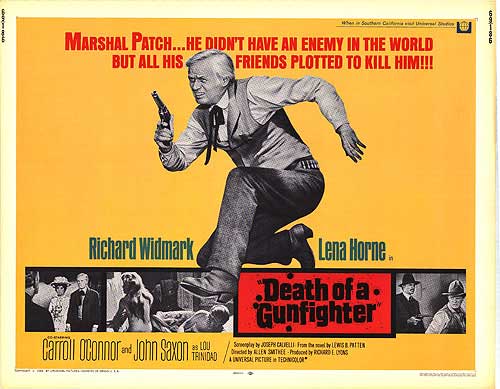
Death of a Gunfighter was originally directed by Robert Totten, who directed the original The Quick and the Dead, as well as plenty of TV like Gunsmoke and Mystery In Dracula’s Castle. Despite a year of work, he couldn’t get along with star Richard Widmark and lost that battle, getting replaced by Don Siegel (Invasion of the Body SnatchersDirty Harry and John Wayne’s last movie, The Shootist).

Siegel had been the original choice to direct, but was overworked, according to the Chicago Tribune. However, in Siegel’s memoirs, he wrote that Widmark pushed from day one to get Totten kicked off the film and replaced by the unwilling Siegel. Finally, three and a half weeks into making the movie, Widmark got Universal boss Lew Wasserman to personally get involved.

When Siegel looked at Totten’s footage, he thought it was great and even made sure his own footage matched. In fact, he didn’t reshoot a single scene, only finishing off the film’s opening and closing sequences, as well as some pick-up shots. In the end, he didn’t think he had done enough work to take directing credit.

However, Totten wanted nothing to do with the film. Siegel didn’t want his name on the film, which upset Widmark even more. Finally, an agreement was made with the Directors Guild of America for the pseudonym Alan Smithee to be used.

In fact, this was the first Alan Smithee-directed film.

Here’s where it gets weird: critics loved the film and the new director. The New York Times claimed that it had sharp direction and that Smithee “has an adroit facility for scanning faces and extracting sharp background detail.” Roger Ebert said that it was “an extraordinary western by director Allen Smithee, a name I’m not familiar with, allows his story to unfold naturally.” I wonder if Ebert was aware what was going on and was having fun with his review. I’d like to think so.

Based on Death of a Gunfighter by Lewis B. Patten, this movie feels like Hollywood realizing that some of the better Westerns were coming from other countries, mostly Italy, at this point. Marshall Frank Patch (Widmark) is an Old West-style lawman in Cottonwood Springs, Texas, a town determined to be modern and, as such, conveniently forget its numerous sins and just whitewash the past.

“What would happen,” the mayor says, “if an Eastern businessman came to town and saw old Patch there, wearing that shirt he probably hasn’t washed in a week?”

Patch shoots a drunk in self-defense, which the town leaders use as a way to get him out. Knowing that the town is about to murder him with their own gunfighters — he knows too much — the old lawman settles his affairs, including marrying brothel owner Claire Quintana (Lena Horne), an interracial relationship that is a fact of life, something bold for 1969.

This is a film rich with character actors that I love — Carroll O’Connor, Royal Dano, John Saxon — and a town unlike many other Westerns, one made up of all races, a place where a lone car causes worry, where the trains must get ever closer, where the past — and Patch — must die to move progress ever forward, no matter what.
APRIL MOVIE THON DAY 11: Invocation of My Demon Brother (1969)

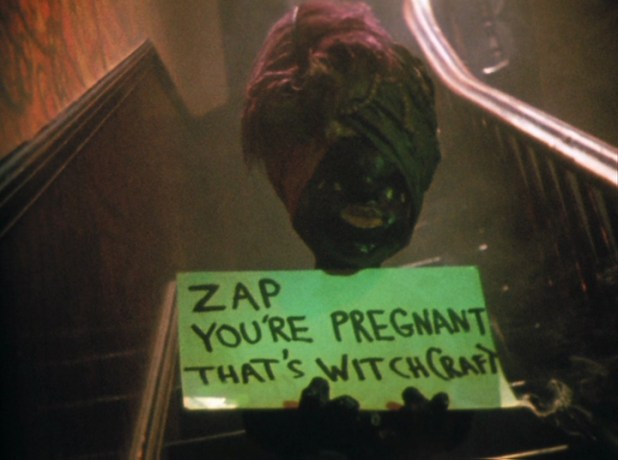
While you can say that this is but an 11-minute movie, this Kenneth Anger directed, edited and photographed work of art — complete with Moog soundtrack by Mick Jagger — is one of the films that started midnight movies.

Assembled from what remains of the first version of Lucifer Rising, this movie strobes your mind with an assemblage of Anton LaVey presiding over a public funeral for a cat, the cast smoking out of a human skull, Anger on stage leading a ritual, nude men, Vietnam footage, the Stones playing their ill-fated Altamount show and is itself a ritual that follows Crowley’s Holy Law of Thelema in that one must master this universe before achieving the mindset needed to become your own god.

You could also say that it’s a lot of noise over a collage of imagery. Or perhaps Anger’s theory of film as magickal weapon is true. If you follow the logic that this isn’t for everyone, then you believe in Crowley’s thought process and how he claimed the esoteric would become “that which is understood by the people I wish to instruct.”

Evolution will only come by shocking our senses and overloading them with tones, with colors, with images.

Obviously, Bobby Beausoleil is Lucifer and the connections between the occult and the loathsome Manson Family will always be cited.

APRIL MOVIE THON DAY 1: The April Fools (1969)

I think my new obsession is watching movies where Jack Lemmon is flummoxed by modern love. Here, he’s Howard Brubaker, a man married to Phyllis (Sally Kellerman), who cares more about money, real estate and status than love. The person he falls for is Catherine (Catherine Deneuve) whose uncaring and philandering mate is Howard’s boss, Ted Gunther (Peter Lawford). When they meet Grace and Andre Greenlaw (Myrna Loy and Charles Boyer), they start to believe that maybe they could be happily married, just like the Greenlaws, if they can only run away and start again.

Deneuve’s part was originally intended for Shirley MacLaine, which would have reunited the stars of The Apartment. Knowing that makes me realize that that casting would have truly improved this, as with as stunning as Deneuve is, it makes it seem as if the affair is simply over attraction and not the idea that the two could be life partners, not just attracted to each other — no insult to MacLaine, who is also quite fetching. I hope you understand my point.

Maybe after The Apartment I just see Lemmon and MacLaine as the perfect couple.

Director Stuart Rosenberg also made Cool Hand Luke and The Amityville Horror, while writer Hal Dresener wrote SssssssThe Eiger Sanction and Zorro: The Gay Blade. Dionne Warwick sang the title song, while one of her biggest hits, “I Say a Little Prayer,” is sung at a party in the film by Susan Barrett. The b-side of that single? “Theme from Valley of the Dolls.”

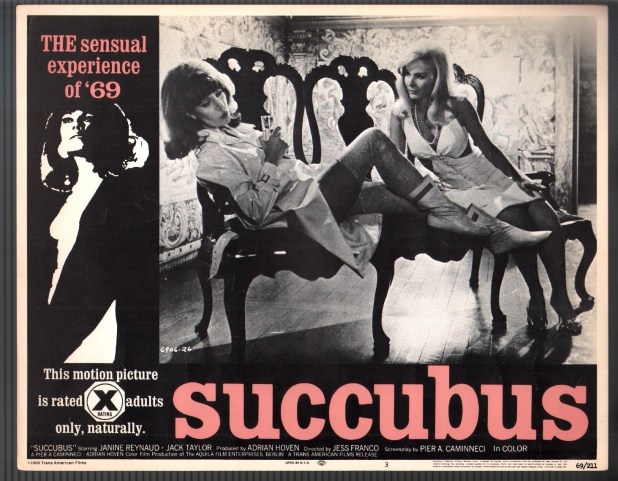
JESS FRANCO MONTH: Succubus (1969)

The German title for this movie, Necronomicon – Geträumte Sünden (Necronomicon – Dreamt Sins) is metal as fuck and when you get right down to it, isn’t Jess Franco the same way? I feel like him like I do about Venom. Most Venom songs sound the same, but man, they all sound pretty good and while they aren’t the best musicians, they lucked on to some really great riffs and really, isn’t that what we’re looking for?

Franco’s first movie outside of Spain, this was his hope that he’d escape all the rules and censorship by working in Germany. The script was three pages long, which feels like two and a half pages too long for a Jess Franco movie, and the funding didn’t come through, but producer Pier A. Caminnecci paid for the rest and had an affair with lead actress Janine Reynaud despite her husband Michel Lemoine being in the cast. And that’s how a Jess Franco movie gets made.

American-International Pictures released this movie in the United States under the title Succubus and when Roger Ebert reviewed it, he called it “a flat-out bomb. It left you stunned and reeling. There was literally nothing of worth in it. Even the girl was ugly.”

Reynaud, who was also in Franco’s Kiss Me Monster and The Case of the Scorpion’s Tail, plays Lorna Green works in an S&M club where members watch fake deaths from the whip, the cross and yes, sex. And as Lorna continues to dance, she takes on the role of the femme fatale not just on stage, but in reality. But what is reality, after all, in a Jess Franco movie, particularly in 1969 when he had something of a budget, was shooting on film and some youth?

That said, if he had one of his muses in this, like Soledad Miranda or Lina Romay, I fear it would have been even wilder.

At once a mannequin movie and a film about a woman that may have killed someone and can’t remember and it’s driving her insane — oh man, two of my favorite themes — and it gets wild, like you’re drunk at a party and end up at another party and talking in the kitchen to someone and then someone hands you some pills and you wind up standing in the cold in the middle of a major city and the snow and rain and wind are in your face and you close your eyes and open them to heat and the most gorgeous and demonic creature you’ve ever seen is dancing mere feet away from you and you’re just a mere mortal and you want to touch their garment and jazz is blaring and you’re sure you’re in your bed but you’re so fucking far from home.

All hail Jess Franco.

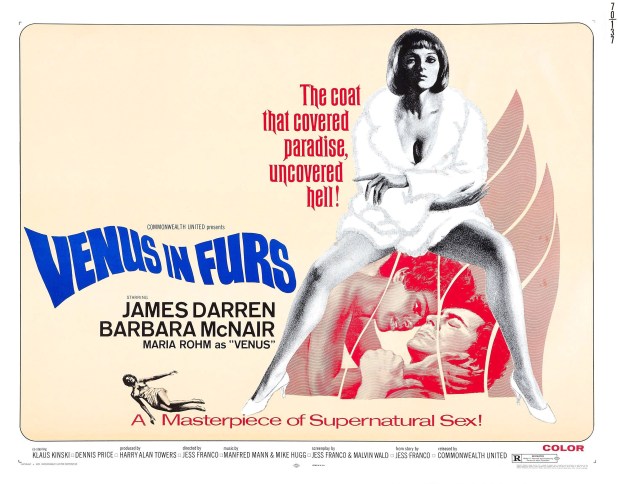
JESS FRANCO MONTH: Venus In Furs (1969)

Someone asked me, “So I’ve never seen a Jess Franco movie. What’s a good one to start with?”

I’m loath to recommend movies to people that haven’t yet built a tolerance for movie drugs. I mean, most Franco is high test black tar heroin movie drugs, films that achieve near murderdrone levels of nothingness balanced with zooms into anatomy that challenge your sanity and synth that seems to drift in the ether like a Spanish fog. Or jazz, maybe?

Also known as Paroxismus, Schwarzer Engel (Black Angel) and Paroxismus – Può una morta rivivere per amore? (Paroxismus – Can a Dead Woman Live Again for Love?), this movie has pretty much nothing to do with the novel by Leopold von Sacher-Masoch other than character names.

Imagine if Vertigo was made by a Hitchcock that wanted to see nudity. Lost Highway by a Lynch that liked trumpet blaring bleats and slow motion. And then, you’re somewhat close, but still have to contend with the fact that at times, it seems like Franco hasn’t even seen another movie before, much less made one, except this time that works and this is as close to perfect as he gets, as if a thousand mustached Lina Romay obsessed glasses wearing madmen were all typing in the same room for one thousand years.

You know how some movies have a fight between style and substance? Well, this movie finds substance being submissive and loving when style edges it and treats it bad and calls it names.

Art dealer Percival Kapp (Dennis Price, living in the tax haven of Sark, making movies like Twins of Evil and five movies with Franco), photographer Olga (Margaret Lee,  who was in 12 movies with Klaus Kinski and if anyone is getting a better next life or into heaven, it’s probably her for dealing with that) and depraved and devious playboy Admed (the maniac’s maniac, the just mentioned Kinski) have whipped, assaulted and drank the blood of Wanda Reed (Maria Rohm, Eugenie… The Story of Her Journey into Perversion) and leave her for dead on a beach where trumpet player Jimmy Logan (James Darren, a former teen idol singer whose song “Addio Mondo Crudele” was a huge hit in Europe; he’s best known as Moondoggie in the Gidget films) can only watch.

So when Wanda washed up on the beach, somehow alive, can we blame Jimmy when he falls for her? Not even Rita (Barbara McNair from They Call Me Mr. Tibbs! and the singer of “Till There Was You” and how did she end up in a Jess Franco movie?; then again, her third husband was killed in a mob hit and she got busted for heroin once at a Playboy Club, no judgment) can take his mind off of her, but when you see a nude woman gliding through reality and murdering people while her own theme song — Manfred Mann! — accompanies her deadly doings.

There are two other Venus In Furs movies — by Joseph Marzano and Massimo Dallamano — but I really think there’s no way they can compare to this. I mean, does a multiple mirror version of an angel of death kill a perverted old man in those films? Empty beaches, rich colors, dead women rising from the sand to kill, baby, kill?

To answer that question at the beginning of all this, this is probably the best Franco movie — well, I can also make an argument for Vampyros Lesbos — there is. At the end of it, I got really emotional and just spent and was like one of those cartoony critics clapping in a basement room all by myself shouting “Cinema!” while tears streamed down my face.

Man, I have problems.

You can watch this on Tubi.

Here’s a drink.

Venus In Furs

  • 1 oz. raspberry vodka
  • 1 oz. Citroen vodka
  • 3.5 oz. apple juice
  • 3 dashes Angostura bitters
  1. Place everything in a shaker with ice and shake it up like you’re finding a trumpet buried in the sand.
  2. Pour in a glass and enjoy.

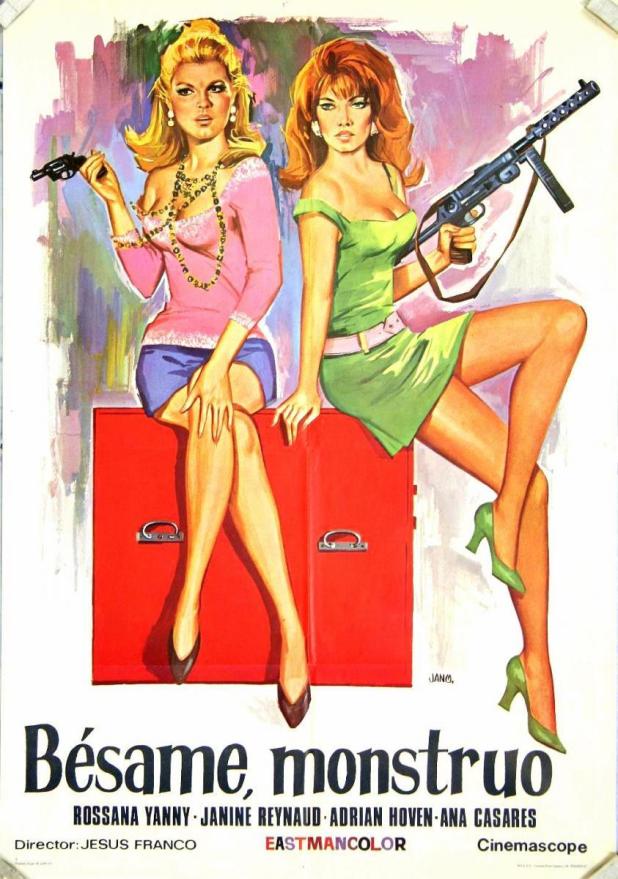
JESS FRANCO MONTH: Kiss Me Monster (1969)

EDITOR’S NOTE: The third Red Lips movie was originally on our site on April 27, 2020. Stay tuned — we’re going to try to get to all of them this month. 

Regina (Rosanna Yanni, Count Dracula’s Great Love) and Diana (Janine Reynaud, The Case of the Scorpion’s Tail) are back again for the third Red Lips movie from Jess Franco.

If the last film — Two Undercover Angels — made no sense, guess what? This one doubles down, almost a stream of consciousness film made up of murders, jazz clubs, stripteases, our girls play saxophones and near-escapes.

The sell copy for this claims, “Stiffs, Satanists and Sapphic sadists all after a secret formula for human clones!”

Maybe it’s the fact that I watched Jess Franco movies one after another and pounded what’s left of my brain into putty, but I loved every single minute of this movie.

Also known as Castle of the Doomed, it feels like Franco ran out of ideas here and just decided to have more things happen to the point that continuity and plot became the contrivances that lesser people try to bring up as necessary elements for a movie.

Nope. Not to Jess Franco.

Knife throwing clones? Evil lesbians? Good lesbians? Satanic murderers? Yeah. It’s got all that and an ending that doesn’t solve anything.

The failure of this movie would bring an end to the girls’ adventures until 1999’s Red Silk, although you can perhaps consider Two Female Spies with Flowered Panties a spiritual side quest.

But I think you should only watch a few Jess Franco movies in a row if you want to survive. And my head is already throbbing.

Also note: Two Undercover Angels had a monster in it. Kiss Me Monster has no monster.

Somewhere in there is a koan that will change your life.

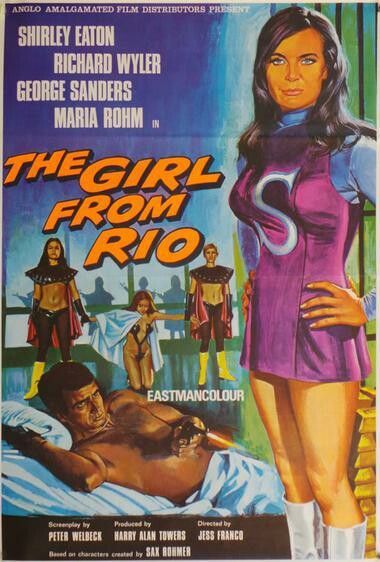
JESS FRANCO MONTH: The Girl from Rio (1969)

EDITOR’S NOTE: This is the fourth time this movie has been on our site. Twice —December 5, 2019 and April 27, 2020 from me — and on November 25, 2020 from Phil Bailey. Here’s Phil’s take.

ABOUT THE AUTHOR: Phil Bailey is a long time photographer and film writer, who doesn’t actually hate everything, but has no fear of being a contrarian.  Follow at Twitter at @stroke_midnight or on Facebook at https://www.facebook.com/philbaileyphoto

Sumuru, the femme villain bent on world domination, originally created for a BBC radio serial by Fu Manchu creator and author Sax Rohmer. If there is a Sax Rohmer story, then producer Harry Alan Towers must be lurking somewhere nearby. Towers produced a series of Fu Manchu films with Christopher Lee starring as the Chinese scientist bent on world domination and decided to take on Rohmer’s lesser known creation with James Bond girl Shirley Eaton in the lead with The Million Eyes of Sumuru in 1967 and followed it up two years later with The Girl from Rio.

The Girl from Rio was directed by Eurocult legend Jess Franco, sandwiched between his two Fu Manchu films The Blood of Fu Manchu and The Castle of Fu Manchu. This is nowhere as gonzo as his most famous/notorious films, it still boasts some great style and a bevy of beautiful women is all manner of undressed and barely dressed. Shirley Eaton, the blonde who was killed by being painted gold in Goldfinger is Sumuru who doesn’t really do much other than lounge around and look beautiful so Eaton is perfectly cast, but the real stars of the movie are Jess Franco regulars Maria Rohm and Beni Cardoso who just fit better with Franco’s vision (that vision being long legs and bare midriffs) and you can just feel Franco’s energy perk up when they are on screen, especially the impossibly leggy Cardoso as Sumuru’s head torturer/dominatrix Yana Yuma who basically steals the movie.

If you’re waiting fora recap of the plot, forget it, because that’s basically what the director did. Rio suffers from the common ailment of Eurocult films of having simultaneously too much and too little plot, It has so many plot threads that are so underdeveloped you can’t really keep it straight, despite all of the on-screen expository telephone calls. It has something to do with a mobster and a British Lord both vying to plunder Sumuru’s island fortress: Femina. Sumuru’s island fortress comes complete with a torture chamber and an all girl army decked out in pleather halter tops, capes, and go-go boots. There’s a lot of talking, a lot of scantily clad women, just enough nudity to keep the plot moving forward. The whole affair plays out like a super sexy, R rated The Man from U.N.C.L.E episode, which makes sense as the title is an obvious play on The Girl from U.N.C.L.E. tv series.

The Girl from Rio is a trashy if slight Eurocult delight that has loads of stylish eye candy. The trippy Italian comic feel to the scenes on Femina almost make up for how odd and disjointed the rest of the movie is. Structurally the movie is a bit of a mess, obviously stitched together from multiple chunks of footage that never quite convinces you that all of these people are in the same story. All faults aside, the campy, fetishistic delights that Jess Franco indulges in during the Femina sequences are well worth the 90 minutes and make the whole affair worthwhile, if just barely.

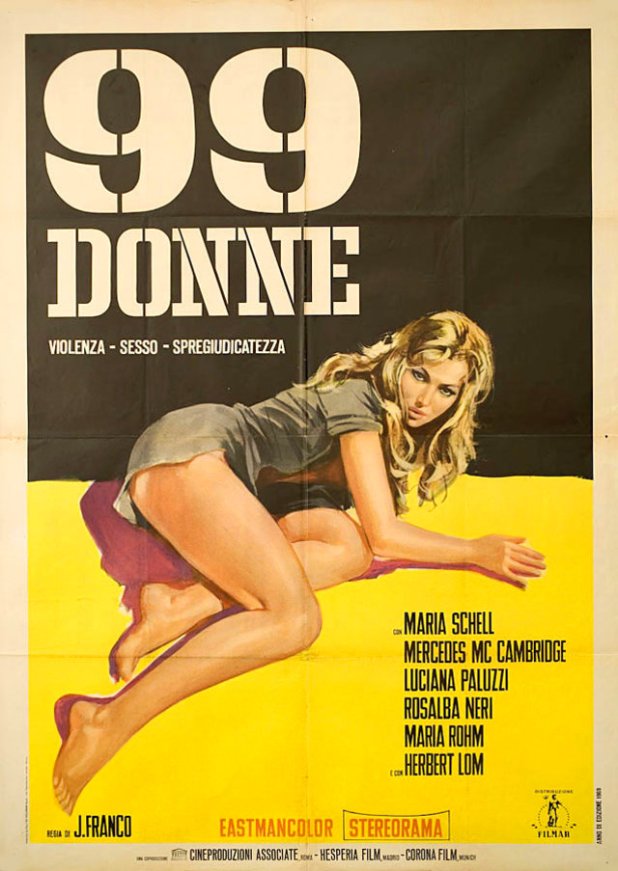
JESS FRANCO MONTH: 99 Women (1969)

EDITOR’S NOTE: Way back during the week of Bruno Mattei, we covered this movie. All the way back on May 16, 2021 and now it’s back with some edits.

This movie is quite literally the Justice League — more like the Legion of Doom — of scumbag film superstars.

It was written and produced by Harry Alan Towers, who went from syndicating radio and TV shows to being arrested along with his girlfriend Mariella Novotny — who was played by Britt Eklund in Scandal — for operating a vice ring. He jumped bail and ran to Europe while his lover revealed that Towers was a Soviet agent using his girls to get info for the Russians. And Novotny, a high-class call girl, had already been linked to both John and Robert Kennedy, as well as having experience working for MI5.

Once he settled down in Europe, Towers married actress Maria Rohm — she’s in this, as well as several other Jess Franco movies — and started writing and producing movies based on the novels of Agatha Christie, the Marquis de Sade and giallo father — one of many, but a father nonetheless — Edgar Wallace.

Plus, he worked extensively with the second member of our rogue’s gallery: Jesus “Jess” Franco.  This may have been the first film that Jess and Towers worked on, but they would make The Girl from Rio, Venus in Furs, Justine, Eugenie… The Story of Her Journey into Perversion, The Bloody JudgeCount Dracula, The Blood of Fu Manchu and The Castle of Fu Manchu.

Franco made at least 173 movies and took a gradual slide from horror, Eurospy and softcore films into grimier and grimier films. He’s an acquired taste that I’ve grown to enjoy, yet for every well-made movie like Bloody Moon, you’ll find one where you wonder if Franco had even seen a film before, much less made one.

The reason for that is often the funds that Franco had at his disposal. He’s the kind of filmmaker who would make ten bad movies instead of one good one, providing that he was getting the chance to make a movie.

He reminds me a lot of the third member of our exploitation army of evil and that would be the man that edited this movie — and from all accounts directed the pornographic insert (pun intended) scenes — Bruno Mattei..

The French version of this movie features eight minutes of fully adult footage, shot with body doubles in similar settings, all to give the illusion that this movie is way more hardcore than it really is.

To be perfectly frank, this movie is an aberrant work of absolute indecency even without seeing gynecological footage of the old in and out.

New inmate Marie (Rohm, yes, the producer’s wife, yet she endures so much that you really get the idea that this is not an example of nepotism) has arrived at Castillo de la Muerte, an island prison where she’s given the number — she no longer has a name — 99.

She’s joined by Helga, now known as 97. She’s played by Elisa Montes, who had appeared in several peplum and westerns before this. And Natalie Mendoz — 98 — is played by Luciana Paluzzi, who was SPECTRE assassin Fiona Volpa in Thunderball, as well as showing up in everything from The Green Slime to A Black Veil for LisaThe Man Who Came from Hate and The Klansman.

They’re suffering under the oppressive sapphic rule of Thelma Diaz, a tough warden who is, shockingly, played by Oscar-winner Mercedes McCambridge, who won that award for All the King’s Men, was nominated for Giant and was also the voice of Pazuzu. She’s berserk in this movie, laying it all on the line, unafraid to go over the top and then keep her upward trajectory.

“From now on you have no name, only a number. You have no future, only the past. No hope, only regrets. You have no friends, only me,” she barks at them before they even get into the prison.

Eventually, Diaz takes things too far, but even the new warden Caroll (Maria Schell, who had an affair so memorable with Glenn Ford that she remembered it two decades later and gifted him with a dog named Bismarck who became his constant companion) can’t improve this hell on earth. So the women escape at the same time that several men break out from the similarly brutal rule of Governor Santos (Herbert Lom).

What happens when you have several damaged women on the run being followed by men who haven’t even seen a woman in decades? And what if that happens in a Jess Franco movie? Yeah, you can see where this is heading.

Rosalba Neri — Lady Frankenstein! — is also on hand to pretty much set the film on fire in every single frame that she shows up in.

Every Women In Prison movie that would follow in the slimy wake of this film would be based upon the path that it blazed, including Mattei’s own The Jail: Women’s Hell, which he waited nearly four decades to make and pretty much stuck pretty close to what Franco started. Well, he was also following the even more berserk template he’d established with Violence In a Women’s Prison and Women’s Prison Massacre. Man, if you want a WIP movie, call Bruno Mattei. Sadly, you can’t. He’s dead.

Or you could call Jess Franco, were he alive. He made nine WIP movies in his career, including Isla the Wicked WardenJustine, The Lovers of Devil’s IslandBarbed Wire DollsWomen Behind BarsLove CampSadomania and this movie.

This is one of the Franco films where he’s making not just a movie, but a good movie. The focus is soft, the feel is surreal and the interplay with the Bruno Nicolai score is fabulous.

JESS FRANCO MONTH: The Castle of Fu Manchu (1969)

EDITOR’S NOTE: As we celebrate this month of all things Franco, we’re bringing back our August 19, 2021 of this Sax Rohmer adaption. 

Man, Christopher Lee may rival Donald Pleasence for not being able to say no — I say this with full knowledge that the former turned down Halloween while the latter said yes to that series more than he should have — and here he played Sax Rohmer’s “yellow peril” character of Fu Manchu, who is joined by his just as sadistic daughter Lin Tang. She’s played by Tsai Chin, who was a Bond girl twice in You Only Live Twice and Casino Royale, topped the music charts with “The Ding Dong Song” and played Auntie Lindo in The Joy Luck Club.

Rosalba Neri is also in this and you know, as bad as this movie might be, Rosalba Neri is in it. You should be so lucky as to get to spend 92 minutes with her.

This is the fifth and final time that Sir Lee played Fu Manchu, if you can believe that. Also starring in this movie is plenty of pilfered footage, including the entire opening effects coming from A Night to Remember and the dam bursting being taken from Campbell’s Kingdom.

There’s lots of fog, which I appreciate, and a plot about freezing the oceans, which I am also totally down with. Man, is Fu Manchu the good guy?

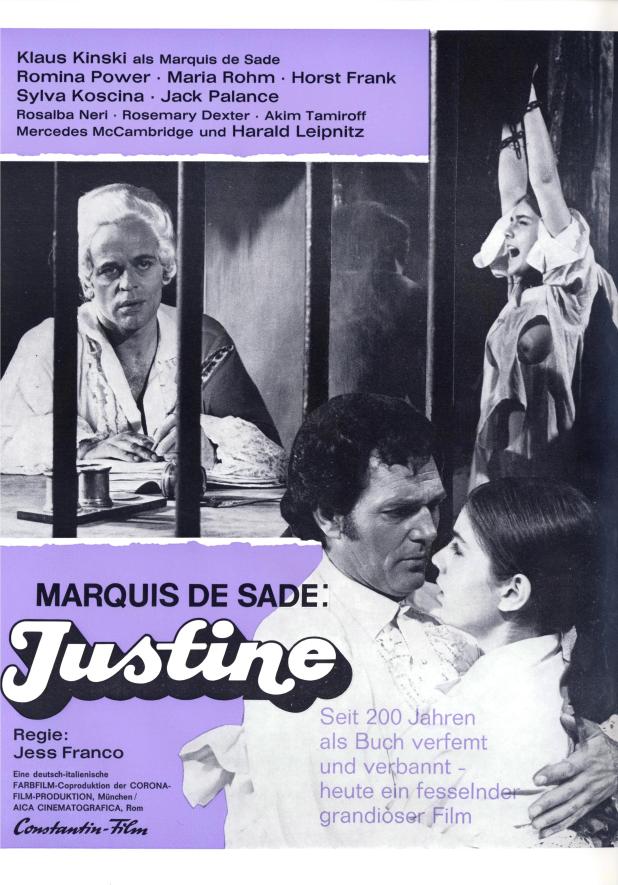
JESS FRANCO MONTH: Marquis de Sade: Justine (1969)

After The Blood of Fu Manchu, producer Harry Alan Towers and Jess Franco wanted to make a more adult film and this movie was the result, made with a million dollar budget, which isn’t much for some people but would be one of Franco’s largest budgets.

There were still some issues, like how Rosemary Dexter (Eye in the Labyrinth) was supposed to play the lead, yet she was moved to the smaller role of Claudine when Romina Power was chosen by a Hollywood money man to play the lead. Franco was unhappy with her in the movie, saying “most of the time she didn’t even know we were shooting” and that he had to rewrite the story and move away from DeSade as she was so hard to reach.

Justine and Juliette (Maria Roma) are sisters who live in a convent, a place they’re taken from when he dies and leaves his gold behind. While Juliette goes to stay at Madame de Buisson’s (Carmen de Lirio) house of ill repute, learning the skills of the oldest business, her sister Justine goes to the church, where a priest introduces her to du Harpin (Akim Tamiroff), who hires her on as a maid, but it’s all a scheme to steal from his master and use her as a stooge, yet Justine escapes prison thanks to Madame Dubois (Mercedes McCambridge, can this movie have more great actors in it? Yes, it can.).

While all this is going on, Juliette and another prostitute named Claudine (yes, Rosemary Dexter who was supposed to be the lead) kill their boss and a client, stealing gold and going on the run all the way to Madame Dubois. The men there end up trying to assault her more innocent sister, as she runs to the home of an artist named Raymond (Harald Leipnitz) before being caught in the murderous games of the de Bressacs (Horst Frank and Sylva Koscina), which ends up getting her branded with an M — for murderess — on her breast.

I kind of love that every decision that Juliette makes is stuff like killing people and drowing her crime partners while Justine ends up trapped in all manner of Little Annie Fanny situations like being kidnapped by Father Antonin (Jack Palance) and his order of ascetics. Instead of studying and meditating, they’re making filthy love to anything that moves. When Father Antonin offers to free Justine from this world by making her a sacrifice, but she escapes yet again, finally finding her way back to her sister.

Meanwhile, the Marquis de Sade (Klaus Kinski) has hallucinated this all while stuck in prison, obsessed as always with female flesh. I mean, when Rosalba Neri is in the story you’re imagining, wouldn’t you? Also — just as a warning — Rosemary Dexter was 16 when she made this. Fair warning.

People often ask me, “What’s the one Jess Franco movie I should watch?” Depending on how well you can handle this material, this would be the best produced of his movies, filled with gorgeous settings, period perfect costumes, a wonderful Bruno Nicolai score and perhaps the most focused Franco I’ve seen, despite the fact that he wasn’t getting to make the movie that he wanted to make. And if you’re a maniac, I have a bunch more to tell you about.