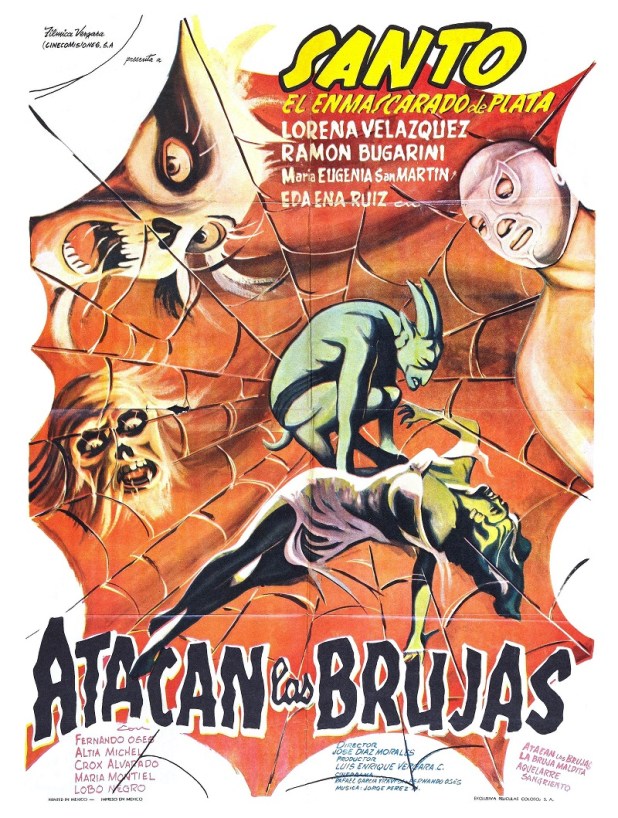
Also known as Santo Attacks the Witches, this film finds the Mexican superhero wrestler El Santo trying to save a woman named Ofelia, who keeps having visions of Satan and his witch followers using her as a human sacrifice. Santo saves her by literally making the shadow of the cross with his body, stopping not only the witches but sending Satan away and waking up Ofelia. She’s had this dream ever since she’s been forced to live in the home of her dead parents in order to get their fortune in the will. Luckily, her boyfriend Arturo knows that Santo exists and sets out to contact him.
It turns out that the family secretary died fifteen years ago and has been a witch named Mayra* since then. She commands an army of witches who go out of their way to “infernally seduce” our hero who sends them on their way back to Hell. Santo uses all manner of weaponry to make that happen, from flaming torches to giant crosses.
Satan wants Ofelia and Santo out of the way, but our hero is just too much for those who trod the left hand path. By the end, the man in the silver mask has set dozens of occult dabblers ablaze, leaving the young lovers in an embrace as he jumps in his sportscar and drives away, presumably to wrestle a match or perhaps battle female werewolves.
There are better Santo movies, but honestly, a Santo movie is like a taco. They’re all good. Some are better than others. But even a bad taco is better than anything else.
*She’s played by Lorena Velázquez, who was also Thorina the Queen of the Vampires in Santo contra Las Mujeres Vampiros and Gloria Venus in the Wrestling Women series.
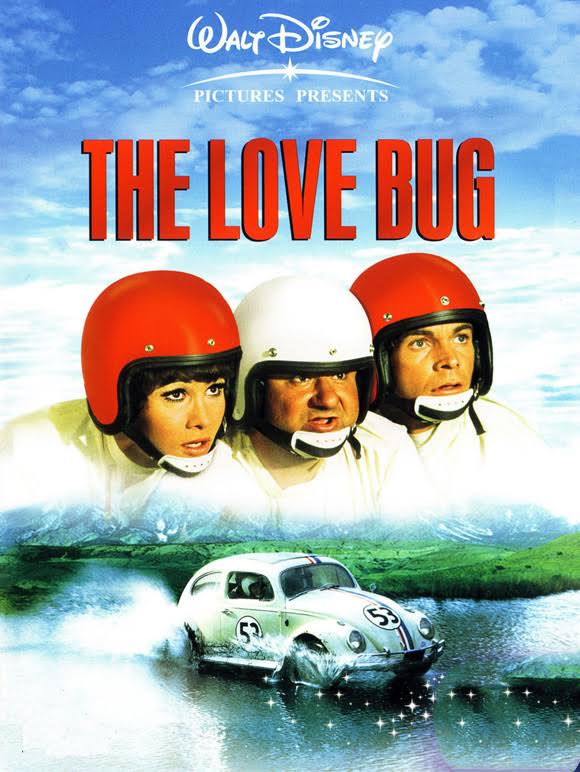
Based on the 1961 book Car, Boy, Girl by Gordon Buford, this was the first of many movies that woud feature Herbie the Love Bug, who is driven by Jim Douglas (Dean Jones) and worked on by Tennessee Steinmetz (Buddy Hackett), a mechanic who transforms used car parts into art.
Jones claimed that this film was so good with the fact that it was made when Walt Disney was still invovled with his films. It was released just two years after Walt’s death. I would also say that having Robert Stevenson as director — he also made Mary Poppins, That Darn Cat! and Old Yeller — helped.
Douglas has big dreams of racing, but all he getsto do is compete in demoltion derbies. After racing and crashing another car — an Edsel, no less — our protagonist comes across a car dealer named Peter Thorndyke (David Tomlinson, Mary Poppins) abusing a Volkswagen Beetle. The next morning, the car just so happens to show up at Douglas’ house and he’s nearly arrested until Thorndyke’s sales assistant and mechanic Carole Bennett (Michele Lee) convinces her boss to sell the car.
Herbie — so named by Tennessee — seems to have a mind of his own, but he’s able to help Douglas win several big races, to the continual chagrin of his former owner. Much like nearly every Dean Jones character, Douglas is a jerk and just wants a Lamborghini 400GT instead of the heroic little VW Bug. Herbie responds by running away, damaging big stretches of Chinatown and nearly driving himself off the Golden Gate Bridge in his depression. Yes, back in the day, live action Disney got dark.
Of course, not so dark that a small Volkswagen can’t win a race against cars with much more horsepower, like Thorndike’s Apollo GT (the avergae VW bug had 40 hp while the Apollo GT had 225 hp).
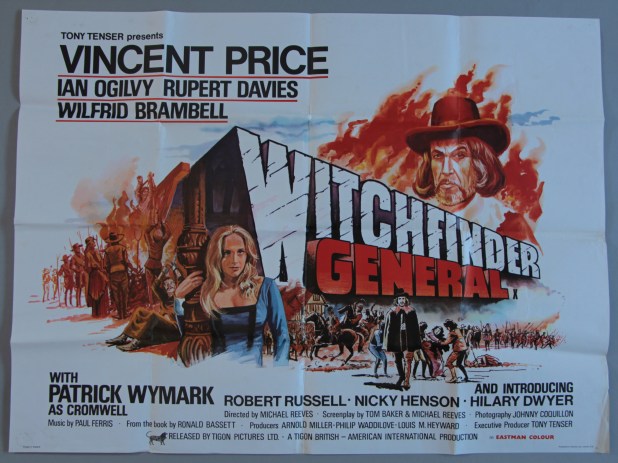
Based on Ronald Bassett’s — a man who was primarily known for his medical and pharmaceutical work — novel about Matthew Hopkins, a notorious 17th-century witch-hunter, this 1968 film was a co-production of Tigon British Film Productions and American-International Pictures (who retitled the film The Conqueror Worm to link it to their series of Edgar Allan Poe movies).
Movie posters used to be awesome.
Michael Reeves was 24 and only three films* into his career when he made this film, the tale of Hopkins (Price), a lawyer who has opportunistically become a witchhunter with no morality whatsoever, blackmailing and killing his way through the world. This film is pure nihilism and makes the statement that when the world goes to hell, there is no way to be an angel.
Reeves saw Donald Pleasence as Price, but AIP only saw Vincent Price as the lead. Reeves had refused the courtesy of meeting Price at Heathrow Airport which was a “deliberate snub calculated to offend both Price and AIP” according to Benjamin Halligan’s book Michael Reeves. When they met for the first time, Reeves said, “I didn’t want you, and I still don’t want you, but I’m stuck with you!”
According to Kim Newman in Nightmare Movies, Reeves and Price argued over the actor’s propensity to chew the scenery and Price supposedly said, “Young man, I have made eighty-four films. What have you done?”
Reeves replied, “I’ve made three good ones.”
And that’s how Reeves pushed Price into delivering the performance in this film. In the book Faster and Furiouser: The Revised and Fattened Fable of American InternationalPictures, Price said that he wrote the director a ten-page letter after he saw the film, praising the director’s work.
Reeves wrote back, “I knew you would think so.”
After Reeves’s death, Price would think back and say, “I realised what he wanted was a low-key, very laid-back, menacing performance. He did get it, but I was fighting him almost every step of the way. Had I known what he wanted, I would have cooperated.”
That said — Reeves was notoriously poor with actors, mainly concentrating on what the visual look of the film leaving the acting direction — outside of his playing with Price — to the actors.
The poster tagline — “Leave the realized at home…and if you are squeamish stay home with them!” — isn’t a lie. This is a film packed with some of the most intense torture and violence you’ll see. It was heavily censored in England** — yet still upset people — and played uncut in the U.S.
Hopkins is using the English Civil War and the destruction of social order to brutally abuse and torture those he deems witches throughout East Anglia. Then, he and his assistant John Stearne charge the local government for their work and move on.
Richard Marshall (Ian Ogilvy, who was in several of Reeves’ teenage short films and appeared in his movies The She Beast and The Sorcerers) is a young soldier returning home from the war, asking John Lowes (Rupert Davies) if he may marry his niece Sara (Hilary Dwyer, The Oblong Box, Scream of the Banshee). The old man confides that they are concerned for their safety and feel as if the village has turned on them as Marshall gives his word to protect them. As he leaves their town, he gives the witchfinder directions to get there.
Hopkins and Stearne enter town and instantly go to work taking out witches, including using rats and hot needles to find the Devil’s Mark inside Lowes. Sara offers sexual favors to protect her uncle and as soon as Hopkins leaves town, his partner assaults her.
When Marshall returns, he marries Sara in his own ceremony and vows to kill the two men, nearly beating Stearnes to death. Yet the tables are turned and the hero must watch as his love is tortured before him. That’s not the end, but I’d like you to see this for yourself.
AIP originally made this movie as a tax write-off, but was surprised by the quality of the film. Samuel Z. Arkoff said, “Michael Reeves brought out some elements in Vincent that hadn’t been seen in a long time. Vincent was more savage in the picture. Michael really brought out the balls in him. I was surprised how terrifying Vincent was in that. I hadn’t expected it.”
This film led to the second wave of AIP Poe films like The Oblong Box (originally scheduled to be directed by Reeves, but handed over to Hessler after Reeves fell ill during pre-production), Murders in the Rue Morgue and Cry of the Banshee, which reteamed Price and Dwyer.
It also inspired several inquisitonploitation*** films such as Mark of the Devil and The Bloody Judge, as well as leading the way for religious horror such as The Devils and the folk horror of The Blood on Satan’s Claw.
It also influenced metal, as the band Cathedral has a song “Hopkins (Witchfinder General)” and the band Witchfinder General outright took the name. Like all great NWOBHM bands, they have a self-titled song.
There was even a BBC4 radio play, Vincent Price and the Horror of the English BloodBeast, which tells the story of the relationship between Price and Reeves.
Sadly, a few months after this movie was released, director Reeves died in London at the age of 25 from an accidental alcohol and barbiturate overdose. What an incredible blow to the world of film, as obviously he was going to be a director whose work could only have gotten better.
*Castle of the Living Dead, The She Beast and The Sorcerers.
**Even the script provoked this reply from censors: “A study in sadism in which every detail of cruelty and suffering is lovingly dwelt on…a film which followed the script at all closely would run into endless censorship trouble.”
Author Dennis Wheatley was expelled from Dulwich College for allegedly forming a “secret society,” which is pretty awesome and hilarious. He was also gassed while serving in World War One and then went on to coordinate strategic military deception and cover plans during World War Two, during which he earned a direct commission in the JP Service as a Wing Commander and took part in the plans for the Normandy invasions. After the war, he was awarded the U.S. Bronze Star.
After his second book, The Forbidden Territory, he decided to write a book about black magic. A friend introduced him to Aleister Crowley, the Reverend Montague Summers and Rollo Ahmed, which led to The Devil Rides Out. In the years after this novel, Wheatley became known as an expert on came to be considered an expert on the paranormal.
He was so popular for this that in the 70s, there was even The Dennis Wheatley Library of the Occult, a series of books that he selected and wrote the introductions for, including books by Crowley, Bram Stoker, H. P. Blavatsky, Maurice Magre, Isaac Bonewits and Cheiro.
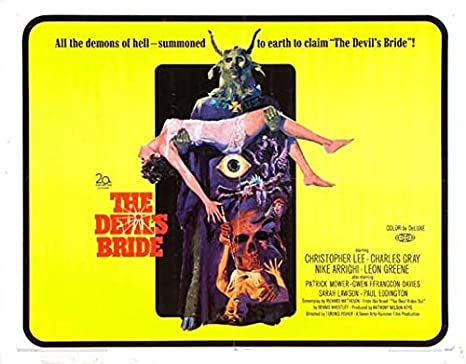
This was one of Christopher Lee’s favorite movies — he’s a heroic character, which is rare for him — and would say in interviews that Wheatley was so pleased with the movie that he gave the actor a first edition of the book.
The Devil Rides Out doesn’t dance around the issue as to whether or not. the devil exists. Lee’s Duc de Richleau character — who appeared in eleven of Wheatley’s novels — doesn’t just fight occultists. He comes up against the literal Goat of Mendes called Baphomet and the Angel of Death for real.
This movie also presents Christianity as the ultimate destroyer of evil, so if you get upset by the Conjuring films and how they simplistically make the battle of heaven and hell white and black, well…this movie goes even further. Wheatley believed all of these things and even saw Communism as a force from Hell.
If you only know Charles Gray from Rocky Horror, let me tell you, he’s great in this movie. I love every single minute of this film. His character of Mocata was based on Crowley in the book, in which he was seeking to start an occult magic world war with a mummified penis called the Talisman of Set. Obviously, that is not in the film.
While Simon and Tanith were played by Patrick Mower and Nike Arrighi in the film, the roles were originally going to be given to Roddy McDowall and Linda Evans. Sadly, McDowall had to pull out at the last minute to take care of his ailing friend Louise Brooks, who was suffering from emphysema and arthritis.
Directed by Terence Fisher from a script by Ricard Matheson, I’d say this is in the top ten of Hammer’s output.
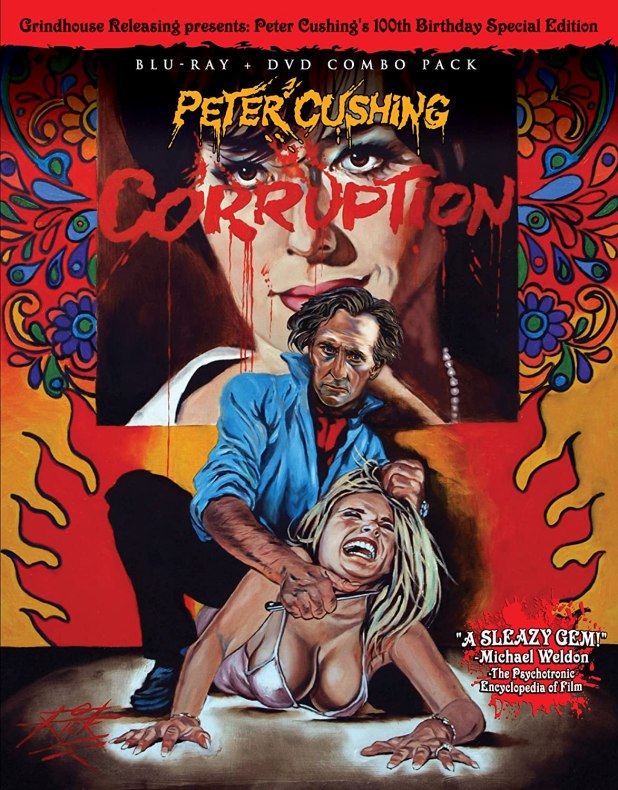
As the trailer will tell you, Corruption is not a women’s picture.
That’s debatable.
What is not is that Corruption is a ripoff of Eyes without a Face.
But hey — some of my favorite movies are total ripoffs.
Renowned plastic surgeon Sir John Rowan (Peter Cushing) starts the movie at a swinging 60s party with his beautiful fiancée Lynn (Sue Lloyd, Hysteria). Sir John isn’t dealing well with all this counterculture excess, so when a pervy photographer makes a pass at his girl, he attacks the man, sending a hot light into Lynn’s face. This party may seem like a parody when seen today, but this is a serious scene, with Cushing facing the Summer of Love and not dealing so well with all of it.
Rowan pledges to flix Lynn’s scarred face through a combination of laser technology and a pituitary gland transplant. Sound good? Well, it’s fueled by murder, giving the fluids of young women to his wife, to keep her face from scarring and it needs to be repeated again and again to stop the scars from coming back. Everything goes well — as well as repeatedly killing people and basically feeding their skin to your wife can go –until Sir John and Lynn try to seduce a new victim who ends up being part of a gang of robbers.
Those criminals break into the home of Sir John and they soon learn his secret. However, no one profits from this knowledge, as everyone end up getting killed by a surgical laser. And then, get this — it’s all a dream!
Cushing would say, “It was gratuitously violent, fearfully sick. But it was a good script, which just goes to show how important the presentation is.” You have to love a movie where Van Helsing flips out at a party that Austin Powers would say is way too mod. And wow, it’s pretty gory for a late sixties British movie!
Director Robert Hartford-Davis would also make Incense for the Damned, Gonks Go Beat and The Fiend.
Also, just to remind you one more time, Corruption is not a women’s picture.
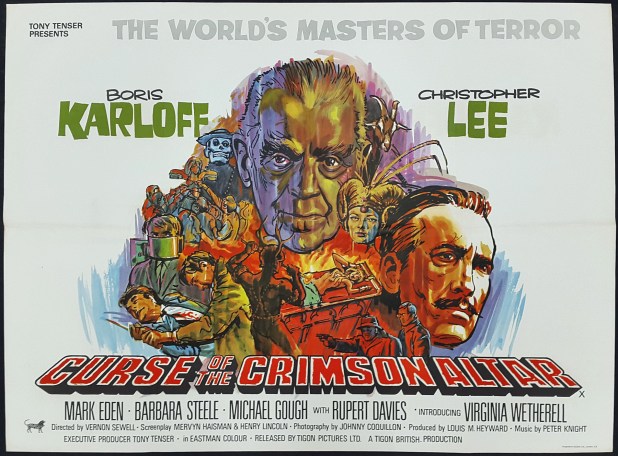
I’ll be perfectly honest. This could have been the worst movie ever made and you put Barbara Steele in green body paint and I’ll watch it anyway. Luckily, it’s a pretty great movie.
Director by Vernon Sewell (The Blood Beast Terror) and written by Mervyn Haisman (Dr. Who, Jane and the Lost City) and Henry Lincoln (who wrote The Holy Blood and the Holy Grail, which Dan Brown completely ripped off to make The DaVinci Code, as well as one of the main researchers into Rennes-le-Château and an honorary Militi Templi Scotia knight in recognition of his work in the fields of sacred geometry and Templar history), this movie piles on the occult and I couldn’t love it anymore for that fact. Or that it was based on “The Dreams in the Witch House” by H. P. Lovecraft.
Antiques dealer Robert Manning is looking for his brother, who has gone missing after visiting their family’s ancestral home in Graymarsh. He arrives in the middle of a party — people are painted like they are on Laugh-In and there’s a catfight tournament seemingly being held — and by the first evening’s rest, his dreams are filled with images of ritual sacrifice. That’s when he joins up with occult expert Professor Marsh (Boris Karloff!) to battle the forces of Satan himself.
Making this all the better, Morley, the owner of the Craxted Lodge*, is played by Christopher Lee.
Also — Michael Gough appears as a sinister butler!
When this was released by American-International Pictures in the U.S., all of the nudity in the virgin sacrifice scenes were, well, sacrificed.
Honestly, no one is going to blame you if you just watch the scenes with Steele leading wild orgies of death and psychedelic mayhem. They even distort her voice and toss all kinds of different colors all over these scenes, which make them more than worthy of the time it takes to watch this movie.
*It’s actually Grim’s Dyke, an allegedly haunted house that also was the setting for Zeta One, several episodes of the Avengers and Cry of the Banshee. It was also the home of W.S. Gilbert of Gilbert and Sullivan.
The feature debut of Norman J. Warren, Her Private Hell came about producer Bachoo Sen approached Richard Schulman, owner of London’s Paris Pullman Cinema, with the idea to make their own films. This is how the production company Piccadilly Pictures started.
Schuman was the owner of London’s Paris Pullman Cinema and was showing Warren’s short film Fragment, so they made an offer for him to film two movies for them. The director would later tell Rock Shock Pop!, “I had no idea what the film would be, but to be honest, I would have said yes to anything. I was 25 and desperate to direct a feature film.
The story was written y Glynn Christian, a New Zealand immigrant who based his screenplay on his own experiences as a foreigner living in the swinging London of the 60s.
Marisa (Lucia Modugno, LSD Flesh of the Devil, Danger: Diabolik) has come to London to be a model and the first magazine she works for decides to keep her in a fancy high rise apartment along with their top photographer, Bernie (Terry Skelton). They explain its for her protection and not to be the sole owner of her image, which she soon realizes as the magazine begins to control her every move.
While Marisa sleeps with Bernie, she also falls for Matt (Daniel Ollier, who beat Udo Keir for the role), a young photographer whose avant-garde nudes end up in Margaret — one of the magazine’s owners — possession and get sold to a foreign magazine. The film then becomes all about who Marisa will leave with — Bernie, Matt or alone. And perhaps Margaret and Bernie aren’t strangers to one another, as it turns out.
At once a naive girl done wrong film mixed with a movie about the literal swinging 60s morals, Her Private Hell isn’t the Norman J. Warren you may know and love. This is closer to French New Wave than anything else he’d make.
At one point, this Norman J. Warren’s was rated X. Today, it plays uncut on YouTube. Such is the changing of the tides.
Just listen to that song that opens this up! You know instantly it’s the end of the 60s and you’re about to watch something romantic. Or dirty. Probably both.
This is the story of Steve (Simon Brent, Love Is a Many Splendored Illusion) who can’t decide between all of the women who want to sleep with him or his wife Suzanne (Georgina Ward, The Man Who Finally Died), who now has a new lover in her life.
Of course, when all of the women are as attractive as the French model who is new in town (played by Françoise Pascal, who was also in There’s a Girl In My Soup and Incense for theDamned), that’s not going to be so simple.
Warren would move on to make Her Private Hell before discovering the horrors that he’d make his name on, stuff like Satan’s Slave, Prey and Terror — all great movies you should totally check out. For someone who started life stricken by polio and grew to adulthood with only one functioning arm, Warren ended up having one of the strongest careers a horror director can dream of.
This would be the last secular movie that Ron Ormond would ever make and what a movie to end that era of his career on. He also plays the mob boss Nemo, the man who rules the strip clubs of New Orleans — this movie is also known as The Monster and the Stripper — and decides to book a creature three men found in the marshes known only as Swamp Thing to be menacing next to his array of beehived go-go girls who are absolutely astounding in their inventiveness, twirling flaring tassels off their pasties.
The movie plays like a sketch comedy show, except that the Swamp Thing — played by Ormond’s next-door neighbor, a hulking rockabilly singer with the marvelous name of Sleepy LaBeef — is absolutely horrific, biting the necks off chickens to drink their blood and bearing men to death with their own arms. He’s like a Herschell Gordon Lewis movie character inserted into this wanna-be Russ Meyer film made by a Southern family who would soon almost die ina plane crash — and then Roger would have to nearly die again — and then find God and make movies with none of this sin.
This movie has something for everyone. You want a creature feature? It has that. How about some mob drama? Yes. And how about something for daddy? This movie is filled with dancing of the most prurient kind. The Swamp Thing falls for the new girl who is too shy to strip nude — someone needs to make a Letterboxd list of strippers in movies who never get unclothed — and when she’s attacked by the queen of the club, well, you’ve seen every monster movie ever made. Human beings are gonna pay.
This is the kind of movie that describes Bourbon Street as “sleepy by day, psychedelic by night,” which is pretty much the best thing ever written in a film. The world needs more movies that have 60s exotic dancing mixed with surprising torrents of gore.
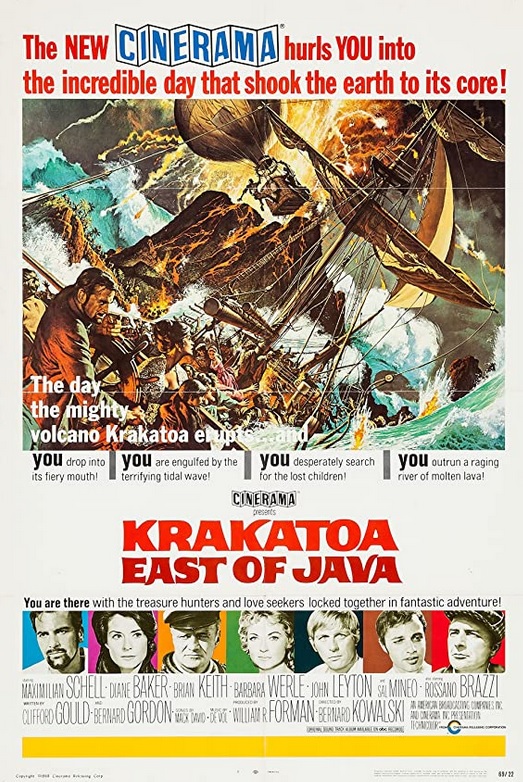
Editor’s Note: We hope you’re enjoying our tribute to the films of director Bernard L. Kowalski. Today, we’re reviewing his first major studio feature film. And in a twist that only a B&S About Movies reader can appreciate: the leads of Maximilian Schell and Brian Keith would later star in their own, respective Star Wars-boondoggles that were The Black Hole and Meteor. Now, if that doesn’t make you want to watch this proto-disaster drama, then we don’t know what will.
Lost somewhere between Arthur Hailey and Irwin Allen igniting the ’70s disaster genre with their respective Airport franchise and the one-two-punch that is The Poseidon Adventure and The Towering Inferno (and not forgetting Mark Robson’s Earthquake for Universal), there was ’50s blacklisted and ex-Poverty Row Monogram Pictures and King Brothers low-budget drive-in scribe Philip Yordan’s return to the Hollywood majors with his proposal of making a film about the 1883 eruption of the island of Krakatoa. Yordan’s “blacklisting” was actually a blackballing, due a script mix up that brought forth a contractual dispute between 20th Century Fox and Warner Bros. Unable to work in Hollywood, Yordan ended up in Spain working for Samuel Bronston, where Yordan incorporated Security Pictures. However, when it comes to “blacklisting”: he did, before his own ouster, front for ’50s blacklisted writers.
Now, back in 1965: Yordan began his “come back” with the man-screws-up-the-Earth disaster epic, Crack in the World. (Yeah, it was made on the cheap in Spain for Yordan’s Security Pictures, but Paramount gave it a U.S. release.) However, for the B&S crowd, Yordan pumps our VHS-lovin’ hearts with his final films, ones that we go on and on about: Cataclysm (1980), The Nightmare Never Ends (1980), Savage Journey (1983), Night Train to Terror (1985), Cry Wilderness (1987), Bloody Wednesday (1987; which we need to review), and the The Unholy (1988). Oh, and how can we forget Marilyn Alive and Behind Bars (1992), aka Scream Your Head Off (sometime in the ’80s).
I know . . . let’s move on from my Yordan geek-dom. Back to the mountains of Krakatoa, we shall go!
So, for dramatic effect — as if people running for their lives from an erupting volcano wasn’t enough drama — ‘ol Phil concocted a subplot about a band of unsavory characters aboard the decrepit steamer Batavia Queen attempting to salvage a sunken cargo of pearls deep in the island’s watery outskirts, with the bragging rights of a $3 million production budget. Initially, the film started out at Columbia Pictures with Rock Hudson (who eventually ended up in a disaster flick of his own with 1978’s Avalanche) as Captain Chris Hanson, the commander of the Batavia Queen. As with most “big” movie plans, the project fell into “development hell,” and came out on the other side under the Cinerama Releasing Corporation shingle, a studio-distributor that did pretty with the John Boorman-directed (Zardoz, The Exorcist II: The Heretic) World War II drama Hell in the Pacific (1968) starring Lee Marvin.
Then, the real disaster erupted.
The then in-camera effects and process shots required to make the volcanic disaster appear convincing on film proved to be difficult; Philip Yordan gave up on his dream project; a new producer, Clifford Newton Gould, commissioned a new script; the film’s runtime ballooned to 130 minutes (two hours and ten minutes); once conceived as a family-friendly adventure, it now had racier, adult-dramatic elements added; the weather, the seas, and animals on the location weren’t cooperating within the budget.
At the time, Bernard L. Kowalski was a young TV director who cut his teeth with Roger Corman on Hot Car Girl, Night of the Blood Beast, and Attack of the Giant Leeches, but he more than proved himself in the more commercial realms of network television directing episodes of westerns (Rawhide, The Wild Wild West, The Virginian, Gunsmoke) and law procedurals (Perry Mason, The Untouchables, Mission: Impossible). There’s no doubt Kowalski was more-than-ready for a major studio, million dollar-plus project. But the “what ifs” abound: If only Columbia had backed the project (with more money). And, no disrespect to our leads of Maximilian Schell and Brian Keith, both are fine actors — if only Rock Hudson had carried the picture. And you didn’t have bickering I-know-better-than-you-do producers revamping a locked script and adding superfluous, saucy adult drama that left us with a confusing plot rife with a constantly changing adventure-to drama-to romance-to-adventure tone augmented with beyond-the-budget, haphazard special effects.
And, of course . . . there’s that pesky Cinerama Releasing Corporation boondoggle with the title: not only did the producers misspell (insist) the island, known as Krakatau; the island is — while technical part of the Indonesian “Far East” — is actually west of the isle and sea of Java. But how many of us dumb ticket buyers back in 1968 knew that fact? Well, the film critics made sure we knew in their reviews. And besides, “East” is sexier, you know, with Japan and all. In the end, the cataclysmic event that killed 36,000 people referenced in the film isn’t a docudrama: it is merely a (wildly, historically in accurate) backdrop for its family adventure-cum-adult dramatic relationships storyline.
So . . . do we need to tell you the movie was a critical and box office bomb? Not every movie with an overture and intermission (as did Fiddler on the Roof and 2001: A Space Odyssey) can be a success. The 130-minute print that ran in theaters in 1969 was later edited-for-television — with scenes shorted or wholly deleted — into a 106-minute print. Vying for the epic sweep of David Lean’s Lawrence of Arabia (1962), which ran near four hours long and cleared $70 million against its $15 million budget to sweep The Golden Globes and Oscars, Philip Yordan’s dream project turned into a box office bomb.
Sadly, as with most directors-for-hire who have no control over the script they’re hired to shoot, nor a voice against those I-know-better-than-you-do producers, Bernard L. Kowalski shouldered the blame. After making two more major studio films for AVCO Embassy Pictures, Stiletto(1969), based on a Harold Robbins paperback best seller (starring Alex Cord and Britt Ekland), and the Civil War western Macho Callahan (1970; stars Gene Shane of The Velvet Vampire and Werewolves on Wheels alongside David Janssen), neither which set the box office on fire, Kowalski made his TV movie debut — and forged a successful TV movie career — with the airline disaster flick, Terror in the Sky(1971).
While Tubi carries the 106-minute TV print, we found the 130-minute theatrical cut on You Tube to enjoy. Moi? Even with its flaws, I stick to the epic — in more ways than one — theatrical print. You can enjoy the trailer on You Tube.
About the Author: You can learn more about the writings of R.D Francis on Facebook.He also writes for B&S About Movies.





 B&S About Movies
You must be logged in to post a comment.