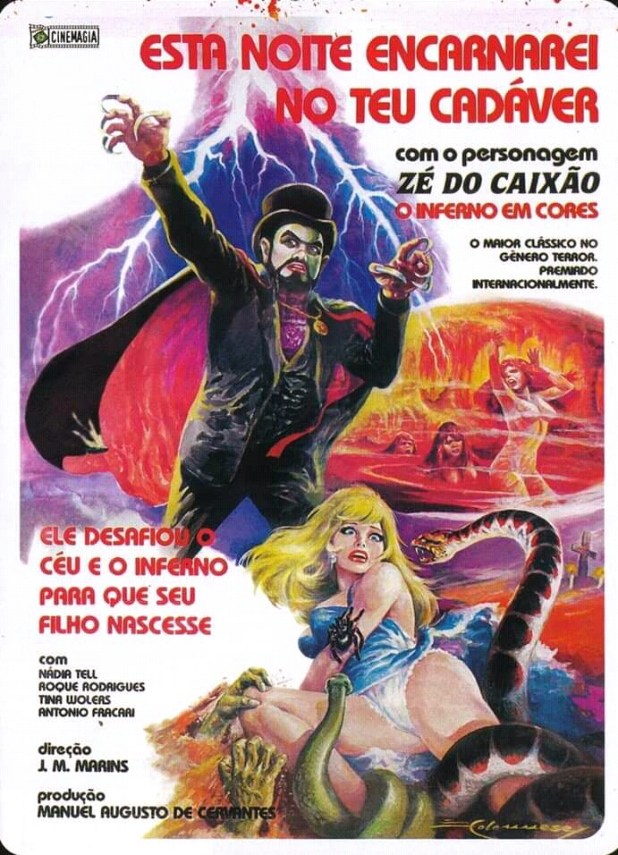
Sure, Coffin Joe was dragged into a pond by the skeletons of his victims and had accepted God, but now he’s back and seemingly as filled with hate for the human race as ever before. Instead of his search for the perfect woman, he’s here to tell you three stories, as if he’s an EC Comics character. Well, a year after this movie, he would have his own comic book series with the same title. It was also the name of his much later TV talk show.
In “The Doll Maker,” a man and his four gorgeous daughters make the most realistic and sought after dolls. Criminals rob them when they learn that they don’t keep their money in the bank. After the doll maker faints, the robbers assault the daughters, who actually start to accept and encourage their advances after remarking about their eyes. And soon enough, we learn how the dolls have such human-looking eyeballs.
“Obsession” is about a poor balloon seller with a foot fetish and a love for a beautiful woman well above his station. After her wedding, which he watches from afar, he learns that she has been murdered. Too poor to attend her funeral, he comes to her body in the mausoleum where, well, he makes love to her and her feet before returning the shoes he saw her lose when she was still alive.
Finally, “Theory” has Professor Oãxiac Odéz (José Mojica Marins, also Coffin Joe and this film’s creator) bring a rival professor and his wife to his home. Soon, he has imprisoned them and forces them to go through a series of sadistic experiments to prove if instinct can overcome reason and love.
So yes, Coffin Joe is in this for about three minutes. But his fingerprints — and long fingernails — are all over every frame.
EDITOR’S NOTE: The Power was on the CBS Late Movie on April 7, August 1, 1972 and February 4, 1976.
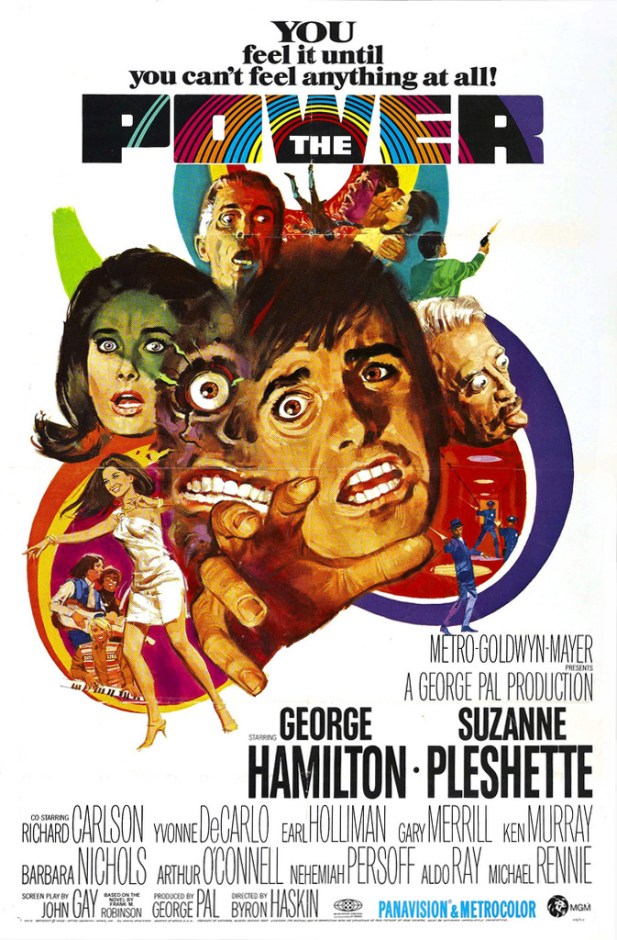
The last film by director Byron Haskin*, who also made War of the Worlds with this film’s producer George Pal, The Power was written by John Gay and based on the book of the same name by Frank M. Robinson. Robinson was also the speechwriter for Harvey Milk and his designated successor, but he didn’t take office after the politician was killed. Another of his books — The Glass Inferno, co-written with Thomas N. Scortia — was combined with Richard Martin Stern’s The Tower and filmed as The Towering Inferno.
The Committee on Human Endurance has been researching the ability to survive pain and physical stress for the space program. Dr. Henry Hallson (Arthur O’Connell) has been screening committee members—biologist Dr. Jim Tanner (George Hamilton), geneticist Dr. Margery Lansing (Suzanne Pleshette), physicist Dr. Carl Melnicker (Nehemiah Persoff), biologist Dr. Talbot Scott (Earl Holliman), Dr. Norman Van Zandt (Richard Carlson) and government liaison Arthur Nordlund (Michael Rennie)—to see who has the best survival ability.
He brings out a psi wheel and claims that someone on the committee has superhuman telekinesis, but the exercise doesn’t prove who it is. He’s soon killed by whoever has the power, and his widow Sally Hallson (Yvonne De Carlo) tells Tanner that a note was left with the name Adam Hart. That was the name of her husband’s childhood friend, whom no one else would know but him.
Tanner becomes the prime suspect when it looks like he lied about his background. He starts to hallucinate and then nearly dies as a result of a psychic attack. Whoever Adam Hart is, he wants him dead. He goes to the man’s hometown and learns that Hart has controlled people there for decades.
This had already been adapted in 1956 as an episode of an hour-long installment of Studio One.
*According to Haskin, the studio was so anxious to be finished with Pal that they ruined this film, casting it with the wrong actors, keeping the budget low and skipping out on many special effects.
EDITOR’S NOTE: The Swimmer was on the CBS Late Movie on February 22 and December 4, 1973, and July 3 and December 5, 1974.
“It was one of those midsummer Sundays when everyone sits around saying, “I drank too much last night.” You might have heard it whispered by the parishioners leaving the church, heard it from the lips of the priest himself, struggling with his cassock in the velarium, heard it on the golf links and the tennis courts, heard it in the wildlife preserve, where the leader of the Audubon group was suffering from a terrible hangover.”
With those words, John Cheever started his short story “The Swimmer,” which ran in the July 8, 1964 issue of The New Yorker.
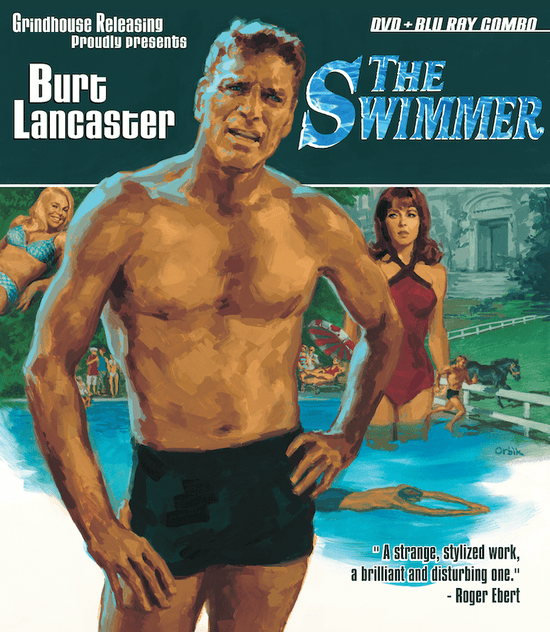
It’s the story of Ned Merrill (Burt Lancaster, who feared the water before making this movie), a middle-aged man with a toned body, no shoes and a swimsuit who emerges from the woods that border the affluent homes of a Connecticut suburb. The first party that Ned wanders into welcomes him warmly, withcool drinks in their hands, old friends who welcome him even though it seems like he’s been missing for some time. He doesn’t know, doesn’t care, and isjust interested in the idea of swimming his way home through the pools that form the river of his neighborhood.
He meets Julie Ann Hooper (Janet Landgard) in one of those pools, the girl who used to babysit his daughters but now works as a secretary in the big city. She used to nurse a crush on Ned — surely, so many women and girls did; he takes it in stride — and she’s having a rough time dealing with the sexual attentions of the lotharios in the high rises. Ned wants to protect her, drive her to the train, andpick her up when needed, but that’s too much for her. They part ways.
Pool by pool, people open up to Ned. There’s young Kevin Gilmartin Jr. (Michael Kearney), who he teaches to swim in an abandoned pool. Or maybe they don’t quite understand him, like the nudist couple or the woman who insults him for being an uninvited guest.
Somewhere along the way, the swim gets dark. Ned’s obsessed with the idea; the people he thinks he’s connecting with are just ciphers. And so is he. His neighbors are only concerned with bragging about how great their lives are and insinuating that maybe Ned’s life isn’t quite as wonderful as his charming demeanor would make it out to be.
Even Joan Rivers is there, as a woman intrigued by him before a concerned friend leads her away. Ned splashes into the pool only to emerge and see a hot dog cart that was once his. Indeed, it was his, and he wondered why they were keeping it from him. Why are they throwing him out?
Then he remembers Shirley Abbott (Janice Rule, an actress for a time before becoming a psychotherapist and someone who knew a bit about being with intense men, having relationships with Farley Granger, N. In her lifetime,Richard Nash, Robert Thom and Ben Gazzara; her role was initially played by Barbara Loden, the “female counterpart to John Cassavetes.” I’ll get back to that…), someone who he once had an affair with and who he can’t reconcile her hatred of him with his memories.
When once Ned ran, now he’s limping shoeless across a highway, making his way to a public pool where he doesn’t even have the money to get in, a place where he endures the insults of people who gossip about his wife’s expensive taste and his daughters’ troubles with the police. And then there are all Ned’s unpaid bills…
Finally, he gets home, but it’s not the grand castle it was inside his mind. The tennis court where his daughters are playing, well, that’s not even standing any longer. Trees are down, the lawn is overgrown, and the windows are shattered. And Ned slumps in the doorway because he no longer has a key.
The Swimmer is a truly unique and deranged movie, and I say that with a sense of intrigue and curiosity. It was the brainchild of Sam Spiegel, a three-time Academy Award Best Picture winner, and director Frank Perry, who had a personal connection to the story’s setting and shooting location, Westport, Connecticut.
After the film’s shooting wrapped up in September 1966, Perry had plans for additional transition scenes. However, he was unexpectedly replaced by Lancaster’s friend Sydney Pollack and cinematographer Michael Nebbia, who was brought in by Spiegel to finish the movie. This West Coast shoot saw several cast replacements, adding a layer of complexity to the film’s production history.
Speaking of that…
Loden was married to Elia Kazan — man, what is it with 60s playwrights and directors getting impossible gorgeous blonde bombshells to marry them and then making them feel inferior? — the director of Spiegel’s On the Waterfront. The Swimmer was her first significant film, but she had a prominent career as a star.
During post-production, there was a dispute about the scene where Loden confronts Lancaster between Spiegel and Perry, whose wife Eleanor wrote the script. According to Eleanor, Spiegel hated the rough cut, which, to be fair, wasn’t anywhere near finished. He started showing it around to other directors in Hollywood, including Kazan, who began interfering with the final cut, which belonged to Perry. Kazan wanted the scene toned down, as he didn’t like how Lancaster’s character assaulted his wife’s character — Kazan wrote in his autobiography that his wife depended on her sexual appeal in a condescending way — which led to Loden being replaced. Neither Kazan nor Spiegel would take the blame but accused each other. All that is left of the scene between the two is in Chris Innis’s 2014 documentary The Story of The Swimmer.
After all those reshoots, they still needed one more day to finish, so Lancaster paid for it himself: “The whole film was a disaster; Columbia was down on it. I personally paid $10,000 out of my pocket for the last day of shooting. I was furious with Sam Spiegel because he was over at Cannes playing gin with Anatole Litvak whilst he was doing The Night of the Generals. Sam had promised me, personally promised me, to be there every single weekend to go over the film because we had certain basic problems – the casting and so forth. He never showed up one time. I could have killed him, I was so angry with him. And finally, Columbia pulled the plug on us. But we needed another day of shooting – so I paid for it.”
I thought the wildest thing was that Marvin Hamlisch got hired to score the movie after playing one of Spiegel’s parties.
I love this movie. It feels like the modern mid-60s that I’ve only read about, and it takes you through the rise and fall of that decade and how things changed so much in just a few years. Or a few hours through ten pools. Most of all, I love the tagline, which is so of its era: “When you talk about The Swimmer, will you talk about yourself?”
Lancaster wore 17 identical pairs of suits for this movie, warred with the director over how actors should play their parts, gained twenty pounds of muscle and still said it was his favorite role, despite all the hardship.
It’s also a movie where you slowly fall out of love with its lead or grow in empathy for him. Seriously, they’re right, those tagline writers. Is this the Riddle of the Sphinx, starting on four feet in the morning, two in the afternoon and three at night? Is the measure of a man his accomplishments that he brags about or the fact that in the face of morality, he never wavers? Can you swim the whole way home?
When I write about The Swimmer, will I talk about myself?
For the best possible version of this movie, there’s only the Grindhouse Releasing set. You can get it here, and as with everything they’ve put out, it has the love and care that so few would put into something that anyone else would release as a throwaway. Where others see dross, they know it is gold.
EDITOR’S NOTE: The Legend of Lylah Clare was on the CBS Late Movie on March 15, 1976.
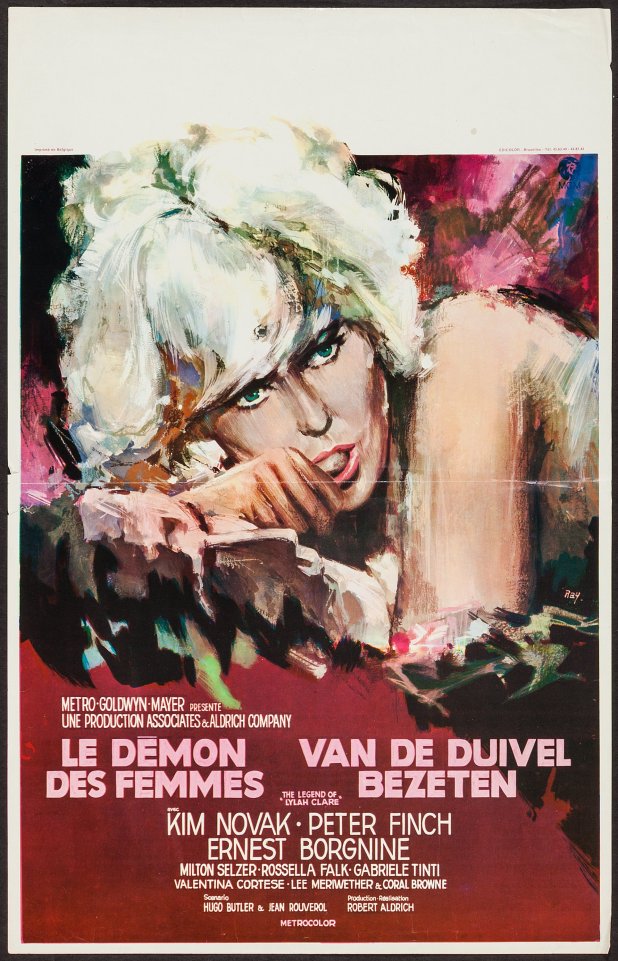
The Legend of Lylah Clare was based on a 1963 DuPont Show of the Week co-written by Robert Thom (Wild In the Streets). It’s about Elsa Brinkmann (Kim Novak), an actress who looks and sounds exactly like Lylah Clare, a star who fell to her death twenty years ago. Agent Bart Langner (Milton Selzer) gets Lylah’s ex-husband, Lewis Zarkan (Peter Finch), to meet her. Once he’s won over, they convince studio boss Barney Sheean (Ernest Borgnine) to make a movie with Elsa becoming Lylah as they make the movie of her life.
As the movie’s shooting begins, Lylah takes on the role to almost a Method degree while dealing with Hollywood’s pressures. She sleeps — and falls in love — with her director, battles gossip columnist Molly Luther (Coral Browne) and avoids the attention of her acting coach, Rossella (Rossella Falk). As filming continues, her identification with her role gets more intense.
She has become the role by the end, doing things Lylah would do, such as sleeping with a landscaper (Gabriele Tinti, who did the best out of anyone in this movie by marrying Laura Gemser) and making sure that she’s caught to make Zarkan jealous and finally killing herself by falling, again, from a high wire. That makes her a star all over again, but amid her newfound posthumous fame, her would-be lover Rossella murders Zarkan.
Here’s where the film gets audacious. The entire movie stops for a dog food commercial, a deliberate and unexpected break from the narrative that serves as a commentary on the commercialization of Hollywood. I’m sure people who saw it then were enraged at director Robert Aldrich. It’s the best thing in the entire movie, which is overwrought at times and ridiculous at others, but I love Aldrich and his work. Some moments in this made me laugh out loud because they’re so melodramatic.
I also have to confess that I’m a sucker for old Hollywood and glamour, so when Novak shines in this movie or stands in the cement footprints of a long-dead actress, she embodies the essence of classic Hollywood. Her performance and the film’s nostalgic elements evoke a sense of reverence for the golden age of cinema, and I’m definitely loving this movie.
The director had announced that he would make this movie five years before as part of a $14 million production program of eight films from his new company Associates and Aldrich, including Cross of Iron, Whatever Happened to Cousin Charlotte? (which became Hush…Hush Sweet Charlotte), The Tsar’s Bride, Brouhaha, Paper Eagle, Genghis Khan’s Bicycle, and There Really Was a Gold Mine (a sequel to Vera Cruz). He had also planned to make Now We Know, Vengeance Is Mine, Potluck for Pomeroy, The Strong Are Lonely, Pursuit of Happiness, a TV series called The Man and Too Late the Hero.
Before making those movies, he had to direct The Flight of the Phoenix and The Dirty Dozen. In between, he worked on the script with Hugo Butler and Jean Rouverol before saying, “It got terribly disjointed, and the big problem was to make it legitimately disjointed and not arty-crafty disjointed.”
Kim Novak was signed on to star. She hadn’t been in a movie since Eye of the Devil, in which she was injured in a riding accident during a crucial scene. This accident led to a significant delay in production and may have contributed to the film’s lukewarm reception. This, coupled with a series of personal setbacks, including a divorce and financial losses, had taken a toll on her.
He saw Novak as a gamble and dealt with the well-regarded original in which Tuesday Weld played Marilyn Monroe.
The movie was poorly reviewed and did poorly in theaters. In the years that followed, Aldrich reflected on it several times, blaming Novak’s performance and bad editing for its failure.
He was pretty diplomatic when he spoke to Film Comment in 1972, “I was about to bum rap Kim Novak when we were talking about this the other day, and then I realized that would be pretty unfair. Because people forget that Novak can act. I really didn’t do her justice. However, some stars have a motion picture image so firmly and deeply rooted in the public’s mind that an audience enters a movie with a pre-conception about that person. And that pre-conception makes “reality” or any myth contrary to their pre-conceived reality impossible. To make this picture work, to make Lylah work, you had to be carried along into that myth. And we didn’t accomplish that. You can blame it on a lot of things, but I’m the producer, and I’m the director. I’m responsible for not communicating that to the audience. I just didn’t do it.”
Five years later, Aldrich took full responsibility for the film’s failure, acknowledging that, as the director, he bore the ultimate blame.
As for Novak, she regretted her decision to make the movie, calling it ‘a weird little picture.’ Her distress was evident when she discovered that Aldrich had Hildegard Knef dub her in some scenes. She candidly confessed to The Washington Post, “God, it was so humiliating.”
This would be her last starring role in an American film.
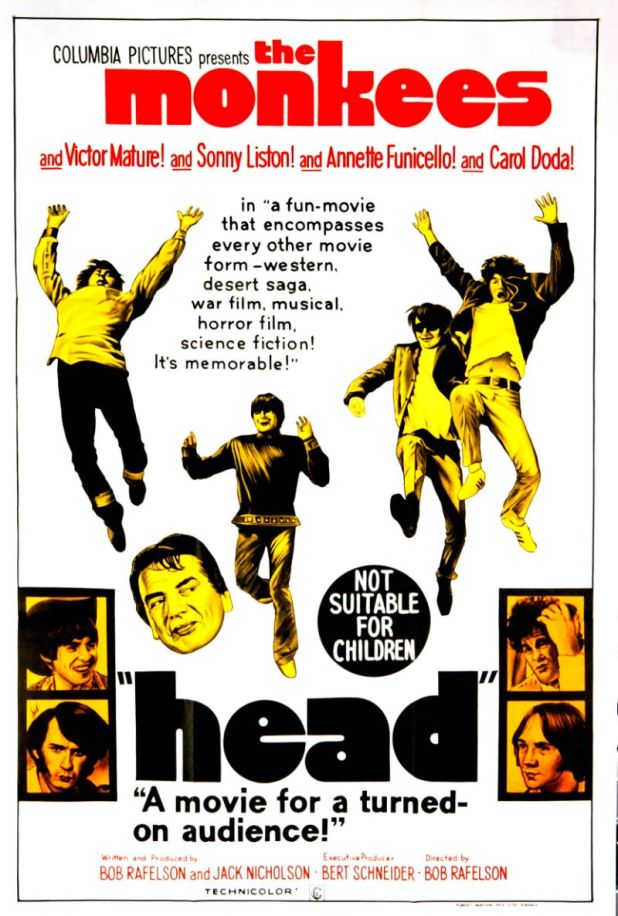
EDITOR’S NOTE: Head made its TV premiere on the CBS Late Movie on December 30, 1974. It also aired on July 7, 1975.
Despite breaking up in 1971, The Monkees remained in syndication throughout the decade, and that’s when I discovered them. A band created for a TV show—a burst of comedy, silliness and catchy songs—instantly appealed to me.
Initially formed in Los Angeles in 1965 by Bob Rafelson and Bert Schneider, the band was Micky Dolenz, Michael Nesmith, Peter Tork and Davy Jones. Producer Don Kirshner initially supervised the band’s music, with songs written by the songwriting duo of Tommy Boyce and Bobby Hart. The four band members were on set filming for nearly twelve hours a day, so session musicians originally played most of their tunes (that said, Nesmith did compose and produce some songs, with Tork playing guitar and all four contributing vocals).
By the TV show’s second season, The Monkees had won the right to create their own music, marking a significant shift in their artistic journey. They effectively became musicians, singers, songwriters, and producers. This growth was further evident in their fourth album, Pisces, Aquarius, Capricorn & Jones Ltd., where the band collaborated with respected session and star talents like the Wrecking Crew, Glen Campbell, members of the Byrds and the Association, drummer ‘Fast’ Eddie Hoh, Stephen Stills and Neil Young. This artistic growth is a testament to their determination and talent.
However, the Monkees continually battled against the notion that they were a manufactured band. Sure, that’s how things started, but they weren’t that way anymore. While their TV show remained successful, they were bored with its conventional format. They proposed making the show a variety program, a format that would allow them to showcase their musical talents and experiment with different styles and genres. But NBC objected, and by then, most of the band wasn’t getting along anyway.
The film’s title, Head, is a nod to the band’s desire to break free from their manufactured image and the constraints of their success. It’s a reference to the phrase ‘to get your head ‘, meaning to understand or grasp something, which reflects the band’s journey of self-discovery and artistic expression. After The Monkees was canceled in February 1968, Rafelson co-wrote and directed this film with Schneider as executive producer. Jack Nicholson, the other writer — a virtual unknown at the time — worked with the band and Rafelson in a jam session weekend with plenty of weed on hand. Later, under the influence of LSD, Nicholson would rewrite the stream-of-consciousness tapes into the script.
When the band learned they would not be allowed to direct themselves or receive screenwriting credit, every Monkee except Peter Tork had a one-day walkout. The studio agreed to a larger share of the film’s profits if the band returned, which ended the professional relationship between the band and their creators.
The filming of Head resulted in a movie that completely alienated their fanbase. Both Nesmith and Tork felt that this movie was a betrayal, a murder of the band by its creators, who seemed to have their eyes on bigger goals. This sense of disillusionment is palpable in their reactions, adding a layer of disappointment to the narrative.
At the dedication of the Gerald Desmond Bridge, an old man politician struggles with his speech. Suddenly, The Monkees appear, racing through the officials and creating chaos. Micky jumps off the bridge to the water below as we hear the words of “Porpoise Song. ” The lyrics intone, “A face, a voice, an overdub has no choice, an image cannot rejoice.” He floats under the waves until mermaids find him and bring him back to life.
After a kissing contest with all four Monkees being called “even” by Lady Pleasure (Mireille Machu, Nicholson’s girlfriend at the time), they launch into a distorted version of the TV show’s theme song:
“Hey, hey, we are The Monkees
You know we love to please
A manufactured image
With no philosophies.
You say we’re manufactured.
To that, we all agree.
So make your choice, and we’ll rejoice
in never being free!
Hey, hey, we are The Monkees
We’ve said it all before
The money’s in, we’re made of tin
We’re here to give you more!
The money’s in, we’re made of tin
We’re here to give you…”
BAM! A gunshot interrupts the proceedings, with the famous footage of the execution of Viet Cong operative Nguyen Van Lem by Chief of National Police Nguyen Ngoc Loan being shown. Head has no interest in being subtle.
From here, the movie becomes a kaleidoscope of ideas and pastiches as each Monkee gains a moment in the spotlight, yet none of them are thrilled with their situation, and each feels trapped. Any escape attempt — whether it’s through dance (Davy has a great scene with Toni Basil, who choreographed Head more than a decade before her hit song “Mickey”), punching waitresses, blowing up Coke machines with tanks, attending a strange birthday party (shot on one of the sets of Rosemary’s Baby, which was under production at the same time), a swami who claims to have the answer and even a rampage through the movie set itself, the boys can’t escape their prison, which is a large black box.
That box could symbolize the lounge area built for the band during the filming of their television show. When they first started filming, the band would wander the set between takes, bored by the filming speed. They’d often get lost, so Screen Gems built a special room where they were forced to remain, smoking cigarettes, playing music and studying their scripts. Whenever a band member was needed on the stage, a colored light corresponding to that member would inform them.
Throughout the film, the band runs into a massive cast of characters, with everyone from Mickey Mouse Club star Annette Funicello, Carol Doda (considered the first public topless dancer), Sonny Liston, Frank Zappa, Teri Garr, Victor Mature and Dennis Hopper.
After evading the box and all of their enemies in the desert, The Monkees run back to the film’s beginning and all leap from the bridge, this time to the triumphant return of “Porpoise Song.” But it’s all another sham: as they swim away, we see that they’re stuck in an aquarium, another big box, and taken away on a truck.
Unyielding sadness. It seems a far cry from “Hey, hey we’re The Monkees and people say we monkey around.”
Head bombed hard on release, bringing back only $16,000 on its $750,000 budget. It may be the ad campaign. While trailers say the “most extraordinary adventure, western, comedy, love story, mystery, drama, musical, documentary satire ever made (And that’s putting it mildly),” none of the band would appear in the ads.
The Monkees were trapped by another fact: younger and more mainstream audiences rejected the more serious side of the band, along with their new sound. While critics agreed that this was the band’s best music ever recorded — Carole King and Harry Nilsson co-wrote much of the music — serious hippies wanted nothing to do with a band they perceived as plastic and pre-manufactured.
Nesmith said, “By the time Head came out, The Monkees were a pariah. There was no confusion about this. We were on the cosine of the line of approbation, from acceptance to rejection…and it was over. Head was a swan song.”
At the end of the film, a still shot of a stylized Columbia Pictures logo appears before the movie skips frames, gets tangled and melts as we hear the soundtrack continue and the laugh of Lady Pleasure. Maybe some joy has escaped the box that The Monkees are trapped in. I want to think so, as Head may have been a failure upon release, but when viewed more than fifty years later, it transcends the divide between real and fake, manufactured and created, commerce and art.
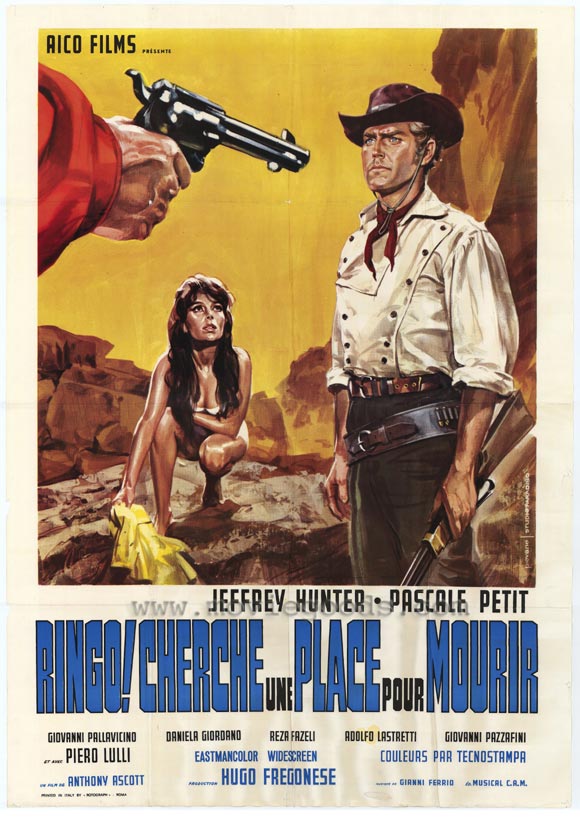
In Italy, it was known as Joe… cercati un posto per morire! (Joe…Find a Place to Die!). That title refers to Joe Collins, the hero of this movie, played by Jeffrey Hunter, who also produced and handled the initial distribution in the U.S.
After a long fight with a gang of killers led by Chanto (Mario Dardanelli), Lisa (Pascale Petit, Four Times That Night) escapes with her life while her geologist husband does not. She hires Collins, a former Confederate officer, and another gang to gain revenge. But all that gold Lisa and her husband had found, and her beauty put everyone against each other.
There’s also the crazy character of Reverend Riley, a man of the cloth who doesn’t deny himself the pleasures of the flesh. Played by Alfredo Lastretti he’s the best part of this movie. There’s also the fantastic scene where Daniela Giordano (Four Times That Night, Your Vice Is a Locked Room and Only I Have the Key) sings the theme song inside a saloon that was once a church.
Sadly, a year after this movie, Hunter was injured in an explosion gone wrong while making the crime movie Cry Chicago (¡Viva América!). On his way back to the U.S., he went into shock and couldn’t speak or move. Doctors could only find a displaced vertebra and a concussion, yet within seven months, he would suffer an intracranial hemorrhage while walking down the stairs at his home, crack his skull and die after brain surgery was not successful. He was only 42.
The Arrow Blood Money: Four Western Classics Vol. 2 set offers a thrilling viewing experience with 2K restorations of all four films from the original 35mm camera negatives by Arrow Films. The set also includes original Italian and English front and end titles, restored lossless original Italian and English soundtracks, English subtitles for the Italian soundtracks, brand new introductions to each film by journalist and critic Fabio Melelli, galleries for all four films, and an illustrated collector’s booklet featuring new writing by author and critic Howard Hughes. The limited edition packaging with reversible sleeves featuring original artwork and a slipcover featuring newly commissioned artwork by Gilles Vranckx adds to the excitement of owning this set.
Find A Place to Die features extras such as brand new audio commentary by author and critic Howard Hughes, a newly edited archival interview with director Giuliano Carnimeo and an in-depth appreciation of the soundtrack and its composer, Gianni Ferrio, by musician and disc collector Lovely Jon.
EDITOR’S NOTE: Speedway was on the CBS Late Movie on May 4, 1973 and February 1 and November 22, 1974.
I always thought the Eddie Murphy joke about Elvis acting — he’d just sing instead of speak — was a joke until this movie.
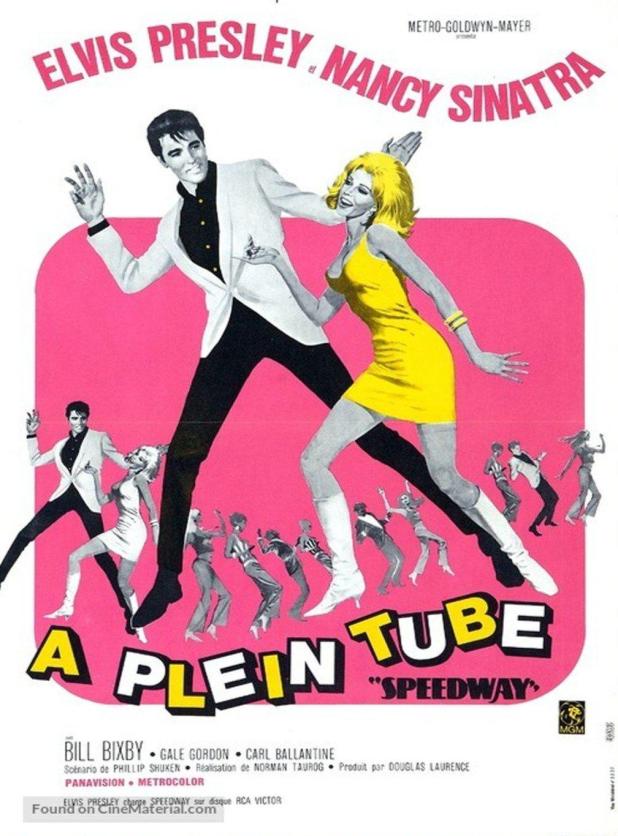
Elvis embodies the role of Steve Grayson, a NASCAR race driver whose generosity knows no bounds. He showers his friends with gifts, bails them out of financial hardships, and is always there for everyone. This portrayal reflects the real Elvis, who was known for his generosity. He often gifted his Memphis Mafia and even strangers with money, homes and cars.
The bad news is that his manager, Kenny Donford (Bill Bixby), is a compulsive gambler who has mismanaged Steve’s fortune to support his habit. Just like Colonel Tom Parker did to Elvis.
The IRS sends agent Susan Jacks (Nancy Sinatra) to watch over Grayson and ensure that they get their $100,000 in back taxes, but of course, she falls in love with the big lug.
The film is a treat for NASCAR aficionados. It features authentic late-’60s NASCAR footage shot at the Charlotte Motor Speedway. Viewers can catch a glimpse of Richard Petty, Buddy Baker, Cale Yarborough, and Tiny Lund on the track. This is a unique experience as it marks the first time NASCAR drivers were featured in the opening credits. Elvis’ car, a 1967 Dodge Charger, the Cotton Owens team #6 car, driven in real life by David Pearson, adds to the historical charm of the film.
Directed by Norman Turong, who made plenty more with Elvis, as well as movies with Martin and Lewis and Dr. Goldfoot and the Bikini Machine. It was written by Phil Shuken and was the twenty-second movie Elvis made since he debuted in Love Me Tender. Fun fact: It’s the only Elvis movie to feature someone other than him on the soundtrack, with Sinatra singing “Your Groovy Self.”
EDITOR’S NOTE: Wild In the Streets was on the CBS Late Movie on February 13, 1973 and March 1, 1974.
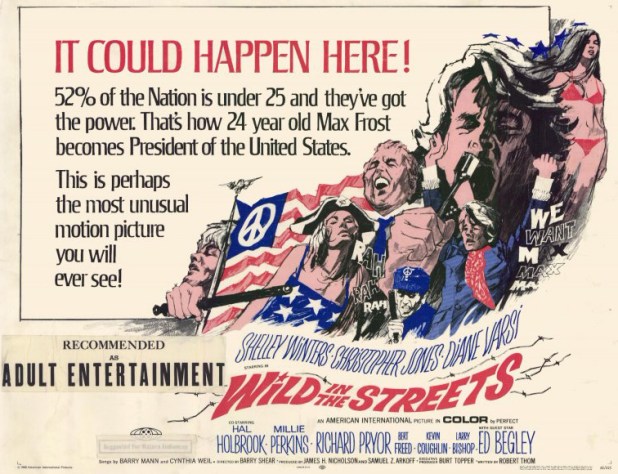
Barry Shear (Across 110th Street) directed, and Robert Thom (Death Race 2000) wrote this youth-oriented movie. Yeah, it’s kind of heavy-handed, but it also has Shelley Winters trying to escape a barbed wire fence in a prison, and I’m all for that.
Rock singer and revolutionary Max Frost (Christopher Jones) leads the Troopers, a band that lives with him in a Beverly Hills mansion. They are 15-year-old guitarist and legal mastermind Billy Cage (Kevin Coughlin), anthropologist Stanley X (Richard Pryor) playing drums, ex-child star Sally LeRoy (Diane Varsi) on backing vocals and hook-handed bass player Abraham Salteen (Larry Bishop) on bass guitar and trumpet. Their song “Shape of Things to Come” would end up coming out in the real world and hitting #22 on the charts; it’s really Paul Wibier and his band The 13th Power.
An entire album of songs would come out, including the song “Fifty Two Per Cent,” which explains to their fans that 52% of the world’s population is 25 or younger. That means that they can rise and take over.
Senate candidate Johnny Fergus (Hal Holbrook) wants to lower the voting age from 21 to 18 and uses Max’s popularity to get some attention. It blows up because Max and the band sing a song called “Fourteen or Fight!” and demand the voting age be lowered to 14. Protests started nationwide, but Max and the Senate candidate came together and announced that the new age should be 15, and Max introduced a new song: “Fifteen and Ready.”
The politician thought the band was done with politics. They’re just getting started.
When a Congressman from Sally LeRoy’s home district dies, the band enters her in the special election because she’s the only one old enough to run. She easily wins, thanks to all the young voters. Fergus’ son Jimmy (Michael Margotta) joins the group, the voting age becomes 14, andteens spike Washington’s water with LSD and send teenage escorts to keep all the senators occupied.
The Grand Old Party gets Max on their side, and he runs for President. Once he wins, he turns on them. Everyone over thirty must retire and be dosed on LSD for life in re-education camps. Fergus tries to bring Max’s parents in (Bert Freed and Shelley Winters) but feels nothing for them. His first political act was exploding their car. He even tries to kill the new President, who soon takes over and rounds up the Fergus family.
Does Max change the world? Yes. He takes the military out of every country, puts actual smart people and computers in charge of the gross national product, ships surplus food to starving countries, breaks apart the secret police and turns America into a hedonistic place. But the problem is that even if the rest of the world is following, now the under-ten kids want to put the old people—those in their twenties, like Max—in camps someday.
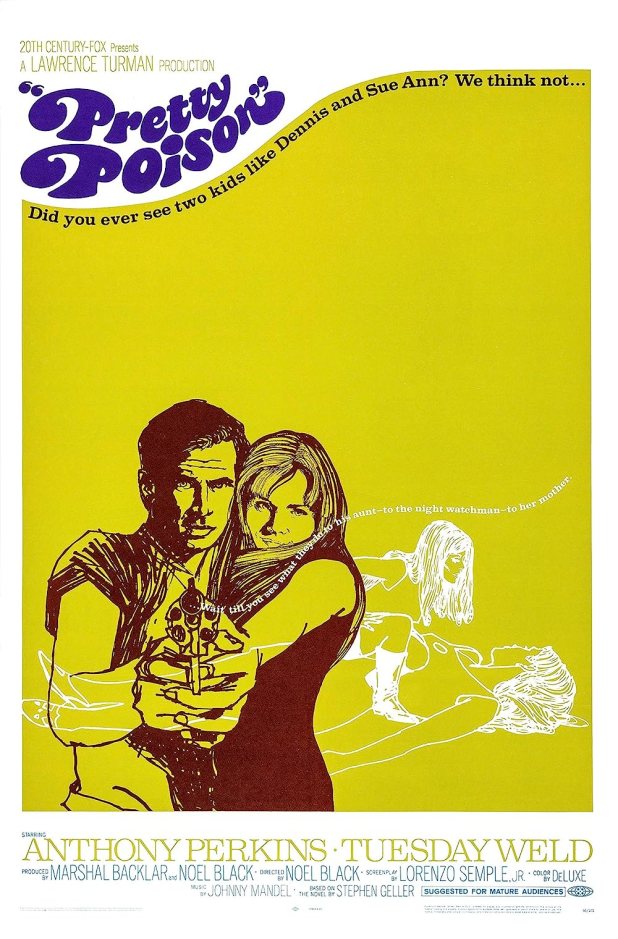
EDITOR’S NOTE: Pretty Poison aired on the CBS Late Movie on May 15 and December 5, 1973 and July 23, 1974.
Dennis Pitt (Anthony Perkins) wants a life of adventure, and he gets it.
On parole from a mental institution — he set the fire that accidentally claimed the life of his aunt — he works a menial job watching bottles go through the line at Sausenfeld Chemical Company. So when he sees the gorgeous Sue Ellen Stepanek (Tuesday Weld) march across the field in her majorette uniform, he brings her along into the games in his head, pretending to be a CIA agent and having some fun with a young and innocent teenager.
Except that Dennis goes from being the antagonist to the protagonist.
Directed by Noel Black (Private School) and written by Lorenzo Semple Jr. (the TV Batman, Flash Gordon) from the book She Let Him Continue by Stephen Geller, Pretty Poison spends so much of the movie making us think that Dennis is the same kind of killer that Perkins played in Psycho — the last film he was in before going back to the stage — and he’s really just a scared little boy being shocked by the evil inside a gorgeous young lady.
Semple told Shock Magazine, “It was very hard to cast. Tuesday was excellent for it but Tony was much too obvious for it. We really tried to find somebody young to do it. We never could find a new, young actor the studio would go with.”
Weld had tremendous issues with Black. She told Rex Reed it was “The least creative experience I ever had. Constant hate, turmoil and dissonance. Not a day went by without a fight. Noel Black, the director, would come up to me before a scene and say, ‘Think about Coca-Cola.’ I finally said, ‘Look, just give the directions to Tony Perkins, and he’ll interpret for me.” She further hated the movie, saying, “I don’t care if critics like it; I hated it. I can’t like or be objective about films I had a terrible time doing.”
The movie pretty much disappeared in theaters, and any reputation it had came from critics like Pauline Kael, who vilified Fox for its failure to market PrettyPoison. 1968 was a strange year. However, it was a time when the country felt like it was falling to bits, and Robert Kennedy and Martin Luther King were both shots. A film that has a young woman gleefully accepting murder and even turning a gun on her mother (Beverly Garland) was going to have a hard time.
But wow — this movie. It really took me unaware, and I loved the turn Perkins gives to his character; at the end, he is so frightened of Weld that he willingly goes to prison for her crimes. She’s learned nothing and is already moving on to her next victim, yet the end teases that parole officer Morton Azenauer (John Randolph) has figured her out. At one point, it seems like Dennis has all the answers, but when the world cracks on him, he becomes a child.
By the way, Dennis and Sue Ellen go to see The St. Valentine’s Day Massacre, directed by Roger Corman.
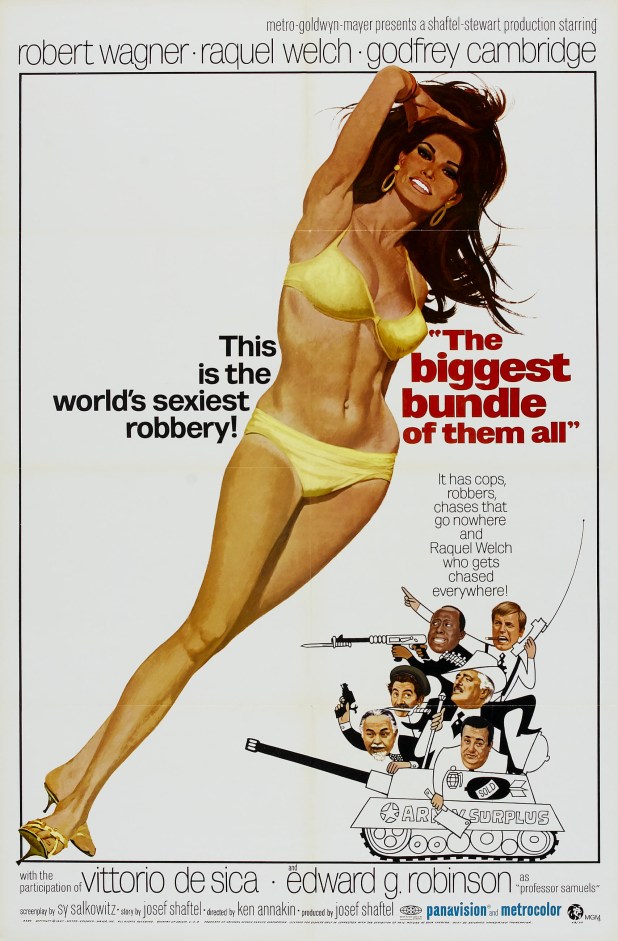
EDITOR’S NOTE: The Biggest Bundle of Them All was on the CBS Late Movie on March 24 and July 26, 1972; September 13, 1973; March 24 and August 30, 1976.
It’s easy for us in 2023 to forget just how big of a deal Raquel Welch was. I was born in 1972, so by the time I hit puberty, she was playing the role of the former sex symbol. But once you see her in this film, it all makes sense.
In this, she’s Juliana, the girlfriend of criminal Harry Price (Robert Wagner). Price’s gang has taken former Chicago gangster Cesare Celli (Vittorio De Sica, yes, the director of Bicycle Thieves) captive. Yet none of the older man’s fellow bosses try to save him. No one is more insulted by Cesare, who decides to teach Price and his gang how to steal $6 million in plutonium.
Ten days before shooting, director Ken Annakin realized he’d read a similar script called The Happening. That movie was being made by Sam Spiegel at Columbia, who got 15% of the profits for this, got to approve the script, changed the title from The Italian Caper and delayed it for six months after his movie.
There’s a great cast in this, with Edward G. Robinson as a professor of crime, plus Godfrey Cambridge, Davy Kaye, Francesco Mulé, Mickey Knox and Victor Spinetti. The soundtrack is also a pretty choice because Johnny Matthis sings “Most of All There’s You,” with music written by Riz Ortolani.
It’s funny reading interviews with Annakin and Robinson, as they both didn’t think much of Welch. They either said she winged all of her lines and didn’t learn them or that she was just using her body instead of being an actress. Robert Wagner wrote that she was late so often that Robinson cut a ten-minute promo, leaving Welch in tears.

 B&S About Movies
You must be logged in to post a comment.