THE FILMS OF COFFIN JOE: This Night I’ll Possess Your Corpse (1967)

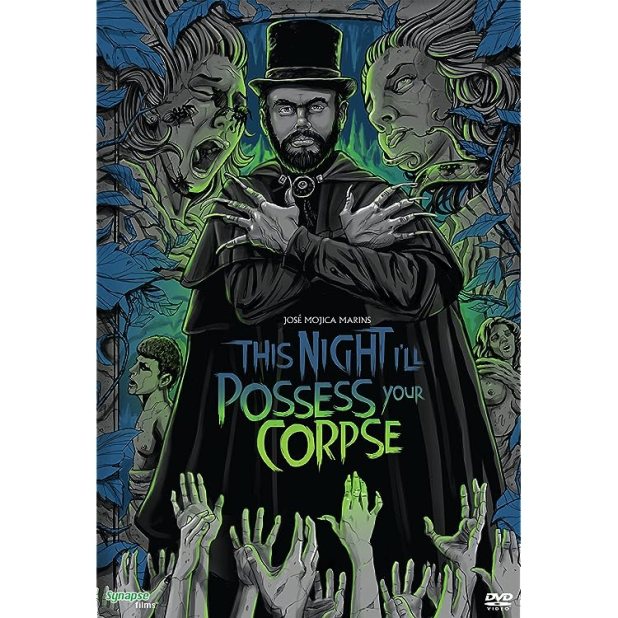
Four years later, Coffin Joe has returned from the end of At Midnight I’ll Take Your Soul and has recovered from shock, blindness and being accused for a series of murders. Now it’s time to get back to finding his perfect woman and continue his blood.

Together with a hunchbacked assistant named Brono, he kidnaps six gorgeous women and puts them all through a horrific series of tasks to determine who will bear his child. Only Marcia doesn’t scream in the face of the madness Coffin Joe puts them through, so only she can be the one. Yet even though he takes her to his bed — and kills the other five with snakes — she refuses him. He releases her, claiming he knows that she will never tell anyone what she has seen.

That’s when he meets the Colonel’s daughter, Laura, who actually returns his affection. The military man and his son try to break off their union, but Coffin Joe acts as only as he can to such an offense: he has Bruno kill Laura’s brother and blames the colonel’s henchman Truncador.

Yet now comes the dark night for the man who has no soul, as he goes to Hell after learning that one of his six brides was pregnant when he killed her. Dooming her child, he wanders the technicolor nightmare that is the abyss and comes upon Satan himself, who is also Coffin Joe. Our world’s version renounces his ways in light of this revelation.

Coffin Joe resists all the killers the colonel and his men send after him and finally impregnates Laura, just as Marcia kills herself by drinking arsenic. Yet before she dies, she tells the townsfolk of Coffin Joe’s crimes and they form a lynch mob just as he must decide who will survive, his bride or the baby, as the pregnancy has complications. Together they agree that the child must live, but fate is cruel and both Laura and Joe’s scion die. Destroyed by this, he is no match for the lynch mob that arrives, shooting him in the cemetery where he drowns in the same pond where he drowned so many of his victims.

At the point of death, a priest offers to hear Joe’s confession. He accepts God as his Savior and drowns as the skeletons of his victims claim him.

Brazilian censors forced filmmaker — and the human avatar of Coffin Joe — Jose Mojica Marins to recut and redub the end of this movie. That’s why the strange ending of salvation is in here. It enraged Jose Mojica Marins and put a curse on his career, or so he felt, to the point that he could never finish his planned trilogy of three Coffin Joe movies. It took until 2005 and filmmakers who grew up as his fans before Embodiment of Evil closed out the story and showed how Coffin Joe survived.

In The Wizard of Oz, a better world is in color instead of black and white. In This Night I’ll Possess Your Corpse, Hell itself is the only place to get the full color gel Mario Bava treatment and that says something about the nihilistic worldview of its creator and his creation. I grew up in a small town too, Coffin Joe, but I wasn’t brave enough to grow out my fingernail to absurd lengths, go on and on about my superiority and make out with a woman while throwing snakes at others. I can only watch you and see how it could have been.
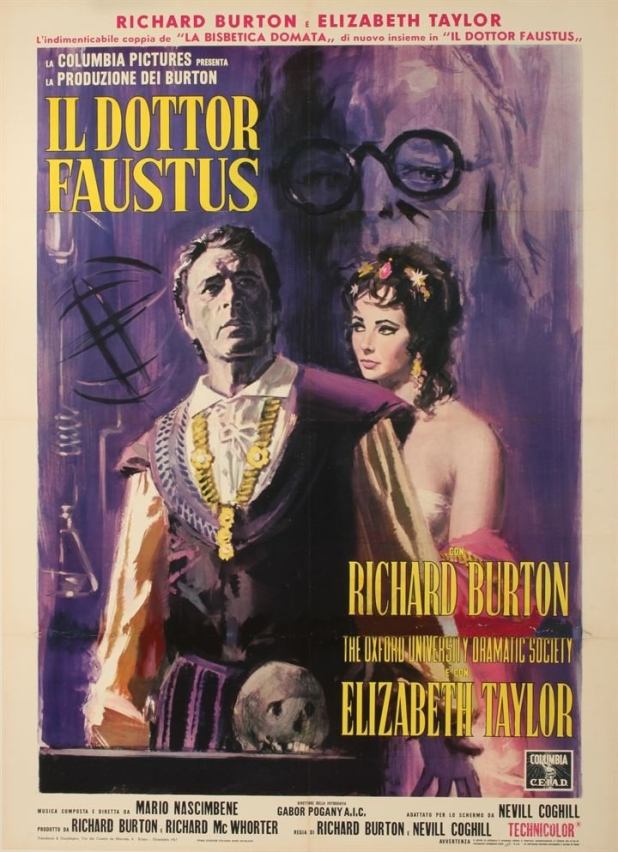
CBS LATE MOVIE MONTH: Doctor Faustus (1967)

EDITOR’S NOTE: Doctor Faustus was on the CBS Late Movie on August 14 and December 28, 1972 and August 30, 1973.

The only film directed by Richard Burton or Nevill Coghill, the actor’s Oxford University mentor, this adaption of The Tragical History of Doctor Faustus by Christopher Marlowe stars Burton as Doctor Faustus, Elizabeth Taylor as Helen of Troy and members of the Oxford University Dramatic Society.

It’s a stage play filmed in very stage play style, but yet you have to wonder what viewers who stumbled upon this in the middle of the night on the CBS Late Movie had to have felt like when they watched this. Shot on the sets at Dino De Laurentiis Cinematografica Studios in Rome, this movie was shot by Gábor Pogány, who would go on to be the cinematographer of Colt 38 Special SquadPink Floyd: Live at Pompeii and Last Stop on the Night Train.

If celebrities as big as Burton and Taylor made a movie filled with this much occult energy in 2023, I have no idea how insane people would go. The cameras get gelled all over the corners, things get neon, skeletons appear and the idea that this is the sixth of thirteen movies that Liz and Dick would make together takes on numerological significance.

It’s an indulgent project just for Burton and if only he’d let go and gone wild in this instead of seemingly sleepwalking through the movie, but you know, you can’t have everything. Not when this looks so fantastic. It’s like Burton watched a few Bava movies late at night and was like, “I want that.” Imagine if he’d gone all the way and hired John Old and given him the money no one ever gave him before and they made something truly inspired — not that this isn’t — but something that shook the very foundations of our reality.

But hey — Liz painted silver and barely speaking and she was the biggest movie star there was at the time.

You can watch this on Tubi.

ARROW BLU RAY BOX SET RELEASE: Blood Money: Four Western Classics Vol. 2: Vengeance is Mine (1967)

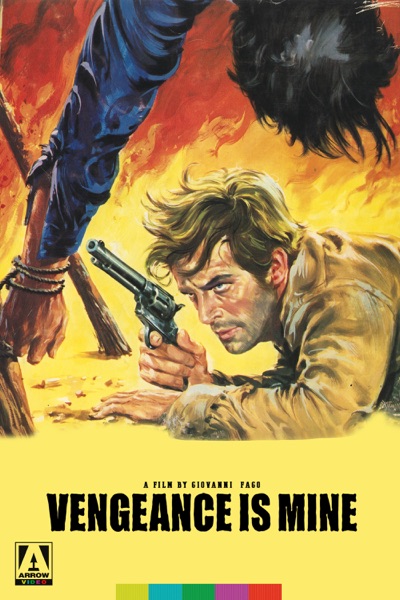
Per 100.000 dollari ti ammazzo (Will Kill You for 100,000 Dollars) was also released as For One Hundred Thousand Dollars for a Killing and its title in this Arrow Video set, Vengeance Is Mine.

It’s a big film in the life of star Gianni Garko, who met Czechoslovakian actress Susanna Martinkova while making it. She was married to him from 1973 to 1986, and they have a daughter named Maria Clara.

Director Giovanni Fago is billed as Sidney Lean here. Before this film, often using the name John M. Farquhar, he’d worked as an assistant director on films like Werewolf in a Girls’ DormitoryThe Loves of Hercules and Massacre Time. It was written by Ernesto Gastaldi, whose resume boasts some of the most essential films in Italian genre cinema, including All the Colors of the DarkMy Name Is NobodySo Sweet… So PerverseThe Whip and the Body, and so many more. His co-writer? Sergio Martino!

John Forest (Garko) has had a rough life. Ten years in prison for a murder he was innocent of committing, a brother named Clint (Claudio Camaso) who kicked him out of the family when it turned out he was illegitimate and now working as a bounty hunter. And oh yeah, that murder? When their father tried to bring John back home, Clint gunned him down like a dog and said his brother did the deed.

John’s mother dies just as a bounty on Clint’s head is named. She has a dying request for her son: Clint is to be brought to justice but not killed. But John can’t fire the first bullet if there is a gunfight between the brothers.

As always in the Italian West, the lure of happiness — a life for John with Annie (Claudie Lange) and her son — isn’t as strong as money, blood or vengeance. She tells him that they could have a life together. He replies, “Sorrow and hate just don’t mix with happiness, Annie.”

Interestingly, this film is part of the same set as $10,000 for a Massacre, sharing leads, writer, and composer Nora Orlandi. Garko plays a bounty hunter in both, with Camaso as his bounty. The key difference is that Garko’s morals are not in question in this film. Instead, it’s a tragedy, as the rift between brothers has led to a decade in prison for one and a descent into darkness for the other. Both movies are tragic for anyone who tries to build a life with Garko’s characters, serving as a poignant reminder of the destructive power of violence and retribution in the Italian West.

When watched one after the other, they make for a fascinating study of how violence and retribution in the world of the Italian West destroy the lives of its heroes.

The Arrow Blood Money: Four Western Classics Vol. 2 set offers a treasure trove for film enthusiasts. It features 2K restorations of all four films from the original 35mm camera negatives by Arrow Films, original Italian and English front and end titles, restored lossless original Italian and English soundtracks, English subtitles for the Italian soundtracks, brand new introductions to each film by journalist and critic Fabio Melelli, galleries for all four films, an illustrated collector’s booklet featuring new writing by author and critic Howard Hughes, a fold-out double-sided poster featuring newly commissioned artwork by Gilles Vranckx and limited edition packaging with reversible sleeves featuring original artwork and a slipcover featuring newly commissioned artwork by Gilles Vranckx. This meticulous restoration work ensures that these classic films are presented in the best possible quality, preserving their cinematic legacy for generations to come.

Vengeance Is Mine has brand new audio commentary by critics Adrian J. Smith and David Flint; Cain and Abel, a newly edited featurette with archival interviews with actor Gianni Garko and screenwriter Ernesto Gastaldi; an archival interview with composer Nora Orlandi; a new interview with producer Mino Loy and a trailer.

You can get it from MVD.

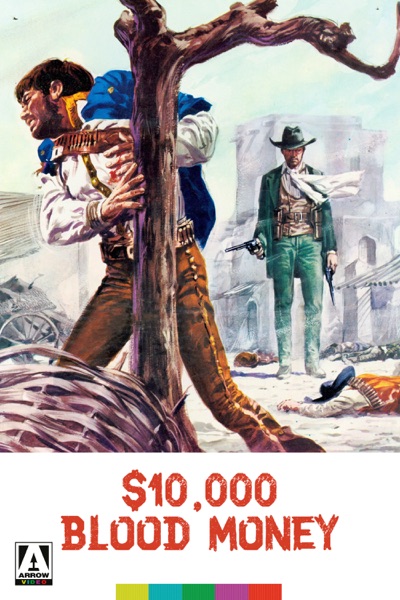
ARROW BLU RAY BOX SET RELEASE: Blood Money: Four Western Classics Vol. 2: $10,000 Blood Money (1967)

As one of the many unofficial sequels of Django, this film, originally titled 7 dollari su Django (7 Dollars on Django), is a must-watch for fans of the original. It’s also known as Ten Thousand Dollars for a Massacre and Guns of Violence, further cementing its place in the Django universe if such a thing can be constructed from pastiches.

Django (listed as Gary Hudson, but come on, we all know Gianni Garko when we see him) is a bounty hunter — he’s more like a bounty killer, as he never brings back anyone alive — who is watching Manuel Vasquez (Claudio Camaso) as he goes on a crime spree, knowing the more he kills, the more he’ll be worth. Once there’s a price of $10,000 on his head, Django will take care of business.

That price is reached when Vasquez kidnaps the daughter of Mendoza (Frank Little), a rancher. Dolores Mendoza (Adriana Ambesi, who often went by Audrey Amber and is also in Secret Agent Super DragonMalenka and The Bible: In the Beginning…) is a young woman beloved by her older father, so he doubles the reward.

Django was ready to quit killing for money and wanted to settle down with Mijanou (Loredana Nusciak, The Tiffany MemorandumSomething Creeping in the Dark). But the lure of big money was too much, and after all, he’d only be gone for a week.

Yet once he’s on the trail of Vasquez, fate puts them together as partners. Money will do that. But at the end of it all, they have to face one another, this time in a ghost town where only one will walk out alive. That’s because Django — who often kills when his prey isn’t ready and usually continues shooting them long after their dead — has finally screwed up in his cynical pursuit of the almighty dollar, and Vasquez has gotten one over on him by killing Mijanou. To say that this Django has issues that cost him everything that’s putting it lightly. His lover once begged him to leave this life behind. Now, she’s dead, and he’s reached his rock bottom with no prize for clawing his way out.

Now, you’d think that at least Django gets to save Dolores from being with such a horrible man, a criminal put in jail by her father and used to get back at him. But she’s found that she loves this life just as much as Django once did, the excitement, money and blood. So, one more death may bring him that $10,000, but money is meaningless at the end of all this unpayable loss.

Directed by Romolo Guerrieri and written by a talented team, this film delivers on the brutal promise of the Italian West. What sets it apart is the Theremin soundtrack composed by Nora Orlandi, adding a unique and haunting dimension to the film’s atmosphere.

The Arrow Blood Money: Four Western Classics Vol. 2 set has 2K restorations of all four films from the original 35mm camera negatives by Arrow Films, original Italian and English front and end titles, restored lossless original Italian and English soundtracks, English subtitles for the Italian soundtracks, brand new introductions to each film by journalist and critic Fabio Melelli, galleries for all four films, an illustrated collector’s booklet featuring new writing by author and critic Howard Hughes, a fold-out double-sided poster featuring newly commissioned artwork by Gilles Vranckx and limited edition packaging with reversible sleeves featuring original artwork and a slipcover featuring newly commissioned artwork by Gilles Vranckx.

$10,000 Blood Money has brand new audio commentary by author and film historian Lee Broughton; Tears of Django, a newly edited featurette with archival interviews with director Romolo Guerrieri and actor Gianni Garko; The Producer Who Didn’t Like Western Movies, a brand new interview with producer Mino Loy; a brand new interview with screenwriter Ernesto Gastaldi and the theatrical trailer.

You can get it from MVD.

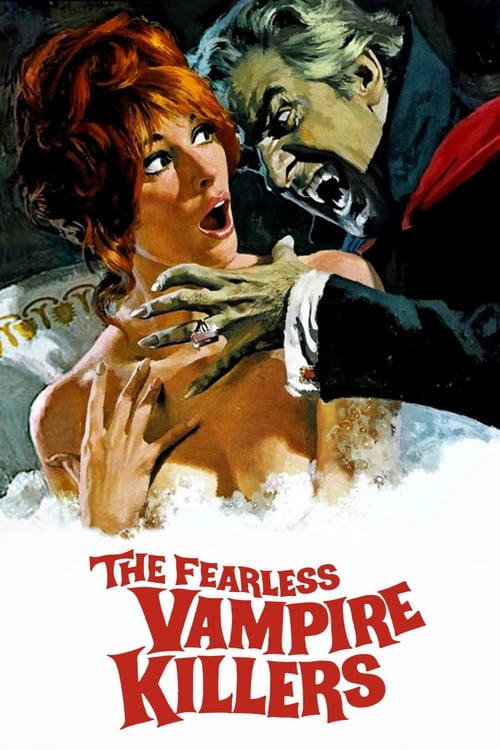
CBS LATE MOVIE MONTH: The Fearless Vampire Killers (1967)

EDITOR’S NOTE: The Fearless Vampire Killers was on the CBS Late Movie on February 18, 1972; May 31, 1974 and June 15, 1976.

Pete Stein asked for this movie and I was happy to write about it. Hope he enjoys this.

Created before Polanski’s U.S. debut, Rosemary’s Baby, this film was marketed by MGM as a farce, with twelve minutes cut from the movie, an animated prologue added, and both protagonists dubbed with cartoony and silly voices. This version was retitled from Dance of the Vampires to The Fearless Vampire Killers, or Pardon Me, But Your Teeth Are in My Neck.

I’ve seen that version of the film, which was the one most commonly seen in the U.S. until it disappeared from circulation in the mid-1970s.

In the early 1980s, MGM found the original cut and released it. This version has garnered new interest and better opinions of the film. I probably need to see that one to evaluate the movie properly, but I’m not sure I could make it through this one again.

Overall, it just feels too cute.

It’s about the adventures of the ancient Professor Abronsius and his apprentice Alfred, played by Polanski. They bumble their way through just about everything they do, which some would take as comedic, but I took as boring and cloying.

They end up in a village filled with angry townsfolk who constantly engage in occult rituals to keep the vampires away. Alfred falls in love with the tavern owner’s daughter, Sarah, but who can blame him? The best part of this movie is the doomed Sharon Tate, who owns every second she’s on screen.

The vampiric Count von Krolock (Ferdy Mayne, who played God in Night Train to Terror) captures her and even turns her father into a vampire. Soon, a convention of vampires and the Count’s gay son enter the story. Yet our heroes are never heroic and simply fail to make it to the movie’s end.

Again, I may need to check out the real version. But I’ve always found this too cheeky. Perhaps that’s the intention, and perhaps it’s just dated. Then again, a few hours of Sharon Tate isn’t the worst thing.

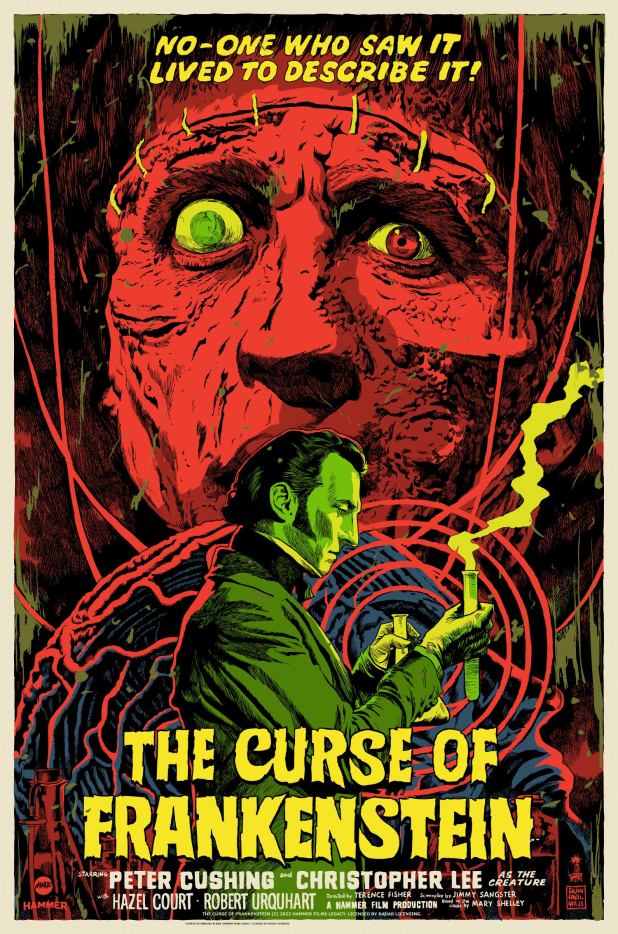
CBS LATE MOVIE MONTH: The Curse of Frankenstein (1957)

EDITOR’S NOTE: Curse of Frankenstein aired on the CBS Late Movie on May 24 and September 21, 1972 and June 28, 1974.

Hammer was initially founded in 1934 by William Hinds, whose stage name was Will Hammer, as he grew up in the Hammersmith section of London. They produced the now-lost The Public Life of Henry the Ninth and The Bank Messenger MysteryThe Mystery of the Mary CelesteSong of Freedom and Sporting Love before going out of business. That said, Hinds also co-owned a distribution company, Exclusive Films, with Enrique Carreras, which stayed in business.

In 1947, Hammer was revived after the war and began shooting low-budget radio show adaptations. They learned that they could save money by shooting in country homes rather than film sets—and stayed with that for much of their output—and would remodel Down Place on the Thames into Bray Studios, their best-known base of operations.

Hammer’s first horror movie was their 1955 adaptation of Nigel Kneale’s BBC Television science fiction serial The Quatermass ExperimentThe Quatermass Xperiment and Quatermass 2 were big hits; while the TV show was an unknown entity in the U.S., it was exported here as The Creeping Unknown to play a double feature with The Black Sleep. The results were so successful that United Artists offered to pay for part of the sequel.

Also — in the November 6, 1956 issue of Variety, it was claimed that a nine-year-old boy died of a ruptured artery while watching that movie in Oak Park, Illinois. According to The Guinness Book of Records, this would be the only known case of an audience member dying of fright. William Castle immediately took notice, one imagines.

As production began on Quatermass 2, Hammer needed someone in the U.S. willing to invest in and promote their movies. This led them to Associated Artists Productions. At the same time, Max J. Rosenberg and Milton Subotsky had sent Associated Artists an adaption of Mary Shelley’s novel Frankenstein, or The Modern Prometheus. They’d only made one movie and were hard to bet on, but Associated Artists’ boss Eliot Hyman did send the script to Hammer.

Until the day he died — and beyond — Rosenberg claimed that he produced The Curse of Frankenstein. However, Subotsky’s script was perhaps very close to Universal’s Son of Frankenstein and was only 55 minutes long. Screenwriter Jimmy Sangster said he had never seen Subotsky’s script or was unaware of Rosenberg’s involvement. In fact, he had never seen the Universal Frankenstein films and had just written what he thought the movie should be.

If the names Rosenberg and Subotsky are familiar, well — they became Amicus.

Another issue Hammer had to deal with was that studios had to submit their scripts to censors before making them in England. The censors said, “We are concerned about the flavour of this script, which, in its preoccupation with horror and gruesome detail, goes far beyond what we are accustomed to allow even for the ‘X’ category. We can give no assurance that we will be able to pass a film based on the present script, and a revised script should be sent to us for our comments, in which the overall unpleasantness should be mitigated.

You can only imagine how much more upsetting it would all be in vivid color instead of black and white. Hammer’s new take on horror didn’t avoid blood or gore; compared to the horror of the past, it zoomed in on it and let it take up the screen. It may seem tame today, but in the days before splatter and even Blood Feast, it was incendiary.

Directed by Terence Fisher, The Curse of Frankenstein has an intriguing opening that puts you right in the middle of the story: As Baron Victor Frankenstein (Peter Cushing in his first significant film role) awaits execution for the murder of his maid Justine (Valerie Gaunt), he reveals his story to a priest (Alex Gallier).

With the death of his mother, Victor owns the Frankenstein estate and pays for his remaining family, Aunt Sophia (Noel Hood) and her daughter Elizabeth (Hazel Court). He also pays for Paul Krempe (Robert Urquhart) to teach him science, which leads to them bringing a dead dog back to life. Indeed, they can do the same with human beings, but as Victor descends into scientific butchery, Paul leaves just as Victor’s fiancee — his cousin Elizabeth — comes to live with him.

His plan is sound, if not maniacal, as the dead body parts are sewn together to make the ideal human being, which will be guided by the brain of a professor. Sadly, that brain is damaged as Paul returns to try and stop Frankenstein. At this point, the scientist is so deluded that he thinks that it’s fine that he’s pushed the old teacher to his death. The creature (Christopher Lee) he brings to life is a madman, and Paul helps him stop it; later that night, Frankenstein still brings it back to life and uses it to murder Justine, with whom he has been having an affair. She seals her fate by claiming that she will reveal that he has impregnated her and is conducting experiments against nature.

Paul is invited back to the house the evening before the Frankenstein wedding, but the creature goes wild and grabs Elizabeth. Victor stops it and sends it into a vat of acid, where it disappears; he is arrested, and Paul refuses to tell the truth. Standing outside with Elizabeth, they remark about the insanity that took Victor as he is led to the gallows.

Released on May 20, 1957, with Woman of Rome in the UK and on July 20 in the U.S. with Hammer’s Quatermass-inspired X the UnknownThe Curse of Frankenstein made back seventy times what it cost. It led to five sequels and one comedic remake, the only time Cushing didn’t play Victor. The look of this film led to a Gothic craze in horror that everyone from Corman to Bava eventually took to greater heights. It sensationalized British critics who hated how bloody and exploitative it was, but as for fans of horror films, well…Hammer was the new name on their lips.

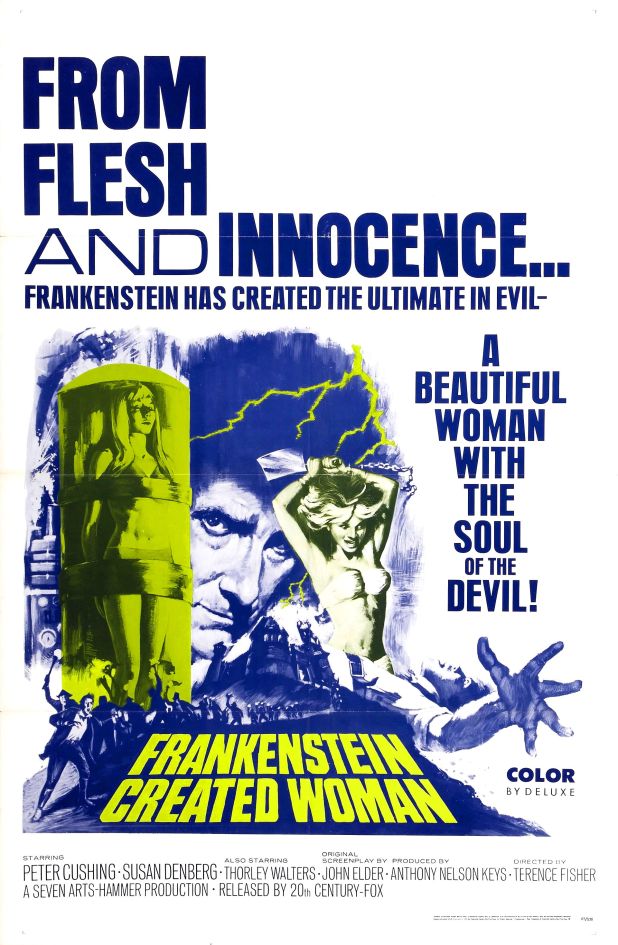
CBS LATE MOVIE MONTH: Frankenstein Created Woman (1967)

EDITOR’S NOTE: Frankenstein Created Woman played the CBS Late Movie on February 9 and June 18, 1973.

From flesh and innocence, Frankenstein has created the ultimate in evil. A beautiful woman with the soul of the devil!

With a tagline like that, how can you not watch this movie?

The fourth film in Hammer’s Frankenstein series is a thought-provoking exploration of the soul and morality. It’s the one in which we stop thinking about death as a physical matter and start delving into these profound questions.

The movie starts with Hans Werner watching his father executed by the guillotine. Then, we see him as a young man, working as an assistant to Dr. Hertz and Baron Victor Frankenstein (Peter Cushing, as it always must be). The doctors have learned how to trap the soul before it leaves the body — they must have been watching The Asphyx* — and think that they can transfer it into another body.

They get their chance when Hans is put to death defending the honor of his girlfriend Christina (Susan Denberg, Playboy Playmate of the Month for August 1966) after several rich men abuse her for her deformities and kill her father. After he follows in his father’s footsteps, the doctors can extract his soul.

Unable to live without Hans, Christina tragically drowns herself in a river. The doctors, however, decide to transfer Hans’ essence into the body of his lover. For months, the two doctors work to heal her physical maladies and make her the perfect woman. The big problem is that she’s haunted by Hans, who she sees as a ghostly apparition, and begins to hunt down the men who killed him and her father.

As the film closes, Christina realizes that she should have never come back to life, so she drowns herself again as Frankenstein somehow learns a lesson and walks away.

Directed by Terrence Fisher, this is the kind of Hammer film that I love. It boldly moves away from simply being modern versions of classic horror and creates its own unique commentary on the world through the lens of the fantastic.

*I realize that the movie was made five years after this, but the joke was too simple not to use.

She Freak (1967)

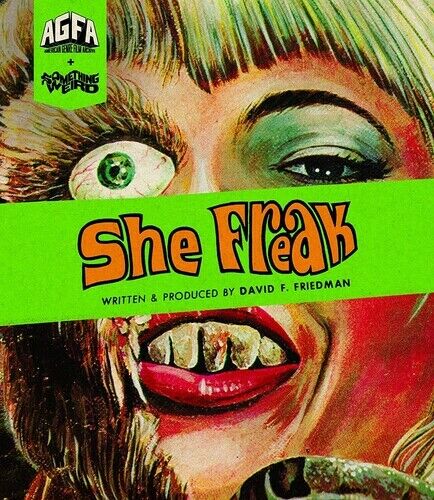
Claire Brennan plays Jade Cochran, a diner waitress who hates freaks and sadly for her, she’s pretty much in a remake of Tod Browning’s Freaks but, you know, 35 years later and somehow with a lower budget. Within minutes — and just one ferris wheel ride — she’s the wife of circus owner Steve St. John (Bill McKinney) and moments after that, rough trade Blackie Fleming (Lee Raymond) is treating her how she likes being treated behind her new old man’s back and then, even sooner than that, Steve’s dead at the hands and switchblade of Blackie and Jade owns it all.

Again, if you saw Freaks, you know how this all ends, the comeuppance of it all, right? The effects are rudimentary but effective and I mean, you can’t call a movie She Freak and not have a she freak.

Directed by Byron Mabe (The Acid EatersSpace ThingNude Django) with inserts from Donn Davison. Donn was the manager of Florida’s Dragon Art Theatre and one of the guys who would work four-walled theaters and talk marks into buying gimmicks. He also narrated the trailer for The Crawling Thing and Creature Of Evil.

This was written by Michael B. Druxman (who also wrote Cannon movie Keaton’s Cop) and producer David F. Friedman, who produced this and also plays the carnival barker. He learned how to make movies in the army and when he was discharged, he sold army-surplus searchlights. His first customer? Kroger Babb, perhaps the most carny of all carnies. And this, Friedman entered the world of film, working with Herschell Gordon Lewis, making more money in softcore and retiring when hardcore took over.

Filmed during the Kern County Fair and the Ventura County Fair, She Freak takes advantage of the rides and attractions of West Coast Shows, which was such a major company that they could do five carnivals in different locations at the same time. Most of their crew are in this.

Even though Jade and Shorty (Felix Silla) are at odds in this movie, the truth is there’s a thin line between love and hate. This movie started a nine year affair between the two that was kept a secret, even when Brennan gave birth to Silla’s son.

You can watch this on Tubi.

Way Out (1966/1967)

ABOUT THE AUTHOR: Jennifer Upton is an American (non-werewolf) writer/editor in London. She currently works as a freelance ghostwriter of personal memoirs and writes for several blogs on topics as diverse as film history, punk rock, women’s issues, and international politics. For links to her work, please visit https://www.jennuptonwriter.com or send her a Tweet @Jennxldn

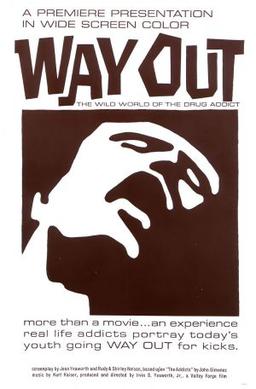
The little-seen Way Out is a gem for fans of obscure cinema with quirky histories and happily, it’s way better than it should be. I first saw it as part of a double bill released by Something Weird Video along with the hippie-themed Ghetto Freaks (1970.) 

A cautionary tale about drug use, the film was made by director Irwin S. Yeaworth, Jr. following the sci-fi hits The Blob (1958) and Dinosaurs! (1960.) Right about now you’re probably wondering how in the hell that happened. It turns out Yeaworth was extremely religious in his private life, serving in both presbyterian and non-denominational evangelical ministries with Billy Graham. No doubt, the church funded its production. 

As if that wasn’t weird enough, Way Out is based on a play written by and starring former junkies who turned to religion to replace (ahem…I mean cure) their addictions. That’s right. Not a single actor in this film was an actual actor. And yet, the film boasts exceptionally good acting and ticks all the boxes meeting modern standards for representation. 

Set against the backdrop of the slums of The Bronx in the 1960s, the film tells the stories of young (mostly Hispanic) people, struggling in poverty. The main character Frankie (Franklin Rodriguez) has a strained relationship with his drunk cop dad. Despite the hardship of life in their neighborhood, Frankie meets and falls in love with a lovely, innocent young lady named Anita (Sharyn Jimenez.)

Anita watches as one by one, Frankie and his buds fall into the clutches of addiction and turn to crime to keep from getting dopesick. When Frankie gets arrested, he’s forced to go cold turkey in jail. He comes out clean, having turned to Jesus for a “way out”, but his world is turned upside down when he finds out everything that happened while he was away. His best friend was killed by the police and two other friends are in prison.

 Worst of all, when he visits Anita, he finds a totally different girl from the one he pined for from inside his cell. The pure girl he fell in love with is gone. The new Anita is a trash-talking, world-weary junkie turning tricks to feed her habit. It does not end happily. And yet it does. 

Following the conclusion of the main story, there’s a short epilogue featuring the entire cast marching toward the camera singing a religious hymn in celebration of the fact that they’re all still clean and sober. Is it religious propaganda? You bet it is. Frankie makes the jump from joint to junk ridiculously fast. Its assertion that marijuana is a “gateway drug,” is blatantly incorrect based on modern science, but the film nonetheless paints a grim picture of the ease with which people back then people gained access to heroin. 

The best parts of this movie are the acting and the real-world locations. Not a single person in the film was a professional. These people lived this life for real, living in shabby, sparely furnished rooms, meeting on filthy rooftops to shoot up with shared, dirty homemade needles fashioned from eyedroppers. It’s so realistic that some scenes make other drug films like Sid and Nancy and Trainspotting (1996) look glamorous in comparison. No one in those films ever tried to pour milk down the throat of an OD victim.   

For a night of depression-inducing “entertainment”, Way Out would make an excellent companion piece to other less glamorous New York-centered drug films like Panic in Needle Park (1971) or Requiem for a Dream (2000.) 

Despite its heavy-handed message, it’s a film that makes you root for the principles. Especially knowing they’re baring their souls for us onscreen. When it was over, I couldn’t help but wonder what happened to the cast in the years following its completion. Franklin Rodriguez has a few more credits to his name on imdb, but he probably deserved a bigger career. 

APRIL MOVIE THON 2: How to Kill 400 Duponts (1967)

April 16: Shaken, Stirred, Whatever — Write about a Eurospy movie that’s kind of like Bond but not Bond.

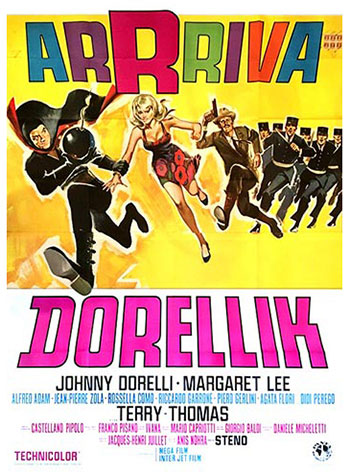
Also known as Arrriva Dorellik, this stars Johnny Dorelli as Dorellik, a character that he played on the television show Johnny Sera that is obviously inspired by Diabolik. His Eva Kant is Baby Eva, played by Margaret Lee, who was a big Eurospy star, appearing in Our Agent Tiger, Agent 077: From the Orient with Fury, Kiss the Girls and Make Them DieDick Smart 2007Secret Agent Super Dragon and OSS 117 – Double Agent. She also somehow made it through 12 movies alongside Klaus Kinski, as the pairing of the two was quite popular.

This movie actually came out before Danger:Diabolik and the producer of the movie, Dino De Laurentiis, sued the makers of this film and made them change the title (which means Here Comes Dorellik) to How to Kill 400 Duponts. What’s funny is that this film’s Inspector Ginko, known as Police Commissioner Green, is played by Terry-Thomas, who ended up being in the De Laurentiis-produced movie.

As for the story, Dorellik must kill everyone with the last name Dupont if he wants to inherit a large fortune. It’s all rather silly instead of a true Eurospy movie, but the ending, where Dorellik and Green switch faces to their surprise is pretty funny.

Director Steno was a brand name for Italian comedies for years. The script was written by Franco Castellano and Giuseppe Moccia, who wrote fifty movies together and directed twenty.