EDITOR’S NOTE: The Murder Clinic was on Chiller Theater on Saturday, May 26, 1979 at 1:00 a.m. and Saturday, July 16, 1983 at 2:00 a.m.
The Murder Clinic predates the Argento era of giallo, coming around the same time as the Bava instigation with The Girl Who Knew Too Much and the krimi films. Known in its native Italy as La lama nel corpo (The Knife in the Body), it was written by Luciano Martino (brother of Sergio and writer of Delirium and The Whip and the Body) and Ernesto Gastaldi (The Sweet Body of Deborah, All the Colors of the Dark, The Case of the Bloody Iris and so many more) with direction coming from Elio Scardamaglia (this is the only film he’d direct as he usually produced movies) and Lionello De Felice. It’s based on the book The Knife In The Body by Robert Williams, a former Tuskegee Airman who became an actor. He also wrote Turkey Shoot, which really means that his work was produced all over the world.
The story takes place in 1870s England, so this movie can also be considered a gothic horror film. Dr. Vance, the director of a mental hospital (Wiliam Berger) is restoring his sister’s face using patients as raw material, all while a masked killer uses the giallo weapon of choice, a strait razor, to kill other people within the hospital.
This story would replay itself across many films—Slaughter Hotel, Faceless, Mansion of the Doomed (well, that owes a debt to Eyes Without a Face)—while the first scene, with a young woman being chased by a killer in the woods at night, and a scene where the killer stalks his prey in a room full of hanging sheets, feel like they inspired Suspiria.
The Murder Clinic itself feels indebted to Bava, really taking to heart the color strategies of Blood and Black Lace.
This is a movie with a fascinating release history. After Berger spent some time in an Italian prison—he had been wrongly accused of possessing hashish and cocaine—it was re-released with a line on the poster that said, “William Berger, guilty or innocent?”
In the U.S., Revenge of the Living Dead was renamed to cash in on Romero’s zombie film. It played triple features with Curse of the Living Dead (Kill, Baby, Kill!) and Fangs of the Living Dead (Malenka) in the 70s as the Orgy of the Living Dead.
With a great location—the Villa Parisi, home of Blood for Dracula and Patrick Still Lives—and appearances by Françoise Prévost (The Return of the Exorcist), Mary Young (who only appeared in this movie and Secret Agent 777), and Barbara Wilson (her only film, and she really should have done more), The Murder Clinic is an early giallo worthy of being enshrined in your collection.
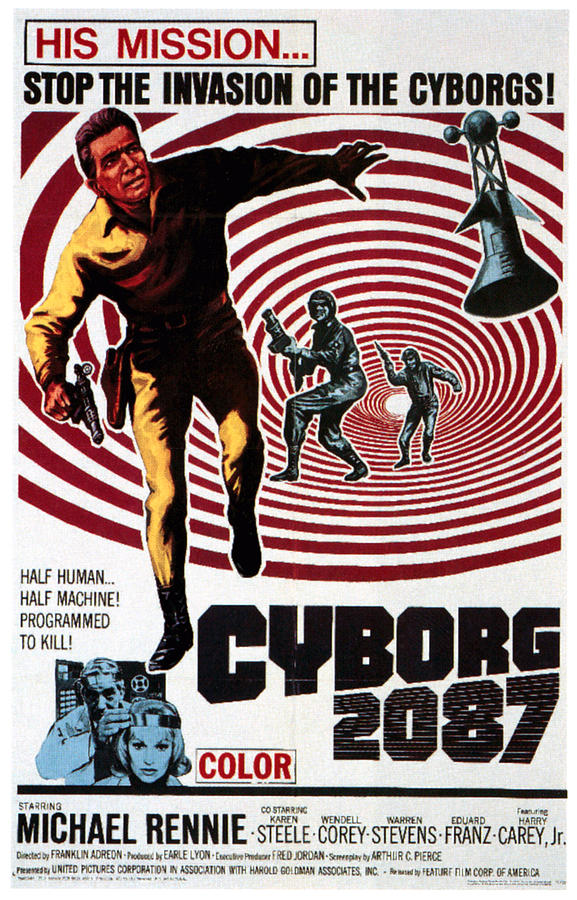
EDITOR’S NOTE: Cyborg 2087 was on Chiller Theater on Saturday, March 1, 1975 at 11:30 p.m., Saturday, October 18, 1975 at 1:00 a.m. and Saturday, January 14, 1978 at 11:30 p.m.
2087: Free thought is illegal. The population is docile. Only a secret group of free thinkers exist and they are able to send Garth A7 (Michael Rennie) back in time to either stop Professor Sigmund Marx (Eduard Franz) from showing his new invention to the government or, if that fails, to murder him. Yes, what Marx makes today will create the mind control of the future. As Garth A7 escapes back in time, he is followed by two other cyborgs called Tracers (Dale Van Sickel and Troy Melton).
To succeed in his mission, he takes over the mind of Marx’s assistant Dr. Sharon Mason (Karen Steele), using her to find Dr. Zeller (Warren Stevens), who removes the tracking device that allows the Tracers to find him.
A member of the Marines in World War II, director Franklin Aderon got into Hollywood as a technical advisor on the serial The Fighting Marines. He wrote screenplays and produced at Republic Pictures before directing his own movies, including Canadian Mounties vs. Atomic Invaders and Dimension 5. He also directed several Western TV shows.
This was written by Arthur C. Pierce, who went from being in the Navy during the war to shooting industrial films and creating special effects. He eventually became a writer, making Beyond the Time Barrier and The Cosmic Man. He also directed The Astral Factor, The Navy vs. the Night Monsters, Women of the Prehistoric Planet, Las Vegas Hillbillies, Mutiny In Outer Space and The Human Duplicators.
For as similar as some of Pierce’s stories are to other films — Beyond the Time Barrier cashed in on The Time Machine and The Cosmic Man is like The Day the Earth Stood Still — this film predates Terminator 2 with the idea of a machine coming back in time to murder the inventor that led to its creation.
Speaking of The Day the Earth Stood Still, this film has its star, Michael Rennie, who is playing a very similar role to Klaatu. He would do the same in a three episode story in the TV series The Invaders, in which he played one of the alien leaders, Alquist.
The strangest part of this is that Dr. Mason falls in love with Garth A7, even when he tells her that he had to get her to do things against her will. It doesn’t matter, as she has found something much like love with him. She asks him to bring her back to his future and he tells her that when he goes back, if he was successful, he will no longer exist. He is willing to cease being to make tomorrow free; she forgets him as he walks back into time and by the end, is making a date with another man instead of looking at this cyborg with a blinking metal chest as a project to fix, a blank slate to project her love upon.
24. SHLOCK & AWE: Can you believe how “good” this is?
The Incredibly Strange Film Show aired on Discovery in the 1990s and it was such a part of my early psychotronic obsession. In just two seasons, I learned who Ray Dennis Steckler, Ted V. Mikels and Doris Wishman were and got so much more info on the movies of El Santo, Russ Meyer, John Waters, Ed Wood, Herschell Gordon Lewis and more.
Ray Dennis Steckler was a filmmaker who I’m fascinated by. Who else could make The Incredibly Strange Creatures Who Stopped Living and Became Mixed-Up Zombies and have László Kovács and Vilmos Zsigmond operating the cameras? Who else could be Cash Flagg, Harry Nixon, Sven Christian, Henri-Pierre Duval, Pierre Duvall, Michael J. Rogers, Michel J. Rogers, Wolfgang Schmidt, Sven Hellstrom, Ricardo Malatoté, Cindy Lou Steckler and Cindy Lou Sutters? And who could direct films like Wild Guitar and Sinthia: The Devil’s Doll, not to mention the music video for “White Rabbit?”
This starts as a very real and horrifying story of The Chain Gang killing people and abducting Cee Bee Beaumont (Carolyn Brandt), the girlfriend of rock star Lonnie Lord (Ron Haydock using the name Vin Saxon) after terrorizing her with phone calls. That’s because this was originally a crime drama called Depraved that was inspired by real-life crank calls Brandt kept getting.
And 40 minutes in, Lord walks into a closet and walks out as Rat Pfink as his friend Titus Twimbly (Titus Moede) becomes Boo Boo. They chase The Chain Gang on their Ratcycle as suddenly, this has become a Batman parody. This is followed by a big bad monkey named Kogar (Bob Burns, always the man who has the costume) knocking out our hero and taking Cee Bee, but he’s soon coming back to her rescue.
You may ask, at this point, why is the title so off? The legend: Rat Pfink and Boo Boo was the intended title, but when they made the titles, and became a and Steckler couldn’t afford $50 to fix it. The truth: Steckler said, “The real story is that my little girl, when we were shooting this one fight scene, kept chanting, “Rat pfink a boo boo, rat pfink a boo boo…” And that sounded great! But when I tell people the real story, they don’t wanna hear it, so you better print the legend.”
You have to love a man who crashes a Christmas parade for his rapey crime movie that somehow becomes a superhero movie by the end, complete with songs. Any time you need a song, get Lonnie Lord, because “He always carries his guitar with him in case he is called on to sing!”
The thing is, I can show some strange movies to guests, but how do you even start showing Steckler’s films? There’s so much backstory and I really don’t want folks coming over saying, “This is stupid,” because I’m very defensive of the art. I mean, the fact that this movie even exists makes me hopeful for the human race.
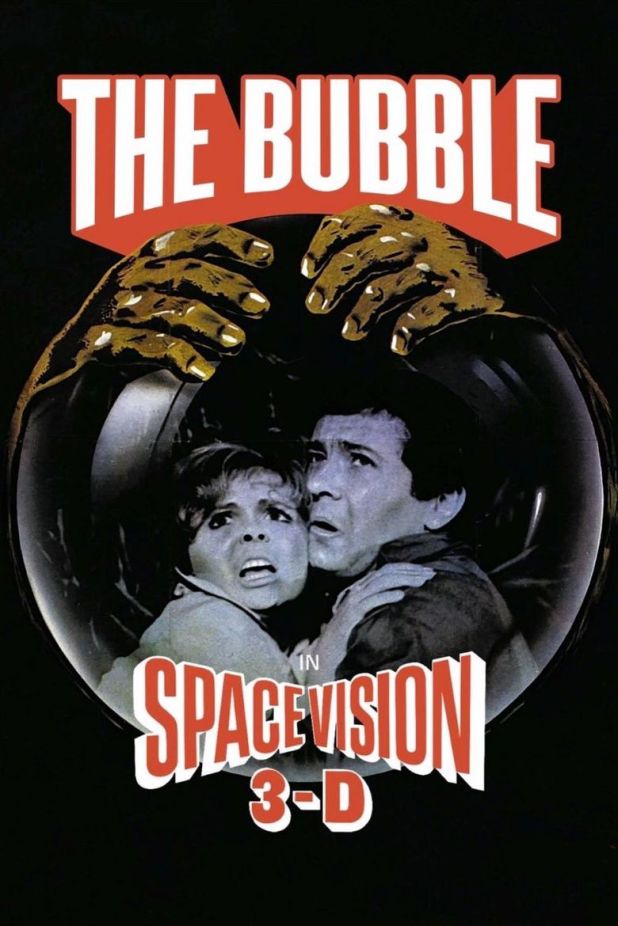
EDITOR’S NOTE: The Bubble was on Chiller Theater on Saturday, October 6, 1979 at 1:00 a.m. It played as Fantastic Invasion of Planet Earth.
Tony (Johnny Desmond) flies Mark (Michael Cole) and his pregnant wife Catherine (Deborah Walley) through a storm which causes them to land. She gives birth as the men wander the city, finding it filled with all sorts of odd buildings and technology, as well as drugged out people. It’s all covered by a dome that keeps people from leaving, other than the shadow that keeps appearing over the town that pulls people into the sky.
As Tony is taken away, Mark starts to dig under the dome before he’s caught. He gives a speech about being free, just in time for it to rain and the aliens to go away.
The Bubble came out in 3D in 1966, years after the first of the fad, and had twenty minutes of pure popping out at the camera moments that got cut from the 2D version of this. This was made in Space-Vision 3-D, the same process that was used for Andy Warhol’s Dracula. It was directed and written by Arch Oboler, who also directed and wrote the 3D movie Bwana Devil and The Twonky.
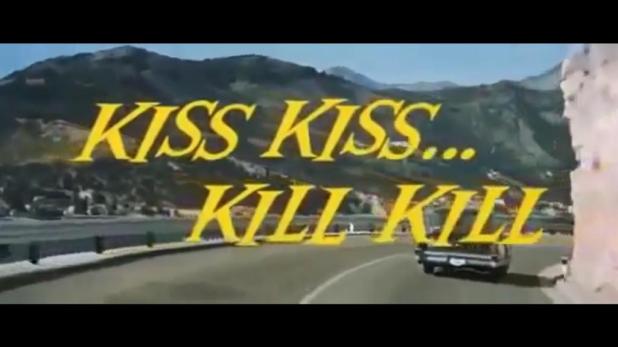
EDITOR’S NOTE: Kiss Kiss, Kill Kill was on Chiller Theater on Saturday, November 11, 1967 at 11:20 p.m.
Instead of having that who is your favorite Bond discussion, we should all talk about who our favorite remix remake ripoff Bond is or which movie is best. Man, Kiss Kiss, Kill Kill is a pretty good one, even if it has some of the most laddish louts I’ve seen in one of these.
Based on Kommisar X, a popular series of crime novels from Germany, Kommissar X is a private detective and FBI Special Agent named Joe Walker, who is played by Tony Kendall. He’s paired with New York City police captain Tom Rowland is played by Brad Harris).
This is just the first of seven movies in this series of films. In 1966 alone, this movie, Kommissar X – Drei gelbe Katzen (Three Yellow Cats AKA Death is Nimble, Death is Quick) and Kommissar X – In den Klauen des goldenen Drachen (So Darling, So Deadly) all were released, followed by Kommissar X – Drei grüne Hunde (Death Trip AKA Kill Me Gently) in 1967, Kommissar X – Drei blaue Panther (Three Blue Panthers AKA Kill Panther Kill) a year later, Kommissar X – Drei goldene Schlangen (Three Golden Serpents AKA Island of Lost Girls) in 1969 and finally, 1971’s Kommissar X jagt die roten Tiger (FBI: Operation Pakistan AKA Tiger Gang).
The two men meet and come together to figure out why a scientist named Bob Carroll was killed. It. turns out that a rich villain named Oberon (Nikola Popović) who was stealing gold from his partners by irradiating it and having Carroll fix that at the cost of his own life when he became sick.
With a theme song called “I Love You Joe Walker,” you know that he’s going to be one of those spies that swing.
I kind of wonder how every Eurospy villain has an army made up of women with go go boots. And somehow, Joe Walker can turn any of them to his side with just a kiss. One can only imagine if he can do that vertically, what he does when things get horizontal.
BONUS WILDCARD WEEK (September 22 – 28) Go order something from the SWV website and watch it!
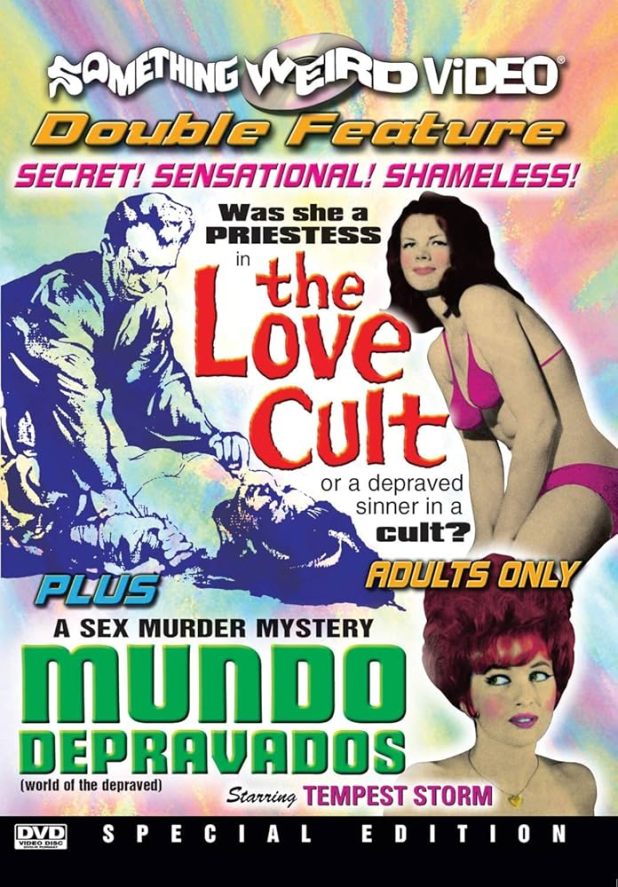
Barry Mahon used the name T.A. Dee to direct this, which is kind of a bummer, because I’d put this on the good side of the Mahon film column. It was written by Forest Russell (using the name Russell Fore), who only wrote one other movie, Unholy Matrimony.
A hypnotist realizes that there’s more money — and women — if he starts a sex cult. He takes the name Brother Eros and starts to preach that “Love is all that counts.”
I dig the idea that there are old rich women who bankroll this cult because they’re elite perverts. But if you’re coming to The Love Cult expecting debauchery, this movie is near PG-13 in content.
I really do love the tagline for it, though: “Here’s a major motion picture that tells the inside story of phony religious groups that used the DEVIL for a preacher!”
Rita Bennett is in this. Despite appearing in movies for directors like Joseph W. Sarno, Barry Mahon, William Rose, and the Ameros during the nudie cutie and roughie eras, then appearing in plenty of mainstream movies like Raging Bull and All That Jazz, she never got her drinking out of control and was buried in a potter’s field, her body unclaimed after her demise.
Uta Erickson, who was in the Findlay’s Her Flesh trilogy, is also in this, as is Sharon Kent from Beware the Black Widow, Some Like It Violent and Carny Girl.
BONUS WILDCARD WEEK (September 22 – 28) Go order something from the SWV website and watch it!
Crazy World…Crazy People was directed by Renato Polselli, who co-wrote the film with Giuseppe Pellegrini, who wrote and did second unit work on several of Polselli’s early movies.
A group of young musicians work with Maurizio, an older vaudeville actor (Posani), to organize a show that only gets on the stage thanks to girlfriends and Elvezia Allori, the actor’s wife (France Polesello). One of those musicians is Claudio Natili, who twenty years later would score Fulci’s The Devil’s Honey.
Thea Fleming also appears and is even on some of the posters. She showed up in several Eurospy movies like SuperSeven Calling Cairo, From the Orient With Fury and Operation Counterspy. Franco Latini is in the cast as well and he was the voice for Stan Laurel, as well as several muppets and the Italian dub voice of Skeletor and Donald Duck.
The film itself is a fake mondo about the concert and the issues of it getting to the public. It has none of the other outright insanity that you can find in Polselli’s other movies.
69 EsSINtial SWV Titles (September 15 – 21): Klon, who came up with this list, said “This isn’t the 69 BEST SWV movies, it isn’t my 69 FAVORITE SWV movies, my goal was to highlight 69 of the MOST SWV movies.” You can see the whole list here, including some of the ones I’ve already posted.
Sold as a double bill with William Grefé’s Death Curse of Tartu, this is Florida regional drive-in exploitation at its absolute best. I mean, sure there are plenty of movies where sea creatures rise to the beach to menace near-nude girls, but do any of them have Neil Sedaka* belting out “Do the Jellyfish?”
Shot on the very same Rainbow Springs that were once attacked by the Creature from the Black Lagoon, this starts off hot, with a hand reaching up from the depths of the ocean to murder an innocent young girl who just wants to listen to her radio.
A bunch of college kids — well, one of them is a doctor and his assistant, but come on, this is basically a slasher in the swamps — just want to drink orange drink and make fun of Egon, their host’s helper with the scary face. Why, it’s enough for a man to turn himself into a half-human, half-jellyfish maniac who knows how to use an axe when he isn’t sending an entire armada of Portuguese Man O’ War jellyfish to kill everyone.
And yeah, he does have a giant jellyfish in a tank and a head shaped like one. This is that kind of movie. That kind of awesome movie where the killer has obviously flippers on and a giant inflatable head.
*They may have advertised special singing star Neil Sedaka, but they never promised you he’d show up, did they?
69 EsSINtial SWV Titles (September 15 – 21): Klon, who came up with this list, said “This isn’t the 69 BEST SWV movies, it isn’t my 69 FAVORITE SWV movies, my goal was to highlight 69 of the MOST SWV movies.” You can see the whole list here, including some of the ones I’ve already posted.
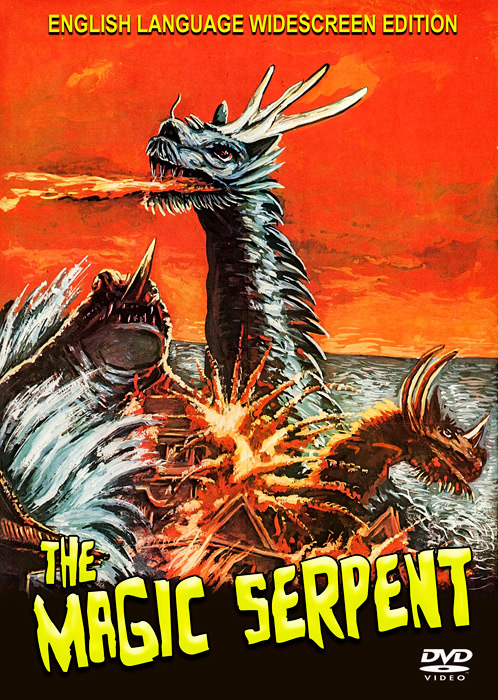
The Oumi Kingdom is in shambles after General Daijo Yuki (Bin Amatsu) and his ninja Orochimaru (Ryūtarō Ōtomo) kill Lord Ogata (Shinichiro Hayashi) and his wife. Soldiers loyal to Ogata have succeeded in helping his son Ikazuchi-Maru to escape but Orochimaru transforms into a serpent and tries to kill him. Luckily, a giant eagle flies in and saves Ikazuchi-Maru.
Trained by Dojin Hiki (Nobuo Kaneko), Ikazuchi-Maru grows to become a ninja who specializes in toad magic. One evening, Hiki is attacked by Orochimaru and it’s revealed that the old man once taught the evil ninja and was also the eagle that saved our hero, who arrives too late — along with Tsunade (Tomoko Ogawa) — to save him. Now out for revenge, he goes after the ninja while Tsunade follows, given a spider pin by the spider woman who saved her.
Ikazuchi-Maru renames himself Jiraiya and becomes friends with Saki (Yumi Suzumura) and her little brother Shirota (Takao Iwamura), saving them from Daijo Yuki’s men. But oh, the twists and turns, as it turns out that while she loves our hero, Tsunade is also the daughter of Orochimaru! And there’s still a battle between the ninjas in their toad and serpent forms to follow.
Man, I absolutely loved this movie. It combines the martial arts movie with kaiju and has so many strange things about it. People hopefully loved it too, but I bet so many people who watched the American-International TV versions just thought it was dumb. Not me!
AIP also redubbed the monsters, so the Orochi-Maru Dragon sounds like Godzilla and Gaira from War of the Gargantuas, the Ikazuchi-Maru/Jiraiya Toad roars like Rodan, the giant eagle is Mothra and Sunate’s giant spider now sounds like a metallic monster and also has the voice of Kiyla from Ultraman. They also removed the opening and closing songs and replaced them with basic instrumentals. The toad also was used on the Toei series Kamen no ninja Aka-Kage.
You could almost see a lot of Star Wars in this movie. An evil magic fighter orphans a young boy who is destined to have great power who is saved by an old man and raised in the ways of the very same magic. He becomes friends with the daughter of that enemy — Leia is, after all, Darth Vader’s daughter — and he finally becomes strong enough in magic that he can fight back and the evil magic fighter becomes briefly good before his heroic sacrifice. Sure, we can all get behind that Joseph Campbell Hero’s Journey, but sometimes, things get a little ripped off.
Speaking of that Hero’s Journey, this is based on a Japanese folktale, The Tale of the Gallant Jiraiya, and was directed by Tetsuya Yamanouchi (Akakage, The Ninja Hunt) and written by Masaru Igami (Prince of Space, the main writer of Kamen Rider, Johnny Sokko and His Flying Robot) and Mokuami Kawatake.
The title in Japan was Great Mystic Dragon Battle, which is super metal, and it has even better ones over the entire world, like Grand Duel in Magic, Ninja Apocalypse and Monsters of the Apocalypse. If you’ve ever seen the Taiwanese movie Young FlyingHero, that feels like a remake of this movie.
Frank Henenlotter’s Sexy Shockers (September 1 – 7) We all know Frank Hennenlotter as the director of the Basket Case films, Bad Biology, Brain Damage, and Frankenhooker, but he’s also a cinematic curator of the crass! An academic of the pathetic! A steward of sleaze! A sexton of the sexual and the Sexy Shocker series is his curio cabinet of crudity. Skin and sin are mixed together in these homegrown oddities, South American rediscoveries, and Eurohorror almost-classics. Your mind may recoil with erotic revulsion at the sights contained within these films, so choose wisely!
Mondo Cane 2 (1963): New Guinea, Germany, Singapore, Portugal, Australia, America and beyond, no country is safe when Gualtiero Jacopetti and Franco Prosperi have their cameras rolling. Paolo Cavara, who helped make Mondo Cane, had moved on to make other films, including Black Belly of the Tarantulaand Plot of Fear.
This time around, their journey takes us through vivisections, lynchings, tranvestitites, sex clubs, alligator hunts and a trip to a mortician’s school. Everything in this consists of cutting room footage of the first film, including a scene where a monk sets himself ablaze that was totally faked with the help of special effects wizard Carlo Rambaldi.
As the mondo had grown beyond their film, this time Jacopetti and Prosperi go abti-establishment, even laughing about how the dog scenes in the original movie kept them off screens in England. They’re incredulous and probably desensitized over all that they have seen.
Mondo Freudo (1966): Mondo Freudo is all about “a world of sex and the strange & unusual laws that govern it,” as told by two absolute maniacs: the producer/director/distributor team of Lee Frost and Bob Cresse, with Cresse himself ranting as we try and make it through another swing through the world of mondo.
Hollywood strippers, Tijuana hookers, London lesbians, Asian sex shows, Times Square Satanists and topless Watusi clubs. Hidden cameras have recorded everything from teenagers making out to a Mexican slave market, a Black Mass near Times Square, while we also see people get painted, beaten and wrestle in mud.
Cresse would go on to make Love Camp 7 and plenty of other upsetting — or awesome — movies before his life fell apart one day while he walked his dog. Coming across two men beating a woman in broad daylight on Hollywood Boulevard, Cresse pulled his gun and ordered the men to stop. Turns out they were cops and shot him in the stomach and then killed his dog. He’d spend seven months in the hospital with no health insurance, losing most of his fortune.
Frost would make The Black Gestapoand put sex inserts into a foreign mondo all about the occult, creating the near-classic Witchcraft ’70. He was smart enough to not fight any police.
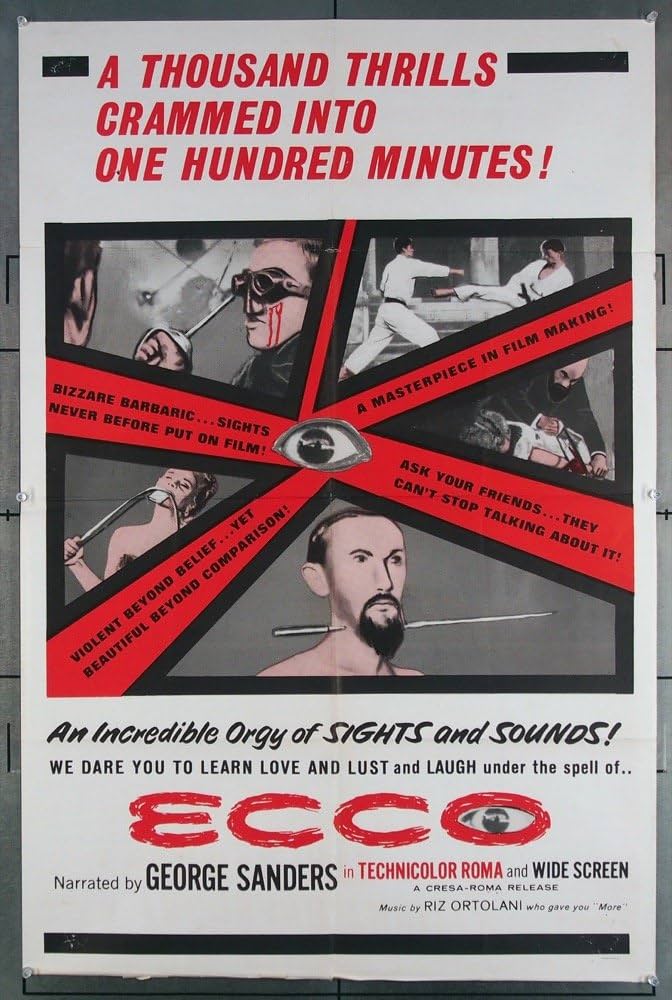
Ecco (1963): Offsetting the globetrotting shock of this film — watch a woman bite off a reindeer’s scrotum with her bare teeth! — is the voice of George Sanders, perhaps way too sophisticated a man for such an endeavor. That said, money is money, and it’s time for Gianni Proia to take us all around This Shocking World (the other title for this mondo).
Beyond the expected lesbians and strippers — show me a mondo that doesn’t have those and it’s amazing that I am seeing them as commonplace at this point — you also get a trip to the original Grand Guignol and get to watch a man repeatedly impale himself.
The US version — re-edited with a new commentary by absolute maniac Bob Cresse and with an Italian title that means “look here” — adds scenes from World by Night No. 2, another Proia mondo, with bodybuilding showgirls, Roller Derby and some vacation footage. Consider it like watching snaps from holiday, except the vacation goers have no compunction showing you absolute filth.
Mondo Balordo (1964): Albert T. Viola — yes, the same man who wrote, directed, produced and starred in Preacherman— completed the American version of this film, known as A Fool’s World in Italy. There, it was directed by Roberto Bianchi Montero, who also made the mondos Africa Sexy, Orient By Night, Sexy Nudo, Sexy nel Mondo, Universo Proibito and Superspettacoli nel Mondo. He would go on to make So Sweet, So Dead.
Imagine a world “throbbing and pulsing with love, from the jungle orgies of primitive tribes to sin-filled evenings of the London sophisticate.” Now imagine those very same words coming out of the mouth of Boris Karloff.
Here are just some of the folks you will meet and sights you will see: a dwarf singer, bodybuilders, bedouin pimps, Japanese models for rent, Indian exorcists, people who can’t stop smoking, Jehovah’s Witnesses, lottery players, a clone of Valentino, high end rich dogs, a Borneo version of Romeo and Juliet, cults, nightclubs, Luna Park, London after hours and so much more.
Mondo Bizarro (1966): “To the worm in the cheese, the cheese is the universe. To the maggot in the cadaver, the cadaver is infinity. And to you, what is your world? How do you know what is beyond the Beyond? Most of us don’t even know what is behind the Beyond.”
Mondo Bizarro blew my mind and it hadn’t even started yet.
Much like all of the Lee Frost and Bob Cresse mondos, this is a mix of both documentary and faked footage. Sure, that one way glass in a changing room is fake, but hey, Frederick’s of Hollywood is real, even if it shows up in so many mondo films that I lose track of which one is which.
This one also has a man sticking nails in his skin and eating glass, the hippies of Los Angeles, Germans watching a Nazi play. Cresse must have been, umm, Cresse-ing his jeans, seeing as how he played a German officer in Love Camp 7 with such aufregung.
The duo also used a high-powered lens to capture what they describe as a Lebanese white-slavery auction. Never mind that it’s obviously Bronson Canyon, the setting for everything from Night of the Blood Beast to Equinox, Octaman and, most famously, the entrance to the Batcave in the 1960’s TV show.
Make no bones about it. This is junk. But it’s entertaining junk.









 B&S About Movies
You must be logged in to post a comment.