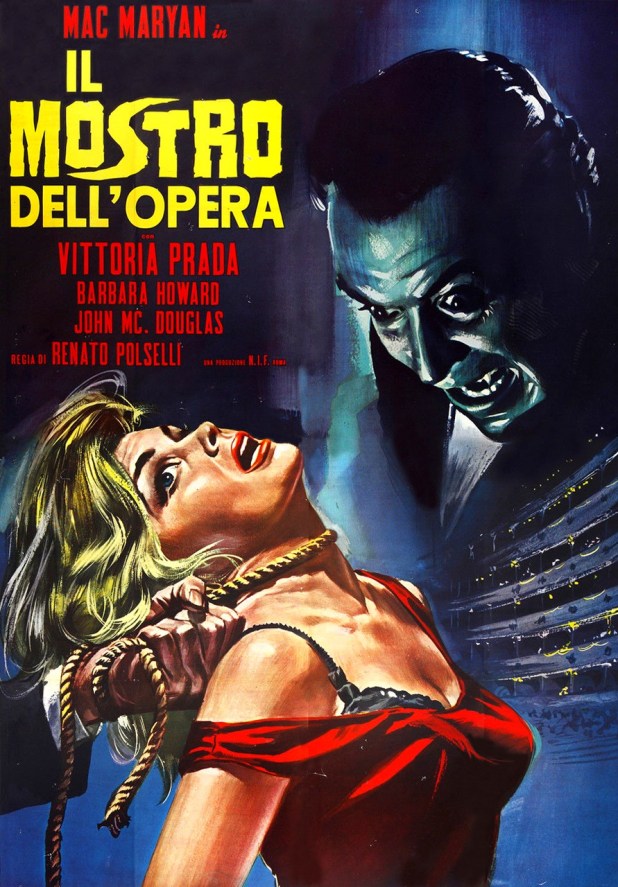
The suggested eroticism of The Vampire and the Ballerina was amped up in Polselli’s quasi-sequel, which was a troubled production started in 1961 and was not released until three years later, it was started as Il vampiro dell’opera (The Vampire of the Opera) and once box office fortunes changed against vampires, the name was slightly altered. Along with Piero Regnoli’s L’ultima preda del vampire (The Playgirls and the Vampire), even more eroticism was added to the bloodsucking. Of course, Gastaldi also wrote all three of these movies, even if he demurred that they were movies similar to others he wrote, only with vampires.
The difference in the few years in between movies is that now the dancers may embrace and even have a timid kiss between one another. Those that devour Polselli’s later films will giggle a bit at this; no corncob penetration here. For 1964, it had to be pretty titillating. So is the opening, in which the monstrous fiend in the opera chases a woman in a nightgown who is carrying the much-needed candelabra until he stabs her with a pitchfork.
Sandro (Marco Mariani) is the leader of an experimental dance group with Giulia (Barbara Hawards) as the star. Soon they are attacked by the titular bad guy, Stefano (Giuseppe Addobatti), and his five vampire wives. The human victims must keep dancing to battle Stefano’s psychic attacks and the suggestions he’s put inside their minds to stay within his crumbling theater.
Polselli’s later films aren’t just insane. They look that way as he never stops moving the camera. That starts happening here as well and I can’t get enough of this movie. Let that fog flow in, chain those vampire women to the wall and let’s dance.
You can watch this on Tubi or buy it on the Severin Danza Macabra: The Italian Gothic Collection Volume 1 set.
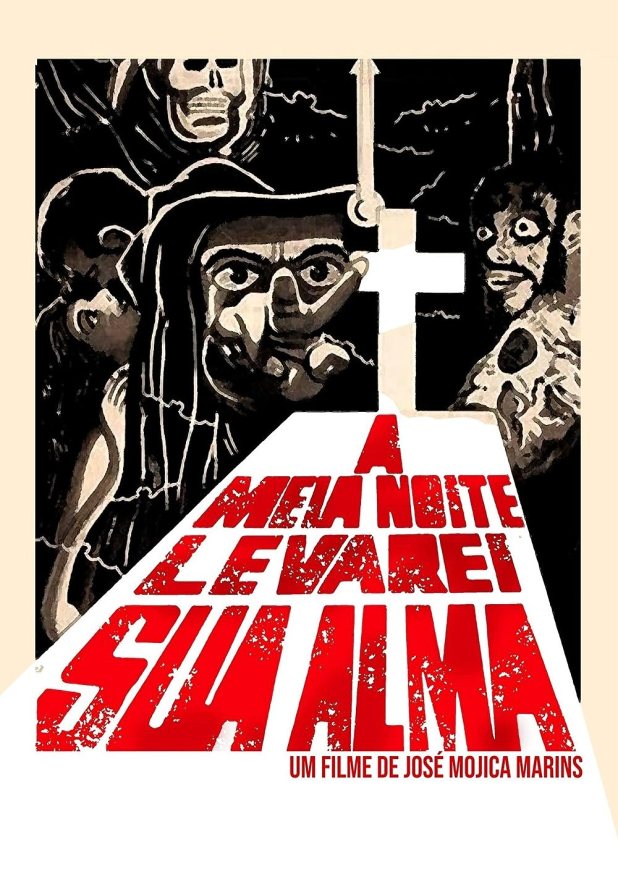
How badass is Zé do Caixão or as we know him, Coffin Joe?
Can you imagine the audacity to not just create this character but to become him in the midst of a country where more than 60% of the population is Catholic?
Can you even comprehend how upset people were when José Mojica Marins become the long-fingernail-wearing amoral undertaker driven to continue his bloodline by having a son with the perfect woman while murdering and ruining everyone in his wake? How did they deal with a boogeyman who filled their head with doubletalk and Nietzschian statements?
As Coffin Joe would yell, “I challenge your power! I deny your existence! Nothing exists, but life.”
The first appearance of Coffin Joe is in this movie, a film in which the evil undertaker searches for his perfect woman who will bear him the child that will make him immoral. After all, his wife is infertile, so he decides to murder her with a spider. And not just on any day. On a Catholic Holy Day. And then he decides to break another Commandment, coveting Terezinha, the fiancée of his friend Antonio.
Joe and Antonio visit a gypsy who foretells that a tragedy will keep Antonio and Terezinha from being married. This causes Joe to scream at the woman about how the supernatural is a lie, then he makes her warning come true by strangling his friend before drowning him. The very next day, he starts to court Terezinha by giving her a canary. When she resists his advances, he beats her and then assaults her. She curses him and reveals that she will kill herself — one of the gravest sins in the Catholic Church — and come back to pull him into Hell. He laughs, but the next day, she has hung herself.
The police just can’t seem to figure out why all this death is happening in this small village, but Dr. Rodolfo does. Coffin Joe responds by tearing out his eyes with his long fingernails and lighting him on fire. Problem solved. He remains unpunished and even starts to fall for another woman, Marta. On their date, he sees the gypsy who warns him that he will be punished. That night, as he walks home, the cemetery calls him, the place where all of his victims are burning. He opens the grave of Antonio and Terezinha and they begin to open their eyes as their mouths are filled with worms and insects. Coffin Joe begins to scream, as he is trapped between life and death, finally paying for his crimes as the church bells ring at midnight.
This is just the start of how strange these movies would become. If you liked the last ten minutes of this, just get ready. It gets really good from here.
EDITOR’S NOTE: 7 Faces of Dr. Lao was on the CBS Late Movie on June 22 and December 14, 1973; June 30, 1975 and May 27, 1976.
The last film directed by George Pal was written by Charles Beaumont, who wrote many Twilight Zone episodes, Queen of Outer Space, Burn, Witch, Burn! and The Masque of the Red Death. Pal said that the writer had “a kooky mind like mine.” It was based on The Circus of Dr. Lao by Charles G. Finney.
Abalone, Arizona, is, well, falling to pieces. Clinton Stark (Arthur O’Connell) knows that the railroad is coming to town, so he’s trying to buy it out from under the townspeople. He’s opposed by only librarian Angela Benedict (Barbara Eden) and newspaper editor Ed Cunningham (John Ericson).
Then, the enigmatic Dr. Lao (Tony Randall) and his mesmerizing circus, brimming with magical wonders, grace the town for a fleeting two days, casting a spell of fascination over the townspeople.
Dr. Lao, a 7,321-year-old sage, arrives with his circus, assuming the roles of Merlin, Pan, a giant serpent, Medusa, Apollonius of Tyana, and the Abominable Snowman. He imparts his profound wisdom, ‘This is the circus of Dr. Lao. We show you things that you don’t know. Oh, we spare no pains, and we spare no dough; oh, we want to give you one hell of a show. And youth may come, and age may go, but no more circuses like this show.‘ His teachings are a revelation, a beacon of enlightenment for the town.
He also takes a moment to explain life to Ed’s son Mike (Kevin Tate):
Dr. Lao: Mike, let me tell you something. The whole world is a circus if you know how to look at it. The way the sun goes down when you’re tired comes up when you want to be on the move. That’s real magic. The way a leaf grows. The song of the birds. The way the desert looks at night, with the moon embracing it. Oh, my boy, that’s…that’s circus enough for anyone. Every time you watch a rainbow and feel wonder in your heart. Every time you pick up a handful of dust, and see not the dust, but a mystery, a marvel, there in your hand. Every time you stop and think, “I’m alive, and being alive is fantastic!” Every time such a thing happens, you’re part of the Circus of Dr. Lao.
Mike: I don’t understand.
Dr. Lao: Neither do I.
Despite the henchmen of Stark destroying the newspaper office — look for Royal Dano as one of them — the entire building is unharmed in the morning.
That night, during the second show, Lao shows the town a magic lantern show that relates their town to Woldercan, a kingdom destroyed by greed (and using special effects from past Pal effects movies like Atlantis, the Lost Continent and The Time Machine). The town is saved by this lesson while the henchmen decide to destroy the circus. As they break a fishbowl, it unleashes the Loch Ness Monster, who chases them away.
As the circus departs, it leaves behind a town transformed, its inhabitants filled with newfound hope and understanding, ready to embrace the magic of life.
EDITOR’S NOTE: Children of the Damned was on the CBS Late Movie on March 6 and October 4, 1972 and September 3, 1973.
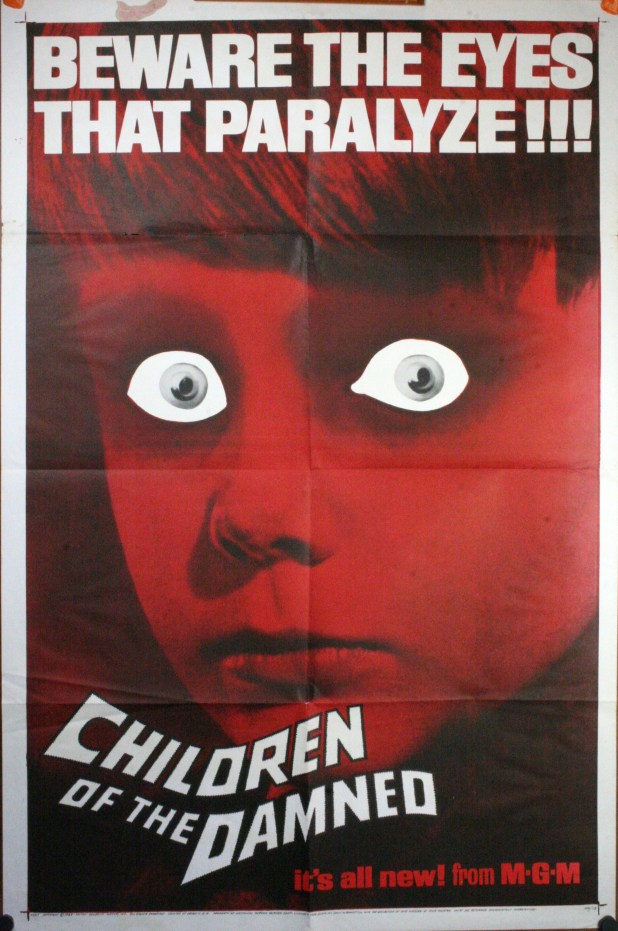
Directed by Anton Leader and written by John Briley (Ghandhi, Pope Joan), Children of the Damned features six children from six countries, all born under miraculous circumstances. These children, with their extraordinary abilities, come to be seen as the next stage in human evolution, a theme that the film explores in depth.
British psychologist Tom Lewellin (Ian Hendry) and geneticist David Neville (Alan Badel) start by studying Paul (Clive Powell), a London-born young boy whose mother hates him. He joins the others who quickly escape and hide in an abandoned church.
Paul, Nina, Rashid, Mi Ling, Aga Nagolo, and Mark, the six children, are not just a threat to the governments of the world, but also symbols of resilience. Despite the world’s rejection, they continue to fight back when attacked, showing a strength that is both inspiring and unsettling.
The idea that these are all the children of aliens is abandoned, however, as this movie is just about the kids and not where they came from. I personally prefer the much darker first film, which delves more into the children’s origins and the implications of their abilities. However, this sequel still maintains a bleak tone as the group realizes that they have arrived at a time when humans are not yet ready to deal with evolution or have their better future selves walk among them.
EDITOR’S NOTE: Cinematic Void will be playing the most classic of all giallo on Friday, Jan. 20, at midnight at The Belcourt Theatre in Nashville, TN (tickets here). For more information, visit Cinematic Void.
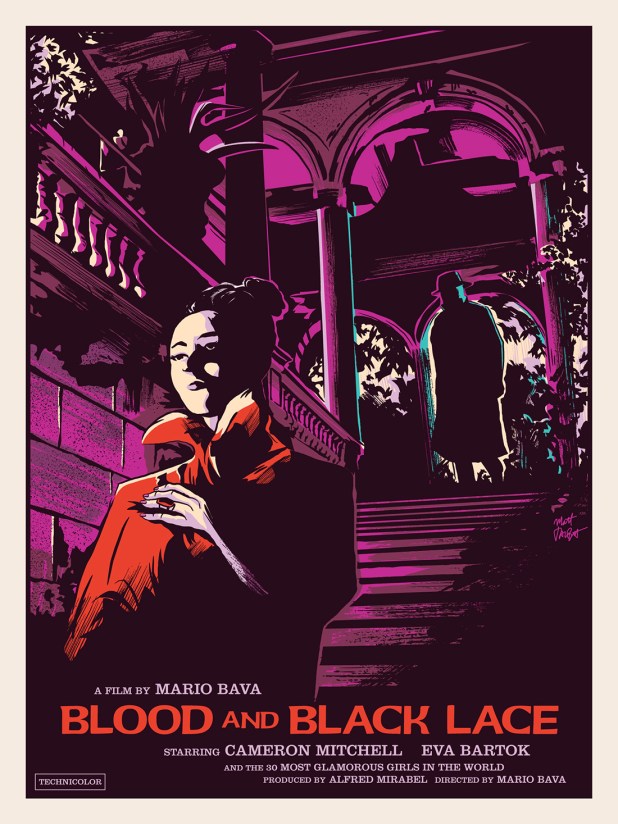
There’s no way to calculate the influence of Blood and Black Lace. It takes the giallo from where Bava started with The Girl Who Knew Too Much and adds what was missing: high fashion, shocking gore and plenty of sex. The results are dizzying; it’s as if Bava’s move from black and white to color has pushed his camera lens to the brink of insanity.
Isabella is an untouchably gorgeous model, pure perfection on human legs. But that doesn’t save her as she walks through the grounds of the fashion house and is brutally murdered by a killer in a white mask.
Police Inspector Sylvester takes the case and interviews Max Morlan (Cameron Mitchell!), who co-manages the salon with his recently widowed lover, the Countess Christina Como. Soon, our police hero discovers that the fashion house is a den of sin, what with all the corruption, sex, blackmail, drugs and abortions going on under its roof. Isabella was murdered because she had kept a diary of all the infractions against God that happened inside these four walls.
Nicole finds the diary and tells the police she will deliver it, but it’s stolen by Peggy. As she arrives at the antique store her boyfriend Frank owns, the killer appears and kills her with a spiked glove to the face. The killing is shocking. Brutal. And definitely the forerunner to the slasher genre.
Even after the cops arrest everyone in the fashion house, the murders keep on piling up. Peggy claims that she burned the diary, so the killer burns her face until she dies. Greta is smothered to death. And Tilde is killed in the bathtub, then her wrists are slit open, spraying red into the water and marking her as a suicide.
So who is it? Come on. You’re going to have to watch it for yourself.
The success of Black Sunday and Black Sabbath had given Bava the opportunity to do anything he wanted. His producers thought that this movie would be a krimi film along the lines of an Edgar Wallace adaption. Instead, Bava gave more importance to the killings than the detective work, emphasizing sex, violence and horror more than any film in this form had quite before.
Blood and Black Lace was a failure in Italy and only a minor success in West Germany, the home of Edgar Wallace. And in America, AIP passed on the film due to its combination of sex and brutality. Instead, it was released by the Woolner Brothers with a new animated opening.
Today, Blood and Black Lace is seen as a forerunner of body count murder movies and the excesses of later giallo films. To me, it’s a classic film, filled with Bava’s camera wizardry and love of color. It is everything perfect about movies.
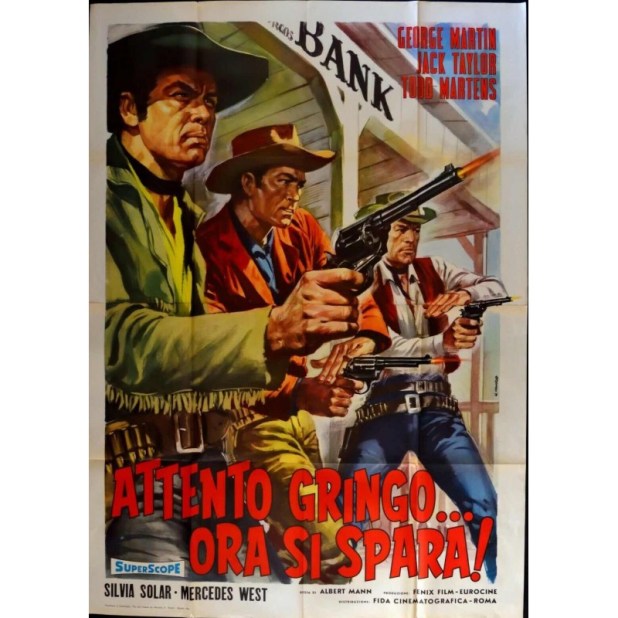
Not the first film Amando de Ossorio would make — that would be Lan Bandera Negra, a short political movie — Tomb of the Pistolero AKA Grave of the Gunfighter is about Tom Bogard (Jorge Martín) looking for the killer of his brother in the mining town of Carson City.
This feels like it has one boot in the old American westerns — indeed, one character is named Hopalong Tennessee — and the other in the new world of the Italian cowboy film. In fact, it was filmed in the same Spanish Western town as A Fistful of Dollars, a movie that would change Westerns around the world that came out the same year as this movie.
Salloon singer Taffy is played by Silvia Solar, who starred with Paul Naschy in Night of the Howling Beastand also shows up in Eyeball. Of course, Jack Taylor is in this. What actor has crossed over into so many genre subfilms? He’s in Mexican horror (The Curse of Nostradamus), lucha movies (Neutron, the Man in the Black Mask), the films of Jess Franco (so many), giallo (The Killer is One of Thirteen, Autopsy), slashers (Edge of the Axe) and so much more.
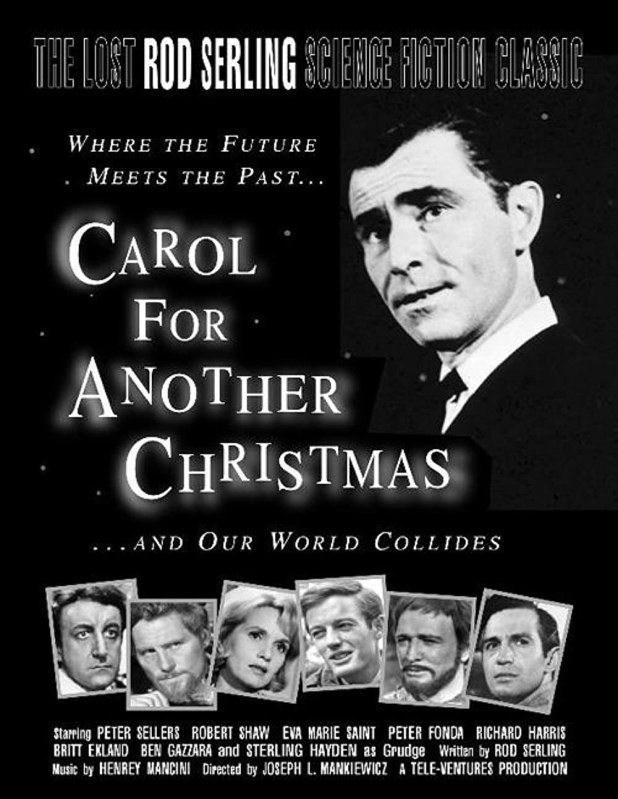
Originally televised on ABC on December 28, 1964 and was the first in a planned series of television specials developed to promote the United Nations and educate viewers about its mission — Who Has Seen the Wind?, Once Upon a Tractorand The Poppy Is Also a Flower are the others.
It sure has a great pedigree, as it was written by Rod Serling and is the only TV work by director Joseph L. Mankiewicz. It also marked the return to acting after Peter Sellers’ heart attack and has his wife at the time, Britt Eklund, in the cast.
On Christmas Eve, rich industrialist Daniel Grudge (Sterling Hayden) is alone in a dark room listening to “Don’t Sit Under the Apple Tree (with Anyone Else but Me)” by The Andrews Sisters. His nephew Fred (Ben Gazzara) comes to ask for help with a United Nations program at his college, but Daniel remarks that he’s tired of the U.S. being the world’s policeman. After all, his son Marley died twenty years ago to the day and he’s never gotten past it.
As you can imagine, three ghosts — Past (Steve Lawrence), Present (Pat Hingle) and Future (Robert Shaw) — take him through the world of isolationism and also introduces the despotic Imperial Me (Sellers) who demands that everyone left on the planet after a nuclear war kill one another until no one is left.
Serling biographer Gordon F. Sander wrote that this movie is unlike a lot of the author’s social change stories, as it ends on a down note. That may be because of the assassination of John F. Kennedy and the war in Vietnam taking more American lives. This film is very heavy handed — it also led to a right wing boycott, which yes was already happening in 1964 — and didn’t play again until nealry fifty years after it first aired.
EDITOR’S NOTE: This was originally on the site on December 25, 2017.
This is the absolute bottom of the holiday barrel, a trip through hell that one can never prepare themselves for. You think you’ve known pain? You’ve known nothing, to quote Samhain.
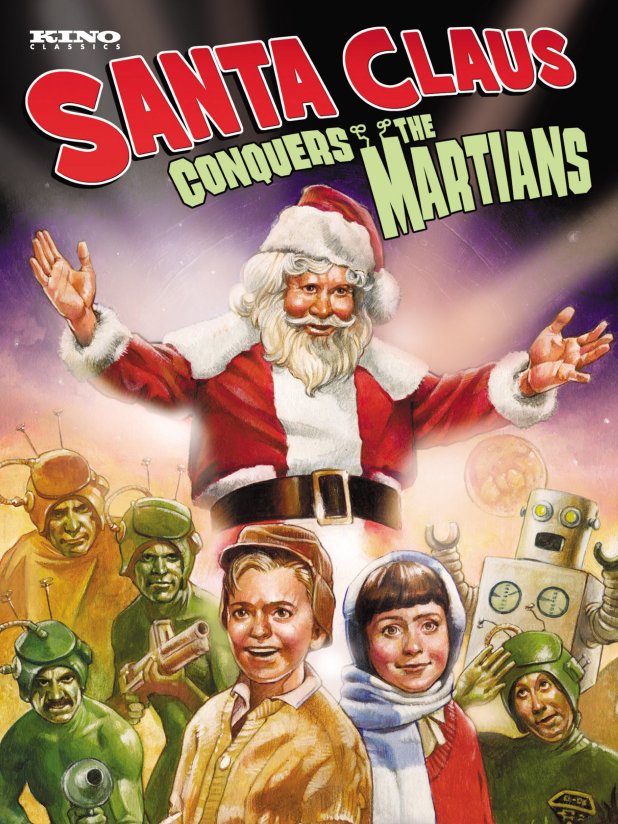
On Mars, Momar and Kimar are worried that their children, Girmar (Pia Zadora, who also sang the horrifying song “Hooray for Santa Claus,” but let’s forgive her because she was in The Lonely Lady) and Bomar are watching too much Earth TV. The big thing they’re all excited about is a live interview with Santa. But the kids have some pretty big issues — their education is fed directly into their brains with no individual thought.
The wise ancient Chochem has seen this coming for centuries and says that Mars also needs a Santa Claus. The Martians are all pretty much assholes, so they decide to steal Earth’s Santa instead of creating their own.
Along the way, the Martians kidnap two Earth children along with Santa. Voldar, a Martian hardliner, disagrees with this idea and keeps trying to kill Santa and the kids. Yes, in a holiday movie meant for children, Santa faces death. Sadly, this film is so painful, children very well may cheer for Santa’s doom in the hopes that this movie ends sooner.
Then there’s the wacky Martian named Dropo, who will challenge your will to live. There are all sorts of badly made toys, wacky hijinks and murder plots. The fact that parents would subject their kids to this travesty upsets me to this day.
Dell even had a comic tie-in, so kids could relive the ennui and forced humor of this film again and again.
It gets worse. There was an album version, so kids could listen to the shrill theme song until they puked! I’ll do you a horrible favor and share the song with you right now!
If you can make it through this movie, you get whatever you want for Christmas!
EDITOR’S NOTE: I was reading through old holiday movie posts, trying to get myself in the spirit of the season, and some of them made me laugh. I decided to pick out my favorite holiday movies — some new, some old — and in the spirit of giving, share them all with you. This originally appeared on December 25, 2019 but has some new material and editing.
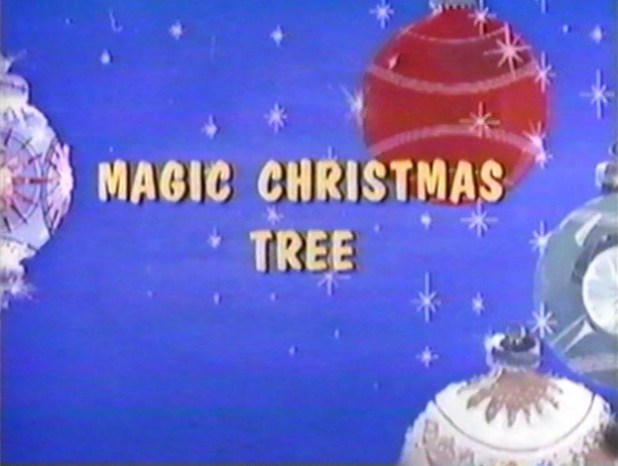
Much like The Wizard of Oz, The Magic Christmas Tree thinks that reality is in black and white while dreams are in color. Both films have a witch. Both movies have wishes. But only one of them had a budget. And only one of them is a classic beloved by families for generations.
Sorry Richard C. Parish. Your one-and-done directorial effort isn’t getting a 4K re-release this year. Or any year, really.
In the black and white real world, three boys are walking home from school on Halloween. One of them, Mark, helps a witch get her cat Lucifer out of a tree. The moment someone told me I had to climb a tree to save a demonic cat, I would honestly be out of there, but Mark instead falls out of the tree and gets knocked out.
When he wakes up, the witch gives him a magic ring, as well as some magic seeds that need planted. On Thanksgiving, while everyone else is sleeping off the turkey, Mark is combining the wishbone of a turkey with the magic seeds and the magic words and the magic ring to grow the magic Christmas tree. His turtle Ichabod just watches in terror as Mark engages in a rite of eroto-comatose lucidity.
This tree that grows is unkillable, even when Mark’s dad cuts the grass in the middle of November. I guess we should assume that they live in California. Also — Mark’s dad is played by the director and his dialogue appears to appear as if by magic. In fact, this entire film appears dubbed even when it isn’t.
While Ichabod the turtle eats the grass, dad has a wacky grass-cutting session that ends up with the mower in flames and him acting drunk. The way he talks to his wife, you can only assume how he really treats her. This film cuts deeply into the dark underbelly of post-war America. The dream is dead. The power mower is in flames. The Christmas tree is alive.
That’s right. On Christmas Eve, the Magic Tree comes to life and can talk. It grants Mark three wishes. The Magic Christmas Tree also speaks with all the snark and pomp of Charles Nelson Reilly. Seriously, it’s as if the tree has seen it all and is bored with this charade. He’s merely indulging Mark.
Now, Mark’s a smart kid, so he wishes for an hour of absolute power, which he promptly is corrupted by absolutely. That said, he’s not that smart, because why wish for only an hour? Just wish for absolute power. Don’t put any limits on it, Mark. And don’t talk to trees.
What does Mark do with all that power? He makes flowers appear and disappear. Mark has obviously not gone through puberty, because if I had magic power in 1964, I would use the entire hour with Barbara Steele. Or Mamie Van Doren. Or Bardeau. Ah, you get the picture, even if Mark doesn’t.
Instead, he makes people run all over the place and throw pies in one another’s faces, but the camera is so far away you may wonder exactly what’s happening. It’s all kind of like Benny Hill but terrifying instead of madcap. Firemen get pies in their faces while their antique engines careen out of control. Happy holidays, La Verne, California. Hope you survive the experience.
Yes, the same town where the wedding scene in The Graduate was shot (and Wayne’s World 2) is subject to the Magic Christmas Tree gifting Mark with the power to be a complete jerk.
Mark’s second wish is to have Santa Claus all to himself. He couldn’t think of any other wishes. I mean, you have any power in the world and you can’t think of a wish?
Santa really seems like he’s senile. He also seems like he can’t stand up from the chair he’s stuck in.
This wish causes every other child in the world to grow very sad, so Mark uses his third wish to send Santa back to the children. That’s because he gets sent to a pocket dimension where his selfishness leads him to meet the very personification of Greed. The giant man yells, “You are my little boy!” and offers him a mountain of cake and toys to stay.
Greed is played by Pittsburgh native Robert “Big Buck” Maffei, who uses his 7’1″ frame to his advantage, playing monsters and aliens in a ton of television shows and movies, including a creature (actually a Taurus II anthropoid) in “The Galileo Seven” episode of Star Trek and the giant cyclops on Lost In Space. His last movie appearance was in Cheech and Chong’s Nice Dreams.
Mark gives Santa back to the children. But of course, it was all a dream. A horrible, horrible dream. Maybe Mark learned something. Maybe we all did.
The bastards at Goodtimes released this on VHS in 1992, pairing it with Rene Cardona’s Santa Claus. I can’t imagine a more horrifying double feature ever — the battle of Santa and Patch directed by the man who brought you Night of the Bloody Apes paired with this film that feels like it was shot on one of those Price Is Right Showcase Showdown sets with all of the lights turned out.
You can watch this for free on The Internet Archive and Tubi. I would advise you to avoid it and ensure that your Christmas Day isn’t filled with relentless horror.
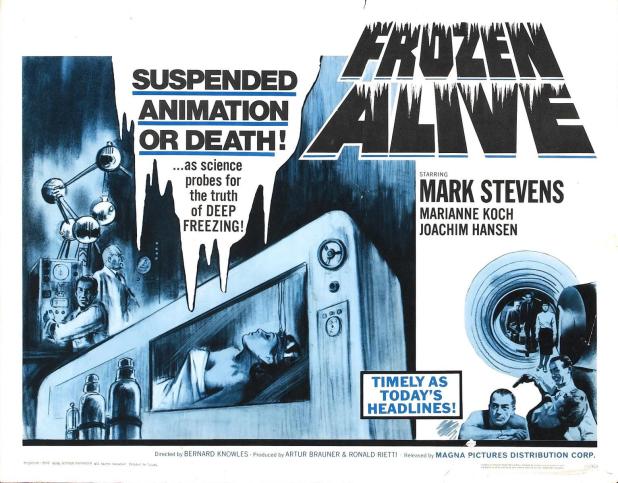
Bernard Knowles shot five of Hitchcock’s early movies before becoming a director himself. He’s probably best known for The Beatles film Magical Mystery Tour, but he also directed this movie which concerns freezing chimpanzees and then thawing them out for space travel because hey, it’s 1964 and we were spending apes to the moon.
World Health Organisation’s Low Temperature Unit doctors Dr. Frank Overton (Mark Stevens) and Dr. Helen Wieland (Marianne Koch, who was an internal medicine specialist after she finished her acting career) have not only frozen these monkees for months, they’ve also fallen in love. The problem? Frank is still married to Joan (Delphi Lawrence), a fashion journalist who is also schtupping crime reporter Tony Stein (Joachim Hansen).
Frank gets $25,000 for his work and offers to buy a house in the country for Joan where they can have children. She argues with him about Helen, basically shoving him into her embrace. As she goes off to argue with her other man, Helen and Frank go against God and freeze him, but not before Joan threatens them with a gun and later shoots herself.
That said, in his book The Biology of Science Fiction Cinema, Mark C. Glassy wrote that the science was pretty much correct: “The level of accuracy in the science throughout this film was refreshingly high, and I have nothing but praise for Elizabeth Frazer, the writer of the film. She did a marvelous job and certainly did her homework.”


 B&S About Movies
You must be logged in to post a comment.