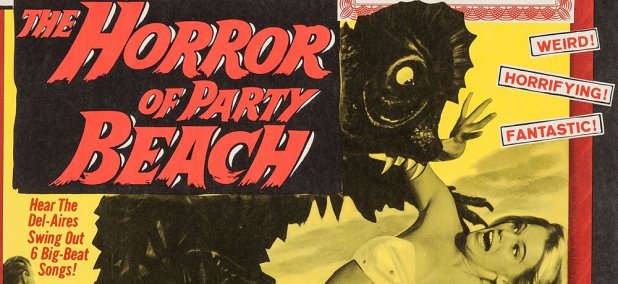
Shot in two weeks for $50,000 outside Stamford, Connecticut by local producer/director Del Tenney, The Horror of Party Beach was advertised as “The First Horror-Monster Musical.” Tenney would also direct I Eat Your Skin, a movie that we all know as the much worse half of the famous double bill with the utterly astounding I Drink Your Blood.
The Del-Aires just want to play a party on the beach for the kids, but radioactive waste transforms a skeleton into a shambling monster. Hank Green just wants to get with Tina, but she’s drunk and wants to hook up with a biker. A fight ensues, but dudes are dudes and get along and end up shaking hands. So The Del-Aires play “The Zombie Stomp” and everyone has a swell time until that monster — remember him? — kills Tina and her bloody body washes up at the party.
Meanwhile, Dr. Gavin and the cops are on the case, but the doctor is more on Hank’s case, but he just knows that his assistant is the object of his older daughter’s affection. And then there’s some voodoo, because you know, why not. And then there’s a slumber party, because that’s what girls do when they’re in their early twenties. But never mind, the monster has found friends and they decide to wipe out all of these nubile young somnambulists.
Through some buffoonery, we learn that sodium can kill these monsters. There are also many, many more songs by The Del-Aires, who can’t seem to grasp the fact that monsters are rising up and mostly killing attractive women. Perhaps they could put their guitars down, pick up some table salt and get to work wiping out whatever the hell these creatures are?
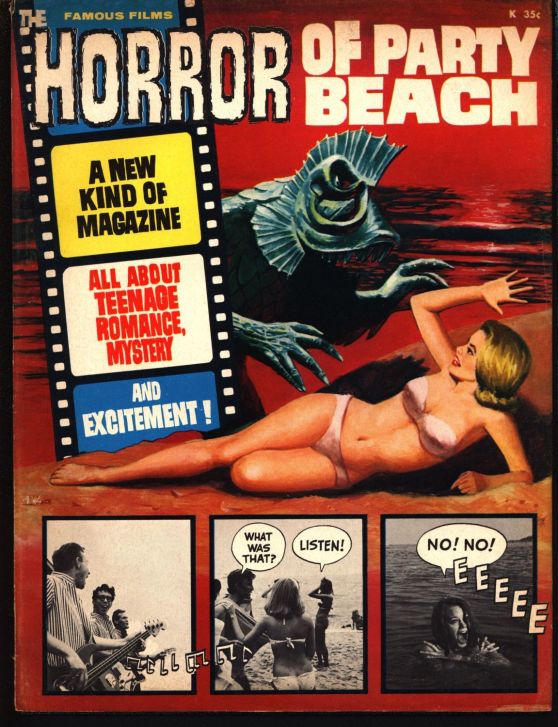
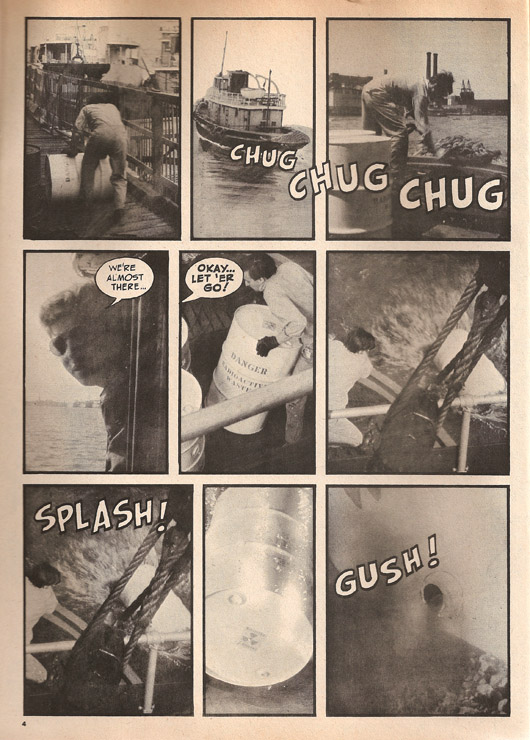
This movie even got a photo comic book tie-in from Warren Publishing, the home of Famous Monsters, Eerie and Creepy. Wally Wood and Russ Jones worked on it and it’s a great collectors’ item.
Beyond all those groovy tunes by The Del-Aires, Edward Earle Marsh composed the soundtrack. You may know him better as Zebedy Colt, who started his career in Laurel and Hardy’s Babes In Toyland before releasing a series of gay cabaret songs before embarking on a career in pornography which would lead him to being in movies like Barbara Broadcast and directing films like The Devil Inside Her, which has nothing to do with the Joan Collins film of the same name.
You can watch this for free on Tubi or buy the Severin blu ray to get the best possible experience.
UPDATE: Thanks to Robert Constant, I am happy to tell you that this is also on Amazon Prime, free with your membership.
Gerry de Leon is considered the godfather of Filipino horror and was also the most awarded film director in the history of the Filipino Academy of Movie Arts and Sciences’ FAMAS Awards. Pretty good for a guy who was arrested after World War II, charged with treason for making anti-American propaganda films for the occupying Japanese forces and Japanese director Abe Yutaka. He was pardoned when it came out that at the same time he was secretly helping the Filipino resistance.
Throughout the 1960’s, he was paid in American money to make some horror films along with Eddie Romero. Terror Is a Man, Curse of the Vampires (AKA Whisper to the Wind), Brides of Bloodand Mad Doctor of Blood Island. He was also the director of the Roger Corman produced Women In Cages, which is a movie that Quentin Tarantino brings up quite often.
Otherwise known as Blood is the Color of Night, this movie is all about Dr. Marco, who looks like a Filipino Telly Savalas. He’s a vampire who has lost his love and decides to bring her back with the heart of her twin sister (they’re both played by Amelia Fuentes). He has an entire group of maniacs to help him, like a somersaulting dwarf, a hunchback and a sexy lady named Tania. And oh yeah — a whole bunch of people he has brought back from the grave.
This is probably the most Catholic horror movie I’ve ever seen, as it stops dead to explain how the Church is the only way that this horror can be stopped.
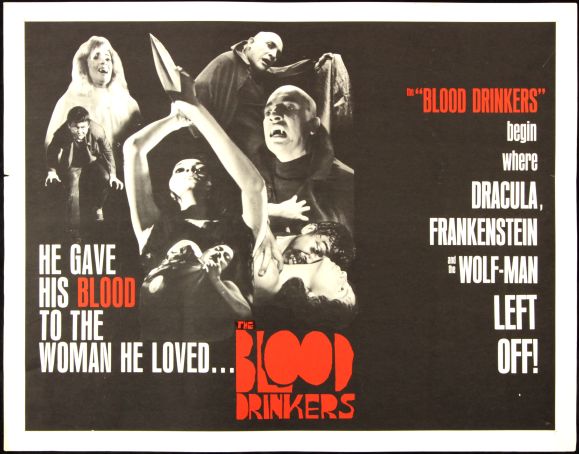
Originally entitled Kulay Dugo Ang Gabi, this movie played the U.S. twice, first as The Blood Drinkers on a double bill with The Black Cat before it came back again as The Vampire People along with Beast of Blood.
The reason why I think everyone should watch this is that it starts out sometimes in color — which at the time was really expensive — and then goes to neon-tinted black and white. Throw in some fog and scenes where it goes from blue to red to color and you have the kind of movie that I get so excited about that I bounce all over our movie room. Also, the whole thing is dubbed, so it really feels like it didn’t come from another country, but an entirely different plane of existance so far beyond our own.
You can get this on a single blu ray from the awesome folks at Severin or go whole blood drinker and grab the Hemisphere box set. It’s also on Amazon Prime.
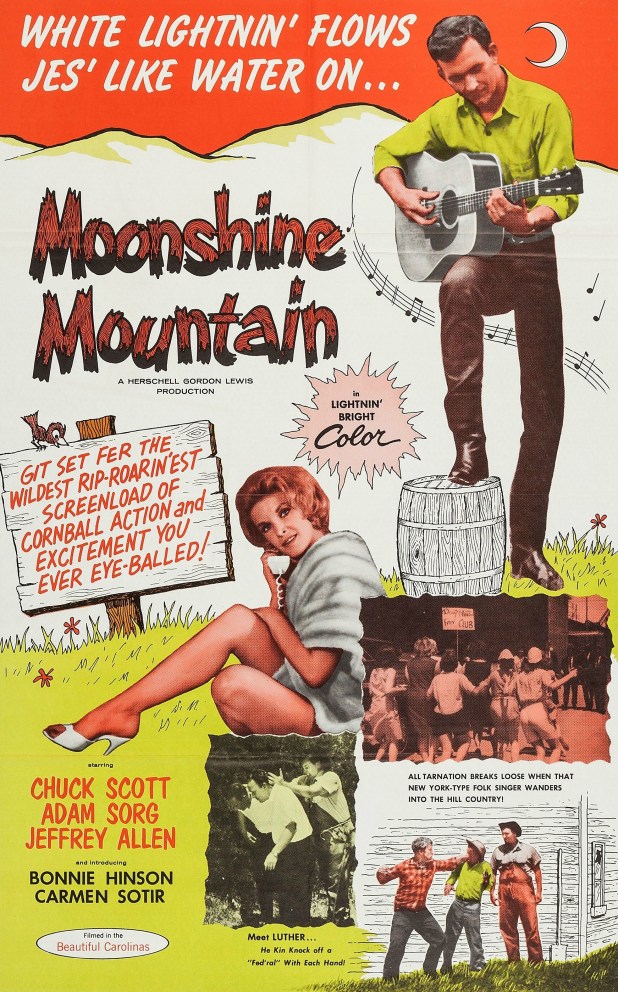
After the success of his gore epics, Blood Feast and Two Thousand Maniacs!, Herschell Gordon Lewis made this, the first of several country fried films. But just because this is supposed to be a sexy comedy romp doesn’t mean that Lewis won’t hit us with plenty of strangeness and lots of the red stuff.
Charles Glore, working here as Chuck Scott, is a country western star who heads back to the hills of the Carolines where within days, he’s in the middle of a feud between the government and the moonshiners. Glore also was the musical director for Two Thousand Maniacs! and wrote this movie.
The title card says “directed by Herchell Gordon Lewis, who ought to know better, but don’t.” Lewis just can’t help himself, as in the midst of the country fun, a psycho named Asa Potter is refused sex from the singer’s girlfriend and then kills her. Keep in mind that he’s also the town’s sheriff and also assaults multiple women in the film, including one mentally challenged girl that eventually fells him with an axe, which is how it works in the universe of Lewis.
This leads to the sheriff shooting people off a watertower, Charles Starkweather-style. Keep in mind this movie was made only six years after that shocking event.
Lewis also wrote and sings the main theme, “White Lightning.” As much as he would live up to the quote “I see filmmaking as a business and pity anyone who regards it as an art form,” you can tell when the man is having a good time. Moonshine Mountain isn’t a good film, but it sure is interesting in parts and it’s pretty short. More films should aspire to both points.
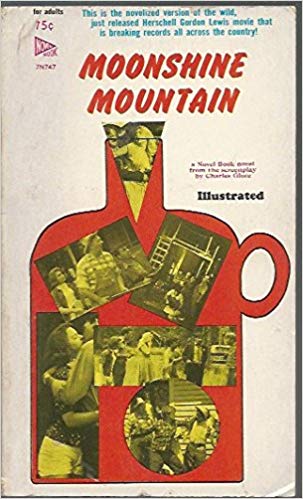
There was also a novelization of the film, which blows my mind. It’s a collector’s item today. I miss the time when every movie had a book that would go with it. Somehow, having this movie written into a novel legitimizes it.
You can watch Moonshine Mountain on Amazon Prime. I’d advise some grain alcohol to speed up the slow parts.
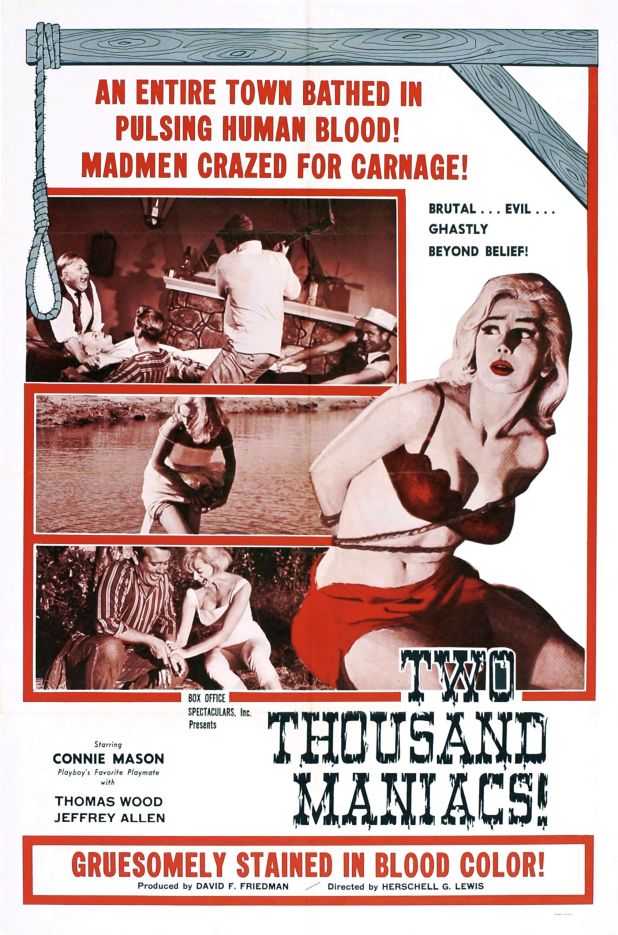
It takes a certain kind of genius — or maniac — to make a gore drenched version of Brigadoon. I was explaining this movie to someone and said that the main reason why I like it so much is the completely joyful way in which the townsfolk of Pleasant Valley go about their murderous rampage. This is the time of their lives — well, post-death lives — and it’s worth hollering and singing and shouting about.
Shot over two weeks in the small Florida town of St. Cloud — not yet a cog in the omnipotent wheel of the Disney vacation empire yet — and featuring the gleeful participation of nearly every citizen in that sleepy community, this movie established the danger of the South to North audiences, a theme that would reach its creative apex in Tobe Hooper’s The Texas Chainsaw Massacre.
Yankee tourists, made up of the Millers, the Wells and unmarried folks Tom White and Terry Adams (Lewis’ muse, if he ever had one and only because he never sliced off one of her limbs or cut out her tongue, Connie Mason) have followed the detours to Pleasant Valley where they’re the guests of honor for the centennial celebration.
Yes, a hundred years ago, the Union troops marched through the town and killed every man, woman and child. What a thing to celebrate!
The town’s mayor, Joseph Buckman (Taalkeus Blank, who used the name Jeffery Allen, could do such a Southern accent that Lewis would also use him in Moonshine Mountain, This Stuff’ll Kill Ya! and Year of the Yahoo!), and the townspeople show everyone great hospitality at first, but before you can say Mason-Dixon Line they’re slicing off their guests body parts, drawing and quartering them, getting rolled down the hill in a nail-filled barrel, having rocks dropped on them and all other manner of grisly crowd pleasing hijinks.
After kidnapping little Billy, Terry and Tom make it out of town and come back with the police, only to discover that the town never existed. When they leave, the townspeople return and wonder what the world will be like when they come back in 2065 before disappearing into the fog.
This was Lewis’ favorites of his films and he even published a tie-in paperback version of the story.
Yes, that’s Herschell Gordon Lewis singing the theme song, too. You have to admire his dedication to filmmaking. This was produced by David F. Friedman, who met up with Kroger Babb before a career that has everything from nudie cuties and roughies to gore and Naziploitation, which he produced under the name Herman Traeger.
More movies should be like Two Thousand Maniacs!, but so few have the gumption to even try.
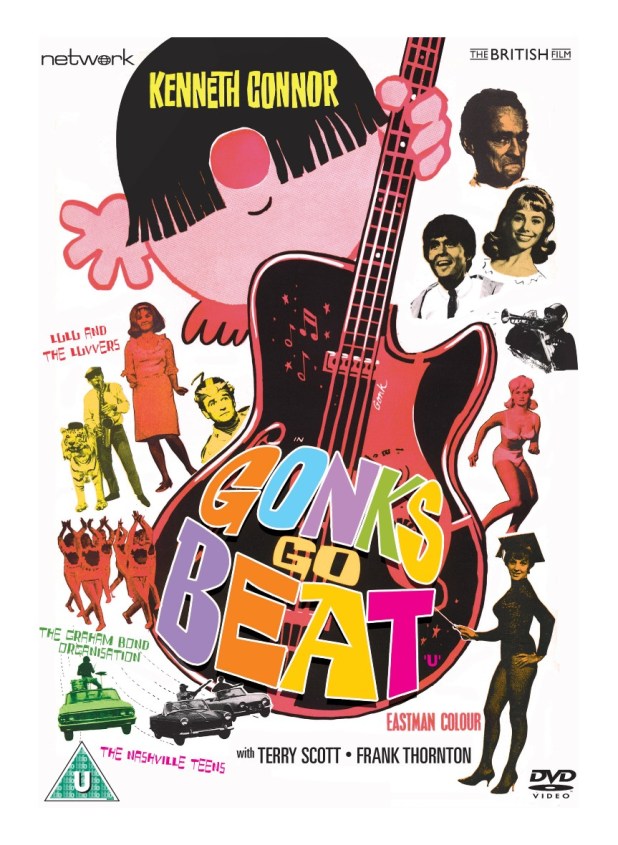
What is it with British musicals with aliens coming to Earth to learn about music this week? Well, here’s another — 1964’s Gonks Go Beat — based on the fad for toys called gonks, which were created by British inventor Robert Benson. At their peak, gonks were collected by Ringo Starr and Peter Sellers. They were quite literally the first toy craze in England post-World War II.
This movie was absolutely savaged in its original release. Reviewers claimed that it had no appeal to any cinema audience demographic and it’s often compared to Plan 9 from Outer Space for its sheer ineptitude. If you read this sentence and thought to yourself, “Where can I find this movie?” then welcome. You’re amongst friends.
This whole mess is directed by Robert Hartford-Davis, who was behind one of my favorite Peter Cushing movies, 1968’s Corruption (if you haven’t seen the trailer, it will warn you that it’s not a woman’s picture repeatedly) as well as the amazingly titled Incense for the Damned.
Kenneth Connor from the Carry On series stars as alien Wilco Roger and Frank Thornton shows up as Mr. A & R. You may know him better as Captain Peacock from Are You Being Served? The real reason to watch this is to see performances by The Nashville Teens, members of the Graham Bond Organisation including Ginger Baker, Jack Bruce and Dick Heckstall-Smith, Ray Lewis and the Trekkers, The Long and the Short, The Trolls, The Vacqueros and Lulu and the Luvvers. Yes, Lulu of “To Sir, With Love” and “The Man with the Golden Gun” fame.
So anyway, at some point in our future, Earth is broken into two camps: you either live in Beatland and are hip and trendy or you live on Ballad Isle and are clean and tidy. Every year, the islands battle in a musical competition.
If Wilco Roger can’t get the two islands to get along, he’s going to be sent to Planet Gonk, filled with those toys and Dixieland jazz. He joins up with Mr. A & R to unite a Beatland Boy and a Ballad Island girl, which of course happens thanks to the song “Takes Two to Make Love.”
I mean, if you watch one movie where aliens come to England to discover love, we gave you two options this week. At this rate, Xanadu is going to feel like a Busby Berkely movie.
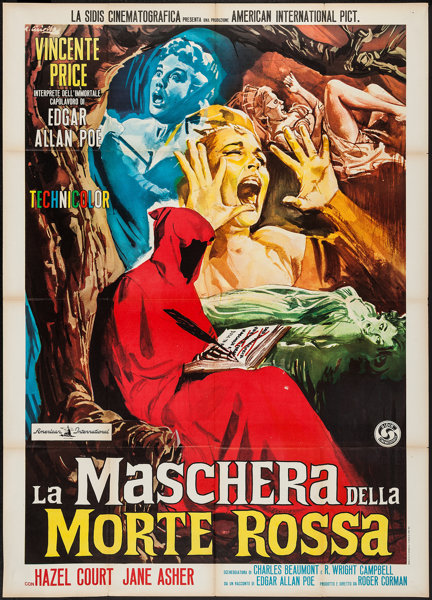
For all the chiding I write about Roger Corman’s later producing efforts, you have to admit the man knows how to direct a movie. This is the best case I can make for his skills, a film packed with delirious visions and gothic menace. It’s everything you want it to be and more.
The seventh in a series of eight Edgar Allan Poe adaptions by Corman, this movie also incorporates part of the Poe story Hop-Frog and some of Torture by Hope by Auguste Villiers de l’Isle-Adam. Corman had wanted this movie to follow 1960’s House of Usher, but worried that people would think he was stealing from Bergman’s The Seventh Seal.
Corman liked an early script by Charles Beaumont, who also wrote The Seven Faces of Dr. Lao and more than twenty Twilight Zone episodes, which had Prince Prospero as a Satanist. Beaumont was too ill to come to England to finish the script (he died at a very young age), so R. Wright Campbell finished writing it.
On a mountain in medieval Italy, we see an old woman receive a white rose that becomes covered with blood from a red-cloaked man who soon returns to shuffling his Tarot cards.
Prince Prospero (Vincent Price, never more perfect) visits the village that he lords over and is confronted by two angry young villagers. He sentences them both to death, even as one of their daughters begs for their lives. That’s when the evil man learns that the red figure was the plague called the Red Death and it has spread from the old woman to the entire village. Prospero demands that the village be burned down and takes the man’s daughter, Francesca, to his castle. She’s played by Jane Asher, who was once famously the girlfriend of Paul McCartney.
Back at the castle, Francesca is tutored and dressed in the finest clothes by Prospero’s jealous mistress Juliana (Hazel Court, Devil Girl from Mars). Meanwhile, nobles have gathered and are being entertained by the dwarves Esmeralda and Hop-Toad. One of them even strikes the poor girl to the anger of her would-be lover.
Juliana wants to be part of Prospero’s Satanic cult and that night, she lies with him in his Black Room while Francesca watches, overcome by either lust, fear or some combination of both.
Meanwhile, the two men who were condemned to death known as Gino and Ludovico are being trained in the art of being gladiators for the nobles’ amusement. As Prospero continues seducing Francesca, Juliana pledges her soul to Satan, gives our heroine the key to the men’s cell and tells her to leave the castle.
As they try to escape, they end up killing three guards, acts of which Prospero finds humorous as they are supposed to be good men. Since they refuse to fight one another, the villain asks them to play a game: they will cut themselves with daggers. Only one has poison on it and Ludovico draws the final blade. But he doesn’t get a chance to use it — Prospero quickly stabs him. He then sends Gino out of the castle to be infected by the Red Death.
In the woods outside, Gino meets the red-cloaked figure, who gives him a tarot card that he says represents mankind. While that weirdness is going on, Juliana has her final initiation in a psychedelic sequence that sees periods from across history stab her as she lies on an altar. After this self-sacrifice, she declares herself the bride of Satan. She then walks into a room and is killed by a falcon.
Yes, I just typed that sentence. As the nobles gather about her body, Prospero laughs and says that now she really is married to Satan.
The villagers try to get into the castle, dying from the red death, while Prospero orders them all killed, except for a small girl. As the rest of the guests gather for a masked ball, Hop-Toad tricks his nemesis Alfredo into dressing as an ape. He covers the man in brandy and sets him on fire before running into the night.
As Gino tries to rescue his love, the red-cloaked figure tells him to stay there and he will send the girl out to him. The party has grown depraved, but all Prospero is interested in is the red-cloaked figure who has broken the only rule of the party: no one is to wear that color. He and Francesca follow it into the Black Room, where the evil man thinks he is about to actually meet an emissary of Satan.
Prospero asks to see its face, but is told that there is no face of Death until the end as the entire party becomes a dance of death, as the nobles succumb to the plague as they keep swaying to the beat. Prospero asks for Francesca to be spared and given the same title he will have at Satan’s side, but even she knows what he can’t grasp. This isn’t Satan. It’s death. She tenderly kissing him goodbye as she runs toward freedom.
Prospero’s beliefs won’t stop the plague. Under the cloak is Prospero’s own dead and blood-spattered face. He has finally seen his own death and despite trying to run, his duplicate is always in front of him before he finally strikes him down.
At a drive-in viewing, the end of this movie screwed with me so badly I started shaking. All the colors of Death meet and reveal how many they have killed, with the red figure saying, “I called many…peasant and prince…the worthy and the dishonored. Six only are left.”
Only Francesca, Gino, a young girl, an old man, Hop-Toad and Esmeralda survive as the figure states, “Sic transit gloria mundi” or Thus passes the glory of the world.”) By the time the cloaked figures moved out in a formation and the words “And darkness and decay and the Red Death held illimitable dominion over all,” were said, I was quaking in my car. That said, I may have been ingesting all manner of substances and it was 4:52 AM on a foggy night. The perfect time to see a film and the perfect way to embrace it to its fullest!
One of the many reasons this film looks like nothing else is because of cinematographer Nicolas Roeg, who would go on to make Don’t Look Now and The Witches. Another is that the sets were all left over from the Academy Award-winning film Becket.
Interestingly enough, I learned that each of the colors of death at the end personifies a different plague of the Middle Ages. Black = Black Death, Gold = Leprosy, Violet = Porphyria, Blue – Cholera, Yellow = Yellow Fever, White = Tuberculosis and Red – Rabies. That was some IMDB trivia with no citation, so feel free to disprove that.
So how is this a Satanic film? Well, Prospero, despite being the villain, does follow one of the Eleven Satanic Rules of the Earth: Do not harm little children. He also follows one of them even more to the letter: If a guest in your lair annoys you, treat him cruelly and without mercy.
He also follows many of the points of LaVey’s Pentagonal Revisionism: A Five-Point Program:
Stratification: There can be no more myth of “equality” for all—it only translates to “mediocrity” and supports the weak at the expense of the strong.
The opportunity for anyone to live within a total environment of his or her choice, with mandatory adherence to the aesthetic and behavioral standards of same: The freedom to insularize oneself within a social milieu of personal well-being. An opportunity to feel, see and hear that which is most aesthetically pleasing, without interference from those who would pollute or detract from that option.
But to me, the most inherently Satanic moment in this film is in the words of the Red Death: “Each man creates his own God for himself. His own Heaven, his own Hell.”
Magus Peter H. Gilmore of the Church of Satan was kind enough to send some thoughts on this work of art: “In The Masque of the Red Death, while Prince Prospero is a Devil worshipper, he does have an essentially Satanic monologue wherein he deals with the human condition. As he brings Francesca into the purple room, at about 19 minutes into the film…”
“The practice of creating one’s own environs (a “total environment”) apart from current societal norms, as a way of satisfying aesthetics and as a means of limiting unwanted interaction with others, operates in many of the list’s films. As does the acceptance of mortality and often the loneliness of the individualist who blazes his own way apart from most others.
Romantic obsession, too, figures powerfully, for such drives can lead to passions that heighten existence, even if the consequences might shorten one’s life span. As is said by Satan (Nick) played by Claude Rains in Angel on My Shoulder (1946) “Live fully while you may and reckon not the cost. Deny yourself nothing, flame and blaze like a torch and toss the fire about you!””
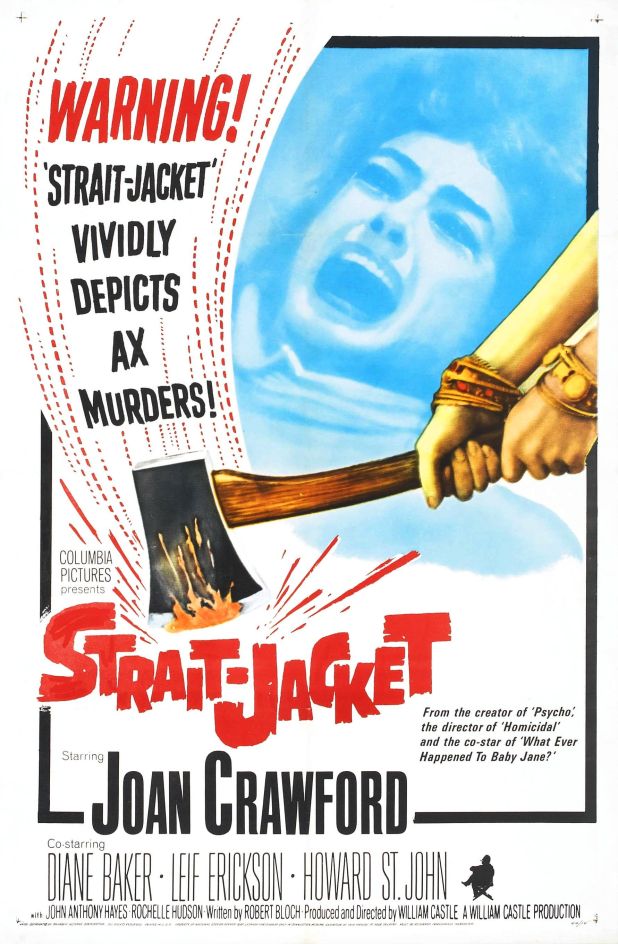
After the success of What Ever Happened to Baby Jane?, Hollywood suddenly had roles for older actresses, as part of psycho-biddy films. And no one was more in demand than Joan Crawford, who agreed to be in this William Castle film with the following demands: script and cast approval, a $50,000 salary and 15 percent of the profits.
Lucy Harbin (Joan!) has spent two decades in a mental hospital after the axe murders of her philandering husband (Lee Majors!) and his mistress. After she gets out, she moves in with his brother Bill (Leif Ericson, who is also in I Saw What You Did with Crawford, along with his wife Emily and her daughter, Carol (Diane Baker, who Crawford hired to replace Anne Helm).
Ironically, Crawford herself was a replacement for Joan Blondell, who was injured before filming and couldn’t make the movie.
Carol seems happy and unharmed by the fact that she watched her mother sliced up her father and his lover with an axe. In fact, she does everything she can to keep her mother from being depressed, changing her look back to how she appeared when she was young.
Soon enough, Joan is acting the hell out of this movie, a new series of axe murders are happening and George Kennedy shows up looking young and perverted. Oh yeah — you can also totally play a drinking game by looking for every appearance of Pepsi in this movie. Even crazier, the character of Dr. Anderson was played by Mitchell Cox, who was not an actor, but rather the Vice President of the Pepsi-Cola Company. Joan did this one all on her own, without even asking Castle. Oh Joan!
Even though William Castle had the best gimmick of all — an A-list star in a B-movie horror flick — he still gave audience members little cardboard axes for coming to see the movie. And at several theaters, he brought Joan along, coming out to greet her public.
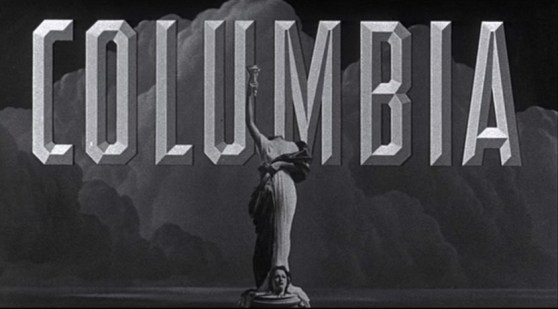
My favorite thing in this entire movie is that the Columbia logo’s torch-bearing woman is decapitated at the end of the movie!
Look — I’m not going to be unbiased when it comes to Joan Crawford movies. This one is ridiculous — a near giallo with Joan acting decades younger than she should — but that makes it so much greater than it should be.
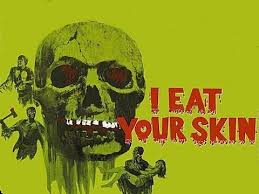
The only reason anyone knows this movie is because of Jerry Gross. He bought it, paired it on a double feature with I Drink Your Blood and renamed it from Zombies to I Eat Your Skin and made this amazing trailer and double poster.
These two movies have nothing in common. I Drink Your Skin is a certified classic of the drive-in while this is a messy black and white film where a writer heads to a Carribean island looking to research voodoo for his next book. Then he meets a mad scientist who is trying to stop aging and hijinks ensue.
This sat on the shelf for six years and you can see why when watching it. Director Del Tenney is also responsible for The Horror of Party Beach, so that should explain so much about this one.
I can only wonder what order these two films played in. Would this be a good comedown from the acid lunacy of its tag partner? Or would the boredom of this one serve as absolutely no preparation for the bloodlust that was to soon follow? One wonders.
This is yet another in the unending stack of evidence that I continually present to Becca as reasons that I will never take a cruise or an island vacation. No one is taking me to the Green Inferno!
While patently ridiculous, the end of this film does pick up some steam, with a lengthy twerking exhibition/voodoo ritual. There’s also a great moment where a zombie carries a box labelled explosives into the prop of the escape plane, grounding our remaining heroes. And I kind of love that the writer hero of this one starts and ends the movie reading love scenes passages from the purple prose he writes to an enraptured audience of bikini clad women. And this is the guy I’m supposed to be rooting for?
Day 10 of the Scarecrow Psychotronic Challenge is Unhead Until…It’s too late! Your last second will be your loudest. We’re looking for the quietest non-silent movie or one where the enemy hunts by sound. It seemed like most people would just pick A Quiet Place and since I’ve been using this month to discover new movies, I again reached out to help. Bill from Drive-In Asylum and Groovy Doom was, as always, gracious and full of knowledge. He also knows just how much I love Ingrid Pitt.
In the Greek countryside, archaeologist Dr. Pete Asilov and Professor Andre are trying to find a treasure in an abandoned cave. This uncovers a reptile-like creature that soon vanishes.
Andre’s housekeeper Calliope warns him that there are curses and angry spirits and monsters in the cave, but he doesn’t listen. When the rest of his business partners arrive — bringing Ingrid Pitt in her first screen role — he keeps pushing, despite further warnings, the decayed body of a cavewoman, a set of bones and one of the men being killed by the creature. Soon, they’ll be more worried about staying alive than they are as to whether or not they get the gold.
For a movie that bills itself as an SQ Picture (Shiver and Shake, Quiver and Quake), this is a pretty silent affair. That is, until the girls just randomly decide to dance for the boys. Oh yeah — the professor’s niece Maria is played by Jess Franco’s muse Soledad Miranda, so that makes this movie a million times better than it would be otherwise.
There’s a great near-silent sequence where Calliope is stalked by the reptilian monster (which could also have fit into yesterday’s there). And hey, look at that lobby card! So I guess perhaps there’s a little more going for this film — like the tension when everyone is barricaded in the house and the allusions to the atomic age — than just Ingrid Pitt and Soledad Miranda.
This is the absolute bottom of the holiday barrel, a trip through hell that one can never prepare themselves for. You think you’ve known pain? You’ve known nothing, to quote Samhain.
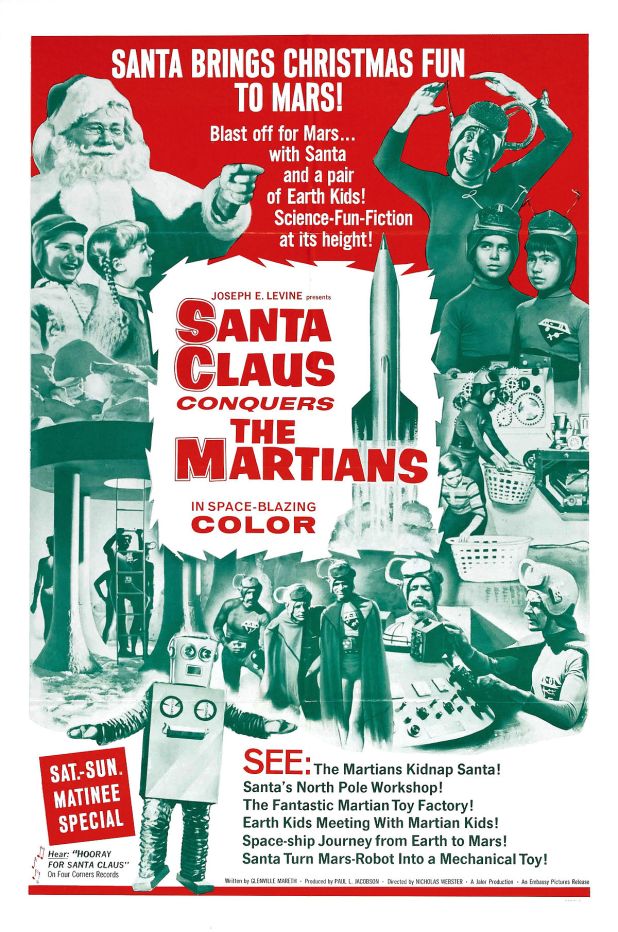
On Mars, Momar and Kimar are worried that their children, Girmar (Pia Zadora, who also sang the horrifying song “Hooray for Santa Claus,” but let’s forgive her because she was in The Lonely Lady) and Bomar are watching too much Earth TV. The big thing they’re all excited about is a live interview with Santa. But the kids have some pretty big issues — their education is fed directly into their brains with no individual thought.
The wise ancient Chochem has seen this coming for centuries and says that Mars also needs a Santa Claus. The Martians are all pretty much assholes, so they decide to steal Earth’s Santa instead of creating their own.
Along the way, the Martians kidnap two Earth children along with Santa. Voldar, a Martian hardliner, disagrees with this idea and keeps trying to kill Santa and the kids. Yes, in a holiday movie meant for children, Santa faces death. Sadly, this film is so painful, children very well may cheer for Santa’s doom in the hopes that this movie ends sooner.
Then there’s the wacky Martian named Dropo, who will challenge your will to live. There are all sorts of badly made toys, wacky hijinks and murder plots. The fact that parents would subject their kids to this travesty upsets me to this day.
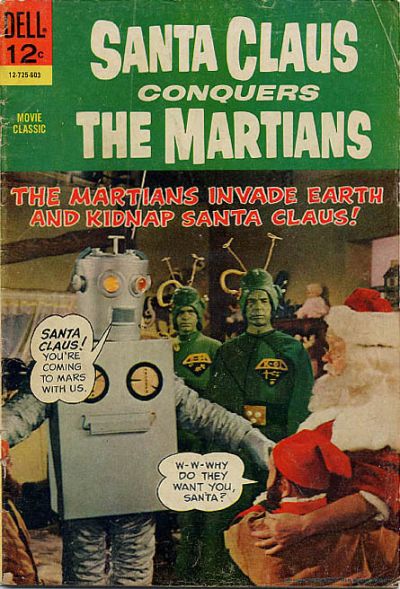
Dell even had a comic tie-in, so kids could relive the ennui and forced humor of this film again and again.
It gets worse. There was an album version, so kids could listen to the shrill theme song until they puked! I’ll do you a horrible favor and share the song with you right now!
If you can make it through this movie, you get whatever you want for Christmas!




 B&S About Movies
You must be logged in to post a comment.