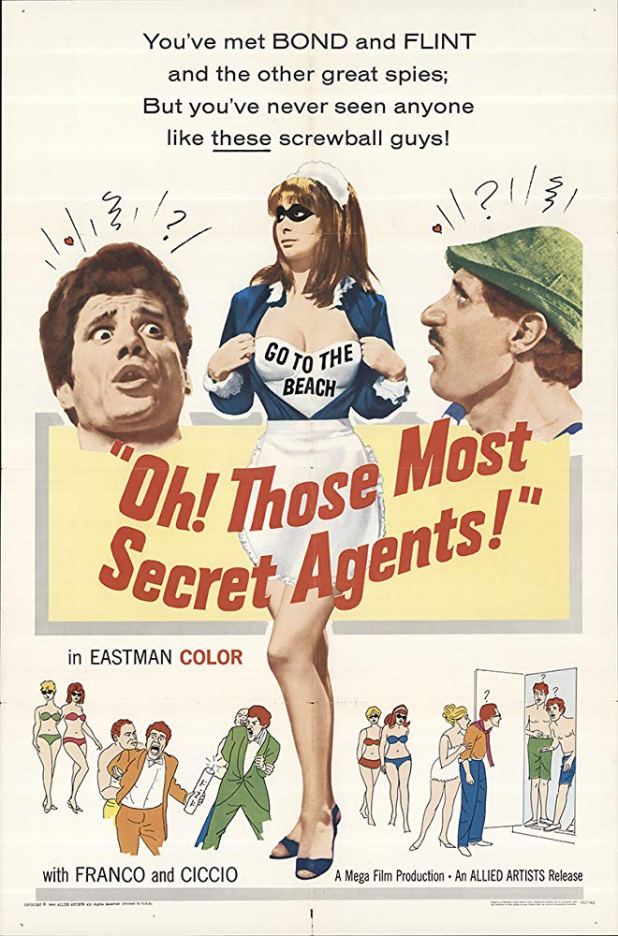
Franco and Ciccio — yes the same comic team who were in the Eurospy parodies Dr. Goldfoot and the Girl Bombs, The Amazing Dr. G and the sequel to this one, 002 Operazione Luna, are back, doing what they do best.
They’re two simple-minded Italianos who get mistaken as KGB agents and hijinks ensue. Those crazy moments include a giant robot that can barely move around, a masked maid/secret agent who flashes message to the boys on her panties, an assassination scene where the X targets keep getting moved around, a microfilm hidden in a tooth that causes all manner of issues and spies from America, China and Russia all chasing the two around the French Riveria.
This would be your standard 60’s spy comedy if not for who directed it: none other than the man who would become the Godfather of Gore 16 years after making this movie, Lucio Fulci. Yes — he made a movie about spies and assassination and not one eyeball got blown out the back or front of someone’s skull.
Believe it or not, this was released by Allied Artists in the U.S. In fact, it would be the first time one of Fulci’s movies made it over here.
Mary Arden, who plays Nadja in this, was Peggy Peyton inBlood and Black Lace and would write the English dialogue of the film, as she found the translated dialogue too stilted.
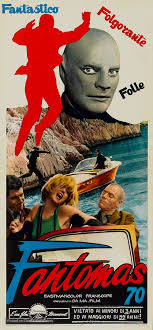
The first of three Fantomas movies, this was an attempt to bring the French character into the world of James Bond. In this story, a journalist named Fandor and Commissioner Paul Juve try to bring in the noted supervillain Fantomas, who is always one step ahead of them.
Fantomas is the man of a thousand masks, able to be anyone and even use his makeup as a weapon. He’s upset that Fandor is writing about him, so he commits a crime looking like the writer. He does the same thing to Juve. And even with all the tools at their disposal, these two — joined by Juve’s girlfriend Helene Gurn — still can’t stop his crimewave.
Obviously, Kriminal, Satanik and Diabolik were all inspired by Fantomas, as was the supergroup that former Faith No More singer Mike Patton formed. If you’re into movie soundtracks — or awesome loudness — you should check them out.
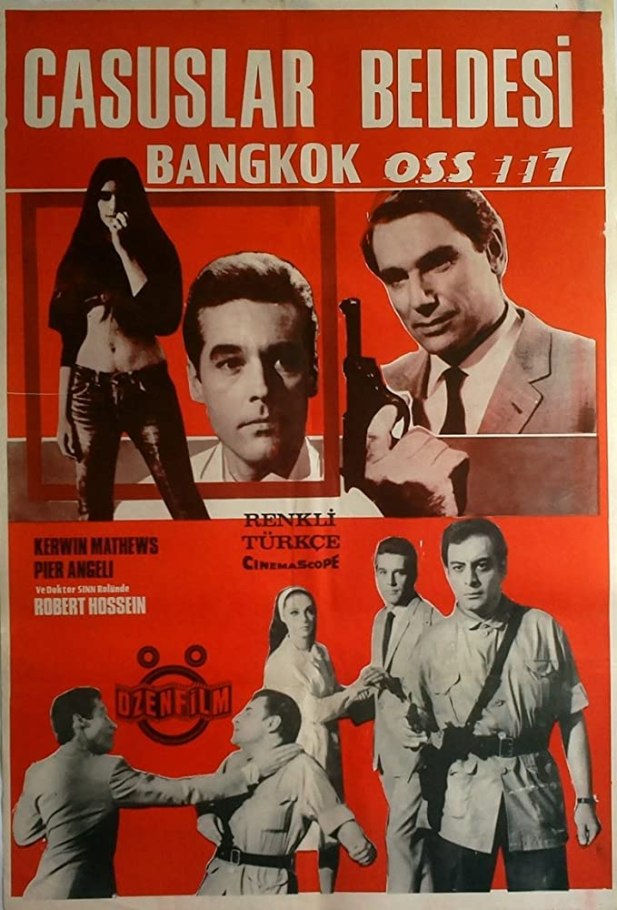
This is the second OSS 177 film, based on Jean Bruce’s 1960 novel Lila de Calcutta, which was the 74th OSS 117 novel. The series predates Ian Fleming’s Bond novels and the first film made from them was filmed before Dr. No.
Secret Agent OSS 117, Colonel Hubert Bonisseur de La Bath (Kerwin Mathews, The 7th Voyage of Sinbad, The Boy Who Cried Werewolf) is in Thailand after the murder of OSS agent Christopher Lemmon, who has been investigating plague epidemics in India. So, you know, if you don’t want to watch a pandemic movie, miss this.
Lemmon was killed because he found out that the medicine that Hogby Laboratories was making had been switched with plague germs, thereby killing much of the population.
OSS 117 then breaks into the secret lair of Dr. Sinn (Robert Hossein, who directed Cemetery Without Crosses), an Indian hypnotist and psychologist. Or maybe he was, because now he is wearing a cape and working for a group called the People Elect who wants to decrease the world’s population and stop nuclear testing. Why do I keep identifying with Eurospy villains?
The Carry On series has 31 movies from 1958-1978, with another made in 1993), 4 holiday specials, a 13-episode TV series and 3 stage plays, all in the British music hall tradition of bawdy parody. Made on the cheap, they are the second-longest British film series, eclipsed only by James Bond. So it makes sense that during this month of Bond, we finally get to a Carry On movie.
From cowboys and horror to army films, cruises and even Emmannuelle, these films hit every angle. And now, it was time for Bond.
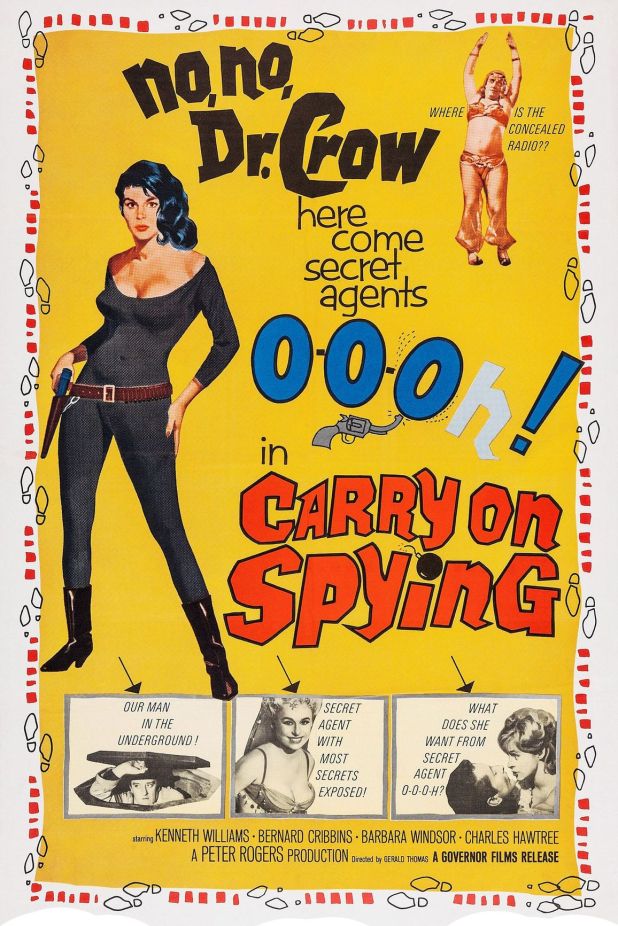
STENCH (the Society for the Total Extinction of Non-Conforming Humans) has stolen a secret formula, which means that agents Desmond Simpkins (Kenneth Williams, who appeared in 26 of these films), Harold Crump (Bernard Cribbins), Daphne Honeybutt (Barbara Windsor) and Charlie Bind (Charles Hawtrey) must get it back.
There’s also the evil Dr. Crow and SNOG (the Society for Neutralising Of Germs), which we all could use some more of right now. There’s also BOSH (The British Operational Security Headquarters) and SMUT (The Society for the Monopoly of Universal Technology).
Bond producer Albert “Cubby” Broccoli threatened a lawsuit over the character name James Bind agent 006½, which led to the change in name to Charlie Bind and his title Agent Double 0-Ohh. He also demanded that the poster be reworked as it was too close to From Russia With Love.
The STENCH henchman The Fat Man was the voice of SPECTRE number 1 — Blofeld — in From Russia With Love and two of the henchwomen have hair that looks just like Modesty Blaise.
Interestingly, this film’s cinematographer Alan Hume who would later work on the Bond movies For Your Eyes Only, Octopussy and A View to a Kill.
This film — the last Carry On in black and white — was the first Bond parody to hit the screen. So many jokes in it would become parts of other films, like the name Charles Bind being used in Lindsay Shonteff’s Bond ripoffs, the restaurant tape recorder being used in For Your Eyes Only and The Living Daylights outright replicated this film’s plot, including an enemy agent with exploding milk bottles.
I also love that this movie was inspired by the fact that a Bond picture was filming at Pinewood Studios at the same time.
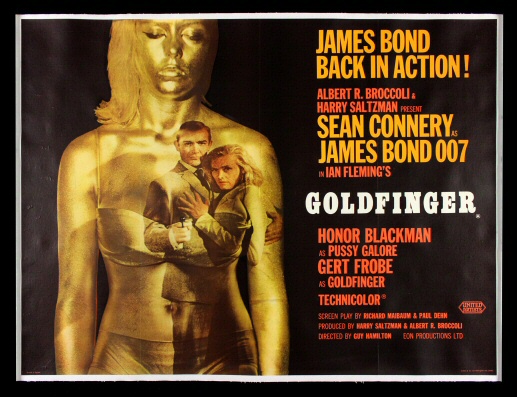
If From Russia With Love was big, Goldfinger is the Bond movie that nearly everyone sees as the greatest success in the series.
With the court case between Kevin McClory and Fleming surrounding Thunderball still in the High Court — more on that this week — producers Albert R. Broccoli and Harry Saltzman picked this story as the third film. They enjoyed a budget that was pretty much the same as both Dr. No and From Russia With Love combined.
However, Terence Young was out after a pay dispute and Guy Hamilton, who had turned down Dr. No, came on board. His idea changed the series — no longer was Bond nearly superhuman; instead his villains would be stronger than him. Hamilton would make three more Bond pictures: Diamonds Are Forever, Live and Let Die and The Man with the Golden Gun.
It also saw the return of stunt coordinator Bob Simmons and production designer Ken Adam, whose presence can be felt in every frame. Before Goldfinger, Bond had a few gadgets. After, gadgets would be one of the reasons to show up for his movies.
After destroying a drug dealer’s operation in Latin America, Bond (Sean Connery, coming back for his third film) goes to Miami Beach on what should be a vacation. Instead, CIA agent Felix Leiter (Cec Linder, taking over the role from Jack Lord) asks him to observer Auric Goldfinger (German actor Gert Fröbe, whose dialogue was dubbed by Michael Collins; he also dubbed him in Chitty Chitty Bang Bang, another movie made from an Ian Fleming book), a rich man obsessed with gold.
Orson Welles was going to play the role, but he asked for too large of a salary. Oh, what could have been.
Goldfinger is cheating at a game of gin rummy — a simple illustration that he corrupts even the most idle of pursuits — with the help of his employee Jill Masterson (Shirley Eaton, who is also in The Million Eyes of Sumuru and The Girl From Rio; she was already a sex symbol but the imagery of her from this film took her to another level). Bond, of course, seduces her and wins the game. Goldfinger wins the whole war by having his henchman Oddjob (former pro wrestler Harold Sakata) knock out 007 and then paints Jill gold, killing her from skin suffocation.
Seriously — we’re a few minutes in to this movie and it already blows away everything that came before.
Here’s a strange story: Fleming had based the villain on Modernist architect Erno Goldfinger, who threatened to sue when he found out he was to be a spy villain. Fleming’s publisher begged him to change the character’s name, to which Bond’s creator offered to change it to Goldprock. The case was settled out of court.
This sets off several stories — Bond trying to determine how Goldfinger is stealing gold and getting richer; Oddjob determined to kill Bond with his steel-rimmed hat; Tilly Masterson’s vendetta against Goldfinger to get revenge for her sister’s death, only to be killed by Oddjob; Goldfinger attempting to rob Fort Knox and his henchwoman Pussy Galore (Honor Blackman, who was Mrs. Gale on The Avengers before this).
Galore was based on Fleming’s friend, mistress and muse Blanche Blackwell. As his wife disapproved of the Bond novels, Fleming grew closer to Blackwell. She inspired not just Galore, but also Dr. No‘s Honeychile Rider. Her son Chris Blackwell would go on to form Island Records.
In the book, Galore runs an all-lesbian Harlem gang known as the Cememnt Mixers. Well, in the movie, she’s the leader of a Flying Circus of acrobatic, judo fighting and plane flying women. Yes, only in the world of Bond.
You also have to adore that the movie ends with a battle where Goldfinger is pulled out the window of a jet. As the plane crashes, Bond and Galore hide under a parachute. Despire her being a criminal, Bond seems like the one who doesn’t want to be found — a theme that will continue as the series goes forward.
I’d be remiss if I didn’t mention that Shirley Bassey’s “Goldfinger” song is astounding. To hit the note at the end of the song, she had to take her bustier off in the studio. And you know who is playing guitar on it? Jimmy Page.
The Aston Martin. The laser scene. “No, Mr. Bond. I expect you to die.” Oddjob. Suggestively named ladies. The playful fighting between Q and Bond.
If you’re going to watch one Bond movie, this should be it. Me? I’m watching hundreds of spy movies all month long.
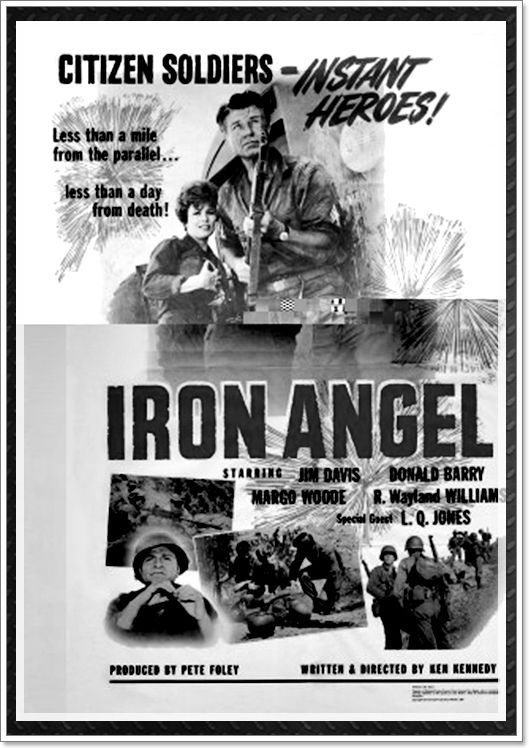
Mill Creek Explosive Cinema set, you are one strange duck. You assault us with Crown International Pictures releases that have been seen by tens of people and then, in the middle of it all, give us a black and white war movie from the mid 60’s about women in combat. How do you do what you do?
North Korea: A bunch of citizen soldiers have to take out a mortar position and make it back to the safety of Uncle Sam, but that’s not as easy as it seems.
Jim Davis, Jock Ewing himself, leads the men. Don “Red” Barry, who played Red Ryder, shows up, as does Tristram Coffin (Rocket Man from King of the Rocket Men) and L.Q Jones, who we all know would someday make The Brotherhood of Satan and A Boy and His Dog, films that just blow my mind for how astounding they are.
Director Ken Kennedy would go on to be the set decorator for Return to Boggy Creek. He also directed the women in danger movie The Velvet Trap and the 1990 version of The Legend of Grizzly Adams, which starred Gene Edwards as Grizzly. Who? He was one of the stuntmen from the TV series. L.Q. Jones is in that, too.
This would be Margo Woode’s last film, as she played heroine Nurse Lt. Laura Fleming.
A gung ho movie about Americans winning the war in Korea. So there’s that. You can download this from the Internet Archive if you want to see a war movie that just about no one else will watch in 2020.
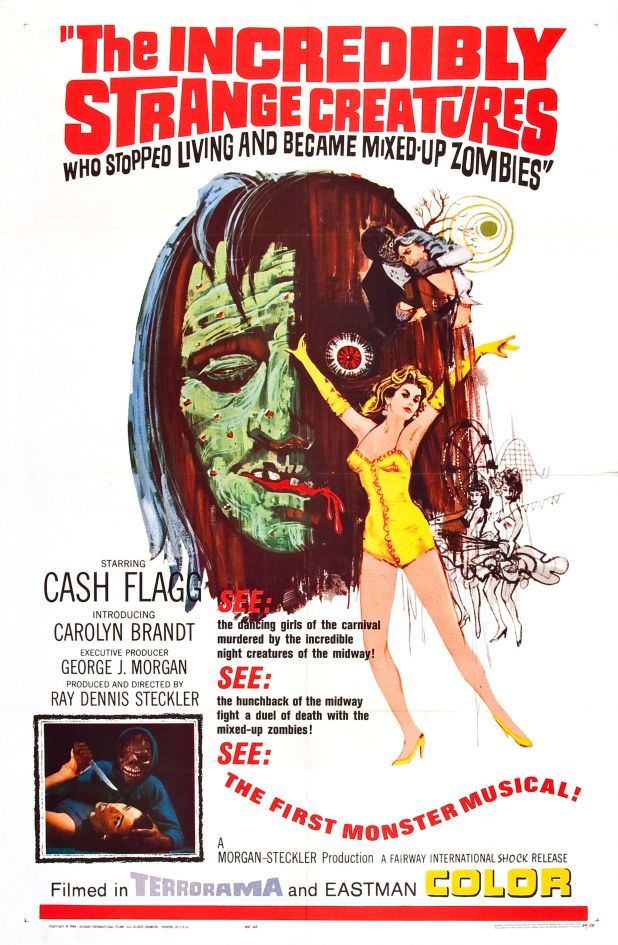
Made for $38,000, this film beat The Horror of Party Beach as the first monster musical by just a few months. It was the brainchild of the man known as Sven Christian, Sven Hellstrom, Harry Nixon, Wolfgang Schmidt, Cindy Lou Steckler, R.D. Steckler, Michael J. Rogers, Michel J. Rogers, Ray Steckler, Cindy Lou Sutters and, of course, Ray Dennis Steckler.
Before he became a B movie director, supposedly Steckler worked at Universal, where he bumped into an A-frame and dropped it onto Alfred Hitchcock. This ignominious exit would soon lead him to a world where he’d make baffling films like The Thrill Killers, Rat Pfink a Boo Boo and The Hollywood Strangler Meets the Skid Row Slasher. His adult film titles read like the kind of movies that exist only in my dreams, such as Sexual Satanic Awareness and Sexorcist Devil.
Jerry (Cash Flagg, another name for Steckler, auteuring it up by starring in his own movie), Angela and Harold decide to head out to the carnival, where they watch Marge (Carolyn Brandt, Steckler’s wife; their station wagon is also in the film) dance.
Marge is spooked by a black cat, which leads her to consult with Estrella, a fortune-teller who is throwing acid in peoples’ faces and making them zombies under her control. She predicts death for Marge, as well as a death near water for someone Angela knows.
Jerry falls in with the carnies because Estrella’s sister Carmelita stares him down and does her bad girl dancing to hypnotize him into acts of murder. You know how it goes. Of course, the zombies soon break loose, nearly everyone dies and Jerry is shot on the beach in front of his one true love, making that earlier prediction come true.
Also — dance numbers!
Steckler was a real showman, taking this movie on the road and constantly retitling it with outlandish names like The Incredibly Mixed-Up Zombie, Diabolical Dr. Voodoo and The Teenage Psycho Meets Bloody Mary. The posters proclaimed that the movie was made in Hallucinogenic Hypnovision, which really meant that at some point, maniacs in rubber masks would run around the theater. If you guessed that Steckler was one of those maniacs, you’d be right.
It was shot at The Film Center Studios, a former Masonic lodge owned by Rock Hudson — yes, I realize that this sounds like the start of a conspiracy story.
Perhaps most strangely — incredible strangely? — the cinematography and camera operating crew included three men who would go on to become major figures in the field.
Joseph V. Mascelli, who also worked on The Thrill Killers and Wild Guitar, wrote The Five Cs of Cinematography. Laszlo Kovacs would work on movies as disparate as A Smell of Honey, a Swallow of Brine and Easy Rider; he was considered a guiding light in the American New Wave. And then there’s Vilmos Zsigmond, whose work on Close Encounters of the Third Kind would win an Oscar (he also worked on The Deer Hunter and Heaven’s Gate).
In his 1987 book Psychotic Reactions and Carburetor Dung, Lester Bangs wrote an essay called “The Incredibly Strange Creatures Who Stopped Living and Became Mixed-Up Zombies, or, The Day The Airwaves Erupted.” Within, he’d state, “…this flick doesn’t just rebel against, or even disregard, standards of taste and art. In the universe inhabited by The Incredibly Strange Creatures Who Stopped Living and Became Mixed-Up Zombies, such things as standards and responsibility have never been heard of. It is this lunar purity which largely imparts to the film its classic stature. Like Beyond the Valley of the Dolls and a very few others, it will remain as an artifact in years to come to which scholars and searchers for truth can turn and say, “This was trash!”
Even more astounding, Columbia Pictures threatened to sue over this movie’s original title, The Incredibly Strange Creature: Or Why I Stopped Living and Became a Mixed-up Zombie. Supposedly the title was too close to the Kubrick film Dr. Strangelove or: How I Learned to Stop Worrying and Love the Bomb. Steckler called the studio and demanded to speak to Kubrick, a crazy move, and of course, Kubrick answered and agreed to the new title and the lawsuit was dropped. This whole story feels so insane that it has to be true.
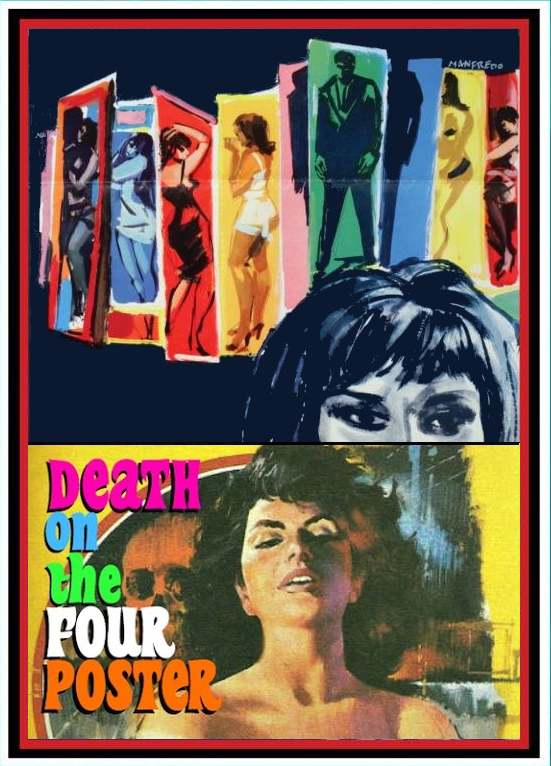
Also known as Sexy Party and Crime in the Mirror, this early giallo — well, it’s a mystery film with some sexual elements and style — is all about Ricky inviting his friends over for a weekend party at his parent’s castle. Because you know — all of our parents have castles.
Leave it to Serena and Anthony (John Drew Barrymore, War of the Zombies and father of Drew) to take over the party — seriously, the interrupt the movie with a dance break — and a game called shattering illusions that put everyone at odds with one another. Then, Anthony goes into a trance and predicts how everyone will die before he goes insane and runs from the castle.
One of these people is the killer. And while you figure out who that is, there’s all manner of relationships and perversion — well, as much as you can show in a movie from 1964 — to get on the table. And oh yeah — Maria Pia Conte from The Arena — is in here, as is Michael Lemoine, who went from being in movies for Jess Franco to making his own films, like Seven Women for Satan and eventually out and out hardcore pornography by the 1980’s.
There’s also a dice game where people lose their girlfriends to other guys. Man, Italy in the 60’s was way swinging in more ways that just fashion and music. This came out a year after The Girl Who Knew Too Much, so don’t expect the way giallo works in the 70’s, but you’ll still find something to enjoy here.
You can watch this movie on Amazon Prime or just check it out on the YouTube link below.
Lindsey Shotneff may have been born in Canada, but he made the majority of his films in the UK. Most famously, he co-wrote and directed the James Bond ripoff License To Kill in 1965, which was released in the U.S. as The Second Best Secret Agent in the Whole Wide World.
In 1977, when there was a publicity battle between who owned James Bond — Albert R. Broccoli (The Spy Who Loved Me) vs. Kevin McClory (the projected James Bond of the Secret Service) — Shonteff made No. 1 of the Secret Service (AKA 008 of the Secret Service), Licensed to Love and Kill and Number One Gun.
He also made the horror film Night After Night After Night about a killer transvestite judge, the groupie film Permissive (it has the Collinson twins from Twins of Evil in it), The Yes Girls and The Big Zapper as well as its sequel, The Swordsman.
This movie got an X rating when it first came out, if you can believe that. Its original director was going to be Sidney J. Furie, who went on to make Iron Eagle and The Entity.
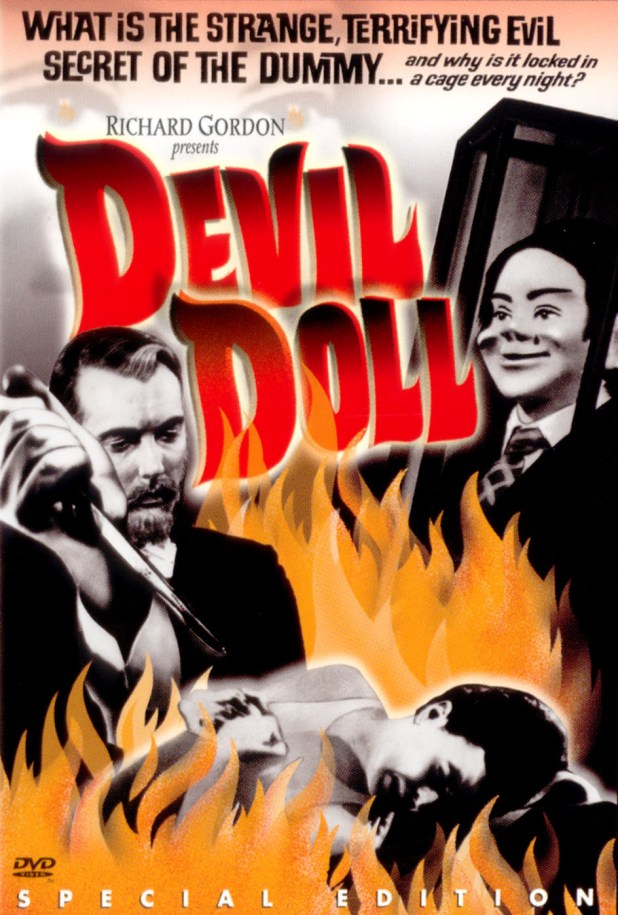
The Great Vorelli and his dummy Hugo perform before packed audiences in London, despite the strange tension between the two of them. Yes, more tension than is usually present in a dummy and performer relationship. Vorelli is played by Bryant Halliday, who did acting as pretty much a hobby, as his true job was running the 55th Street Playhouse in New York and using it as the primary location for exhibiting films distributed by the company he co-owned, Janus. Those films included works by Ingmar Bergman, Federico Fellini, Akira Kurosawa and Michelangelo Antonioni.
American reporter Mark English (William Sylvester, Dr. Floyd in 2001 A Space Odyssey) wants to know more, so he gets his girl Marianne (Yvonne Romain, The Curse of the Werewolf) to go to another show with him. Of course, Vorelli hypnotizes her and makes her dance the Twist. He’s a Svengali who wants to hypnotize her and make her his. And oh yes — Hugo is pretty much alive.
This movie is based on a tale that Frederick E. Smith wrote for London Mystery Magazine in 1951, earning ten pounds for its sale and giving up any rights. Then again, it’s also ripped off from the segment in Dead of Night, that has a killer doll named, you guessed it, Hugo.
You can watch the Mystery Science Theater version of this movie on Amazon Prime and Tubi.
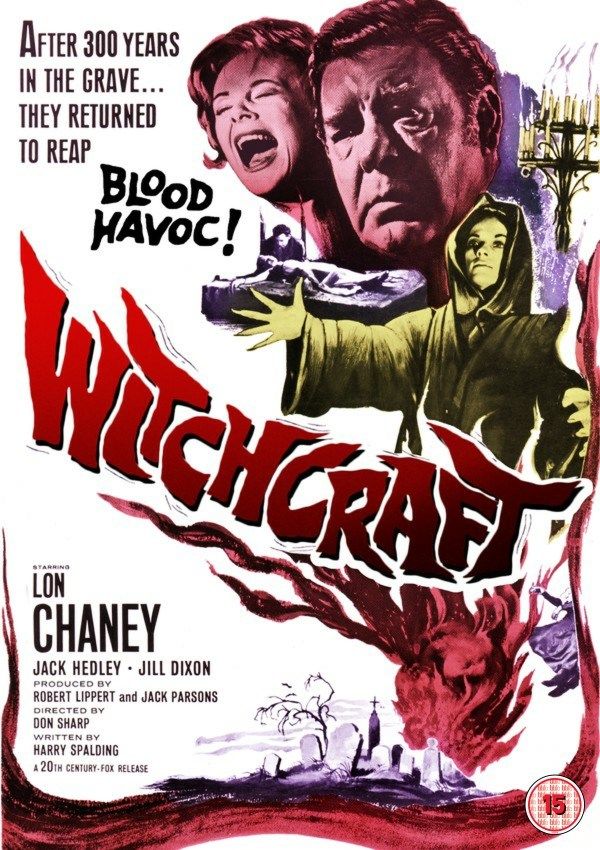
The Kiss of the Vampire. The Return of the Fly. Rasputin the Mad Monk. The Face of Fu Manchu. Psychomania. These are the movies of Don Sharp, who worked at Hammer and eventually on TV mini-series. He was also the father of Massive Attack producer Johnny Dollar.
It’s written by Harry Spalding, who also wrote The Earth Dies Screaming, Chosen Survivors and, believe it or not, Witchery!
Back in the 17th century, the Lanier family buried Vanessa Whitlock alive as a witch. This came with the spoils of taking of their estate and earning the hatred of their neighbors all the way until the mid 1960’s.
However, two of their descendants, Amy Whitlock (Diane Clare, Plague of the Zombies) and Todd Lanier (David Weston, The Masque of The Red Death) are in love and getting married.
Meanwhile, the Laniers keep on building their gigantic estate, even bulldozing over an ancient burial ground, rising Vanessa from the dead and uniting her with Morgan Whitlock (Lon Chaney Jr.!) to kill the Laniers one at a time.
Things can only end with the entire Whitlock estate burned to the ground, at the cost of lives both good and evil.
Perhaps proving that 20th Century Fox was correct to place this and Devils In Darkness in a double feature Midnite Movies DVD set, both Victory Brooks and Marianne Stone show up in both films.
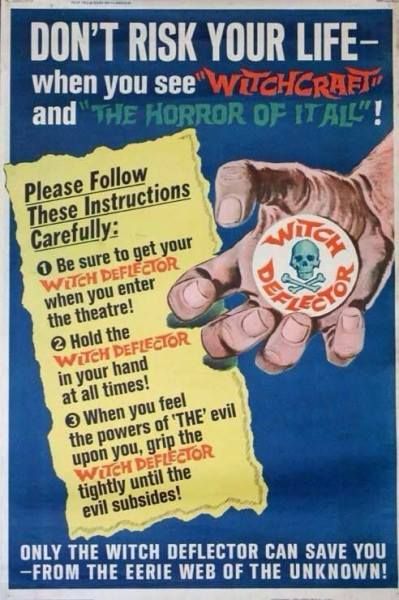
As a promotional gimmick for the U.S. release of this movie, posters warned the public that “Only the witch deflector can save you from the eerie web of the unknown.” Luckily, they could get one when they attended the movie and The Horror of It All as a double bill.


 B&S About Movies
You must be logged in to post a comment.