28. THIS IS JEOPARDY: Ken says you must solve the clues to survive the predicament.
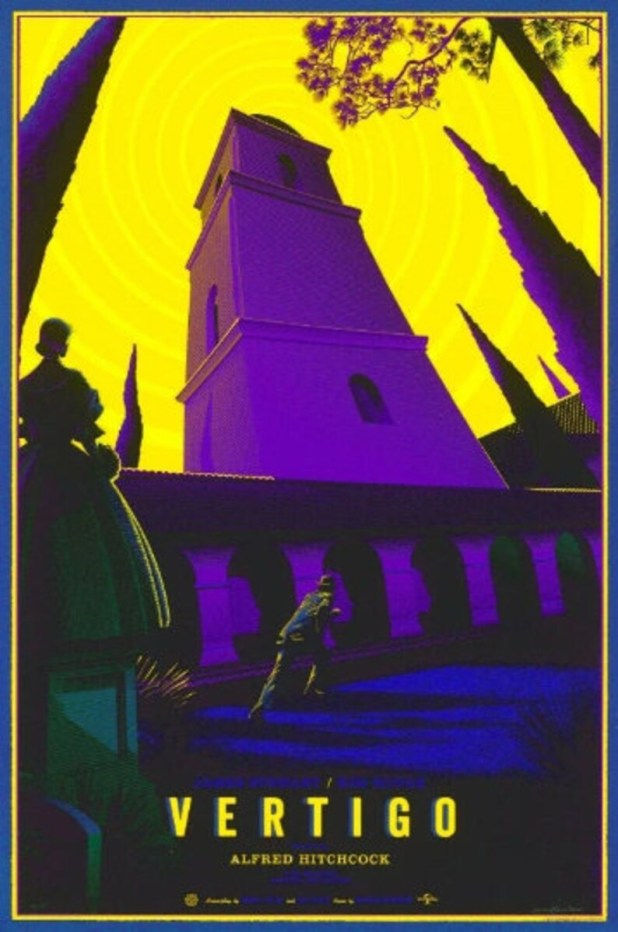
I’m working through my central Alfred Hitchcock blind spot this year. Yes, I jumped right past him to Giallo, De Palma and Krimi. As I look back, I see the beginnings of my obsessions.
It was written by three people: playwright Maxwell Anderson (who worked on The Wrong Man), Alec Coppel and Samuel A. Taylor. Their work was inspired by D’entre les morts by Pierre Boileau and Thomas Narcejac; Hitchcock had tried to purchase their previous work, Celle qui n’était plus (She Who Was No More), which was made as Les Diaboliques.
San Francisco detective John “Scottie” Ferguson (Jimmy Stewart) has had to retire early. A rooftop chase led to the death of one of his fellow officers, and he’s been struck by a fear of heights, which comes out as vertigo. His former fiancée, Marjorie “Midge” Wood (Barbara Bel Geddes), thinks that he needs a shock to his system. As he looks for a way to fill his empty days, his friend Gavin Elster (Tom Helmore) asks him to follow his wife, Madeleine (Kim Novak).
He traces her to the Mission San Francisco de Asís and the grave of Carlotta Valdes — not a real person — then to the Legion of Honor art museum, where she gazes at a painting of her. The woman was Madeleine’s great-grandmother, and Gavin feels that she’s possessed his wife. Carlotta was the mistress of a rich man, but after she gave birth to his child, he kept the child and left her. Then, she killed herself. Whenever possessed, Madeleine has no memory of what she’s done or where she’s visited.
She tries to drown herself and is saved by Scottie, to whom they soon profess their love. She runs up the steps of Mission San Juan Bautista, Carlotta’s childhood home, and demands that he not follow her. He tries, but his vertigo keeps him grounded as she falls to her death. It’s ruled a suicide, but Scottie is institutionalized.
Once he comes back to reality, he sees another woman who reminds him of his lost love. She is Judy Barton and is the woman he knew, but was involved with Gavin in an elaborate murder; as Scottie was afraid to go up the stairs to save Madelaine, Gavin threw her already dead body to the ground below. As Judy has been cast aside by her lover, just as Carlotta was, she falls for Scottie, who asks her to start looking like Madelaine.
To finally get past his fear, he feels that he must go through the event all over again. At the top of the bell tower, he makes her admit her crime. She begs him for forgiveness; she embraces him, just as a nun appears and frightens Judy, who falls to her death. At least Scottie is no longer afraid of heights.
So much of Giallo can be traced to this film. Fulci’s Perversion Story takes the setting and idea of a woman coming back from the dead through someone who appears just like her. One of the shots in this has been used in suspense movies ever since. Uncredited second-unit cameraman Irmin Roberts invented the famous zoom-out and track-in that shows how vertigo feels. That moment — just a few seconds — cost $19,000 to film. Hitchcock based it on how it looked when he passed out at a party.
How Hitchcock explained this to Truffaut — “To put it plainly, the man wants to go to bed with a woman who is dead.” — could be any Giallo. The way light and color twist and turn at key moments is also echoed in Argento’s work.
What is interesting is that, as crucial as Madelaine/Judy is to the story and the motivations of its hero, she doesn’t speak until the movie is a third of the way in. She’s been nearly a cipher for so long, someone that Scottie can fall in love with in a day, projecting perfection onto someone he barely has met.
Judy: If I let you change me, will that do it? If I do what you tell me, will you love me?
Scottie: Yes. Yes.
Judy: All right. All right then, I’ll do it. I don’t care about myself anymore.
Does Scottie even love Judy? Or is he recreating the woman that he thought she was before, without knowing it? In the words of Roger Ebert, Scottie “…falls obsessively in love with the image of a woman–and not any woman, but the quintessential Hitchcock woman. When he cannot have her, he finds another woman and tries to mold her, dress her, train her, change her makeup and her hair, until she looks like the woman he desires. He cares nothing about the clay he is shaping; he will gladly sacrifice her on the altar of his dreams.”
When she remakes herself, emerging from a bathroom with green neon fog, she’s done it for him. As Ebert notes, “The other man has, after all, only done to this woman what Scottie also wanted to do. And while the process was happening, the real woman, Judy, transferred her allegiance from Gavin to Scottie, and by the end was not playing her role for money, but as a sacrifice for love.”
Hitchcock wanted to edit out Judy’s flashback sequence, which reveals that she and Madeleine are the same person. He was worried that if he gave away the twist, audiences would check out. He did a test in New York City. The version with the flashback was the clear winner. That said, the film didn’t do well at its initial release, which the director blamed on Stewart’s age.
Unlike every other movie the director made, the killer is not punished. The American Production Code Administration demanded an ending where a radio show reveals that Elster has been caught. That never made it into the film.


 B&S About Movies
You must be logged in to post a comment.