CHILLER THEATER MONTH: The Snow Creature (1954)

EDITOR’S NOTE: The Snow Creature was first on Chiller Theater on Saturday, December 22, 1963 at 11:10 p.m. It also aired on June 12, 1965; February 11, 1967 and April 19, 1969.

Dr. Frank Parrish (Paul Langton) is collecting botanical samples in the Himalayas when the wife of his guide Subra (Teru Shimada) is kidnapped. The guide takes over and forces the entire group to find his wife who he claims has been taken by a Yeti. Parrish and photographer Peter Wells (Leslie Denison) plan on working together to stop Subra but they soon learn that the creature is real.

By the end of the story, Parrish and Wells have succeeded in bringing the Yeti back to what we call civilization, only for it to escape into the sewers and get killed by one of the men hunting it. Way to go, humans.

The Yeti is played by Lock Martin, who also played a Martian in the original Invaders from Mars and Gort in The Day the Earth Stood Still.

Director W. Lee Wilder is the brother of Billy and also made The OmegansPhantom from Space and Killers from Space. His son Myles wrote the story.

You can watch this on Tubi.

APRIL MOVIE THON 2: A Race For Life (1954)

April 18: Vroom — A movie mostly about cars.

ABOUT THE AUTHOR: Competing since 2014, Demaras Racing is made up of three committed family members: No. 12 Daniel Demaras, No. 29 Michelle Demaras and Chris ‘#16’ Demaras. They also have an awesome website where they share Fast Films every Friday. Here’s one of them! 

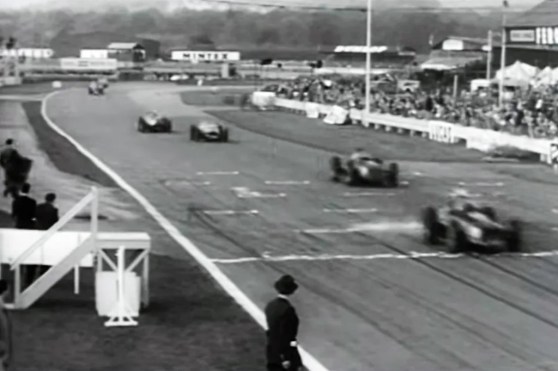
Your eyes do not deceive you. That is the treacherous Don Barzini from The Godfather as a grand prix driver in Mask of Dust. This 1954 British movie was produced by Hammer Films, best known for horror movies like 1957’s The Curse of Frankenstein. Before they found their niche, Hammer Films took footage of the 1953 Formula 1 season, added some melodramatic ‘plot’ to fill up the run time, and created this a car flick that’s truly a B-Movie masterpiece.

Released in the USA as A Race for Life the movie tells the tale of racing driver Peter Wells (silver screen star Richard Conte) a former champion who hasn’t won a race in two years. In the opening scene, Wells hops out of his race car after a practice session (filmed at Goodwood Circuit in England) thinking he’d laid down blistering times, only to be shocked at his slow laps. The pit crew tries to blame the carburetor, but Wells knows the truth… he’s lost his mojo. Wells’ younger, better, faster, stronger teammate even tries to convince the team boss that which is obvious to all; Wells is all washed up.

Fellow racers tell Wells to hang up the goggles. Wells’ hot blonde wife tells him to quit and rambles on about wanting a cottage, a white picket fence, and him not to die. She does not understand that a man like Wells, a superstar racer, cannot quit when he’s down. He must go out on top. Wells needs one more win.

During a race, a rival is critically hurt in a wreck. Wells abandons his car while leading the race, and rushes to the hospital. Team boss is pissed off, and almost fires Wells. Wife is pissed off, and leaves Wells rather than watch him face the same fate.

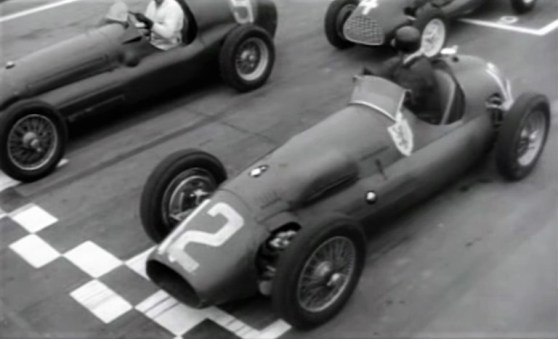
After 30 minutes of self-doubt and hand-wringing, the filmmakers mercifully added one more racing sequence (possibly shot at Oulton Park). The 1950’s Formula 1 cars take their place as the stars of the movie. Front-engined Ferraris speed around treacherous corners, the tree-lined track looking deadly and devoid of safety measures.

Raw footage of grand prix cars is interspersed with some of the worst phony-baloney onboard shots ever filmed. You can only assume this was the maximum special effects of the day, but gosh, would it have been so hard to put a race car on a trailer, and film Richard Conte from the back of a pickup truck?

In a challenge of man versus machine, the race car spits hot oil at Wells, reminiscent of the flames Mickey Rooney drives through in The Big Wheel. Wells’ feet and legs are burned by an overheating engine. But there’s no quit in Wells! It’s not just a race…it’s a race for his life!

Yeah…corny. But who cares! If you just ignore the ‘acting’ and ‘plot’ you’ll see that this film provides an rare glimpse into open-wheel racing action from the genesis of Formula 1, those earliest years. The film includes racing footage of Sir Stirling Moss and John Cooper behind the wheel. As a piece of preserved history, and not just a B-movie, A Race for Life is a champion!

This great old racing movie can be found on Cult Cinema Classics channel on YouTube.

APRIL MOVIE THON DAY 11: Inauguration of the Pleasure Dome (1954)

Kenneth Anger is a near-daily part of my life. He’s a nexus point who has opened my mind to older film, to the power of gossip, to Crowley and to the art that film can be. His first words in the seminal Hollywood Babylon, quoting Crowley, inspires me: “Every man and every woman is a star.”

At once one of America’s first openly gay filmmakers and also one that ran to instead of from homosexual content within his film, he’s also — despite being born into a middle-class Christian Presbyterian family — one of the foremost occult figures of the 20th century.

Anger may or may not have been a child actor, but what is true is that his films were incendiary from the beginning, with Fireworks finding him facing obscenity charges. Yet over the next few years, his work would inspire editing techniques and music videos before they even existed.

It’s astounding that Inauguration of the Pleasure Dome was made in 1954. It could be 2022 or any time or any dimension, as it exists in nearly another universe. Anger was inspired to make the film after attending a Halloween party called “Come as your Madness” and Crowley’s ritual masquerade concept — where party guests dress as gods and goddesses — is shown within this short.

Samson De Brier plays the roles of Shiva, Osiris, Nero, Alessandro Cagliostro and Crowley. De Brier was rumored to be the bastard son of the King of Romania or the son of an Atlantic City politician who was murdered by a jealous woman. He modeled for Picasso, he hosted a radio show in New York City, he rescued old silent movie costumes from the trash. He also had a regular salon that discussed the occult at his Barton Avenue home which was made up of minds like Anger, Curtis Harrington, Anaïs Nin, Jack Nicholson, Dennis Hopper, Jack Parsons, Marjorie Cameron and Anton LaVey. This movie was filmed in his home, a place that was a refuge for a retired Anger in the 80s.

That guest list stars in this film. Joan Whitney is Aphrodite, with Katy Kadell as Isis, Nin as Astarte, Harrington as Cesare, Anger as Hecate, Renate Druks as Lilith, Paul Mathison as Pan and Peter Loomer as Ganymede. Perhaps the most important 20th century occult figure outside of Crowley, Marjorie Cameron, appears as The Scarlet Woman and Kali. There is no irony here, as Cameron may be the actual Scarlet Woman who ushers in the end of all things.

The imagery of this movie — even if you don’t comprehend the symbols — can unlock many feelings within a viewer. I’ve often stared at the still image of Cameron from this movie, but seeing her moving shape is a revelation. I wish that these colors always existed in our world and not for this short moment in time, which we may endlessly rewind.

How strange is it that an occult movie has the same look and feel of believer Ron Ormond’s The Burning Hell? They both exist in their own universes, but the wall between them is so thin that you can feel the fingers on each side.

One of Anger’s gods.

One of Ormond’s demons.

Ismail Yzassin Meets Frankenstein (1954)

The world of strange film is, well, strange.

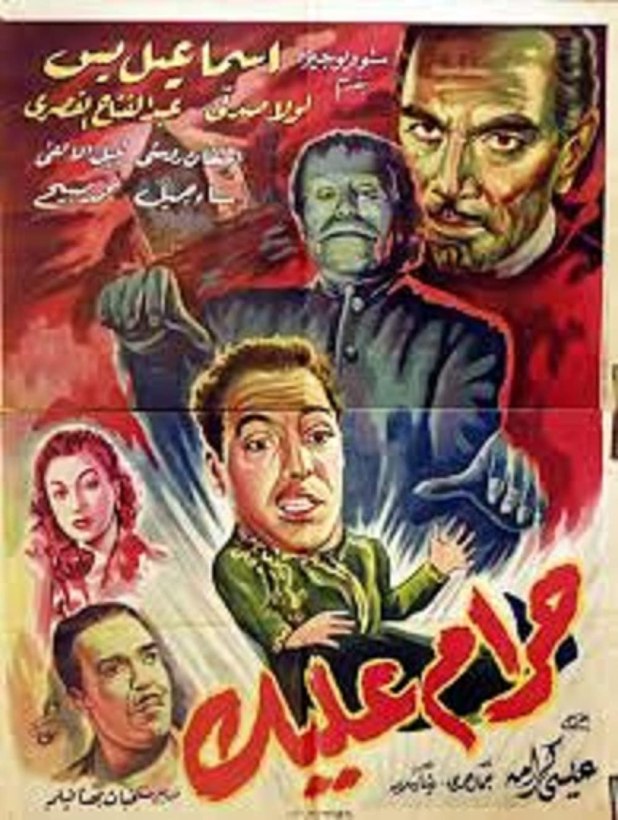
Just as Mexican director Benito Alazraki remade Abbott and Costello Meet Frankenstein for his own country as Frankenstein el Vampiro y Compañía, Isa Karamah made it for Egyptian audiences as Haram alek, which was also released as Pitié! (Pity!) in France, Ismail Yassin Meets Frankenstein in the UK, Ismail and Abdel Meet Frankenstein and Have Mercy in the U.S. and Shame on You in the rest of the world.

It’s the same kind of cross-cultural remixing that happened when you look at El Planeta De Las Mujeres Invasoras from Mexico, the Turkish Uçan Daireler Istanbul and another film by the comedy duo, Abbott and Costello Go to Mars.

Were Bud and Lou so influential? Were they just playing with easily remade archetypes like comedic men meeting the once frightening Universal monsters and aliens? Is it the collective unconsciousness at work?

The difference is that both Ismail Yassin and Abdel Fattah El Kasri can’t play a straight man — in the comedic sense — to save both their lives. So they both end up playing Lou Costello when this remake needs a Bud Abbott.

Yet the monsters are all translated to be Egyptian in nature, with Professor Assem stepping in for Dracula as some kind of never dying ancient Egyptian who can turn into a bat and wants the secret in a box, which is Frankenstein’s Monster by way of a mummy. But they’re not really twins for who they should be, making this anything but a true ripoff.

As for Dr. Morad, the werewolf, he has his curse because he planned on telling the truth about the professor, so he’s just as heroic — more so, to be truthful — than our bumbling antique store employee leads.

The end, instead of Vincent Price as the Invisible Man, has an Angel of Death show up to frighten our heroes.

It’s not an essential watch, but it’s certainly an interesting one.

You can download this from the Internet Archive.

Mill Creek Drive-in Classics: This Island Monster (1954)

Well, for me, this tale of an Italian undercover treasury agent infiltrating an island-based drug smuggling ring that results in the kidnapping of his young daughter isn’t a drive-in classic: it’s a scratchy n’ snowy, UHF-TV classic (well, bore). Those UHF days were the days when a young kid was enamored with all things Boris Karloff. What did my snot-nosed little brat of yore know about Karloff being way past his prime at this point in his career?

Well, with a title like that, well, at least I can warn you this is not a horror film. Leave your memories of The Body Snatcher (1945) and Isle of the Dead (1945) at the porta. Oh, and Boris is barely in it: he shows up in the beginning, vanishes in the second act, then returns to finish off the flick. Plot spoiler: he’s the head clubbing and gun shooting mastermind behind the kidnapping to stop the investigation. His cover story is that he’s a kindly gent who runs a child’s hospice . . . and runs bootleg milk.

Ugh. This flick is cheap and clunky and that smokey ballroom scene looks like they were going for Casablanca — only Karloff is no Bogart — and the production is so cheap the American distributor didn’t make the effort to hire the ex-Frankenstein actor back to dub his own voice in this Italian thriller — a thriller with no action and too much talk (and the high-pitched dub on the kidnapped kid is beyond annoying; somebody gag her, already). Sure, everything you’d expect in a pre-Giallo Italian noir is here: We’ve got a government agent and drug smugglers, cops-in-the-pocket of a criminal mastermind (Karloff), a femme fatale, double-crosses, herrings of red, and chinzy car chases. But again: all done with a lack of action and too much chitty chat.

Director Roberto Bianchi Montero bounced around from genre to genre in the Italian film industry: spaghetti westerns, with Seven Pistols for a Gringo and The Last Tomahawk, to peblum, like Tharus Son of Attila, war movies, like 36 Hours to Hell (with Richard Harrison), Eye of the Spider (with Klaus Kinski), exploitative erotica, like Mondo Balordo (1964), and horror, like So Sweet, So Dead (1972).

Screenwriter Carlo Lombardo sounds like a familiar name with a long resume in many genres (you’re thinking of actor Carlo Lombardi, by the way), but he’s not: amid Lombardo’s work in operas — he’s regarded in Italy as the father of the late 19th and early 20th Century revival in operas — he wrote two more, Italian-only TV movies.

We never reviewed Frankenstein (1931) proper, but rest assure: we reviewed ALL of the knock-off flotsam amid our pages. You need more Giallo? Check out our “Exploring: Italian Giallo” featurette. “Film noir,” you ask? There’s our “Drive-In Friday: Black & White Nite” to ponder, along with our reviews of Rope, Spellbound, and Dead of Night (all 1945) to get you started.

You can watch a nice rip of This Island Monster on Tubi.

About the Author: You can learn more about the writings of R.D Francis on Facebook. He also writes for B&S About Movies and Medium.

Girl Gang/Pin-Down Girl (1954)

EDITOR’S NOTE: We covered Pin-Down Girl under its other title, Racket Girls, earlier this year. Thanks to this Kino Lorber re-release of Something Weird’s The Golden Age of the Exploitation Picture imprint, we’re watching it again.

Girl Gang is really about Joe (Timothy Farrell), who leads the titular group of young ladies. He hooks them on drugs, then gets willing participants in the crimes of robbery and prostitution. Farrell would play pretty much the same role, under the same name, in 1957’s Gun Girls. His main girl June is played by Joanne Arnold, who was the Playboy Playmate of the Month for May 1954.

This is the kind of movie I find myself loving when I’m not watching Italian splatter or Mexican lucha movies: too old to be teenagers getting in trouble and dragging down everyone else with them.

Pin-Down Girl also has Farrell, this time as Umberto Scalli, a women’s wrestling manager who uses the world of pro wrestling to hide all of the racketeering, bookmaking and prostitution he has his dirty little fingers wrapped up in. Oh yeah — he also owes the mob enough money for them to want him dead.

Peaches Page, Clara Mortensen and Rita Martinez were all real wrestlers in a movie that threatened to show the real side of the business.

Farrell had already played Scalli in The Devil’s Sleep and despite getting killed by organized crime at the close of this film, he would come back for Dance Hall Racket, which has Lenny Bruce and his wife Honey Harlow. Now that I think of it, Scalli dies in every movie he shows up in. Is he an eternal man forced to be killed again and again for the sins of vice and wrestling women?

The man playing these roles was no saint either. At the same time that he was making these movies, the actor worked as a bailiff for the Los Angeles Marshal’s Department. He was embarrassed at work when he — and the entire cast — of Paris After Midnight was arrested by the Los Angeles Vice Squad as they made the movie. Things went pretty well after that with Farrell being appointed the County Marshal in 1971. But in 1975, he was fired after his conviction on felony charges for illegal use of deputy marshals in political activities. He would have gone to jail for six months, but just got probation because he was in bad health. He spent the rest of his life managing properties and a lumber mill when he wasn’t saving animals with his wife, so perhaps he learned his lesson.

Both of these movies came to be because of producer George Weiss, who is perhaps best known for getting Glen or Glenda? out there, as well as padding the film with nonsensical sequences of BDSM and dancing women. He’s also the man responsible for producing Olga’s House of Shame, White Slaves of Chinatown, Olga’s Girls, Mme. Olga’s Massage Parlor and Olga’s Dance Hall Girls, a series of roughie films that scandalized the screens of their era, as well as providing insidious influence for the Findlays and John Waters.

I truly appreciate that these films are being released on blu ray and preserved for generations of weirdos like me who may come in the future.

The Kino Lorber blu ray re-release of these films has Girl Gang and Pin-Down girl remastered in 2K from the original and re-release 35mm negative. The former has commentary by Alexandra Heller-Nicholas while the latter has a commentary track by Eric Schaefer, author of Bold! Daring! Shocking! True!: A History of Exploitation Films 1919-1959.

El Enmascarado de Plata (1954)

In 1952, José G. Cruz created a comic book that turned Santo into a Mexican hero. This series ran for 35 years and was the basis for the Santo films, yet before that, director Rene Cardona wanted to make this film. Santo decided to not be in this, as he thought it would fail.

Who can say if he was wrong or right? All we do know is that within a few years, Santo would be a movie star, so maybe he just knew how to pick the right scripts.

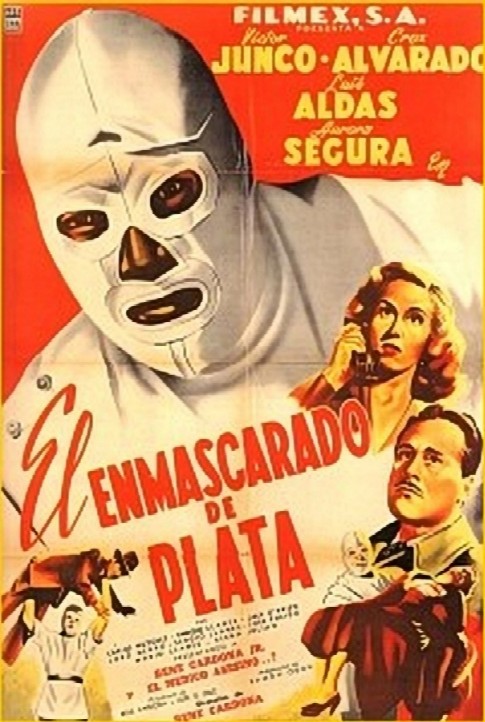
This film is filled with villains. There’s Lobo Negro and his street gang, there’s a Silver Mask that gives the orders and another villain in a hood named El Tigre that gives even more orders, but he’s the one to listen to because he’s figured out how to throw lightning and change the weather. You know, if you could do this, wouldn’t you want to do it all the time? Well, El Tigre is more into being a traditional gangster, so perhaps he feels like having all these mereological powers are kinda like cheating.

Our hero is El Médico Asesino and his sidekick Freckles. One wonders how is a man named Killer Doctor the good guy, but these questions are best left unasked.

This isn’t the first lucha movie. That would be Huracán Ramírez, a movie in which actor David Silva played the masked wrestler. Eduardo Bonada wrestled as Huracán Ramírez until he was replaced by Daniel García, who kept the character until he retired; he’s in the movies El misterio de Huracán Ramírez, El Hijo de Huracán RamírezLa Venganza de Huracán Ramírez*. If you ever hear of a wrestler doing a move called a huracánrana, it came from García as Huracán Ramírez. He also played Santo in La Leyenda. Huracán Ramírez regularly teamed with Santo in the ring — but not in the movies — often forming a trio with Rayo de Jalisco.

During a match between this tecnico team and El Signo, El Texano and Negro Navarro — who still wrestles to this day as a maestro-style luchador** — Santo had a heart attack and was saved by Huracán Ramírez. Lifelong friends, he would be a pallbearer for Santo when he was buried in his silver mask. As for El Signo, El Texano and Negro Navarro, the infamy they received from this match led to them becoming known as Los Misioneros de la Muerte (The Missionaries of Death) and their trios-style would make trios matches the most common match form in Mexico.

As for Médico, he would go on to appear in El Luchador Fenómeno and La Bestia Magnifica before becoming one of the most famous Mexican wrestlers of his era. He was the first luchador to have a female second — La Enfermera del Médico Asesino — and teamed with Santo and Enfermero as Ola Blanca (White Wave). He also feuded in Texas with Pepper Gomez, Duke Keomuka and Johnny Valentine as a babyface using the name El Medico. He even had four NWA title matches against Lou Thesz at this time, a major deal in that era.

Sadly, Médico would be dead from advanced cancer just a few years later. There’s an urban legend that his family kept the cancer a secret from him, but for a guy who weighed 275 pounds in his prime to die at around 110 pounds, he had to know something was wrong. Luckily, he had insurance and saved his money, so his family didn’t suffer monetarily. Ironically, his wife worked as a nurse after his death.

His death was enough to reduce his opponents — and partners, El Enfermero famously broke down during a match and just sat on the floor of Arena Coliseo — to tears. He may not be known in the U.S. like Santo or Mil Mascaras, but he was an incredibly important figure in lucha libre history.

Anyways — this film is a footnote in Mexican wrestling movie history, but an important one.

*He is not playing the character in the boxing movies Huracán Ramírez y la Monjita Negra and De Sangre Chicana.

**This ground wrestling escape style is closer to the British World of Sport style than modern lucha, as it has near dance-like motions. It’s the best thing ever. Another example of a star that does this style is El Solar. You can also catch Navarro’s son’s as Los Traumas.

Note: Sources used include Luchawiki and the November 16, 2020 issue of the Wrestling Observer, in which Médico Asesino was inducted into the Wrestling Observer Hall of Fame.

SON OF KAIJU DAY MARATHON: Godzilla (1954)

It’s difficult to remember, but the cuddly Godzilla that emerged in the 70’s as monster kids watched the films repeatedly on TV was anything but when he first emerged from the waves and brought the same destruction to Japan that it had endured just one decade before.

Director Ishirō Honda completely shot Tokyo rampage with the same terror that came from the atomic bombings of Hiroshima and Nagasaki, saying “If Godzilla had been a dinosaur or some other animal, he would have been killed by just one cannonball. But if he were equal to an atomic bomb, we wouldn’t know what to do. So, I took the characteristics of an atomic bomb and applied them to Godzilla.”

It’s also a cultural metaphor for how Godzilla is the victim of the United States — Japan as a whole felt the same way — with the bomb tests that woke him sending the giant dinosaur searching for something and finding only the need to destroy everything. It is filled with bleak and brutal images from a country that was the only one in the world that had to deal with having nuclear hell unleashed upon it.

Unlike every movie that ripped off this film and gave birth to the kaiju film, this is not just men in suits ripping up model buildings. This is a film that uses a gigantic beast as a metaphor for trying to start again, for being bombed into oblivion, for dealing with fear and so much more. It’s an astounding piece of art that couldn’t play that way in our country, leading to Godzilla, King of the Monsters! 

Director Ishirō Honda — who worked shirtless in blazing heat to make several scenes in this movie come to life, leading to permanent scars on his back from sunburns — felt that no one would respect a science fiction movie, so this needed to be presented as a documentary and the titular creature would only be seen in shadow and never in full frame until late in the film.

Dr. Kyohei Yamane wants to save Godzilla, as he’s waited his entire life to see a real dinosaur or ancient sea creature or whatever this creature, awakened by nuclear bomb testing, really is. Yet all anyone can do is send more bombs, more bullets and more electronic fences after the creature who shrugs it all off. The hospitals are overflowing with the dead and dying, reminding one of the radiation-scarred cities at the end of World War II.

Only Dr. Daisuke Serizawa and his horrifying Oxygen Destroyer — which disintegrates oxygen atoms and causes living things to rot — can really stop Godzilla, but Serizawa realizes that if he uses this weapon, it won’t be the last time that it is unleashed. So he reacts exactly like a man who embraces Japanese honor would, even in the face of death. He burns his notes and commits to dying as he faces the monster one-on-one, knowing that all of his work will never fall into the wrong hands.

Many thought that this film would flop and it opened to mixed reviews. Critics believed that the movie exploited the nuclear terror Japan had survived as well as the Daigo Fukuryū Maru incident, in which a Japanese fishing boat had been caught in a U.S. nuclear test. It wasn’t until American reviews pointed the art in using monsters to deal with real-life horror that the film was considered a success.

As for that American movie, Honda wasn’t even aware that it had been re-edited until it played Japan as Monster King Godzilla in 1957. We’ll get to that on our site soon enough, but it’s odd that the kind American reviews that prompted critical reevaluations in Japan were watching a movie that had been sanitized of much of the real-world elements, making it more of a monster movie than a parable.

Godzilla is an important film, not just because thirty films plus and a cultural force emerged from it. It demands to be watched and considered, particularly in a world where it seems like we’ve learned none of its lessons.

Devil Girl from Mars (1954)

Edward J. and Harry Lee Danziger may have come from America, but their films were all over UK screens through the 50’s and 60’s. Devil Girl from Mars is a great example of the kind of movies they made money with.

Patricia Laffan was Empress Poppaea in Quo Vadis — with costumes by Herschel McCoy, hairstyles by Sydney Guilaroff and jewelry by Joseff of Hollywood — before this movie and an international fashion impresario after this. She owns every single moment of screen time as Nyah, the title character.

Accompanied by one of the goofier robots ever — Chani is its name — she also has a raygun that she uses to kill anyone that gets in her way, seeking men to come back to help repopulate her planet, which has been dying off ever since a devastating battle between the sexes that one would assume that the women have won.

She can’t find a single man willing to go back to Mars with her. This is why this movie is science fiction, because Nyah — and Laffan herself — is absolutely stunning.

Maybe it’s because she’s landed right in the middle of a soap opera, because she’s outside a bar where a fashion model (Hazel Court, Dr. Blood’s Coffin) is running away from the runways of New York City and a relationship with a married man. And at the very same place, a convict who accidentally killed his wife has come to reunite with the barmaid (Adrienne Corri, Mrs. Alexander from A Clockwork Orange) who he really loves.

What’s even more interesting is that while The Day the Earth Stood Still presents Klaatu as Jesus, this movie pretty much presents Nyah as an evil Virgin Mary. Or seeing as how Laffan had dark reddish eyes and green eyes, perhaps we can see her as the Scarlet Woman, come to Earth to lead us to the End Times.

One final irony: Laffan was a lesbian and the last girlfriend of divorce lawyer Frances Blacket Gill, the first female lawyer in the UK. So how strange is it that she’s here on Earth ready to kill men to get them to copulate with her?

The Fast and the Furious (1954)

Before “Racer X,” the 1998 Vibe magazine article that detailed an illegal street racing circuit operating within New York City . . . before Vin Diesel and Paul Walker . . . there was this tale of romance and cops-on-the-case originally known as Crashout, written by Roger Corman.

In a deal similar to the one Corman made with Ron Howard years later on Grand Theft Auto: John Ireland agreed to star only if he could direct. And in nine days on a budget of $50,000, Ireland (The Shape of Things to Come, Incubus) directed his first feature film, Corman had his second producer’s credit (after Monster from the Ocean Floor), and the newly-incorporated American Releasing Corporation (which would become American International Pictures) had their first feature film. For Ireland’s co-star, Corman was able to get a down-and-out Dorothy Malone, who was without talent representation at the time, for an affordable price.

In the pages of his 1990 biography, How I Made a Hundred Movies in Hollywood and Never Lost a Dime, Roger Corman states that producer Neal H. Moritz and Universal Pictures approached him to licensed the title for 2001’s The Fast and the Furious after Moritz learned of Corman’s 1954 film while watching a documentary about American International Pictures. At the time, Moritz toyed with the idea of retaining the Racer X title from the Vibe article, along with the titles of Race Wars and Street Wars. One of Moritz’s rejected titles, Redline, was later used by one of the many F&F rip-offs, a 2007 film starring Tim Matheson and Eddie Griffin. (And another of the knockoffs, 2008’s Street Racer from Asylum Studios, sounds suspiciously like a portmanteau of Mortiz’s others rejected titles.) The deal that got it done: Moritz could have Corman’s title-by-trade: all he had to do was give Corman some stock footage to use in his later productions.

Universal welcomed Corman into the fold again when he got the idea to make his own sequel to 1975’s Death Race 2000. The idea came to fruition when an Italian journalist interviewing Corman commented The Hunger Games shared similar social and political themes explored in Death Race 2000. So Corman reached out to Universal, who produced Paul W. S. Anderson’s 2008 remake, with a plan to bring back the dark, sociopolitical satire of the original — and the killing of pedestrians. Universal was on board: the studio co-produced the film that became Death Race 2050 with Corman’s New World for the home video streaming market.

As you watch Corman’s ’54 car racing drama, you’ll notice the plot bears a striking resemblance to the glut of low-budget indie knockoffs made in the wake of F&F 2001’s success: We have another ne’er-do-well charged with a murder he did not commit and his salvation lies on the quarter mile.

Broken out of jail and on the run, someone recognizes Frank Webster (John Ireland) in a small, roadside coffee shop. To facilitate his escape, he kidnaps a customer, Connie (Dorothy Malone), and hits the road in her white Jaguar sports car. To elude police, and courtesy of Connie’s sleek ride, Frank easily slips into a cross-border sports car race into Mexico. Cops, guns, crashes . . . and love, ensues.

You have a couple of streaming choices. You can watch this on TubiTV or on You Tube HERE and HERE. The quality on all three uploads is about the same, but the Tubi upload carries ads. You can also watch it over on the Internet Archive, which is turning out to be a great repository for hard-to-find and classic films.

About the Author: You can learn more about the writings of R.D Francis on Facebook. He also writes for B&S About Movies.