CHILLER THEATER MONTH: The Mummy’s Curse (1944)

EDITOR’S NOTE: The Mummy’s Curse was on Chiller Theater on Saturday, September 25, 1965 at 1:00 a.m., Saturday, February 10, 1968 at 1:00 a.m., Saturday, September 30, 1972 at 1:00 a.m., Saturday, January 25, 1972 at 1:00 a.m., Saturday, September 20, 1975 at 1:00 a.m. and Saturday, April 23, 1977 at 1:00 a.m.

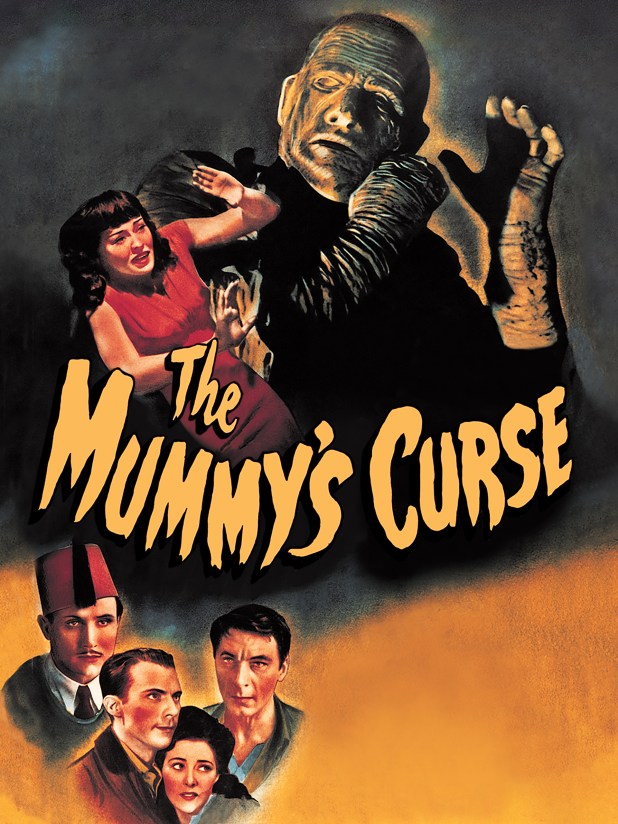
The fifth entry in Universal’s original Mummy franchise, this is a direct sequel to The Mummy’s Ghost. Kharis (Lon Chaney Jr.) and his beloved Princess Ananka (Virginia Christine ) remain in the swamp, even if the swamp has moved from Massachusetts to Louisiana—even if the accents don’t always sound right.

The Southern Engineering Company — one of those TVA or New Deal kind of public works projects — wants to drain the swamp, but the locals are afraid of even going there. Sure, they’re poor, but would you want to deal with a mummy, much less two?

Scripps Museum sends Dr. James Halsey (Dennis Moore) and Dr. Ilzor Zandaab (Peter Coe) to investigate, just as a worker is killed with all the handmarks — literally of Kharis. But never trust science, as Zandaab is really a priest of the pharaohs and is working with Ragheb (Martin Kosleck) to fully return the Egyptian royalty to life within the mucky confines of this deep southern bog.

Thus follows brewing the tea leaves and killing a monk as Kharis rises, filled with power anew. Ananka also rises, being found by a bulldozer and washing herself clean. She’s found by beloved local Cajun Joe (Kurt Katch) and, of course, taken to the local bar before Kharis busts in and starts killing people. She’s found by Halsey and Betty Walsh (Kay Harding) and is shocked by how much she knows about Ancient Egypt. I was shocked finding out how much English she could speak.

Of course, it ends as it always does, with evil scientists pushing their luck and the Mummy being dead all over again.

Directed by Leslie Goodwins, this had a huge list of writers attached, including Bernard Schubert, Leon Abrams, Dwight V. Babcock, Ted Richmond and Oliver Drake, who would go on to make another mummy movie, many years later and somehow with an even lower budget, The Mummy and the Curse of the Jackals which, outside of the Las Vegas setting, feels like it could be the lost sequel for this film.

Universal had one left — Abbott and Costello Meet the Mummy — but Joe Dante in Famous Monsters Vol. 4 No. 3 wrote that this was one of the most disappointing horror films the studio would release, packed with footage from The Mummy and The Mummy’s Hand instead of new scenes. Between the stock footage and stunt men stand-ins for the occasionally drunk Chaney Jr., The Mummy is played by at least three people, including Boris Karloff and Tom Tyler.

I kind of love this, as the swamp is a fun place. If we follow the timeline of these movies, with The Mummy’s Tomb set in 1970, The Mummy’s Ghost two years later and this twenty-five years after all that, it should be 1997. It does not feel like 1997 at all.

UNSUNG HORRORS HORROR GIVES BACK 2025: The Mummy’s Ghost (1944)

Each October, the Unsung Horrors podcast does a month of themed movies. This year, they will once again be setting up a fundraiser to benefit Best Friends, which works to save the lives of cats and dogs across America, giving pets second chances and happy homes.

Today’s theme: Lon Chaney (Jr. or Sr.)

I do love a mummy movie. I really love Lon Chaney Jr. as Kharis, the Mummy. But Chaney went through a lot to play this role, telling Frederick C. Othman that “I sweat” and I can’t wick away. I itch and I can’t scratch.” He took out his anger by choking actor Frank Reicher out, according to director Reginald Le Borg.

Andoheb, a High Priest of Arkam, has summoned Yousef Bey (John Carradine) to the Temple of Arkam to pass on his duties. Meanwhile, Professor Matthew Norman (Frank Reicher) is trying to convince his students that the mummy Kharis is a real thing. One of his students, Tom Hervey (played by Robert Lowery, the second actor to portray Batman), barely listens. After all, he has a hot Egyptian girl, Amina Mansori (Ramsay Ames, actually Spanish; she got the role when “Venezuela Volcano” Acquanetta fell during a dizzy spell and landed head-first on rocks painted white that she assumed were fake). But when anyone even mentions Egypt, Amina starts to feel uneasy.

Yousef Bey starts brewing the nine tea leaves, Kharis returns, the professor gets choked and Amina somehow has a new birthmark after seeing the mummy. Kharis starts leaving mold all over his victims, and the body of Ananka falls into dust, as she’s reincarnated into Amina, as you probably already figured.

The actual problem arises when Bey decides that she’s so gorgeous that he wants him for herself. Kharis reacts by shoving him out a window and narrowly avoiding a mob, only to sink back into the swamp as both he and his bride age. Too bad for Tom, who was about to elope.

When you see Kharis tearing up the museum, know that that’s what it is. They didn’t put the necessary items into the set on time, and Chaney cut himself. That blood is all real! Hardway blood, as they say in wrestling.

Hayes Code be damned, the female heroine doesn’t survive and you can see her, well, nipples in one scene. I guess they snuck this one in!

As I mentioned earlier, I love all mommy movies. At least the Universal ones are somewhat tied together. Too bad Lon hated the wrap so much.

Bill Fleck’s Horror Behind the Scenes writes, “According to Christopher Lock, makeup master Jack P. Pierce’s current biographer, the Mummy’s make-up is by now a rubber mask fashioned by propman Ellis Berman. But before the mask is applied, Chaney is wrapped by John Bonner and Pierce in what studio publicity claims is “400 yards of gauze tape.”

Pierce then takes Chaney out into the California sunshine when possible, and applies dark paint to the wrappings in order to suggest the scorching the creature has lived through in previous films. Pierce then wraps up Chaney’s hand, so as to give the illusion that the Mummy’s fingers have been burned off — and puts that arm in what looks like a sling.

Finally, the rubber mask, blocking out Chaney’s eye is glued to the actor’s face —presumably by Fuller’s Mud — and this is also raked through his hair, and Pierce then applies cotton, spirit gum, liquid latex, and tissue on the mask to form a more realistic look. Lastly, greasepaint and powder are added.

It’s by far Chaney’s least favorite makeup.”

The good news is that his dog, Moose, got to visit the set. Moose was Bela Lugosi in werewolf form in The Wolf Man and became Chaney’s beloved pet.

You can download this from the Internet Archive.

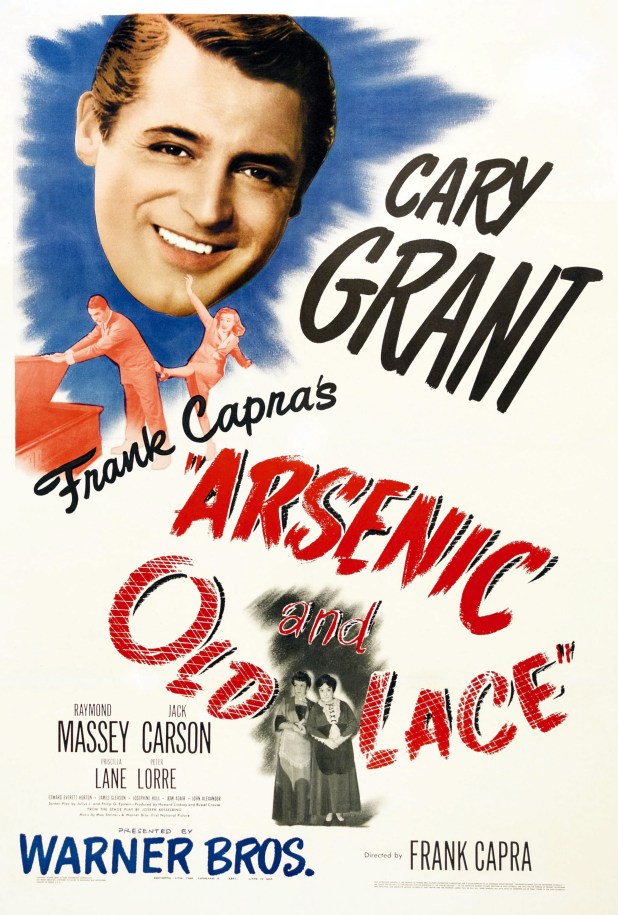
Sizzlin’ Summer of Side-Splitters 2025: Arsenic and Old Lace (1944)

July 28 – Aug 3 Screwball Comedy: Just imagine, the Great Depression is raging and you’re getting less than a fin a week at the rubber boiling factory, but it only costs two bits to go to the movies all day, so let’s watch some quick-talking dames match wits with some dopey joes!

Based on Joseph Kesselring’s play, this movie was completed in 1941 but delayed until 1944, as the producers agreed to not show it in theaters until the Broadway run ended.

On Halloween, Mortimer Brewster (Cary Grant), a theater critic and author who is anti-marriage and a minister’s daughter, Elaine Harper (Priscilla Lane), get married. On the way to their honeymoon, she goes to tell her father, and he visits the aunts who raised him, Abby (Josephine Hull) and Martha (Jean Adair), who still live with his insane brother Teddy (John Alexander). While there, he finds a dead man; he learns that his aunts have been killing old single men — twelve so far — with elderberry wine that has arsenic, strychnine and cyanide. What a mixed drink.

Then, his evil older brother Jonathan (Raymond Massey) arrives, also a killer of twelve people, with his plastic surgeon, Dr. Herman Einstein (Peter Lorre). Jonathan is said to look like Boris Karloff, who originated the role on Broadway and stayed so that the entire cast didn’t leave to make the movie. Or, as some suggest, the producers forced him to stay, and he was not allowed to participate. He did get to play the part in the 1962 TV movie.

Indeed, in Dear Boris, Cynthia Lindsay wrote that “Josephine Hull and Jean Adair went to their graves believing that Boris Karloff had been so saintly as to agree to let them go to Hollywood to make this film while he stayed on Broadway doing the play. Nothing could have been further from the truth: Karloff was furious and disappointed that he was the only cast member not allowed out of his contract to do the film.”

Warner Bros. even offered Humphrey Bogart to the play’s producers; they kept Karloff.

In The Capra Touch: A Study of the Director’s Hollywood Classics and War Documentaries, 1934–1945, Matthew C. Gunter argues that the theme of both the play and film — directed by Capra — “is the United States’ difficulty in coming to grips with both the positive and negative consequences of the liberty it professes to uphold, and which the Brewsters demand. Although their house is the nicest in the street, there are 12 bodies in the basement. That inconsistency is a metaphor for the country’s struggle to reconcile the violence of much of its past with the pervasive myths about its role as a beacon of freedom.”

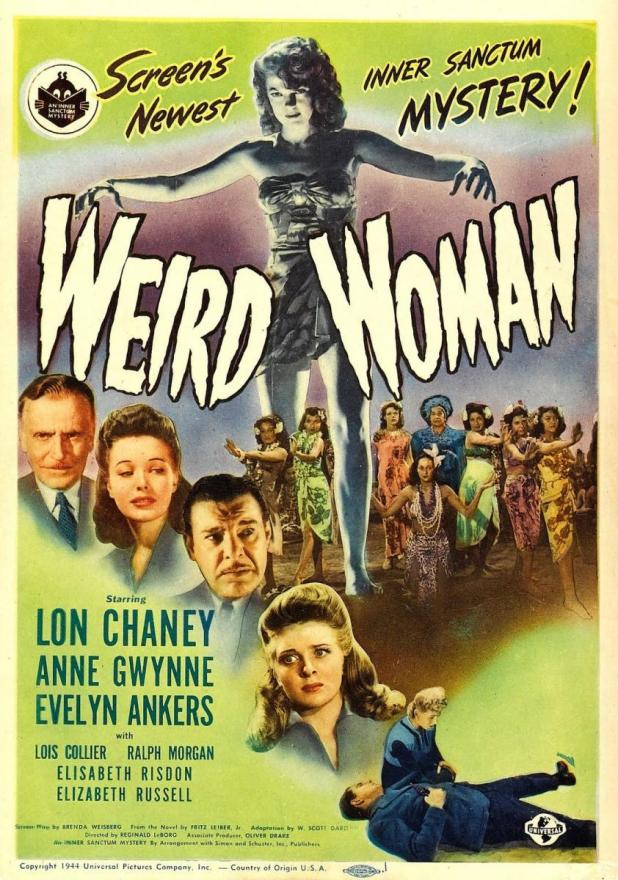
CHILLER THEATER MONTH: Weird Woman (1944)

EDITOR’S NOTE: Weird Woman was on Chiller Theater on Saturday, December 22, 1973 at 11:30 p.m.

The second of The Inner Sanctum Mysteries series of movies, these Universal B movies took two weeks and $150,000 to make. Director Reginald LeBorg was given the script on a Friday and had until the following Monday to start making this. It was only his third film but I think he did quite well, despite having to use the prefab sets and day players.

While he’s on vacation in the South Seas, Professor of Ethnology Norman Reed (Lon Chaney Jr.)  meets a jungle white goddess named Paula (Anne Gwynne, one of the first scream queens and the grandmother of Chris Pine) who he first encountered when she was just a child and her father was a professor of archaeology who worked with Reed. Going by the actual ages, she’s 26 and Chaney is 38, so it doesn’t seem all that far apart (I mean, the same age difference between my wife and me) but physically, she seems like a child compared to Chaney. It’s also strange that he knew her when he was just a little girl and now he’s in love with her, taking her out of the jungle and back to Monroe College as his wife.

This upsets Ilona Carr (Evelyn Ankers, who was often cast opposite of Chaney), who always saw Reed as hers. Professor Reed is one of those absent minded men who surrounds himself with younger women, like his new secretary Margaret (lovely Lois Collier), who fall in love with him and are decimated when he actually does show attention to another woman. It’s not like he’s using his status and authority to take advantage of them, but in today’s world, it still seems weird.

When Prof. Millard Sawtelle (Ralph Morgan) is discovered using a student’s essay as the major part of his most famous work, he shoots himself. This angers his wife Evelyn (Elizabeth Russell), who thinks that Paula is pushing her husband to take over the department. As for the couple, he’s forced her to give up all of her voodoo, so she feels like she can no longer protect the man she loves.

This is quite important as Melissa’s jealous boyfriend David (Phil Brown, who would many years later be Uncle Owen Lars) comes to kill him and ends up shooting himself, which makes it look like Reed has killed the boy who has come to punish him for touching his pure lady.

Ankers and Gwynne were best friends, so when the normally kind Ankers had to act mean, the entire cast and crew would start to laugh.

Written by Brenda Weisberg and Scott Daring, this is based on the Fritz Leiber story Conjure Witch, which was remade as Burn, Witch, Burn!

This is also part of the Universal Shock Theater package of 52 films. These movies made up much of the library of channels that had horror host programs, much like Pittsburgh’s Chiller Theater.

CHILLER THEATER MONTH: Murder In the Blue Room (1944)

EDITOR’S NOTE: Murder In the Blue Room was on Chiller Theater on Saturday, October 23, 1976 at 1:00 a.m.

A remake of the 1933 movie of the same title, which was also a remake of a German film made in 1932 and which was also remade in 1938 as The Missing Guest, this film was directed by Leslie Goodwins and written by I. A. L. Diamond and Stanley Davis.

The original plan was for the Ritz Brothers to be the stars, but instead, The Three Jazzybelles (Grace McDonald, Betty Kean, June Preisser) were the leads.

Nan (Anne Gwynne) and her mother have opened their home to boarders, despite her father killing himself in the Blue Room twenty years ago. The Three Jazzybelles perform for the lodgers and one, Larry (Bill Williams), demands to stay in the Blue Room, only for the room to be empty and locked from the inside in the morning.

It’s pretty much the same story as the original, only with all singing and all dancing. So, if you want that with your mystery, you have that here.

You can watch this on YouTube.

UNSUNG HORRORS HORROR GIVES BACK 2024: The Mummy’s Curse (1944)

Each October, the Unsung Horrors podcast does a month of themed movies. This year they will once again be setting up a fundraiser to benefit Best Friends, which is working to save the lives of cats and dogs all across America, giving pets second chances and happy homes.

Today’s theme: Universal Horror

The fifth entry in Universal’s original Mummy franchise, this is a direct sequel to The Mummy’s Ghost, as Kharis (Lon Chaney Jr.) and his beloved Princess Ananka (Virginia Christine ) remain in the swamp, even if the swamp has moved from Massachusetts to Louisiana — even if the accents don’t always sound right.

The Southern Engineering Company — one of those TVA or New Deal kind of public works projects — wants to drain the swamp, but the locals are afraid of even going there. Sure, they’re poor, but would you want to deal with a mummy, much less two?

Scripps Museum sends Dr. James Halsey (Dennis Moore) and Dr. Ilzor Zandaab (Peter Coe) to investigate, just as a worker is killed with all the handmarks — literally of Kharis. But never trust science, as Zandaab is really a priest of the pharaohs and is working with Ragheb (Martin Kosleck) to fully return the Egyptian royalty to life within the mucky confines of this deep southern bog.

Thus follows brewing the tea leaves and killing a monk as Kharis rises, filled with power anew. Ananka also rises, being found by a bulldozer and washing herself clean. She’s found by beloved local Cajun Joe (Kurt Katch) and, of course, taken to the local bar before Kharis busts in and starts killing people. She’s found by Halsey and Betty Walsh (Kay Harding) and are shocked how much she knows about Ancient Egypt. Me, I was shocked finding out how much English she could speak.

Of course, it ends as it always does, with evil scientists pushing their luck and the Mummy being dead all over again.

Directed by Leslie Goodwins, this had a huge list of writers attached, including Bernard Schubert, Leon Abrams, Dwight V. Babcock, Ted Richmond and Oliver Drake, who would go on to make another mummy movie, many years later and somehow with an even lower budget, The Mummy and the Curse of the Jackals which, outside of the Las Vegas setting, feels like it could be the lost sequel for this film.

Universal had one left — Abbott and Costello Meet the Mummy — but Joe Dante in Famous Monsters Vol. 4 No. 3 wrote that this was one of the most disappointing horror films the studio would release, packed with footage from The Mummy and The Mummy’s Hand instead of new scenes. Between the stock footage and stunt men stand-ins for the occasionally drunk Chaney Jr., The Mummy is played by at least three people, including Boris Karloff and Tom Tyler.

I kind of love this, as the swamp is a fun place, and if we follow the timeline of these movies, with The Mummy’s Tomb being set in 1970, The Mummy’s Ghost two years later and this twenty five years after all that, this should be 1997. It does not feel like 1997 at all.

DISMEMBERCEMBER: Curse of the Cat People (1944)

EDITOR’S NOTE: Thanks to Beth Waldron for suggesting this movie. This was on the site originally on May 7, 2021.

After the success of Cat People, RKO demanded that Val Lewton get started on a sequel. The original director was Gunther von Fritsch, but when he fell behind schedule, Robert Wise took over.

It was the first film for both men. Fritsch would eventually make Body and Soul and Stolen Identity while Wise would win Best Director and Best Picture for both West Side Story and The Sound of Music. Of interest to genre fans would be his films The Body SnatcherA Game of DeathStar Trek: The Motion PictureThe Andromeda Strain and, of course, The Haunting.

Sharing sets with The Magnificent Ambersons — just as the original Cat People did — this film may be a sequel and have the same cast and characters, but it is a much different movie. Lewton wanted to call it Amy and Her Friend, but the studio wanted to make money.

Lewton invested so much of his time and himself into this movie, basing it on his childhood and own mindset. RKO, on the other hand, was upset that it wasn’t the same movie that Lewton had already made.

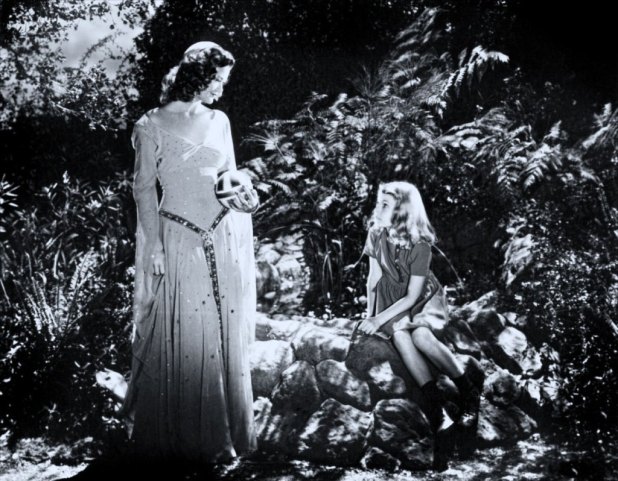
Sometime in the past, Irena (Simone Simon) died — see Cat People — and Oliver Reed (Kent Smith, The Cat Creature) moved on to marry Alice Moore (Jane Randolph, Abbott and Costello Meet Frankenstein). Now, he has a six-year-old daughter named Amy (Ann Carter, The Boy with Green Hair) who lives in a dream world. At the center of it is Irena — now a ghost who she only knows from a photograph.

Amy also becomes friends with an aging actress named Julia Farren (Julia Dean, Nightmare Alley) whose daughter Barbara (Elizabeth Russell, who was also implied to be a cat person in the original film) hates her. Barbara also begins to hate the attention that Amy receives from her mother.

The end of this film — with Barabara about to kill the young girl and Irena’s spirit returning to save her — is sheer artistry on celluloid. It astounded me and I still can’t shake the feeling I had as I watched this film.

The theme of this film — everyone believes that Amy is insane because she cannot leave the world of fantasy — was pretty much how Lewton lived as a child. In fact, his wife believed that he never truly came back to the real world as an adult. He also based the tension between Amy and her father on the relationship that he had with his daughter Nina.

You could see this as a holiday movie. You could also see it as a story of what child abuse does. Several therapists used this movie as a teaching tool for years, even asking Lewton why he had such a silly name for such a serious movie.

Shout! Factory has a blu ray of this that I urge you to purchase. This is pure cinema and has my highest recommendation.

Captain America (1944)

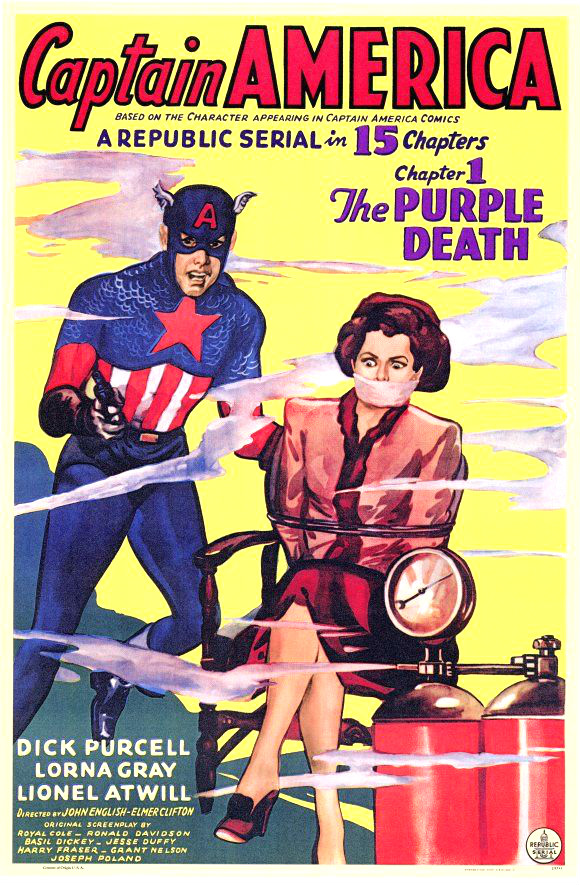
The last Republic serial made about a superhero — and the most expensive serial that they would make — Captain America is about the hero in name only. Republic was famous for making major changes in their adaptations, but these ones get crazy.

Cap isn’t Steve Rogers, he isn’t in the army, there’s no Bucky, he doesn’t fight any Nazis, he uses a gun instead of his shield and he never got the Super Soldier Syrum. Instead, he’s District Attorney Grant Gardner.

Huh?

Therte are a few different theories.

Jim Harmon and Don Glut believe that this was going to be a sequel to 1940’s Mysterious Doctor Satan, which had already substituted the invented superhero The Copperhead for Superman after Republic lost the rights to Paramount to make that serial.

Film restoration director Eric Stedman has the theory that since Republic had made two serials the Fawcett Comics characters Captain Marvel and Spy Smasher, this serial was meant to start Mr. Scarlet, whose alter ego is District Attorney Brian Butler.

After multiple scientists and businessmen — who all went on the same Mayan exploration — kill thenselves and are found holding a scarab, the police ask District Attorney Grant Gardner to bring in Captain America and seeing as how they’re the same person, that’s easy. The bad guy? Lionel Atwill, playing the Scarab. This was a major downturn in the star’s career, as after numerous scandals, he’d been blacklisted by the major studios. That said, he still is working hard in this, made just two years before his death.

He also has a weapon called the Purple Vibrator, so look out.

This was a very successful serial, but sadly, the strain of playing the physical role was too much for lead Dick Purcell, who died a few months after filming was complete.

Mill Creek Drive-In Classics: Nabonga (1944)

More people have seen this rubbery, sound-studio shot jungle rot by way of Mill Creek box sets in the ’00s than through its UHF-TV broadcasts in the ’60s and ’70s. And boy, did the cheapjack studios of Republic (the biggest), Monogram, and the cheapest-of-the-cheap behind this Buster Crabbe-starrer, PRC, love crankin’ out their Tarzan-ripped exploits from the 1930s through the 1950s. (Eh, I am too lazy to research how many Chesterfield Pictures made.) While we’ve never done an “Exploring” feature on those jungle romps, we did, thanks to Mill Creek’s recycling, break down and review the similarly-themed, Terror in the Jungle (1968).

South of Egypt and west of Ethiopia in the Sudan (aka an L.A. sound studio).

Ray Gorman (Buster Crabbe) is a treasure hunter seeking a downed airplane in the jungles of Africa. While there, he learns one of the survivors, a young girl, has matured (Julie London; Jack Webb’s ex and retiring after a 126-episode run on NBC-TV’s Emergency! as Dixie McCall, R.N. from 1972 to 1978) to become the jungle’s feared, mountain dwelling “White Witch” — complete with a gorilla protector. Hot on Gorman’s trail is Carl Hurst (Barton MacLane, who seen better days in The Maltese Falcon and High Sierra with Humphrey Bogart, then became General Peterson on TV’s I Dream of Jeannie), who also wants the priceless jewels spoils inside that plane.

What “spoils,” you ask?

Well, you see that young girl’s father was an embezzler who, before being caught, escaped in said plane with her on board.

Amid the rubbery brush, there’s plenty of wildlife stock footage — some not native to Africa — and a man in a ratty gorilla suit. It’s easy to get through at a meager 71 minutes . . . once you slop through that 20-plus minutes of stock wildlife. So, with fast forwarding, it’s only 51 minutes for you to see Buster Crabbe in something other than Rocky Jones, I mean, Flash Gordon, I mean Buck Rogers. Wait he was both Flash and Buck. Was he in Beyond the Moon (1954)? No that was Rocky Jones. But Crabbe was Tarzan at one point, so Fred Olen Ray flew him down to Florida for few days to film The Alien Dead (1980). And that, believe it or not, was also a jungle flick — complete with alligators eating zombies . . . or zombies eating gators (it’s been so long). No really.

Speaking of ex-Tarzans: Allan Nixon, who played with the Washington Redskins and was an MGM contract player who almost became Tarzan: he ended up in the same rubbery jungles battling ratty guerillas amid the wild life stock footage in Untamed Mistress (1956). Is the Italian-imported Mill Creeker, Women of Devil’s Island (1962), a “jungle” pick? Eh, 19th century French navy, pirates, sand . . . well, there’s a little bit o’ swampy jungles in there as they pan for gold.

Oh, but poor ol’ Buster: You can check out of the loin cloth, but you can never leave the jungle. Hey, at least Tommy Lee Jones portrayed you, sort of, in The Comeback Trail (2021).

Do you need a few more Monogram and PRC-variety cheapies? We’ve done a few: Scared to Death (1947) with Bela Lugosi, one of my personal favorites, Flight to Mars (1951), and I Accuse My Parents (1944). See? We just don’t do “horror films” at B&S About Movies. We’re well-rounded lads. Not as smart as Fredo Corleone, but we get by.

Shannon Tweed and Buster Crabbe in one box set? Mill Creek, we love you!

You can check out the trailer and full film on You Tube. If it starts to suck, well, there’s always The Alien Dead, also on You Tube.

About the Author: You can learn more about the writings of R.D Francis on Facebook. He also writes for B&S About Movies.

Voodoo Man (1944)

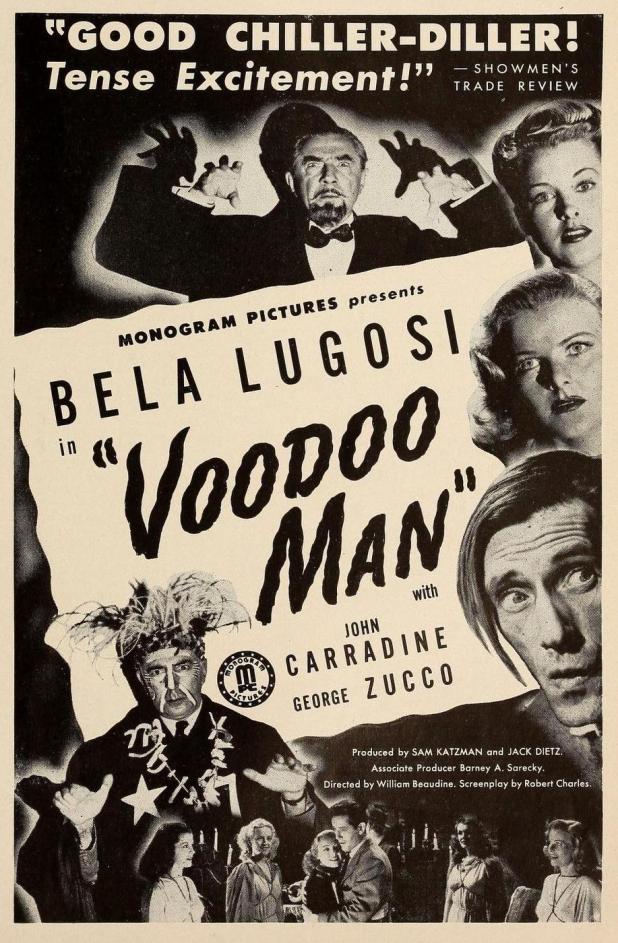
Originally written as Tiger Man by author Andrew Colvin — uncredited, of course — Voodoo Man was made in seven days along with Return of the Ape Man and was the last film that Bela Lugosi would make for Monogram.

This movie really has a dream cast. For me at least. There’s British character actor George Zucco (House of FrankensteinThe Mummy’s Tomb) as a gas station owner. And there’s Bela as a doctor who captures gorgeous women and takes their life essence. And oh yes, John Carradine as the assistant who plays the bongos.

Our hero Ralph (Tod Andrews, who played the doctor in The Baby) of course comes through by the end, then writes a script about his experiences called Voodoo Man and suggests that Bela Lugosi appears in it. Yes, they made references like this back in 1944.

Voodoo Man was directed by William Beaudine, who made perhaps the most important exploitation movie of all time, Mom and Dad.

You can watch this on Tubi.