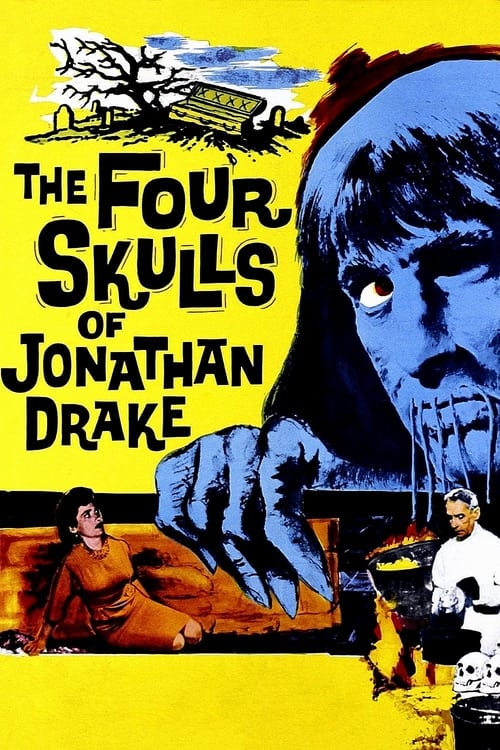
EDITOR’S NOTE: The Four Skulls of Jonathan Drakewas first on Chiller Theater on Saturday, November 30, 1963 at 3:00 p.m. It also aired on August 2, 1964 and August 7, 1965.
Directed by Edward L. Cahn and written by Orville H. Hampton, this is the tale of the Drake family. Because of a massacre in Ecuador led by Capt. Wilfred Drake, the men of their family have all been cursed to die at the age of sixty, beheaded and their severed heads shrank down. A killer named Zutai (Paul Wexler) kills one of the Drake men, Kenneth, before Jonathan (Eduard Franz) can warn him.
Of course, the family physician seems to think that the real curse of the Drake men is heart disease. That may be true, but then where are their heads? After all, we’ve seen the Zutai and his bamboo weapon stabbing people and he nearly poisons Jonathan, who keeps having visions of floating skulls.
There’s also The Cult of Headless Men who have had their lips sewn shut and fingertips branded with small skulls to achieve endless life. Perhaps the real culprit behind all of this could be Dr. Emil Zurich (Henry Daniell). After all, he has a white person’s head on a black person’s body, which is pretty wild for 1959. Either way, the curse demands four skulls and right now, it only has three.
This was kind of movie that was “Written, Produced and Directed To Scare The Daylights Out Of You!” Whether or not it did may depend on just how creeped out you are by voodoo and skulls.
As part of United Artists’ Science Fiction-Horror-Monster Features, which was sold to TV stations in 1963, this aired all over the U.S. well into the 70s. It also played theaters with another movie by the same director, Invisible Invaders. These movies have two different production companies listed — Premium Pictures for Invaders and Vogue Pictures for Four Skulls — but they are the exact same company.
EDITOR’S NOTE: House of Dracula was on Chiller Theater on Saturday, May 14, 1966 at 1:00 a.m. It was on so many times: Saturday, October 28, 1967; December 16, 1972; November 3, 1973; October 12, 1974; October 30, 1976 in a triple feature with House of Frankenstein and Curse of Bigfoot; November 19, 1977 and January 1, 1983.
A sequel to House of Frankenstein, this would be the seventh film to feature Frankenstein’s Monster (Glenn Strange*) and the fourth for both Count Dracula (John Carradine) and the Wolf Man (Lon Chaney, Jr.). Although it was a success, it would be the last of the serious Universal Monster films, with the comedic Abbott and Costello Meet Frankenstein coming out in 1948.
Director Erle C. Kenton made 131 movies between 1916 and 1957, including several horror movies for Universal like The Cat Creeps and The Ghost of Frankenstein. He started as an actor with Mack Sennett’s Keystone Kops and finished his career on TV, directing shows like The Texan and Telephone Time.
Baron Latos — come on, everyone knows that you’re Dracula — ha come to Visaria to discover a cure for vampirism from Dr. Franz Edelmann (Onslow Stevens, Them!) and his assistants Milizia (Martha O’Driscoll, Ghost Catchers) and Nina (Jane Adams, who was given her first name by American servicemen and played Vicki Vale in the second Batman and Robin movie serial). Of note is that Nina is a hunchback, which is certainly a gender switch way ahead of its time.
Edelmann has been working on the clavaria formosa plant, which has the ability to reshape bone. How this is possible is the kind of horror movie science that requires you to just accept it and move on.
Soon, Larry Talbot also shows up and he wants the cure for his lycanthropy. What, did Edelmann put out an ad in a trade magazine for monsters? They don’t believe him, so he begs Inspector Holtz (Lionel Atwill, who memorablely was quoted in Hollywood Babylon as saying, “All women love the men they fear. All women kiss the hand that rules them… I do not treat women in such soft fashion. Women are cat creatures. Their preference is for a soft fireside cushion, for delicate bowls of cream, for perfumed leisure and for a master – which is where and how they belong.”) to lock him up. He transforms and then the doctor theorizes that pressure on the brain is why he turns furry, not the moon. He responds by flinging himself into the ocean, where he survives and washes up inside the castle, where an unresponsive Frankenstein’s Monster still holds the skeleton of Dr. Niemann from House of Frankenstein.
If you’re thinking — I bet Dracula tries to sleep with that comely blonde assistant, because after all Martha O’Driscoll played Daisy Mae in the original Li’l Abner, you’d be right. The quick-thinking Edelmann drags his coffin into the sun and sets him ablaze, but before long, a blood transfusion gone wrong leads to Dracula’s blood making him evil.
By the end, the good doctor is breaking necks, villagers descend on the castle and Talbot ends up being the one to save the day, wiping out every single other monster. This would be Chaney’s last Universal contract film, although they’d bring him back for the aforementioned Abbott and Costello movie.
Throughout the production, his drinking was out of hand. For example, Glenn Strange was stuck in the cumbersome Frankenstein’s Monster makeup and also had to spend the day in quicksand. He could barely feel his feet, so Chaney helped the only way he knew how. He got the actor smashed thanks to a bottle of scotch.
Speaking of sad stories, Atwill died a few months after this movie from lung cancer. The last few years of his life were a mess. He had married socialite Louise Cromwell Brooks, the ex-wife of General Patton, but after their 1939 separation, he went a little wild. So wild that a 1940 Christmas party, where at the least stag loops were shown and at the worst underage girls were assaulted, ended up getting him in front of a grand jury on morals charges. Sure, he was judged guilty of felony perjury and sentenced to five years probation. But thanks to the Hays Office — who also took the fangs )pun intended) out of the original version of this script — his career went from Universal to movie serials and lower than B movies. He died while making one of those serials, Lost City of the Jungle.
This movie was a big part of monster kid’s lives, as it was part of the Son of Shock package that was sold to TV stations in 1958. The other movies are Before I Hang, Behind the Mask, The Black Room, The Boogie Man Will Get You, The Face Behind the Mask, Island of Doomed Men, The Man They Could Not Hang, The Man Who Lived Twice, The Man With Nine Lives, Night of Terror, The Devil Commands, Black Friday, The Bride of Frankenstein, Captive Wild Women, The Ghost of Frankenstein, House of Frankenstein, The Invisible Man’s Revenge, Jungle Captive, The Mummy’s Curse and The Soul of a Monster.
*Actually, four different actors played Frankenstein Monster: Strange, Boris Karloff in footage from Bride of Frankenstein and Lon Chaney Jr. and his stunt double Eddie Parker from The Ghost of Frankenstein.
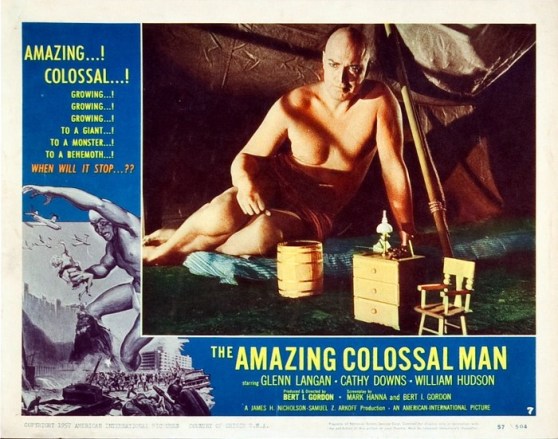
EDITOR’S NOTE: The Amazing Colossal Man was on Chiller Theater on Saturday, December 5, 1964 at 11:15 p.m. and December 10, 1966 and the sequel, War of the Colossal Beast, was on Saturday, October 17, 1964 at 1 a.m. and also was on December 4, 1965 and September 2, 1967. The Cyclops was on the October 10, 1964 episode.
The Amazing Colossal Man: Lt. Colonel Glenn Manning (Glenn Langan) has been given orders to keep his men safe from a nuclear blast, but when a civilian glider crashes close to the area, he races out to save the day. He ends up getting blown up real good — one would argue exactly like Dr. Bruce Banner five years later — and has third-degree burns all over his body. Then, the bad news. The plutonium blast has caused his old cells to stop dying while the new ones multiply at an accelerated rate. That means that he’s growing ten feet a day and there’s no sign of it stopping.
Before long, his heart and brain can no longer support him and he’s running wild, decimating the olf Vegas strip and throwing giant syringes at scientists before taking a tumble off the Hoover Dam directly into next year’s War of the Colossal Beast.
Jim Nicholson of American International Pictures made this movie because The Incredible Shrinking Man was a success and he had the rights to Homer Eon Flint’s The Nth Man, which is about a man ten miles tall. Charles B. Griffith was hired for the script ad Roger Corman was brought on board to direct but soon dropped out. You know, if you’re going to make a movie with way too big or way too small people, get the man whose very name says BIG: Bert I. Gordon.
You can watch this on YouTube.
War of the Colossal Beast: A spiritual sequel to The Amazing Colossal Man — with a different cast — this movie starts with Joyce Manning believing that her gigantic brother Lt. Colonel Glenn Manning survived his fall from Hoover Dam in the last movie.
He does live, except that his face is disfigured and he’s lost his mind as it tries to deal with the traumatic fall that he took. This facial damage was because there was a new star — and also a stagehand on the film — Dean Parkin and this would disguise the fact that they changed up who would play the lead. Stranger still, the dream sequence in the movie shows original actor Glenn Lanagan.
War of the Colossal Beast was produced, directed and written by Bert I. Gordon — the king of these kinds of movies — and co-produced by Samuel Z. Arkoff. The last scene of the movie was shot in color and then made into black and white to match the rest of the film.
The Cyclops: Bert I. Gordon made three movies in two years that had a giant bald man, played by Dean Parkin, menacing tiny people. Paul Frees is the voice of this horrible titular beast. It also has the same makeup artist as War of the Colossal Beast, Jack H. Young.
Bruce Barton is missing and his girlfriend Susan Winter (Gloria Talbott, who was also in this movie’s double feature, The Daughter of Dr. Jekyll) goes to find him. Lee Brand (Tom Drake) will fly the plane, scientist Russ Bradford (James Craig) will study the area and mining expert Martin “Marty” Melville (Lon Chaney Jr.) will get drunk and mean.
They also find all of the effects you expect from a Burt I. Gordon movie, like a giant iguana, a mouse, an eagle, a huge snake, a spider and yes, the Cyclops, who is really Bruce after being around all the radiation in the area.
Made in five days and before the money from RKO was taken away, this was a rough movie to work on, helped by the very real drinking of Chaney. But hey, Bert had a great poster that said “World’s Mightiest Horror! More Monstrous Than Anything Human Eyes Have Seen! The Giant Man-Thing growing 50 Ft. high in a horrendous land where nature has gone mad!”
In Tom Weaver’s Interviews with B Science Fiction and Horror Movie Makers, it turns out that Chaney wasn’t the only one getting loaded. During one scene in the plane, Talbott said, “Both Lon and Tom were absolutely smashed. James Craig was nipping a little, too, but nothing like what was going on in the front! And in this -h-o-t, tiny mock-up I was getting blasted from the fumes! It was such close quarters and so hot that I was ingesting alcohol through my skin. I was getting absolutely stoned, and by the time we got out of there I was weaving. If you watch that scene, you’ll see that every once in a while I look a little sick – well, I was!”
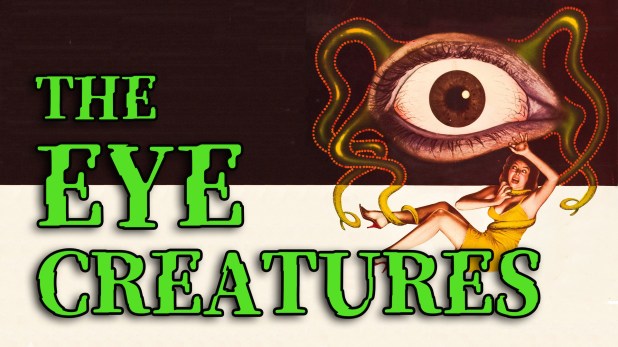
EDITOR’S NOTE: The Eye Creatures was on Chiller Theater on Saturday, June 5, 1971 at 1:00 a.m. and April 22, 1972.
Directed by Larry Buchanon and written by Paul W. Fairman, Robert J. Gurney Jr. and Al Martin, The Eye Creatures is based on Fairman’s “The Cosmic Frame” and is a remake of American-International Pictures’ Invasion of the Saucer Men. It was made in Dallas for $25,000 as a series of remakes that would fill in AIP’s TV packages. They had Jonn Ashley, who took up most of the budget, but his wife left him just before they made the movie.
Buchanan told Fangoria, “We got John Ashley on the weekend that his wife Deborah Walley said goodbye to him. And here I am with him on the set the next morning; he was in bad shape. Deborah had gone over to Arkansas on an AIP publicity junket for one of those “Beach Party” things, and John asked me if he could fly up and see her. I said, “John, we just started!” I sat down with him and worked it out, I shot around him for two days while he tried to reconcile with her. It didn’t work. But it did work for me in that when he came back, he worked his tail off. I told him he had to make a break— he had a little money— and go as far away from Deborah as he could get. And we talked long into the night, about shooting, casting and making movies. I don’t think we ever stopped on that picture. We would work all day and talk all night. And then he went off to Manila and began making those Bamboo-girl pictures and made a fortune.”
Buchanan also made In the Year 2889 (a remake of Day the World Ended), Zontar, the Thing from Venus (a remake ofIt Conquered the World); Curse of the Swamp Creature (a remake of Voodoo Woman); Creature of Destruction (a remake of The She-Creature); It’s Alive!, Mars Needs Women and Hell Raiders (a remake of Suicide Battalion) for AIP. All of these movies went straight to late night horror shows on UHF channels.
AIP told him, “We want cheap color pictures, we want half-assed names in them, we want them eighty minutes long and we want them now.”
Project Visitor should be used to search for UAPs, but the horny soldiers use it to watch teenagers like Stan Kenyon (Ashley, who was a 33-year-old teenager in this movie) and his girlfriend Susan Rogers (Cynthia Hull) make out. When she tells him that she thinks someone is watching them, he tells her that everyone in every car is watching each other. Maybe later, they’ll watch some other couples. 1967 is wild.
As they pull out of lover’s lane, they hit and kill an alien with their car. The alien body ends up getting used in a get rich plan and the government looks for it. It. turns out that the aliens plan on attacking the town but the teens soon learn that bright light destroys them, so everyone stops dry humping and shines their headlights on the eye creatures, destroying them.
If you watch The Ghost In the Invisible Bikini, the eye creature shows up. There’s a lot more recycling in this movie, as the UFO scene is from Invaders from Mars and music is taken from Attack of the 50 Foot Woman, Beach Party and The Hypnotic Eye.
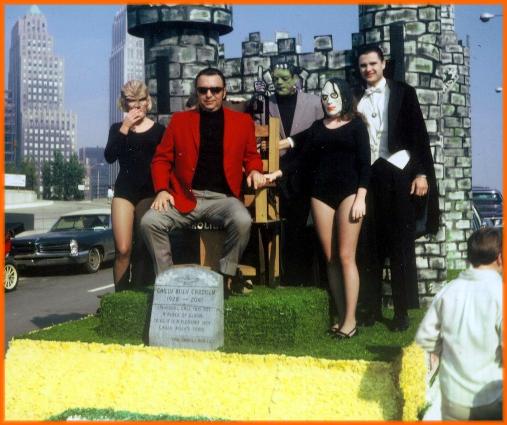
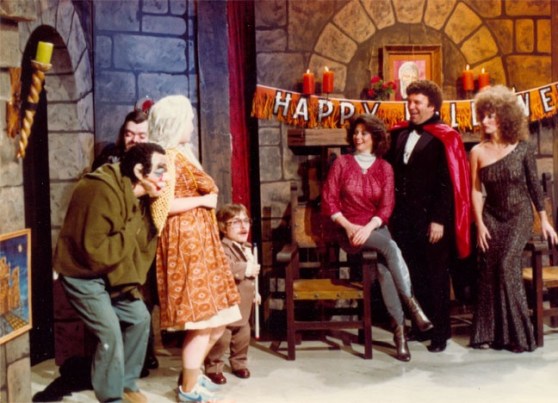
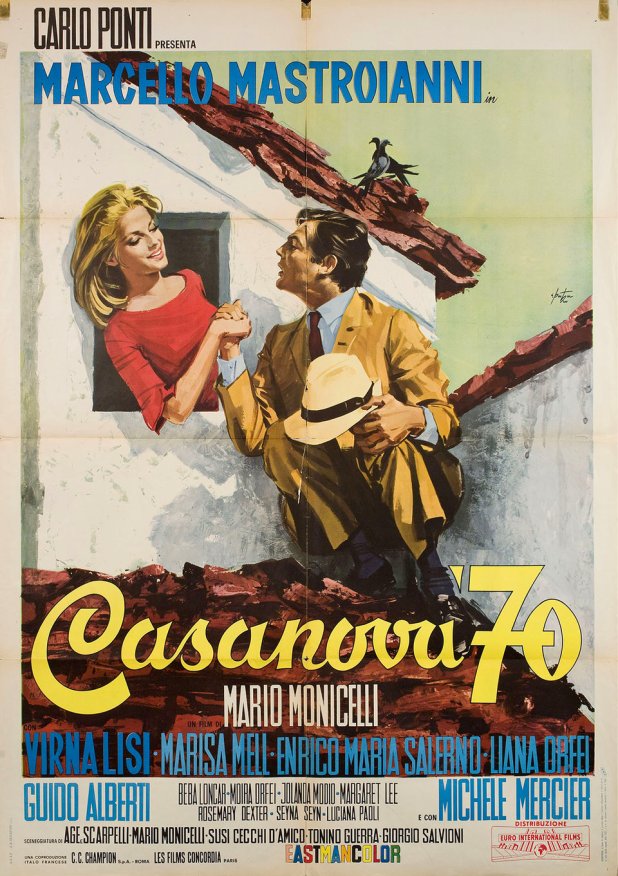
EDITOR’S NOTE: Casanova ’70 was on Chiller Theater on Saturday, September 13, 1969. Well, kind of. Chiller Theater temporarily became known as The Saturday Late Show and Bill Cardille hosted the first movie from a living room set. For the second feature, Chilly Billy returned to the Laboratory set. The second movie was Voyage to the Planet of Prehistoric Woman. This didn’t last long but the movies shown were Crazy Desire, No Love for Johnnie, The Reluctant Spy, The 10th Victim and Dingaka before taking a week off for Halloween. The Saturday Late Show continued by showing Yesterday, Today, and Tomorrow; The Easy Life; Sins of Casanova; The Success; Red Culottes; Marriage, Italian-Style; Boccaccio ’70; The Naked Kiss and The Bigamist. On January 3, 1970, Chiller Theater stopped showing non-horror films and was back to normal. I’ve always thought that Count Floyd showing non-horror movies like Ingmar Burgman’s Whispers of the Wolf and trying to sell them as scary came from this time. Joe Flaherty was from Pittsburgh and was so complete with his Chiller Theater impression that Count Floyd was often joined by a sidekick known as The Pittsburgh Midget, played by Flaherty’s brother Paul Flaherty. He’s a nod to Stefan, the Castle Prankster, who was played by Stephen Michael Luncinski on Chiller Theater.
Directed by Mario Monicelli, this may be one of the few movies nominated for an Oscar that played Pittsburgh’s Chiller Theater. It’s all about NATO officer Andrea Rossi-Colombotti (Marcello Mastroianni), a lover who can only perform with women when he might get killed. His psychiatrist recommends that instead of sex, he seeks out the spiritual and emotional qualities in women. Of course, he’s in an Italian comedy, so that’s not happening.
He almost marries the religious Gigliola (Virna Lisi) but days before he says “I do,” a liontamer (Liana Orfei, who really did that in the circus before being in movies like Mill of the Stone Women) dares any man to kiss her while she’s surrounded by the deadly beasts. He can’t resist this and is alone again. She tries to stay with him because she’s his true love, but he can’t ruin her life with his sickness. By the end, she even marries him, even if he can’t be cured.
Then again, this movie has so many gorgeous actresses for him to nearly be killed over, including Rosemary Dexter (Marquis de Sade: Justine), Seyna Seyn (Flashman), Jolanda Modio (Face to Face), Margaret Lee (Kiss the Girls and Make Them Die), Moira Orfei (the queen of the Italian circus who was known as Moira of the Elephants), Beba Lončar (Some Girls Do), Michèle Mercier (Web of the Spider) and Marisa Mell (Marta) in her first Italian film.
EDITOR’S NOTE: Dracula’s Daughter was on Chiller Theater on Saturday, February 26, 1966 at 1:00 a.m. It was on a total of nine times: January 21, 1967; July 12, 1969; December 2, 1972; April 6, 1974; May 17, 1975; December 18, 1976; July 8, 1978 and February 8, 1983.
Directed by Lambert Hillyer and written by Garrett Fort, the only cast member to return from the original film was Edward Van Sloan, now playing Von Helsing instead of Van Helsing. Supposedly based on a deleted chapter from the book, which was published as “Dracula’s Guest,” Dracula’s Daughter is much closer to Carmilla. Certainly early ads exploited the sapphic undertones of this movie with the line “Save the women of London from Dracula’s Daughter!”
David O. Selznick and MGM would get the rights to Bram Stoker’s books if Universal didn’t make this by October 1935, which meant. that it was rushed into filming with a script barely complete.
Countess Marya Zaleska (Gloria Holden) is the daughter of Count Dracula and has the same vampiric curse. She believes that if she destroys his body, she will finally be free. That doesn’t work, so she tries psychiatrist Dr. Jeffrey Garth (Kruger). When that also doesn’t take hold, she kidnaps Dr. Garth’s assistant Janet (Marguerite Churchill) and takes her to Transylvania.
How does Van or Von Helsing come in? Well, he’s been arrested for killing Dracula and his defense is that since the man had been dead for half a millennia, it wasn’t murder. Instead of a lawyer, he hires Dr. Garth, one of his former students, to explain his point of view. Obviously, Von Helsing is not dealing with an actual court in our real world.
Doomed love is the theme of this movie, as Zaleska intends to transform Dr. Garth into a vampire to be with him forever. He has had an antagonistic relationship with Janet and now realizes he loves her. As for Sandor (Irving Pichel), the servant of Dracula’s daughter, he is growing angry as she has promised to make him a vampire and now just seems to give it away to the scientist.
There’s also a lot of hypnosis via ring and Lili (Nan Grey), an artist model, being painted by Zaleska before she gives in to her need to kill and drain her.
As for the MGM version that was never made, it was written by the writer of Universal’s Dracula and Frankenstein John L. Balderston. He was trying to wrap up some of the plot of the first movie, as Von Helsing would be looking to destroy Dracula’s brides and learn that there was a fourth grave that his daughter used. She would follow him back to London and pose as a countess. The story also implies that Dracula’s daughter enjoys torturing her male victims and they enjoy it as well. They also would show her dungeon filled with whips. The script couldn’t be made as the contract with Stoker’s estate didn’t allow him to use any characters that didn’t appear in the short story, so Van or Von Helsing was out.
This same script was sent to Universal and wasn’t used. There was another script by R. C. Sherriff that went through so many censors and was finally not filmed.
There’s a theory that so much of Sunset Boulevard was influenced by this movie. According to this article on The Last Drive-In, both Countess Zaleska and Norma Desmond have male servants who are obsessed and utterly devoted to them. Hedda Hopper is also in both movies.
It definitely had an impact on the books of Anne Rice. I kind of like how the Bright Lights Film Journal described the villain of this movie: “Gloria Holden in the title role almost singlehandedly redefined the ’20s movie vamp as an impressive Euro-butch dyke bloodsucker.” Holden hated that she was cast in this and her disdain for the role lends itself a coldness that is actually just right for her character.
Speaking of Sunset Boulevard, its male star, William Holden, was named for Gloria Holden. This article in Billboard explains: “William Holden, the lad just signed for the coveted lead in Golden Boy, used to be Bill Beadle. And here is how he obtained his new movie tag. On the Columbia lot is an assistant director and scout named Harold Winston. Not long ago he was divorced from the actress, Gloria Holden, but carried the torch after the marital rift. Winston was one of those who discovered the Golden Boy newcomer and who renamed him — in honor of his former spouse!”
How strange that the lead in Dracula’s Daughter is Gloria Holden and the leads in Sunset Boulevardand Gloria Swanson and William Holden.
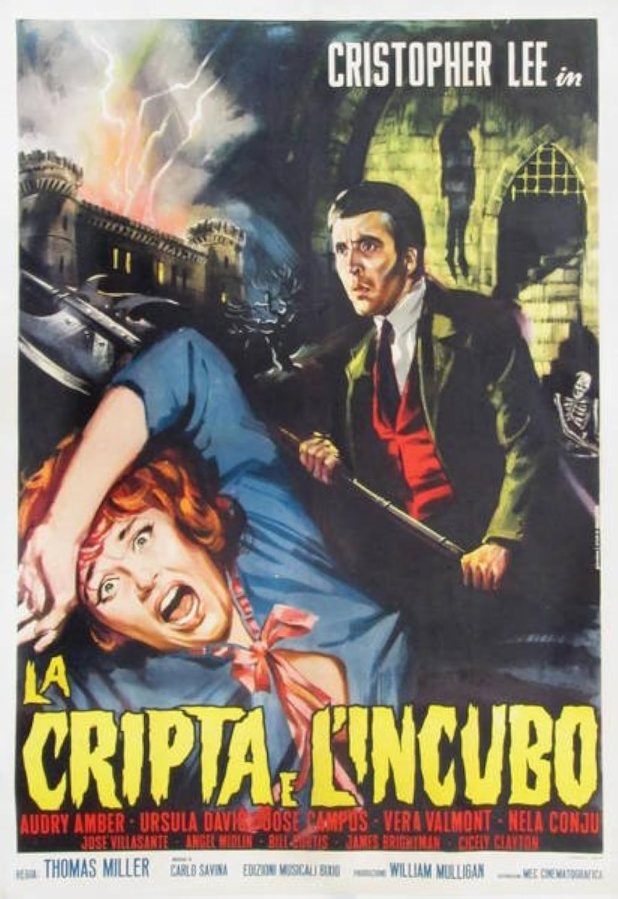
EDITOR’S NOTE: Terror In the Crypt was on Chiller Theater on Saturday, October 7, 1967 at 1:00 a.m. It also appeared on November 21, 1970.
La cripta e l’incubo was released in the U.S. on TV by American-International Pictures and retitled Terror In the Crypt. The script was called La maledizione dei Karnstein and Ernesto Gastaldi said that he wrote it in a day. It’s based on Carmilla and is the third adaption of that book after Vampyr and Blood and Roses.
Antonio Margheriti was the intended director but was busy, so Camillo Mastrocinque, who usually made comedies, directed. He also directed An Angel for Satan. He was helped by co-writer and assistant director Tonino Valerii, who would direct some great Westerns like The Price of Power, Day of Anger and My Name Is Nobody as well as the giallo My Dear Killer.
Count Von Karnstein (Christopher Lee) claims that his family is cursed and the next victim is his daughter Laura (Adriana Ambesi). She keeps dreaming of horrific scenes where she finds people with all of the blood drained out of their bodies.
That’s because Sira Von Karnstein, one of their ancestors, was killed for being a witch which has led to the family suffering for centuries. The maid conducts a ritual — with a hand of glory created from the body of a lynched and decapitated dwarf — that brings back Sira just in time for another girl to show up named Lyuba (Ursula Davis) and the murders — and an obsession between Laura and the young lady — to really begin.
This may start to feel like a cover version of some of your Italian gothic horror favorites — fog, skeletons, a woman being put to death and cursing everyone, white gowns barely covering gorgeous Italian women — but those are some pretty awesome things to bring back. I’m for all of it, including Christopher Lee as the hero.
EDITOR’S NOTE: The Tingler was on Chiller Theater on Saturday, October 2, 1965 at 1 a.m. It also aired on March 11 and November 25, 1967 and May 9, 1970.
The third of five films that director William Castle and writer Robb White made together — the others are Macabre, House On Haunted Hill, 13 Ghosts and Homicidal — this movie starts with Castle talking right to us, the audience: “I am William Castle, the director of the motion picture you are about to see. I feel obligated to warn you that some of the sensations—some of the physical reactions which the actors on the screen will feel—will also be experienced, for the first time in motion picture history, by certain members of this audience. I say ‘certain members’ because some people are more sensitive to these mysterious electronic impulses than others. These unfortunate, sensitive people will at times feel a strange, tingling sensation; other people will feel it less strongly. But don’t be alarmed — you can protect yourself. At any time you are conscious of a tingling sensation, you may obtain immediate relief by screaming. Don’t be embarrassed about opening your mouth and letting rip with all you’ve got, because the person in the seat right next to you will probably be screaming too. And remember this—a scream at the right time may save your life.”
Dr. Warren Chapin (Vincent Price) has learned that each one of us has a tingler, a parasite that is attached to our spine that feeds and grows stronger when we are afraid. The only way to stop this from killing us is to scream.
He is able to take a tingler from the body of Martha Higgins (Judith Evelyn), a deaf and mute woman who could not scream and the wife of a man — Oliver Higgins (Phillip Coolidge) — whose theater only shows silent movies. It turns out that Higgins killed his wife by fright and now the tingler gets loose in his theater. This is where the gimmick of this movie would come in, as special chairs would vibrate as Dr. Chapin asks for the lights to be shut out and everyone to scream for their lives.
Percepto was the gimmick for this movie. Castle attached electrical buzzers — war surplus airplane wing deicing motors — that buzzed the seats. When the big scene happens — during a scene from the silent movie Tol’able David — Price’s voice frightens everyone by saying, “Ladies and gentlemen, please do not panic. But scream! Scream for your lives! The tingler is loose in this theater!” In drive-ins, there was a different version of the movie with Castle’s voice saying that the tingler was loose in the drive-in.
In their excoriable book The Golden Turkey Awards, Harry and Michael Medved gave Percepto the award for “The Most Inane and Unwelcome ‘Technical Advance” in Hollywood History.” My hatred for them is incalculable.
Castle hedged his bets by adding red color to a black and white murder scene in the bath as well as placing professional fainters and a doctor and nurse that would revive them in certain theaters. The guy was the kind of lunatic that I wish was still making movies. He also experimented with rolling bean bags to brush against the legs of audience members, speakers mounted at different areas that would make noises when the tingler appeared and even having people physically tickle the legs of people in their seats.
This was also the first movie to reference LSD.
John Waters has mentioned this movie several times as one that he loves. He told NPR that when the tingler got loose, “Every kid went crazy. It was cinema mayhem.” He even played Castle on the TV show Feud: Bette and Joan and wrote an introduction for the 1992 re-issue of Castle’s autobiography, Step Right Up!: I’m Gonna Scare the Pants off America.
EDITOR’S NOTE: The Manster was on Chiller Theater on Saturday, September 28, 1964 at 11:15 p.m. It also aired on June 24, 1967 and July 20, 1968.
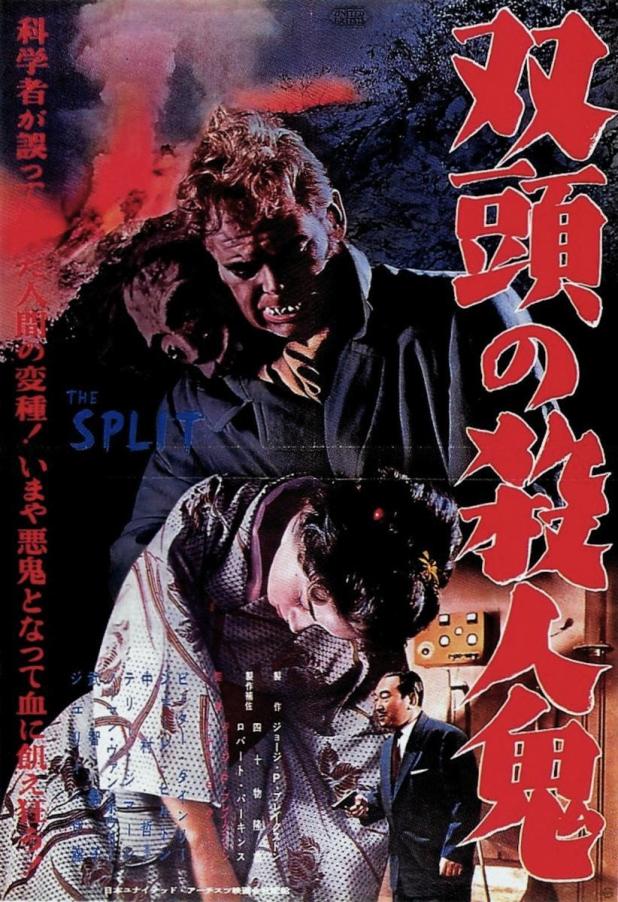
Also known as Soto no Satsujinki or The Two-Headed Killer, The Manster was directed by Greg Breakstone, who was Beezy in the Andy Hardy movies. It was one of several movies that he made in Japan, where he stayed after World War II, including Geisha Girl and Oriental Evil. It was co-directed by Kenneth G. Crane, the movie’s editor, and written by. William J. Sheldon.
Larry Stanford (Peter Dyneley) has been in Japan too long for his wife Linda (Jane Hylton), who wants him back in the U.S., but his last job is interviewing Dr. Robert Suzuki (Tetsu Nakamura), who works with his assistant Tara (Terri Zimmern) to slip him a mickey, the kind of libation that causes a monster to grow right out of his shoulder. By the end of the movie, Larry has become two totally different beings, one willing to toss women into volcanos.
The Manster isn’t great, but it sure is fun. I mean, when else would you get to see someone fight his evil side on the rim of an active volcano?
EDITOR’S NOTE: I Was a Teenage Werewolf was on Chiller Theater on Saturday, November 21, 1964 at 1:00 a.m.
Herman Cohen started his climb up the show business ladder from the lowest rung, working as a gofer and usher at Detroit’s Dexter Theater at the tender age of 12. By 18, he’d be the manager. His career would take him from being the sales manager for Columbia’s Detroit region to their Hollywood publicity department and finally making his own films.
His greatest success came in the 1950’s with this film — which he wrote and produced for American International — which earned $2 million dollars on a $100,000 budget (approximately $18 million on a $900,000 budget when adjusted for today’s inflation). He was also behind the films Craze, Trog and Berserk!
Back in 1957, when this film was made, the idea of a teenager becoming a monster was shocking to audiences. Producer Samuel Z. Arkoff claimed that he received plenty of guff for exploiting this idea. In fact, this is the first of many I Was a Teenage movies, but it certainly wouldn’t be the last.
It’s also the first role for Michael Landon, who would go on to enjoy a long and fruitful Hollywood career with three landmark series on his resume: Bonanza, Little House on the Prarie and Highway to Heaven. When I was a kid, I was often afraid of the photo of the werewolf in this movie and my mother would say, “It’s just Michael Landon. You shouldn’t be afraid.” Also, as a youngster, if I ever went to another kid’s home and they were fans of Little House on the Prarie’s adventures of the Ingalls family, I’d instantly judge them as boring and want to go home.
Here he plays Tony Rivers, a troubled teenager to say the least. Unlike most 1950’s fare that portrays its protagonist as noble, we’re shown that Tony is a rough character right from the beginning. He doesn’t just rail against authority, he hates everyone. And he’s not all that forthright about it. In a fistfight with another classmate, he goes so far as to throw dirt in the man’s face and try to kill him with a shovel instead of just using his fists. His love of violence and hatred for his fellow man stands in dramatic contrast to his pretty boy looks.
Barney Phillips, who was also Sergeant Ed Jacobs on Dragnet, plays Detective Donovan, a cop who feels bad for Tony and tries to intervene on his behalf several times. After all, Tony grew up without a mom and his dad’s probably a drunk.
Yvonne Lime, who would move on from acting to becoming a noted philanthropist with her husband, plays his girlfriend Arlene. While her parents don’t seem to enjoy the cut of Tony’d jib, she’s in pure love with him, believing in him no matter what.
That said, the real horror starts at a haunted house party. After an extended dance sequence where Vic and his girl sing along to a record — amazingly, this is announced as a big deal and I can’t imagine attending a party where the highlight is some guy playing bongos and lipsynching to a 45 — Tony flips out and nearly kills the man for surprising him from behind. I mean, everyone was pranking one another to an inordinate degree and only Tony tried to outright murder Vic. Look — I hated Vic after a minute, so I get it, Tony. I can’t even imagine what it would be like to have to spend time with him on an extended basis.
Don’t believe me? Just watch these antics and tell me you don’t wish you could go full lycanthrope and strike them all down.
However, Tony’s rage ends up knocking down his girlfriend, so he volunteers to meet with hypnotist Dr. Alfred Brandon. He’s played by Whit Bissell, who would play a psychologist in not only this film, but in its follow-up, I Was a Teenage Frankenstein. He also had the same occupation in Invasion of the Body Snatchers.
This being the 50’s, the doctor has to be a quack. He’s really only interested in experimenting on Tony, regressing him to his most primal state.
After another party at the haunted house — this is made a major point yet we never see a single ghost — Tony drives Arlene home and Frank, one of their friends, is mauled and killed. As the cops debate the autopsy, Pepi the janitor (Vladimir Sokoloff, a Russian actor playing a Carpathian, so this isn’t whitewashing as much as its Hollywood not really even knowing at this point what ethnicity is. In fact, Sokoloff would play 35 different nationalities in his career, including people from Greece, China, Spain, Mexico and so many more) tells them all the truth: these are the marks of a werewolf!
Tony feels like there’s something wrong with himself, but the principal is so happy with his progress that she’s recommending him to State College. One would assume that the marks on his permanent record have been removed.
As he leaves her office, he notices Theresa practicing her gymnastics. This drives his teenage hormones into overdrive and he responds by going full werewolf and killing her, which is about the best translation for toxic masculinity that 1957 can muster. Just seeing the comely form of Dawn Richard (Playboy Playmate of the Month for May 1957) as she stretches out is all it takes. That said — her sexuality had to be somewhat shocking for the puritanical Baby Boom era. Therefore, she had to be destroyed.
Tony’s recognized by his jacket and goes on the run. He calls Arlene for help and she can only listen, unable to reply. And a visit to Dr. Brandon only leads to the man using our protagonist and filming his transformation, at which point Tony kills everyone. The cops are forced to gun him down — silver bullets are unnecessary when you have good old fashioned American steel — and that’s all she wrote.
One of those cops — they opine that man shouldn’t mess in the affairs of God — is Guy Williams, who would soon be swashbuckling in Zorro and sailing through the galaxy in Lost In Space.
Less than four months after the release of this film, AIP would release two movies that are pretty much the same story: I Was a Teenage Frankensteinand Blood of Dracula, which is even more of a remake, just with a female lead and doctor. It’s such a paint by numbers recreation that there’s even another dance number thrown in, references to Carpathia, dialogue lifted nearly line by line and an observer who knows that it’s a vampire when no one else will believe them.
I watched this movie on the very same day I rewatched An American Werewolf In London and it’s stunning to see the different ways that they interpret not only being a werewolf, but the transformation itself. Instead of the pain that 1981’s Rick Baker effects depict, all we see here is a slow dissolve of Tony getting a furry face. But it works — for so often, this was how American audiences saw werewolves.











 B&S About Movies
You must be logged in to post a comment.