AUXILIO (Help) is a captivating film directed by Tamae Garateguy, who is known for her previous acclaimed work on She Wolf. The narrative centers around Emilia, a spirited young woman portrayed by Cumelen Sanz. She finds herself in a challenging situation after her father sends her to a secluded convent. This drastic decision is a reaction to her defiance in rejecting the marriage proposal from a man chosen for her, reflecting the societal pressures she faces and her refusal to conform to traditional gender roles.
Upon arriving at the convent, Emilia encounters a strict and cloistered world governed by the rigid rules of the Sisterhood. Guided by Rebeca, a compassionate nun played by Paula Carruega, Emilia begins to navigate the complexities of her new life. As she attempts to adapt, she gradually becomes aware of a mysterious and deeply buried secret that lies within the convent’s walls—a secret that grants supernatural powers to the nuns. This revelation introduces an enthralling layer of suspense and intrigue, drawing Emilia deeper into the enigmatic world around her.
The film intricately weaves themes of hidden romance and passion, hallmarks of the nunsploitation genre. The interactions between the characters reveal much about their desires and conflicts, emphasizing the tension between their spiritual vows and earthly yearnings. Mother Superior, portrayed by Marcela Benjumea, serves as a formidable figure, adept at hiding the convent’s darker secrets and protecting its inhabitants—often societal outcasts—from the outside world. Her complex character adds depth and a sense of urgency to the plot as she navigates the fine line between authority and compassion.
Throughout its runtime, AUXILIO raises profound questions regarding faith, identity, and the nature of belief. Are the residents of the convent divinely inspired beings, or are they merely ordinary individuals seeking solace and purpose? This exploration invites viewers to reflect on their own definitions of spirituality and the human experience, making the film not just a visual spectacle but an engaging meditation on the struggles and strengths of its characters.
I watched this film as part of The Bucheon International Fantastic Film Festival (BIFAN). You can learn more at their official site.
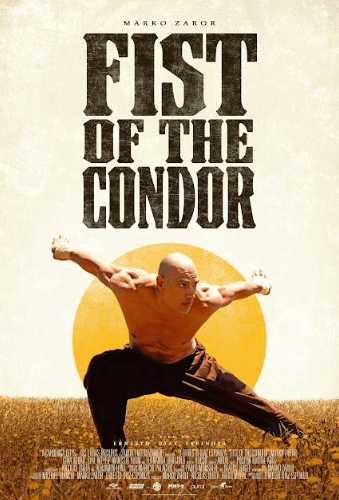
When the Incan empire fell to invading conquistadors, the martial arts masters who practiced their Rumi Maki style hid a sacred manual containing the secrets behind their deadly fighting technique. But after centuries of careful safeguarding, the manual may fall into the wrong hands, leaving its rightful guardian to battle the world’s greatest assassins to protect the ancient secrets within.
The Fist of the Condor is a secret martial art that allows its fighters to defy gravity in battle. It has been passed down from generation to generation to the purest in heart, but now a set of twin brothers (both roles are played by Chilean martial artist Marko Zaror, who was Chidi in John Wick: Chapter 4) has been challenged to keep the book. Gemelo, one of the brothers, has run, and now the other, Guerrero, must find him while fighting the greatest martial arts experts in the world; all want the book for themselves. Some have even been sent by Gemelo to kill his own brother.
The battle between them seems to be postponed until another movie, as this one ends with a battle between Guerrero and Kalari (Eyal Meyer), his brother’s student and the killer who murdered our hero’s teacher, Master Wook (Man Soo Yoon).
Director and writer Ernesto Diaz Espinoza and Zaror are both worth watching. This movie was a blast from start to finish. Like the best Hong Kong martial arts movies, it has a mystical feel, but thanks to its Chilean origins, it’s very unique. Highly recommended.
Fist of the Condor is available on digital, DVD and Blu-ray from Well Go USA Entertainment.
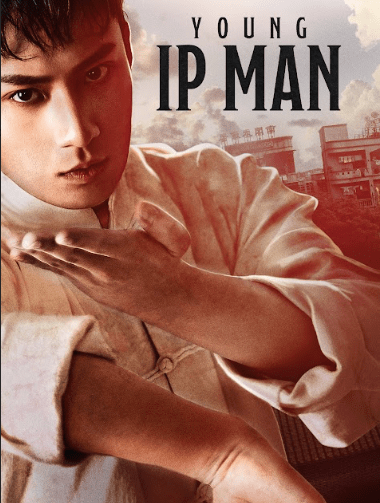
Director Li Liming, alongside action coordinator Sun Fe, crafts an engaging narrative that explores the life of a younger Ip Man, with the character brought to life by the talented Zhao Wenhao. The story begins when Ip Man arrives in the bustling city of Hong Kong, eager to start his college education. However, his academic aspirations take a dark turn when he and his classmates are taken hostage by a menacing gang leader named Ma Long (played by Mu Feng-bin), who happens to be Ip Man’s former mentor. This twist of fate propels Ip Man into a harrowing ordeal marked by danger and deceit.
As the plot unfolds, Ip Man finds himself embroiled in a treacherous conspiracy that intricately weaves together local authorities, criminal factions, and a deeply personal betrayal from someone he once considered an ally. This betrayal shakes the foundation of his moral beliefs and challenges everything he has learned thus far.
Unlike previous films featuring renowned actors Donnie Yen and Wilson Yip, this rendition does not draw from historical events. Instead, it presents an original and thrilling action narrative that creatively utilizes the iconic Ip Man name. The film shines through its spectacular fight sequences, showcasing a blend of choreography and raw emotion that captivates audiences.
The character of Ma Long undergoes a significant transformation into a villain, driven by the profound corruption of the British colonial regime. Once a man seeking justice, Ma becomes consumed by grief and rage, redirecting his anguish into a destructive mission aimed at dismantling the lives of those in power. His vendetta escalates to the point where he even targets the children of the elite, illustrating the depths of his moral decline. In a reversing of roles, Ip Man, who once revered Ma and learned valuable lessons about right and wrong from him, must now confront the very man who instilled those beliefs.
As the story builds to its climax, Ip Man faces the daunting challenge of defeating all of Ma’s henchmen. Each encounter intensifies the stakes and tests his limits. The ultimate showdown with Ma Long looms ahead, forcing Ip Man to rely not only on his martial arts skills but also on the wisdom he gained during his formative years under Ma’s guidance.
Younger Ip Man is available on digital, DVD, and Blu-ray from Well Go USA Entertainment.
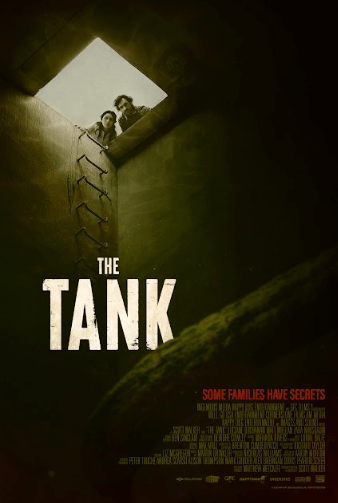
Ben inherits a mysteriously abandoned coastal property in Hobbit’s Bay, Oregon and takes his family to explore it. The property, with its overgrown house and a gigantic tank, holds a dark secret. As the family delves deeper, they accidentally unleash an ancient, long-dormant creature that had once terrorized the town. The film follows their struggle to survive and escape the wrath of this monstrous entity.
Directed and written by Scott Walker, this has led me to add to my advice of never going home to settle family estates. If your family has an overgrown house with a gigantic tank as part of it, just sell it sight unseen. You don’t need to live there, and you don’t need to open anything to unleash a creature.
The Tank, shot in New Zealand and featuring practical effects by WETA, promises a visually stunning monster. Matt Whelan, as Ben, and Luciane Buchanan, as Jules, deliver compelling performances that carry much of the film’s weight. The tension is palpable, and the audience is aware from the start that a monstrous threat looms.
Or monsters! Who is to say!
It looks great, even if you’ve seen everything in it before, but it’s a dependable monster movie, and sometimes, that’s precisely what you want to watch.
The Tank is available on demand, as well as DVD and Blu-ray from Well Go USA Entertainment.
In November 2022, Ticketmaster and its parent company, Live Nation, were widely criticized for the ticket sales for Taylor Swift’s Eras Tour. The pre-sale website crashed within an hour, but 2.4 million tickets were sold despite the outage, breaking the all-time record for the most concert tickets sold by an artist in a single day.
Ticketmaster claimed that “historically unprecedented demand with 14 million showing up” was the cause, but it felt like just another example of bad customer service and worse business practices for so many.
Directed by Pieter Colpaert and Nicholas Fraccaro, this film shows how Ticketmaster and Live Nation, following their significant 2010 merger, have caused ticket sales to increase in price and give you no other option to buy tickets or see a show. This has led to the U.S. Congress attempting to revert the merger, as it appears to be a monopoly that has led to high prices and worse service.
Swift’s tour promoter, AEG Presents, remarked that Ticketmaster has exclusive deals with the majority of U.S. live venues, so they had to work with them. However, AEG Presents has also been criticized for its role in the high ticket prices. Fans have responded by filing a variety of lawsuits.
This should be no surprise to music fans.
In 1994, Pearl Jam was one of the few bands that tried to do something about it. Their complaint with the U.S. Department of Justice antitrust division claimed that Ticketmaster had a “virtually absolute monopoly on the distribution of tickets to concerts.”
It’s a stark reminder that the issue of ticket sales has been brewing for decades, and we’re still grappling with it today. This reiteration of the historical context helps the audience feel connected and part of a larger narrative.
Former Ticketmaster CEO told The Los Angeles Times, “The public brought all this on itself. I have no sympathy for people whining about high ticket prices. They helped create this situation where artists must make all their money on tour. Artists and the market set the prices, and you can’t pay a Motel 6 price and stay at the Four Seasons.”
This movie might not solve the problem, but it does an excellent job of laying it out. By presenting the issue in a clear and comprehensive manner, the film ensures that the audience feels informed and enlightened.
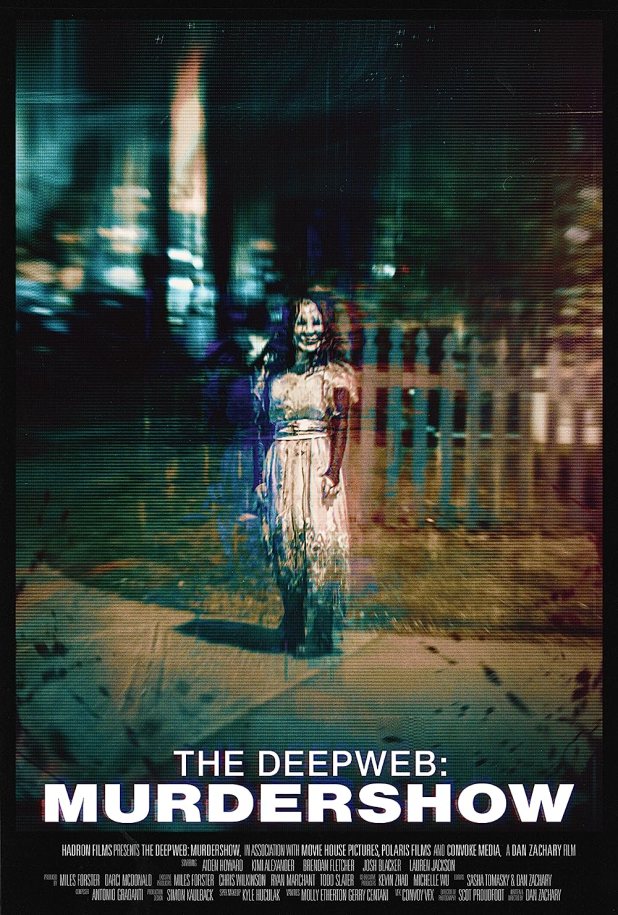
Ethan Newton (Aiden Howard) is a podcaster who doesn’t just track down true crime stories; he also reveals the lousy police work and abuse that happens along the way. Perhaps that doesn’t make him very popular, but he feels he has a mission to expose things. One evening, after recording his latest episode, he gets a call from Seattle, the home he left behind. His sister is dead. Now, the world of true crime is more accurate and personal than it ever has been before.
After spending some time there and reconnecting with his estranged mother, Ethan discovers that the cops missed a cipher in his sister’s apartment, which leads him to the dark web—ominous music, please—and the Murdershow, a live killing floor that his sister Amanda “Mandy” Newton (Lauren Jackson) and her friend Kate (Kimi Alexander) watched once in their battle to scare one another.
It turns out that this dark web group is run by clowns who look like they stepped out of The Purge or The Strangers wearing generic Spirit store Slipknot costumes — indeed, you can buy the Twisty the Clown, Dollmaker and Doxy masks from this movie on Trick or Treat Studios which claim this movie was actually made in 2020, because they’re on clearance — who took Mandy, crucified her and then sliced her up with a chainsaw while they lived in a haunted house that looks like it’s sponsored by Hot Topic. Also, much of this movie feels like it happened sometime in the 2000s.
Of course, the cops — like Detective Sawchuk (Josh Blacker) — are no help, but they all hate Ethan and his show. So he has to go into business for himself, working with Kate (Kimi Alexander), who he’s always had a crush on, and his hacker friend Shadow (Brendan Fletcher).
It turns out that the news reports in the beginning that this is a death cult are accurate, and soon, Ethan and Kate know way more than they ever wanted to know about the Murdershow.
So many moments in this movie feel like they are taken whole cloth from Ed Piskor’s comic book Red Room, even calling the room such. I know that these urban legends have been around before the comic, but between the chat windows and what people are saying within the room, as well as having people pledge crypto to watch people die, it’s a bit too close to be a coincidence.
There’s also a not-so-shocking twist ending that really feels more like the expected ending, but you know that going into straight-to-streaming horror these days, right?
I don’t really want to speak ill of the dead, as director and writer Dan Zachary died on New Year’s Eve of last year after a brief and unexpected illness. He also made American Conjuring, Mortal Remains and Darkest Hour.
This is rather polished for a Tubi Original, but if there’s one mean thing I can say, they should have given Aiden Howard a few more takes for his funeral scenes. It might be amongst the worst emoting I’ve seen, and I exist on a steady diet of Claudio Fragasso and Bruno Mattei movies.
There’s a sound—a nearly imperceptible sigh—that my wife makes when a film displeases her. I’ve heard it sitting next to her in quiet theaters, and I know that I don’t even have to ask if she liked the movie.
During this film, I heard it more than a few times.
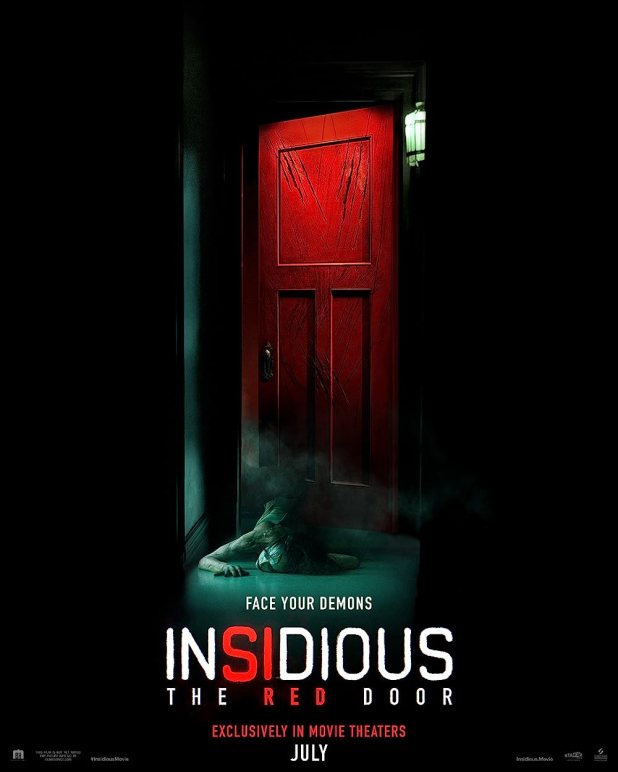
As someone who mainly loves either drive-in era movies, foreign horror or films out to test the audience’s gag reflex with a torrent of upsetting scenarios and body decimation, it took some time for me to begrudgingly respect the ghost and possession cycle of James Wan, starting with 2010’s Insidious, followed by 2013’s The Conjuring and then alternating each year or so between these franchises. Both of these series are marked by his quality eye for direction and some truly well-delivered art direction, something that’s lacking in so many modern horror movies.
But as it goes, franchises get stale. The Conjuring will hit nine movies this fall — and two shorts — while this is the fifth Insidious film. Created by Leigh Whannell (who also worked on Saw and Dead Silence with Wan and directed the underappreciated Upgrade), the first two films center on Josh and Renai Lambert (Patrick Wilson and Rose Byrne) and their children Dalton, Foster and Cali. They’re, as usual in long franchises, the best in the overall series.
A review, for those that haven’t seen the film: Dalton encounters an entity in the attic of the family home and goes into a coma, but is genuinely trapped in a realm past life and death called The Beyond, err, The Further. That place nearly trapped Josh when he was a child, a fact that he learned from his mother Lorraine (Barbara Hershey), and required the help of psychic Elise Rainier (Lin Shaye). Now, she must come back, along with paranormal investigators Specs and Tucker (Whannell and Angus Sampson), and figure out how to rescue the Lambert family.
The events of this movie—and the second, which was predestined based on the shock ending of the original—run deep within every moment of this reimagining, sequel, and restart of the franchise, the first film in the series in seven years.
Spoilers for everything after the trailer…
Directed by Wilson and written by Scott Teems—more on him in a bit—this movie opens with tragedy. Lorraine has died, Josh and Renai have divorced, Dalton (Ty Simpkins, who played the role in the original, and Andrew Astor as Foster) and his father are distant, and Josh seems to have spent the last few years in what he calls a fog. Even an attempt at connecting by driving Dalton to college fails.
While there, the young artist goes through a memory exercise in class and unlocks memories of The Further, drawing the red door at the entrance. Along with his roommate — by accident, she’s played by Sinclair Daniel and is accidentally placed in his dorm — he begins to investigate his ability to astral project and avoid ghosts at frat parties. There is a cute scene where Specs, Tucker and Elaine appear on YouTube.
Meanwhile, Josh attempts to discover why he’s felt lost most of his life. Between a CAT scan gone jump scare and a memory game—also gone jump scare—he finally has to talk to his ex-wife and learn that he once menaced the entire family with a hammer while possessed by Michelle Crane, the Woman in White, and the Lipstick Demon.
Those same entities have trapped Dalton—cue the red room, start “Tiptoe Through the Tulips,” and start the fog—and the father must save the son.
The issue with this movie is what you want it to be. Do you want closure for a family that has dealt with the paranormal and blocked it out of their lives until the act of forgetting it splits them? Or do you want a scary film that takes ordinary people into the frightening unknown of The Further? This film series has always dealt with loss and grief and the missing spaces caused by those gone from our lives — Josh’s father, Elaine’s husband — but this goes further (pardon the pun) by spending nearly an hour in the miserable lives of a family that has failed to connect before it seemingly remembers that oh yes, this is also a possession movie.
Wilson does fine for a first-time director, but it’s a challenging walk emulating the footprints of Wan. I watched the original right after we got home from the theater, and it’s striking how much bigger and richer the first movie is. As for the script, well, Scott Teems has somehow gotten to write a Firestarter reboot, the excoriable Halloween Kills and is now set to write The Exorcist: Believer, all based on a few shorts and some TV work, as far as I can tell. The height of his wit is named a character, Nick the Dick, after a scene in Bachelor Party, and really, that’s the limit of creativity in a film that outright restages scenes from the second movie.
This is less a movie that is out to scare you as a summer thrill ride and more one that brings closure to a family constantly dealing with decades of missing people and trying to process grief. The film that it wants to be is not always compatible with the type of movie it is sold as. It needs defter hands to pull that off, and instead, we are like the characters in The Further, wandering the fog for 90 minutes or so until the lights come on and we can finally go home. The film’s attempt to bring closure to the family’s long-standing issues gives a sense of resolution, even if it’s not always successful.
PS: A man literally screamed out things while we watched this movie, frightened by almost every jump scare, and he wasn’t joking. I hope that if you see this movie, he’s in the audience with you because he’s the best part of the film.
At the height of sheer Q-Anon craziness — I think probably when a shaman in red, white and blue facepaint led an army of people into government buildings, and people defecated on the walls, maybe — people were grasping for straws and pearls and wondering, “How could this happen?”
I’m here to tell you that this has always been here.
In the 1980s, high school me was the same as old me. I was always in black, with long hair, and I only cared about music, movies and studying weird things. As such, I was brought into the Core Group, a team of teachers led by an occult expert cop who studied which students could be worshipping Satan. This group was led by my godmother.
The Satanic Panic wasn’t started by Michelle Remembers, but it felt like it was. The union of Canadian psychiatrist Lawrence Pazder and his psychiatric patient (and eventual wife, but we’ll get to that) Michelle Smith. In the mid-70s, while treating Michelle for depression due to a miscarriage, she confessed to him that she knew that something horrible had happened to her and could not recall what it was. Using hypnosis, Michelle was soon screaming for 25 minutes non-stop and speaking in the voice she had as a child. 14 months and 600 hours later, a conspiracy was found: Michelle’s mother and other citizens in Victoria were members of a worldwide Church of Satan.
At one point, Michelle was part of a ritual that lasted 81 days that Satan himself showed up for, and during that time, she was tortured, raped, witnessed others get killed and was covered with the blood of murdered babies until St. Michael the Archangel, Mary and Jesus appeared, healing all of her scars and blocking all of her memories of the years of Satanic desecration of her body and soul.
None of these stories were challenged, even a decade after, when Michelle and Laurel Rose Willson, who wrote Satan’s Underground about being a breeder for Satanists and having two of her children killed in snuff films, were on Oprah Winfrey and at no moment did Oprah challenge either of them, in 1989. The year, I was repeatedly questioned and challenged and told that I was giving my soul to Satan.
I was a white kid from a small town, and in no way have I ever dealt with racism, sexism, transism or any isms in any other way again. This experience, however, showed me a small, tiny glimpse into what it’s like to know you’re right and everyone is sure you’re wrong based on no facts at all.
By the 80s, Pazder was an occult expert, consulting in the McMartin preschool trial and appearing on a 20/20 segment called “The Devil Worshippers” that stoked the flames of the Satanic Panic. That report claimed that movies like The Godsend, The Incubus, Amityville II: The Possession, Exorcist II: The Heretic, The Exorcist, The Omen and Omen 2 allowed people to visualize and be inspired by the devil. This aired in prime time on ABC, a major cable network. They also refer to The Satanic Witch as a book filled with evil rites. And then, of course, heavy metal. As Anton LaVey was in his era of not speaking to the media, this also has footage taken from Satanis.
As part of the Cult Crime Impact Network, Pazder got into business working with police groups and consulting on Satanic ritual abuse, while lawyers used his book while doing cases, and social workers used Michelle Remembers as their training manual.
According to NPR host Ari Shapiro, “One reason these fictions were so appealing was that they gave people a sense of purpose. They had a mission – to defend the innocent.”
This is what’s happening today. It’s why trans people are grooming children, why Democrats are eating babies, andwhy elections are being seen as conspiracies. Because the truth — the idea that things happen randomly for no reason — is less frightening than Satanism or Q-Anon.
Man, did I digress?
In Satan Wants You, filmmakers Sean Horlor and Steve J. Adams explore the history of Michelle Remembers and what most people don’t know, such as how Pazder and Smith left their families to be together and how the book was debunked. It would be one thing if their sessions led to a book and some press, but it would be another if they kicked off an entire movement.
The directors have stated: ““This is the first time that Michelle’s sister, Larry’s ex-wife, and Larry’s daughter have gone on the record to tell their side of this story. This was a once-in-a-lifetime opportunity to combine all these stories together to reveal the true origins of the Satanic Panic and show how they connect to the Pizzagate and QAnon conspiracies of today.”
This movie must be seen, even if we’ve entered a time when feelings matter more than facts. But did facts ever matter?
This film also found an anonymous source sending Michelle’s actual tapes, which have never been heard until now.
I don’t discount that she went through some trauma. Yet, how many lives were destroyed along the way?
The sad fact is that no one has learned anything. That same refrain of “protecting the children” exists today. And yes, that’s a noble endeavor. But as someone who grew up in a town of 7,500 people that had more than one Catholic priest abusing children in the last fifteen years of my life, Often, the abuser is someone the abuser has known and trusts.
Just like a worldwide Satanic network — paging Maury Terry and The Family, a book that lost a court case to the Process Church over false claims — and a public ritual lasting 81 days seems complicated to swallow, so do all the claims of the far right today.
Back when I was a kid getting grilled over my slasher movie magazines and love of Danzig, I figured, “Well, someday soon, all of these close-minded people will die off, and we can get past racism, and we can learn how to be more open-minded together.” But now, everyone is close-minded. No one seemingly wants to learn. And this movie is a great teaching tool — it’s a must-see, an intense documentary worthy of rewatching — because it happened before, and yes, it’s going on all over again. The message may have shifted, but it’s still the message.
And it’s still wrong.
I watched this film as part of The Bucheon International Fantastic Film Festival (BIFAN). You can learn more at their official site.
Bruce Lee died in 1973 after four major movies: The Big Boss, Fist of Fury, The Way of the Dragon and Enter the Dragon. Yes, he had been acting since his teens and also appeared on The Green Hornet and worked in Hollywood, but he became a cultural force through those movies. The world of film—more than that, pop culture, martial arts, and cultural identity—were all shaped by a man who died at the age of 32.
Just when the world had started to love Bruce Lee, his sudden departure left a profound void in the cultural landscape.
What happens when the demand exists and there’s no supply?
You invent a supply to fill that vacuum.
Brucesploitation is a truly unique film genre that revolves entirely around one individual. Actors like Ho Chung-tao and Moon Seok transform into Bruce Li and Dragon Lee. The titles of these films are so reminiscent of Bruce Lee’s movies that they even incorporate footage from his funeral. These films, which initially portray the life stories of these actors, often delve into sequels of Bruce Lee’s films or even venture into the realm of pure fantasy, where Bruce Lee can be seen fighting characters like Popeye and Emanuelle in the afterlife.
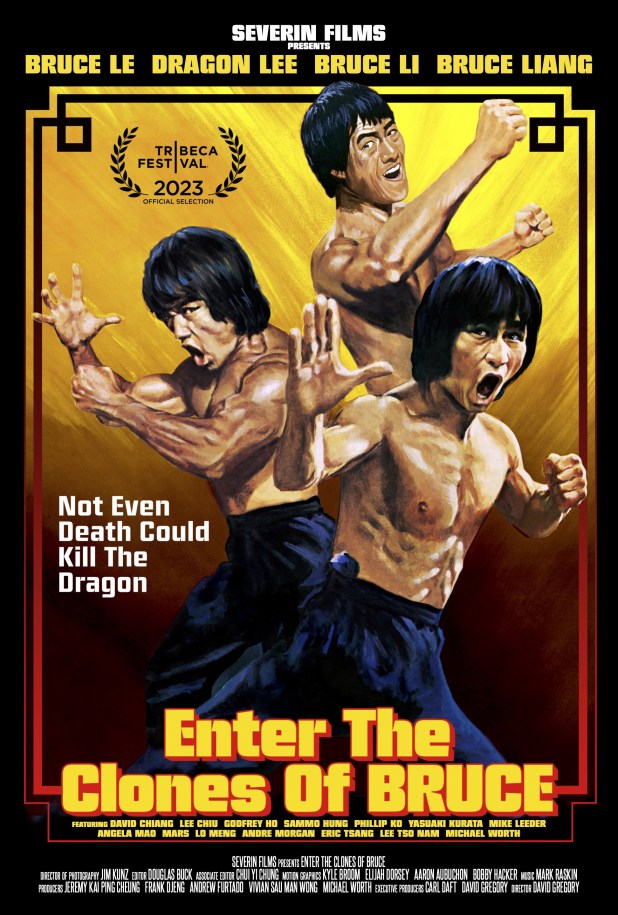
Directed by David Gregory and featuring contributions from Carl Daft, Frank Djeng, Vivian Wong, and Michael Worth, Enter the Clones of Bruce is a film that not only entertains but also educates. It is a must-watch for those unfamiliar with this unique genre, as well as for those who have delved deep into its peculiar and potent flower.
David Gregory, known for his work on Al Adamson’s life in Blood & Flesh: The Reel Life & Ghastly Death of Al Adamson and the making of The Island of Dr. Moreau in Lost Soul: The Doomed Journey of Richard Stanley’s The Island of Dr. Moreau, brings us another gem. Enter the Clones of Bruce, like his previous works, avoids being overly academic and never ridicules its subject. Instead, it celebrates how Bruce Lee revolutionized the portrayal of Asian men in Hollywood and why his films were so crucial. It also argues that these imitations were perhaps just as necessary in the healing process following the martial arts legend’s death.
The true joy of this film is in hearing from the performers and how it made them feel to become stars while living in the shadow of the man they were impersonating. Like Bruce Le, who was in Shaw Brothers’ Infra-Man before changing his name from Ho Chung-tao and appearing in movies like The Big Boss Part II, Return of Bruce, My Name Called Bruce and many more, including a cameo in Pieces. Or Dragon Lee was once Moon Kyung-seok, the star of The Real Bruce Lee, Kung Fu Fever and Dragon Lee vs. the Five Brothers. Or Bruce Li, who was in Goodbye Bruce Lee: His Last Game of Death and Bruce Lee: The Man, The Myth.
The film also offers a wealth of knowledge from martial arts film experts, including Mike Leeder, Christophe Lemaire, Michael Worth, Christophe Champclaux, and Stephen Nogues. Their perspectives, along with those of director Lee Tso Nam, Golden Harvest producer Andre Morgan, Jean-Marie Pallardy, Uwe Schier, and Aquarius Releasing’s Terry Levene, provide a comprehensive understanding of the genre.
Perhaps one of the most insightful voices is Valerie Sou, professor of Asian studies at San Francisco State University, who explains why Lee meant so much to Asians not just in America but worldwide, as well as his cultural relevance to African-American audiences.
Even better, the film has many of the great martial arts actors of all time, including David Chiang (The 36th Chamber of Shaolin), Lee Chiu (The 8 Diagram Pole Fighter), Mars (Enter the Dragon), Phillip Ko (Heart of Dragon), Lo Meng (The Kid With the Golden Arm), Roy Horan (Game of Death II and the father of martial arts actress Celina Jade), Bruce Liang (The Dragon Lives Again), Caryn White (He’s a Legend, He’s a Hero), Eric Tsang (The Dragon Lives Again), Lo Meng (Five Deadly Venoms), Casanova Wong (Warriors Two), David Yeung (son of Bolo), Angela Mao (I lost my mind when she showed up and got emotional; obviously she was in Enter the Dragon but her films are so inspirational. She even thanks the audience for watching her movies, a charming thing to do); “Black Dragon” Ron Van Clief (Fist of Fear, Touch of Death), Wang Dao, Shan Charang, Japanese actor Yasuaki Kurata (Bruce Lo) and perhaps the greatest cinematographer of fighting ever — as well as a Bruce Lee comedy clone in The Fat Dragon — Sammo Hung.
Another amazing moment is when this film gets not just Joseph Lai but also Godfrey Ho to speak on the traditions of creating products in a demand vacuum. I couldn’t be more pleased with this movie!
Enter the Clones of Bruce does what every good movie about movies should do. It makes you want to watch all of the films in this. I love the stranger examples, like Fist of Fear, Touch of Death and The Dragon Lives Again, but I think Bruce Li in New Guinea might outdo them!
Severin also plans on a box set of Bruceploitation films that will include Challenge of the Tiger, The Real Bruce Lee, Dragon Lives Again, Bruce’s Fingers, Enter the Game of Death, Ninja Strikes Back, Clones of Bruce Lee(a movie that combines Dragon Lee, Bruce Lai, Bruce Le and Bruce Thai) and The Death of Bruce Lee. I’ll be first in line to buy it.
If you’d like to get a head start on the movies in this genre, I’ve compiled a Letterboxd list of the movies the film mentions. Watch them all, scream loudly at the camera and remember, “An intelligent mind is one which is constantly learning.” Or watching movies.
I watched this film as part of The Bucheon International Fantastic Film Festival (BIFAN). You can learn more at their official site.
I watched this film as part of The Bucheon International Fantastic Film Festival (BIFAN). You can learn more at their official site.
Directed and written by Andrew Adams, American Meltdown follows Olivia Walker (Jacki Von Preysing), who experiences a series of unfortunate events. Her boyfriend Rich (Christopher Mychael Watson) dumps her, her boss puts her on leave to avoid paying benefits, and her apartment is robbed, all on the same day. Her boss blames unions, her property manager, Lou (Clayton Farris), blames her lack of insurance, and the cops seem indifferent. The sheer absurdity of Olivia’s predicament is both amusing and unbelievable.
She becomes friends—and later roommates—with Mari Navarro (Nicolette Sweeney), who starts their relationship by lifting Olivia’s wallet. Their eventual burglary is a humorous yet poignant response to the absurdities the heroine has already endured. Sometimes, humor can be a balm that allows us to address more serious themes. In my mind, we’re going to need more of it to get through the next several years.
It feels like no one is here for you. The majority of the day is work, then more work and the reward is often, well, more work if you can handle it. But said, “You can handle it, right?” The notion that the only way to escape late-stage capitalism is through acts of crime should be frankly terrifying instead of heartwarming, but here we are.
Olivia has to face the idea that to escape the life she’s in, she must destroy it. For so many of us, this means leaving the comfort that we’ve created for ourselves. It’s so much easier to complain and feel that momentary release than to tear off the bandages and attempt to change everything forever. This film makes you face that, but in a way that is gentle, nudging and hilarious. It has definitely made me better consider the choices that I make.
The Chattanooga Film Festival is over. For more information and to see how you can donate so that next year is even bigger, visit chattfilmfest.org and follow us on Facebook,Twitterand Instagram.





 B&S About Movies
You must be logged in to post a comment.