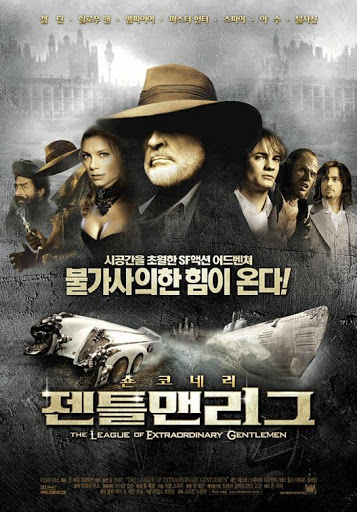
The League of Extraordinary Gentlemen (2003)

Sean Connery turned down the roles of the Architect in The Matrix films and Gandalf in The Lord of the Rings trilogy. He would have made $450 million off that last role, so that led to him taking this movie, even though he didnt understand the script. But hey — $17 million makes things much simpler, right?

He warred with director Stephen Norrington (Death MachineBlade), who was uncomfortable with large crews. It makes sense, as Norrington came up from working with special effects on movies like Split Second and Aliens. For what it’s worth, Norrington did not attend the premiere, and when he was asked where the director was, Connery is said to have replied, “Check the local asylum.”

Jason Flemyng, who played Dr. Jekyll in the film, told Empire, “My favorite bust-up was in Venice. The League had to walk from Captain Nemo’s boat down the street, Magnificent Seven-style. At the end of the take, Sean shouted to Norrington, ‘What? You want us to do that again?’ He replied, “For $18 million, I don’t think it’s too much to ask you to walk down a road.” To which Connery’s reply was unprintable.”

Since this film, Norrington has been attached to several projects but hasn’t made another film, claiming that he would never direct again.

Interestingly enough, Larry Cohen and Martin Poll filed a lawsuit against 20th Century Fox, claiming the company had intentionally plagiarized their script Cast of Characters, which the two had pitched to Fox several times. But wait — isn’t this movie based on the Alan Moore and Kevin O’Neill comic book?

Cohen and Poll claimed that the studio bought the rights as a smoke screen, as both their script and the final movie shared public domain characters who did not appear in the comic book series.

The case was settled out of court, a decision Alan Moore told the New York Times  was upsetting, as he had “been denied the chance to exonerate himself.” No wonder the guy hates the movies made from his comic books so much.

In 1899, Fantomas (Richard Roxburgh, Van Helsing) and his army have broken into the Bank of England to steal da Vinci’s blueprints of Venice and kidnap several scientists. To figure out what is happening, Allan Quatermain (Connery) is brought back to for a new team of the League of Extraordinary Gentlemen, along with Captain Nemo, vampire Mina Harker (Peta Wilson from the TV version of La Femme Nikita), invisible man Rodney Skinner (the production couldn’t get the rights to the original story, so they made up their own invisible person), Dorian Gray (Stuart Townsend, Queen of the Damned), Tom Sawyer and the twin form of Dr. Henry Jekyll and Edward Hyde.

Whereas the comic showed the league battling Martians and Fu Manchu, instead of the revelation that M — yes, like the Bond films — is also Fantomas and Sherlock Holmes’ archenemy Professor James Moriarty. Like they say, this is loosely based on the source material.

David Hemmings shows up as Ishmael, which is a nice cameo. The effects are big and bold, while the movie sets up a sequel at the end. That never happened — this is another one of those “even though the movie made $179.3 million on a $78 million budget” movies that still isn’t a success. Hollywood math.

The character of Campion Bond, British Intelligence Director — and the ancestor of James Bond — was supposed to appear and be played by Sir Roger Moore. The character was dropped before filming began to be saved for a possible sequel, which was never made.

Despite only a few references to Tom Sawyer in the comic books, the character was added to appeal to young Americans, which upset many fans of the comic, as well as Moore and O’Neill. That said, Mark Twain wrote two little-known sequels to Tom Sawyer, is Jules Verne-like one called Tom Sawyer Abroad and another where he becomes Tom Sawyer, Detective.

O’Neill would later say that he believed this movie failed because it was not respectful of the source material, such as how Allan Quatermain was changed so much and that Mina Murray was marginalized by becoming a vampire.

The Wold Newton family — a literary concept derived from a form of crossover fiction developed by the American science fiction writer Philip Jose Farmer — is a great concept. The comic takes full advantage of this. The movie ended a director’s career and retired Connery from anything other than voice-over work.
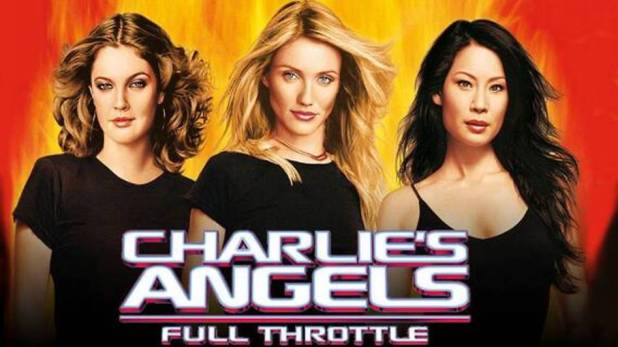
Charlie’s Angels: Full Throttle (2003)

The Angels are all back, as is Crispin Glover as The Thin Man in the next installment of this series. This time, however, Bosley’s half brother, played by Bernie Mac, is in charge and the Angels are going up against one of their own. This entire film is packed with cameos and more comedy than the original, which is OK. In times like these, it’s a nice bit of fluff that goes down easy.

Natalie Cook (Cameron Diaz), Dylan Sanders (Drew Barrymore) and Alex Munday (Lucy Liu) are up against former angel Madison Lee (Demi Moore) as well as numerous criminal organizations.

Jaclyn Smith returns as one of the original girls. You also get John Cleese as Alex’s dad, Bruce Willis as a federal agent, Robert Forester, the Olsen twins, Carrie Fisher as a nun and many, many, many early 00’s celebrities. You can have a great time just naming each new one who appears.

There were plans for two more sequels, but they never happened.

Mayor of the Sunset Strip (2003)

George Hickenlooper was a director who excelled at telling peoples’ stories. Edie Sedwick in Factory Girl. Jack Abramoff in Casino Jack. And documentaries on Dennis Hopper, Apocalypse Now, Peter Bogdanovich, Monte Hellman and this take of Rodney Bingenheimer, Rodney on the ROQ, the Mayor of the Sunset Strip, the man who launched so many bands into American consciouness.

When Rodney was 16, his mother dropped him off at Connie Stevens’ house, told him to get her autograph and abandoned him. He ended up as a stand-in for Davy Jones, as the live-in publicist for Sonny & Cher, opened a club, brought glam to the U.S. and took to the air on Los Angeles’ KROQ.

The list of bands that Rodney broke on his show includes The Runaways, Blondie, the Ramones, Social Distortion, Van Halen, Duran Duran, Oasis,The Donnas, No Doubt, The Offspring, The Go-Go’s, The B-52’s, X, The Smiths, Suicidal Tendencies, Dramarama and Nena.

In fact, I always wondered how a song like “99 Luft Balloons” broke in our country. It was because Nina Hagen and Christiane Felscherinow liked the song and asked Rodney to play it. The rest was 80’s video history. And in the same way he brought glam to the U.S., he’d bring Britpop here as well.

This movie took six years to produce and presents Rodney as a Zelig, a person that was there for the biggest moments in rock ‘n roll. He got Bowie his record contract, but he lives in a small apartment and until 2017, was happy playing music on Sundays from midnight to 3 AM on KROQ. But no more.

Rodney wasn’t the only Mayor of the Sunset Strip. There was also Bobby Jameson, who released Songs of Protest and Anti-Protest under the name Chris Lucey. He appears in Mondo Hollywood and his role in the Sunset Strip riots earned him the title.

Then, there was the shadowy cult figure Kim Fowley, who held sway over the Runaways (duBeat-e-o), recorded the song “Alley Oop,” wrote “They’re Coming to Take Me Away Ha-Haaa!,” co-wrote “King of the NIght Time World” for KISS, produced the demos for Gilby Clarke’s band Cherry, started another version of the Runaways and even had the time to make a mess of underground films.

Rodney comes from a time when celebrity actually mattered, when rock and roll felt like something and when one play of a song could make you rich and get you laid. We’ll never know that era again.

You can watch this for free on Tubi.

One Missed Call (2003)

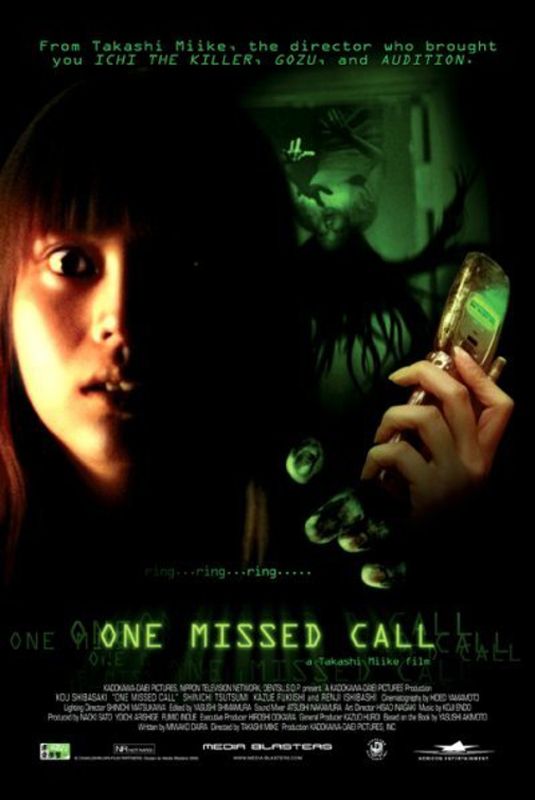
This Japanese horror film — directed by Takashi Miike (Ichi the KillerDead or AliveThe Happiness of the Katakuris and a few other movies that will either upset you or make you happy) and written by Minako Daira (who wrote all three films in the series) — is all about a psychology student named Yumi Nakamura (Ko Shibasaki, Battle Royale) whose friends begin getting messages from the future that gives the time and date of their deaths. And then — you guessed it — they die. Now, Yumi has received her message.

Based on the novel Chakushin Ari by Yasushi Akimoto, this movie was remade in that mid-2000’s time when every single J-horror movie was getting Westernized.

Detective Hiroshi Yamashita (Shinichi Tsutsumi, Why Don’t You Play In Hell) begins helping Yumi, telling her that she isn’t crazy. His sister was one of the early victims, who are all called an hour after each murder and then die at the time and date that the message prophecizes. Then, they spit out a red jawbreaker.

Everything points to Mimiko Mizunuma, a girl who died from an asthma attack and whose ailments would indirectly happen to her sister Nanako like some psychic Munchausen syndrome by proxy.

There’s also a televised exorcism that goes horribly wrong, more possession, stabbings, severed hands clutching cel phones and the kind of twisted imagery that would be beyond the scope of most directors. However, this may be one of Miike’s tamest movies. That’s not a slight, but he has a tendency to go well beyond the boundaries of sanity. There’s also plenty of light and shadow here, along with a Bava-esque blue and red color palette in some scenes.

If you enjoy Japanese horror, consider this a greatest hits collection. A ringtone plays music from Miike’s Gozu, the idea of the curse itself is from Ringu, the apartment building with a water tank shot is from Dark Water, the idea of ghosts in the machine of modern technology comes from Pulse and The Grudge lends the ghost child imagery.

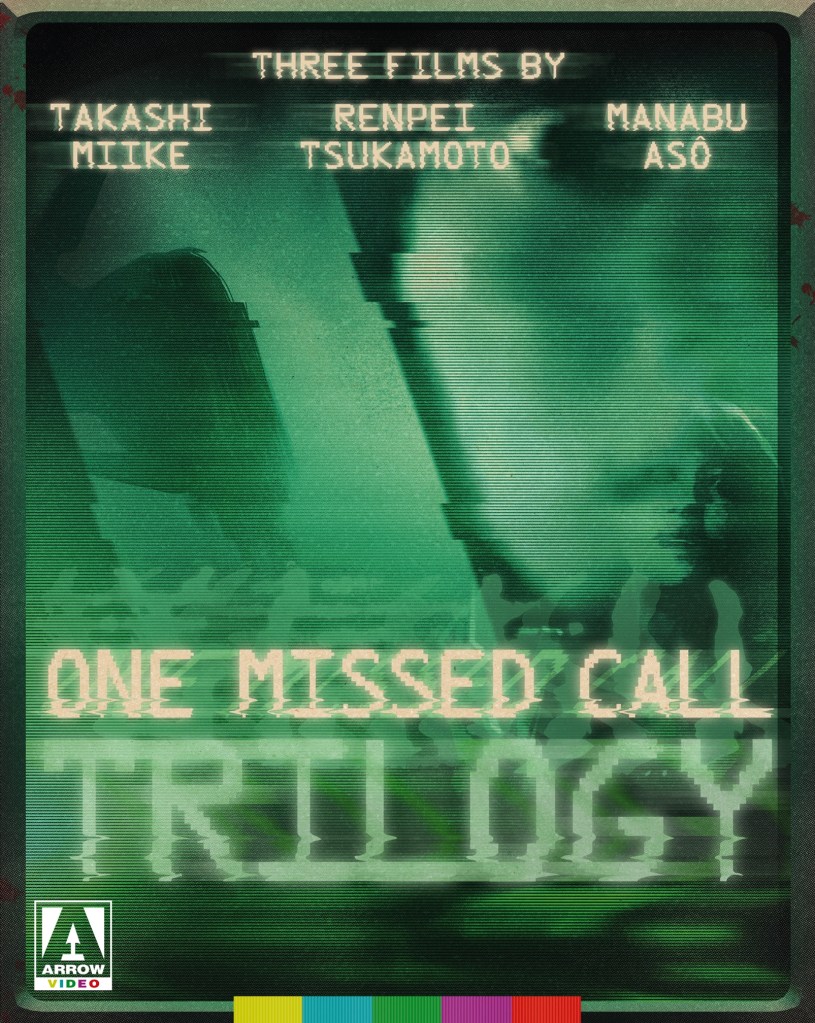
This film is available on the One Missed Call Trilogy release from Arrow Video. Not only does it have all three films in high-def 1080p, it also features plenty of extras for each film. This one has new audio commentary by Miike biographer Tom Mes, archival features like The Making of One Missed Call, interviews with actors Ko Shibasaki, Shinichi Tsutsumi and Kazue Fukiishi, and director Takashi Miike, footage from the premiere, an alternate ending, the Live of Die TV special and a feature called A Day with the Mizunuma Family.

DISCLAIMER: This set was sent to us by Arrow Video.

Arachnia (2003)

Brett Piper (Mysterious Planet, 1982) has written, directed or provided special effects for some pretty entertainingly named movies: Raiders of the Living DeadA Nymphoid Barbarian in Dinosaur HellDrainiac!Muckman and ZillaFoot. This is filmed in Vermont on video, but if Piper had been around for the regional era of exploitation, he would totally be making drive-in or direct to video films.

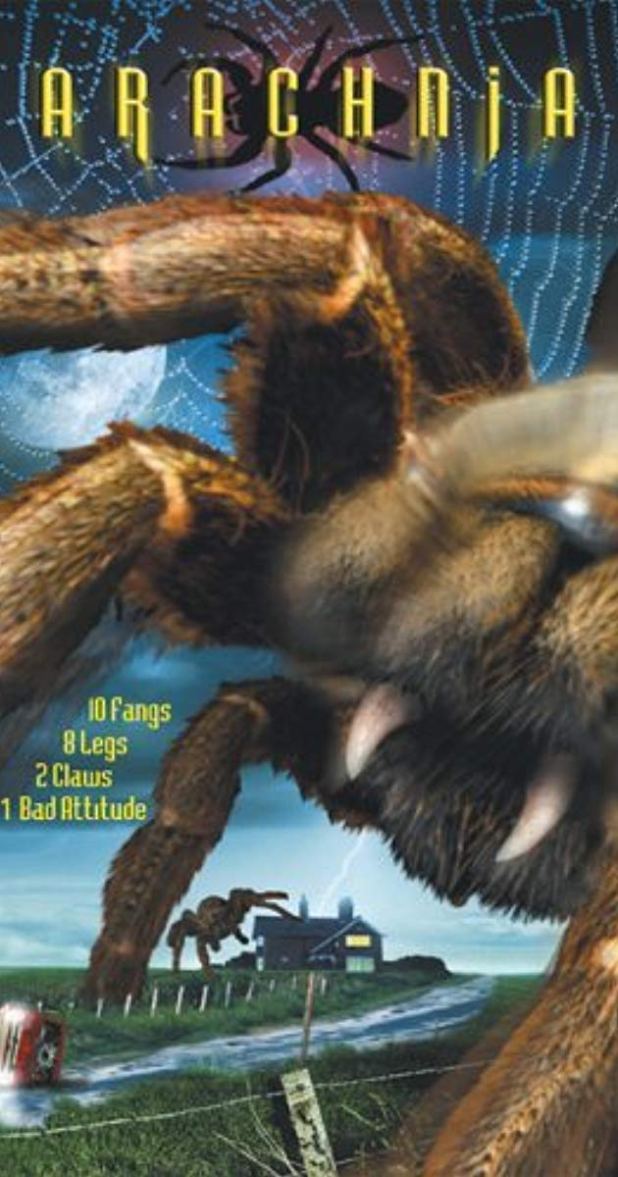
When a small research plane — filled with science students and their professor — makes an emergency landing in the middle of nowhere, the survivors head to a nearby farmhouse to look for help. Instead, they find some mutant spiders.

With a budget of a day of catering on the last movie that you saw in the theatrer, these guys tried. An ex-military man with a past and the robotic lead girl must survives so that someday, I’m forced to watch Arachnia 2. Which doesn’t exist. But it probably should.

You can watch this on Tubi along with Rifftrax commentary.

And don’t forget: We dedicated one of our “Drive-In Friday” featurettes to Brett Piper and screened four of his films, including Queen Crab and Muckman, and Outpost Earth.

Shade (2003)

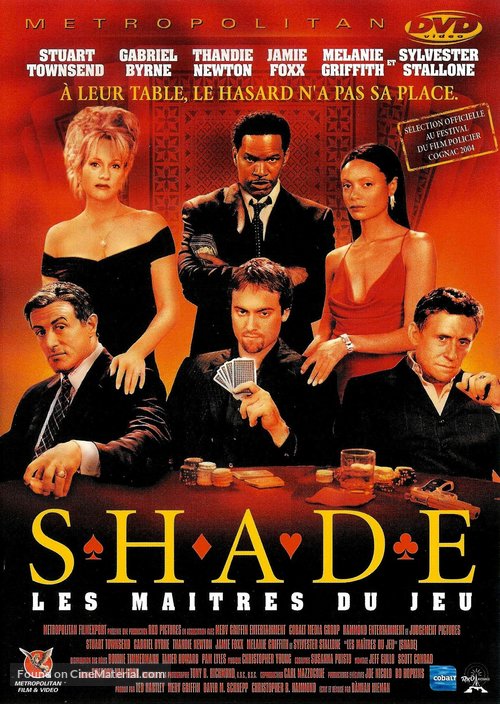
My fool’s errand to watch every single Sylvester Stallone movie has brought me here to 2003’s Shade, a movie made by Damien Nieman, a real-life sleight of hand card magician who created a DVD called Fast Company detailing all of the many ways to cheat at cards. Those are his hands doing the cuts at the beginning along with card mechanics R. Paul Wilson, Jason England and Earl Nelson. These three men also taught Sylvester Stallone and Stuart Townsend how to properly perform their card manipulation in the film.

Many years ago, Dean “The Dean” Stevens (Stallone) played in an illegal underground poker game that was attacked by thugs. As he put his hands up, he revealed that he was concealing a winning card. A firefight broke out with only Dean and one mobster surviving.

Today, Tiffany (Thandie Newton), Charlie (Gabriel Byrne) and Larry Jennings (Jamie Foxx) — nearly every character in this movie is named for a famous magician — are planning on taking down an illegal game. They bring in a blackjack dealer named Vernon (Townsend) — named for noted sleight of hand master Dai Vernon — to take a casino for $40,000. They’re shaken down by Scarne (Bo Hopkins), a crooked cop, but still escape with most their cash. He’s named for John Scarne, who was best known for exposing crooked gambling to the public and doubling for Paul Newman’s hands in The Sting.

Unfortunately, Larry gets too greedy and runs afoul of Malini (Patrick Bauchau) and his men Marlo (Roger Guenveur Smith) and Nate (B-Real from Cypress Hill), who kill him.

This triggers a flashback, where we see the mobster and Dean draw cards to decide who takes home all the money. The man cuts a King and Dean an Ace, but there’s a double cross. The mobster pulls his gun, Dean shoots him first and the Ace gets sprayed with blood.

Malini’s men are after our heroes, but they hide out at the Magic Castle, a venerable magic club, where The Professor (Hal Holbrook) discusses magic with them before they head to the Hollywood Roosevelt Hotel for Malin’s five card stud poker game. Dean’s former lover Eve (Melanie Griffith) arrives and they discover that Dean is using a marked deck, but even then, he’s able to win the final $3 million dollar hand, before the next double cross, which reveals that the Dean and Vernon were in on the game all along as the master of cards flips the bloody Ace card to Vernon.

This is part of Stallone’s attempt to push himself in more dramatic directions and he’s quite good in the film. It’s not a slam bang action affair, of course, but interesting nonetheless. You can watch it for free on Amazon Prime.

The Stranger Beside Me (2003)

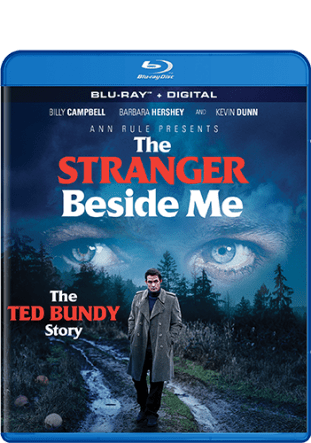
The Stranger Beside Me is based on Ann Rule’s New York Times bestseller. Before she became a true crime writer, amazingly enough Ann became close friends with one of the most notorious serial killers — Ted Bundy.

Ann Rule (Barbara Hershey, The Entity) is an ex-cop and single mother who volunteers on the suicide hotlines in Seattle. That’s where she meets Ted Bundy (Billy Campbell, The Rocketeer), who comes off as the nicest man she’s ever met.

Of course, that changes. She’s already been called in to help with the murders of women that have stretched from Utah to Seattle and may have provided a criticial piece of insight on the fact that Ted fits a sketch and drives the same car as the suspect.

As their lives go in separate directions, Ted stays in touch with Ann, always convinced of his own innocence. While she may have stood up for him in the past, by the end, she only knows him as a monster.

It’s directed by Paul Shapiro, who also directed the new VC Andrews adaption Heaven which airs later this month, as well as an upcoming remake of one of my favorite Lifetime films, Death of a Cheerleader.

While the film jumps all over the place way too much, Campbell is great as Bundy, proving why so many could find him so attractive and above such crimes. It’s well worth a watch if you’re interested in this case.

The Stranger Beside Me is available for free on Tubi and from Mill Creek Entertainment.

DISCLAIMER: This movie was sent to us by Mill Creek Entertainment, but that has no bearing on our review.

In Hell (2003)

Ringo Lam and Van Damme worked together on three films — Maximum Risk and Replicant are the other two — and this one finds JCVD living the Cool Hand Luke life in a Russian prison. However, unlike the only other Russian prison movie I’ve ever seen, Red Heat, there’s no Sylvia Kristel. There is, however, an appearance by Lawrence Taylor, former NFL great and WrestleMania XI main eventer.

Kyle LeBlanc (Van Damme) is an American working overseas in Russia. One day, he hears his wife being attacked while speaking to her on the phone. He arrives too late to save her and the man who killed her, Sergio, buys off the judges. So Van Damme does what anyone else would: he kills Sergio and goes to jail for life.

Soon, he’s become friends with people like young American Billy Cooper and wheelchair-bound Malakai. Then, he’s put in a cell with the violent Inmate 451 (Taylor), who the head of the guards hopes will kill our hero. Nope — they become friends.

The general who runs the place has a secret fight league inside the prison. Are you surprised? I mean, why else would Van Damme be there? Soon, our hero has lost his mind and is messing dudes up left and right while his friend Billy keeps trying to escape. Sadly, his big attempt is foiled by Malaki being a snitch, so 451 lights the old man up. Yes — another Van Damme movie where someone is covered with gasoline and lit ablaze.

After Billy dies, Kyle realizes that he must win the battle for his own inner peace and once again become the man he was before this all happened. He refuses to fight and gets hung outside the prison by his arms, because this is a JCVD movie and some inner demons want us to see him be tortured for our sins.

Kyle is supposed to fight the giant Miloc, but he ends up communicating with him and they start a riot. Yes, a Van Damme movie that somehow is about dudes learning to talk to other dudes about their issues rather than repeatedly kicking one another in the face. I’m as surprised as you are.

You can watch this for free on Tubi or Vudu.

Kill Bill Volume 1 (2003)

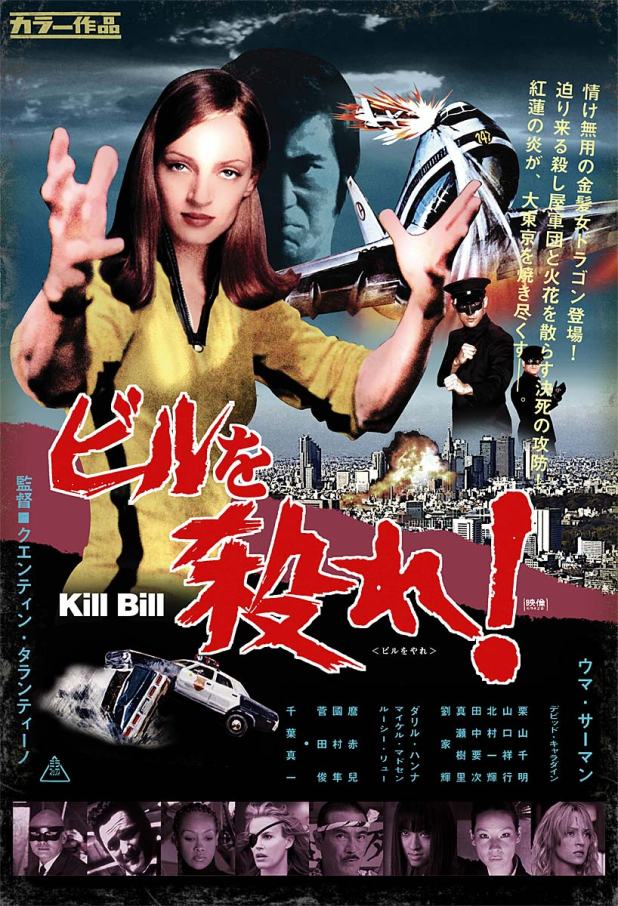
I had a discussion this week about whether or not an excessive amount of tributes and homages within a film makes for a great movie or one worthy of derision. It all depends on how well remixed the source material is. When it comes to the two Kill Bill movies, the multiple references are so dense that there’s almost an art to how they come together. And the places they’re gathered from are so disparate and non-mainstream, the fact that they’ve coalesced into a Hollywood blockbuster is pretty amazing.

A woman in a wedding dress — who we come to know as the Bride and Black Mamba — lies wounded and possibly dying in a chapel in El Paso, Texas. She’s been attacked and left for dead by the Deadly Viper Assassination Squad. With what may be her final breath, she tells Bill, their leader, that she’s pregnant with his child. He responds by shooting her in the head.

The film jumps forward four years and the Bride (Uma Thurman, who helped conceive this movie with writer/director Quentin Tarantino) has hunted down one of the Vipers: Copperhead/Vernita Green (Vivica A. Fox), who has now become a homemaker. Our heroine tries to give her target a break and offers to meet her to battle somewhere that her family isn’t in the crossfire. She responds by trying to shoot and kill the Bride, who dispatches her easily with a knife to the heart.

We go back now those four long years to when the Bride was in a coma. California Mountain Snake/Elle Driver (Daryl Hannah, perfection in this movie) whistles her way through the hallways of a hospital, dressed as a nurse with a matching eyepatch, ready to kill the Bride with a lethal injection. However, Bill decides to cancel the kill order as he finds it dishonorable.

The Bride wakes up, realizes she’s no longer with child and begins her mission of revenge by killing the hospital worker who’s been raping her while she was in a coma. She takes his truck and begins the long journey toward learning how to walk and fight again.

The first Viper who is on her kill list is Cottonmouth/O-Ren Ishii (Lucy Liu)  who has risen to become the leader of a huge clan of Tokyo Yakuza. As a child, O-Ren’s parents were murdered and she spent her early years getting her own revenge.

The Bride seeks to have a sword made by Hattori Hanzo (Sonny Chiba!), who has vowed to never forge a sword again. But after he learns that she wants revenge on his former student Bill, he makes one for her.

Tracking O-Ren to the House of Blue Leaves, the Bride — we don’t learn her name until the next movie, but you can see it on her plane ticket to Tokyo — wipes out O-Ren’s gang, the Crazy 88’s and her bodyguard, schoolgirl with a spiked yo-yo Gogo Yubari.

She then kills O-Ren and tortures her assistant Sofie Fatale to discover where Bill is. The film ends with Bill speaking to Sofie and asking if the Bride knows that their daughter is alive.

This film was Tarantino’s attempt to move from the talky fare he was known for and into the action cinema that he loves. The House of Blue Leaves battle took six weeks longer than expected, but that’s because it’s packed with traditional special effects and stuntwork instead of the CGI we’re now used to.

Obviously, Kill Bill is inspired by grindhouse cinema, drawing inspiration from the Shaw Brothers, Sergio Leone and Lucio Fulci amongst many others. We’ve gone in-depth to breakdown the actual films that it takes inspiration from in this article. Trust us — there are so many, sometimes multiple references within one shot!

According to Uma Thurman, Tarantino asked her to watch three movies to prepare: The Killer, Coffy and A Fistful of Dollars.

Originally intended as one movie, the four-hour runtime was considered too long for filmgoers, so this was split in two separate movies. It’s pretty astounding that after all the death and destruction in this film, The Bride only has one kill left in the sequel.

Kill Bill reminds me of the Beastie Boys’ Paul’s Botique. There are hundreds of samples all over that album, which make it a much richer experience if you know where they all come from. But if you don’t, you can still dance to it.

House of 1000 Corpses (2003)

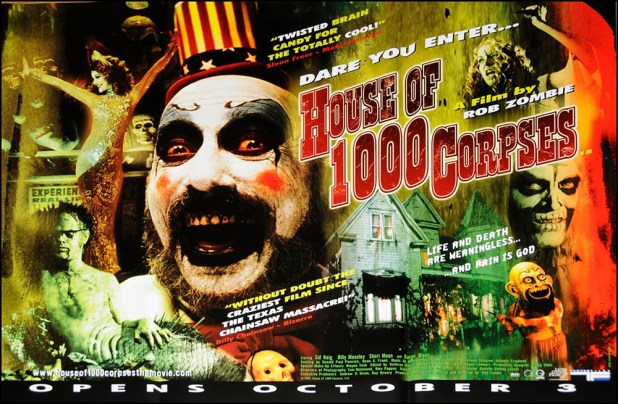
This is the first film from rock star Rob Zombie, a man that I have pretty much vilified in conversations and reviews for basically filming Texas Chainsaw Massacre 2 over and over again (with side dishes of Horror House on Highway 5 and Eaten Alive). That said — I watched this with an open mind and the hope of being entertained.

Zombie started directed several of his band White Zombie’s videos and was selected by Universal Studios to design a haunted maze for their Halloween Horror Nights. It was so successful that he was credited with reviving the attraction and he began a relationship with the studio. He has previously worked on a script for a sequel to The Crow called The Crow: 2037 A New World of Gods and Monsters.

Despite plans for an animated Frankenstein film, Zombie decided to turn his haunted house into an actual movie. Filmed in 2000 on the Universal Studio backlots, which gives this the same feel as the aforementioned Eaten Alive, the film was held for three years as there was concern over releasing it, due to all the blood, gore, masturbation and necrophilia. Not wanting an NC-17, Universal was content to sit on the film until Zombie bought it back and sold it to Lion’s Gate, who finally released it almost three years after the film had wrapped.

The film opens on October 30, 1977, as two criminals attempt to rob the gas station of Captain Spalding (Sid Haig, Spider Baby). It’s a quick intro to get us into the spirit of the film — down, dirty and scummy. Soon, Jerry (Chris Hardwick), Bill (The Office’s Rainn Wilson), Mary and Erin arrive, as they are traveling the country writing about strange roadside attractions.

Spalding gives them a tour of his Museum of Monsters and Madmen, during which he relates the legend of Doctor Satan, a mad doctor who was hung by an angry mob. Before they leave, he gives them a hand-drawn map to the tree where they lynched the man.

On the way, they pick up Baby (Zombie’s muse, Sheri Moon Zombie), a hitchhiker who gets in the car moments before a tire blows out and her half-brother Rufus (former pro wrestler Robert “Bonecrusher” Mukes) picks them up in his tow truck.

What follows is a descent into madness, as the Firefly family (who are all named after Marx Brothers characters) takes over the film. There’s Mother Firefly (Karen Black, Trilogy of Terror), adopted brother Otis Driftwood (Bill Moseley, Chop Top from Texas Chainsaw Massacre 2), Grampa Hugo (character actor Dennis Fimple in his last film) and the deformed giant Tiny (Matthew McGrory , a real-life giant who is also in Bubble Boy and Big Fish). The family has already kidnapped five cheerleaders and now is presenting a Halloween show to their guests, who run in fear before being taken back into the house.

The family begins to torture the four kids, including killing Bill to turn him into a mer-man like something out of an old roadside sideshow and scalping Jerry (who is named for the composer of the Star Trek theme).

Meanwhile, Denise’s dad Don and two deputies (Tom Towles from Henry: Portrait of a Serial Killer and Walton Goggins from TV’s Justified) track down the missing kids, only to be killed by the family. Then, the remaining three are dressed as rabbits and chased through a maze.

Jerry — despite being scalped — and Denise survive, only to find their way to Doctor Satan’s lair, where he operates on Jerry and reveals that his assistant Earl is the father of the Firefly family. Denise, however, escapes again, only to be picked up by Captain Spalding, who offers to drive her to safety. She passes out and Otis appears in the back seat. She awakens on Doctor Satan’s operating table and that’s the end!

The footage for this film is all over the place, much like Natural Born Killers. That’s because Zombie filmed a lot of the sequences in his basement with a 16mm camera, including the opening shot of the moon.

There are moments of style here, but the film feels pretty messy, There are enough ideas to fill several films and no real cohesive tale to be told, but that didn’t take away my enjoyment of the film. It feels like there’s promise here, unlike 31, where Zombie pretty much retold this same story again. There are several films that Zombie never made, like retellings of C.H.U.D. and The Blob, as well as an adaption of his comic The Nail called Tyrannosaurus Rex that would have been an homage to violent 70’s action films. I would have loved to see what he could do with different subject matter.

The Fireflys returned for the more serious The Devil’s Rejects and will soon return one more time for 3 From Hell. You can check this one — and several of Zombie’s other films — out on Shudder.