CANNON MONTH: Thunder Alley (1985)

EDITOR’S NOTE: We have had this movie on our site twice, first on October 16, 2019 and a second take on August 29, 2021. Here’s the second, but make sure to check the first link to learn more about Roger Wilson.

Roger Wilson, the star of this movie, lost his parents at a young age and inherited several million. He graduated Woodberry Forest School in 1975 with Marvin Bush, the brother of the former President, and had a pretty astounding life, marrying Estée Lauder model Shaun Casey before dating Christy Turlington and Elizabeth Berkley, which was the reason why a member of Leonardo DiCaprio’s circle of friends punched Wilson in the throat and damaged his larynx so badly that he never sang again.

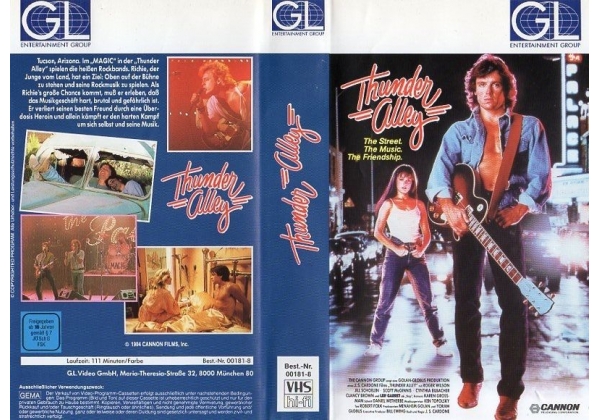
Anyways, Roger is Richie in this movie, the working class kid who becomes the guitarist and singer of the band Magic and also the boyfriend of Beth (Jill Schoelen). You know, if you’re a touring musician and dating Jill Schoelen, you should just settle down and not do too much more. You’re already so far ahead of the rest of all humanity.

Richie has taken the lead role from Skip (Leif Garrett, who knows a thing or two about rock and roll and drugs). Donnie, the keyboard player, is the one who gets into the drugs so badly that he just doesn’t make it. But it’s not all rough. I mean, the band has Clancy Brown — the Kurgan — as their road manager!

Director J. S. Cardone also made The Slayer, a movie that makes no sense so much that I love it, and the direct to video sequel to 8mm. He also directed ShadowzoneA Climate for Killing; Black DayBlue NightOutside Ozona; True Blue and Wicked Little Things.

Shot in Tucson, Arizona — using some of the same locations as The Wraith and Harley Davidson and the Marlboro Man — with local band Surgical Steel* showing up to play, Thunder Alley isn’t the best rock and roll movie there is. But you know, you could microwave up some food and have your own rib fest while you watch it.

*Their singer, Jeff Martin, sang in Racer X and played drums for Badlands after Eric Singer left. He’s also worked with Paul Gilbert and Michael Schenker quite often.

You can listen to The Cannon Canon episode about Thunder Alley here.

CANNON MONTH: Lifeforce (1985)

EDITOR’S NOTE: We originally watched this way back on September 11, 2017, but as the three Tobe Hooper films he made for Cannon are so important, we’ve brought it back with some additions.

We’re here to praise Tobe Hooper, not bury him. But to get there, we have to go through some rough periods.

By 1985, Hooper’s career was in limbo. Sure, he’d tasted box office success with 1982’s Poltergeist, but he’d also be dogged with rumors — or truths — that he’d not really directed the film. Toss in a bad experience on 1981’s Venom, a film that he was replaced on ten days into shooting (Klaus Kinski claimed that the cast and crew ganged up on Hooper in an effort to have him replaced), as well as being replaced as the director of The Dark and a rumored nervous breakdown.

A three-picture deal with Cannon Films and the promise of no interference would be the panacea that would soothe Hooper’s pain. Or so he thought.

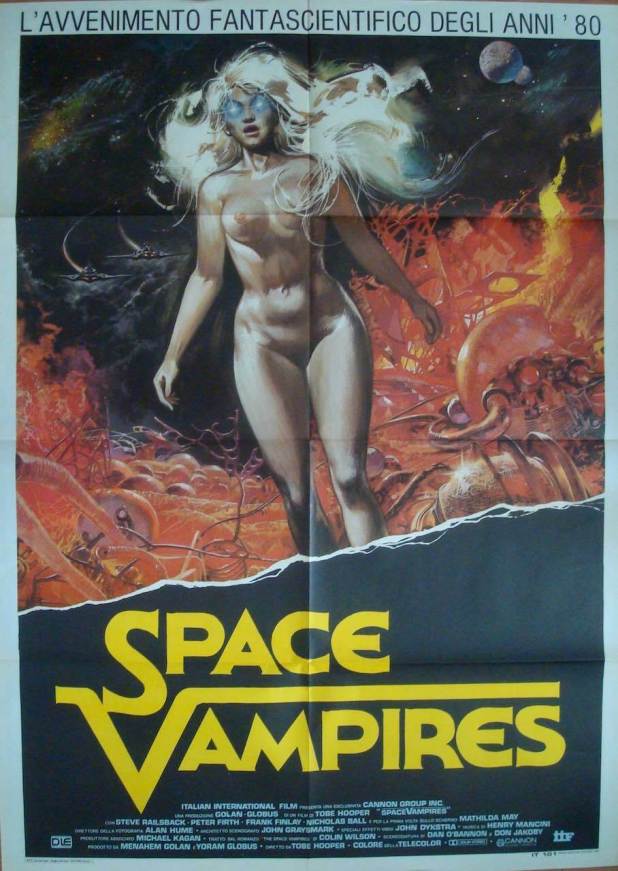
The first film in the three picture deal was Lifeforce. Based on Colin Wilson’s 1976 novel The Space Vampires and scripted by Dan O’Bannon (AlienReturn of the Living Dead) and Don Jakoby,  the film was originally going to use the original title. After spending $25 million to make it, Cannon decided that they wanted a blockbuster instead of their normal exploitation films, hence the change to Lifeforce.

Once Hooper had his money and freedom, he was beyond excited, seeing the film as his chance to remake Quatermass and the Pit. In fact, he said, “I thought I’d go back to my roots and make a 70mm Hammer film.”

Hopper turned in an initial film that was 128 minutes long, starting with 12 minutes of near silence in space aboard a space shuttle.  This is 12 minutes longer than the final version which had several scenes cut, most of them taking place on the space shuttle Churchill. Three actors —  John Woodnutt, John Forbes-Robertson and Russell Sommers — ended up completely cut from the final film, as was some of Henry Mancini’s score.

Even worse — the film went way over schedule and cost so much that the film was shut down when the studio ran out of money, leaving some of the most important scenes unshot.

Look — it could have been worse. Michael Winner was the original choice to direct.

So what’s it all about? Good question.

The crew of the Churchill discovers a massive spaceship — nearly 150 miles long and shaped like an artichoke (no, really) — inside Halley’s Comey. Hundreds of dead bat creatures surround the ship and inside, two perfect males and one perfect female sleep in suspended animation. They take the aliens and come back to Earth, because there are no protocols or rules about that kind of thing. I mean, I can’t even fly back from Japan with fruit and these dudes take aliens directly to London.

Tragedy strikes — a fire consumes the ship, destroying everything and everyone except for the aliens. The aliens turn out to be vampires that can shapeshift and suck out the life force of everyone they meet.

In Texas, a survivor is found — Colonel Tom Carlsen (Steve Railsback, Manson from Helter Skelter!). He explains how the crew’s life force was taken and why he set the shuttle on fire. He also has a psychic link to the female alien (the constantly naked Mathilda May). Patrick Stewart also shows up as Dr. Armstrong here — who has the female vampire inside him. They take her/him back to London, but the plan backfires when she/he escapes.

London is now filled with zombies, as the two male vampires have turned the entire population and everyone feeds on one another. All of these life forces are sent by the males to the female and then to their spaceship. The lighting looks like Poltergeist by way of Mario Bava. Still with me?

Turns out that leaded iron can kill the vampires. And oh yeah, Carlsen is in love with the female vampire. She keeps calling to him. “CARLSEN. CARLSEN. CARLSEN.”

She’s naked on the altar of St. Paul’s, sending energy to the ship, as she reveals that they are bonded through their psychic link. Carlsen responds by killing the other male (one of the two is Mick Jagger’s brother Chris) and then impaling himself and the female at the same time.

The damage to Carlsen is mortal, but the female is unfazed. She creates a column of energy to her ship and rides it back, taking Carlsen with her. This looks completely sexual, which has to be no accident, as the connected bodies look coital.

The end? The end.

Does this mean that Earth is now a planet of vampires? Did she save him to make a new group of vampires? When did this become a zombie movie?

I don’t have the answers. And now that Tobe is gone, I can’t ask him.

Plain and simple, Lifeforce is a mess. It seems inconceivable that this film and Chainsaw came from the same director. It seems more of a British film. There’s some inventive gore, such as when the female vampire (her name is only listed as Space Girl) comes out of Patrick Stewart’s body as blood.

It has moments of gorgeous shots, like the scene where we flashback to when Space Girl reaches out to Carlsen. And the battle of London is a huge effects piece. But the story is — I don’t even know where to begin. It feels more like Meteor than what you expect from Hooper. Which is, I guess, the point of so much of his Cannon films. They are all unique, all strange and all end up being completely different from the movie you expect them to be.

CANNON MONTH: Hot Chili (1985)

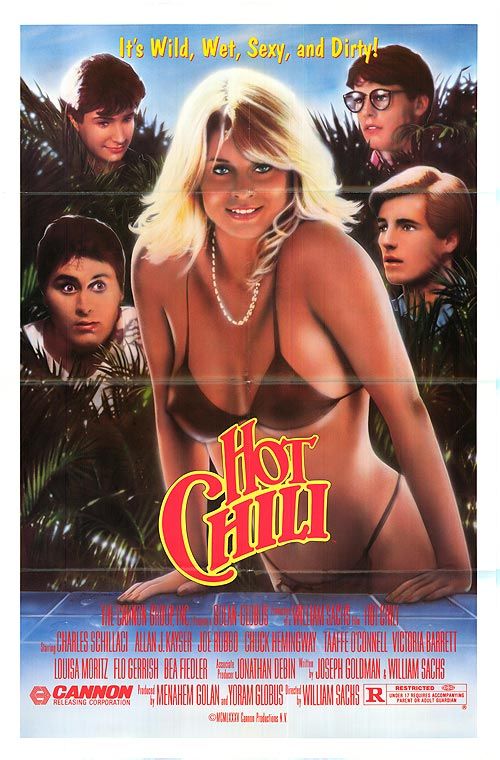
William Sachs may have made There Is No 13, The Incredible Melting Man, Van Nuys Blvd., Galaxina and Exterminator 2, but he may be better known for his ability to script doctor and save movies. Hot Chili is another film he directed and co-wrote with Joseph Golden, who is actually producer and Cannon boss Menahem Golan.

This may remind you of Hot Resort, which has an incredibly similar plot, but then again, teen sex comedies were big money makers and dear to the heart of Cannon, who had ridden a wave from Israel to Los Angeles on the profits of Lemon Popsicle.

Then again, you’d also be forgiven if you think this may be another film, seeing as it rips off a Lemon Popsicle sequel Private Popsicle, as well as the songs from Breakin’ and Rappin, because I guess if Cannon pays for something once, they just own it, a trick ad agencies and their clients have been trying to do for years.

Four guys — Ricky (Charlie Stratton, Munchies), Jason (Allan Kayser, Bubba from Mama’s Family), Arney (Joe Rubbo, The Last American Virgin) and Stanley (Chuck Hemingway, Neon Maniacs) — get summer jobs at a Mexican resort but are forbidden from having sex with the guests and therefore must have sex with the guests.

It’s a typical 80s teen sex movie, but what are the factors that may cause you to watch this?

Perhaps it’s the charms of Taaffe O’Connell, who you may recall was assaulted by a worm in one of the most repellant scenes in film history in Galaxy of Terror, a scene during which the one-ton prop nearly crushed her. Or could it be Victoria Barrett, who is in Cannon’s Hot ResortOver the Brooklyn Bridge, Three Kinds of Heat and American 3000?

Or, if you’re like me, do you love when Ferdy Mayne and Robert Z’Dar are in movies you don’t expect them to be in?

I’m trying to figure out why so many Golam and Globus-related sex comedies have female music teachers that like to have sex. It’s a common theme in so many of them. What is not is everyone’s sexual hijinks being recorded and later shown during breakfast, including Jason’s parents, a senior swinging couple and a BDSM duo from Germany.

CANNON MONTH: Grace Quigley (1985)

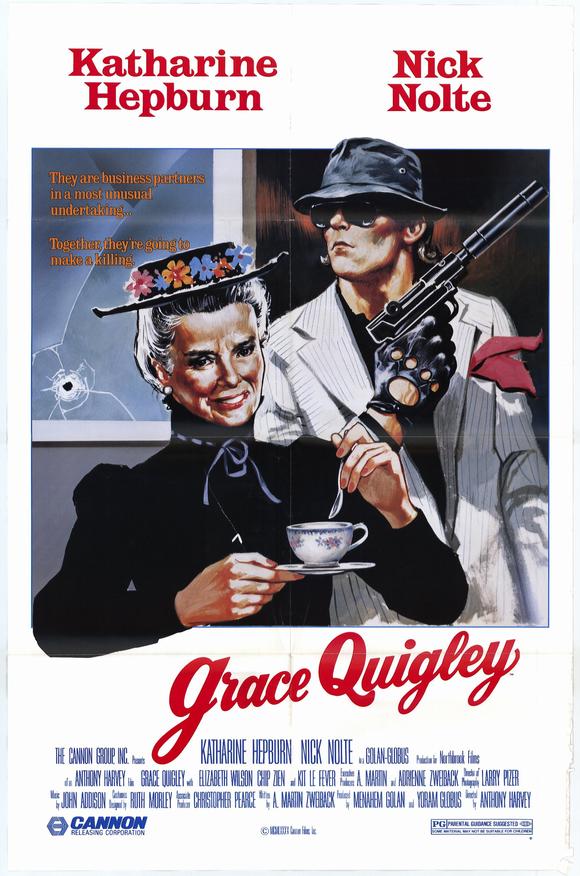
One of Katharine Hepburn’s last leading roles in a motion picture was in a Cannon movie. Yes, that’s true. It’s in a black comedy in which she has tried suicide twice before hiring Nick Nolte to be the hitman who brings about her demise. Before that, however, they help her friends get past their old age by, well, death.

Directed by Anthony Harvey (They Might Be GiantsThe Lion In Winter), the subject matter of this movie worried Cannon, who asked that the end of the film be reshot — Nolte’s Seymour drowns when he tries to save Hepburn’s Grace when she walks into the ocean — so that it ended on a happier note. They also shortened the name from The Ultimate Solution of Grace Quigley, because when you realize that name may come off as a bit, oh, Aryan.

The story of how this was made is more interesting than the finished product: A. Martin Zweiback tossed a 25-page treatment over George Cukor’s garden gate in 1972. Strangely, that’s where Hepburn was recuperating from surgery. She found the script, loved it and tried to get it made with Steve McQueen. It took seven years to get it to Columbia and Nick Nolte stepped in, but left, and then came back by 1983, but Columbia now backed out. And that’s where Cannon comes in, with Zweiback slated to direct.

However, Anthony Harvey, who had worked with Hepburn on The Lion in Winter and The Glass Menagerie — and on the TV movie This Can’t Be Love after this film — had been injured in a car accident and his career had suffered. Hepburn promised he could direct her next film and Zweibeck stepped aside as long as he and his wife would be credited as executive producers and allowed to come to the set.

Harvey didn’t want them near his movie and threatened to quit, but the Zweibacks didn’t have any involvement in the movie until they saw the premiere at Cannes where everybody hated the final film.

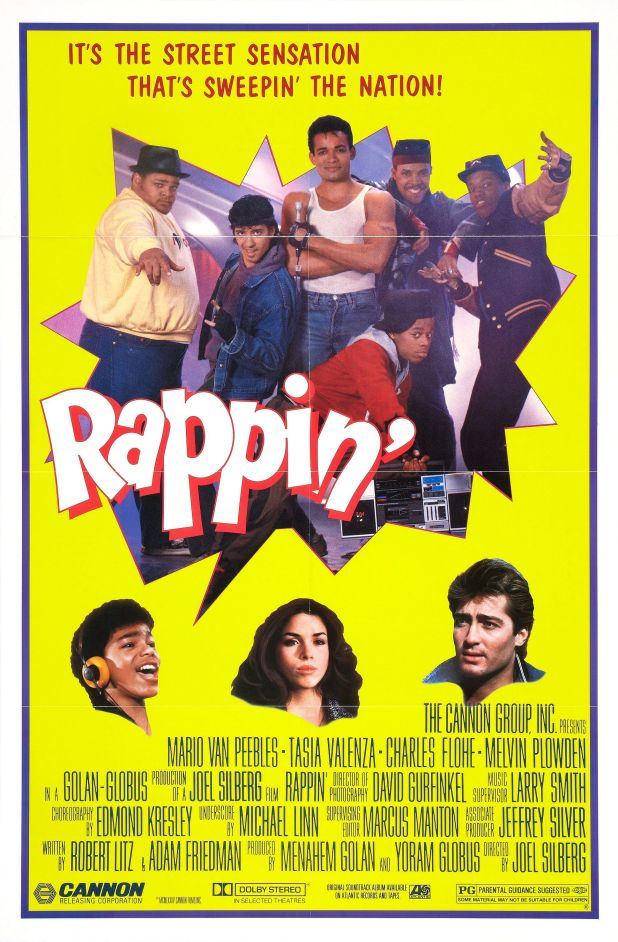
CANNON MONTH: Rappin’ (1985)

I love this movie.

If Breakin’ 2: Electric Boogaloo exists in its own dimension, this one is the Earth-3 to its Earth-2, a place where rap can save the world. And to make it even better, it’s filmed right where I call home, Pittsburgh, PA.

Directed by Joel Silberg — the man who brought us Breakin’ and Lambada  — and written by Adam Friedman and Robert J. Litz, this is the story of Rappin’ John Hood (Mario Van Peebles), who has just been released from prison only to come home to a neighborhood dealing with gangs and developers kicking out everyone to prepare for high paying real estate.

He reunites with his old crew, like Moon (Kadeem Hardison from A Different World) and Ice (Eric La Salle), Fats (Melvin Plowden) and his little brother Allan (Leo O’Brien, the real-life younger brother of The Sugarland Gang’s Master Gee) while dealing with a rival gang led by Duane (Charles Flohe, The Delta ForceP.O.W. the Escape), who loses his girlfriend Dixie, who used to be John’s girlfriend, back to John (Tasia Valenza, who is the voice of Sniper Wolf in the Metal Gear Solid games).

There’s also Cedric (Rory Clanton), a former resident of the neighborhood who is selling it out to the white man when he isn’t making deals with Duane’s gang. And there’s a plot about the music industry wanting to hire John, probably just for the song “Snack Attack.”

It also has the Force MDs and Ice-T himself shows up and either he or Master Gee supposedly ghost rapped Van Peeble’s rhymes–  which the credits claim he wrote himself — but man, Ice-T provides a nice multiverse crossover with the Breakin’ films. When he raps “Killers,” a song all about bad cops, rich murders and politicians treating normal people as “just puppets in the games they play” alongside David Storrs, you’ll be excited that a happy-go-lucky film doesn’t forget to include harsh reality inside the bubblegum.

There’s also a scene where Fats and the local lady of the evening, Rosalita, pull a scam not unlike a scene in every Lemon Popsicle movie where a heavyset man gets surprised by a woman’s boyfriend coming home. And the movie even has room for Mommie Dearest and Amityville II: The Possession star Rutanya Alda to be in this!

Someone on a Pittsburgh film site picked this as one of the worst movies ever made here. What a joke. Come on — we should all be so lucky as to live in the same neighborhood as John Hood.

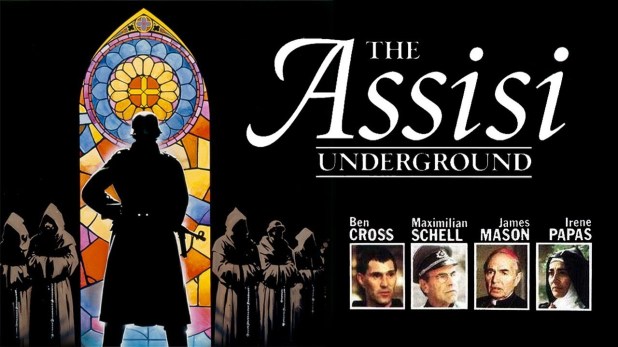
CANNON MONTH: The Assisi Underground (1985)

During World War II, Alexander Ramati worked as a war journalist, entering Assisi with the Allied forces where he met Father Rufino Niccacci, whose Franciscan Monastery of San Damiano in Assisi worked to give Jewis people during World War II new identities and hid them from the Germans, which is much different than how so much of the Catholic Church dealt with that side of World War II.

After interviewing Niccacci, he would write the book that this is based on, as well as direct the movie. Not many authors have directed their own books, but thanks to this Letterboxd list, you can count Ramati in the same league as Fernando Arrabal (Long Live DeathCar Cemetery), Clive Barker (HellraiserNightbreedLord of Illusions), Enki Bilal (Immortal), William Peter Blatty (The Exorcist IIIThe Ninth Configuration), Bertrand Blier (Going Places), Catherine Breillat (A Real Young GirlNight After NightAnatomy of Hell36 FilletteAbuse of Weakness), Emmanuel Carrère (The Mustache), Medgi Charef (Tea In the Harem), Stephen Chbosky (The Perks of Being a Wallflower), Jean Cocteau (The Eagle with Two HeadsThe Storm Within), Michael Crichton (Pursuit, First Great Train Robbery), Ramón de España (Haz conmigo lo que quieras), Margeuerite Duras (Agatha and the Limitless ReadingBaxter, Ver BaxterThe ChildrenDestroy, She SaidEndless Days In the TreesIndia SongJaune, Le SoleilLa Musica), Brad Fraser (Leaving Metropolis), Buddy Giovinazzo (Life Is Hot In Cracktown), Sacha Guitry (The Story of a Cheat), Peter Handke (The AbsenceThe Left-Handed Woman), Václav Havel (Odcházení), Ethan Hawke (The Hottest State), Michel Houellebecq (Possibility of an Island), Alejandro Jodorowsky (The Dance of RealityEndless Poetry), Junji Ito (Tomio), Elia Kazan (America AmericaThe Arrangement), Stephen King (Maximum Overdrive), Neil LaBute (In the Company of MenThe Shape of Things), Robert Lepage (), André Malraux (Days of Hope), David Mamet (Oileanna), Thomas McGuane (92 In the Shade), Gian Carlo Menotti (The Medium), Oscar Micheaux (The Homesteader), Frank Miller (Sin CitySin City: A Dame to Kill For), Rebecca Miller (Personal VelocityThe Private Lives of Pippa Lee), Yukio Mishima (Patriotism), John Cameron Mitchell (Hedwig and the Angry Inch), Hayao Miyazaki (Nausicaä of the Valley of the WindThe Wind Rises), Dito Montiel (A Guide to Recognizing Your Saints), Laura Mulvey (Riddles of the Sphinx), Ryū Murakami (Almost Transparent BlueIt’s Aigt, My FriendRaffles HotelTokyo DecadenceDance With Me), Katsuhiro Otomo (Akira), Marcel Pagnol (Topaze), Gordon Parks (The Learning Tree), Pier Paolo Pasolini (Accattone), Lucía Puenzo (The Fish ChildThe German Doctor), Atiq Rahimi (Earth and AshesThe Patience Stone), Jean Rollin (Two Orphan Vampires), Ousmane Sembène (MandabiXala), John Patrick Shanley (Doubt, Wild Mountain Thyme), Vasily Shukshin (There Is Such a Lad), Tom Stoppard (Rosencrantz & Guildenstern Are Dead), Preston Sturges (Christmas In July), Abdellah Taïa (Salvation Army), Adriana Trigiani (Big Stone Gap), Dalton Trumbo (Johnny Got His Gun), Petr Zelenka (Wrong Side Up), Florian Zeller (The Father) and for Cannon lovers, Norman Mailer’s Tough Guys Don’t Dance.

Ben Cross is Rufino Niccacci, James Mason is Giuseppe Placido Nicolini and Maximilian Schell plays Colonel Valentin Müller, while Edmund Purdom probably is in the classiest movie of his late career as Cardinal Della Costa. Yet somehow, even with an hour cut from the movie, it still moves quite slow.

Yet as I must watch every Cannon movie, I watched it. There’s an idea for a good movie here. This isn’t it, sadly. And it was released a year after Mason died, which just makes me sad.

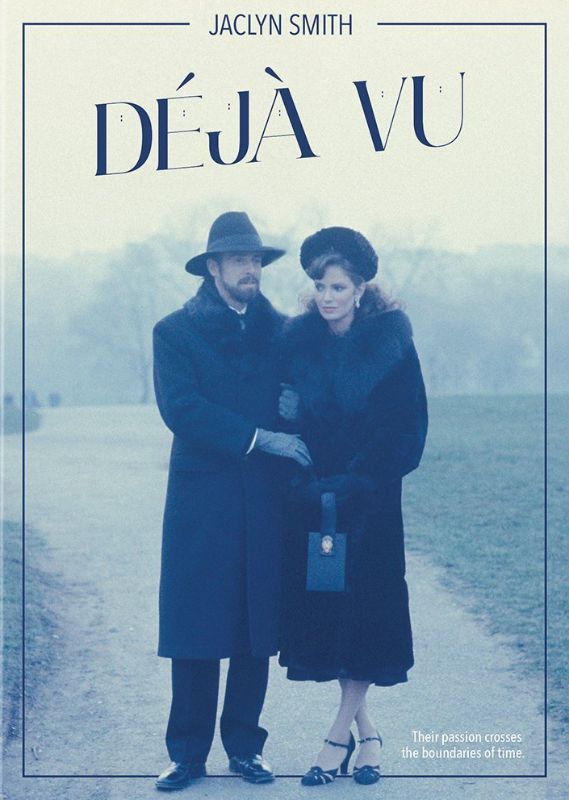
CANNON MONTH: Déjà Vu (1985)

Based on the novel Always by Trevor Meldal-Johnsen, this is all about Gregory (Nigel Terry), a writer who believes that he was reincarnated and that his fiancee Maggie (Jaclyn Smith) was once his doomed ballerina love in a past life. What takes this movie from somewhat boring to Cannon magic is Shelley Winters, who plays a Russian psychic named Olga Nabokova, and no one told Ms. Winters not to start at a 3 or 4 and then turn it up, because you can’t crank down a ten, but she never tries to modulate for the entire film and I’m beyond overjoyed at this fact.

Meanwhile, Gregory was once Michael and Brooke was once Ashley and they all died in an inferno and Gregory is writing a novel about his past life instead of actually writing something that his agent thinks can make money, but you know, when you get obsessed, you get obsessed.

This is the only movie that Anthony Richmond, Nicholas Roeg’s cinematographer for Don’t Look Now, ever directed. There’s a good Pino Donaggio score, too. But the story doesn’t really add up and meanders pretty well with only Winters — and Claire Bloom as Maggie’s mother — realizing that this is a Cannon movie and acting for all of us in the cheap seats.

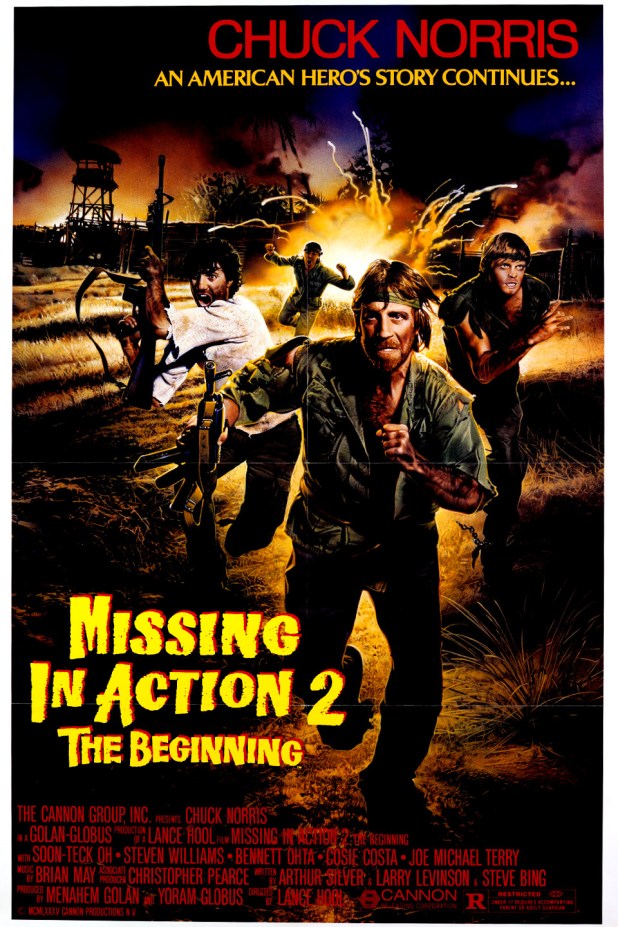
CANNON MONTH: Missing in Action 2: The Beginning (1985)

Only with Cannon can you have the sequel be the prequel when it was supposed to be the first movie. The Joseph Zito-made Missing In Action was considered to be the better of the two movies, so this one was turned into the second movie, but everything worked out pretty OK.

This was directed by Lance Hool, who sold the script to Chuck Norris, who was looking for a movie to pay tribute to his brother Wieland, who had died in Vietnam. They took the script to Cannon, who had a Vietnam POW movie in development, so that’s how we got two movies so quickly. Also, I’m amazed that Vietnam movies were impossible to make in Hollywood before Stallone and Norris changed everything.

Years before he freed US POWs in the first film, Colonel James Braddock (Chuck Norris was tortured in a North Vietnamese POW by Colonel Yin (Soon-Teck Oh, who was also in Good Guys Wear Black). He and his fellow soldiers have been forced to grow opium and if they want to be released, Braddock has to confess to war crimes. I mean, it’s Chuck Norris. Do you think he’s going to do that?

Yet that’s exactly what Captain David Nester (Steven Williams, X from The X-Files) believes should happen and he’s joined the side of the enemy as they subject the Americans to torture like guns being shoved in their faces and fired with no bullets. Then, after a fight that Braddock beats Nestor in, he gets a live rat dropped in a bag covering his face while they tell him that his wife thinks he’s dead and has remarried.

That’s also not a fake rat.

Then, to add even more pain, Braddock exchanges an admission of guilt to Yin’s charges of war crimes in order to get medicine for Franklin, a soldier with malaria. Yin overdoses the soldier with opium and burns him in front of Braddock, who escapes from the camp and — as you can imagine — murders every single other soldier, which includes pro wrestler Professor Toru Tanaka.

This came out three months after the first movie but still made $11 million at the box office.

For more info on all three Missing In Action movies, get Austin Trunick’s The Cannon Film Guide Volume 1: 1980-1984.

You can listen to The Cannon Canon episode about Missing In Action 2: The Beginning here.

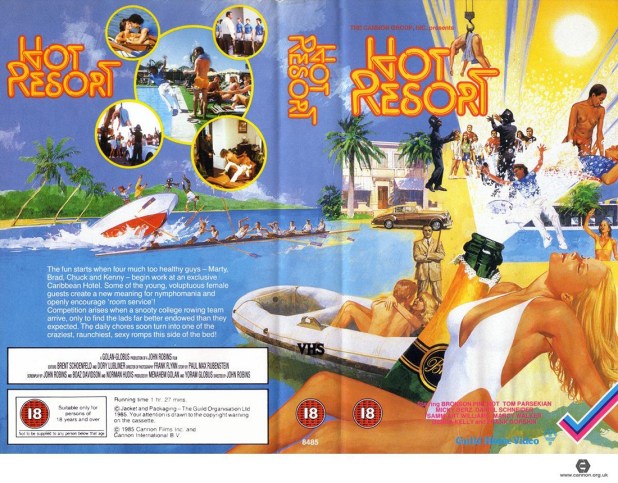
CANNON MONTH: Hot Resort (1985)

Hot Resort is an American Lemon Popsicle-style movie without the strangeness of The Last American Teen Virgin. I feel like I could stop writing here, but let’s trudge on.

Directed by John Robins, who worked on The Benny Hill Show which had to have served him well in this film, and co-written by Robins, Boaz Davidson (who, yes, made Lemon Popsicle and the American version, the aforementioned The Last American Teen Virgin) and Norman Hudis, who wrote several Carry On movies and lots and lots of TV, Hot Resort has four guys — Marty (Tom Parsekian), Kenny (Michael Berz), Chuck (Dan Schneider, who ends up being in two Cannon movies I watched in two days) and Brad (Bronson Pinchot) — working at a resort and really, that’s the plot. There’s some Meatballs competition against a rowing team and the winner gets to be in a soup commercial and you know, maybe this movie is pretty strange. Not bringing oranges to the hospital odd, but close.

Also, it seems like every teen comedy has to have some old Hollywood in it, and we all know that Satan is inside every actor from the time, so here’s Frank Gorshin. Marcy Walker — ex-daughter-in-law of Dick Warlock — is in this, as well as Debra Kelly and Linda Kenton, Penthouse Pet of the Month May 1983.

There are good 80s sex comedies. Then there’s Hot Resort. And Hot Chili, which is the same movie just about.

CANNON MONTH: Up Your Anchor (1985)

Up Your Anchor may be the sixth Lemon Popsicle film, but it truly feels like the sixtieth I’ve watched. Benji (Yftach Katzur) and Huey (Zachi Noy) are back and this time, they’re on a cruise ship.

Not returning would be Jonathan Sagall, who played Bobby in all of the films up until Baby Love. He clashed with Golan and Globus, as well as director Dan Wolman, which is why there’s a scene in the beginning where the remaining boys watch a home movie that replays scenes from the original movie instead of, you know, paying the actor. Boaz Davidson wasn’t involved either. That said series writers Sam Waynberg and Eli Tavor are on board, as is Bea Fielder, who was a frequent sex object in these movies.

There’s even less music, but at least Little Richard’s “Bama Lama Bama Loo” and the Yardbirds’ “For Your Love” are on the soundtrack. As for the rest of the film, it recycles what you’ve seen before, but as mentioned before, this is the sixth time this movie has been made and while the first was shocking for showing the sex lives of Israeli boys, by 1985 audiences had seen this all before.

One good thing: Yehuda Efroni is in it and he’s like the utility Cannon actor, showing up in The Happy Hooker Goes HollywoodDr. Heckyl and Mr. HypeNanaHerculesNight SoldierSeven Magnificent GladiatorsThe Delta ForceMillion Dollar MadnessRumpelstiltskinThe Emperor’s New ClothesSleeping BeautyBraddock: Missing In Action IIIAmerican Ninja 3: Blood HuntSinbad, Hanna’s War and Ten Little Indians.