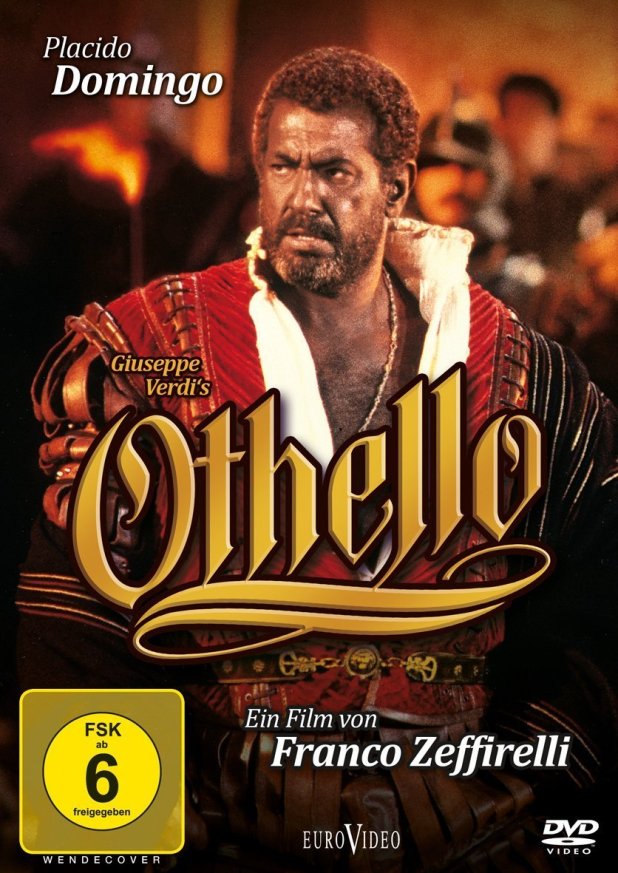
If you haven’t realized it by now, Menahem Golan and Yoram Globus wanted Cannon to mean more than action movies. That’s why they made a deal with opera star Plácido Domingo to make a movie of one of his operas. They wanted to make Verdi’s Il trovatore but he felt that Otello was the right one to film, as it was his signature role.
Domingo had worked with Franco Zeffirelli (whose career goes from the highs of Romeo and Juliet and Taming of the Shrew to, well, The Champ and Endless Love) on Cavalleria Rusticana and Pagliacci. As they were working on Tosca as a stage production, they taked about collaborating again.
As shooting was to begin, there was a massive earthquake in Mexico City. While born in Madrid, he grew up there and left his career to help with the rescue efforts. He also performed at several benefit concerts to raise funds for the victims and released an album of one of the events for charity. His work was so important to the people of Mexico City that tehre’s a statue in his honor, sculpted by Alejandra Zúñiga, and made from keys donated by people.
Zeffirelli said that the tenor used his hard work in this film to help forget the traumatic sights in Mexico of the injured and dead, several of whom were his family members.
Otello follows the original score of Arrigo Boito’s opera with some changes, such as cutting some sections short. It also allows for the medium of film to expand on what would normally happen on stage. The soundtrack, however, has the full opera.
Unlike many Cannon movies, this was well-reviewed. It was named Best Foreign Film of 1986 by the U.S. National Board of Review of Motion Pictures and played the 1986 Cannes Film Festival. It was Zeffirelli’s favorite movie that he made to the point that he felt that he could never make another film this good.
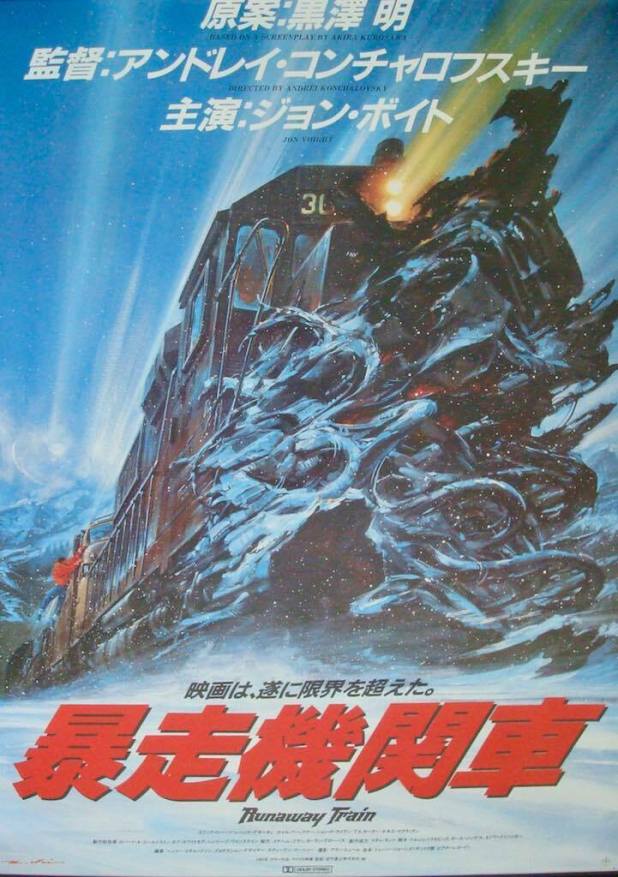
It’s easy to forget that at one time, before the controversies of paternity and politics, Jon Voight was considered one of, if not the, greatest actors in the world. The same can be said for Eric Roberts in the era before he was in a movie every single week. Runaway Train is a reminder that just how powerful both men can be.
It’s also a remembrance that Cannon wasn’t just the studio of ninjas and Norris. The script came from director Djordje Milicevic, Paul Zindel and Edward Bunker and it was based on an original screenplay by Akira Kurosawa (who worked on it with Hideo Oguni and Ryūzō Kikushima). That’s a real pedigree for any movie, much less one that was produced by Golan and Globus.
Kurosawa had read an article in Life magazine about a runaway train and worked up his original script, which he intended to make in 1966 for Embassy Pictures in America, but the money kept falling through and he moved on to make Tora! Tora! Tora!
Fifteen years later, the Nippon Herald company owned that script and decided to get it made. They asked Francis Ford Coppola to recommend a director and he suggested Andrei Konchalovsky.
Konchalovsky had made Maria’s Lovers already for Cannon (he’d also make Duet for One and Shy People for Golan and Globus) and he was able to get the studio on board, as well as Voight, who had aided him in receiving his first U.S. work visa.
The result? A Cannon film nominated for three Oscars: Best Film Editing, Best Supporting Actor for Roberts and Best Actor for Voight.
Oscar “Manny” Manheim (Voight) is a hero to the men of Alaska’s Stonehaven Maximum Security Prison. He’s almost escaped numerous times and a three-year bid in solitary hasn’t dulled his edge or need to be free. After a court order gets him back in general population, he’s targeted by the warden (John P. Ryan, who is also in Cannon’s Avenging Force, Death Wish 4: The Crackdown and Delta Force 2: The Colombian Connection). There’s an incredible scene set during a boxing match — look for a young Danny Trejo* — when another prisoner tries to stab Manheim under orders. Even as he’s knifed and sliced through his hand, Manheim is a feral animal, walking through the gunfire of the guards and demanding that his would-be killer keep coming after him.
All of this means that his next escape plan needs to happen now. He works with Buck McGeehy (Roberts) to scale the wall, run through the snow, swim across a frozen river and take a train across the country to freedom. If only it were that simple.
What follows is a train — and Manny — out of control, roaring into the snow-strewn world with the cry of a feral beast, challenging man, nature, machine and fate as the convict would rather choose the victory of death than the defeat of being held within prison walls. I was struck by the final shot as he stands atop the ruined lead engine, arms outstretched and howling at destiny.
Rebecca De Mornay is also great in this as Sara, one of the few crew members on the train and an example of humanity in the midst of all this rage.
Runaway Train is probably the best film that ever came out of Cannon, if not the most successful at the box office. It never lets up and makes you believe and care about its leads unlike any movie I’ve seen in years. I can only imagine how excited Golan and Globus were to be, if only fleetingly, the producers of a movie that people took seriously.
*Trejo was the Narcotics Anonymous sponsor of one of the production assistants on this movie. He was visiting that person when he was offered a job as an extra. Edward Bunker, who wrote Straight Time and Animal Factory — as well as this film — had been in San Quentin with Trejo and got him hired as Roberts’ boxing coach. Konchalovskiy was so impressed with Trejo that he gave him his role. Trejo would later say that he was amazed to earn $320 a day, more than any crime had ever made him.
Fool for Love got its start as a play written by American Sam Shepard as part of his Family Trilogy, which is really five plays. The others are Curse of the Starving Class, Buried Child, True West and A Lie of the Mind. Originally, Kathy Bates and Ed Harris were the May and Eddie, who are played in this film by Shepherd and Kim Basinger.
This is yet another bid for artistic importance for Cannon, who not only got a screenplay and lead role out of Shepard, but Robert Altman as director.
Set in Shepard’s beloved American Southwest and expanding the play’s smaller cast and setting with more characters and an entire motel complex — the crew used the other rooms for production — we discover May, who is hiding out in said hotel when her old flame Eddie shows up. They’ve been through make-up and break-up more times than we can probably count and she refuses him at every turn, claiming to have moved on with Martin (Randy Quaid).
Meanwhile, the Old Man (Harry Dean Stanton) acts as the story’s Greek chorus, telling each of the main characters the information they desire. It turns out that he had two families in one town, which led to our leads being siblings without knowing it. After becoming lovers, Eddie’s mother shot herself. Eddie has started to become his father, sleeping around without considering the emotions that are destroyed in his wake, such as The Countess (Deborah McNaughton), a revolving carrying love who keeps coming back to enact her revenge.
Cannon somehow released this film the same year as Missing in Action 2: The Beginning, Rappin’ and American Ninja, which speaks to the sheer volume — and all over the place insanity — of what the studio released. Not many other studios released movies meant for Cannes as it also unleashed films born for the drive-in.
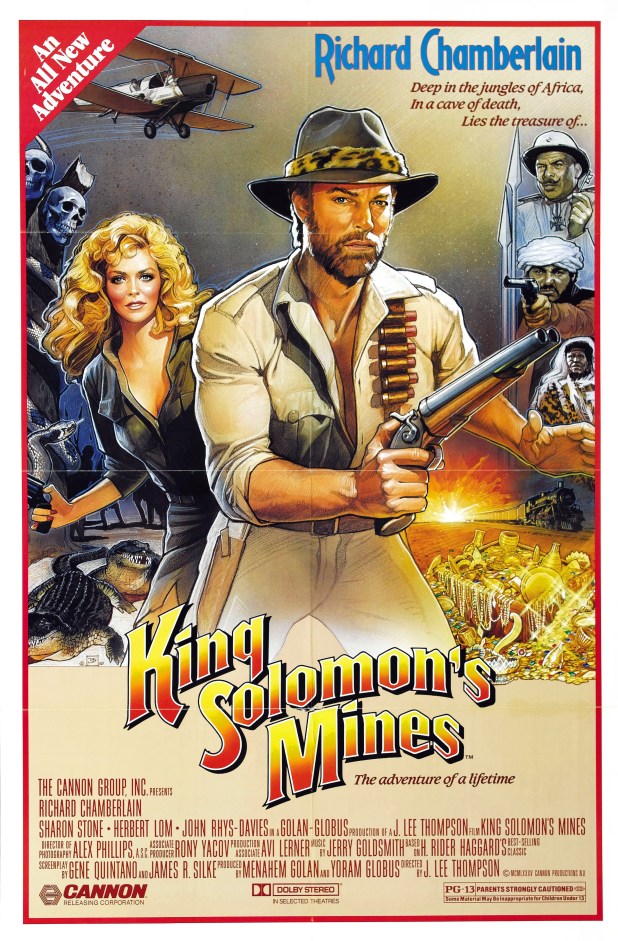
Richard Chamberlain described this movie as “…very much a Raiders of the Lost Ark type of movie – very tongue-in-cheek and full of adventures and stunts. Bullets flying, lions eating people, witches up in the trees. All that stuff.”
Yes, pretty much, but nowhere near as fast, exciting or successful. But man, I find so much love in my heart for this movie and I figure it’s probably because it was on cable so much that I eventually liked it.
And well, it’s Cannon and has a major Cannon bit of ridiculouness behind it.
Kathleen Turner was reportedly offered $1.5 million to play Jesse Huston but turned it down as it was to similar to her part in Romancing the Stone. Cannon Group leader Menahem Golan demanded they get “that Stone woman”, meaning Turner, and that’s how Sharon Stone was cast, which if it were any other studio I’d think was an urban legend but given that it’s Cannon, I’m more inclined to blindly agree.
Also, as a lifelong marketing person, Cannon’s big media campaign on this film pushed it hard enough to make it a success, which was important, as the sequel Allan Quatermain and the Lost City of Gold was made directly afterward and was ready to come out just as quickly. Sadly, the third movie, Allan Quatermain and the Jewel of the East — which would have adapted She and Allan — was to be directed by Golan, but it never happened.
Jesse (Sharon) has hired Allan Quatermain (Chamberlain) and his companion Umbopo (Ken Gampu) to find her father, a man lost on the way to King Solomon’s Mines. This puts them at odds with Colonel Bockner (Herbert Lom) and a slave master named Dogati (John Rhys-Davies).
Yes, in true Cannon style, if you can get someone from the movie you’re making your own version of, get them. As Sallah, Rhys-Davies is a fondly remembered character in two Indiana Jones movies. Also, as Cannon will do, they made him the bad guy.
Evil priestesses, gigantic crocodiles, exploding vulcanos, enormous diamonds, romantic tension, quicksand, a monster known as the Mokele-mbembe — this one really has it all. Critics absolutely hated it, but you knew that, and audiences pretty much loved it and you knew that too.
Based on the H. Rider Hagard novel, the screenplay was by Gene Quintano, who would later direct National Lampoon’s Loaded Weapon 1, and James R. Silke, who dependably wrote Revenge of the Ninja, Ninja III: The Domination, American Ninja and The Barbarians for Cannon.
It was directed by J. Lee Thompson, whose 80s were filled with the kind of movies I rented all the time, such as Happy Birthday to Me, 10 to Midnight, The Evil That Men Do, Murphy’s Law, Death Wish 4: The Crackdown, Messenger of Death and Kinjite: Forbidden Subjects.
In the years afterward, Chamberlain has changed his point of view on the movie, saying that the $5 million dollar budget was more like $2.50 and that Cannon pitched the movie to him as a big budget rival to Indiana Jones with a great supporting cast and Thompson directing. The truth was that the sets and effects didn’t look like they were for a blockbuster, Sharon Stone was hard to work with (allegedly crew members would go into her trailer and urinate in her bathtub) and Thompson wasn’t that interested in the movie.
EDITOR’S NOTE: We originally watched this as part of a Death Wish week of movies on November 6, 2018. This might be my favorite Cannon movie. It may also be one of my favorite movies of all time, to be perfectly frank.
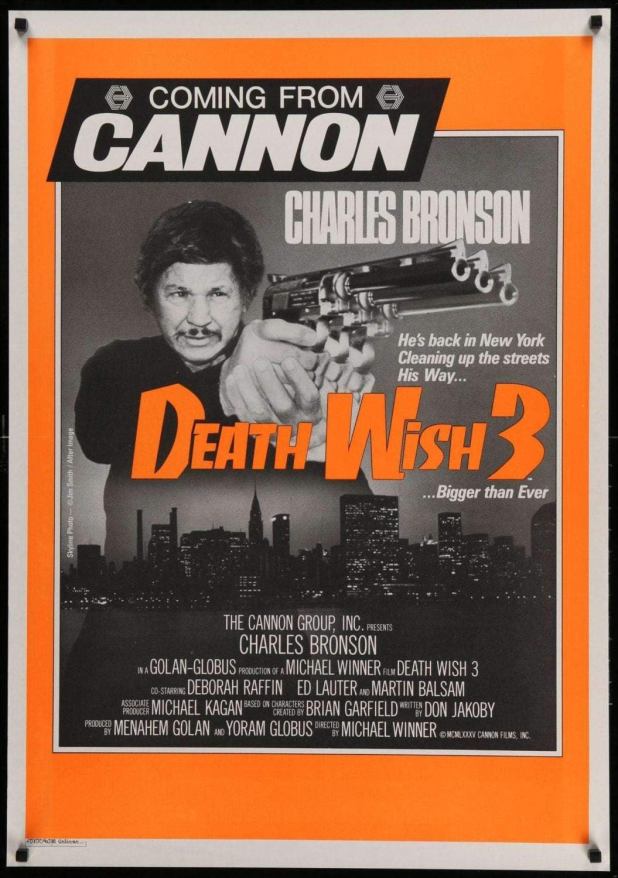
Paul Kersey is back in New York City, despite being kicked out at the end of the first Death Wish. His Korean War buddy Charley has invited him to ask for help as his East New York apartment building has been under attack by a gang. Paul gets there just in time for his friend to die in his arms and the police arrest him for the murder. Inspector Richard Shriker recognizes him as the vigilante from back in the first movie, so he throws him into a holding cell with the leader of the gang, Manny Fraker (Gavan O’Herlihy, son of Halloween 3: Season of the Witchbad guy par excellence Dan O’Herlihy). After a fistfight ensues, the villain gets released before Paul. If you think that’s the end of all of this, you haven’t been reading our website this week.
Shriker offers our hero a deal: kill all the punks you want, but inform him of any activity so that he can get a big bust and make the news. With that, we’re off and to the races in what is not only the craziest of the Death Wish movies, but perhaps the most bonkers movie you’ll ever see.
Paul moves into his dead friend’s apartment and into a warzone. He makes friends with the other tenants, including World War II vet Bennett Cross (Martin Balsam from Psycho), a kindly old Jewish couple named Mr. and Mrs. Kaprov, a young Hispanic couple named Rodriguez and Maria (a pre-Star Trek: The Next Generation Marina Sirtis who in real life is a Greek girl born in London). There’s even a young kid who continually walks into the path of gunfire. Obviously, this is a neighborhood made for Paul Kersey. It is, as my wife pointed out, Sesame Street where people die horribly.
Paul uses a car as bait for the gang, killing two who break into it. And he saves Maria twice, but the third time, the gang takes her and she soon dies in the hospital, not knowing the most important rule of Death Wish: if you are a woman, stay away from Paul Kersey.
That’s when Paul orders a .475 caliber Wildey Magnum, a gun that has the same muzzle velocity as a .44 Magnum at 1000 yards. This big bore handgun, as Danny Vermin once said, “shoots through schools.” He traps The Giggler by putting his new camera where he knows the criminal can steal it, then he blows him into another dimension with his gigantic handcannon. “I can’t believe they got The Giggler, man,” laments the punk rock gang.
Why this gun? Well, it was Bronson’s personal handgun in real life. According to the gun’s inventor and the film’s technical consultant, Wildey Moore, sales for the Wildey Magnum increase whenever this film airs on TV.
You know who else didn’t get that memo about dating Paul? Public defender Kathryn Davis (Deborah Raffin, The Sentinel), who dates our hero long enough for him to joke that he likes opera and for mohawked punk gang leader Manny to shove the car she is waiting for Paul in toward oncoming traffic, where it explodes in a giant fireball.
Shriker decides that enough is enough and he puts Paul into protective custody. But after the gang blows up Bennett’s taxi garage, the old man tries to use the ancient Browning .30 machine gun that Charley brought back from the war. Sadly, the ancient detective from Psycho is no Roadblock from G.I. Joe and he’s quickly beaten into near death by the gang. Paul is allowed to visit him at the hospital and quickly makes a break to defend his new friends once and for all.
There’s another big machine gun, so Paul and Rodriguez use it to kill every single gangbanger they can before they run out of ammo, just as their neighbors finally come to arms to help them. What follows is what can only be described as sheer orgasmic violence, as hundreds of stunts all happen at the same time. Grenades are thrown from motorcycles. Handgun blasts send people flying through glass windows. Fire is everywhere. And there’s Paul Kersey, walking cooly and doing what he does best: killing punk rock criminals of all colors, races and creeds, including a very young Alex Winter.
Finally, Manny almost kills Paul, but he’s saved by Shriker, who is wounded by the punker but succeeds in shooting him. Kersey calls for an ambulance just as Manny rises, showing his bulletproof vest. In a moment that will live in my mind forever, Paul shoots him dead in the chest with an M72 LAW rocket and sends him flying through the side of the building as his girlfriend (Barbie Wilde, the female Cenobite from Hellraiser) screams in pain, their psychic link obviously broken like Cyclops and Jean Grey on the dark side of the moon. The gang realizes they’re beaten as the cops show up in force, with Kersey simply walking away.
Death Wish 3 is many things, but none of them are subtle. It’s a sledgehammer blow to your sensibilities, a veritable tour of depravity and sadism. It’s also entertaining as hell. Bronson hated Don Jakoby’s (Invaders from Mars, Lifeforce and a frequent collaborator of Dan O’Bannon, with whom he wrote an unproduced script called Pinocchio the Robot that would have featured Lee Marvin as Geppetto!) script and the fact that they turned Paul Kersey into Rambo, but he got $1.5 million for starring in this movie. Frequent rewrites led to Jakoby taking his name off the film and he’s listed as Michael Edmonds.
All told, 74 people die in Death Wish 3, as detailed in this completely amazing article. They are stabbed, shot, run over, set on fire and more. They fall from tall buildings. They are thrown from tall buildings. And there’s a gang that combines all races and creeds — except old people — including white supremacists, punk rockers and lovers of reggae. It is the rainbow coalition of death. There was also a video game that lives up to the violence on screen.
The film also includes a rape scene with the victim played by Sandy Grizzle, who was the girlfriend of director Michael Winner. After they broke up, she reported to London tabloids that this was part of him treating her as a sex slave. Winner sued the News of the World tabloid and won.
Before you scoff at this notion, keep in mind that Winner spent six days filming the rape scene in Death Wish 2, a movie that took from May to July of 1981 to shoot. Also, following the allegations made against Harvey Weinstein in 2017, Winner was accused by three women of demanding they expose their breasts to him. Seeing as how he’s not around to refute the charges, let’s just move on.
Beyond these rumors, Winner was the kind of special individual that almost died from eating dinner — twice. He got the bacterial infection vibrio vulnificus from eating an oyster in Barbados, nearly losing his leg and his life. Then, years later, he’d almost die from food poisoning after eating steak tartare four days in a row. He died in 2013 at the age of 77.
Let’s ignore the gossip on Michael Winner and concentrate on how awesome Death Wish 3 is. Because wow, they literally can’t, don’t — and some folks would say probably shouldn’t — make them like this anymore.
You can listen to The Cannon Canon episode about Death Wish 3here.
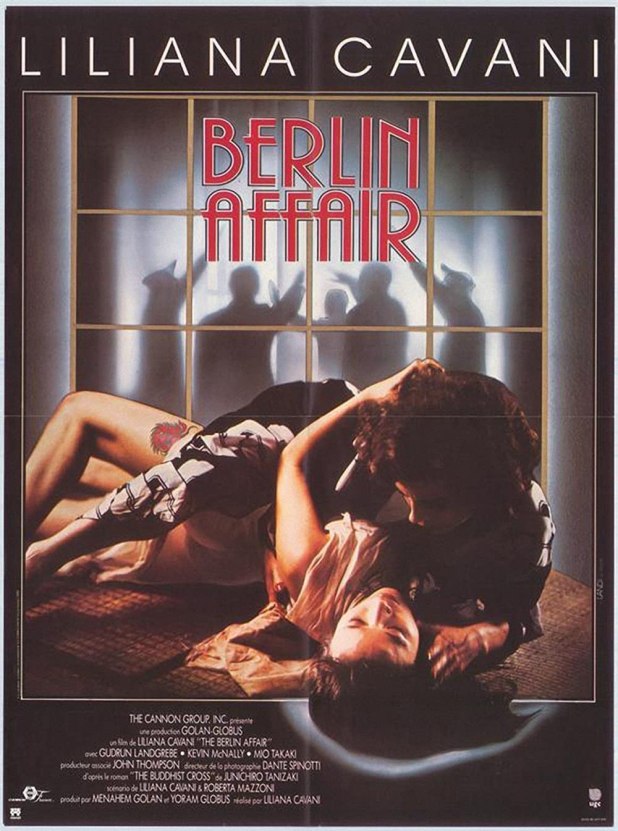
Based upon the novel Quicksand by Jun’ichirō Tanizaki, this is the story of Louise von Hollendorf (Gudrun Landgrebe), whose husband Heinz (Kevin McNally, who much later ended up in the Pirates of the Carribbean series) is the senior diplomat at the Ministry of Foreign Affairs. She’s lonely and decides to take up art, but really takes up falling for another student, Mitsuko Matsugae (Mio Takaki), the daughter of the ambassador from Japan, a romance that Heinz attempts to stop.
Of course, he falls for Mitsuko, who soon turns their relationship into a triad with her in control, using sleeping pills to keep husband and wife from ever making love without her. You know, for a love affair that starts with a fake suicide, can you expect things to go well? And you can just imagine how the Third Reich feels about all of this. And then there’s more suicide, as all three lovers decide to die from drinking poison together.
Director and writer Liliana Cavani is perhaps best known for another movie that plays in this same space — sex and control in the midst of war — The Night Porter. This was the first film produced by Cannon’s Golan and Globus in Italy and it’s actually more art than sleaze, despite the movie’s description.
EDITOR’S NOTE: We originally wrote about this movie on February 1, 2019 and are bringing it back — with some edits and new additions.
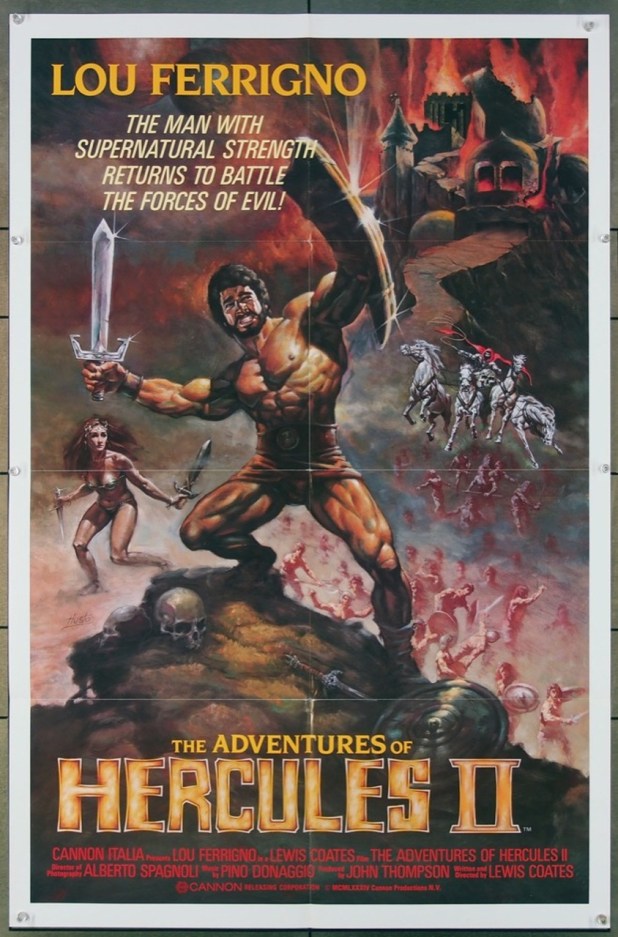
Luigi Cozzi decided to bring back Lou Ferrigno to be Hercules one more time. Now, Hercules must search for the seven thunderbolts of Zeus, which have been stolen by renegade gods. There was only one trouble: he only had three weeks to film this one, so plenty of the story is padded out by showing scenes from the last movie.
Actually, according to Austin Trunick’s The Cannon Film Guide Volume 1: 1980-1984 — and Luigi Cozzi — Ferrigno had been lured to Italy to do reshoots for Seven Magnificent Gladiators when Menahem Golan came up with a plan to get him to stay for four weeks instead of two and secretly make a sequel. No one was allowed to inform Ferrigno that they were making a new movie, as they couldn’t afford to pay him for one.
The movie begins by telling the story of Zeus’ Seven Mighty Thunderbolts that have kept peace throughout creation. But one day, Aphrodite, Hera, Poseidon and Flora (Margit Evelyn Newton, Maria Rosaria Omaggio, Ferdinando Poggi and Laura Lenzi) steal them, taking away the leader of the god’s power and sending the moon flying at Earth.
The Little People tell the sisters Urania and Glaucia (Milly Carlucci and Sonia Viviani, who is in Nightmare City and The Return of the Exorcist) that only Hercules can save them. Zeus — remember how he had no power — sends Hercules back from the stars to help mankind, but the evil gods resurrect King Minos (William Berger) from the last movie and have Dedalos (transgender actress Eva Robin’s) help him with her powers of science.
Hercules battles everything in this movie from giant apes to Slime People, a Gorgon, a knight that fires lightning bolts and hangs people from trees, the fire monster Antaeus, the Queen of the Spiders and then Minos, who transforms into a giant laser dinosaur, to which Hercules says, “Watch this” and becomes a laser King Kong. No, that’s not the drugs talking. This really happens.
Zeus then grows Hercules as big as the universe and he moves the moon and Earth back to where they belong. Then, Urania sacrifices herself, as her body contains the last thunderbolt. Zeus then allows both her and Hercules to live amongst the gods in space.
While not as amazing nor as entertaining as the original, the end — with the laser monster fight — must be seen to be believed.
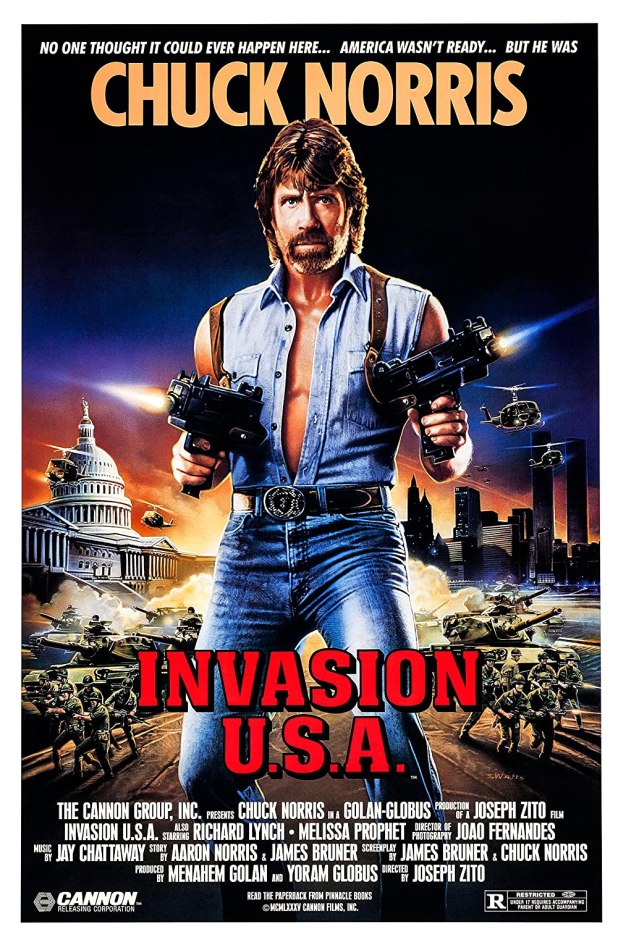
The first in a six-film deal that Chuck Norris signed with Cannon after Missing In Action, this was inspired by Chuck thumbing through Reader’s Digest and learning that terrorists — real terrorists — were running loose in the U.S. by the hundreds.
Chuck was interviewed by the Sun Sentinel and his inspiration: “I thought, “Boy, that’s scary. What if some guy on the order of a Khomeini or a Khadafi mobilized those guys and started sending them out to every major city? I know it’s going to happen, and even in the movie, the head terrorist says, “It’s so easy because of the freedom of movement in this country.” So we’re really accessible to this. The movie is not meant to scare people, but to make us aware of a potential problem.”
Not only did this movie cost $12 milion, but it was spent the right way: the houses that get blown up real good are all real, as is the Avondale Mall. The Hartsfield–Jackson Atlanta International Airport was going to bulldoze an entire suburban neighborhood to extend a runway and the mall was also being rebuilt, so the filmmakers paid enough that they could explode some real lhonest-to-goodness slice of America.
The movie lets you know a few things right off the bat. It’s a Joe Zito (The Prowler) film, it’s uncompromisin and it’s villains are simply villains. They off an entire boat of Cuban refugees in the guise of being coast guardsmen, but they’re really an internationall collective of scumbags led by Soviet operative Mikal Rostov (Richard Lynch, the best of all 80s bad guys). Their first move, after killing all those Cubans and taking the cocaine in their boat, is to try and take former CIA agent Matt Hunter (Norris) off the board. They decimate his Everglades home and kill his best friend John Eagle (Dehl Berti), which makes the retired hero re-enlist to deliver death.
As boats full of soldiers unload on the beaches of Miami while another group pretends to be cops and sow chaos. Churches are targeted, a mall is destroyed, a carnival gets bombed to bits and suburban neighborhoods are under attack. During all this, the FBI arrests Hunter for his vigilante attacks on the terrorists, but come on. You know that he’s going to be found innocent, strap on some guns and fire a rocket launcher directly at Richard Lynch. We demand blood.
This is the kind of movie where shoving a cocaine straw up a woman’s nose, launching her through a window and shooting Billy Drago in the dick is an afterthought. That’s how pure evil Lynch is.
I wish that they made twenty of these. Avenging Force may have been a proposed sequel, but Chuck wanted to do other things, so Michael Dudikoff played Matt Hunter, who may or may not be the same character. And that movie is just as deranged as this one. Perhaps slightly more so.
But yeah. Invasion U.S.A. Inspired by Reader’s Digest and then 129 people get killed. Chuck killed thirty of them. Invasion brings every state leader together with no politics. Chuck watches Earth vs. the Flying Saucers. God bless America.
You can listen to The Cannon Canon podcast about Invasion U.S.A. starring the Molasses 2×4 here.
I couldn’t find this movie anywhere, so why don’t I just share what I know and hope that someone helps me track it down?
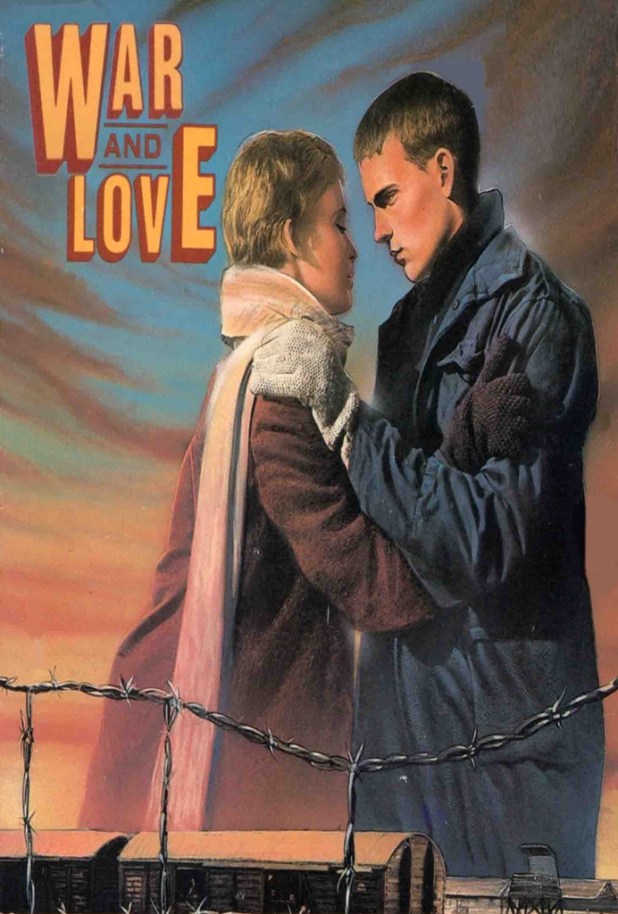
Jacek Szteinman (Sebastian Keneas) has somehow survived World War II Warsaw and daily threats on his life from German soldiers, all while romancing Halina, who is played by Kyra Sedgwick in her first movie.
It’s based on the Jack Eisner book The Survivor and the screenplay was written by Abby Mann, who wrote Judgment at Nuremberg and helped create Kojak. It was directed by Moshé Mizrahi, the husband of Michal Bat-Adam, who made Boy Meets Girl and The Lover for Cannon.
EDITOR’S NOTE: We originally posted this movie on May 26, 2020 as we covered several heavy metal horror movies. It’s back for our month of Cannon Films.
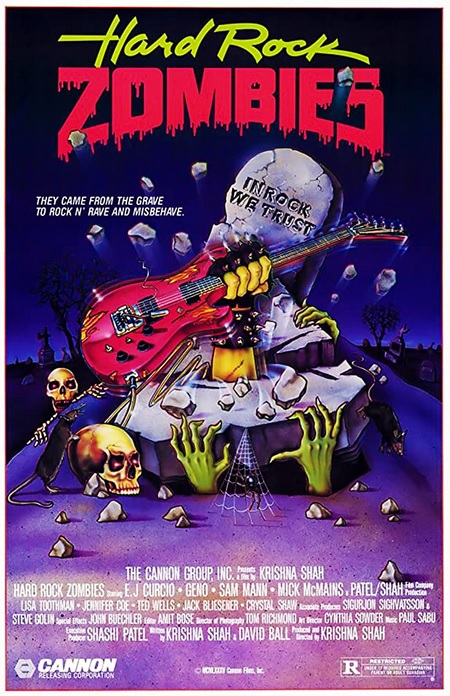
Evil Laugh. American Drive-In. Hard Rock Zombies. These are the legacy of producer/director Krishna Shah. This movie is…well, there’s never been a movie exactly like this. I’ll leave it up to you to decide whether or not that’s a good or bad thing.
Jessie, Tommy, Chuck and Bobby are Holy Moses and in order to impress a music business bigwig, they decide to go to a town that has outlawed rock and roll. Of course, these towns were everywhere in the wake of Footloose because they saw how well that went.
The town they pick — Grand Guignol is the name, which is only slightly more subtle than Nilbog — has not only outlawed music, but it’s also full of evil dwarves, sex perverts and not just Nazis, but Hitler and Eva Braun who has become a knife-carrying werewolf who lets other men have sex with her while she cucks Der Fuhrer.
The band gets killed, but thanks to the fact that their new song was based on an occult prayer, they come back to life and bring the town’s dead back from the choir invisible to kill everyone else.
Jessie is also in love with a young fan named Cassie, who is all of 12. So there’s that. And he’s the good guy.
This movie was supposed to be only twenty minutes long and appear as the movie within a movie for American Drive-In. Someone decided to spend a little more cash and finish the film.




 B&S About Movies
You must be logged in to post a comment.