When a Stranger Calls is a remake of Fred Walton and Steve Feke’s short film The Sitter, with the first 23 minutes — the best part of the movie — being, well, The Sitter. That short played before Looking for Mr. Goodbar, and then this was the full-length result.
Jill Johnson (Carol Kane) is watching the children of Dr. Mandrakis (Carmen Argenziano). A phone call comes in, and a voice — we later learn it’s Curt Duncan (Tony Beckley) — keeps asking if she’s checked on the children. Spoiler: The kids are dead.
Seven years later, he’s escaped from prison, and the cop who caught him, John Clifford (Charles Durning), has been hired to catch him before he kills again. He remembers Jill, and he’s also getting close to a woman who actually treats him well, Tracy (Colleen Dewhurst). Sure, the calls coming from inside the house had already been done in Black Christmas, but this does have some moments of fright.
Dr. Henry Jekyll (James Mathers, who also wrote this movie; he was a playwright and actor whose career was filled with minor roles on TV and on stage) is the grandson of the one from the book and lives in San Francisco. This movie feels like it could take place in the 1800s or 1979, depending on the scene. He invites his teacher, Professor Atkinson (John F. Kearney, in his first acting role at the age of 48; he’s follow that with non-sex roles in the Gary Graver adult movies Indecent Proposal and Society Affairs; he also directed Steinbeck’s Of Mice and Men at the Savoy Theatre in London, England with George Costigan, Matthew Kelly and Tyrone Huggins in the cast and OH YEAH is Mike Justice’s dad!) to see his work and commisaerate on the death of Atkinson’s daughter — and Jekyll’s girlfriend and lab assistant — Julia (Dawn Carver Kelly, one and done).
Except that his experiments involve making men and women battle in proto-MMA fights after being injected with drugs. And he also has a mute sister, Hilda (Nadine Kalmes), whom he claims that he hates and desires as much as their mother. There’s also his lab assistant, Boris (Jake Pearson), who we’re led to believe was attacked by Jekyll during an adventure and is now serving him.
Jekyll wants to hurt — or marry — Julia and often forces her to accept him making love to her while his sister watches one-handed from the hallway. He also likes to whip Boris and say “Love is pain” over and over again. He also loves to inject his test cases — Rick Alemany (also the fight coordinator), Tes Luz, Lydia Altamirano, Jesse Washington and Earl Garlin — in fights to the death that are way too worked.
It’s…well, great is too much, but it’scertainly strange, as everyone starts this movie on 10 or zero, depending on if you’re a scientist or brainswashed, and you get long scenes of savagery and the professor screaming “No, no, no more!”
Hyde Productions Inc. registered its copyright in Nevada, and the premiere was a double feature with The Driller Killer at Miami-area drive-ins: the Turnpike Drive-In, the Tropicaire Drive-In, and the Homestead Theatre. Arthur Weisberg, the presenter of this film, also used the name Rochelle Gail Weisberg, also was behind Teeny Buns, C.B. Hustlers, Drive In Massacre, Spirit of Seventy Sex, 9 Lives of a Wet Pussy, The Driller Killer and Ms. 45. He also conducted the score for Dark Dreams, played basoon on The Miracle Worker and is credited with inventing the “Future Basoon” and taught at the Juilliard School, State University of New York at Stony Brook, Yale School of Music, Manhattan School of Music and Indiana University’s Jacobs School of Music.
If any film earned being a video nasty, it would be this one, a movie that has a man who was abused as a child growing up to be a serial killer obsessed with burning people alive. There is no one to root for or cheer for, only mayhem, malice and murder.
In short, the kind of movie that Gene Siskel would have a conniption over.
When Donald (Dan Grimaldi, a math professor who also played Philly and Patsy Parisi on The Sopranos) was a kid, his mother would use a stove to burn the evil out of him. Now fully grown, he seeks out women that remind him of her and kills them with a flamethrower in relentlessly graphic detail.
While the killer tries to confess his sins, he can’t stop. Even a simple double date ends with him smashing a candle over a woman’s head. And get this, it even has an ending very similar to Maniac, another movie that offers no easy answers or way out.
This is also a definite disco slasher. A truly mean spirited blast of sheer degeneracy — and therefore everything wonderful about the slasher form — Don’t Go In the House has songs like “Boogie Lightning,” “Dancin’ Close to You,” “Straight Ahead” and “Late Night Surrender” playing in between moments of women being set ablaze and a mother rotting somewhere in a house that has an impossibly huge torture chamber in the basement.
You can watch this on Tubi or buy the blu ray from Severin.
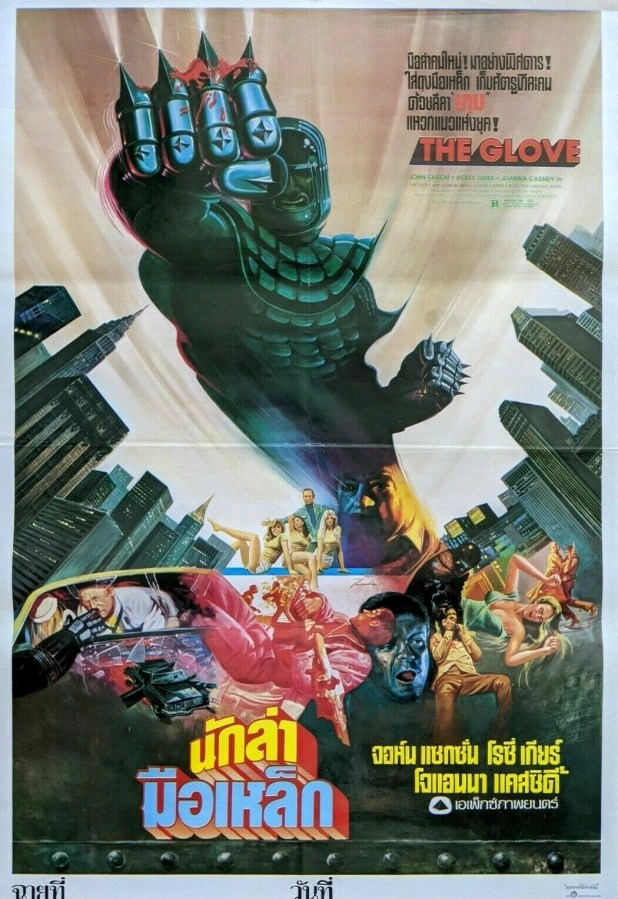
Imagine a movie that starts with a fourteen year-old girl being killed by a faceless maniac wearing a black leather glove with razor-tipped fingers. If you’re ready for that before the first credits roll, then you’re ready for The Demon.
That very same killer then kills a trucker, steals all his money and gets a place in a sleazy hotel in Johannesburg. Emily’s parents are frustrated by the police and turn to Bill Carson (Cameron Mitchell, the whole reason why I picked this movie), a psychic detective who was once a U.S. Marine. Of course.
Emily’s mother just wants to know if her daughter is alive or dead. Her father, though, wants revenge. Carson replies that its best for the Parkers if they don’t find the killer, telling them that he’s pure evil. I mean, you should believe a dude who can tear up a bed like this.
The killer has moved on to an American schoolteacher named Mary (Jennifer Holmes, who was on TV’s Newhart before being replaced by Julia Duffy). She first sees him outside her classroom window, as he can seemingly appear and disappear at will. And when she’s not seeing killers, she’s hanging out with her South African cousin who is dating Dean Turner, a rich American playboy that Mary hates.
Jo is out having fun and poor Mary is stuck at home, getting phone calls with heavy breathing and menacing knocks on her front door. Is it the killer? Or is he happy to be at home grunting, groaning, doing push-ups and shredding porno mags?
The Demon also likes to go out and try and pick up ladies. And where does he go? Boobs Disco! Yes, this was a real place. And yes, it was really called that.
We even get to hear some of Lipps Inc.’s “Funkytown” in this scene, as the killer is stopped from raping a girl by two motorists, one of whom is slashed and the other gets his motorcycle blown up real good.
Meanwhile, Cameron Mitchell is getting the most out of his ten minutes of screen time. I guess that’s all the producers could afford. He creates a faceless sketch of the killer and tells the Parkers where the man lives. He warns Mr. Parker one more time, but the guy just can’t listen and gets his neck snapped pretty much immediately, then thrown off a balcony.
Children are playing in the woods when they find Emily’s remains, which brings Carson back to Mrs. Parker, telling her that he’s sorry, but the time of The Demon is drawing close. She accuses him of being behind all of this to keep his career going as a psychic and shoots him in the face. Well, that had really nothing to do with the other half of this film, which is becoming a riff on Halloween.
Mary and Jo go out on dates that night while The Demon gets ready for them. Mary tells Bobby, her man, that she’s been getting stalked late at night. And she’s right — The Demon has, for reasons known only to him, broken in to kill Jo and rich guy Dean, then hide in the house.
You know, if I had a cool razor glove, I wouldn’t suffocate people with a plastic bag like The Demon. But hey — I’m just a writer on a web site.
It’s time for this movie to go full Halloween, with The Demon chasing Mary all over the house — up and down the stairs, through a closet, into the attic and finally through a hole in the roof. She finally makes it to the bathroom, where she builds a trap with scissors, the shower and shampoo. That’s right — The Demon is the first masked killer I’ve seen that is basically killed by slipping in the shower.
If you’re watching this movie based on the description Mill Creek gives, you’re going to be disappointed. Cameron Mitchell never gets to be the Australian Dr. Loomis, instead being felled by a housewife with a handgun. And I know that I give generous berth to the transfers on these, but even I was amazed by how long scratches would appear on the footage.
If you enjoy scenes that having nothing to do with the overall film being given the same importance as major facts, then let me recommend The Demon. Come for Cameron Mitchell, stay for Boobs Disco.
Each October, the Unsung Horrors podcast does a month of themed movies. This year, they will once again be setting up a fundraiser to benefit Best Friends, which works to save the lives of cats and dogs across America, giving pets second chances and providing them with happy homes.
Today’s theme: Animals Attack!
ABOUT THE AUTHOR: Adam Hursey is a pharmacist specializing in health informatics by day, but his true passion is cinema. His current favorite films are Back to the Future, Stop Making Sense, and In the Mood for Love. He has written articles for Film Eastand The Physical Media Advocate, primarily examining older films through the lens of contemporary perspectives. He is usually found on Letterboxd, where he mainly writes about horror and exploitation films. You can follow him on Letterboxd or Instagram at ashursey.
Ecology horror boomed in the 1970s. The reason is clear. Environmentalism was becoming a major political talking point. Companies were disposing of their toxic waste without proper regulations. In 1969, the Cuyahoga River in Ohio caught fire due to the amount of chemicals in the waterway. By 1970, Earth Day was established to bring awareness to the fragility of the Earth and its resources. And the Environmental Protection Agency (EPA) was established as a government agency via an executive order by Richard Nixon, later ratified by Congress. You mean there was a time when Republicans cared about the environment and the future of our planet?
There are of course many films that base its plot around animals running amok, perhaps seeking revenge on the neglect or outright disdain humans have for the environment. Frogs. Bug. Squirm. One word really sums it up.
You can add John Frankenheimer’s Prophecy to that list. His film takes the next step, though. Not only is the improper waste management of a capitalistic corporation to blame for the mayhem that ensues, the encroachment of indigenous land plays a major part in the mutation of a bear out for righteous revenge. Although, in retrospect, perhaps casting Armand Assante as the leader of the Native American resistance was not ideal. You have to take social change in cinema one bite at a time, I suppose.
Unfortunately, despite the importance of the story, the film itself is a bit bland, perhaps focusing a bit too hard on the relationship between ecologist Robert Verne (Robert Foxworth) and his cellist wife Maggie (Talia Shire). Maggie recently found out she is pregnant, and Robert is not interested in bringing a child into such a broken world. She has not broken the news to Robert, though, when they go to the area of dispute between the evil corporation and the Native Americans. The situation gets dicier when she realizes she may have exposed her unborn child to the environment that mutated the bear. As much as I love melodrama in my horror film, this story left me underwhelmed.
What left me properly whelmed, though, is the sleeping bag child kill! Is it wrong that I literally laughed out loud when it happened? If laughing at kids getting demolished in movies is wrong, I don’t wanna be right.
11. DYSTOPIAN FUTURE: Polite society just ain’t what it used to be.
George Miller was a medical doctor in Sydney before he made this, his first directing work. He’d worked in an ER and saw so many vehicular accidents and even lost three friends to car crashes as a teenager. So why not take the telekinetic violence of autos and people colliding and make a movie?
The Main Force Patrol (MFP) is barely keeping order in Australia as the world slides into the end times. Max Rockatansky (Mel Gibson) is exhausted and sick of being on the force, but they bribe him with a new cruiser, a V8-powered monster of a muscle car. After Max kills Nightrider (Vincent Gil) and his girlfriend, the entire gang — Toecutter (Hugh Keays-Byrne), Johnny (Tim Burns) and Bubba Zanetti (Geoff Parry) — run wild, killing almost everyone in their path. The cops try to do their jobs, but the legal system is too lenient on criminals, and soon, they’re back on the streets all over again.
This isn’t a post-apocalyptic film so much as a revenge film. The gang kills Max’s partner, Goose (Steve Bisley), his wife (Joanne Samuel) and their child. He tries to get away, but we know that he can’t keep the thoughts of killing every single one of them out of his mind.
One of the last movies released by American International Pictures, this was redubbed for the U.S. It didn’t do well. In fact, The Road Warrior, the follow-up, is the movie that many point to as having started the trend of end-of-the-world films. That shouldn’t take away from just how good this is.
James Wan and Leigh Whannell credit the film’s final scene — Max handcuffs Johnny’s ankle to an overturned car and gives him a hacksaw to cut off either the handcuffs or his own foot, then blows him up — as the inspiration for Saw.
9. MASTER OF DISASTER: Watch any Irwin Allen offering.
The crew of the tugboat Jenny — Captain Mike Turner (Michael Caine), First Mate Wilbur Hubbard (Walter Matthau) and passenger Celeste Whitman (Sally Field) — spot the rescue helicopter saving the Poseidon passengers from the first movie, just in time to claim salvage rights.
They’re soon joined by Dr. Stefan Svevo (Tally Savalas), a Greek Orthodox missionary here to save anyone on board. Poor Stella Stevens, we see her dead body from the first movie as the teams cut through the hull. Somehow, more people have survived than the first movie, as we have ship nurse Gina Rowe (Shirley Jones), wine steward Dewey “Tex” Hopkins (Slim Pickens), elevator operator Larry Simpson (Mark Harmon), Frank and Theresa Mazzetti (Peter Boyle and Angela Cartwright), Harold and Hannah Meredith (Jack Warden and Shirley Knight), and Suzanne Constantine (Veronica Hamel).
The truth is that Stevo is on board to take plutonium and he soon kills one of his own employees, Suzanne, when she tries to reveal the plan. As you can imagine, hardly anyone survives, seeing how this is an Irwin Allen movie.
Soon after the first film came out, Allen said there would be a sequel in which the survivors would take part in a hearing on the disaster in Austria. While on a train to the hearing, a miles-long mountain tunnel would collapse, leaving the survivors of the train trapped inside. Could people have worse luck?
Roger Ebert said, “But what did we really, sincerely, expect anyway, from a movie in which Karl Malden plays a character named Wilbur, and Slim Pickens plays a character named Tex? If you can think of a single line of dialogue that Slim Pickens, as Tex, wouldn’t say in Beyond the Poseidon Adventure, please do not miss this movie, which will be filled with amazements and startling revelations.”
It’s mostly Michael Caine shouting at Sally Field, who loves him anyway.
Each October, the Unsung Horrors podcast does a month of themed movies. This year, they will once again be setting up a fundraiser to benefit Best Friends, which works to save the lives of cats and dogs across America, giving pets second chances and providing them with happy homes.
Today’s theme: Stelvio Cipriani
ABOUT THE AUTHOR: Adam Hursey is a pharmacist specializing in health informatics by day, but his true passion is cinema. His current favorite films are Back to the Future, Stop Making Sense, and In the Mood for Love. He has written articles for Film Eastand The Physical Media Advocate, primarily examining older films through the lens of contemporary perspectives. He is usually found on Letterboxd, where he mainly writes about horror and exploitation films. You can follow him on Letterboxd or Instagram at ashursey.
I’m ashamed to admit that the name Stelvio Cipriani did not ring any bells when I first saw this category on the list this year. It is just my ignorance, because Cipriani’s score for Mario Bava’s masterpiece A Bay of Blood (AKA Twitch of the Death Nerve AKA Carnage AKA Blood Bath AKA dozens of other titles) is one of my favorite film scores of all time—across all genres. It has so many different flavors, from the menacing, almost jungle beats of the introduction, to the whimsical finale. It is pretty perfect.
Cipriani’s score here in Ring of Darkness is definitely also scoring. It probably helps that his composition is executed by Goblin, really leaning into the prog rock, almost droning feel. I could not help but think about the score used in Lucio Fulci’s City of the Living Dead and John Carpenter’s Prince of Darkness as comps to the style of the score. I’m also ashamed to admit that I might have fallen asleep halfway through Ring of Darkness. I’ll blame a combination of sleep deprivation and the beats dropped throughout the film that just lulled me to slumber. Now, Ring of Darkness is not a very exciting film, but I was never bored by it.
Beginning with an extended opening sequence, we learn that a group of women is bound together by their love of dance and the love of the devil. Years pass, and eventually the daughter of one of the women is having her own sort of spring awakening, suddenly becoming self-aware that her true father is Lucifer himself.
While Ring of Darkness was accused of being another Italian rip-off of The Exorcist (writer-director Pier Carpi claimed to have written the story prior to William Blatty’s novel), the film really owes more to films such as Rosemary’s Baby and The Omen. Really, all three films form a sort of unholy trinity that, let’s just say, inspired many horror films in the 1970s and 80s.
No one would confuse Daria (Lara Wendel) with Reagan or Damien in terms of memorable, menacing demonic characters. Is she the spawn of Satan, or has she just hit puberty? She goes around calling her mother “mother” in an annoying way that only a teenage girl could do. She does leave a scorching handprint on the chest of a classmate who wants to try to make the moves on her, an ability I’m sure most girls wish they had to rid themselves of annoying teenage boys.
Eventually, Daria ends up at the Vatican. Why? I guess we will never know, as no sequel was produced, or probably asked for by anyone ever. Still, I was interested in knowing what would happen next. Just like I wanted to know the next chapter in The Omen after Damien turns around and smiles back at the camera as he attends his parents’ funeral.
I watched this one on TUBI under the alternate title Satan’s Wife, which might just be one of the worst titles in cinematic history. There is no wife of Satan here. I’m not sure Satan is down with such long-term commitments. A much better title would have been To the Devil a Daughter, but Hammer had already used that one a few years prior.
Sept 22-28 Chuck Vincent Week: No one did it like Chuck! He’s the unsung king of Up All Night comedy, a queer director making the straightest romcoms but throwing in muscle studs and drag queens. His films explore the concept of romance from almost every angle – he was deeply passionate about love.
Directed by Chuck Vincent and written by Mark Borde and Avrumie Schnitzer, this had such a low budget that the cast and crew actually stayed at camp to save money.
Here’s the story: Camp Malibu’s director, Herman (John F. Goff using the name Jack Barnes), invites past campers to a ten-year reunion in the hopes of persuading the young adults to help save the camp. Hijinks ensue, and at least everyone is in their twenties, right? But why are they having a contest over who can poop the most?
It’s also a The Witch Who Came from the Sea reunion! John F. Goff and Virkina Flower were both in that. At least this time, he wasn’t her abusive father, and she wasn’t the younger version of his daughter.
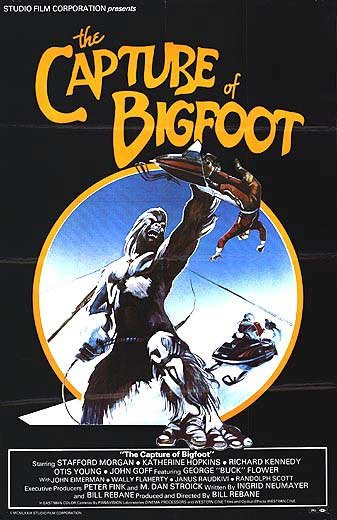
Speaking of Virinka, her career was wild. As a child, she appeared in the aforementioned Matt Cimber film and Drive-In Massacre, as well as Mag Wheels, The Capture of Bigfoot, Beyond Evil, Terror On Tour(as the “well-endowed lady”), the end-of-times movie Early Warning, and the Leif Garrett film Longshot. She went on to be a costume designer — on the Chuck Norris kid film Top Dog and the Aaron Norris starring Overkill — as well as a set decorator on Kirdy Stevens’ adult film Playing With Fire, as a wardrobe supervisor on Frightmare, They’re Playing With Fire, Silent Night, Deadly Night, Midnight and Grounded for Life, plus being the assistant director on Island Fury. And oh yeah! She’s the daughter of George “Buck” Flower.
If you see Barbara Gold in this role as Pam and wonder, “Why do I know her?” That’s a super young Linnea Quigley.
Also look out for Brenda Fogarty (Fairy Tales, Fantasm Comes Again) and Vincent as a prospector under the name Dustin Pacino Jr.
EDITOR’S NOTE: Alien was on USA Up All Night on November 17, 1995 and December 28, 1996.
What else can I say about Alien that so many others have already said?
Directed by Ridley Scott and written by Dan O’Bannon, based on a story by O’Bannon and Ronald Shusett, Alien influenced just as many movies as Star Wars.
The designs of H. R. Giger, Ron Cobb and Chris Foss took what Lucas started — the future didn’t have to be clean and in working order — and took it further, while the story shared that space wouldn’t be like a comic book or movie serial. It’d be just more hard work for a gigantic corporation, and death would not be dignified.
It also has one of the best taglines ever: “In space, no one can hear you scream.”
For all that Alieninfluenced, the DNA of this movie comes from many places:
Queen of Blood: Astronauts respond to a distress call and take an alien on board that slowly kills them off, one by one. Its director, Curtis Harrington, said, “Ridley’s film is like a greatly enhanced, expensive and elaborate version of Queen of Blood.”
Planet of the Vampires: Mario Bava’s movie features a crash landing, where the disembodied inhabitants of an alien planet possess the crew of a rescue ship and take over their bodies. There’s a scene where the crew examines an alien ship and discovers the gigantic remains of the long-dead inhabitants of this planet, which is 100% stolen by Alien, regardless of what Dan O’Bannon and Ridley Scott said otherwise.
It! The Terror from Beyond Space: This 1958 black and white horror film — about the sole survivor of a crashed ship being rescued and slowly killing the crew of another vessel — is incredibly close to the ideas in Alien.
But no matter. This remix succeeds and has the crew of the Nostromo — Captain Dallas (Tom Skeritt), executive officer Kane (John Hurt), warrant officer Ripley (Sigourney Weaver), navigator Lambert (Veronica Cartwright, who was also in The Birds and Invasion of the Body Snatchers), science officer Ash (Ian Holm), and engineers Parker (Yaphet Kotto) and Brett (Harry Dean Stanton), along with the ship cat Jonesy — have answered a distress call and end up bringing back an alien attached to Kane’s face.
The scene that results, where an alien bursts from Kane’s chest, shocked audiences and is still perfect today. That’s all you need to know: these aliens are perfect killing machines that can’t be reasoned with; they live to kill. This is a haunted house in space, in some ways, but also a chase.
I love that this movie led to a toy that no parent wanted their children to have, as well as a series of films that, well, are one good and the rest bad. But you know, I show up for all of them, because the memory of what this movie is gets me every time. This is the ultimate movie monster in one of the greatest horror films ever made. It’s just that simple.
Note: Thanks to Andrew Chamen for pointing out a typo I made!
You must be logged in to post a comment.