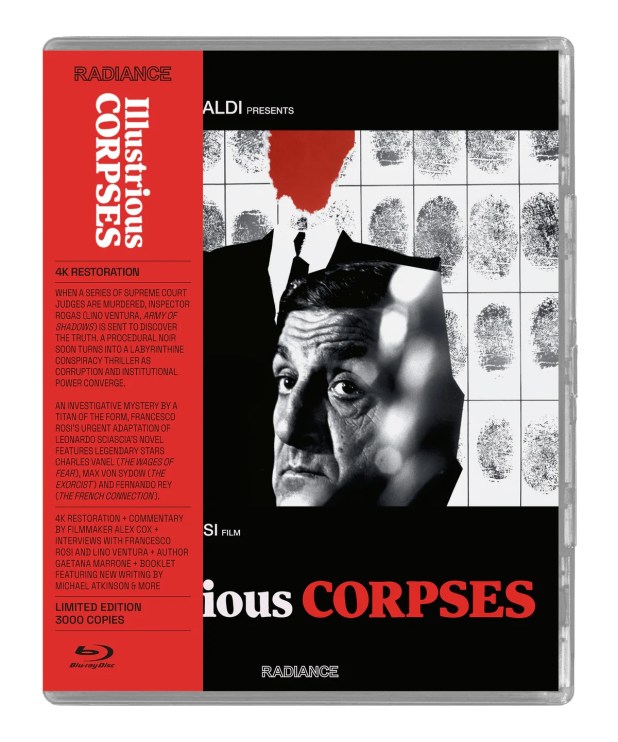
RADIANCE BLU RAY RELEASE: Illustrious Corpses (1976)

When several important judges are murdered, Inspector Rogas (Lino Ventura) is put on the case, but what starts as a simple detective story soon becomes a conspiracy thriller.

Based on Leonardo Sciascia’s book, this was directed by Francesco Rosi (The Mattei Affair, The Moment of Truth), who wrote the script along with Tonino Guerra and Lino Jannuzzi.

When three judges are killed — during the Years of Lead, the times of great political unrest in Italy — Rogas is told not to go into the crimes that the men committed and just to solve their murders. This leads to Rogas being demoted after the murders don’t stop and told to work with the political division so that the crimes can be blamed on revolutionary Leftist terrorist groups and not Cres, a man who was set up by the judges and his wife (Maria Carta). 

Or maybe it goes deeper. Even the chief of police is in on the crimes, which leads Rogas to believe that while Cres killed the first three judges, the other murders were ordered to justify the prosecution of the far-left groups. But he’s too deep, and there’s no way he can learn this much and make it out alive.

In case you’re wondering, the title of this film is based on Cadavre Exquis (Exquisite Corpse), the surrealist game invented by André Breton. It’s when players contribute words or images to a collective piece of art without seeing what others have done.

The last line of this, when the reporter asks whether people will ever know the truth, and the answer is “Truth is not always revolutionary,” sparked widespread controversy.

The Radiance release of this film has a 4K restoration of the movie by Cineteca di Bologna at L’Immagine Ritrovata and The Film Foundation, as well as audio commentary by filmmaker Alex Cox, archival interviews with director Francesco Rosi, Francesco Rosi and Lino Ventura, an interview with Gaetana Marrone, author of The Cinema of Francesco Rosi, a trailer and an image gallery. It has a reversible sleeve featuring designs based on original posters, a limited edition booklet featuring new writing on the film by Michael Atkinson, and newly translated writing by and an interview with Rosi. This is a limited edition of 3000 copies, presented in full-height Scanavo packaging with removable OBI strip leaving packaging free of certificates and markings. You can get it from MVD.

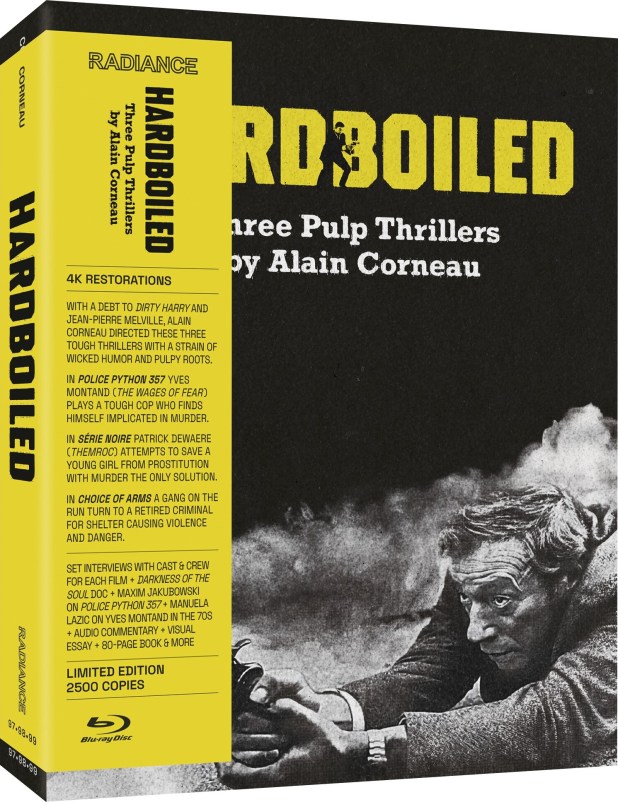
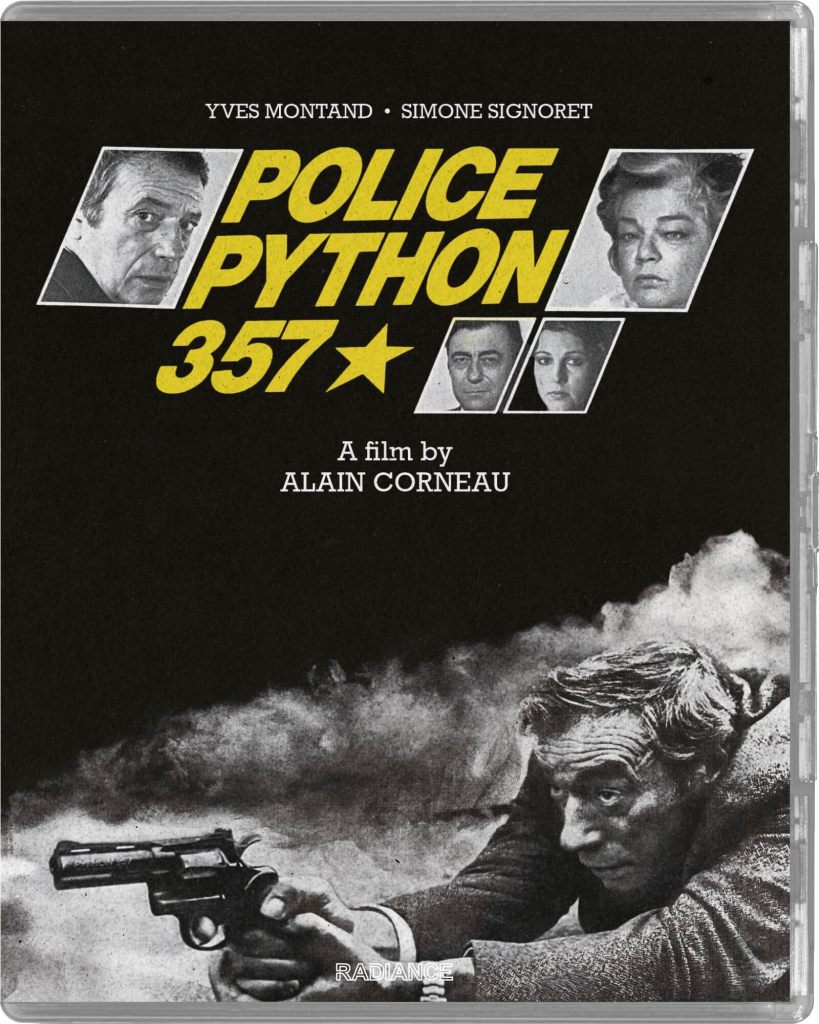
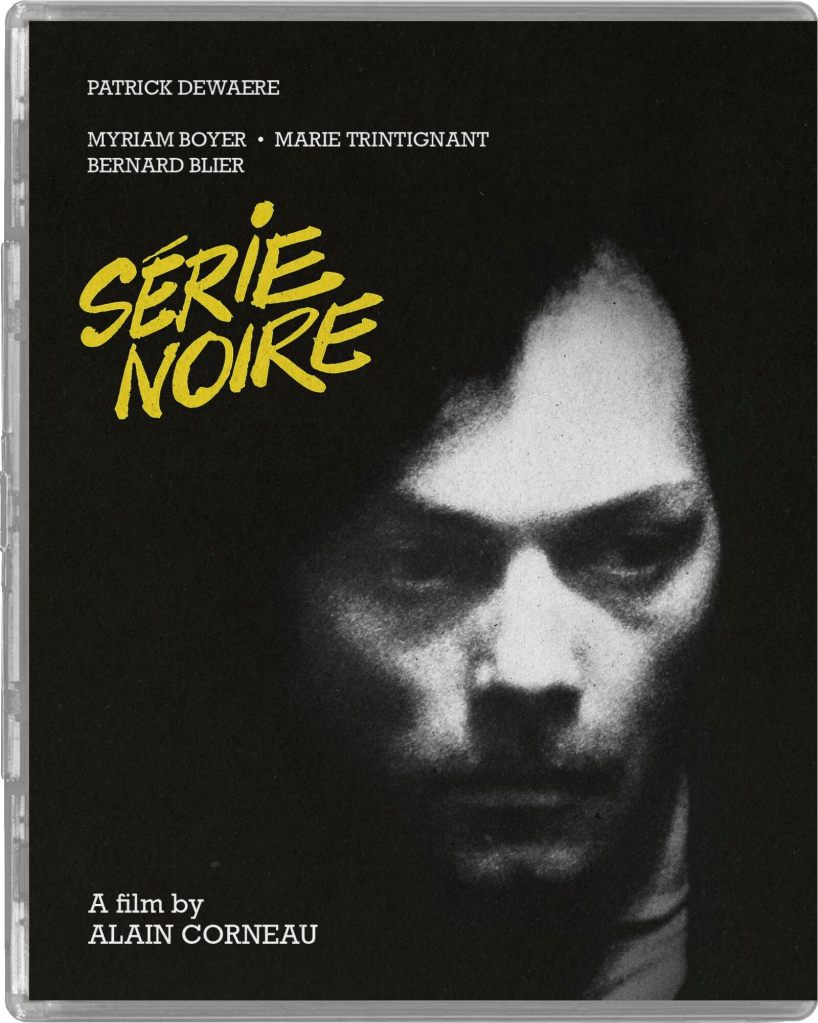
RADIANCE BLU-RAY BOX SET RELEASE: Hardboiled: Three Pulp Thrillers by Alain Corneau

Hardboiled: Three Pulp Thrillers has three pulp thrillers in the spirit of Dirty Harry from director Alain Corneau.

Police Python 357 (1976): The second screen adaptation of Kenneth Fearing’s The Big Clock — the first has Charles Laughton — this stars Yves Montand as Inspector Marc Ferrot. How close to Dirty Harry is this? The beginning is pretty much Magnum Force. Ferrot is in love with Sylvia (Stefania Sandrelli), a mysterious woman who has already been sleeping with his boss Commissaire Ganay (François Périer), despite him being married to Thérèse Ganay (Ferrot’s real-life wife Simone Signoret). That woman was killed by Ganay, and Ferrot is now the main suspect. This is very much noir, despite being influenced by early 70s violent cop movies from America.

While the box set is sold out, MVD has this by itself. You get extras like commentary by Mike White, Maxim Jakubowski on Police Python 357’s source novel and adaptation and an archival interview with Alain Corneau and François Périer about Police Python 357. 

Serie Noire (1979): An adaptation of Jim Thompson’s A Hell of a Woman, this moves the story to Paris. Franck Poupart (Patrick Dewaere) is a door-to-door salesman stuck in a dilapidated apartment and married to a depressive wife (Myriam Boyer). He’s drinking all the time as he gets over being on drugs. But when he hunts down a man who owes him money, he falls for a young prostitute named Mona (Marie Trintignant). When he’s arrested for stealing, she bails him out, and they decide to steal the money her madame has hidden. The attraction he feels for her will cause him to give up everything that matters to him: his morals, his job, even his marriage. Is it the right choice? 

While the box set is sold out, MVD has this by itself. You get extras like an interview with Alain Corneau, Patrick Dewaere, and Miriam Boyer; a making-of documentary; another interview with Alain Corneau and Marie Trintignant; and a visual essay about Jim Thompson adaptations for the screen by Paul Martinovic. 

Choice of Arms (1978): Noel Durieux (Yves Montand) is an old gangster content to be retired with his wife, Nicole (Catherine Deneuve). This all ends when an old accomplice shows up, only to die, but brings along the wild Mickey (Gérard Depardieu) with him. Two cops, Bonnardot (Michel Galabru) and Sarlat (Gérard Lanvin), start to hunt down Mickey and make life dangerous again for Noel, who just wants his wife to be safe. As this film reveals, that’s probably not possible. A life of crime is not an easy one to walk away from forever. This is less a noir than a tragedy.

While the box set is sold out, MVD has this by itself.

Cinematic Void January Giallo 2026: Alice, Sweet Alice (1976)

EDITOR’S NOTE: Cinematic Void will be playing at the Little Theater in Rochester, NY on Thursday, Jan. 15 at 7:30 PM (tickets here). For more information, visit Cinematic Void

Alfred Sole was an architect who dreamed of making movies. His first film, 1972’s Deep Sleep, which starred Deep Throat‘s Harry Reems and The Devil In Ms. Jones‘ Georgina Spelvin, was made for only $25,000. However, it was ruled obscene and pulled from theaters. His second film — the one we’re about to cover — may not have done well at first thanks to spotty distribution, but thanks to Brooke Shields’ popularity and multiple re-releases under multiple titles, like Holy TerrorCommunion and The Mask Murders.

Sole wrote the film with his neighbor Rosemary Ritvo, an English professor with whom he often discussed films. A Catholic herself, they would talk at length about the church in between discussing theater and horror films. Nicolas Roeg’s Don’t Look Now was a huge influence, as is evident by the yellow raincoat worn by the film’s villain.

The film is set in 1961 in Paterson, New Jersey, the director’s hometown; as such, much of it was based on his childhood. In fact, Mrs. Tredoni is directly based on a woman who lived next door to his grandmother, who would look after the priests.

While Sole claims he had never seen any Giallo before he made this, Alice, Sweet Alice is perhaps the most giallo of all American films before DePalma would make Dressed to Kill.

The film begins with Catherine Spages (Linda Miller, the daughter of Jackie Gleason and the mother of Jason Patric) visiting Father Tom with her two daughters, nine-year-old Karen (Shields) and twelve-year-old Alice (the astounding Paula Sheppard), who are students of St. Michael’s Parish Girls’ School. Father Tom gives Karen his mother’s crucifix as a gift for her first communion, making Alice jealous.

Alice is a wild child, her hair barely tied back, constantly in trouble for all manner of mischief. Is she a bad girl or just a misunderstood little girl dealing with the specter of her parent’s divorce in 1961, a time when this rarely happened and in a heavily Catholic neighborhood where this would indeed be judged? Her antics include wearing a clear mask and repeatedly frightening and threatening her sister.

This all ends on the day of Karen’s first communion, when someone in the same school raincoat and mask as Alice kidnaps the young girl, strangles her, rips the crucifix from her neck and then sets her body on fire inside a church pew. This is insanely brutal and lets the viewer know that this movie is unprepared to take it easy on you.

At the same time, Alice enters the room and attempts to receive communion while wearing her sister’s veil. It’s never really established where she found it or whether or not she knew it belonged to her sister. There are no easy answers here.

Catherine’s ex-husband Dominick (Niles McMaster, Bloodsucking Freaks) returns for the funeral and fulfills the Giallo role of a stranger pushed into becoming the detective. Furthering the giallo narrative, the ineffective Detective Spina takes over the case, pursuing the lead that Alice is the killer thanks to Catherine’s sister Annie’s suspicions. This lead seems even more apparent after the killer attacks Annie, and Alice is found at the scene, wearing the same clothes.

Alice is sent to a psychiatric institution where it’s revealed that she’s been in trouble numerous times in school, a fact that Father Tom has concealed as he believed he could solve her problems.

The killer tightens her noose around Alice’s neck by luring her father to an abandoned building,g where she gets the jump on him, beating him with a brick, binding his body and pushing him off a ledge. Before he dies, he’s able to swallow the crucifix that the killer had stolen from his daughter. That’s also when we learn who the killer is, way before the film is over: it’s Tredoni, who sees Dominick and Catherine — and by extension, their children — as sinners due to their premarital sex and divorce.

Alice may have been eliminated as a person of interest, but the danger remains. On a visit to Father Tom, Catherine learns that Tredoni lost a daughter on the day of her first communion, which taught her that children pay for the sins of their parents. In her grief, she gives herself over to the church. Her feelings about her calling are confirmed when Father Tom misunderstands her confession.

Finally, Alice’s scheme to leave cockroaches all over, frightening landlord Mr. Alphons,o neatly ties into Tredoni sneaking in to kill either her, Catherine or both of them. Alphonso is stabbed, and the mad older woman runs to the church. Father Todd assures the police he can handle her, but even his mercy and the church’s teachings fail in the face of mania.

The end of this movie shocked me out of my theater seat. It’s visceral in its intensity, and the ending—where Alice walks away—is even more harrowing.

It’s rare to find a movie that completely destroys an audience. Alice, Sweet Alice did that when it played here to a packed house as part of a Drive-In Asylum night of film.

In these modern times, Alice takes on a whole new light. Nearly every male in the movie treats her blossoming womanhood as an invitation, from the lie detector operator who says that when he bound her breasts with the machine, it looked like she wanted it to the guard at the children’s home who silently watches her as she meets with her parents. Perhaps even more disquieting is that Sheppard was 19 when this was made. Her only other film appearance is in the equally bizarre Liquid Sky, which is a shame, as she was incredible in both of these equally strange movies.

Alphonso DeNoble, who plays the grotesque Mr. Alphonso, also appeared in Bloodsucking Freaks. While his main career was as a bouncer at a gay bar, as his side hustle, Alphonso would dress up as a priest and hang around cemeteries, where widows would ask for a blessing, and he’d indulge them for a monetary donation.

This film truly lives up to the ninth Satanic Statement: Satan has been the best friend the church has ever had, as He has kept it in business all these years! And the Satanic Sin of Herd Mentality is obvious. From the actual church, “…only fools follow along with the herd, letting an impersonal entity dictate to you.”

Also, Alice posits that even the pre-Vatican II Catholic Church of 1961 was finding itself ill-equipped to understand the modern world and that people—from the old like Tredoni to the young like Alice—would suffer. It’s women who do most of that suffering, constantly propping up the male members yet never able to ascend to the power of the clergy unless they want to be second-best sisters.

Even 43 years after its debut, Alice Sweet Alice has the power to destroy. It’s a near-perfect film that demands introspection and multiple viewings.

BONUS CONTENT:

This article by Bill Van Ryn of Groovy Doom and the horror and exploitation fanzine Drive-In Asylum provides an even better look at this film.

I also had the opportunity to discuss this film with Alfred Sole’s cousin, Dante Tomaselli, the maker of the astounding Desecration.

Cinematic Void January Giallo 2026: The House with the Laughing Windows (1976)

EDITOR’S NOTE: Cinematic Void will be playing at the Los Feliz 3 on Monday, Jan. 12 at 7 PM. It’s sold out, but you can also see it at the Music Box Theater in Chicago on Friday, Jan. 23 and Saturday, Jan. 24 at 11 PM (tickets here). For more information, visit Cinematic Void

Pupi Avati made Zeder, the zombie movie that really isn’t a zombie movie, so I was excited to see his take on the giallo, basing it on a story he heard about a priest being exhumed in his childhood.

The Valli di Comacchio area has a fresco on the rotting wall of a church that may be the martyrdom of Saint Sebastian. Painted years ago by the long-dead and always mysterious Legnani, it is being restored by Stefano (Lino Capolicchio, who was the Italian voice for Bo Duke), who is also living in the home of the painter’s sisters. Those very same sisters — according to town legend — assisted their brother in torturing and killing people so that he would have inspiration for his artwork.

No one wants Stefano to fix this painting. People start dying and the secret behind the murders may be in the very painting that our lead is fixing. What a time to start a romance with school teacher Francesca (Francesca Marciano)!

I love when the giallo moves out of Rome and into the small cities, such as Fulci’s masterful Don’t Torture a Duckling and Antonio Bido’s The Blood Stained Shadow. Why should the metro locales have all the deep, dark secrets and horrific murders, right?

Don’t go in expecting sleaze and gore. Do expect to be surprised and delighted by the world and mood that this movie creates. This one needs to be unearthed and celebrated by way more than know it now.

WEIRD WEDNESDAY: The Food of the Gods (1976)

Eww, look — that rat has a woman in its mouth,

Man, what a poster.

Directed and written by Bert I. Gordon, The Food of the Gods was ever so loosely based on H. G. Wells’ novel The Food of the Gods and How It Came to Earth.

The food of the gods does indeed appear to Mr. and Mrs. Skinner (John McLiam and Ida Lupino), who feed it to their chickens. Bok bok, those things grow bigger than a person, but so do the rats, wasps and even worms that eat it, so soon enough their island near British Columbia is filled with dangerous human-sized creatures.,

Meanwhile, professional football player Morgan (Marjoe Gortner) — wait a second here, what position does Marjoe Gortner, no offense, play in American football? Punter? — is hunting with his friends when one of them is killed by a giant wasp. He’s so into this that he comes back to see even more, meeting up with a dog food CEO named Jack Bensington (Ralph Meeker) who wants to sell these gigantic animals for food, his assistant Lorna (Pamela Franklin) and the pregnant Rita (Belinda Balaski) and her husband Thomas (Tom Stovall).

Giant rats killed almost everyone, but then Marjoe drowns them all because they’ve become too big to swim, which is the most BS science ever, but sure, why not Bert I. Gordon. Of course, man screws up again and lets cows use the formula and they get huge and so do the kids, eventually but not in this, that drink their milk. Doesn’t pasteurization take care of giant drugs?

This did so well for American-International Pictures that they decided to make H.G. Welles movies, such as Empire of the Ants and The Island of Dr. Moreau. They were lucky Welles was dead, because if he were alive, they’d also have to pay for using a lot of his book Mysterious Island in this, not just the source book of the same title.

EUREKA BOX SET: Furious Swords and Fantastic Warriors: New Shaolin Boxers (1976)

Zhong Jian (Alexander Fu Sheng) drives a carriage, but mostly he gets into fights, trying to be on the side of justice. Everyone in town is sick of him because, even with the best intentions, he ends up causing so many problems. Even his martial arts teacher tells him to stop fighting.

However, the fighting lessons of Choy Li Fut will make him a better man.

This even starts with a short history of the style, with Fu Sheng performing it and discussing its origins and how it evolved.

I loved the last battle because, unlike so many movies that have training sequences, here you actually get to see the training footage matched with how Zhong Jian fights and how what he learned has made him the fighting master and hero that he is now.

Chang Cheh, you did it again.

This Eureka release has a commentary track by East Asian film expert Frank Djeng (NY Asian Film Festival) and martial artist and filmmaker Michael Worth. You can get it from MVD.

WEIRD WEDNESDAY: Emma Mae (1976)

Jamaa Fanaka may have been one of the leading directors of the L.A. Rebellion film movement, but he’s probably best known for his Penitentiary films. Born Walter Gordon, he changed his name so that anyone seeing his movies would know that he was black. Working alongside one of the professors in the African Studies department at UCLA, he came up with the name Jamaa Fanaka, which means “through togetherness we will find success.”

Emma Mae is his first full-length movie, written when he was still in college. It’s the story of a young woman (Jerri Hayes) moving from the deep south to Los Angeles, where she falls in love with Jesse Amos (Ernest Williams III), who soon goes to jail along with Zeke (Charles David Brooks III) for fighting the police.

Also known as Black Sister’s Revenge, it follows Emma Mae as she tries to raise cash to get her man out of jail, starting with a car wash and ending with a bank robbery, only to learn that he never loved her. She then beats him into oblivion, a moment not often seen in film. She reclaims who he is and moves on.

Fanaka would make wilder pictures, but this is an excellent introduction to how he was trying to tell the black experience, even if it is episodic and wanders a bit.

You can watch this on YouTube.
WEIRD WEDNESDAY: Emanuelle in Bangkok (1976)

Italian movie logic: Emanuelle in Bangkok is the sequel to Black Emanuelle, and Black Emanuelle 2 is not.

Photojournalist Emanuelle (as always Laura Gemser) and her archaeologist friend Roberto (Gemser’s husband Gabriele Tinti) are on a series of journeys, whether it’s to meet a Thai king or explode caves in Casablanca or meet a special masseuse or being too close to Prince Sanit (Ivan Rassimov) or Roberto forcing her to choose between him and a female lover Debra (Debra Berger, who was in the Tobe Hooper version of Invaders from Mars).

Like all the D’Amato Emanuelle movies, these films go from narrative to travelogue to mondo, with simulated moments of lovemaking standing in stark contrast to real moments of horrifying violence, like a battle between a mongoose and a snake. And that ping pong trick that other movies joke about? This movie has it.

Yet it’s also a movie that synchronizes pistons on a ship with the first lovemaking scene like high art and has a heroine that refuses to be possessed no matter how many men try to destroy her, breaking hearts and remaining independent and perhaps it’s my hope for a better world and my innocence that I see something life-affirming in the Black Emanuelle films, a series of movies devoted to softcore lovemaking interspersed with brutality. But hey — that’s me.

ARROW VIDEO SHAW SCOPE VOLUME 4 BOX SET: Black Magic II (1976)

A hospital is plagued by black magic that can only be stopped by a married pair of physicians from Hong Kong, Dr. Zhongping Qi (Ti Lung) and his wife, Ciuling (Tanny). The skeptical wife volunteers for a ritual, uncovering an evil, zombie-controlling wizard, Kang Cong (Lo Lieh), who sustains his youth by drinking human breast milk.

Directed by Meng-Hua Ho and written by Kuang Ni, the paragraph above does describe the story, but so much happens that it can barely contain the wildness of this movie. An exotic dancer named Miss Hong (Terry Liu) ages while having sex, eyeballs are destroyed like Fulci took a trip to Hong Kong, nails go through the heads of zombies, sex causes mayhem, and doctors have to treat worms under the skin and pus-filled growths that appear to be human faces.

The evil black magician decides he wants Dr. Zhensheng Shi’s (Lam Wai Tiu) wife, Margaret (Lily Li), so he possesses her and brings her to his manor, shaves all her pubic hair, burns it, and then turns her into his breast milk machine. The very next day, she’s fully pregnant and gives birth to a bloody mutant. This is but another hurdle for our heroes to jump over. Yet even when a witch doctor fails against the voodoo dolls of Kang Cong, what hope do they have?

This was released in the U.S. as Revenge of the Zombies.

The Arrow Vide0 release of this film, part of the Shaw Scope Volume 4 set, has a high definition (1080p) Blu-ray presentation, newly restored in 2K from the original negatives by Arrow Films. There’s a commentary track by critic Samm Deighan and a U.S. opening. You can get this set from MVD.

ARROW VIDEO SHAW SCOPE VOLUME 4 BOX SET: Oily Maniac (1976)

Inspired by a 1950s series of Malaysian movies*, this film is about Sheng Yun (Danny Lee, The KillerThunder of Gigantic Serpent/King of SnakesInfra-Man), a man who has risen past the handicap that polio dealt him to become a lawyer. He tries to helps a man, Lin Yang Ba (Ku Feng), who has killed a criminal to protect his daughter Yue (Chen Ping) and his coconut oil business. Before he is hung, Lin Yang gives Sheng Yu a black magic spell that transforms him into an oily maniac.

The real problem is that Yue is really in love with Chen Fu Sin (Wa Lun) and wants nothing to do with him. That means he goes on a rampage, wiping out all manner of criminals, like a plastic surgeon, a woman who accuses men of rape and a blackmailer. Look, if someone asks you to look at the magic spell on their back, lie in a hole in your yard and cover yourself with oil, I guess you do it.

Some people think all the Shaw Brothers did was martial arts movies. Oh man. I hope you know that they made movies like The Boxer’s Omen, Human Lanterns and Corpse Mania. Somehow, director Meng-Hua Ho (The Cave of the Silken WebBlack Magic) and writer Lam Chua made a movie that feels like The Heap, Man-Thing and Swamp Thing with a bit of Toxic Avenger except, you know, in 1976.

You would also think that because this is a superhero movie that it would be for children. Well, no. Not with the near-constant nudity and threat of sexual violence in every scene. It’s so strange how the goofy costume of the creature is juxtaposed against the sheer depravity on display in this movie, including scenes where a woman reveals her burned breast and the Oily Maniac attacks an abortionist mid-baby killing.

*According to IMDB, this is based on the Malaysian legend of the orang minyak (oily man), a creature that comes to life out of crude oil and is fueled by the hope for revenge by those who have been done wrong. There are also three Malaysian films — Curse of the Oily Man, Orang Minyak and Serangan Orang Minyak — as well as two modern movies, Orang minyak and Pontianak vs. Orang Minyak, which has the oily man battle a vengeful ghost woman.

The Arrow Video release of this film, part of the Shaw Scope Volume 4 set, has a high definition (1080p) Blu-ray presentation, newly restored in 2K from the original negatives by Arrow Films. It has commentary by Ian Jane. You can get this set from MVD.