Softcore Smorgasbord (August 4 – 10) All of the movies on this list have at one time or another been available through Something Weird Video. I’m sure I’ve missed some but many of them are still available on their website (until the end of 2024). These are their vintage softcore movies listed under categories with ridiculous names like: Nudie Cuties, Sexy Shockers, Sexo a-go-go, Twisted Sex, and Bucky Beaver’s Double Softies.
As far as I’m concerned, Marisa Mell can be in every giallo. She can be in every movie, actually.
In this one, originally called La encadenada, she plays the live-in psychologist of millionaire widower Alexander’s (Richard Conte, wow what a get!) slightly — well, perhaps completely — insane silent son. Within a few moments of plot time, she’s marrying the father, disposing of him and then moving on to his son. But then, of course, her evil ex (Anthony Steffen, who somehow played Django more than Franco Nero) shows up to ruin everything.
There are some wild ideas here — Alexander owns the Holy Grail, the real cup and it’s treated with all of the excitement that another Alexander gets when he shows off his magic window — but the film suffers from a lack of style. It needs the sex, the sizzle, the score, the everything that makes a giallo a giallo.
But man, the ending is slam bang great and Mell is awesome in this, an actress in search of a movie. And it’s got a really great supporting cast. Manuel Mur Oti never really directed that I’ve seen before, but his style here seems very point and shoot. That could be the result of the horrible print that is out there. But hey, let’s be honest: you could do worse than to watch Marissa Mell ruin men for 87 minutes.
In 1974, Shaw Brothers worked with Hammer to make The Legend of the 7 Golden Vampires. That ignited a desire to not only make martial arts films, but supernatural ones. And man, as the studio goes on, these movies grow more deranged in the very best of ways.
Ho Meng-Hua (The Mighty Peking Man, Oily Maniac) directed this and it only hints at how far Hong Kong horror would go. Lang Chia Chieh (Lo Lieh) wants to be with Mrs. Zhou (Tanny Tien Ni), but she’s in love with Xu Nuo (Ti Lung) who only wants to be with the love of his life, Wang Chu Ying (Lili Li Li-li). In order to win her, Lang Chia Chieh goes to magician Shan Chen Mi (Ku Feng) and has him cast a spell on Mrs. Zhou. It works, if just for a night, and she soon learns that she too can turn to the spirit world to win over the lover that she wants.
These magic spells are incredibly organic and gross. Like, you need to cut off someone’s finger and leave it under your intended person’s bed until it turns into a pile of maggots. Or to kill someone, you put worms directly under their skin.
There’s a lot of soap opera in this but every time you think it’s getting slow, someone gets half naked or makes a possessed rice ball with blood and breast milk, so you can never say it’s bad. It’s just the first course for how completely out there these movies will get.
Inspired by the huge success of the Japanese superhero versus monster fare such as Ultraman and Kamen Rider in Hong Kong, the Shaw Brothers produced the first Chinese superhero in 1975, which they called Infra-Man. However, they pushed the envelope created by the Japanese even further, inventing a world where a school bus can crash, Hong Kong can be destroyed, an earthquake can happen and monsters appear all within the first minute of the film.
Let me see if I can summarize the blast of pure odd that I just watched at 5 AM: Princess Dragon Mom (known in the original version of this film as Demon Princess Elzebub) is a ten million-year-old mother of monsters who wants to destroy the Earth. She carries around a whip and has a dragon head on her hand, but can also turn into a monster herself. She also has an entire legion of beasts ready to do whatever she asks, like her assistant She-Demon (Witch-Eye in the original), who is an Asian girl with a hand that has an eyeball in the middle of it. Also: both of these ladies wear metallic bikinis with skulls all over them and have several costume changes. They also have an army of cannon fodder dressed in skeletal costumes, which was obviously the influence for the Skeleton Crew in the new episodes of Mystery Science Theater 3000.
They’re battling with Science Headquarters, led by Professor Liu Ying-de. He’s used the BDX Project to transform Lei Ma (Danny Lee, The Killer) into the bionic kung-fu kicking motorcycle riding Infra-Man, who has whatever powers he needs for any situation. He’s also really good at getting tall and stepping on monsters until their green blood pours out. Bruce Lee tribute actor Bruce Le also appears as Lu Xiao-long, another member of the team.
You get all manner of monsters in this one — the Emperor of Doom, the Giant Beetle Monster, an Octopus Mutant, the Driller Beast, a Laser Horn Monster and the Iron Fist Robots. All of them are given to dramatic pronouncements, overacting and blowing up real good.
Believe it or not, Roger Ebert said, “When they stop making movies like Infra-Man, a little light will go out of the world.” Twenty-two years later, he went even further: “I find to my astonishment that I gave Infra-Man only two and a half stars when I reviewed it. That was 22 years ago, but a fellow will remember a lot of things you wouldn’t think he’d remember. I’ll bet a month hasn’t gone by since that I haven’t thought of that film. So, in answer to those correspondents who ask if I have ever changed a rating on a movie: Yes, Infra-Man moves up to three stars.”
He’s right — this movie is completely unhinged, with dragon witch women who threaten to throw little girls down volcanos, blotting out the sun and rocket fists. They should have made five thousand sequels to this.
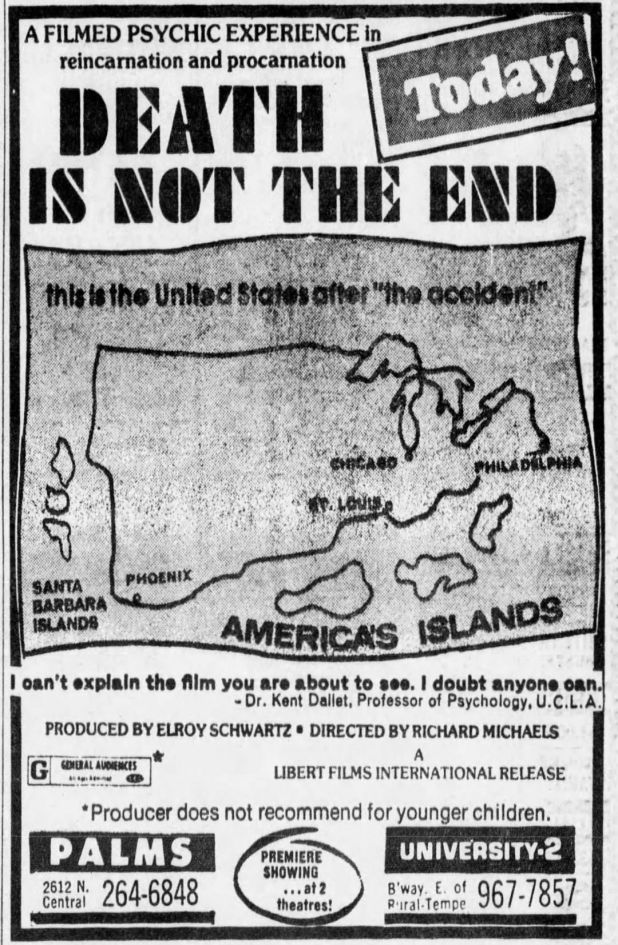
My Drive-In Asylum co-host Bill Van Ryn shared an ad for a movie that I’d never heard of on his Groovy DoomFacebook page and it has fascinated me. What could Death Is Not the End be? Dr. Kent Dallt, Professor of Psychology at UCLA, said “I can’t explain the film you are about to see. I doubt anyone can.”
While G-rated, this movie was not recommended for younger children.
So what is it?
That took some detective work.
First off, it was directed by Richard Michaels. He started his career as a summer assistant to legendary New York sportscaster Marty Glickman before becoming a script supervisor. He worked in this role on several films and TV series before directing episodes of Mr. Deeds Goes to Town and The Odd Couple, as well as producing Bewitched, a show he would direct 55 episodes of.
That show would change his life, as he and star Elizabeth Montgomery fell in love during the eighth year of the show, breaking up her marriage to William Asher and his to Kristina Hansen. They were together for two and a half years.
The rest of his career was spent in TV, mostly directing TV movies such as The Plutonium Incident, Scared Straight! Another Story, Heart of a Champion: The Ray Mancini Story, Leona Helmsley: The Queen of Mean and many more. He retired in 1994 and currently lives in Hawaii. His daughter, Meredith Michaels-Beerbaum, was the first woman to be ranked #1 in the world in equestrian show jumping.
In the midst of his career, in 1975, is Death Is Not the End, which was written by another TV veteran, Elroy Schwartz. The brother of Sherwood Schwartz, he and Austin Kalish wrote the original pilot for Gilligan’s Island, which went unaired until TBS showed it in 1992. He would continue to be a writer on the show along with his brother Al. In 2000, the Los Angeles Times reported that Schwartz and Kalish were suing Sherwood, saying “They charge that the older sibling has been cheating them out of “Gilligan’s Island” credits and royalties for decades. The dispute apparently began in 1963, when Elroy and Kalish say they wrote most of the pilot show. Sherwood was the producer and, as a favor, they honored his request and put his name on the script as a co-writer, the suit says. Ever since, they charge, Sherwood has tricked them out of their share of royalties and has controlled the rights to the show, which has made him as rich as, say, Thurston Howell III.”
Kalish was no neophyte to writing. He and his wife Irma wrote hundreds of television episodes, including memorable installments of Good Times, Maude and All in the Family. It is believed that he conceived the show’s characters, including giving each of them (and the boat, the S.S. Minnow) his or her name. In his obituary in The Hollywood Reporter, it was said that “Years after the show ended, Kalish said documents were uncovered that indicated he should have been entitled to one-quarter ownership of the series, worth about $10 million, but he received nothing.”
But back to Elroy Schwartz.
Before working in TV, he wrote for some of the best known comedians of the 40s and 50s, including Lucille Ball, Groucho Marx and Bob Hope. Outside of his writing work, Schwartz was a licensed hypnotherapist who specialized in past life regressions, which brings us closer to the truth of what exactly this movie is.
The AFI Catalog says, “Writer-producer Elroy Schwartz, president of Writer First Productions, signed a distribution deal for 75 IT with Libert Films International, the 7 Apr 1975 Box Office announced. The 25 Jul 1974 HR stated that 75 IT would premiere at the Atlanta International Film Festival in GA on 16 Aug 1976, but the 15 Dec 1975 Box Office claimed that the film’s premiere occurred a year later, on 8 Dec 1975, in Phoenix, Arizona. When a new releasing company, Dona Productions, took over distribution in 1976, the film’s title was changed to Death Is Not the End, according to production materials dated 6 Aug 1976 in the AMPAS library files. Schwartz, a Palm Springs, CA, hypnotherapist and television screenwriter, wrote in the document, “There wasn’t any established script. The movie is a “happening” — a spontaneous filming of a hypnotic regression into reincarnation, and “procarnation” — a look into the subject’s next life.” He described the film to the 15 Dec 1975 Box Office as a “filmed psychic experience.”
While Writer’s First only has this movie and episodes of the show Dusty’s Trail as released and Dona Productions seems made just to distribute this film, there’s plenty more info on Libert Films International, which seemingly was a tax shelter used to distribute films like Rum Runners, Angela, Encounter with the Unknown, The Great Masquerade, My Brother Has Bad Dreams, Mario Bava’s Roy Colt & Winchester Jack, The Devil With Seven Faces, Never Too Young to Rock, Willy & Scratch, Charlie Rich: The Silver Fox in Concert, Beyond Belief and Stevie, Samson and Delilah.
It was then picked up in 1977 by Cougar Pictures, who also distributed The Flesh of the Orchid, Starbird and Sweet William, Scream, Evelyn, Scream! and Beyond Belief.
The IMDB listing for this film is sadly absent of much info beyond this quick description — “The mystery of life eternal is discussed by a number of purported experts in various fields of metaphysical research, as well as individuals who assert that they’ve lived before.” — and the cast and crew. Let’s get into those.
Listed actors include Ken Dallet, Wanda Sue Parrot as a reporter and Jarrett X as a laborer, as well as Schwartz playing himself. So much for more information on the actors. As for the crew, IMDB lists Hal and Charles Lever as executive producers. And…another dead end.
What about the music? It came from Mort Garson, who wrote the song “Our Day Will Come,” which is on the soundtrack of Grease 2, More American Graffiti, Under the Boardwalk, Shag, Buster, She’s Out of Control, Love Field, The Story of Marie and Julien, You Should Have Left and Role Play. He was an electronic musician who released music based on the zodiac, so this makes sense.
The Zodiac’s Cosmic Sounds was a 1967 concept album released by Elektra Records that had early use of the Moog synthesizer by Paul Beaver (“a Scientologist, a right-wing Republican, unmarried, and a bisexual proponent of sexual liberation” who helped build Keith Emerson’s custom polyphonic Moog modular synthesizer, did the sound effects for The Magnetic Monster and composed the score for The Final Programme) with music written by Garson, words by Jacques Wilson and narration by folk musician and Fireside Theater producer Cyrus Faryar, all with instruments played by members of the Wrecking Crew studio collective, such as Emil Richards, Carol Kaye, Hal Blaine, Bud Shank and Mike Melvoin.
He was an early adopted of Moog and even though he wrote the theme song for Dondi, we won’t hold it against him. After all, he wrote the song “Beware! The Blob!” for the Larry Hagman directed sequel. His song as The Zodiac, “Taurus – The Voluptuary,” also shows up in several gay adult films of the early 70s, including the Satanic-themed Born to Raise Hell, which also uses his songs “Black Mass,” “The Ride of Aida (Voodoo),” “Incubus” and “Solomon’s Rising.”
That’s because Garson was also Lucifer, the electronic artist that released Black Mass — also called Black Mass Lucifer — that AllMusic reviewer Paul Simpson says is “a soundtrack-like set of haunting Moog-based pieces which interpret various supernatural and demonic themes.”
Even wilder, he also scored René Cardona Jr.’s Treasure of the Amazon, Paul Leder’s Vultures and Juan López Moctezuma’s To Kill a Stranger. And oh yeah — ten episodes of an Alex Trebek hosted game show, The New Battle Stars, had him compose the theme. On this show, celebrities seated in triangles answered game questions for the contestants. The object of the game was to capture three celebrities by putting out lights around them and the stars included Rip Taylor, Linda Blair, Jim J. Bullock, Fannie Flagg, Richard Simmons, Charles Nelson Reilly and more.
Alan Stensvold was the cinematographer for Death Is Not the End. He shot everything from Bigfoot and Wildboy to The Astral Factor, Dimension 5, Cyborg 2087, Thunder Road and the TV show Dusty’s Trail, which is where he had to have met Elroy Schwartz, who was the co-creator with his brother Sherwood.
This movie was edited by Joan and Larry Heath. While Joan has no other credits, Larry has a large portfolio of work on TV, including 106 episodes of Rhoda, 46 of Simon & Simon, the film Billy Jack and along with episodes of Gilligan’s Island, also worked on Dusty’s Trail.
All of these many facts don’t get me any closer to finding this movie or knowing more.
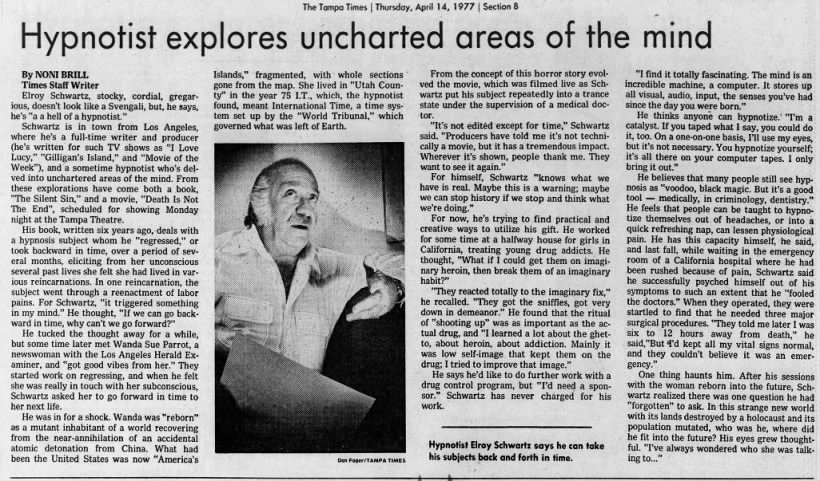
Luckily, there was an article in The Tampa Times from April 4, 1977 that gets me closer.
Hypnotist explores uncharted areas of the mind by Noni Brill
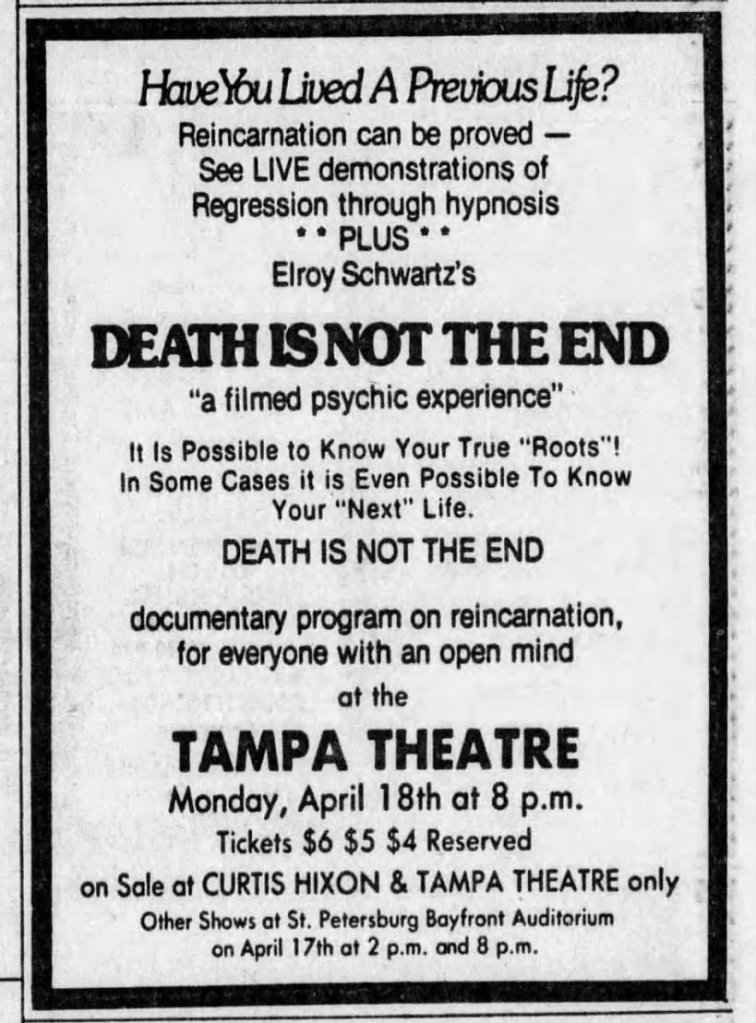
Elroy Schwartz, stocky, cordial, gregarious, doesn’t look like a Svengali, but, he says, he’s “a hell of a hypnotist.” Schwartz is in town from Los Angeles, where he’s a full-time writer and producer (he’s written for such TV shows as I Love Lucy, Gilligan’s Island and Movie of the Week and a sometime hypnotist who’s delved into unchartered areas of the mind. From these explorations have come both a book, The Silent Sin, and a movie, Death Is Not The End, scheduled for showing Monday night at the Tampa Theatre. His book, written six years ago, deals with a hypnosis subject whom he “regressed,” or took backward in time, over a period of several months, eliciting from her unconscious several past lives she felt she had lived in various reincarnations. In one reincarnation, the subject went through a reenactment of labor pains. For Schwartz, “It triggered something in my mind.” He thought, “If we can go backward in time, why can’t we go forward?” He tucked the thought away for a while, but some time later met Wanda Sue Parrot, a newswoman with the Los Angeles Herald Examiner, and “got good vibes from her.” They started work on regressing, and when he felt she was really in touch with her subconscious, Schwartz asked her to go forward in time to her next life.
He was in for a shock. Wanda was “reborn” as a mutant inhabitant of a world recovering from the near-annihilation of an accidental atomic detonation from China. What had been the United States was now “America’s Islands,” fragmented, with whole sections gone from the map. She lived in “Utah County” in the year 75 I.T., which, the hypnotist found, meant International Time, a time system set up by the “World Tribunal,” which governed what was left of Earth.
From the concept of this horror story evolved the movie, which was filmed live as Schwartz put his subject repeatedly into a trance state under the supervision of a medical doctor.
“It’s not edited except for time,” Schwartz said. “Producers have told me it’s not technically a movie, but it has a tremendous impact. Wherever it’s shown, people thank me. They want to see it again.” For himself, Schwartz “knows what we have is real. Maybe this is a warning; maybe we can stop history if we stop and think what we’re doing.” For now, he’s trying to find practical and creative ways to utilize his gift.
He worked for some time at a halfway house for girls in California, treating young drug addicts. He thought, “What if I could get them on imaginary heroin, then break them of an imaginary habit?”
“They reacted totally to the imaginary fix,” he recalled. “They got the sniffles, got very down in demeanor,” He found that the ritual of “shooting up” was as important as the actual drug, and “I learned a lot about the ghetto, about heroin, about addiction. Mainly it was low self-image that kept them on the drug; I tried to improve that image.” ‘ He says he’d like to do further work with a drug control program, but “I’d need a sponsor.” Schwartz has never charged for his work. ”
Hypnotist Elroy Schwartz says he can take his subjects back and forth in time. “I find it totally fascinating. The mind is an incredible machine, a computer. It stores up all visual, audio, input, the senses you’ve had since the day you were born.” He thinks anyone can hypnotize Tm a catalyst. If you taped what I say, you could do it, too.
On a one-on-one basis, I’ll use my eyes, but it’s not necessary. You hypnotize yourself; it’s all there on your computer tapes. I only bring it out.” He believes that many people still see hypnosis as “voodoo, black magic. But it’s a good tool medically, in criminology, dentistry.” He feels that people can be taught to hypnotize themselves out of headaches, or into a quick refreshing nap, can lessen physiological pain. He has this capacity himself, he said, and last fall, while waiting in the emergency room of a California hospital where he had been rushed because of pain, Schwartz said he successfully psyched himself out of his symptoms to such an extent that he “fooled the doctors.” When they operated, they were startled to find that he needed three major surgical procedures.
‘They told me later I was six to 12 hours away from death,” he . said,”But I’d kept all my vital signs normal, and they couldn’t believe it was an emergency.” One thing haunts him. After his sessions with the woman reborn into the future, Schwartz realized there was one question he had “forgotten” to ask. In this strange new world with its lands destroyed by a holocaust and its population mutated, who was he, where did he fit into the future? His eyes grew thoughtful. “I’ve always wondered who she was talking to…”
Schwartz is listed as the co-author — along with Dr. John Woodbury — of The Silent Sin: A Case History of Incest. He conducted the hypnosis that allowed the patients to recall their blocked memories of incest.
The Seventh Sense is another Schwartz book — “A web of murder. A mystery for forty years! Linda Packard was murdered in June, 1952. In April, 2000, Jenny Matthews is hypnotized and, although she does not believe in reincarnation, is regressed to a prior life – Linda Packard. Research proves the reincarnation to be true! With information from Jenny’s subconscious, as Linda, they identify her killer!” — that seems to be self-published on Amazon. He also wrote Enron to the 5th Power, VANISHED (The Snowbird Jones Mysteries), The Iron Christmas Tree, Hyena, The President’s Contract — “When the President of the United States joins forces with the Mafia, the bizarre result is the President’s Contract. Beautiful girls, Black Power advocates and the hilarious misadventures of the V-P complicate their scheme.” — and Tulsa Gold.
Amazon even has a bio: “Writing principally for television and film entertainment, the comedies and dramas of Elroy Schwartz have been enjoyed by millions of viewers over several generations. You may have seen his work in episodes of The Six Million Dollar Man, It Takes a Thief, The Lucy Show, Gilligan’s Island, Baywatch, The Brady Bunch, Policewoman, McHale’s Navy and General Hospital as well as the original or reruns of his movies for television, The Alpha Caper and Money To Burn, among others. Elroy has also worked as an executive story editor, consultant and producer. Today he writes mystery and adventure stories for print and e-book publication. Elroy and his lovely wife Beryl are longtime residents of Palm Springs, California, which is also home of the historic Agua Caliente Indian Reservation. The largest collective landowner in the area, this sovereign tribe stewards more than 31,500 acres of ancestral lands, including the protected Bighorn sheep habitat. The Agua Caliente Band of Cahuilla Indians owns two major casinos and hotels, the Spa Resort Casino in downtown Palm Springs, and the Agua Caliente Casino in Rancho Mirage, California. One of the Indigenous Peoples of North America, the tribe strives to maintain its cultural heritage and past, while supporting and helping to develop the communities of Palm Springs, Cathedral City, Rancho Mirage, and other areas of Riverside County.”
Sadly, Elroy died in 2013 and if this movie is to be believed, he’s moved on to his next life.
The problem is, that’s all I can find about this film.
So this is where I’m asking for help.
If you know anything else about Death Is Not the End, if you have a print, if you’ve seen it — email me at bandsaboutmovies@gmail.com
Doris Wishman week (July 21 – 27) Doris made the loopiest of movies. A self-proclaimed prude who made nudist camp movies, her filmography is filled with contradictions. When she tried to be mean spirited with something like Bad Girls Go To Hell there was always an undercurrent of silliness and fun, but when she tried to be silly and fun in things like Keyholes Are For Peeping there was an underlying seediness and grime that couldn’t be wiped off. It’s hard not to love her!
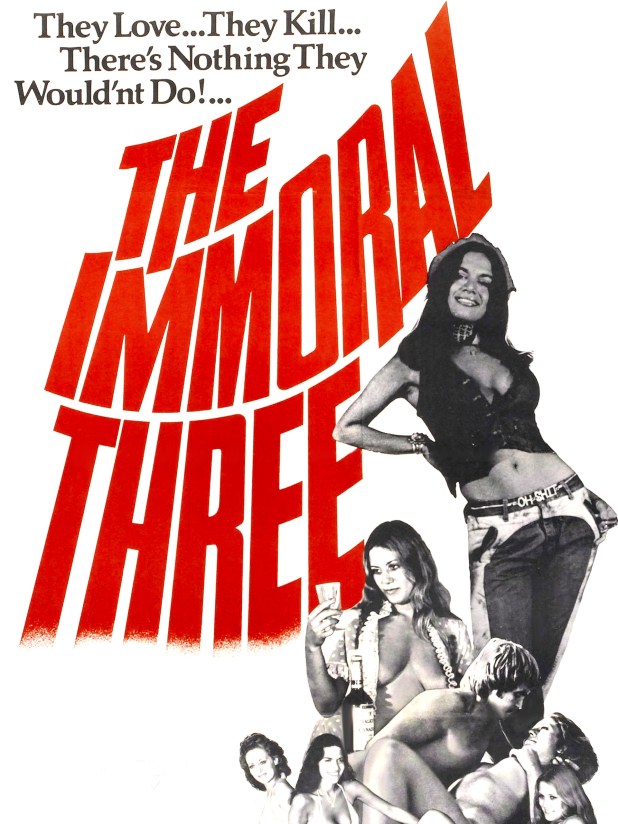
There is a Doris Wishman cinematic universe. This is the sequel to Double Agent 73, as Jane Genet (Chesty Morgan, who didn’t come back for this, as she upset Wishman when she cost her a full shooting day the last time they worked together; in her brief moment in the film she’s played by Cindy Boudreau) has died after being strangled while she was sunbathing and her three daughters — who had no idea each other existed — are brought together for the reading of the will by John Erikson (Robert S. Barba).
Ginny (also Boudreau), Sandy (Sandra Kay) and Nancy (Michele Marie) are charged by the will to get revenge for the death of their mother. If they kill her killer — killers? — in a year, they each get $1 million dollars. If one of them dies, they each get $1.5 million and, well, you can do the math if only one survives. If they all die, Erikson gets the money.
Is this a giallo? Holy shit, yes. There’s a black gloved killer on the loose!
There are four suspects for who the killer could be. All four of these men could also be any of their fathers. But before we get to all that story, Kay decides to fellate a banana in front of a gardener, then do the same to him while we see her banana-loving face superimposed over his. It’s mind-numbing in the way all Wishman’s movies can be and it’s just getting started.
Is Doris Wishman the American Jess Franco? Both have a banana lovemaking scene in their films. Or is she the American Bruno Mattei? Both have no issues just outright taking shots from other movies.
Sandy gets attacked by a grocery boy and Ginny makes love in an elevator for no reason other than the fact that she’s a character is a Wishman movie. Everyone has their feet focused on, slow moving on thick shag carpet or rolling in bed. Ginny does all the heavy lifting, heading off to Vegas and New York City, while the others stay in Fresno, but hey — Sandy has an “On Shit” belt buckle, so who are we to deny her lack of need to move this movie forward?
Written by Judy J. Kushner (who also wrote the first two movies in this series, Deadly Weapons and Double Agent 73) and Robert Jahn (The Yum Yum Girls, Bloodrage), this is one of the most deranged movie I’ve ever seen and imagine the ground that covers. The whole thing ends like Shakespeare and by that I mean — spoiler warning — everyone dies, but not before you find the real dad, you get declarations of love and Doris’ apartment plays Munich.
Doris Wishman week (July 21 – 27) Doris made the loopiest of movies. A self-proclaimed prude who made nudist camp movies, her filmography is filled with contradictions. When she tried to be mean spirited with something like Bad Girls Go To Hell there was always an undercurrent of silliness and fun, but when she tried to be silly and fun in things like Keyholes Are For Peeping there was an underlying seediness and grime that couldn’t be wiped off. It’s hard not to love her!
After years of softcore, Doris Wishman directed two hardcore pornographic features. We already covered Come With Me, My Love and Wishman directed another movie — this one — with that film’s star, Annie Sprinkle. Wishman made more films than any other female director of the sound era and she didn’t really enjoy making hardcore; she denied these movies for years.
Claudia (Bree Anthony, also known as Gloria Hadott, Lauri Suesan, Bree Anthony Fredericks, B. Anthony Fredericks and Sue Richards, the name she used as the editor of High Society) and Victor (Tony Richards, the Tweedledee to Anthony’s Tweedledum in Bud Townsend’s Alice in Wonderland: An X-Rated Musical Fantasy) are engaged, but that won’t stop her sister Terry (Sprinkle) from sleeping with her sister’s fiancee. He’s not exactly innocent, as he’s also sleeping with C.J. Laing — and who would blame him? — while Terry’s mother and Claudia’s stepmother Ada (Sandy Foxx, who also used the alter egos Diana Ames, L’il Annie, Sandy Morelli and Sandy Sludge; she was married to director Lawrence T. Cole) is ready to cheat everyone out of their inheritance.
The inner voices of the sisters comes from Wishman; this also has an ending — spoilers! — where Terry gets Victor a poisoned glass of water, putting Claudia into shock for the rest of her life. Who in the raincoats on 42nd Street realized they were watching Wishman cover Diabolique?
Also: none of the bodies in this movie look like women in adult today and Annie Sprinkle to this day remains as wild and incredible as she was then.
EDITOR’S NOTE: The Devil’s Rain was on the CBS Late Movie on November 2, 1979, August 13, and October 24, 1980.
The Devil’s Rain! is a movie that could only have been made in 1975. It united old Hollywood royalty, television stars, the visionary director of The Abominable Dr. Phibes and the Church of Satan in the Mexican desert.
It is not a perfect movie. You can’t even say that it has plot holes, as that would require something of a coherent plot — a fact director Robert Fuest was all too aware of. On the sparkling commentary track that accompanies the new Blu-ray release from Severin (picked up from the Dark Sky DVD release), he speaks about discussions with the writers (Gabe Essoe, James Ashton and Gerald Hopman, whose only credit is co-producing Evilspeak, so one assumes that he is Satan) where they assured him that the script made perfect sense. While Fuest claims that he did what he could to clear up his issues with the film, a movie that effectively decimated his promising directorial career emerged.
But you know what? I embrace plot holes the way some critics hold dearly onto their Criterion collection films and back issues of Premiere. There’s no way I can be objective about The Devil’s Rain! The only box it doesn’t check for me is a disclaimer stating that it’s based on a true story.
The film begins with close-ups of Bosch’s painting The Garden of Earthly Delights, along with the wails of the damned as they gnash their teeth in Hell. Then, we’re dropped into the lives of the Preston family, who have suffered under a curse for hundreds of years.
Turns out that at some point in the 18th century, the family screwed over Jonathan Corbis (Ernest Borgnine, Escape from New York), a Satanist who was eventually burned at the stake. He had a book containing the souls of all he had damned, which was stolen by Martin Fyfe (William Shatner, who I don’t need to tell you anything else about). Before he dies, Corbis vows revenge on the Fyfe family, which changes its name to Preston. He’s been stealing them one by one, selling their souls to Satan and trapping them in the devil’s rain. They then become living wax figures with melting eyes and black robes.
That’s how we meet Steve Preston, the leader of the family, who has escaped Corbis to warn his wife (Ida Lupino, an actress (and director) known for noir classics like The Bigamist and On Dangerous Ground. She often referred to herself as the poor man’s Bette Davis, as she was usually offered the parts that Davis had turned down. She refused those parts so many times that Warner Brothers suspended her, so she used that time to learn the craft of directing on set. As roles for her slowed, she became the second female director admitted to the Director’s Guild, following Dorothy Arzner, the sole woman director of Hollywood’s “Golden Age.”) and son, Mark (also Shatner). As the old man tells them to return the Book of Souls, he melts in the rain.
So what does Mark do? He takes the book directly to Corbis, challenging him to a battle of faith in the desert. That battle quickly turns into Mark trying to escape, but Corbis’ disciples are too much for him. He shows a cross to the priest, who transforms it into a snake before using a ritual to erase Mark’s memory in preparation for a major ceremony.
Oh, the 1970s — when your main character gets wiped out minutes into a movie because he has to leave town for a three-day Star Trek convention in New York. That really happened, and I have no idea if that was why Shatner went from hero to geek in such record time.
Mark’s older brother Tom (Tom Skerritt, Alien) and his wife, Julie, must save the day. Oh yeah — they also have Dr. Sam Richards (Eddie Albert from TV’s Green Acres) along for the ride, as he’s a psychic researcher.
Finding Corbis’ church, Mark watches the ceremony that converts his brother into a wax follower. Anton LaVey shows up under a hood, and Corbis turns into a goat, which is an event that sent me scrambling through our living room in a paroxysm of glee. The Severin release also contains interviews with the Church of Satan’s High Priest Peter H. Gilmore, High Priestess Peggy Nadramia and LaVey’s wife and biographer Blanche Barton, all of whom share anecdotes of the Black Pope’s time on the set (indeed, it seems to be a madcap time by studying the photos they show, with LaVey in a jaunty leather cap smiling like a child on Walpurgisnacht) and input on the film. He’s nearly caught but also discovers that the source of Corbis’ power is the devil’s rain, a glass bottle containing the souls that the priest has captured.
But wait — if he has the devil’s rain, why did he need the book? If he came back to life, why does he need revenge? Look — perhaps these questions will derail your enjoyment of The Devil’s Rain! But not me.
During the final battle — the film moves incredibly fast, making ninety minutes feel like half an hour — the devil’s rain is destroyed by Mark, who finds his lost humanity. Then, it starts to rain.
I love how the advertising for this film states that this is “absolutely the most incredible ending of any motion picture ever!” They aren’t lying. Corbis and his followers melt for nearly ten minutes of special effects, turning into piles of goop. It’s over the top and ridiculous and extraneous and totally awesome. I use This kind of scene to determine if I can be friends with someone. If you dismiss it, you’ll never share a beer with me.
Producer Sandy Howard (who also was responsible for Meteor, Blue Monkeyand the A Man Called Horse series) based his whole ad campaign around the end of the film, so he took over the final cut to ensure that this sequence would last and last.
Tom and his wife — whose ESP is the sole reason we can see the flashbacks to know why Corbis is doing what he does — make it out alive, but as he embraces his wife, we see that he’s really hugging Ernest Borgnine! Where’s his wife? Trapped in the devil’s rain, in a scene that comes back at the end of the credits that is harrowing as she looks out into the darkness with no hope.
Is The Devil’s Rain! a good movie? Well, that depends on your perspective. Despite the flimsy plot, Fuest succeeds at delivering plenty of pure weirdness and gorgeous visuals. And there’s so much talent on the screen — I didn’t even mention that this is one of John Travolta’s first films and that Keenan Wynn (Piranha, Laserblast) shows up as the sheriff.
Plus, like all 70’s occult movies, plenty of legends are behind the film. Like Ernest Borgnine claiming that there were so many accidents on set that he’d never work on a Satanic fmovieagain. Or he was saying that the Mafia produced the film and that he was never paid. Cinefantastique magazine even wrote that Fuest had suffered a nervous breakdown during the making of the movie, a fact he disputes on the commentary track. And LaVey claimed that he did a special success ritual for Travolta.
PS – Here’s the link to a June 1975 Argosy interview with LaVey during the filming of The Devil’s Rain! where he discusses buying the panties of “MGM’s most famous stars- from Greer Garson to Liz Taylor – with the labels still on them,” being minimized on movie sets and Ernest Borgnine accepting an honorary priesthood.
Bleeding Skull’s Top 50 (July 7 – 13) The middle-brow champions of low-brow horror, Bleeding Skull has picked out some of their favorites from the SWV catalog. They neglected to put I Drink Your Blood or EEGAH!on the list, but I think I can forgive them since they included Ship of Monsters.
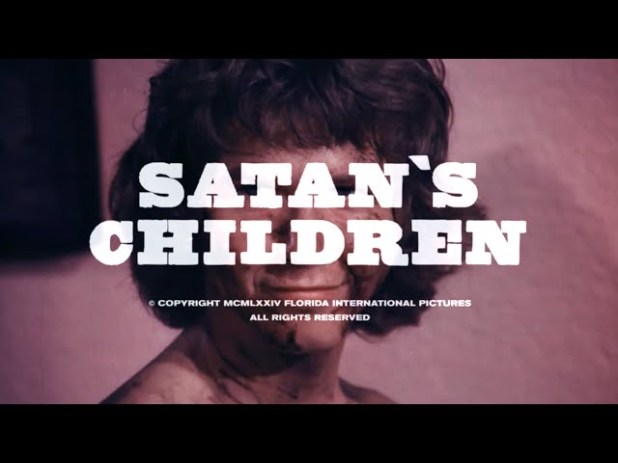
Runaway teen Bobby Douglas (Stephen White, Gas-s-s-s) is given shelter by a cult of Satanists, but both his presence and questionable sexuality leads to conflicts within the group.
To be fair before we begin — The Church of Satan statement on homosexuality is that they “fully accept all forms of human sexual expression between consenting adults. The Church of Satan has always accepted gay, lesbian, bisexual and asexual members since its beginning in 1966. This is addressed in the chapter “Satanic Sex” in The Satanic Bible by Anton Szandor LaVey.”
Made by filmmakers from the gutters of Tampa on short ends as AGFA tells it — Joe Wiezycki also made the movie Willy’s Gone — Satan’s Children was made with students from the University of South Florida drama department.
Bobby escapes his father’s insults and his stepsister’s sexual suggestions — you thought incest only happened like this via Pornhub — to unknowingly end up at a gay bar. All the horror stories from Cruising are true — he’s soon having a train run on him in the grimy backseat of a car against his will. Yep, they drive all around while yelling things as they roger him, then leave him face down and ass up in a field.
So what would you do? Well, if you’re Bobby, you’d join a Satanic coven and get your revenge. After all, Florida may be the home of Disney resorts, but it’s also the birthplace of bands like Nasty Savage, Marilyn Manson, the Genitorturers, Deicide and, well, Creed.
Everybody in this movie is too sweaty, too pale and too frightening to behold. This is all you need to know of Florida to beware of its darkness. The gay bars even look like a diner and not any place that I’d imagine them to appear like. Every scenario here is concrete block and wood-paneled, covered in years of filth, dust and scum.
The first time I saw legit non-Playboy VHS porn was a movie that later research would tell me was 1984’s I Like to Watch with Lisa De Leeuw, Mike Horner, Herschel Savage and Bridgette Monet. It was upsetting. The people looked too strange, too slovenly, too unsexy — exactly the opposite that I thought porn would be.
This movie brought back that queasy feeling, which kind of made me nostalgically happy for films that can still upset me. It’s wonderful to know that that can still happen.
Bleeding Skull’s Top 50 (July 7 – 13) The middle-brow champions of low-brow horror, Bleeding Skull has picked out some of their favorites from the SWV catalog. They neglected to put I Drink Your Blood or EEGAH!on the list, but I think I can forgive them since they included Ship of Monsters.
In 1965, director Massey Cramer and writer Bob Corley made The Legend of Blood Mountain. It’s a comedy about reporter Bestoink Dooley (George Ellis), who comes to Blood Mountain to learn about the legend — see what I did there? — of the creature who is said to rise when a drop of blood is spilled. Everyone else thinks there’s a serial killer, even if we didn’t know what that word meant, as Robert Ressler first used it in a presentation in 1974.
In 1975. Donn Davison — the manager of the Dragon Art Theatre in Gainesville, FL, as well as the director of the “Asylum of the Insane” inserts in She-Freak, Honey Britches and Moonshiner’s Woman, plus the producer of Secrets of the Gods and The Force Beyond; even more, he was a hype man for Film Ventures International and played a folklore expert in Crypt of Dark Secrets and the antiquities expert in Mardi Gras Massacre — must have seen how much money that The Legend of Boggy Creek was making. So he took that aforementioned movie — now ten years old — and added on some “real people” and himself up front as an expert. Then, he shared it with the world.
When he refers to himself as a “World Traveler, Lecturer and Psychic Investigator” who are we to say he isn’t?
If you’re wondering who Bestoink Dooley is, he was the host of the Big Movie Shocker, which aired on Fridays at 11:30 p.m. on Altanta’s WAGA-TV Channel 5. Played by George Ellis, he was also in the movies Swamp Country, Honey Britches (which was renamed and re-released as both Shantytown Honeymoon and later Demented Death Farm Massacre) and Moonrunners, as the villain Jake Rainey. That movie kind of disappeared, but would return when its director Gy Waldron took the concept and narrator Waylon Jennings and went to Hollywood to sell it as The Dukes of Hazzard. Ellis never got to play Boss Hogg.
According to this amazing article in Oxford American, “The Bestoink Dooley Fan Club,” Ellis also bought a theater known as the Festival Cinema. Atlanta magazine described it as a venue where “patrons would often come as much as 30 minutes before the show started to sit in the plush lobby in white sculptured chairs and leaf through copies of Sight and Sound or talk in muted voices and sip the complimentary Viennese coffee.” Despite introducing the city to the French New Wave and New German Cinema, Ellis was broke. So he started showing porn and got arrested for obscenity. Years later, he’d open other theaters — the Film Forum at Ansley Mall, the Film Forum on Peachtree and the Bijou Cinema — all places where “You can trace the roots of Atlanta’s film culture through these theaters.”
As if this movie doesn’t have enough nexus points, the bikini-clad daughter of a town doctor who falls for Dooley by the name of Phyllis Stinson is played by Erin Fleming. She’s also in Hercules in New York, Everything You Always Wanted to Know About Sex* (*But Were Afraid to Ask) and Sheila Levine Is Dead and Living in New York but is best-known as the secretary and manager of Groucho Marx. While many of the actor’s friends admitted that she did much to revive his popularity and getting him an honorary Academy Award Marx, many also believed that she psychologically and physically abused him. After his death, she was ordered to repay $472,000 which she had taken from his estate. She’s gorgeous in this movie, yet sher life went so wrong over the last few decades she was in this plane of reality. She was diagnosed with paranoid schizophrenia, arrested for carrying a concealed and loaded gun and lived out the rest of those dark years homeless and delusional before shooting herself at the age of 61.
Nearly everyone in this is either overacting, reading off cue cards — Davison is wearing sunglasses so you can’t tell that he is doing exactly that — or repeating lines because they think that someone is going to edit this movie.
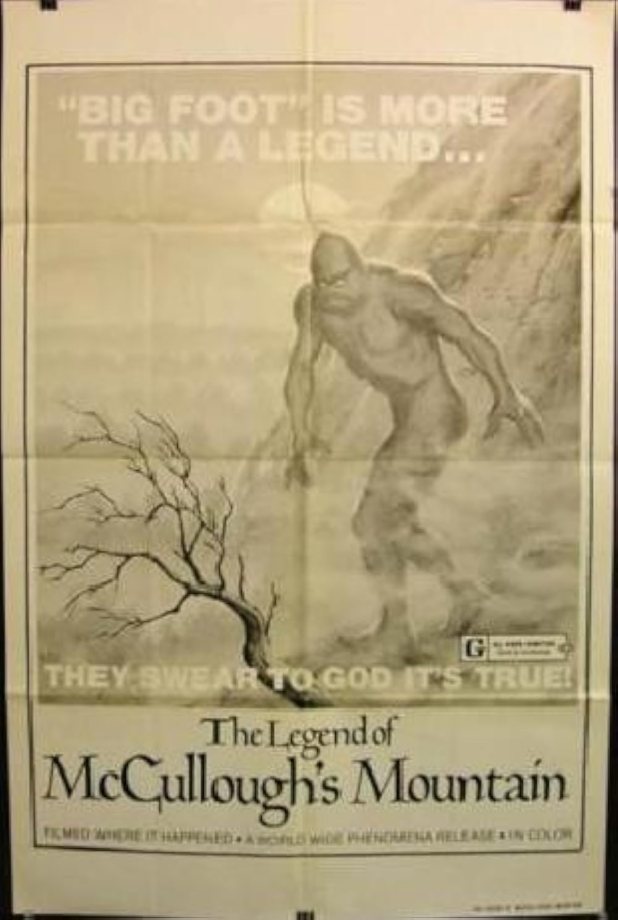
Well, there is editing ten years later, as the strange original monster has been replaced with fog and a sasquatch.
“BIG FOOT” is more than a legend… They swear to God it’s true!” That’s the kind of words that get people in theaters and drive-ins. You know what else helps? Having your own theme song.
“The Ballad of McCullough Mountain” by Tim York is the kind of theme kind of demanded after Boggy Creek. As for three year old me, this movie may have terrified me as much as the frozen Bigfoot that came to the parking lot of my K-Mart. My aunt went to see it and brought back pictures. I remember yelling at her, because now Bigfoot knew that I knew he was here.
EDITOR’S NOTE: Mitchell was on the CBS Late Movie on October 1, 1980.
Mitchell reveals a lot of misconceptions.
First: Joe Don Baker was once presented as the kind of sex symbol who didn’t just get Linda Evans in bed, he was kind of angry about it.
Second: Mitchell was not intended to be riffed on. And yet here we are, with a movie that most people know from the final episode that Joel was on Mystery Science Theater 3000.
Then again, critics hated this when it came out in 1975. Vincent Carnaby said, “Mitchell, starring Joe Don Baker as a hard-nosed Los Angeles detective named Mitchell, has a lot of over-explicit violence, some gratuitous sex stuff and some rough language, yet it looks like a movie that couldn’t wait to get to prime-time television. Perhaps it’s a pilot film for a TV series, or maybe it’s just a movie that’s bad in a style we associate with some of the more mindless small-screen entertainments.
Mitchell spends what seems to be the greater part of the film climbing in and out of automobiles, driving automobiles, chasing other automobiles, parking automobiles, and leaning against the body of automobiles that are temporarily at rest. Once he smashes a hoodlum’s hand in the door of an automobile.
The climax, for a giddy change of pace, features a police helicopter in pursuit of a high-speed cabin cruiser. Automobiles sink when driven onto water.”
He could have been right. After all, the cut that aired on the CBS Late Movie was heavily edited with scenes shot just for TV, eliminating most of the violence, nudity and profanity. It also has the death of John Saxon’s character happen off screen, where we hear about his death on the radio. Keep in mind that he’s presented as Mitchell’s arch enemy.
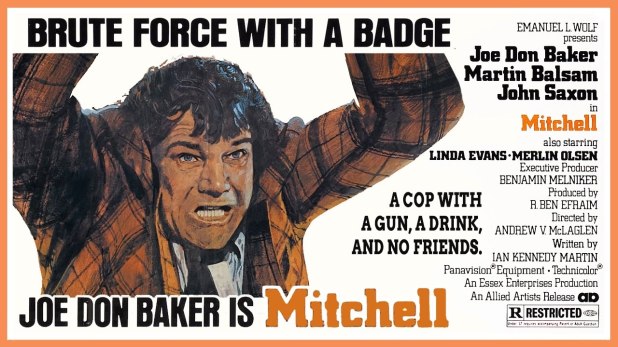
Mitchell (Baker) is after Saxon’s character, Walter Deaney, but learns from the Chief of Police (Robert Phillips) tells Deaney is wanted for “every federal law violation in the book” and “FBI property.” This doesn’t stop Mitchell, who wants to go after him instead of staking out James Arthur Cummins (Martin Balsam), a crime boss shipping in heroin. To get him off the case, Deaney hired $1,000 a night call girl Greta (Linda Evans) to keep him busy. Instead, Mitchell arrests her for possession and even turns down a bribe. Soon, Deaney and Cummins are working together to kill our slovenly hero.
If you enjoy larger men battling, this has Baker fighting Merlin Olsen. I mean, we’ve already imagined a world where a high priced sex worker wants to sleep with Baker for free. Why not?
Directed by Andrew V. McLaglen (The Wild Geese, The Sea Wolves, Sahara) and written by Ian Kennedy Martin, this also has a great theme song, “Mitchell” by Hoyt Axton.
“My my my my Mitchell
What do your Mama say?
What would she do
if she knew you
were fallin’ round and carryin’ on that way…
Crackin’ some heads, jumpin’ in and out of beds
and hangin’ round the criminal scene…
Do you think you are some kind of a star like the guys on the movie screen…
Well oh my my my Mitchell
What would your captain say?
If he knew you was hangin’ round
Eatin’ with the crooks and shootin’ up the town
Know you been out there, roundin’ up the syndicate
succeedin’ where the others have failed
Oh my my my Mitchell
You shoot ’em just to get ’em in jail
When they take a look in the record book, they’ll find you got a lot of class…
The whole shebang, arrestin’ painted ladies for a little grass
Oh my my my Mitchell!”
Supposedly, Baker was so upset by this being on Mystery Science Theater 3000 that he threatened to fight anyone from the show if he saw them. That didn’t stop them from also doing another of his movies, Final Justice — another movie in which he uses an orange to prove how he is going to destroy someone — on the show.







 B&S About Movies
You must be logged in to post a comment.