School of the Holy Beast (1974)

School of the Holy Beast is a sacrilegious blast of exploitation that combines pinky violence, nunsploitation, Bava-esque colors and some of the wildest moments you’ve ever seen in a movie maybe ever. Japan is not Christian or even Catholic, yet somehow they love to make nunsploitation films. This movie proves that they come close and may even go further than their Italian moviemaking competition.

Maya Takigawa (Yumi Takigawa, Karate Bearfighter) has become one of the sisters of the Sacred Heart Convent to learn why her mother was whipped and hung herself before in death giving birth to Maya. I’m sure you can figure out that the Abbess Sadako Matsumara (Yoko Mihara) was the one who was always jealous of Maya’s mother Michiko and that the man who was her father is the blind Father Kakinuma (Fumio Watanabe). Yet this movie embraces style — and excess — and delivers everything you come to these movies for and more, include self-flagellation, sinful nuns, a nun forced to drink salt water and be held over a portrait of Jesus to see if she’s possessed and will urinate all over it, evil nuns falling through trap doors and getting launched out windows and being impaled on a fence and a scene where the nuns all whip another with roses after she’s tied up with rose thorns and small motion petals dance in front of the camera and blood slowly makes its way, as red as any fake hemoglobin that Mario Bava committed to screen against the lush green of the vines. Has blasphemy ever looked so gorgeous?

It all ends on Christmas night, as the priest makes love to his daughter — he didn’t know until its too late — before being stabbed with a crucifix by the ghost of Maya’s mother and then the camera spins and sails into the ceiling to show him dead in the shape of an upside-down cross

Norifumi Suzuki is definitely going to Hell but at least he left this behind to corrupt more souls who will join him in eternal torment. He made fifty more movies, including the incredible Hoero Tekken,and Karei-naru tsuiseki as well as another movie filled with sleaze, Sex and Fury.  Suzuki also directed the ten-movie Torakku Yarō series in which Momojiro Hoshi and Kinya Aikawa race around Japan in dekotora or highly decorated trucks. I need to watch everything he made. He often worked with his co-writer on this movie, Masahiro Kakefuda.

Imagine if an Italian Gothic horror film, a giallo and a nun film all got together, got high and talked about the issues behind everything man has endured. That gives you a clue of just how wild this movie gets, except it may even defile — not a typo for defy — your expectations so much further.

You have to love a heroine who literally destroys an entire convent and then just walks the street of the city, away from this secret world and back in the world of the living, no one knowing the things that she’s seen or what she’s done.

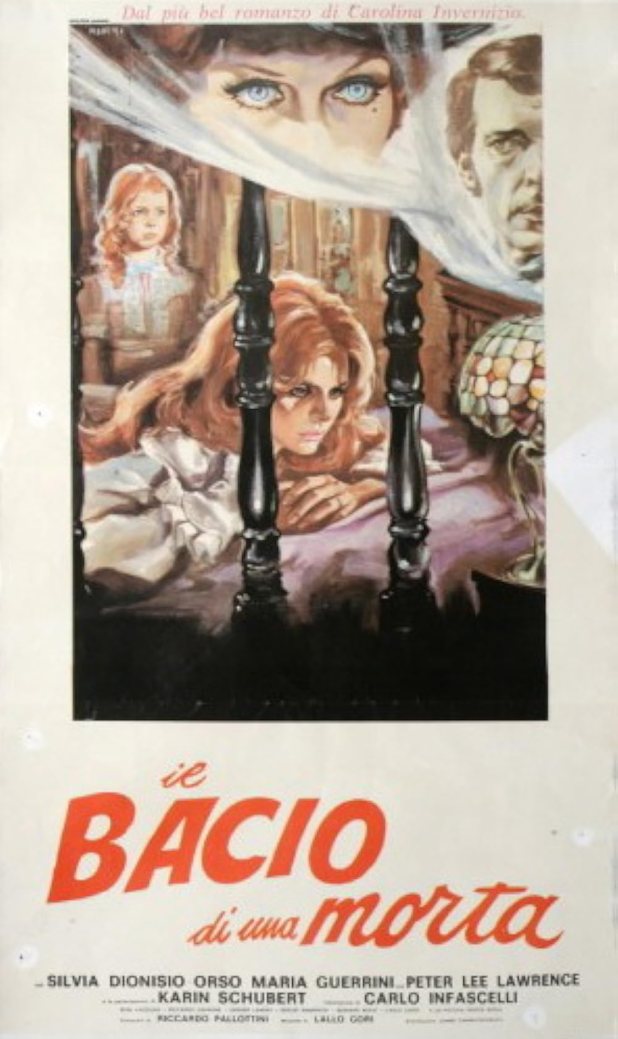
Il Bacio Di Una Morta (1973)

The Kiss of a Dead Woman was directed by Carlo Infascelli (Forbidden Decameron) and would be his last film. It was written by Infascelli, Adriano Bolzoni, Tatiana Pavoni and Gastone Ramazzotti and was based on the same novel, Carolina Invernizio’s Il Bacio Di Una Morta, as the better-known film of the next year, Il Bacio. It was also made into a film in 1949.

The story is the same. It begins with Clara (Silvia Dionisio, Live Like a Cop, Die Like a Man) supposedly dead and her brother Roberto (Peter Lee Lawrence, Killer Caliber .32) saving her by asking to see her body and realizing that she is still breathing. We see in flashback how brother and sister loved one another but she married Count Guido di Lampedusa (Orso Maria Guerrini, The Big Racket), a relationship that seemed good until he fell for singer Yvonne Rigaud (Karin Schubert, Emanuelle Around the World), who plans to take him for her own and murder Clara. Her husband comes to his senses and saves his wife, giving us a happy ending that seems too simple.

That said, this feels more giallo than Mario Lanfranchi’s version of the story with a black gloved poisoner shown in POV shots and even an attempted assault at the close of the story.

Peter Lee Lawrence was the AKA of Karl Hirenbach, a German actor who mainly worked in Italian Westerns. He also appeared in photo comics as Pierre Clement and sadly died of a brain tumor at the too young age of just thirty. As for Karin Shubert, she had a sad life as well. After a career appearing in Italian exploitation films from Westerns to commedia sexy all’italiana and very late Eurospy like Missile X: The Neutron Bomb Incident, she starred in several Joe D’Amato films. That’s not the sad part. That comes in when we learn that she was divorced and her son’s drug addiction led to him having violent outbursts, often directed at her. His treatment was expensive, so she went from posing nude to adult films until retiring in 1994. That year, she tried to mix barbiturates with vodka to escape life but was rescued by neighbors. Two years later, she killed herself by carbon monoxide poisoning.

This movie feels like it was filled with tragedy, as Carlo Infascelli retired after this, as the death of his producer son Roberto was too much. Add to that Riccardo Pallottini, the cinematographer, who was killed in a plane crash while making Tiger Joe for Antonio Margheriti.

Less horror than costume drama, there’s still a lot to like in this film.

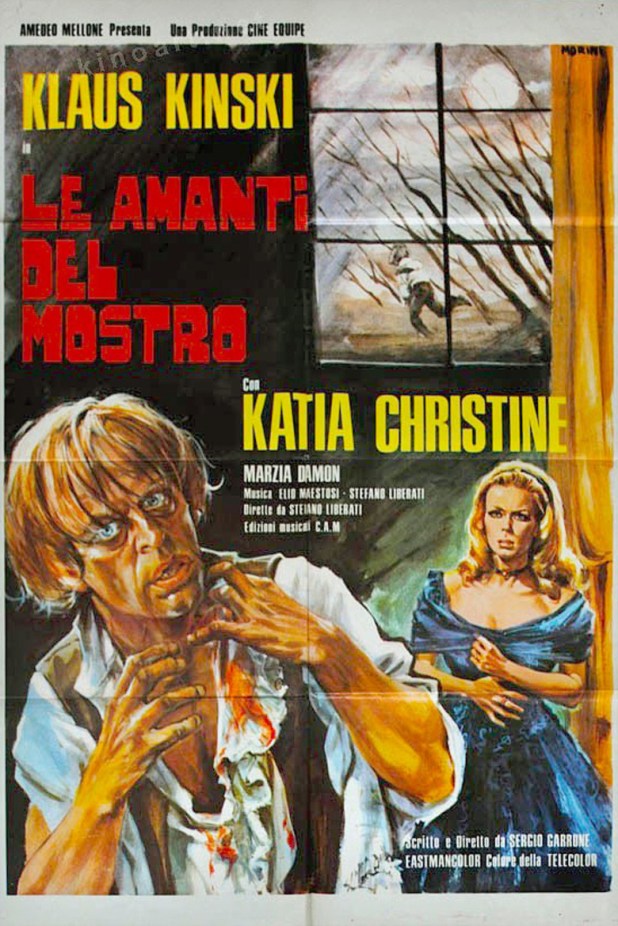
Lover of the Monster (1974)

Filmed at the same time as The Hand That Feeds the Dead, this was also directed and written by Sergio Garrone. It uses a similar cast and crew which is why so many confuse these films for each other. They also share some footage, so that is an easy mistake to make.

Anna (Katia Christine) is the heiress to the Rassimov fortune. The Ivan Rassmimov fortune? Well, if they built that crypt for The Hand That Feeds the Dead, they weren’t going to spend more money getting another last name put on it!

She brings her husband Alex (Klaus Kinski) to her family’s home, where he soon finds the diary of — yes! — Dr. Ivan Rassmimov, who learned how to reanimate the dead with electricity. Alex is impotent and despises his rival Dr. Walewsky (Ayhan Isik), who makes no secret of how he wants to cuck his rival. As he works on learning how to defeat death by attempting to bring his wife’s dead dog back, Alex is electrocuted and gets another personality because that’s how science works. He starts killing people, including his wife but he assaults her first because this is an Italian exploitation movie, and then has his conscience come back. A villager has been blamed for his crimes, so he runs to the city to stop an innocent man from being lynched. It’s too late — the man is already dead — and as Alex climbs the gallows, he is shot and killed.

Don’t believe the cast list you see online. Carla Mancini, Alessandro Perrella and Stella Calderoni aren’t in this movie. If you’re one of those people — I walk among you — that try to find Mancini in movies, well, save your time and energy for one of the other 240 movies that she may or may not be in.

This movie is an absolute mess, as production was halted and by the time shooting started again, Kisnki was gone. That’s why so much of it uses POV shots, stand-ins and murder scenes from The Hand That Feeds the Dead. You have to admire that kind of carny ingenuity, right?

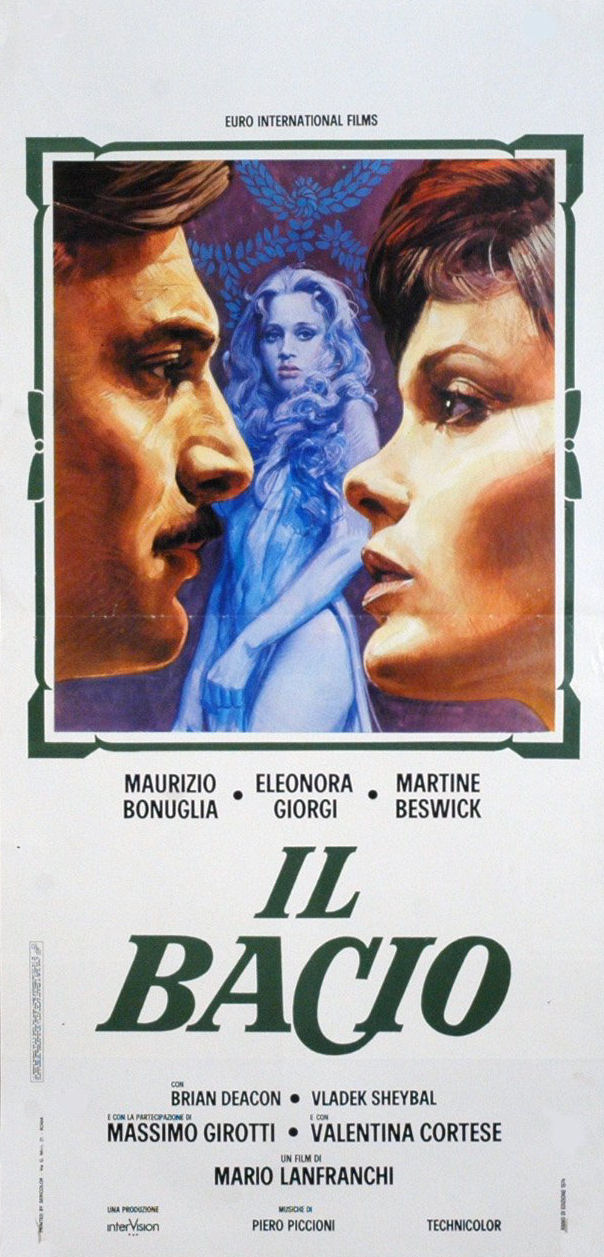
Il bacio (1974)

The Kiss or The Kiss of Death was directed by Mario Lanfranchi (Death Sentence), who also wrote the script with Pupi Avati. It’s based on Il bacio di una morta by Carolina Invernizio, which was already adapted by Guido Brignone in 1949 and Carlo Infascelli just a year earlier in 1973.

Countess Elena Rambaldi (Eleonora Giorgi) has a half-brother named Alfonso (Brian Deacon) who has been exiled by their father, Count Rambaldi. When Alfonso comes home and embraces his sister, it upsets the elder Rambaldi so much that he dies from a heart attack. Elena inherits his fortune and soon falls in love with Guido (Maurizio Bonuglia) and goes to Venice for their honeymoon, which does not last long as he’s soon enraptured by a dancer named Nara (Martine Beswick). She convinces him that his wife and her brother are lovers. He responds by allowing his new lover to poison Elena, who is brought back to life by a kiss from her brother while lying in her coffin. Guido sees that he was wrong and leaves Nara, who accuses him of killing his wife. 

In Robert Curti’s book Italian Gothic Horror Movies 1970-79, he states that this movie was based on an Italian feuilleton or serial novel, which was the literary ancestor of the Italian Gothic, creating a mixture of melodrama, horror and romance.

Avati added occult elements to the story, like the sapphic witch Madame Lixen (Valentina Cortese) who conducts Satanic masses and has a volcanic scene with Beswick. There are also horror elements here, like when Guido searches for his wife’s ghost throughout the streets of Venice and Nara dances for him with a bra that has demonic hands cupping his breasts.

It’s not really horror, not really romance, but actually pretty good.

You can watch this on YouTube.

THE MOVIES OF AL ADAMSON: Dynamite Brothers (1974)

You know how Reese’s Peanut Butter Cups old commercials used to go? Well, the makers of this movie got a real smart idea. They took the two big trends of the early 70s — blacksploitation and martial arts — and made one movie with both of them.

Stud Brown (Timothy Brown, a former NFL player who was also on M*A*S*H*) and Larry Chin (Alan Tang) unite to battle drug dealers and find Chin’s brother Wei (James Hong). They’re up against a corrupt cop named Detective Burke (Aldo Ray!) and the disappearance of our hero’s brother may not be as tragic as it seems.

What makes this movie worth watching is the dream team of director Al Adamson and producer Cirio H. Santiago. Lovers of truly bottom basement movies see these two names and feel a certain twinge, the kind you get when you remember young love or holidays gone by.

Another important thing for lovers of 70s exploitation cinema to notice is that the deaf mute love interest Sarah is played by Carol Speed, who is known and loved as Abby. And don’t forget to check out other Karate Blaxploitation reviews with Force Four, Velvet Smooth, Devil’s Express, and The Black Dragon’s Revenge.

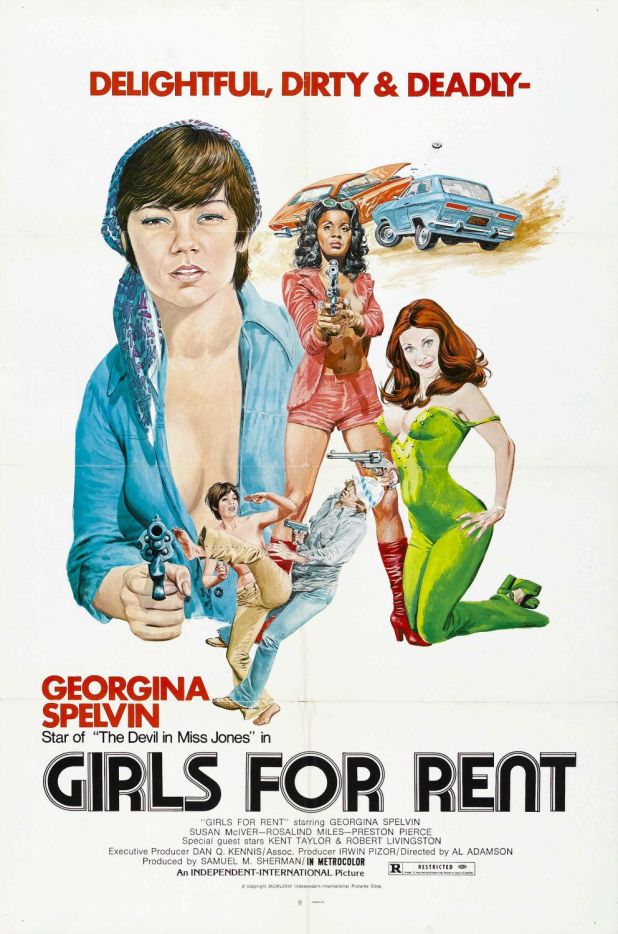
THE MOVIES OF AL ADAMSON: Girls for Rent (1974)

Donna Taylor (Susie Ewing-McIver) is a sex worker recruited by the Syndicate to blackmail a politician by taking him to a motel room, drugging him and taking some photos. Yet she soon learns from Sandra (Georgina Spelvin, The Devil In Miss Jones) and Erica (Rosalind Miles, Friday Foster) that she’s actually poisoned the man and they’ll kill her if she goes to the authorities. She heads to Mexico but her car get stolen by a hitchhiker, which means she needs a ride, which she gets from H. R. Stringham (Robert Livingston) who wants him to make love to his developmentally challenged son Ben. He’s more child than grown-up, at least in his brain, so she runs and steals a car. She’s saved by David, the man that she turned down for a ride before and they have sex.

While that’s going on, H.R. and Ben have met Sandra and Erica. Sandra is the one to be Ben’s first and she follows up that act by blowing his brains out and then shooting his dad. If this was a Hollywood movie, Donna and David would get away, but this is an Al Adamson movie, so Erica kills her and David tracks her down — he’s already murdered Sandra — and kills her.

It’s a ride. A ride through the desert.

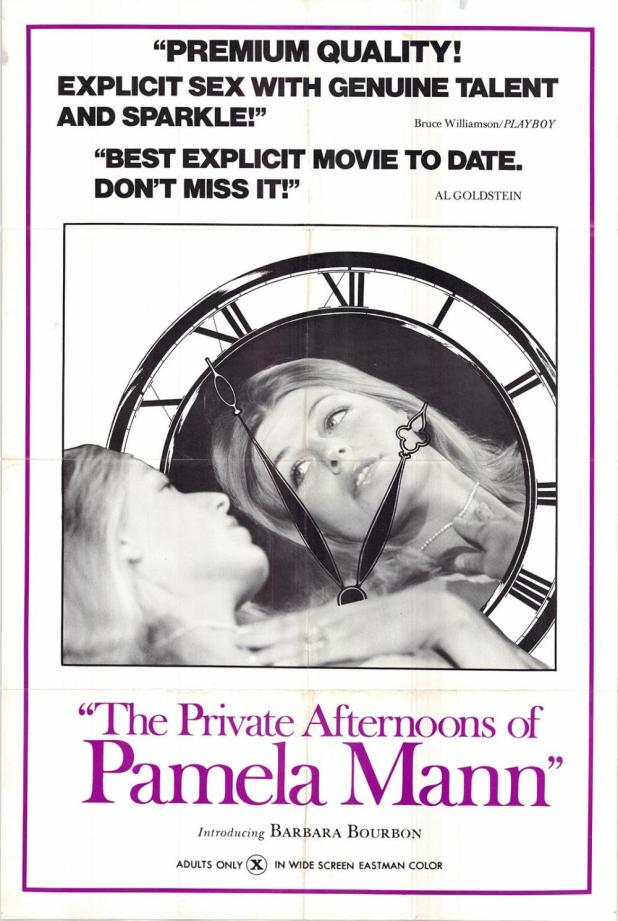
SUPPORTER DAY: The Private Afternoons of Pamela Mann (1974)

EDITOR’S NOTE: Today’s movie is brought to you by AC Nicholas, who has graciously become a Big B&S’er, a monthly supporter of the site and got to pick an entire week of movies. Would you like to have me write about the movies of your choice? It’s simple!

  1. Go to our Ko-Fi site and donate. There’s no set amount and I won’t tell you what to do. In fact, if you just keep reading for free, we can still be friends.
  2. Join as a monthly member for just $1. That makes you a Little B&S’er.
  3. As a Medium B&S’er at just $3 a month, if you pick a movie or a director, I’ll write about them for you. In fact, I’ll do one for each month you subscribe and even dedicate the post to you.
  4. For $5 a month, you basically get some major power. As a Big B&S’er, I’ll write an entire week on any subject you’d like. How awesome would that be? In fact, I’ll do it for every month you’re a member. Do you think any of your other movie sites will do that for you?

Bill Margold said, “The Private Afternoons of Pamela Mann signals an end to the all-balling, no purpose, disposable mastur-movies that go into one orifice and out another.”

There are no movies made like it today.

Pamela Mann (Barbara Bourbon) is a married psychotherapist in Manhattan. Throughout the day, we watch as she has several encounters with everyone from one of her female patients to a group of radicals — one of whom takes the time to recite the Supreme Court decision on pornography while Pamela is being taken — and even a man who is just sitting on a park bench. All while Frank (Eric Edwards), a detective, films every single second. By the end of the film, we learn that unlike most of the detective stories that we’re used to, Pamela is watching the movies herself. With her husband. In bed. The sexual revolution — until a few years and AIDS — has been won.

Based on the life of the real Pamela Mann, who was in The Seduction of Inga, Side Street GirlsKeyholes Are for Peeping and Dungeon of Pain, this found Radley Metzger recovering from the bad box office of The Score and embracing hardcore, but not before taking his middle name and favorite town to become Henry Paris. And yes, that politician that she sleeps with is Sonny Landham, who would someday be in Predator.

Throughout the movie, a woman keeps asking questions of the characters after they finish making love. “Do you think the welfare state is still viable considering the inability up to the present of the system to reconcile the isolation of the poor with the assimilation into the system of relatively well-to-do hierarchy of government, administrators, corporate functionaries and executives and the other white color elite who are the necessary benefactors of these poor?” seems like a strange thing to bring up after we’ve seen so much on camera that was once kept from public eyes.

At the end, when they ask her why she’s so inquisitive, she replies, “I’m here to give the film socially redeeming values.”

It also has Georgina Spelvin as a sex worker named Klute and a moment that is just as incendiary and flat-out shocking as it was when this was released, as Darby Lloyd Raines and Jamie Gillis assault Mrs. Mann at gunpoint. I was completely unprepared for this moment and it’s kind of astounding that in the middle of a movie that has cute winks at the camera that all this open sex can be so dangerous.

SUPPORTER DAY: Score (1974)

EDITOR’S NOTE: Today’s movie is brought to you by AC Nicholas, who has graciously become a Big B&S’er, a monthly supporter of the site and got to pick an entire week of movies. Would you like to have me write about the movies of your choice? It’s simple!

  1. Go to our Ko-Fi site and donate. There’s no set amount and I won’t tell you what to do. In fact, if you just keep reading for free, we can still be friends.
  2. Join as a monthly member for just $1. That makes you a Little B&S’er.
  3. As a Medium B&S’er at just $3 a month, if you pick a movie or a director, I’ll write about them for you. In fact, I’ll do one for each month you subscribe and even dedicate the post to you.
  4. For $5 a month, you basically get some major power. As a Big B&S’er, I’ll write an entire week on any subject you’d like. How awesome would that be? In fact, I’ll do it for every month you’re a member. Do you think any of your other movie sites will do that for you?

Even today, almost fifty years after Score was made, it pushes taboos. It’s one of the first films to explore bisexual relationships, which is something movies still shy away from. And it was one of the porn chic movies of the 1970s Golden Age, a time when adult movies could both be adult and movies.

It was directed by Radley Metzger, someone who one can honestly say was an auteur of adult filmmaking. He told Cinedelphia, “When I was coming of age, eroticism was always in films, but eroticism was punished. The promiscuous girl never got the leading man, the woman who sold her charms, always had a bad fate. The “good girl” always achieved ends the bad girl never did. As a reaction to that, I tried to do the opposite. You could have a free attitude and behave in a free way and not be punished. A parallel to that is that it could also be light. It didn’t have to be tragedy. You could look at sex in a fun way. That was a personal thing, to work against the clichés in cinema when I was growing up.”

It’s based on an off-Broadway stage play that ran in 1970 and even had Sylvester Stallone in a small part. The movie version was written by Jerry Douglas, who also wrote the original play, who would go on to create the magazine Manshots and eventually direct several of his own adult films.

In the mythical European city of Leisure — the play was set in a New York City apartment building — married couple Jack (Gerald Grant) and Elvira (Claire Wilbur, who originated the role and would go on to win an Oscar for producing Robin Lehman’s The End of the Game) have a bet about who can pick up whom. She thinks she can win over Betsy (Lynn Lowry, who is still in so many horror movies and making them better just by being herself), a young bride who has just married Eddie (Casey Donovan, who was a popular gay adult star and the long-time lover of Tom Tryon).

Betsy might be a Catholic schoolgirl who doesn’t know the world yet but she’s fascinated by Elvira, who even seduces a telephone repairman (Carl Parker) right in front of her. That night, she catches her husband masturbating and confesses that she’s not happy.

A costume party allows them all to change it up, as Eddie is dressed as a cowboy and Betsy a nun. They pair up with their same sex — just to talk, hmm? — and confess that they’re unsatisfied. The pot helps. So does the poppers. Before midnight, the young couple is seduced. The shocking part — for some — may be that in the hardcore cut that the man-on-man sex is given just as much time as the female-on-female. By the end, Betsy and Eddie wonder which one of them is the strange one.

By the way, Lowry’s scenes have a body double in them, as she didn’t participate in the unsimulated coupling.

While yes, this is a dirty movie, one of the things you find in all of Metzger’s films of this era are class. The budget is good, the setting — Croatia — is beautiful and there’s more story than sin.

MILL CREEK THE SWINGIN’ SEVENTIES: F. Scott Fitzgerald and The Last of the Belles (1974)

Directed by George Schaefer and written by James Costigan, this has a pretty fun cast. There’s Richard Chamberlain as F. Scott Fitzgerald, Blythe Danner as Zelda Fitzgerald, Susan Sarandon (a year before The Great Waldo Pepper and The Rocky Horror Picture Show) as Ailie Calhoun, David Huffman (who died way too young as he was stabbed by a criminal while outside the Old Globe Theater in San Francisco) as Andy McKennam, Ernest Thompson (the writer of On Golden Pond) as Earl Shoen, Richard Hatch (Battlestar Galactica) as Bill Knowles and Planet of the Apes TV show cast member James Naughton as Captain John Haines. And Brooke Adams!

This is the story of how Fitzgerlad met his wife. I worked with Blythe Danner a bunch on health care commercials and I always got her after she’d been through twelve other agencies, so she was exhausted and would turn a :30 second commercial into a :90. I purposefully watched the time she hosted SNL and told her. After nearly years of us barely interacting, she sparkled and said, “Was I any good?” It wasn’t a great episode, the kind of one that aired in 1982 when the show was finding its way back. It was the kind of SNL where the music guest — Rickie Lee Jones — did three songs instead of two. But I told her, “Your monologue was perfect.”

Don’t have the box set? You can watch this on YouTube.
MILL CREEK THE SWINGIN’ SEVENTIES: The Klansman (1974)

Directed by Terence Young and written by Millard Kaufman and Samuel Fuller, The Klansman had its film rights bought by black film producer William D. Alexander who spent a year putting the movie together. The movie was put together by Bill Schiffrin, Fuller’s agent, and he said the movie was a mess from when Terence Young was hired. Young was picked because of the European investors — the same mysterious people who demand worm sex in Roger Corman movies — and that’s why Luciana Paluzzi plays Southern girl Trixie with Joanna Moore speaking her lines. Yes, Fiona Volpe being voiced by Tatum O’Neal’s mother.

You know who probably didn’t want to be there? Richard Burton, who despite being paid $40,000 a week for ten weeks plus a percentage did most of his scenes lying down because he was so drunk. Years later, he claimed that he didn’t even remember meeting Lee Marvin before when they drank together at a party. Later than that, he did say “I wouldn’t have survived without Marvin.” He was drinking hard, the kind of drinking you do when you’ve lost everything.

When Burton was filming his death scene, Young was happy with the work the make-up artist had done, only for the artist to remark that he had not done anything. Young brought a doctor in to examine Burton and it was determined that he was dying. He was rushed to St. John’s Hospital in Santa Monica with a temperature of 104 degrees. Both kidneys were collapsing and he had influenza and tracheo-bronchitis. It would take six weeks in the hospital — where it was announced that he and Liz Taylor were divorcing — for him to get better.

After all that, one of the investors failed to come up with the money so Marvin and Burton were not paid their full salary.

Sheriff Track Bascomb (Marvin) has broken up white men assaulting a black woman. He arrests no one. Part of that is racism. Part of that is just keeping the peace.

Despite the fact that he’s part of the system and Breck Stencill (Burton) is a rich liberal who wants to change the South, the two remain friends. But when white Nancy Poteet (Linda Evans) gets assaulted by a black man, the Klan — which includes Deputy Butt Cutt Cates (Cameron Mitchell, somehow not the drunkest person in this movie with Marvin and Burton) — are trying to find the man who attacked her.

The Klan goes into a black bar and attacks a man, castrating him and then shooting him. His friend Garth (O.J. Simpson) gets away and goes to war with anyone who sides with the KKK. They deserve it. One of the things they do is capture Loretta Sykes (Lola Falana) and rape her, leaving her near death from bleeding. Mitchell was so upset by this scene that he burst into tears and brought roses and a letter of apology the next day.

It’s not that good but hey, I enjoyed seeing Burton try to get his lines out.

Don’t have the box set? You can watch this on Tubi.