MOVIES THAT PLAYED SCALA: Female Trouble (1974)

Thanks to the British Film Institute, there’s a list of films that played Scala. To celebrate the release of Severin’s new documentary, I’ll share a few of these movies every day. You can see the whole list on Letterboxd.

Dedicated to Charles “Tex” Watson, this movie proves that if you thought John Waters was a fluke after Pink Flamingos — not that he hadn’t been already making movies for years — he would return with a movie perhaps even more vicious, strange, upsetting to some and hilarious to others.

Dawn Davenport (Divine) flips out on Christmas when she doesn’t get the cha-cha heels she’s been hinted at for months. She meets a man named Earl (also Divine), who drags her to the city dump and quickly fertilizes her egg on a garbage strewn mattress. She gives birth to Taffy (Mink Stole), a daughter she never wanted, one she often beats into oblivion when she isn’t working as an exotic dancer or committing crimes with her friends Concetta (Cookie Mueller) and Chicklette (Susan Welch).

At the Lipstick Beauty Salon, Dawn meets and marries Gater Nelson (Michael Potter). His Aunt Ida (Edith Massey) wants him to be gay and is upset that he’s now married to Dawn. Meanwhile, the salon’s owners, Donald (David Lochary) and Donna Dasher (Mary Vivian Pearce) have convinced her to become their artistic experiment. Crime and beauty are the same, they say, so they get her to not only keep being a criminal, but to take photos of her crimes.

Dawn and Gater break up, enraging Ida, who throws acid in Dawn’s face. The Dashers convince her to not get surgery and instead to inject makeup like heroin. They also kidnap Ida and place her in a big bird cage, allowing Dawn to chop off her hand. Meanwhile, her daughter tracks down her real father and ends up killing him, causing her to convert to being a Hare Krishna, which enrages Dawn so much that she strangles her just before going on stage to jump on a trampoline and fire a gun into the audience. That’s really Divine jumping like that, which found her training at the YMCA to get it perfect.

All the fame has gone to her head and the rich Dashers quickly sell her out. She’s electrocuted, but not before giving this speech: “I’d like to thank all the wonderful people that made this great moment in my life come true. Ha ha ha ha ha! My daughter Taffy, who died in order to further my career. My friends Chicklette and Concetta, who should be here with me today. All the fans who died so fashionably and gallantly at my nightclub act. And especially all those wonderful people who were kind enough to read about me in the newspapers and watch me on the television news shows. Without all of you, my career could never have gotten this far. It was you that I burn for, and it is you that I will die for. Please remember, I love every fucking one of you.”

This pales in comparison to my favorite speech in the movie, as Dawn screams on stage ” You’re looking at crime personified and don’t you forget it! I framed Leslie Bacon! I called the heroin hot line on Abby Hoffman! I bought the gun that Bremmer used to shoot Wallace! I had an affair with Juan Corona! I blew Richard Speck! And I’m so fuckin’ beautiful I can’t stand it myself!”

Originally called Rotten Mind, Rotten Face, this got its name from when Waters and Stole visited Mueller in the hospital. Asking what was wrong — she had pelvic inflammatory disease — she answered, “Just a little female trouble, hon.”

Red Reed said, “Where do these people come from? Where do they go when the sun goes down? Isn’t there a law or something?”

Always and forever, fuck Rex Reed. That line ended up on the poster and the DVD box.
88 FILMS BLU RAY RELEASE: The Golden Lotus (1974)

Yes, this sex drama is Jackie Chan’s first acting role, but you have to watch it closely, as it’s not like he’s a major part of it.

Based on the book by Lanling Xiaoxiao Sheng — a pseudonym of someone who didn’t want their identity known — called Jin Ping Mei, it gets its name from three of the female characters: three central female characters: Pan Jinlian, whose name means Golden Lotus; the concubine Li Ping’er, whose name means Little Vase and maid Pang Chunmei, whose name means Spring plum blossoms, which means sexuality.

The book is a spin-off, of sorts from The Water Margin and All Men Are Brothers. It starts with Wu Song avenging the murder of his older brother by killing his brother’s former wife — and killer — Pan Jinlian. She was one of the many wives of Ximen Qing, who is killed in The Water Margin by Wu Song. In Jin Ping Mei, Pan Jinlian overdoses him on aphrodisiacs.

While only a small portion of the book is pornographic, it’s enough to get it banned from many libraries. That said, it has also been named as one of the “Four Masterworks of the Ming Novel” by scholar Andrew H. Plaks.

In the movie, Ximen Qing (Yueng Kwan) is a rich man who keeps adding to his collection of wives. One day, as he sees the dwarf Wu Dalang (Chiang Nan) selling pancakes in the street, he takes notice of the man’s wife, Pan Jinlian (Hu Chin). They soon fall in lust and murder her husband.

There’s no Wu Song in this, though his return is rumored. Thanks to Heroic Cinema, I learned that that story is part of another Li Han-hsiang movie, Tiger Killer. Beyond making that adaption of this story, he also made The Golden Lotus: Love and Desire in 1991 and The Amorous Lotus Pan in 1994.

As for Jackie Chan being in this, he’s the fruit vendor who figures out that the pancake seller has been murdered. He’s in the first part of the film, but with all this power, there’s no way anyone is going to jail for the crime.

I’m loving that 88 Films is giving us more than just martial arts Shaw Brothers movies. Here’s hoping that the entire output gets a chance to come out. I realize that I will be long gone before that happens, as that would be hundreds of films.

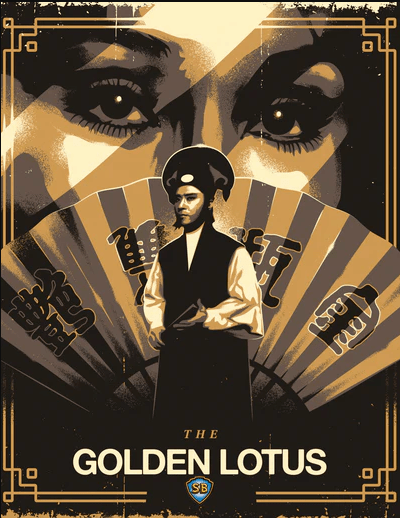
The 88 Films release of The Golden Lotus has a trailer, a stills gallery and a reversible sleeve with the original Hong Kong poster artwork. You can buy it from MVD.

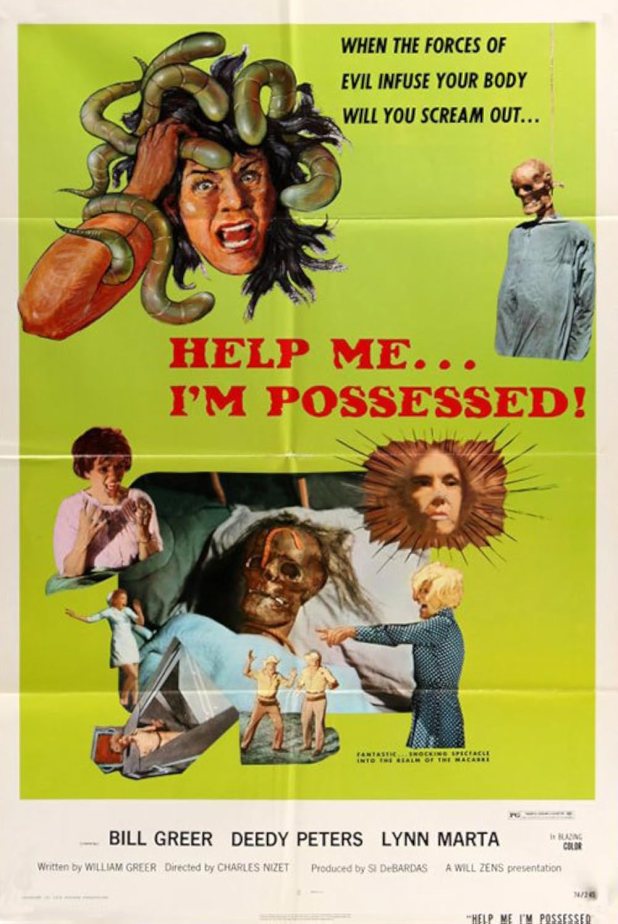
Help Me… I’m Possessed (1974)

I’m still trying to figure this out.

Made as Nightmare at Blood Castle, this is about Dr. Arthur Blackwood (Bill Greer, who co-wrote the script with Deedy Peters, who were a comedy team; he would go on to write and produce House CallsGoodnight Beantown and Charles In Charge; she would be in 17 episodes of House Calls), who runs his own sanitarium and is doing experiments on the forces of evil. Deedy also plays his wife in this, who is working with the sheriff (Jim Dean) to figure out why some teens have been killed. She should be looking inside her own house, as her husband has a hunchback (Pierre Agostino) and they’re whipping girls and locking people up in cages.

This is the kind of movie that has a wig budget, a spaghetti monster, guillotine suicide and dialogue with lines such as “When I saw Mr. Zolak’s head severed from his body, I felt a definite sexual thrill. I must be very careful.” Also snakes.

Somehow, this is PG. 1970s PG. You know what that means.

Director Charles Nizet also made The RavagerVoodoo Heartbeat and Rescue Force. There’s nothing like this, a regional movie in the desert that has women put in coffins with poisonous snakes and it feels perverted but it’s not as dirty as it feels, which means that it’s really deranged.

A cave blows up at the end. I still, as I said, have no idea why.

You can watch this on YouTube.

Here’s a drink.

Spaghetti Monster (based on the drink from Strawbs Bar in Leeds, England)

  • 1 oz. vodka
  • 1 oz. gin
  • 1 oz. rum
  • 1 oz. tequila
  • 4 oz. orange juice
  • .5 oz. grenadine
  1. Shake up everything with ice in a cocktail shaker other than the grenadine.
  2. Pour in a glass and top with grenadine.

The Sizzlin’ Something Weird Summer Challenge 2024: Frankenstein’s Castle of Freaks (1974)

BONUS WILDCARD WEEK (September 22 – 28) Go order something from the SWV website and watch it!

Known in Italy as Terror! Il Castello Delle Donne Maledette (Terror! The Castle of Cursed Women), this movie was released as Terror Castle, The House of Freaks, The Monsters of Dr. Frankenstein and Dr. Frankenstein’s Castle of Freaks in the U.S., while it was named Frankenstein’s Castle in the UK.

According to Roberto Curti’s Italian Gothic Horror Films, 1970–1979, no one can even agree on who the director of this movie is.

Suspects include Spanish actor Ramiro Oliveros (The Pyjama Girl Case), producer Oscar Brazzi (The Loves of Daphne), cinematographer Mario Mancini (who ran camera on Blood and Black Lace, as well as acting as the director of photography for The Girl In Room 2A and directing Frankenstein ’80), producer Dick Randall (who produced Mario Bava’s Four Times That Night, as well as For Your Height OnlyDon’t Open ‘Till Christmas and Slaughter High) and screenwriter William Rose (who wrote Pamela, Pamela, You Are… and shows up in the film as the Devil and in Herzog’s Fitzcarraldo).

Although director Robert H. Oliver was a pseudonym of Mancini, actor Gordon Mitchell claims that the director was Robert Oliver, while actress Simone Blondell remembered that the director “spoke English, he wasn’t Italian.” Perhaps the best answer comes from assistant director Gianlorenzo Battaglia (the cinematographer for A Blade In the Dark, BlastfighterDemonsWitchery and so many more films — he was also the underwater camera operator for Popeye, Cozi’s HerculesAlligatorScreamers and Phenomena!) said that “the American director left the film because of disagreements with the producer, and so Mario finished it on his own. I’m not 100% sure though!”

After a Neanderthal man named Goliath (Salvatore Baccaro, billed as Boris Lugosi) is lynched by villagers, Count Frankenstein (Rossano Brazzi, who was in Krakatoa, East of Java) brings the monster back to life.

Man, let me tell you about Rossano Brazzi. In 1940, he married Baroness Lidia Bertolini. They never had children, but he did have a son with Llewella Humphreys, who was the daughter of American mobster Murray “The Camel” Humphreys. At a young age, Llewella had shown fine musical talent, so her father sent her to Europe to study. After all, her father would do anything for her. There’s a story that when she went to the prom, she wanted to take Frank Sinatra. One phone call later and “Old Blue Eyes” was her date.

While in Rome, Llewella fell for Brazzi and they had that aforementioned son. When she returned to America, she changed her name to Luella Brady, an anglicization of Brazzi. Humphreys sent her and George, the baby, to live with her mother in Oklahoma, but she was so mentally unstable by this point that she was institutionalized. Man — her dad was the man who said, “If you ever have to cock a gun in a man’s face, kill him. If you walk away without killing him after doing that, he’ll kill you the next day,” taught mobsters how to plead the Fifth and inspired Tom Hagen in The Godfather and here’s the married Brazzi getting her pregnant!

After his wife’s death from liver cancer in 1984, Brazzi married Ilse Fischer, a German woman who had been the couple’s housekeeper for many years who had met the actor when she was a twenty-four-year-old fan.

But I digress…

Michael Dunn also shows up as Genz, an evil dwarf who indulges in necrophilia. Perhaps you know Dunn from Dr. Miguelito Loveless from The Wild Wild West or as Dr. Kiss in The Werewolf of Washington. Also invited to this Castle of Freaks party are Edmund Purdom (Pieces), Gordon Mitchell playing Igor (you may recall him as playing Dr. Otto Frankenstein in Frankenstein ’80), Loren Ewing (Big John from the Batman TV show as well as, get this, the transportation department for the movie Idaho Transfer), Walter Saxer (who would later produce Herzog’s films), Simonetta Vitelli (who was in four totally unrelated Sartana movies), Luciano Pigozzi (Pag from Yor Hunter from the Future) and Xiro Papas, who is, of course, Mosaic from Frankenstein ’80, the vampire monster from The Devil’s Wedding Night and Lupo in The Beast In Heat.

Somehow, all of this depravity got a PG rating.

This movie is not great, but gets many points for having 19th-century villagers wearing modern blue jeans.

Want to read more? You can check out our list of Edmund Purdom movies on Letterboxd because yeah — we’re just that crazy. And for more movies that were rated PG that don’t quite make sense, check out this list.

You can watch this on Tubi or the Internet Archive.

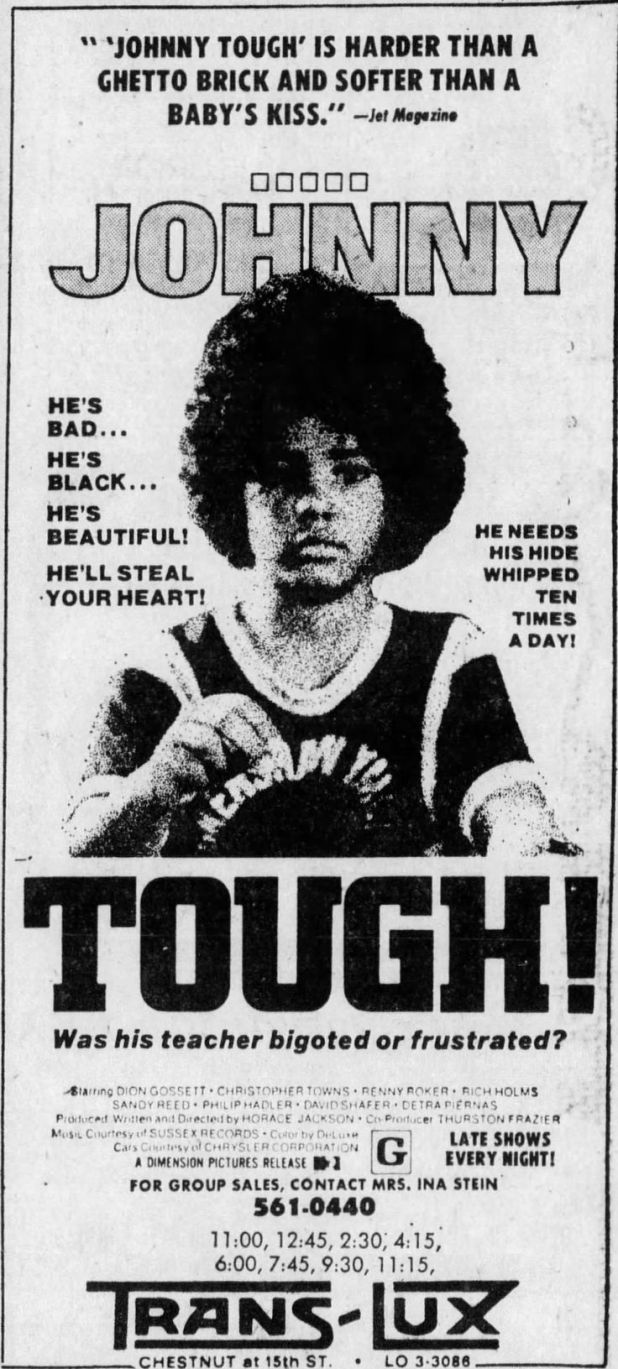
CANNON MONTH 3: Tough (1974)

EDITOR’S NOTE: As the journey through Cannon continues, this week we’re exploring the films of 21st Century Film Corporation, which would be the company that Menahem Golan would take over after Cannon. Formed by Tom Ward and Art Schweitzer in 1971 (or 1976, there are some disputed expert opinions), 21st Century had a great logo and released some wild stuff.

Gene Siskel gave this zero out of four stars.

This proves that I know nothing, as I enjoyed it and ranked it much higher.

“He’s bad…he’s Black…he’s beautiful! He needs his hide whipped ten times a day!”

Directed and co-written by Horace Jackson (Deliver Us From Evil), along with Lynda Holmquist and Michele Searcy Jackson, this breaks the blacksploitation mold by being about a child.

Johnny “Tough” Baines (Dion Gossett) is the kind of student who puts a for sale sign in front of his school and who drives his teachers crazy with how combative he can be. His parents Phil (Renny Roker) and Denise (Sandra Reed) barely get along and by the end of the movie, you get the idea that if Johnny just ran away for good, his mom would be happier than if she had to raise him.

I don’t know if Siskel — or audiences — realized it, but Jackson was influenced by The 400 Blows. The end of this movie totally blew me away, as I never saw it coming. It’s easy to see why this is a Quentin Tarantino favorite.

Johnny never comes off as someone you want to emulate or too cool as he battles his way through life. He’s struggling with a mother who, again, probably doesn’t want him and a father who loves bowling more than him. Acting out is the only way he ever gets notice and b the time his father finds him, it’s too late.

Other than Roker, this is a nearly all unprofessional cast, which is why some critics disliked it. Honestly, if it weren’t a black film and a few critics got behind it, people would still be talking about it. Instead, it was pretty much a low budget grindhouse film.

This was released by Dimension Pictures in 1974 and played as Tough and Johnny Tough. It’s one of the movies that 21st Century got when they bought their films.

You can watch this on YouTube.

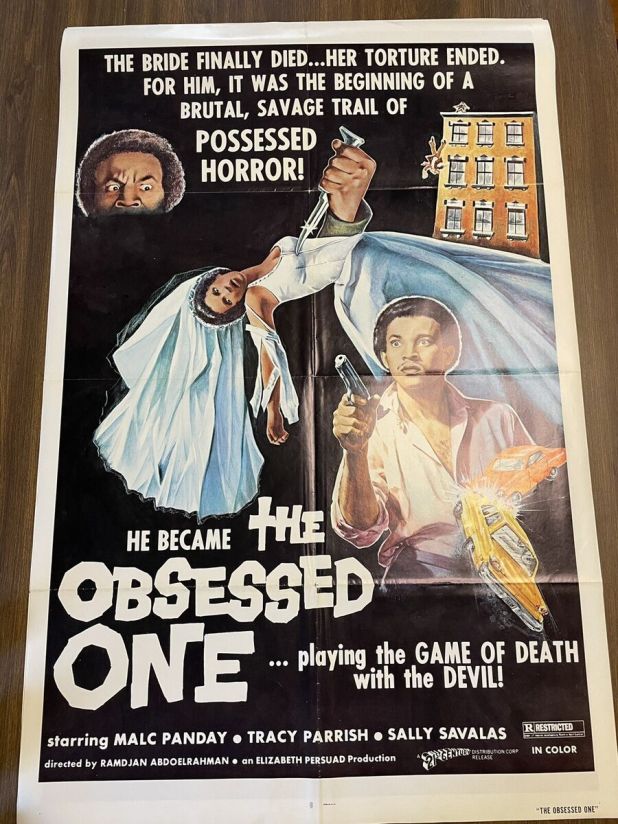
CANNON MONTH 3: The Obsessed One (1974)

EDITOR’S NOTE: As the journey through Cannon continues, this week we’re exploring the films of 21st Century Film Corporation, which would be the company that Menahem Golan would take over after Cannon. Formed by Tom Ward and Art Schweitzer in 1971 (or 1976, there are some disputed expert opinions), 21st Century had a great logo and released some wild stuff.

Tyrone (Malc Panday) and his fiancee were just trying to walk through the park when three drugged-out maniacs read some tarot cards and saw that they should attack them. They beat him into oblivion and then assaulted and murdered her. When the police arrived, they locked him up for her rape and murder. I have no idea how this happened, as they stabbed her right in the chest and no one seemed to check for prints or defense wounds or any of the many things we’ve learned from Forensic Files.

Instead of waiting for the establishment to let him down again, Tyrone escapes from jail, ready for his own revenge.

I learned from Mondo Digital that this movie was made in Suriname, the South American Dutch-established state adjoining Guyana. That means that it doesn’t look like anywhere or anything else. It’s way scummier than most revengamatics — which is saying so much — and I’m amazed that the bad guys have a tarot roulette wheel, which seems like a good — well, bad — idea.

This was made in 1974 as Operation Makonaima and released in the U.S. seven years later by 21st Century. The dialogue sounds weird, the action is wild, some moments feel very goofy and when you add that together, it’s one tasty bowl of moksi-ales. That’s a native Suriname dish made with mixed boiled rice; salted meat, shrimp or fish; and vegetables, including cassava, which is a key ingredient in their cooking. What a cool country, one that has produced a cuisine that’s combines many cultures, including Indian, Javanese, Chinese, Dutch, Jewish, Portuguese and Native Amerindian. This movie feels the same way.

You can watch this on YouTube.

The Sizzlin’ Something Weird Summer Challenge 2024: Axe (1974)

69 EsSINtial SWV Titles (September 15 – 21): Klon, who came up with this list, said “This isn’t the 69 BEST SWV movies, it isn’t my 69 FAVORITE SWV movies, my goal was to highlight 69 of the MOST SWV movies.” You can see the whole list here, including some of the ones I’ve already posted.

Shot in North Carolina on short ends for $25,000 in a house that cost $25 to shoot in, Axe has risen above its humble beginnings to end up on the Video Nasties section one list. Writer-director Frederick R. Friedel dreamed of making a film by 25, despite never having been on a film set in his life. He also ended up playing the morally conflicted Billy, which was to save the expense of hiring another actor.

Originally released as Lisa, Lisa, this North Carolina regional film was re-released in 1979 by Harry Novak as Axe (it was also called California Axe Massacre in the UK and it also played as The Virgin Slaughter). While Friedel felt that Axe felt that Novak’s title didn’t have the subtlety, surprise, and irony of his intended title, it certainly sells better under that simply — and yet sinister — name.

Three thugs — Steele (Jack Canon, who is also in Friedel’s Kidnapped Co-Ed), Lomax and Billy — beat a man named Aubrey to death, but not before they make him eat a lit cigar. After seeing the carnage, the victim’s boyfriend jumps out the window. They follow this mayhem up by assaulting a shopgirl, firing a gun over her head and pouring soda all over her.

They end up at the farmhouse of Lisa (Leslie Lee, who is an otherworldly figure in this and sadly, stopped acting after this movie), who lives alone with her grandfather. She keeps them a secret even from the police and has even more skeletons in her closet, as she’s slicing herself in the bathroom when no one is watching.

That night, Lomax tries to assault her. She responds by slicing his throat open and cutting him to pieces with an axe and shoving him into a trunk. She convinces Billy to drag it upstairs and when he learns what is inside, she tells him Steele did it.

There’s a great scene here where Billy takes her into the woods and tries to tell her that he will protect her. She pulls out her razor and he thinks that she’s trying to give him a weapon to battle the more physically imposing Steele. The viewer knows better.

Steele is no match for her, as she soon dispatches him with an axe and serves his blood up as soup to her grandfather. Billy notices the villain’s ring in the broth and then the body magically falls from the fireplace, sending him running outside and into a gunshot from the cops who’ve come back.

Not a 100% slasher by any means, as we said before, the ad campaign and video nasty image of the Axe re-release give it a historic reason to include as a movie in our slasher month. This is the kind of movie where nothing happens for long stretches, only to have moments of extreme violence quickly destroy the narrative tension. It’s a really intriguing film and I wish that Friedel had made more than just four movies.

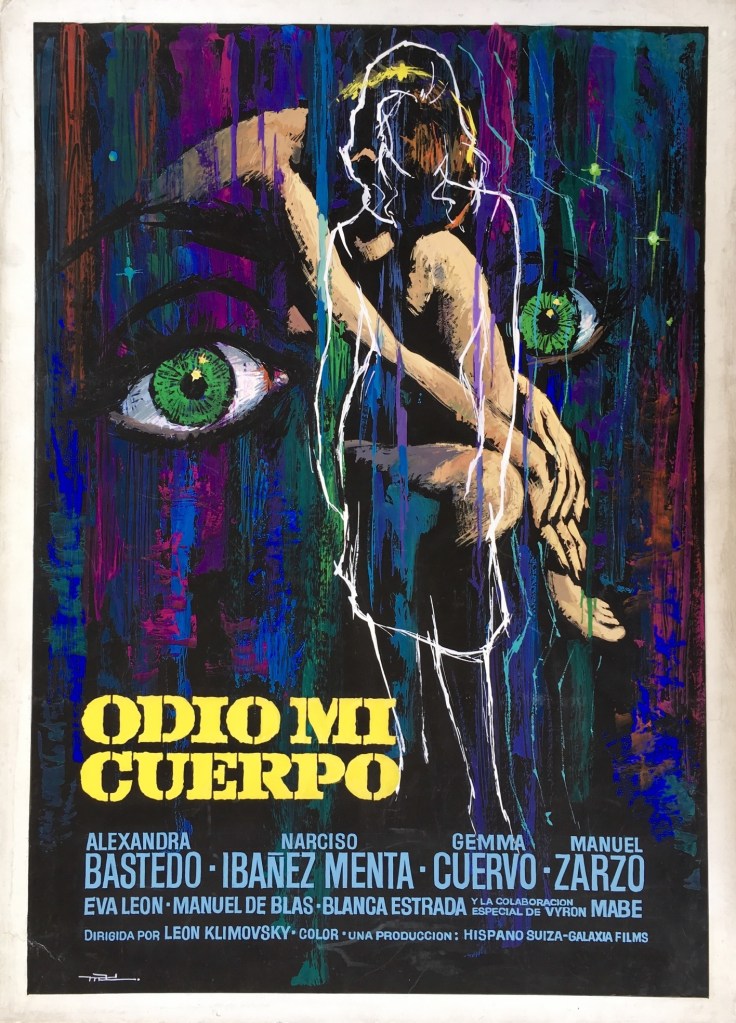
The Sizzlin’ Something Weird Summer Challenge 2024: I Hate My Body (1974)

Frank Henenlotter’s Sexy Shockers (September 1 – 7) We all know Frank Hennenlotter as the director of the Basket Case films, Bad Biology, Brain Damage, and Frankenhooker, but he’s also a cinematic curator of the crass! An academic of the pathetic! A steward of sleaze! A sexton of the sexual and the Sexy Shocker series is his curio cabinet of crudity. Skin and sin are mixed together in these homegrown oddities, South American rediscoveries, and Eurohorror almost-classics. Your mind may recoil with erotic revulsion at the sights contained within these films, so choose wisely!

All hail León Klimovsky, who directed this absolutely deranged movie and co-wrote it with Solly Wolodarsky. “The brain of a man… the body of a woman… the sexual horror story of our time!” That isn’t all of it. Man, this starts wild and gets even stranger.

An engineer named Ernesto (Manuel de Blas) is out on the town with his friend and some ladies when he gets injured in a car accident. He wakes up in a hospital room where former Nazi doctor Adolfo Berger (Narciso Ibáñez Menta) takes his brain and places it into the body of Leda (Alexandra Bastedo, The Blood Spattered Bride), a gorgeous woman. The doctor wants to keep him/her prisoner in a hospital room so that he can prove that he’s the first person to perfect this surgery.

What’s wild about this movie is that while Leda gets to live out some of the fantasies of Ernesto — yes, there is a lesbian scene, there’s also a scene where he whips Adolfo’s wife and nurse Lydia (Gemma Cuervo) and she likes it — but the truth is that this sets itself up as sleaze and then, just as you’re savoring the sin, it reminds you of the male gaze, how women are mistreated in the world a half century after this movie and that most people are no closer to understanding gender change now.

Ernesto also wakes up to a world where his wife Mary (Maria Silva) has already moved on to marry his best friend weeks after he has disappeared. There are also moments that when Leda is being pushed around by men, we see her as her male self. It’s a really intriguing way to frame what’s happening inside her, even if she’s a murderous maniac at times who sets a hospital on fire to kill the doctor who put her in this state.

Actually, I have lost track of the pronouns and apologize.

In Italy, this was known as Super Sexy Vamp, a title doesn’t really match what we are watching. That said, Leda quickly learns how to become a femme fatale. She engages in an insurance scam that Mary was planning and even picks up her former dead body, which has to be weird and yet she wants money and that worry never even is discussed. She’s already spent most of the movie learning that she can have the same qualifications as a woman that she did as a man and only find work as a secretary or in manual labor. If she can use the body she’s been given to get ahead, she has no issue.

Then, because this was 1974, this has to end with a downbeat ending. Or maybe evil in any sex needs to be punished. Or sometimes shock endings just are demanded.

You can watch this on YouTube.

CANNON MONTH 3: Enter the Devil (1974)

EDITOR’S NOTE: As the journey through Cannon continues, this week we’re exploring the films of 21st Century Film Corporation, which would be the company that Menahem Golan would take over after Cannon. Formed by Tom Ward and Art Schweitzer in 1971 (or 1976, there are some disputed expert opinions), 21st Century had a great logo and released some wild stuff.

This movie is literally the center of the Venn Diagram that would be made of the movies that I love the most.

Italian ripoff of a successful film — This movie is obviously trying to be The Exorcist.

Satanism — This film has some of the goofiest and most awesome devil tricks of any of I’ve seen.

Exploitation — No one in this film acts like a normal human being and reality has been supplanted by insanity before the demons even get involved.

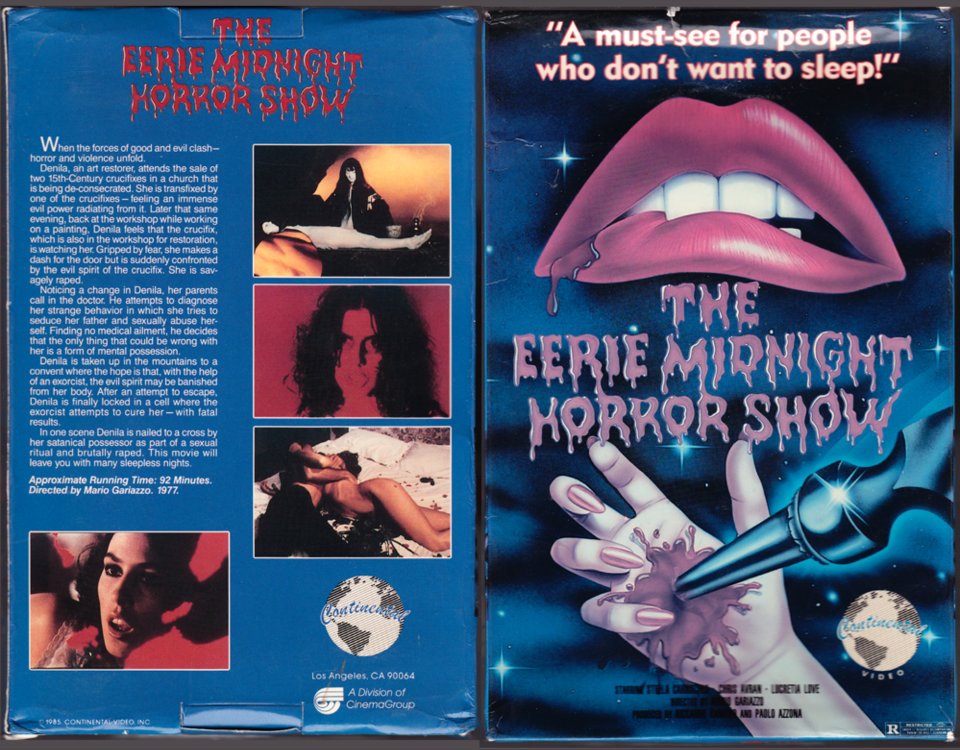
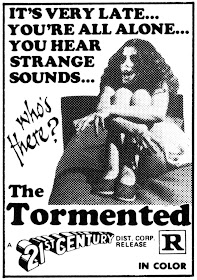
Multiple titles — This film is also known as SexorcistThe TormentedDevil ObsessionL’Ossessa and was later re-released post-Rocky Horror midnight movie success in 1977 as The Eerie Midnight Horror Show.

And the title card that comes up before the movie begins: THIS FILM IS BASED ON A TRUE STORY.

Daniela is an art student in Italy who is so respected by her teachers that she gets to join them as they acquire religious sculptures from a church due to be torn down. That church was deconsecrated way back in the 1700’s because the priests and nuns decided that they would turn against God and start having orgies in the church. And one of the statues, an incredibly lifelike display of one of the thieves crucified next to Jesus, catches Daniela’s eye. She is told that it was pulled directly from a tree, that it was already inside the wood and all the sculptor had to do was bring out the details. However, many tourists have had mental breakdowns just looking at this sculpture.

Daniela’s life is weird even before the crazy gets started. Her rich parents throw a party and we learn that her mother isn’t just cheating on her husband, she’s doing it pretty much in public. Yep — Daniela catches her mother getting whipped by the thorns of a rose — a scene that Becca just randomly walked into and asked, “What are you watching?!?”

Our heroine leaves for her studio at the university. As she paints, the sculpture comes off the cross in a scene that can only come from the deranged mind of Italian exploitation filmmaking (director Mario Gariazzo wrote Sister Emanuelle and directed Very Close Encounters of the Fourth Kind). Of course, that revived religious icon then has sex with her, sex that appears to be a dream as she runs from the studio.

Later that night, as Daniela climbs the stairs to her family’s apartment, she keeps thinking she is alone, but the sounds of her footsteps don’t match up. She hears a demon whisper her name and she runs in fear before the demon overcomes her, forcing her into a state of sexual mania and a dream where she is crucified. She spends the rest of the movie trying to get anyone to have sex with her while stigmata appears on her hands and she does all of the tropes of exorcism rip-offs.

And then Ivan Rassimov (All the Colors of the DarkShock/Beyond the Door IIYour Vice Is a Locked Room and Only I Have the Key ) shows up as Satan, giving Daniela her beauty back so that she can work with him to tempt all of the priests, like Father Xeno (Luigi Pistilli, Oliviero from Your Vice Is a Locked Room and Only I Have the Key). She tries to seduce him, so to forget that she has tempted him he self-flagellates.

The priest dies and the girl is saved, after she pukes out the demon. But you knew that, right? You’ve seen this film repeated before. But that doesn’t mean that this film isn’t great. And by great, I mean the scummiest version of everything you love about films like this. No matter title you refer to it by, it is everything you want to see.

21st Century released this as The Tormented.

SHAWGUST: Five Shaolin Masters (1974)

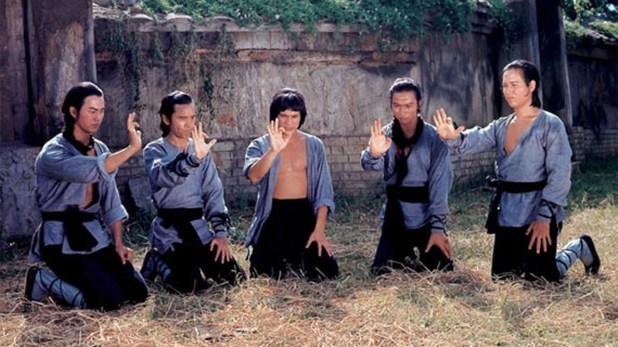
After suffering numerous defeats at the hands of the Qing kung fu experts, five patriots return to the ruined Shaolin temple — that burned down at the end of Shaolin Temple — to perfect their kung fu and take revenge.

Hu De-Di (David Chiang), Cai De-Zhong (Ti Lung), Fang Da-Hong (Mang Fei), Ma Chao-Xing (Alexander Fu Sheng) and Li Shi-Kai (Chi Kuan-Chun) must now become their own masters, training themselves and overcoming self-doubt in order to become legends.

However, one of their number is a traitor, which adds some intrigue to the proceedings. The best part of the movie is the huge battle and escape at the beginning, as each hero gets an introduction and a freeze frame with their name as we rock out to their theme song. Better than that, the villains get the same treatment, including a villainous song for them to do evil to.

Chang Cheh directs this and Wang Lung-Wei again plays the traitorous villain, which is pretty astounding as he died at the end of the last film, but you can’t keep a great heel down. There’s also a bad guy in this that can snap necks with his ponytail, which is definitely the kind of martial art that you don’t see in many films.