FVI WEEK: Quando le Donne Avevano la Coda (1970)

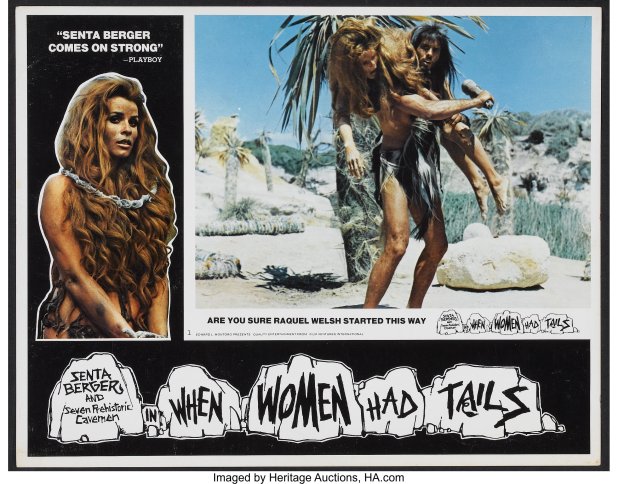
When Women Had Tails was directed by Pasquale Festa Campanile (Autostop rosso sangue), who wrote it with Marcello Coscia and Lina Wertmüller. Yes, 1970s art house film director Lina Wertmüller. The first woman to ever be nominated for a Best Director Oscar.

It’s the story of seven cavemen who were sent on a boat — Ulli (Giuliano Gemma), Kao (Lando Buzzanca), Grr (Frank Wolff), Maluc (Renzo Montagnani), Put (Lino Toffolo), Uto (Francesco Mulé) and Zog (Aldo Giuffrè) — and now they live alone on a small island. One day, they find what they think is an animal in their trap but its really a woman named Filli (Senta Berger). As you can guess, she upsets their natural order even more than the beat that attacks them. Ulli, being the alpha, must have her and for his lust makes him fight his own brothers.

Somehow, this caveman sex comedy also has a soundtrack written by Ennio Morricone and directed by Bruno Nicolai.

This movie was so popular that it had two sequels, When Men Carried Clubs and Women Played Ding-Dong and When Women Lost Their Tails. As hard as this was to watch, you know that I will also be watching both of those movies.

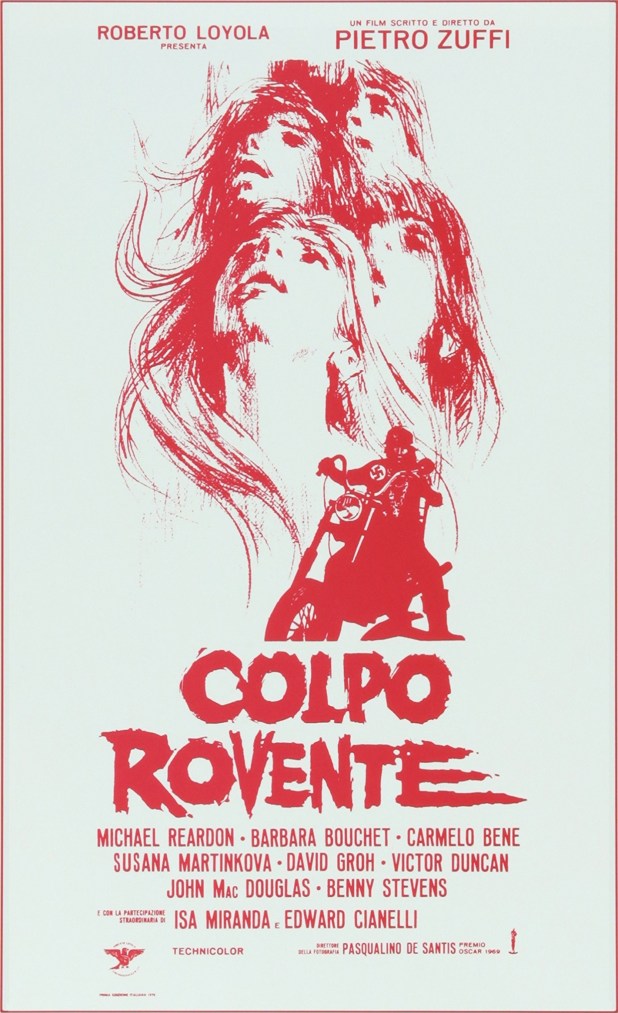
Colpo rovente (1970)

Piero Zuffi was an Italian set designer and painter who worked for a decade at Milan’s historic opera house Teatro alla Scala. He also worked as a production designer on several movies, directed and wrote this movie — with Ennio Flaiano — and wrote one other, General Della Rovere.

So yeah, this is a poliziotteschi with giallo leanings, but when you’ve watched more than four hundred gialli, you start hunting for things you haven’t seen. Also released as Red Hot Shot and The Syndicate: A Death In The Family, this is the story of NYPD detective Frank Berin (Michael Reardon) who is trying to learn who killed a pharmaceutical company owner named Mac Brown (Vittorio Duse), gunning him down right in the middle of Wall Street. There are no leads or suspects, so Brown’s daughter Monica (Barbara Bouchet) goes on TV and offers a reward of $250,000 for any information.

Berin is no fan of the Brown family, as he’s always felt that they ran the heroin trade in the Big Apple, but his case ended when his main witness Fanny (Susanna Martinková) was blinded. And Monica is worried that whoever killed her father is coming after her. That killer could be her fiancee, Don Carbo (David Groh).

What’s kind of strange is that Michael Reardon was in two acting roles. This movie and a bit part on the Burt Reynolds’ TV show Hawk. And that’s it. This movie is near impossible to find and Reardon died in 2006. This was given an X rating for some reason, so it never really played, but it’s astounding thanks to Berin going wild with its look, filling it with a great Piero Picceroni score, parties in mirrored rooms, numerous flashing light shows, old rich people gorging themselves on a nonstop menu of food while near a swimming pool and a scene where drug addicts nearly take on the look and feel of Romero’s zombies. And perhaps strangest of all, Bouchet is a brunette!

There are giallo elements in this and yes, there are tons of plot holes and the story isn’t all that great, but there are so many weird elements in it that I think you really have to see it. Speaking of the soundtrack, it’s been released several times, but this hasn’t come out on DVD or blu ray. In a world where every movie has been rereleased so many times, let’s get this out and into peoples’ hands!

You can watch this on YouTube.

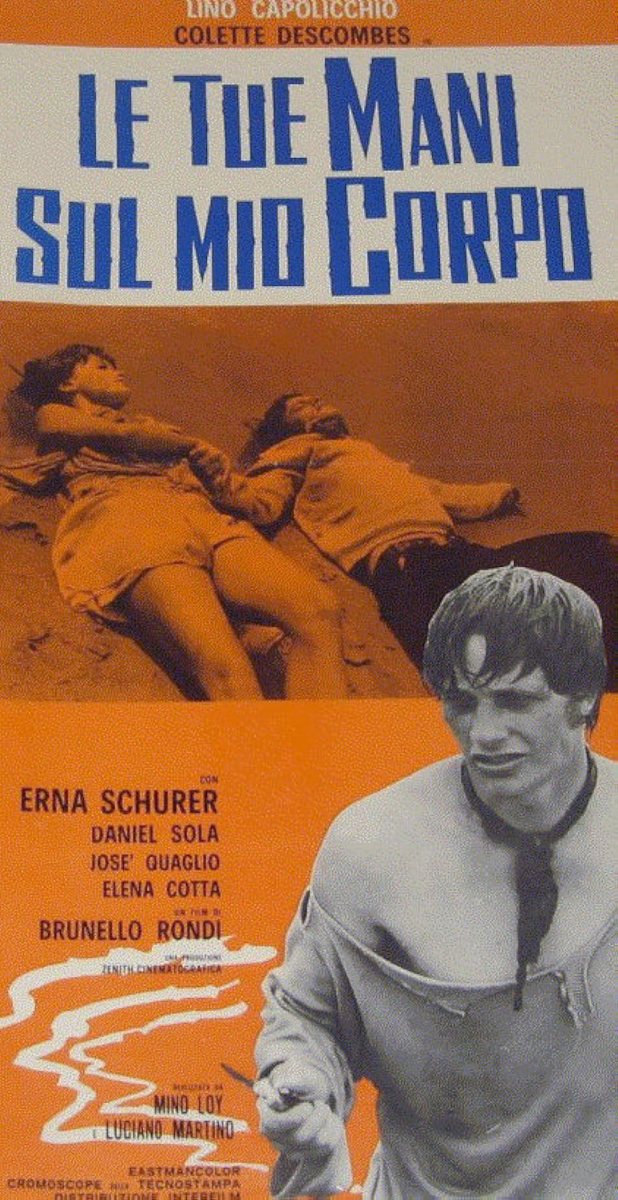
Le tue mani sul mio corpo (1970)

Directed by Brunello Rondi (Run. Psycho, Run), who wrote the story with Luciano Martino and Francesco Scardamaglia, this is about Andrea (Lino Capolicchio), the son of a rich publisher. He rebels by living a life of excess as a way of dealing with the death of his mother when he was a very young man. Beyond sleeping with anyone and everyone, he really wants to cuck his father and to have sex with his stepmother Mireille (Erna Schürer, Strip Nude for Your Killer) and her gal pal Carole (Colette Descombes, Orgasmo).

A giallo with no murder, this is about one man trying to ruin everyone through his desires — and need to film all of his fantasies — as well as him learning what happened to his mother, who he only sees in glimpses wearing white.

Also known as Schocking, there’s a scene where Andrea dresses a black girl in a Klan hood to, well, shock you. Aren’t you scandalized? There’s no real hero or heroine here, unless you like the spoiled rich man who loves to use his camera to film women make love to other men, then burn the film while they watch.

It looks nice, though, and the Giorgio Gaslini score is solid. He also did the music for So Sweet, So DeadFive Women for the Killer and was the original composer for Deep Red. When Argento didn’t like the music, he contacted Goblin, although some of the original music is in the movie.

You can watch this on YouTube.

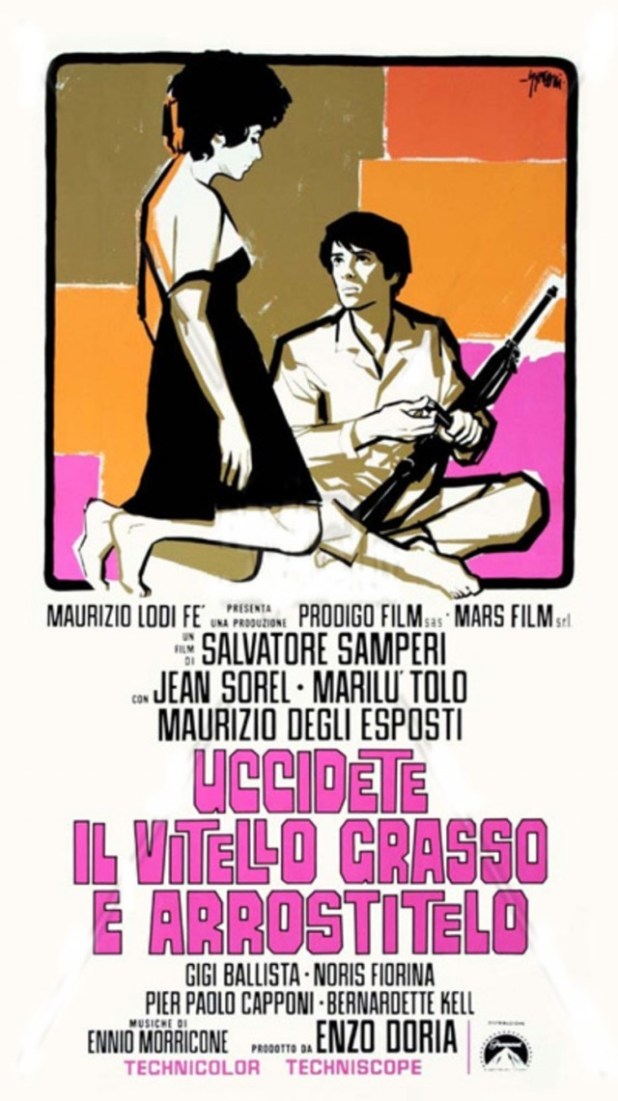
Uccidete il Vitello Grasso e Arrostitelo (1970)

Directed by Salvatore Samperi, who wrote the story with Dacia Maraini, Kill the Fatted Calf and Roast It is about a cursed family. Maurizio Degli Esposti plays Enrico, who has left his Swiss boarding school to come home for his father’s funeral. That’s when he remembers just how strange his family is and starts to wonder if his dad’s death really was an accident or if his older brother Cesare (Jean Sorel) did it — he did watch him and his cousin Verde (Marilù Tolo) inject it — and if his family really is doomed.

All of the family’s servants had been let go before the father’s demise and the most faithful of them, Talia (Aleka Paizi) has been put into a mental home. This is the same place where Enrico’s mother was committed in the past and where she presumably killed herself. Even though that happened in his childhood, Enrico feels a closeness to her and constantly listens to tapes of her voice. This is all the evidence that Cesare needs to try and put Enrico into that same clinic. Our protagonist’s mistake is being in love with Verde, who could be just as bad as his brother, and who he feels a love beyond family — yes, the incestual love that Italian horror seems to flirt so much with — and it’s even odder because she reminds him of his mother, so it’s like double family obsession. When he gets pneumonia, she should be taking care of him, but she may also have her own sinister plan.

After Arcana, this is the second movie I’ve watched where Maurizio Degli Esposti is in love — really in love — with his mother. To give you another reason to watch this strange giallo, the Ennio Morricone soundtrack is great.

You can watch this on YouTube.

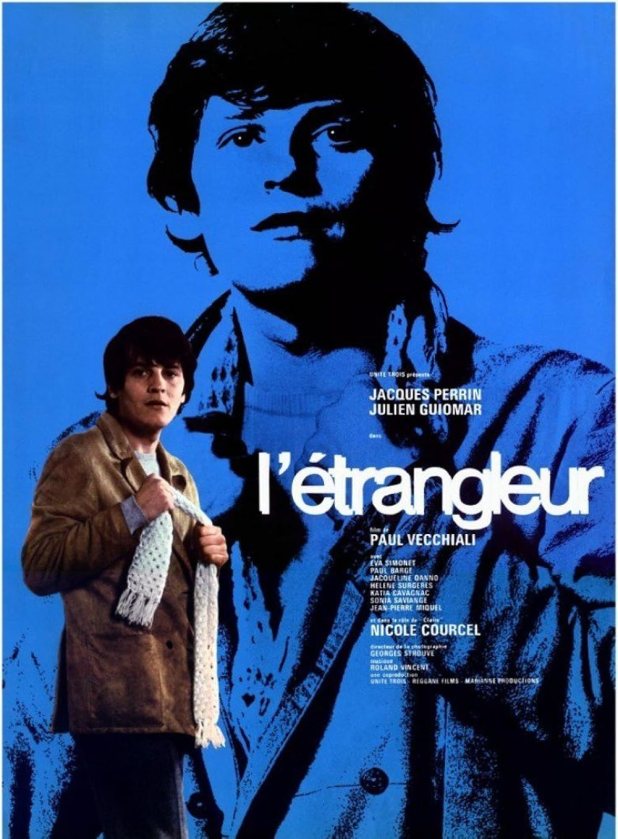
Cinematic Void January Giallo 2024: The Strangler (1970)

EDITOR’S NOTE: Cinematic Void will be playing this movie on January 15 at 7:00 PM CT at Music Box Theatre in Chicago, IL. You can get tickets here. For more information, visit Cinematic Void.

Émile (Jacques Perrin) has an interesting reason for being a killer. He sees what he does as a public service, taking unhappy women away from this world with his white scarf.  Inspector Simon Dangret (Julien Guiomar) is on the case but the ways that he goes after the killer are just as morally suspect. There’s also Anna (Eva Simonet), a gorgeous woman who feels that she’s the next victim. Maybe she even wants to be that person. And then there’s the thief (Paul Barge) who lurks at each scene and takes what cash and trinkets are left from each dead woman.

Directed and written by Paul Vecchiali, this giallo comes from the same year as Argento’s The Bird With the Crystal Plumage. It may not have the same visual madness as that film but it does have a villain who looks like a hero, a child of a man damaged by seeing a murder when he was young using the same knit white scarf that he uses to snuff out lives today. The women that he murders would have just killed themselves regardless, he reasons on the phone to Dangret, so he was saving them. The breakup that Anne has just emerged from has left her feeling that life is worthless; she volunteers to Dangret to be the lure.

Unlike most giallo, we know who the killer is from the start. Yet each kill is so planned, so precise, such a murder set piece as the women give themselves to Émile. He isn’t getting any sexual thrill from killing these women, unlike so many black gloved killers. These are mercy killings. It seems like the person he really wants is the cop.

You can also get this from Altered Innocence, a partner of Vinegar Syndrome.

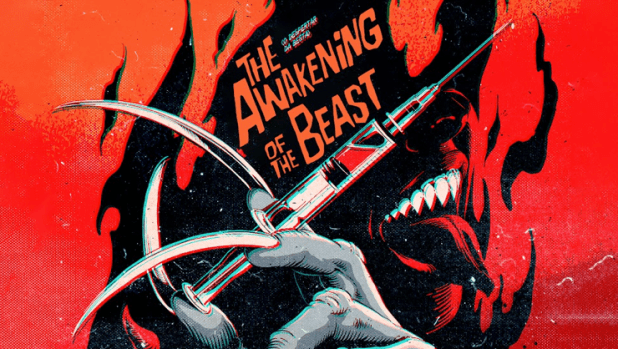
ARROW VIDEO BOX SET RELEASE: Inside The Mind Of Coffin Joe: The Awakening of the Beast (1970)

José Mojica Marins directed movies for six years before making At Midnight I’ll Take Your Soul, the first appearance of Brazil’s national boogeyman, Zé do Caixão, or Coffin Joe.

Joe is a man with no morals but a devotion to Nietzschian philosophies and absolute hatred for religion with the goal of achieving immortality through the birth of a perfect son. And while he does not believe in the supernatural, he often finds himself walking through visions of the otherworld.

Coffin Joe came to Marins — the man who would often be referred to as the character interchangeably — in a very magic way. “In a dream saw a figure dragging me to a cemetery. Soon he left me in front of a headstone, there were two dates of my birth and my death. People at home were very frightened, called a priest because they thought I was possessed. I woke up screaming, and at that time decided to do a movie unlike anything I had done. He was born at that moment the character would become a legend: Coffin Joe. The character began to take shape in my mind and in my life. The cemetery gave me the name, completed the costume of Joe the cover of voodoo and black hat, which was the symbol of a classic brand of cigarettes. He would be a mortician.”
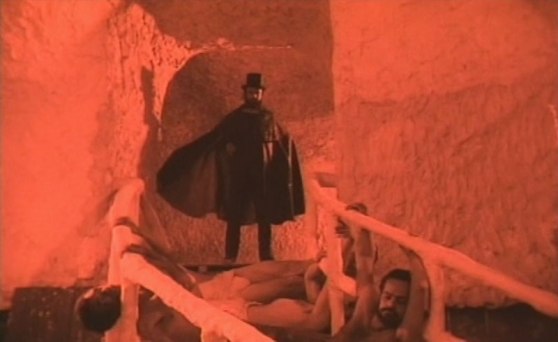
Awakening of the Beast begins in black and white, as a series of vignettes of the ways that drug users debase themselves are shown in lurid, sweaty detail. A TV panel debates the idea that sexual perversion is caused by the use of illegal drugs, with more stories that illustrate this point. The TV show needs an expert on depravity, so they ask Marins to appear on the show.

Afterward, the doctor who conducted the experiment doses four volunteers and asks for them to stare at a poster of The Strange World of Coffin Joe. Supposedly Marins didn’t know much about using drugs, but he intended this movie to speak against the fact that the uses of drugs are treated worse than the suppliers and that the Brazilian film industry saw him as no better than a long-nailed drug dealer.

The acid trip that follows is highlighted by Coffin Joe, ranting against anyone and everyone. Of course, this film was banned by the very establishment it rails against. So basically, Coffin Joe is a self-fulfilling prophecy; the maniac attacking belief structures created by an artist who only believes in the power of film.

“My world is strange, but it’s worthy to all those who want to accept it, and never corrupt as some want to portray it. Because it’s made up, my friend, of strange people, though none are stranger than you!”

Arrow Video’s limited edition collection of the movies of Coffin Joe will own your soul. Awakening of the Beast has commentary with Marins, Paulo Duarte and Carlos Primati in Portuguese with English subtitles. There’s also a new interview with Guy Adams on Marins’ esoteric aspects, a new video essay by Alexandra Heller-Nicholas on the gender politics of Marins’ films and alternate opening titles. You can get this set from MVD.
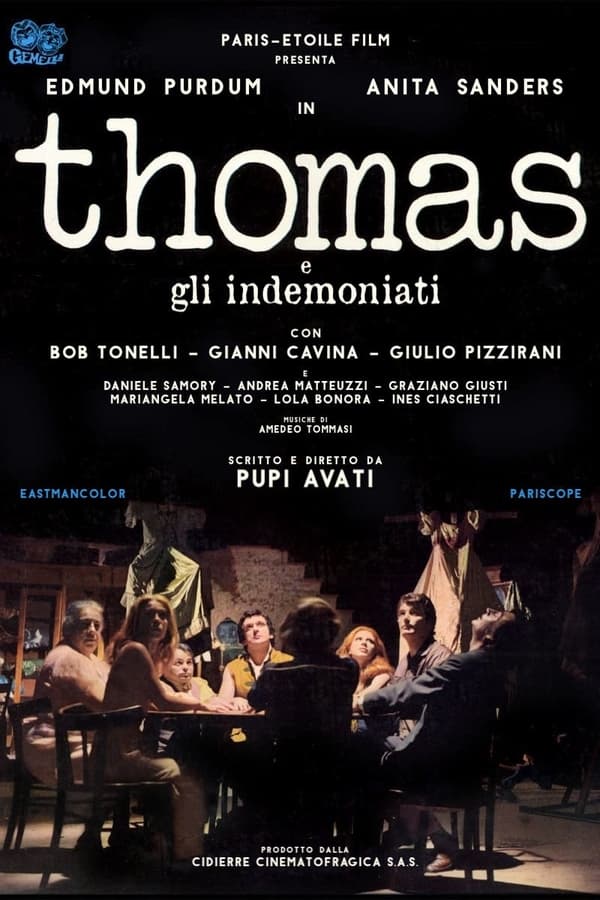
Thomas… …gli indemoniati (1970)

Thomas the Possessed (or Thomas and the Bewitched, I have seen both translations) is from director Pupi Averti, who wrote it with his brother Antonio and Giorgio Celli. It was his second film, one he said that was cursed by family issues and money issues.

A new theater company — Edmund Purdom is one of the actors — is about to put on its first performance, the story of a child named Thomas who a woman believes that she has given birth to but who does not exist. They’re met by a man who offers to read the fortune of the play. At that seance, they are introduced to Thomas, who has become a real person.

On the way to the town where they will perform, they meet an actor hanging from a tree who claims to be the only survivor of a performance gone wrong, one that ended with the audience murdering all of the actors except for him. This must have happened, as the audience is already attacking the stage before the first scene. This is after they rode a ghost train to the town, so at this point, anything could happen.

From a cemetery with bottles instead of graves, the sexual revolution and a hospice home where the elderly die rapidly, Thomas the Possessed is one strange movie, yet we should accept no less from its director. If it all ends where it begins, we must accept this.

After this failed to find an audience, it would take Averti five years to make his next film, La mazurka del barone, della santa e del fico fiorone. A year later, he would make Bordella and the movie he may be best known for, The House With the Laughing Windows. He’s still directing movies today.

For some time, the only way to see this was to rent the copy in the Bologna library, which Averti himself donated. Its production company went out of business and the movie had only played the 1970 film festival in Locarno.

You can watch this film on YouTube.

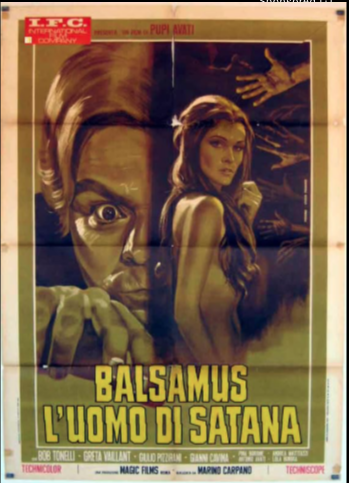
Balsamus, l’umomo di Satana (1970)

Balsamus the Man of Satan was directed by Pupi Avati and nearly the entire cast and crew were close friends of his, including writers Enzo Leonardo and Giorgio Celli. It stars Ariano Nanetti (Bob Tonelli) is the dwarf of the title. He was an entrepreneur who had a man named Mister X — businessman Carmine Domenico Rizzo — who paid for most of the movie. It’s the director’s first movie and if you want to watch some of the better films that he would do, I would say The House With the Laughing Windows and Zeder are two solid ones.

Balsamus is a magician who says that he can solve human and animal sterility and who has been gathering several rich women around himself. Meanwhile, his wife Lorenza is sleeping with his assistant Alliata and his servant Ottavio does all of the work. He kills his mother-in-law and resurrects her, but when he tries to add to his magical powers, he fails. Depressed, he calls out all of his wife’s affairs and kills himself. The court mocks him other than the faithful Ottavio.

Based on Giuseppe Balsamo, Count of Cagliostro, a famous alchemist and necromancer. Avati said, “I was fascinated by readings on paranormal and alchemical themes, furthermore in the film there was a rural matrix, my rural life in Sasso Marconi. I wanted to write Cagliostro’s life, in grotesque terms, setting it in the present day.” 

Yet much like its protagonist, this all ended up as a movie that others didn’t understand. “I had a lot of hope in Balsamus, I hoped to be appreciated by who knows what critics, but in reality it was a resounding defeat,” concluded Avati. He also claimed that the movie would have been a bigger disaster if not for the assistance of director of photography Franco Delli Colli, who was on camera for Leone’s Duck, You Sucker! and lit Django Kill… If You Live, Shoot! as well as being the cinematographer for plenty of great movies like GhosthouseRats: Night of TerrorStrip Nude for Your Killer and Avati’s Zeder

This was released in other countries as Blood Relations and The Man of Satan.

You can watch this on YouTube.

THE MOVIES OF AL ADAMSON: Hell’s Bloody Devils (1970)

It just makes sense that the Third Reich would regroup in Las Vegas, I guess. FBI agent Mark Adams (John Gabriel) poses as a member of a Sin City organized crime gang to get into the world of war criminal Count von Delberg (Kent Taylor) and stop him from his plan to counterfeit U.S. dollars. He’s helped by Israeli agent Carol Bechtal (Vicki Volante) whose parents were killed by von Delberg during the war. But the Count hasn’t slowed down or not gotten with the times. He’s working with the Bloody Devils, a motorcycle gang, to make his plans work.

This started as a spy movie called Operation M before it was The Fakers and then a few years later, bikers — real bikers, the kind that get busted for weapons charges during filming — joined the cast.

You know who else is in there? Colonel Sanders. He’s in one of his KFC restaurants. The Colonel had sold the restaurants in 1964 but retained ownership of the Canadian stores and was a brand ambassador, even if he started to despise the way the new owners made his chicken cheaper and not to his taste. In 1975, he said, “My God, that gravy is horrible. They buy tap water for 15 to 20 cents a thousand gallons and then they mix it with flour and starch and end up with pure wallpaper paste. And I know wallpaper paste, by God, because I’ve seen my mother make it. There’s no nutrition in it and they ought not to be allowed to sell it. Their fried chicken recipe is nothing in the world but a damn fried doughball stuck on some chicken.” KFC has paid for product placement in this movie, which may seem strange, but the Colonel also shows up — as does his chicken — in some Herschell Gordon Lewis movies. The Godfather of Gore used to serve up the original recipe as his craft service. The Colonel is also in Blast-Off GirlsThe Big Mouth and The Phynx.

John Carradine plays a pet shop owner. That’s enough to make me watch.

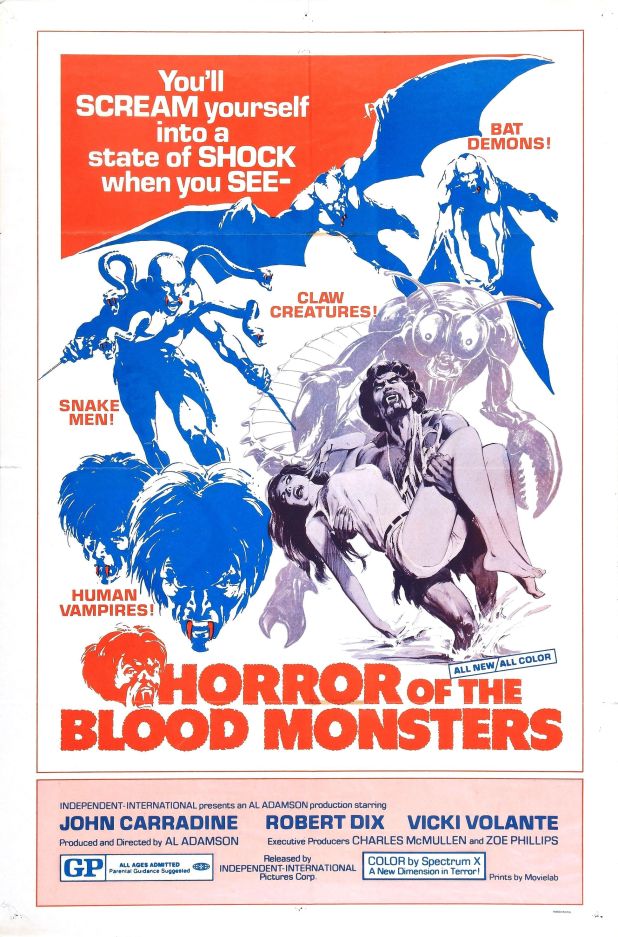
THE MOVIES OF AL ADAMSON: Horror of the Blood Monsters (1970)

Al Adamson was remixing movies back in 1970. Invasion of the Blood Monsters has footage from Robot MonsterUnknown IslandOne Million B.C., the Filipino movie Tagani and The Wizard of Mars. By the time it was ready for drive-ins and theaters, that black and white footage looked old. Adamson used a process called Spectrum X that made everything a single color. It’s really strange when mixed with full color footage yet I kind of enjoy it.

Exploitation heroes like Gary Graver and Adamson play vampires in the beginning as we listen to Brother Theodore tell us what has happened to our home world and why a rocket must go into space and John Carradine will lead humans in their quest to save Earth.

Jennifer Bishop is the beautiful girl who will help them fight snake men, lobster people and more vampires — hey, Bud Cardos — and oh yeah, bat people! Sam Sherman produced this and it was originally started in 1966 with reshoots in 1970. It was getting renamed all the way up until it was a Star Wars clone — well, in title only — under the AKA Space Mission of the Lost Planet.

I just read a bad review of this movie and it made me dislike the person who dare say anything mean about this film. From the moment the Independent International logo shows up, I was happy. Like, deliriously joyous. How can you not love a movie like this? What’s next, people don’t like Brain of Blood?