SARTANA WEEK: I Am Sartana, Trade Your Guns for a Coffin (1970)

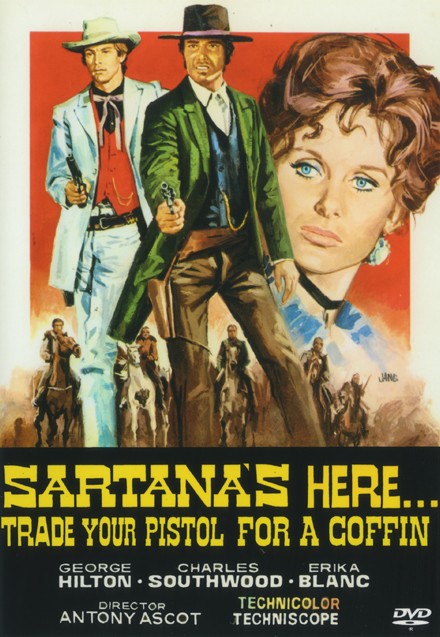
In the third of the five original Sartana films, our hero gains a new actor: George Hilton takes over for Gianni Garko with Giuliano Carnimeo staying in the director’s chair. In this installment, Sartana faces Mexican bandits and Sabbath, a man who may be his equal.

Hilton was in a ton of films. Of note, The Strange Vice of Mrs. WardhThe Case of the Bloody Iris, All the Colors of the Dark have been covered on our site. According to spaghetti-western.net, “Carnimeo discovered that Hilton fitted his ideas better than Garko: he had always been a supporter of a more parodist approach, but his plans had been obstructed by Garko, who felt that the daring mix of comedy and extreme violence of the movies would only work within a tongue-in-cheek context, and would become ridiculous if they turned the whole thing into a farce. Hilton agreed with a more fanciful approach. As a result, the Hilton-movie shows a strong tendency towards the absurd. For this reason, some fans don’t see it as an official Sartana.”

Although they didn’t team up on this Sartana film, Carnimeo and Garko also did They Call Him Cemetery and His Name Was Holy Ghost, which are quite similar to the Sartana films. In addition, Carnimeo and Hilton did two films with a hero called Halleluja and two more with a hero called Tresette which take off from Hilton’s role in this film but are played for comedy.

Of course, Sartana comes up against criminals who are all out for themselves. However, the wild card in this movie comes in the form of Sabbath (Charles Southwood), a bounty hunter who dresses in white, carries a parasol, reads Shakespeare and has promised his mother that he will be on his best behavior.

There are — did you catch the theme yet — plenty of double crosses. Even on you, the viewer, with somewhat of a trick ending. While many decry this entry, I found it quite entertaining. You can find it on the gray market and on a few compilation DVDs of varying quality. Or you know…YouTube.
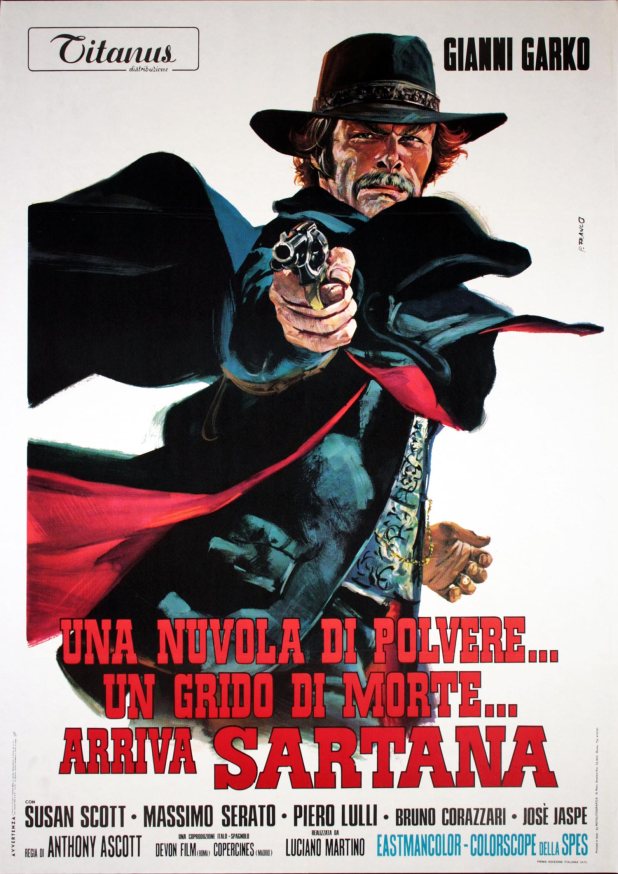
SARTANA WEEK: Light the Fuse…Sartana is Coming! (1970)

In his very first line in the movie, Sartana paraphrases the Bible verse “I have come to call not those who think they are righteous, but those who know they are sinners and need to repent” before killing a corrupt sheriff and two of his deputies. If I wasn’t already excited about the fourth Sartana film, I’m now fully ready.

Sartana turns himself in for their murders in order to get one of his old friends, Grandville Full, out of the corrupt jail, one so horrible that the wardens urinate onto men desperate for water. That friend I mentioned earlier — Grand Full for short — knows where a half million in gold and two million in counterfeit money is. But there are plenty of people after it too, like an evil widow (Nieves Navarro!), a one-eyed killer, another corrupt lawman and even a general gone deaf and mad.

Like every Sartana movie, the only person you can trust is Sartana himself. The entire town of Mansfield is looking for the gold and ready to kill one another and anyone else that comes to visit. Like Mara Krupp, who pretty much plays the same horny hotel owner that she played in For a Few Dollars More.

Well, maybe Pon Pon, an old friend and inventor, can be trusted. After all, he’s invented a robot for Sartana named Alfie. Yep, in the middle of a spaghetti western, there’s a robot. Welcome to the Sartana films! He’s also building a giant organ for his dance hall, which he claims to be the reason why he needs the money.

The scene where Alfie the robot blows up the sheriff, spraying out burning counterfeit money that Sartana lights a cigarette with while laughing? That’s exactly why I love the Sartana series. They’ve moved from him as an angel of death to a detective with James Bond gadgets over the four Gianni Garko films.

The finale, where the pipe organ is taken into the street, only for it to contain machine guns that mow down hundreds — if not more — soldiers and assorted killers, thieves and liars has to be seen to be believed.

The music, by Bruno Nicolai, is great. He also scored plenty of Jess Franco films, as well as The Red Queen Kills Seven TimesAll the Colors of the DarkThe Case of the Bloody Iris and so many more. Here, he continually brings back the haunting theme of Sartana and ups the intensity at the close of the film.

Of the four Sartana films I’ve watched for this week, this one has been my favorite. Now, it’s not the dark and realistic film that a Leone Western can be, but it has a charm and verve all its own. Also, I want a robot that lights my cigars like Alfie!

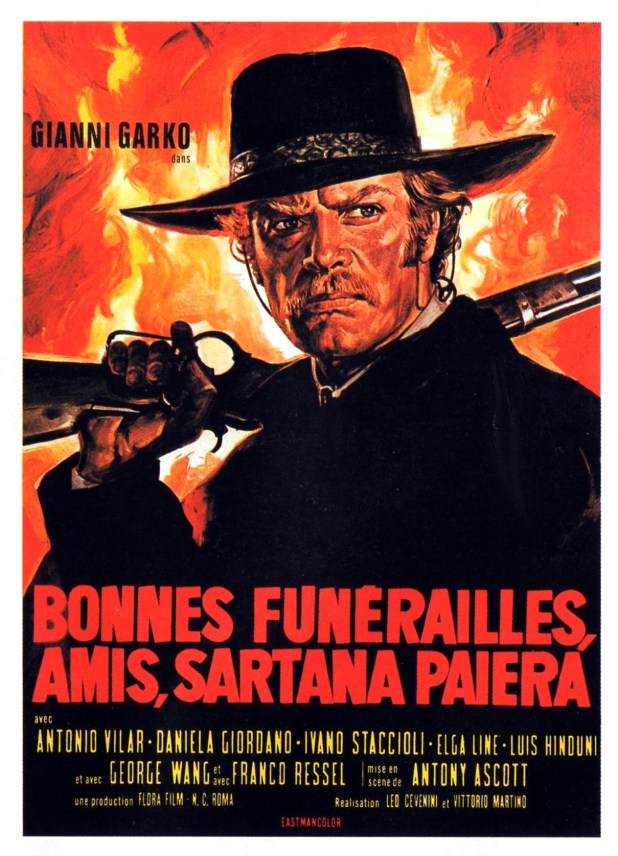
SARTANA WEEK: Have a Good Funeral, My Friend… Sartana Will Pay (1970)

Deadly playing cards. A Confucius quoting casino owner. And every man and woman out for themselves. Yep, it’s time for another Sartana movie.

Sartana (the returning Gianni Garko) sees several gold prospectors get killed, then kills their killers. Soon, he meets Abigail Benson (Daniela Giordano, Your Vice Is a Locked Room and Only I Have the Key), who has paperwork claiming she owns a parcel of land. Everyone tries to get her to sell the land — which is said to be worthless — and she even gets kidnapped by Hoffman, an evil banker. But, of course, this being a Sartana movie, nothing is as it seems.

The second Sartana film to be directed by Giuliano Carnimeo (The Case of the Bloody Iris), filled with plenty of action and great lines, like when Sartana tells a gang of men that he will “pray for them before he sends them to hell.” Or when he informs a gunman that “You don’t want to kill me, because I don’t allow myself to get killed.”

There are some sillier sequences, but Sartana has not become fully camp. That would come soon enough. This is closer to a cowboy procedural drama and a pretty interesting one at that.

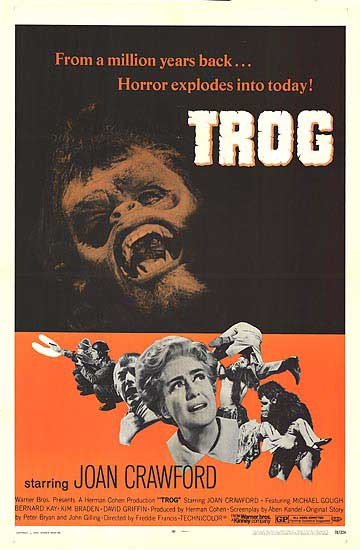
Trog (1970)

Trog makes me sad. Beyond the fact that it feels a lot like King Kong or Son of Konga doomed monster from our past that just can’t survive in today’s horrible modern world—it’s also depressing at times to watch Joan Crawford act her heart out in a film where no one else can come close to her power.

That’s not to say this is a bad film. It’s delightful and well-directed by genre vet Freddie Francis (Tales from the Crypt and plenty of other wonderful Amicus portmanteau films). It’s also quick-moving and enjoyable.

But it’s still sad.

A troglodyte (TROG!) is found alive in the caves of England. Dr. Brockton (Crawford) has had some success communicating with him and sees him as the missing link. However, her neighbors do not like her having a monster in her house, mainly after it kills a dog when it steals his ball.

Local businessman Sam Murdock (Michael Gough, who appeared in many Hammer films and as Alfred in the 1980s and 1990s Batman films) worries that the creature will negatively impact local businesses. But he really has an issue with a woman being in charge.

Meanwhile, Trog undergoes multiple surgeries, which enable him to learn to communicate. In a trippy sequence, we see into his mind, which is filled with memories of the Ice Age and dinosaurs.

The court upholds Dr. Brockton’s goal of teaching Trog, so Murdock sneaks in and lets him loose. He kills several people, including the businessman, before taking a little girl and retreating to his cave. Dr. Brockton can communicate with Trog, and the girl goes free. Meanwhile, soldiers open fire on our titular caveperson, and he falls to his death, impaled on a stalagmite.

As Dr. Brockton leaves in tears, a reporter tries to interview her. She has no comment as she wanders away.

See? Depressing.

Due to the film’s low budget, Crawford used her own clothes. And it shows. She’s a beacon of fashion in a grimy town. She stands out like no one else. And speaking of suits, the one for Trog was left over from 2001: A Space Odyssey!

This was Crawford’s final film, but I don’t believe the TV show Feud: Bette and Joan. She’d continue to act afterward, appearing in an episode of TV’s The Sixth Sense called Dear Joan: We’re Going to Scare You to Death. If you’ve ever listened to My Life with the Thrill Kill Kult, that’s where the sample on the song “A Daisy Chain for Satan Comes From.”

PS: I would know none of this were it not for Bill from Groovy Doom.

I’m glad I watched Trog. But the sad ending — and thinking of Joan changing in her car during the breaks in filming — make me a little misty-eyed. That said, it’s one of John Waters’ favorite films, so there’s that.

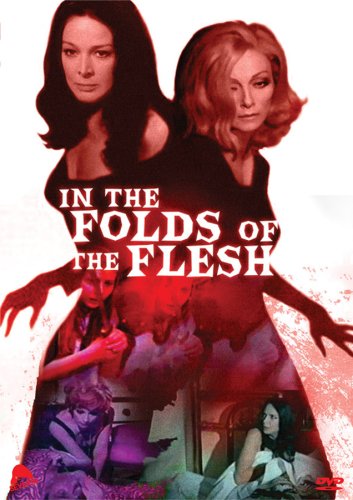
In the Folds of the Flesh (1970)

“…And then a sudden violent shock that left a deep impression on the mind and damagen (sic) it permanently…”

“What has been remains imbedden in the brain nestled in the folds of the flesh. Distorted, it conditions and subconsciously impels…(Freud)”

Those words start this movie off, with a crime being shown in the past and then fast forwarding 13 years into the future, where we meet one screwed up family. There’s the mother, Lucille and her children Colin and Falesse. Yet all is not as it seems — the real Falesse has been locked away in a mental institution and is being replaced by Lucille’s daughter from her first marriage, Ester.

Ester lures man after man to their estate and then goes into a trance and kills them, upon which point she relives the decapitation of her stepfather 13 years ago. Of course, she’s also in love with her brother Colin. Remember when I said this family had some problems?

Then, Pascal, the killer from the opening sequence returns. He’s brutal and uncompromising, demanding $200,000 from the family, then having sex with Lucille and Ester in front of Colin. Finally, after killing one of Colin’s vultures, Lucille draws on her experience in a concentration camp to kill Pascal with gas while he showers. The flashback to the Nazi camp is harrowing and feels so different — and much darker — than the body of the film.

Yet what if Ester’s father isn’t dead? And what if he comes back? Can the family keep killing and getting away with it? And is “I’m sorry I took your place, but I really had no idea I wasn’t you!” the best giallo quote ever?

This is one strange movie — it combines Nazi elements, a police procedural, a giallo, a psychological examining of identity and even comes close to a Last House on the Left vibe.

Severin released this film several years ago, but it’s sadly out of print. It’s certainly one of the oddest entries in the genre and one you should track down. I’ve only barely touched on the many twists and turns of the plot because I believe that you should enjoy them for yourself.

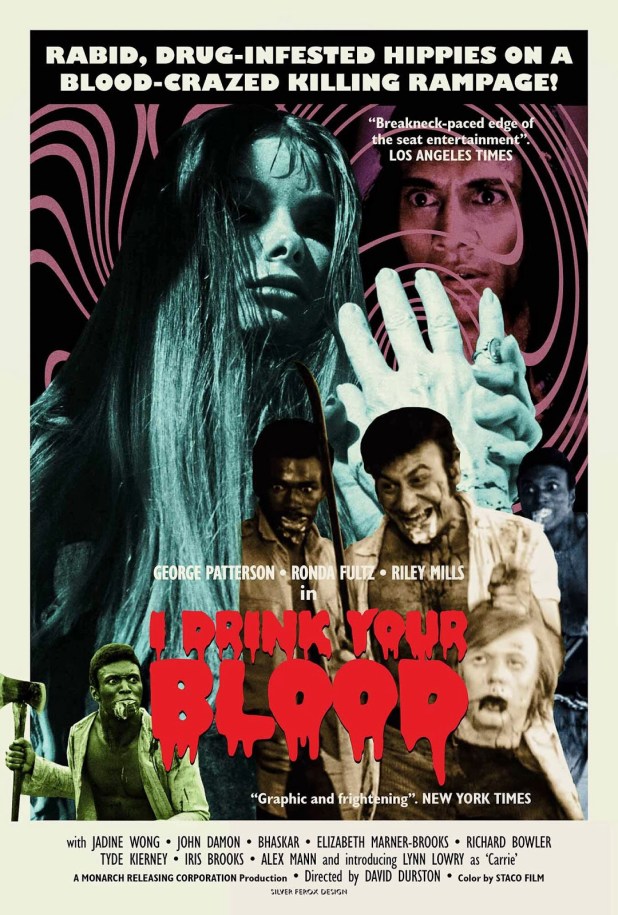
I Drink Your Blood (1970)

“Let all the spirits hear. I am the first born Son of Satan. He commands my thoughts. I speak his words. The Book of the Dead! Sons and daughters of Satan. Put aside your worldly things and come to me. Let it be known, sons and daughters, that Satan was an acid head. Drink from his cup; pledge yourselves. And together, we’ll all freak out.”

Has a movie ever started better? I don’t think so. I Drink Your Blood will take you prisoner, stab in the stomach with a fork and write on the walls with your blood!

In fact, I watched that opening at last year’s April Ghouls Drive-In Monster-Rama in the middle of the night, surrounded by fog and inebriated on a variety of vices. It was a transcendent moment.

Horace Bones leads a cult that worships Satan and drops acid. A young girl, Sylvia, watches from the woods but is caught, then raped by the cult members before she escapes. She’s found the next morning by Mildred, a baker, and Sylvia’s brother Pete. They get her back to her father, Doc Banner, the town’s veterinarian. And oh the town — it’s been abandoned due to dam project. The hippies break down and decide to stick around.

The only food in town? Meat pies from Mildred’s bakery, which Horace and family take as they set up their home in a house scheduled for demolition. And when Doc comes for revenge, the gang smashes his glasses and force him to take LSD.

So how do you get revenge? Well, if you’re Pete, you kill a rabies infected dog and inject the blood into meat pies, which infects the gang and makes them go crazy. They begin to attack one another as Molly runs away, finding the mill workers, who she ends up having sex with all night long until she bites one of the men.

Horace goes full-on insane, even more insane than the beginning of the film, attacking two of the construction workers. Only Andy from the group is not infected and he finds Sylvia and Pete. Meanwhile, the infection spreads to the rest of the town. 

Banner gets impaled. Horace is stabbed by Rollo, the African-American member of the family. Mildred is barricaded inside her bakery and Andy is beheaded before they get in. The Japanese member of the family sets herself on fire. Everyone other than Mildred, her boyfriend Oaks (who comes to save them), Sylvia and Pete dies horribly. 

Director David Durston worked with producer and CEO of Cinemation Industries Jerry Gross to write and direct this film. He said that “wanted to make the most graphic horror film ever produced, but he didn’t want any vampires, man-made monsters, werewolves, mad doctors, or little people.” The director couldn’t come up with an idea until he read an article about a village in Iran where a pack of rabid wolves infected several villagers, making them insane and homicidal. Dunston found a doctor who had been to the village and that had filmed the evidence. He was further inspired by the Manson family trials.

This is the first film to be given an X rating for violence instead of sex. And while originally entitled Phobia, the name change to I Drink Your Blood and pairing with  1964’s Zombies, also retitled as I Eat Your Skin, proved a potent blend for audiences. The two movies are almost always thought of together.

This film is unafraid to be the exploitation junk that normal people avoid. It’s grimy, filthy and ultimately entertaining as hell. It takes everyone’s worst fears of the hippies and shows you in graphic detail what happens when those fears come true.

Want to see it for yourself? It’s available on Shudder.

BAVA WEEK: Five Dolls for an August Moon (1970)

Bava believed this was one of his worst films. It wasn’t released in the U.S. until 2001. And yet, I found plenty to like about this murder-filled affair. It also taught me an important lesson: if you invent a new chemical process, don’t go to a rich industrialist’s vacation island.

George Stark is one of those industrialists and he’s invited a bunch of guests to his private island, including Professor Farrell, who has created an industrial resin. Several of the guests want him to sell it. Here’s where the hijinks ensue.

Stark’s wife Jill is sleeping with Farrell’s wife, Trudy (Ira von Fürstenberg, The Fifth Cord). Stark’s partner Nick treats his wife, Marie (Edwige Fenech!) horribly, but allows her to sleep with Charles, one of the servants. Isabelle (Ely Galleani, A Lizard in a Woman’s Skin) is a teenage girl along for the ride. And Jack and Peggy just seem to get along, unlike everyone else.

The men beg Farrell for his formula, sending away the only way off the island — a motorboat — away until the deal is done. So when Charles is killed, they simply hang him in the freezer until they can get the radio working to call the mainland. As you do.

Then, teenage Isabelle kills Farrell, but the others only know he’s dead. The killings now pick up, with Peggy being shot to death, Marie being stabbed and Jill being electrocuted in the bathtub. One by one, their bodies are added to the freezer.

With Isabelle having gone missing, Stark, Jack, Nick, and Trudy decide to stay in the same room for the night, as one of them has to be the murderer. Nick takes off after an argument and is found dead the next day, so of course, as is custom, he is also added to the freezer.

Stark has a boat, which makes you think he’d be the suspect. But as he comes back to the house, Jack reveals that he has killed everyone else to steal their checks. He kills Stark and meets with Trudy, who was the real boss. She’s got the resin formula. He has the checks. But they’re both out for themselves and end up killing one another. Isabelle makes herself known and takes everything.

That’s not the whole story. Isabelle also shows up to see Farrell in prison. He didn’t die, but had come up with the whole scheme with Trudy. Turns out he wasn’t the good man that he appeared to be and had stolen the formula. He got Isabelle to be part of his plan, but she gave him a drug that would make him appear to be dead, then pushed him out to the sea. Rescuers found him and he was so messed up on the drug that he confessed. She laughs about the whole thing and leaves the prison, finding it all rather funny that he’ll be hung in the morning while she’ll enjoy three million dollars.

There are better Bava films to be found, but there are plenty of twists and turns in this film. It’s certainly entertaining and you know, Edwige Fenech is in it. So there are way worse movies to spend your time with.

Just remember. If you come up with a great formula or steal one, just keep it to yourself. And don’t go on vacation. Stay at work.

UPDATE: You can watch this for free on Amazon Prime.

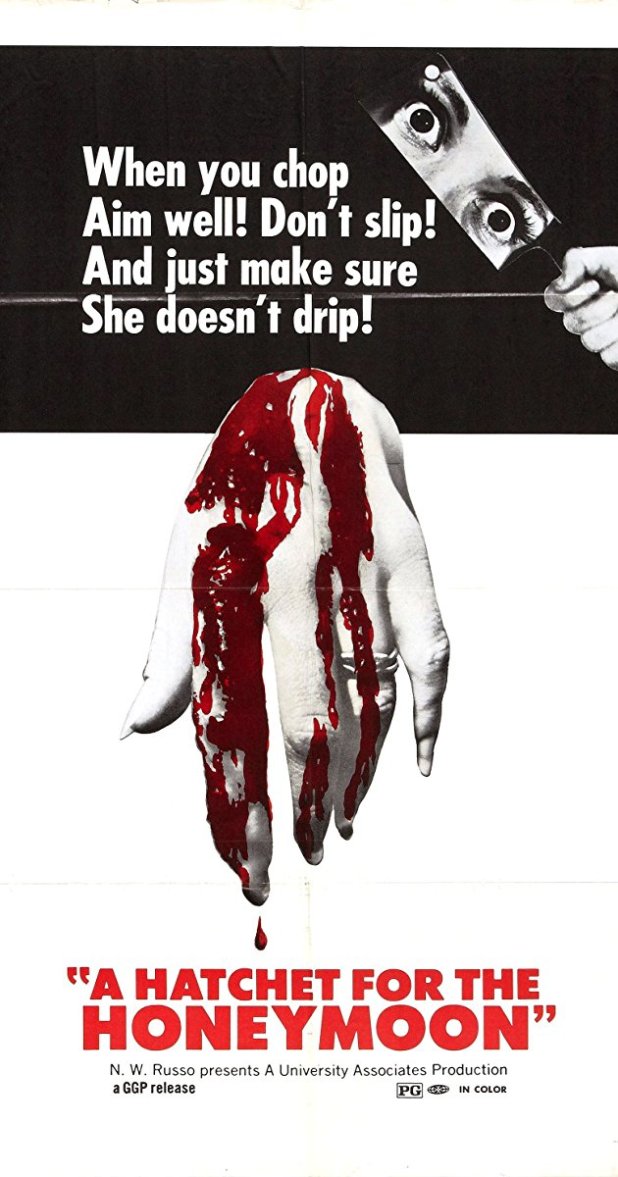
BAVA WEEK: Hatchet for the Honeymoon (1970)

Do you need to love, trust and care about the hero of the movie? Mario Bava is here with Hatchet for the Honeymoon in an attempt to craft a story where the hero is the absolute worst person in the entire film.

Meet John Harrington. He’s 30, runs a bridal dress factory, lives in a gorgeous villa near Paris and kills young women to overcome his impotence and Oedipus complex. His wife, Mildred, refuses to divorce him. And he’s instantly smitten with Helen (Dagmar Lassander, Forbidden Photos of a Lady Above Suspicion, The House by the Cemetery), a young model who has come to replace a missing girl.

Why is she missing? She was one of the models at the salon who John took a liking to, giving her one of his dresses for her wedding. The moment she tried it on, he hacked her up with a meat cleaver, burned her corpse and used it to fertilize the plants in his greenhouse.

Inspector Russell knows that something isn’t quite right. After all, how can six models disappear from the same dress company? If only there was some evidence…

John, however, is falling in love with Helen. And he finally decides to do something about his wife. That something entails him putting on a wedding dress and killing her. But there’s one problem. Here’s where Bava twists the film from giallo into supernatural territory: she won’t stay dead.

While John can’t see or hear his wife, everyone else can. Even after burning her remains and placing them in a handbag, she keeps coming back. He takes the handbag with him to a club, where an attempt to bring another woman home fails when she sees his wife. Beaten by a bouncer and ejected, he cannot even use his charms to win over women. He throws his wife’s ashes into the night, but she remains with him

If John can’t be happy, at least he can murder Helen. He convinces her to wear a wedding dress and tells her that he never wanted to hurt her. She avoids the final blow of his cleaver, which unlocks a flashback where we learned the truth: John loved his mother and that love grew as he became the man of the house after his father’s death. But when she remarried — and started having sex again — he couldn’t take it and murdered her and her new husband. His mind erased the evidence until now.

Helen was an undercover cop all along, leading Inspector Russell and his men back to arrest John. While being transported to prison, he’s happy knowing that his many trials are over. Then, to his horror, he sees the handbag and notices his wife sitting next to him. Now, he’s the only person who can see her. She promised to be with him forever, even in Hell. He goes insane before accepting his fate.

Hatchet for the Honeymoon predates the slasher, yet many of its conventions can be found here and in other early Bava works. This film is a masterwork of both style and substance, with gorgeous fashion, sets and camerawork creating a gorgeous tableau. I love the scene where John uses Bava’s Black Sunday, playing on the TV, as an excuse for the screams that come from his apartment. And as his wife’s blood drips down onto the ground floor, it’s almost as if Bava dares you to empathize with a hero who is completely contemptible. What a predicament to be in!

FeedShark

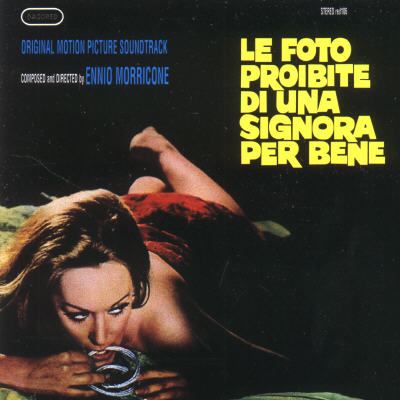
Forbidden Photos of a Lady Above Suspicion (1970)

Minou (Dagmar Lassander, The House by the Cemetery) loves her husband, Peter. But Peter is cold and only really seems to care about work. All she does all day is pine for her husband and take care of a turtle. Yep. You just read that correctly.

One night, a mysterious stranger attacks her, cuts open her clothes and then warns her: her husband is a killer.

The mysterious man is proven correct when a man who owed Peter money shows up dead. He demands that she come to his home, where he blackmails her into sleeping with him. Seeing as how he has recorded their tryst, he now has more material on her.

Even her friend Dominique (Nieves Navarro, All the Colors of the Dark, who was married to the director, Luciano Ercoli) can’t be trusted, as Minou finds photos of the blackmailer in provocative poses in her possession. When she finally gets the police to investigate, the man’s home is empty and Dominique tells the police he never even existed. Oh yeah. Dominique was once Peter’s woman before Minou. So there’s that.

Minou has a nervous breakdown and overdoses on tranquilizers before sobering up and learning that it’s all been a plot against her from the beginning. But come on — if you’ve watched any giallo, you knew that going in.

Despite its lurid title, Forbidden Photos of a Woman Above Suspicion isn’t filled with sex or even all that much violence. It’s more about alcoholism and how women were taught that they had to have the skills to land a man, but not what to do with their lives to make them fulfilled beyond just a relationship.

Director Luciano Ercoli has some gorgeous shots in here that really take advantage of the space age 1960’s aesthetic. And a bossa nova score by Ennio Morricone keeps this film bouncing. It wouldn’t be the first giallo I’d recommend, but it’s not the last, either.

If you have Shudder — and you totally should — you can find this film right here.

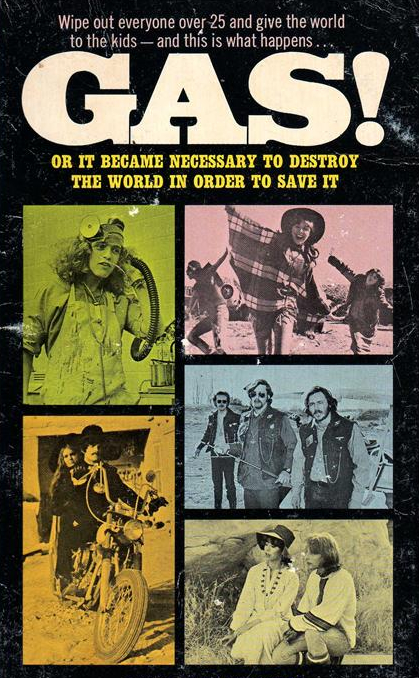
FUCKED UP FUTURES: Gas-s-s-s (1970)

Gas! -Or- It Became Necessary to Destroy the World in Order to Save It would be the last movie that Roger Corman would direct for AIP. And it would be the last film he’d helm for nearly twenty years, too.  Why? Turns out Corman was unhappy to the cuts made to the film (AIP and Corman had a handshake agreement that he would have final cut). In particular, he was enraged that they’d removed what he saw as the end of the movie — a shot where God looked over 300 extras and commented on the action. The shot that he felt was one of the greatest he had made in his life ended up on the cutting room floor.

The film opens with an animated sequence where the end of the world is overseen by a John Wayne-sounding general. The army was in charge of a gas that killed everyone over the age of 25 and it is accidentally released.

Cut to Southern Methodist University, where the news is all over campus. Two hippies, Coel and Cilla, fall in love. As a Nazi-esque police force is running Dallas, they decide to run toward Mexico. On the way, they meet Marissa (Cindy Williams, Shirley from TV’s Laverne & Shirley, as well as The Conversation and American Graffiti), Carlos (Ben Vereen), Hooper (Bud Cort) and Coralee (Talia Shire, billed here as Talia Coppola).

What follows are some stream of consciousness adventures, like a concert at a drive-in where Country Joe and the Fish (Joe’s name here is AM Radio and he can speak with the voice of God, who sounds like an old Jewish man) play, a game of golf with some bikers and some sleeping around but it’s all cool because this is the future of the hippies and everyone is chill with one another.

Finally, they find a peaceful commune, but a football team attacks. God comes to help, everyone is reunited and then a big party happens where everyone gets along. Peace and love, peace and love.

Writer George Armitage had pitched Corman on a film called Carrot Butts, where cartoon characters came to life. They couldn’t get it produced but did get this one off the ground. He went on to write and direct several films, most famously Grosse Pointe BlankVigilante Force and Private Duty Nurses.

There’s even a tribute to Corman’s Edgar Allan Poe movies, as Poe appears riding a motorcycle.

It really shows that Corman was growing tired of the hippie rhetoric and ethos. In the book Roger Corman: Interviews (Conversations with Filmmakers Series), he said,  “I was beginning to get a little disillusioned. I intended that the picture be sympathetic toward our lead gang of kids yet, at the same time, I wanted to show that I was beginning to suspect that all of the ideas being spouted by the counter-culture and all of the dreams were not totally rooted in reality. In the picture, I wanted to literally give youth the world they desired and, then, make a cautionary statement about how youth might not be able to handle it as perfectly as they anticipated.”

This is a film of its time. It’s filled with long shots of riding dune buggies to folk music and lots of earnestness. If Idaho Transfer is the dismal end of idealism, this is its last gasp, struggling for a perfect world, even if the world has to die to get there.