CHILLER THEATER MONTH: Dracula Has Risen From His Grave (1968)

EDITOR’S NOTE: Dracula Has Risen from His Grave was on Chiller Theater on Saturday, October 29, 1977 at 9 p.m. on a prime time special. It was also on the show on July 21, 1979 and November 14, 1981.
This was the fourth Hammer Dracula movie and the third to star Christopher Lee (he doesn’t appear in The Brides of Dracula). It was directed by Freddie Francis, who stepped in to replace Terence Fisher, who injured his leg in a car accident. It has an extraordinary and wonderful effect when Dracula appears in the film, as the edges of the frame take on the colors of crimson, amber and yellow.

There’s a fantastic beginning where a young altar boy (Norman Bacon) finds a dead woman hidden inside a church bell, just one more of Dracula’s victims. But a year after — and the events of Dracula: Prince of Darkness — finds the greatest of all the undead quite dead.

Monsignor Ernst Mueller (Rupert Davies) visits the village from the opening and learns that the altar boy can no longer speak and the town’s holy man (Ewan Hooper) has lost his faith. Because Dracula’s castle has a shadow that extends over their church, they refuse to even come near it. The Monsignor decides to exorcise the castle, which leads to the kind of strange occurrences that always bring Dracula back: lightning strikes, the older priest slips, he hits his head on a rock, and the drips of his blood through the cracks in the ground make their way to the deceased vampire.

As Mueller returns home, Dracula quite literally rises from his grave and takes on the frightened priest as his familiar. Now unable to enter his castle, he flips out and demands revenge, heading off to Keinenberg, where he plans on making Mueller’s niece Maria (Veronica Carlson, Frankenstein Must Be DestroyedThe Horror of Frankenstein) into one of his lovers.

Luckily, her boyfriend Paul (Barry Andrews) is ready to protect her, even if he has to defeat the advances of a barmaid Zena (Barbara Ewing, who has since become a well-reviewed author) who has been hypnotized by Dracula. There’s a wild moment when Dracula orders the priest to kill Zena, so he burns her body in a bakery oven while Dracula leaps across the rooftops to find and bite Maria.

This has some fascinating ideas as Paul has to go it alone after the Monsignor dies. As an atheist, he and the lost faith priest are unable to properly stake and destroy Dracula. As always, Dracula is stopped, and faith is restored. This is the most challenging time for achieving that end goal.

As a kid, the Hammer movies were quite literally the end-all, be-all of my existence. I thought about them all day and would discuss them with anyone who wanted to hear about them—often, many who didn’t.

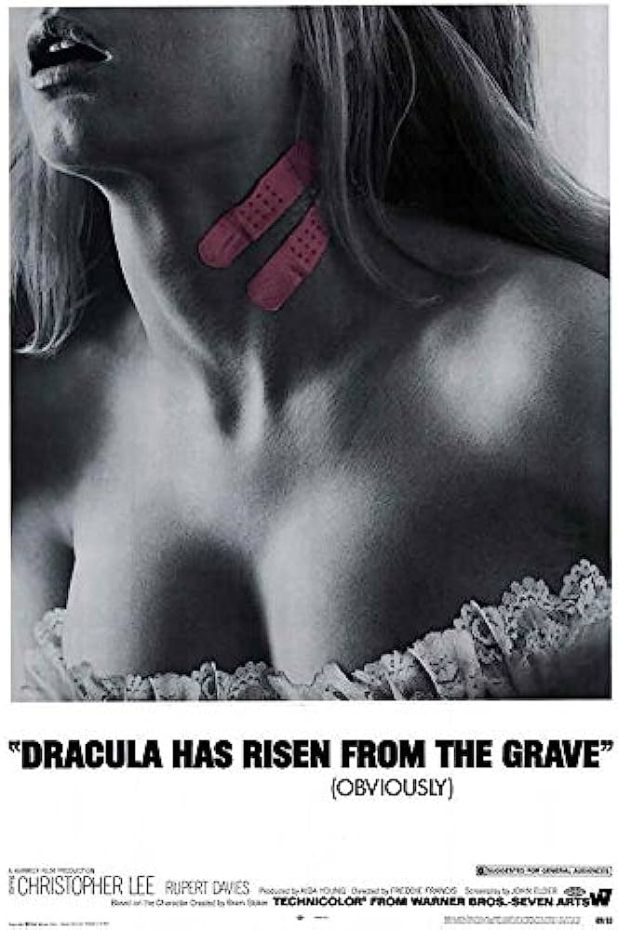
As an old man, I’m struck by how often the film in the movie is sped up, which doesn’t work, while the color effects and rooftop scenes have lost none of their infernal power. Plus, this has one of the best posters I’ve seen, just the throat of a bosom woman with band-aids where Dracula’s teeth have penetrated her.
CHILLER THEATER MONTH: Run. Psycho, Run (1968)

EDITOR’S NOTE: Run,. Psycho, Run was on Chiller Theater on Saturday, March 28, 1970 at 11:30 p.m. It also appeared on June 26, 1971.

Director Brunello Rondi directed Il Demonio, a movie that didn’t do well. He was interviewed by Dario Argento and said that this movie was made with “no intention of making a mystery, or a horror film, or even a suspense yarn, Hitchcock-style. What really interests me is to grasp with a film set in 1912 the origins of today’s disease within the bourgeoisie, and to portray its degeneration with extreme violence. I read very few crime novels in my life. And I must say that I do not even like them very much. In my film there is indeed a crime, and an investigation. But it’s only a pretext, in a story full of hatred set in the last years of the “Belle Époque,” when some kind of false euphoria was decomposing, while one could glimpse the first signs of the impending war, the signs of hatred and the strengthening of class struggle.”

Rondi wrote La Dolce Vita and 8 1/2, so he was an intellectual. Then again, he directed Riot In a Woman’s Prison and Black Emanuelle, White Emanuelle. Therefore, I respect him.

It was called Più tardi, Claire… più tardi (Later, Claire…Later) in Italy but when AIP bought it to show on American TV, it was called Run, Psycho, Run. It’s never been released on home video.

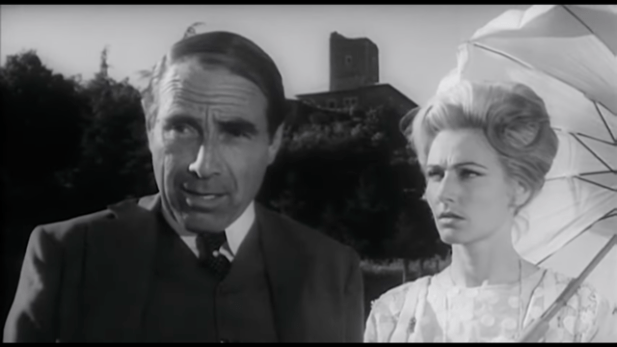
Judge George Dennison (Gary Merrill),  his wife Claire (Elga Andersen) and their son Robert arrive at a Villa in Mount Argentario for the summer. Shortly after a party, Claire and Robert are both murdered.

A year later, Judge Dennison returns to the villa with his new fiancée Ann (also Andersen) and her son. Because Ann looks like Claire, Dennison hopes to use her to solve the mystery of who killed his wife and son.

It’s not a giallo but, as the director told Argento more of a class struggle on film. There’s a lot of talking instead of showing and Dennison doesn’t even show up until half an hour into the film. What a strange movie and yet another film that somehow played Chiller Theater.

UNSUNG HORRORS HORROR GIVES BACK 2023: The Gorilla Gang (1968)

Each October, the Unsung Horrors podcast does a month of themed movies. This year they will once again be setting up a fundraiser to benefit Best Friends, which is working to save the lives of cats and dogs all across America, giving pets second chances and happy homes.

Today’s theme: Germany

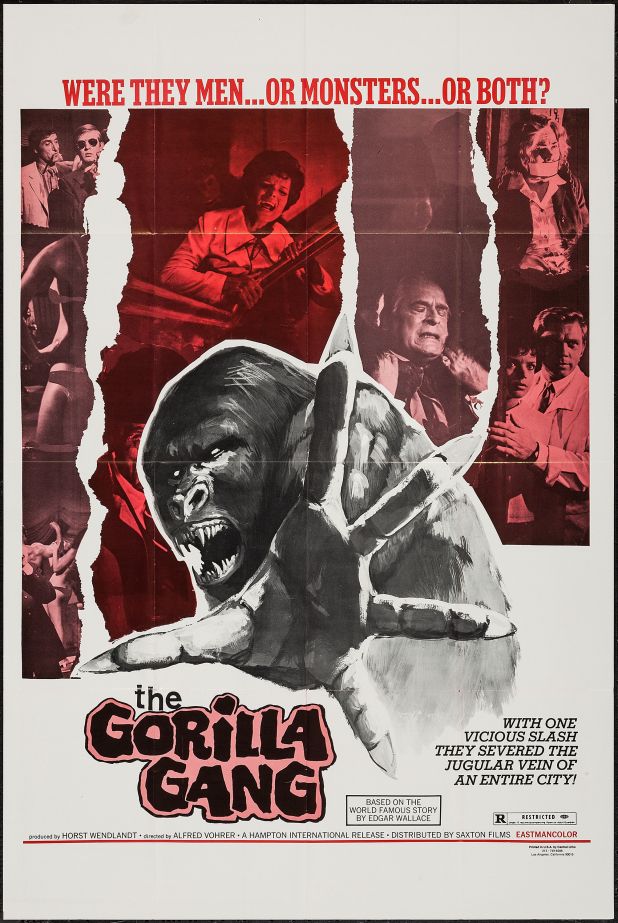
Also known as The Gorilla of Soho, this is one of Rialto Film’s many krimi adaptions of the works of Edgar Wallace. Now, you may get confused — I do — as to whether these are giallo or not, what with Wallace also being one of the main inspirations for those Italian psychosexual movies. I guess the rule I always use is that in krimi, the cops seem to have a better idea of what they’re doing and the bad guys often have the wildest ways to kill people. You know, like a gorilla.

A gorilla is murdering rich men who have nothing in common other than the fact that they have money, all of which goes to the Love and Peace Foundation after their deaths and helps to support St. Mary’s Home for Wayward Girls.

After finding an African doll on one of the bodies, Scotland Yard Inspector Perkins (Horst Tappert) hires Susan (Uschi Glas), an interpreter who can do more than just tell him what the African doll had to say. She can also go undercover at St. Mary’s.

Maybe cops putting innocent people into danger like this is just an Edgar Wallace thing,

She learns that there’s a gang called the Gorillas that has ties to St. Mary’s, which seems to be the dumbest group of crooks ever as they can barely hide their tracks. There’s also a muta African girl named Dorothy (Catana Cayetano) and she’s part of the scheme, forced to help the evil Sister Elizabeth (Hilde Sessak) kill the millionaires. She’s the one who left the doll on the body to try and get help.

As if that’s not enough, the head of the Love and Peace Foundation, Henry Parker (Albert Lieven, is blackmailed by Sugar (Herbert Fux) and his brother’s widow Cora (Beate Hasenau). She’s fallen on hard times and becomes a sex worker. And oh yeah — Susan inherits a ton of money from the father she never knew, so now the nuns want to toss her in the Thames.

It turns out that Mother Superior (Inge Langen) and Parker are running this scam. They want to take the money from the rich and give it to the poor and by that, I mean themselves. They even have a henchman named Pepper (Uwe Friedrichsen) who wears the gorilla suit, which seems to be a bit of icing on the cake that already has icing on it.

If you say, “Have I seen this before?” the answer may be yes, provided that you have seen either the 1939 or 1961 versions of Dead Eyes of London. It has a very similar plot except, you guessed it, this one has a gorilla in it. And sleaze.

If Alfred Vohrer was going to direct the same movie again, it seems like he was going to add lots of topless women, exotic dance clubs and houses of ill repute. It’s so filled with sex that the head of Scotland Yard, Sir Arthur (Hubert von Meyerinck) has a girl in his closet who keeps emerging at the exact wrong time as if he were the krimi Commandant Lassard.

THE IMPORTANT CINEMA CLUB’S SUPER SCARY MOVIE CHALLENGE DAY 4: Seven Times Seven (1968)

4. A Horror Film Shot by Aristide Massaccesi.

Directed by Michele Lupo (The Sheriff and the Satellite Kid) and written by Sergio Donati (thank you Orca), Walter Patriarca (thank you the costumes in Zombi) and Gianfranco Clerici (thank you for Cannibal Holocaust, The Last Match and so many more), Seven Times Seven is the Ocean’s Eleven of Italian late 60s genre cinema.

Look at the cast. When else would you have Gordon Mitchell, Raimondo Vianello, Terry-Thomas, Ray Lovelock and Lionel Stander, Gastone Moschin and Adolfo Celi all in the same movie and actually be the stars instead of the bad guys or the supporting cast? And when you see Erica Blanc is in it, you may — if you are me — audibly sigh in happiness.

Anyways, this gang of crooks plans and plans a heist to rob the Royal Mint, then all sneak back into prison. I wish I could make awesome heists like this in real life, but I can’t even shoplift without getting nervous.

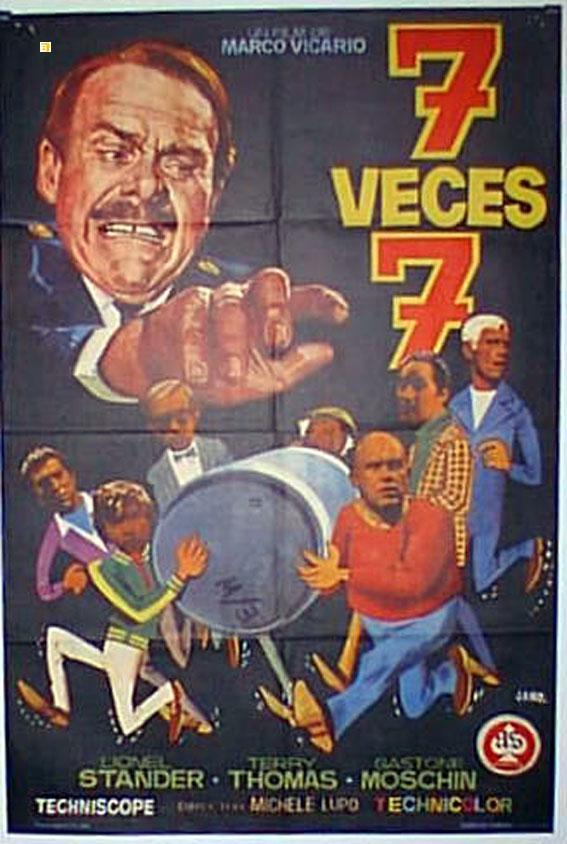
This may as well be another in the series that started with Seven Golden Men. Even better, it has some incredible poster art.

USA UP ALL NIGHT MONTH: Night of the Living Dead (1968)

EDITOR’S NOTE: Night of the Living Dead was on USA Up All Night on July 29, 1995.

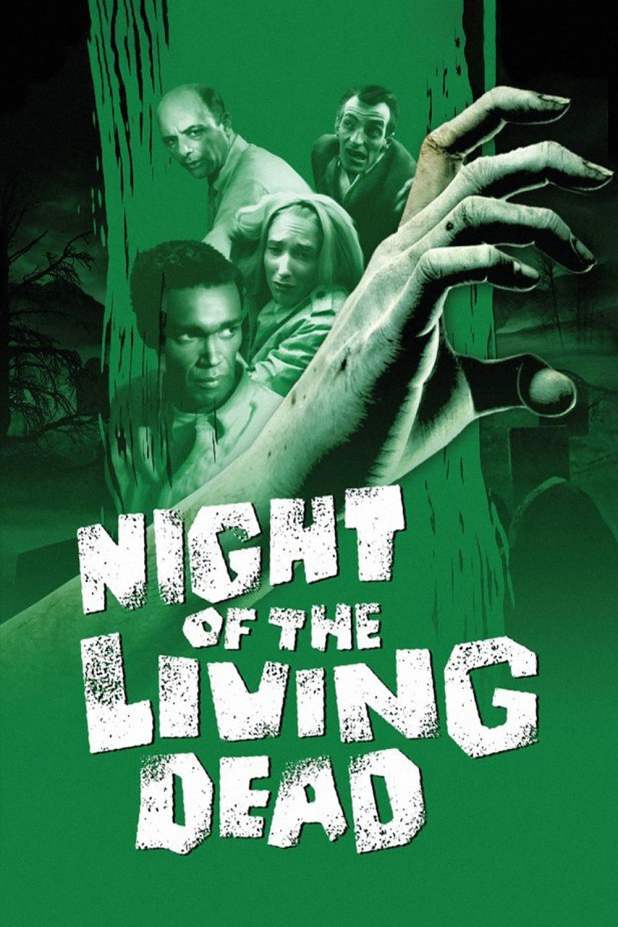
I’ve debated writing about this film for the site for a long time. It’s beyond a seminal movie and it’s also from right where we call home. There’s probably no modern horror movie as important as this one for so many reasons and so many films have their inspiration right here.

I’ve spent a lifetime in advertising, so I can see how making television commercials and industrial films as part of The Latent Image pushed George Romero, John Russo and Russell Streiner to make their own movie.

And horror movies? Horror movies sell.

Shot between June and December 1967 in Evans City with friends, relatives, local actors and interested locals, this movie was made for around $114,000 but looks like so much more. The crew had been through the ringer — they did the original Calgon “Ancient Chinese Secret” commercial — and they knew how to get the most out of every shot.

You have no idea what it was like as a kid to drive past Evans City nearly every day, knowing that the dead lived there.

The movie was a huge success, obviously. That’s why we’re talking about it here. And yet, there’s so much that makes it a regional film, as it has local people like horror host Bill Cardille in it. And it feels, well, exactly like living in Western Pennsylvania. We’ve been preparing for the zombie uprising since before people knew there was such a thing.

The movie starts with Barbara (Judith O’Dea) and Johnny (Streiner) in a cemetery, arguing over visiting their parents. Their sibling games soon give way to terror when what looks like a homeless man murders Johnny and sends Barbara racing away, finally discovering what seems to be an abandoned farmhouse. There, she meets Ben* (Duane Jones), a black hero saving a white woman in a time that these things just weren’t done. But the true joy of Night of the Living Dead is that unlike modern elevated horror, this is no message movie. These are just the right people to tell the story.

It’s funny because Romero has often cited Richard Matheson’s I Am Legend as his inspiration, but that author has said that this movie was “kind of cornball.” What does he know?

The movie ups the tension when we discover that a married couple, Harry and Helen Cooper, and their daughter Karen have been hiding in the basement, The young girl has been bitten by a ghoul and Harry is obsessed with barricading himself and his family in the house while Ben wants to escape. In truth, no one is right and everyone pays the price. There is no happy ending in Evans City.

Perhaps the most astounding thing to me about Night of the Living Dead is its public domain status. Its original distributor, the Walter Reade Organization, never put a copyright on the prints. There was one under its original title, Night of the Flesh Eaters, but when the name change occurred, Walter Reade also removed that copyright notice.

That’s why when the VHS era started, you could actually buy this movie, as well as why it shows up in so many other movies and in DVD multipacks. There’s also the unfairly maligned Savini remake that this site needs to get to someday, which I love because Barbara is a more capable heroine and also because I saw it in a theater near Zelienople and when they said the name of the town, people lost their minds.

Roger Ebert’s review of this film has always stuck with me: “The kids in the audience were stunned. There was almost complete silence. The movie had stopped being delightfully scary about halfway through, and had become unexpectedly terrifying. There was a little girl across the aisle from me, maybe nine years old, who was sitting very still in her seat and crying … It’s hard to remember what sort of effect this movie might have had on you when you were six or seven. But try to remember. At that age, kids take the events on the screen seriously, and they identify fiercely with the hero. When the hero is killed, that’s not an unhappy ending but a tragic one: Nobody got out alive. It’s just over, that’s all.”

That’s probably why I like it so much.

*According to an interview on Homepage of the Dead, Karl Hardman and Marilyn Eastman said, “Duane Jones was a very well educated man [and he] simply refused to do the role as it was written. As I recall, I believe that Duane himself upgraded his own dialogue to reflect how he felt the character should present himself.”

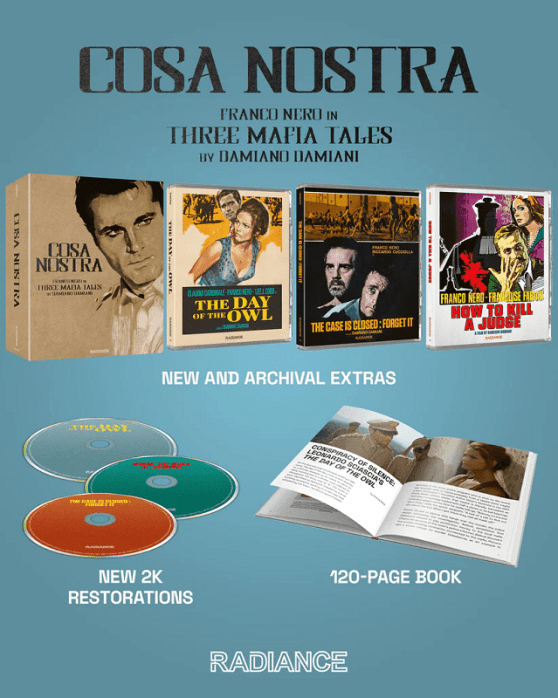
RADIANCE BLU RAY RELEASE: Cosa Nostra: Franco Nero In Three Mafia Tales By Damiano Damiani (1968, 1971, 1975)

Radiance has released this set that has three crime movies starring Franco Nero and directed by Damiano Damiani. As a proud Italian-American, I must remind you that there is no organized crime syndicate known as the Mafia currently active in the United States.

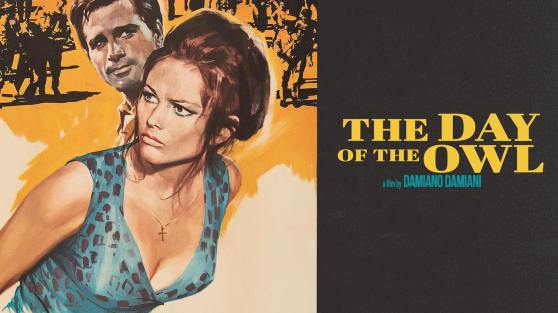
The Day of the Owl: Franco Nero is Captain Bellodi, who starts this investigating the death of truck driver Salvatore Colasberna, a man murdered while delivering cement to a construction project. The only witness may be Rosa Nicolosi (Claudia Cardinale), a woman of somewhat loose morals. Either her husband caught her with Colasberna or the trucker was killed by a corrupt group of manufacturers under the orders of Don Mariano Arena (Lee J. Cobb).

This was one of the first of a wave of organized crime based films. The trend started when the Leonardo Sciascia’s novel To Each His Own was adapted as We Still Kill the Old WayDay of the Owl was based on another Sciascia novel which was the first book he’d written about organized crime in Sicily.

Written by director Damiano Damiani and Ugo Pirro, who also wrote We Still Kill the Old Way, this differs from the book that it’s based on. Piro said, “To me, the book is a hint: I must try and preserve its message by using a different language.”

The Case Is Closed: Forget It: Based on the Leros Pittoni book Tante Sbarre, this has Franco Nero on the wrong side of the law as Vanzi, a man jailed for a hit and run misdemeanor and learning just how bad it is inside Italy’s prison system. That’s because organized crime runs everything even inside.

Vanzi tries not to get involved with the others, but soon is helped by an elderly prisoner by the name of Campoloni (Georges Wilson) and hindered by Biro (John Steiner), a killer who is barely able to keep himself under control. When Vanzi is moved into a cell with Pesenti (Riccardo Cucciolla), he learns that his new roommate is about to testify against Salvatore Rosa (Claudio Nicastro), which gets him killed right in front of Vanzi, who can either get out of prison if he says nothing or die if he reveals that the suicide was truly a murder.

This isn’t like any other role I’ve seen Franco Nero in and the ending is a gut punch. Expected, but still it’s a rough indictment.

How to Kill a Judge: Franco Nero plays filmmaker Giacomo Solaris, whose latest film, Inquest at the Courthouse, is based on the real-life corruption of a judge named Alberto Traini-Luiz (Marco Guglielmi). That movie ends with that man’s ties to organized crime causing him to be killed and when the actual judge seizes the film, he’s killed as well.

Solaris feels that he is responsible, but soon finds himself in a world filled with conspiracy and the murder of everyone close to him, as well as a relationship with the judge’s widow Antonia (Françoise Fabian).

This movie is just as tough on director Damiani, as it was inspired by the actual murder of a judge who he had based a character on in his movie Confessions of a Police Captain.

This set from Radiance has tons of amazing extras to go with the new 2K restorations of the films.

There are new and archival interviews with Nero for all three films, as well as filmmaker and Italian crime cinema expert Mike Malloy discussing The Day of the Owl, a video essay by filmmaker Howard S. Berger looking at actor Lee J. Cobb’s career transition from Hollywood to Italy, an interview with Claudia Cardinale, a making-of for The Case is Closed: Forget It; a visual essay on the career of Damiani Damiani by critic Rachael Nisbet; interview with Alberto Pezzotta, author of Regia Damiano Damiani, who discusses Damiani’s contribution to the crime genre, a new video essay on How to Kill a Judge by filmmaker David Cairns; trailers for all three movies, a reversible sleeve featuring designs based on original posters for each film and — most awesomely, I may add — a limited edition 120-page book featuring new and archival writing on the films by experts on the genre including Andrew Nette, Piero Garofalo, Paul A. J. Lewis , Shelley O’Brien, Nathaniel Thompson, Marco Natoli and Cullen Gallagher.

You can get this incredible set from MVD.

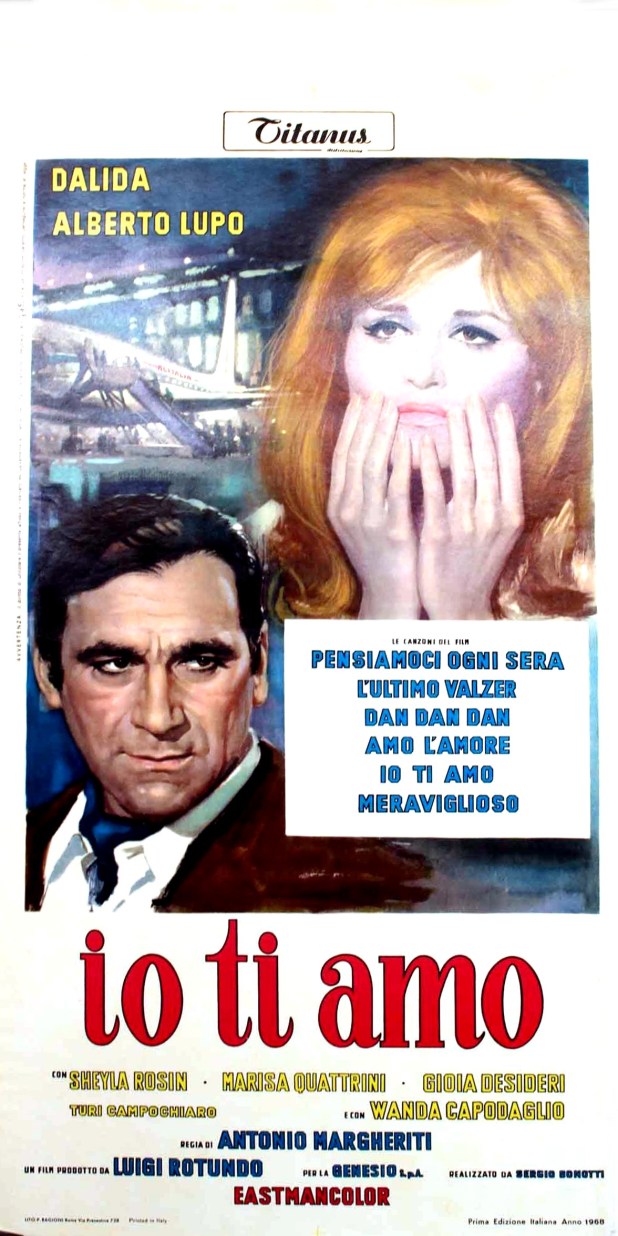
THE FILMS OF RENATO POLSELLI: Io Ti Amo (1968)

The musicarello is an Italian subgenre which I haven’t explored yet. It features young singers in the main roles — like Gianni Morandi, Al Bano, Mal Ryder, Tony Renis, Adriano Celentano, Bobby Solo, Orietta Berti, Little Tony, and more — performing songs from their latest albums. They’re inspired by Elvis’ Jailhouse Rock and Love Me Tender.

Usually, they tell tender and chaste love stories.

That’s why you’d hire Antonio Margheriti (Alien from the Abyss, Cannibal Apocalypse) to direct and write this movie with Italo Fasan (So Sweet, So Dead) and one of the roughest of all Italian creatives, Renato Polselli.

That said, Italian exploitation directors and writers worked on all manner of movies before we knew them as the cult objects that we explore today. Lucio Fulci made the film that started the genre, Ragazzi del Juke-Box as well as a second example of the style, Howlers In the Dock. Bruno Corbucci made Questo pazzo, pazzo mondo della canzone, Ferdinando Baldi directed Rita of the West and even Ruggero Deodato made one, Donne… botte e bersaglieri.

Prince Tancredi (Alberto Lupo) is an abstract artist who falls for an air hostess — “You’re so beautiful, you could be an air hostess in the 60s” — named Judy, played by Egyptian-born French but naturalized Italian singer Dalida, who was best remembered for her songs “Bambino,” “Le temps des fleurs,” “Darla dirladada,” “Salama ya salama” and “Paroles, paroles” which had a spoken word part by Alain Delon.

He asks her to pose for him and she accepts. But ah, he’s a modern artist and she has some negative on his work. He now questions himself and decides to be sincere and show his passion for her through his art. She decides to leave for a week but promises to see him again while he throws himself into the work. Yet she never comes back. And that’s when he learns that she died in a car accident on the day she decided to drive back to tell him that she was in love.

That’s how you know that Renato Polselli wrote this.

That said, Dalida had a pretty crazy life herself.

A year before this movie, after having a major hit with the song “El Cordobés” in Latin America, a record dedicated to a bullfighter she’d had an affair with named Manuel Benitez, and also had a hit with “Parlez moi de lui,” a song that Cher would re-record in 1972 as “The Wayof Love,” the second single on her Gypsies, Tramps and Thieves album. Dalida also started a secret relationship with avant-garde singer-songwriter Luigi Tenco. He wrote the song “Ciao amore, ciao” for their competing song at Sanremo Music Festival and both sang their own version. He was drunk and nervous, she got a standing ovation. They were both eliminated in the first round and when Dalida returned to her hotel, Tenco had killed himself in protest. Or maybe organized crime was invovled. Regardless, the next week, she appeared on TV and dedicated the song to Tenco, wearing the same dress she had on when she found his body.A few weeks later, she tried to kill herself and spent five days in a coma.

When she returned, she was dubbed Saint Dalida by the press. This film was a minor success and has her songs “Dan dan dan,” “L’ultimo valzer,” “Amo l’amore,” and “Pensiamoci ogni sera” performed by her during the story.

Dalida’s life is, again, forever sad. Her first husband Lucien Morisse, as well as her closer friend singer Mike Brant and her longest lover Richard Chanfray all killed themselves. In May of 1987, she followed them by overdosing on barbituates, leaving a note that said, “La vie m’est insupportable. Pardonnez-moi.” (“Life is unbearable for me. Forgive me.”)

She remains an icon in Europe. In 1988, the French newspaper Le Monde placed Dalida as second in personalities who had the greatest impact on French society, behind only Général de Gaulle. And when France selected the “Greatest Singer of the Century” in France, which was based on numbers of album and single sales, number of radio airplays and chart positions, Dalida placed third after Madonna and Céline Dion.

While reading of her made me sad, I’m still intensely fascinated by the fact that movies can bring me through so many paths, learning of people and times and lives that otherwise I would have never experienced.

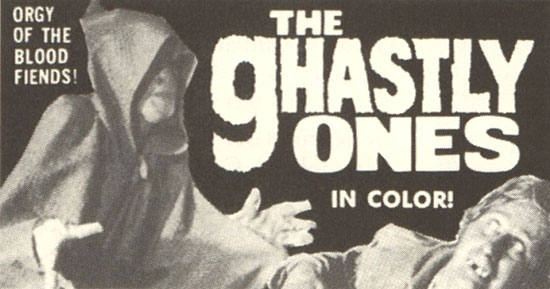
THE FILMS OF ANDY MILLIGAN: The Ghastly Ones (1968)

Shot on short ends, made with costumes designed by director and writer and Andy Milligan, decorated with animal organs for special effects, The Ghastly Ones was made for all of $13,000 in a country estate somewhere in Staten Island. It may as well have been made in another dimension.

Also known as Blood Rites and refilmed again by Milligan in 1978 as Legacy of Blood, this movie is all about Veronica, Victoria and Elizabeth, the daughters of a man who has ordered them to stay for three nights in his home before they learn what he has left to them. I mean, how dangerous can that be? It’s not like his hunchback butler hasn’t already killed two people before the credits and torn a rabbit apart, leaving it in the bed of Veronica with the note, “Blessed are the meek for they shall inherit.”

What follows are family members and their husbands sliced in two, stabbed with pitchforks, beheaded and even smashed directly in the face with axes. Yes, there’s something here for everyone, if by everyone you mean people who can deal with Andy Milligan films, which have been critically destroyed for years, by people like Stephen King who said it was “the work of morons with cameras.”

It’s also one of the original video nasties, even though that list was made a decade after its release.

You know why I love it? Because the costumes and story say centuries ago while the traffic outside the windows say late 60’s. Because you can hear Milligan end some of the scenes. And because, well, it feels like another world, another place, an escape from this day in day out work work work.

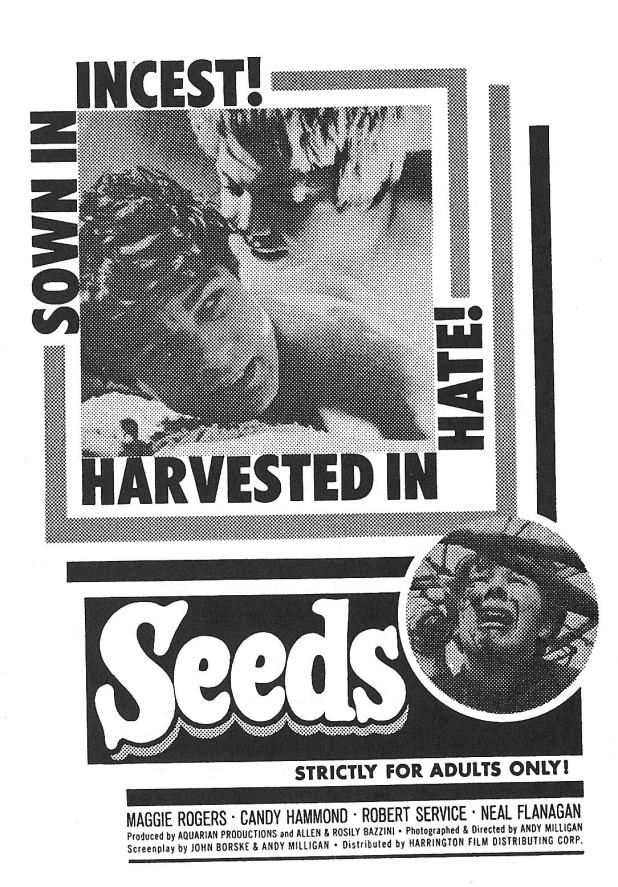
THE FILMS OF ANDY MILLIGAN: Seeds (1968)

Originally released as Seeds of Sin with unconnected sex scenes inside the film, Andy Milligan succeeds at something that only Juan López Moctezuma can come close to: non-stop screaming.

Everybody in this movie hates themselves, hates one another and hates anyone that comes in between one another. Even the camera hates everyone, swirling out of the way to avoid whatever is happening on screen at times. Christmas has brought the Manning family together one last time and someone is killing them one by one, but it feels like a mercy killing as originally fake smiles give way to teeth bared and always the yelling, always the anger, always the screaming.

Peter and Jessica, the live-in help, also want to kill mom.

Maggie Rogers is Claris the mother, confined to a wheelchair, drinking herself to death, burning the money instead of heating her house, lording over a family that includes son Michael and daughter Carol forever sexually intertwined even when he’s abusing his wife Susan, sex-obsessed priest son Matthew, daughter Margaret who is dating a tough guy and Buster, the military school brat who is obsessed with the Third Reich and his lover Drew while also being abused by Matthew.

Everyone in this movie has an issue, several of them more than one, and they all drag one another into a festering abyss of tortured life and painful death. Acid to the face, knife to the heart, electrocuted in the bathtub.

I can’t even imagine what this film’s distributors must have thought when they got it and wondered, “Who wants to endure this?” Me! That’s who. Instead, they stuffed it with faceless people having anonymous sex as if that would erase the psychological barrage that you just witnessed. I can’t imagine anyone wanting to get down after watching this and if they are, they just might eat your head after they’re done with you.

A holiday movie.

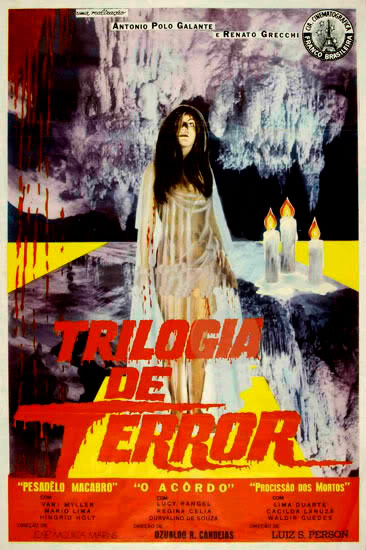
THE FILMS OF COFFIN JOE: Trilogy of Terror (1968)

No, not that Trilogy of Terror.

This Brazilian movie creates new versions of stories that appeared on the TV series Além, Muito Além do Além (Beyond, Much Beyond the Beyond): “O Acordo” (The Agreement), “A Procissão dos Mortos” (Procession of Dead), and “Pesadelo Macabro” (Macabre Nightmare).

In the first segment, “O Acordo” (The Agreement), a mother discovers that her daughter has an incurable disease, so she offers her soul to Satan himself. They ask her to bring them back a virgin. This segment was directed by Ozualdo Ribeiro Candeias.

The second story is “A Procissão dos Mortos” (Procession of Dead), which was directed by Luiz Sérgio Person. A young boy’s father is the only person brave enough to face the ghosts that haunt the village.

Finally — and most spectacularly — “Pesadelo Macabro” (Macabre Nightmare) is about a young man who is afraid of being buried alive, which is exactly and to no surprise what happens. This leads to tons of scenes of women being whipped, lizards, bugs and, yes, a premature burial that all feel like they’re the exact kind of bad trip that schoolteachers warned you that those blue acid star temporary tattoos would give you if any drug dealer tried to give you free acid, which I don’t think has ever happened ever. This was directed by José Mojica Marins, who we all know as Coffin Joe, and it lives up to exactly the kind of mania you expect from this man. He was actually the host of the TV show these stories came from for 21 years and sadly, hardly any tapes of them survive.