RADIANCE FILMS BLU RAY RELEASE: Tattooed Life (1965)

ABOUT THE AUTHOR: Joseph Perry writes for the film websites Gruesome Magazine, The Scariest Things, Horror FuelThe Good, the Bad and the Verdict and Diabolique Magazine; for the film magazines Phantom of the Movies’ VideoScope and Drive-In Asylum; and for the pop culture websites When It Was Cool and Uphill Both Ways. He is also one of the hosts of When It Was Cool’s exclusive Uphill Both Ways podcast and can occasionally be heard as a cohost on Gruesome Magazine’s Decades of Horror: The Classic Era podcast.

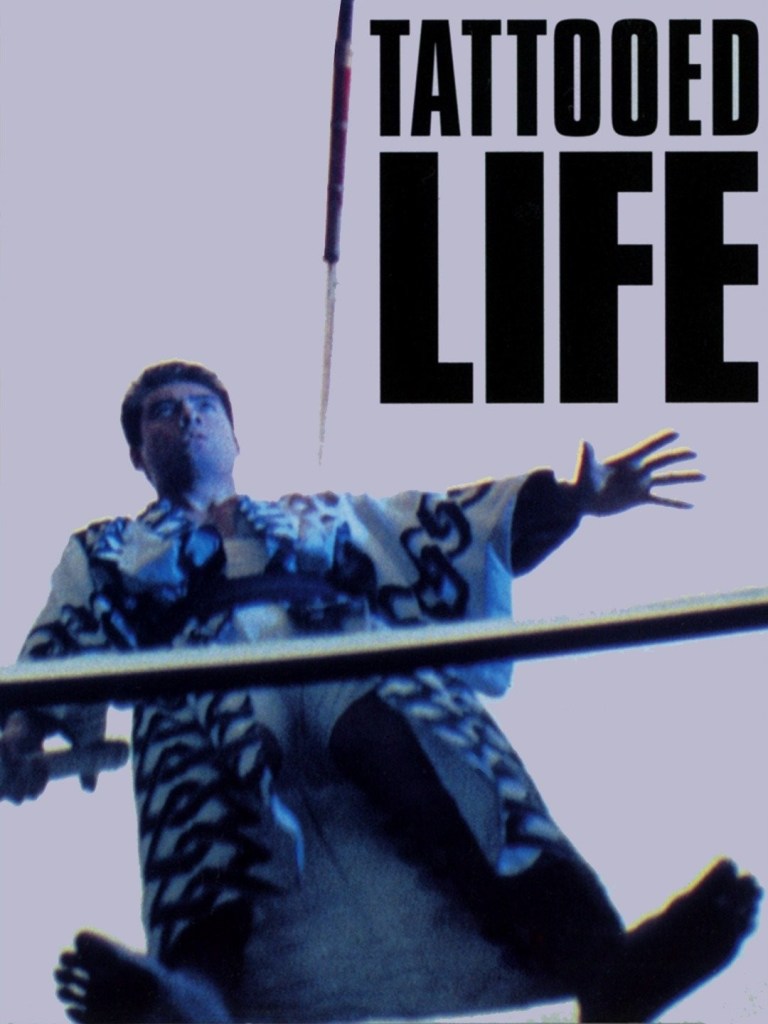
Official synopsis: Tetsuo, a low-level yakuza, is double-crossed by his boss and attacked. His younger brother Kenji, an aspiring artist with no connections to crime, comes to his aid and kills Tetsuo’s assailant. Fearing repercussions from the yakuza, they flee to Manchuria where they risk coming under suspicion of rival gangs. Seijun Suzuki remains loyal to the conventions of the yakuza film, yet Tattooed Life contains flashes of his later creative genius, including a final act of explosive visual excess that has become one of the director’s all-time classic scenes.

Seijun Suzuki directs the yakuza drama Tattooed Life with flair, and although the majority of the film involves brotherly drama and romances that cannot be, the climax provides a fine payoff. Hideki Takahashi gives a standout performance as older brother and yakuza member Tetsuo, who does his best to hide the identities of himself and his younger brother Kenji (Kotobuki Hananomoto, also solid as a tortured artist consumed by love with their boss’s wife), as both are on the run after a yakuza murder.

Lighthearted moments prevent the film from becoming overly heavy, as camaraderie, cautiousness, suspicion, and semi-unrequited love are all at play. Lighter on violence than later films in the subgenre, there are still flashes of ferocity and danger. The members of the sizable cast all give fine performances, and just wait until you get a load of the beautifully choreographed swordplay. Tattooed Life comes strongly recommended from me for aficionados of Suzuki’s work, yakuza films, and Japanese cinema in general.

Tattooed Life screens on OVID in May 2025. For more information, visit https://www.ovid.tv/.

It’s also available from Third Window Films and has extras such as audio commentary by William Carroll, author of Seijun Suzuki and Postwar Cinema, a newly edited archival interview with Seijun Suzuki, a newly edited archival interview with art director Takeo Kimura, a trailer, a reversible sleeve featuring original and newly commissioned artwork by Time Tomorrow, a limited edition booklet featuring new writing by Tom Vick and a newly translated archival review of the film, all in a limited edition of 3000 copies, presented in full-height Scanavo packaging with removable OBI strip leaving packaging free of certificates and markings. This is the first time this movie has been available in the West and you can get it from MVD.

ARROW BLU RAY RELEASE: The Threat (1966)

Misawa (Rentaro Mikuni) is a post-war success. He works at a big ad agency and lives in a massive home with his wife (Masumi Harukawa) and their son. But then, two criminals — Kawanishi (Ko Nishimura) and Sabu (Hideo Murota) — show up and want to bring him into their plan, as they have kidnapped the baby of cancer researcher Dr. Sakata (Ken Mitsuda).

Directed by Kinji Fukasaku, this film arrives decades before home invasion movies were supposedly invented. It also has Misawa be no hero, instead a man who deals with the attempted assault of his wife by doing the same to her later. He’s living on credit, giving his life over to the foreign enemy who dropped two nukes on his countrymen. Maybe he’s as much a criminal as the bad guys. He definitely has less of a code to live by.

Fukasaku Kinji would go on to make Yakuza Graveyard and more famously, Battles Without Honor and Humanity and Battle Royale. Oh yeah — he also directed Message from Space!

The Arrow Video Blu-ray release of The Threat — available for the first time outside of Japan — has extras including audio commentary by Japanese film expert Tom Mes; Warning Warning Danger Danger, a brand new 20-minute video appreciation by critic and Japanese film specialist Mark Schilling; the original theatrical trailer; an image gallery; a reversible sleeve featuring original and newly commissioned artwork by Tony Stella; an illustrated collector’s booklet featuring writing on the film by Hayley Scanlon and a double-sided foldout poster featuring original and newly commissioned artwork by Tony Stella. You can order it from MVD.

Asia-Pol (1966)

ABOUT THE AUTHOR: Joseph Perry writes for the film websites Gruesome Magazine, The Scariest Things, Horror FuelThe Good, the Bad and the Verdict and Diabolique Magazine; for the film magazines Phantom of the Movies’ VideoScope and Drive-In Asylum; and for the pop culture websites When It Was Cool and Uphill Both Ways. He is also one of the hosts of When It Was Cool’s exclusive Uphill Both Ways podcast and can occasionally be heard as a cohost on Gruesome Magazine’s Decades of Horror: The Classic Era podcast.

Director Matsuo Akinori’s Hong Kong/Japan coproduction Asia-Pol (AKA Asiapol Secret Service and Asia Secret Police Force; 1966) is a 1960s James Bond inspired movie with a difference . . . a few, actually, when compared with other Bond knock-offs from around the world. Overall, it’s an entertaining watch from the combined production efforts of the Shaw Brothers and Nikkatsu studios, which right there makes it worthy of recommendation.

Ryutaro (Jimmy Wang Yu, a major action star for the Shaw Brothers), a secret agent for the titular Japan-based organization, searches for Georgie Eaton (Jo Shishido), the ringleader behind a gold smuggling scheme who happens to have a highly selfish chip on his shoulder regarding wanting revenge on Japan. It’s possible that Ryutaro’s father may have been mixed up with the baddies, and he hopes to clear his deceased father’s name.

Interestingly, quite unlike James Bond and the heroic knock-off characters he inspired, Ryutaro is uninterested in women. This despite the fact that the beautiful Asia-Pol secretary Sachiko (Ruriko Asaoka) is making her interest in him strongly known. He also throws out a lovely young lass who was waiting for him in his room. The young woman who gets the most attention from him is Ming Hua (Fang Ying), who may be his sister and therefore is a pawn in the evil game Georgie and his underlings play.

Aside from the differences it sports, Asia-Pol shares many tropes and cliches in common with the 1960s Bond films and knock-offs. From “Ha! You’ve walked right into our trap!” lines to the main villain explaining his grandiose plans in detail before leaving the hero to escape his certain-doom predicament, it’s all here, just in case the viewer has never seen a sixties spy movie before.

There’s a certain charm to the lo-fi aspect of the inventive gadgets on display — from cigarette case phones to incendiary devices — and though the fight scenes and chase scenes also show budgetary limitations, everyone involved obviously gave their all. The prolific Akinori was no stranger to action cinema, and he keeps things interesting with solid pacing. The cast members all provide interesting performances, and Toshiro Mayazumi’s jazzy score fits the proceedings perfectly.

Aficionados of sixties secret agent adventures should find plenty to enjoy with Asia-Pol. Akinori and his cast bring a big helping of spirit to the film, making for a fun cinematic ride.

From January 31, Asia-Pol will be available on FILM MOVEMENT PLUS, which can be found on its own site at filmmovementplus.com or via Amazon Prime Video.

ARROW VIDEO 4K UHD AND BLU RAY RELEASE: Incubus (1966)

Created by ophthalmologist L. L. Zamenhof in 1887, Esperanto is supposed to be a universal second language for international communication. In English, the name means one who hopes and it’s the largest constructed international auxiliary language with a few thousand speakers.

Zamenhof had some big dreams that go past making an easy and flexible language. He thought that this new way of speaking would lead to world peace.

Incubus is the second film to be made in the language, following Angoroj. This was directed and written by The Outer Limits creator Leslie Stevens, who used the cancellation of that show to make an art house movie with that show’s cinematographer Conrad L. Hall and composer Dominic Frontiere.

This is the story of a spring in Nomen Tuum that heals the sick and makes ugly people ravishing and oh yes, there are many succubus and incubus there to lure humans to Hell.

Kia (Allyson Ames) wants a pure man to be her perfect target, but her sister Amael (Eloise Hardt) tries to tell her that if she falls in love, she will lose so much. Then she goes after Marc (Shatner), a soldier here to heal his wounds of battle. He’s with his sister Arndis (Ann Atmar) who is so dumb that she loses her sight by staring at the sun.

This gets wild, as Marc’s purity defiles the demons, who call upon an incubus (Milos Milos, whose life is insane; he was the bodyguard for Alain Delon and a friend of Stevan Marković, who died owning sexually explicit photos of Claude Pompidou, wife of French President Georges Pompidou, causing a big scandal and an unsolved crime; Milos went to America where he married Cynthia Bouron, who had a paternity case against Cary Grant, and was beaten to death and found in the trunk of her car outside a grocery store. As for Milos Milos, he was dating Barbara Ann Thomason, the wife of Mickey Rooney, at the same time he was married to Cynthia Bouron, and they died in a murder suicide that many believed that Rooney engineered) to kill Marc and defile and murder his sister.

This was thought to be a lost film, shown only at the San Francisco Film Festival — where Esperanto speakers laughed at how bad the actors spoke — and in France. Between the language and the scandal over Milo killing his girlfriend and himself, the movie was kind of dead. It was found in 2001 when it was reassembled from existing materials.

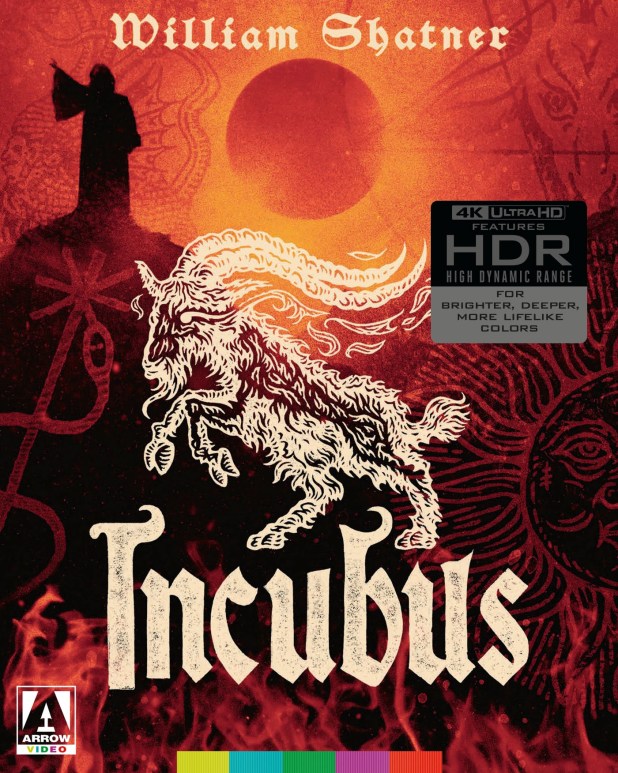
The Arrow Video release of this movie has it restored in 4K from the last known surviving 35mm print. Extras include commentary by writer and genre historian David J. Schow, author of The Outer Limits: The Official Companion, a second commentary by William Shatner and a third by producer Anthony Taylor, cinematographer Conrad L. Hall and camera operator William Fraker; an alternate 1.37:1 presentation of the film; Words and Worlds: Incubus and Esperanto in Cinema, a newly filmed interview with genre historian Stephen Bissette; Internacia Lingvo: A History of Esperanto, a newly filmed interview with Esther Schor, author of Bridge of Words: Esperanto and the Dream of a Universal Language; An Interview with the Makers of Incubus, an archive interview by Schow with Taylor, Hall and Fraker; a trailer; a reversible sleeve featuring newly commissioned artwork by Richard Wells and an illustrated collector’s booklet featuring new writing on the film by Frank Collins and Jason Kruppa.

You can get the 4K UHD and blu ray from MVD.

MOVIES THAT PLAYED SCALA: Blow-Up (1966)

Thanks to the British Film Institute, there’s a list of films that played Scala. To celebrate the release of Severin’s new documentary, I’ll share a few of these movies every day. You can see the whole list on Letterboxd.

The first English language movie by Michelangelo Antonioni, who wrote the story with Tonino Guerra and Edward Bond, this was based on Julio Cortázar’s 1959 short story “Las babas del diablo.” It would go on to inspire The Conversation and Blow Out.

Thomas (David Hemmings) is bored with shooting models — Veruschka von Lehndorff appears as herself — and has been taking photos in hostels and parks — one of the people whose photos he takes is author Cortázar — trying to capture humanity. One of the people whose photos he has taken is Jane (Vanessa Redgrave), who demands that he stop shooting her. He feels like he’s being followed afterward and she asks that he give her the film. He gives her the wrong roll; she gives him a fake phone number.  That’s when he blows up the film and discovers a dead body. He begins to have his life turned upside down, but this isn’t a film about the mystery of who is killed and why. As Antonioni said, Blow-Up isn’t about “man’s relationship with man, it is about man’s relationship with reality.”

That all sounds quite intelligent and raises the idea that this movie is about Thomas’ feelings that he is out of step with life and he’s given up on art for material gain, which causes him to fade away from the world, as even the tools he knows so well fail to ground him and prove the truth of whether or not he saw a murder. Even his mastery of the camera is now in question.

Or maybe the truth is they ran out of money.

Director Ronan O’Casey wrote to Roger Ebert and informed him that scenes that would have shown “the planning of the murder and its aftermath – scenes with Vanessa, Sarah Miles, and Jeremy Glover, Vanessa’s new young lover who plots with her to murder me – were never shot because the film went seriously over budget.”

This had to be incendiary when it was made — it still feels that way — with scenes of the Yardbirds performing live and Jeff Beck destroying an amp and a guitar and an open depiction of sexuality, including a threeway between Hemmings, Jane Birkin (who recorded the duet “Je t’aime… moi non plus” with Serge Gainsbourg) and Gillian Hills.

Antonioni didn’t want to explain the movie to anyone. He did say, “By developing with enlargers…things emerge that we probably don’t see with the naked eye. The photographer in Blow-Up, who is not a philosopher, wants to see things closer up. But it so happens that, by enlarging too far, the object itself decomposes and disappears. Hence there’s a moment in which we grasp reality, but then the moment passes. This was in part the meaning of Blow-Up.”

I love this thought that Hemmings had of the director, who was twice his age when this movie was made. “For a man of his age, he was impressively eager for new experiences. I think perhaps he was a little in thrall to the idea of swinging London and even once shooting had started, he spent a great deal of time hanging around in search of oscillation, often with photographers and models. Perhaps he considered it all research, but in his quest he raved ceaselessly, night after night in clubs and discotheques, in the company of the new goddesses of the fashion world, with his fierce eyes shining intensely in the dark, grave face as he drank grappa till his ears bubbled and tried to extract every last ounce from the swinging city – a man from Rome, a modern Bellini, determined to leave his mark in the middle of the liberated new world.”

You can watch this on Tubi.
MOVIES THAT PLAYED SCALA: The Wild Angels (1966)

Thanks to the British Film Institute, there’s a list of films that played Scala. To celebrate the release of Severin’s new documentary, I’ll share a few of these movies every day. You can see the whole list on Letterboxd.

The Wild Angels earned $7 million on a budget of $360,000, making it the highest-grossing low-budget film of its era. Not bad for a movie that had script issues between Roger Corman and Charles B. Griffith, as well as numerous re-writes by Peter Bogdanovich. Plus, the US State Department tried to prevent the film from being shown in Venice on the grounds that it “did not show America the way it is.”

And yet the Hells Angels brought a $5 million defamation lawsuit against Corman for how they were portrayed in this movie, which really makes me want to be a biker. Maybe they didn’t notice while they were acting as extras, each getting paid $35 per day for their cooperation and $20 per day for their motorcycles.

It’s also the first movie that Peter Fonda would be associated with the counter-culture and motorcycles. While promoting The Trip and autographing astill from this movie showing he and Bruce Dern on one motorcycle, the actor came up with the concept for Easy Rider.

It’s also a movie packed with taglines that shove you into the theater like “

Heavenly Blues (Fonda) shouts, “We wanna be free! We wanna be free to do what we wanna do. We wanna be free to ride! We wanna be free to ride our machines without being hassled by The Man. And we wanna get loaded. And we wanna have a good time. And that’s what we’re gonna do. We are gonna have a good time. We are gonna have a party.” That opening is at the beginning of Primal Scream’s “Loaded,” which informs so much of Edgar Wright’s The World’s End.

This episodic film moves from trying to find Joe “Loser” Kearns’ (Dern) stolen motorcycle to the gang evading the police to plan the Loser’s funeral and how Blues, Loser’s girl Gayesh (Diane Ladd) and Blues’ lover Mike (Nancy Sinatra) are pulled along as the gang disintegrates as a final party descends into madness.

The close of this movie, as Blues shovels dirt onto the grave of his best friend and says, “There’s nowhere to go,” is exactly why I keep coming back to Corman movies, which have such a heart and something to say in the midst of the mayhem and carny edge that get you into the theater.

We also have this movie to thank for Laura Dern, as the daughter of Dern and Ladd was conceived while this movie was being made.

RADIANCE FILMS BLU RAY RELEASE: Tokijiro: Lone Yakuza (1966)

Tokijiro (Kinnosuke Nakamura) has left behind being a killer and instead is wandering in search of freedom. That’s impossible, as he still has obligations, including one to a gang boss which forces him to kill a man named Mutsuda no Sanzo (Chiyonosuke Azuma). Seeking absolution, he listens to the man’s dying wish and vows to take care of his victim’s widow Okinu (Junko Ikeuchi) and her young son. That doesn’t matter to the Yakuza, who now want the entire family killed.

Directed by Tai Kato, whose Eighteen Years In Prison was also released by Radiance, this takes the novel Kutsukake Tokijiro by Shin Hasegawa and creates a gangster film that’s set in the Muromachi period. Tokijiro may be the deadliest of all swordsmen, but he has a code of honor that he must follow no matter what, even when it goes against his moral code. Complicated, yes. That said, he leads a violent, bloody and often depressing existence in which he must follow duty to the end.

Even those who kill for a living have to believe in something. Can someone ever wash their hands of all that murder? And for a movie that asks these questions, it isn’t afraid to present up close and gritty battles filled with blood.

The Radiance Films blu ray of Tokijiro: Lone Yakuza has extras including an interview with Koushi Ueno about the film’s place in genre cinema history, a visual essay on star Kinnosuke Nakamura by Japanese cinema expert Robin Gatto; a reversible sleeve featuring original and newly commissioned artwork by Time Tomorrow and a limited edition booklet featuring new writing by scholar Ivo Smits and a newly translated archival review.

You can get it from MVD.

CHILLER THEATER MONTH: The Murder Clinic (1966)

EDITOR’S NOTE: The Murder Clinic was on Chiller Theater on Saturday, May 26, 1979 at 1:00 a.m. and Saturday, July 16, 1983 at 2:00 a.m.

The Murder Clinic predates the Argento era of giallo, coming around the same time as the Bava instigation with The Girl Who Knew Too Much and the krimi films. Known in its native Italy as La lama nel corpo (The Knife in the Body), it was written by Luciano Martino (brother of Sergio and writer of Delirium and The Whip and the Body) and Ernesto Gastaldi (The Sweet Body of Deborah, All the Colors of the DarkThe Case of the Bloody Iris and so many more) with direction coming from Elio Scardamaglia (this is the only film he’d direct as he usually produced movies) and Lionello De Felice. It’s based on the book The Knife In The Body by Robert Williams, a former Tuskegee Airman who became an actor. He also wrote Turkey Shoot, which really means that his work was produced all over the world.

The story takes place in 1870s England, so this movie can also be considered a gothic horror film. Dr. Vance, the director of a mental hospital (Wiliam Berger) is restoring his sister’s face using patients as raw material, all while a masked killer uses the giallo weapon of choice, a strait razor, to kill other people within the hospital.

This story would replay itself across many films—Slaughter Hotel, FacelessMansion of the Doomed (well, that owes a debt to Eyes Without a Face)—while the first scene, with a young woman being chased by a killer in the woods at night, and a scene where the killer stalks his prey in a room full of hanging sheets, feel like they inspired Suspiria.

The Murder Clinic itself feels indebted to Bava, really taking to heart the color strategies of Blood and Black Lace.

This is a movie with a fascinating release history. After Berger spent some time in an Italian prison—he had been wrongly accused of possessing hashish and cocaine—it was re-released with a line on the poster that said, “William Berger, guilty or innocent?”

In the U.S., Revenge of the Living Dead was renamed to cash in on Romero’s zombie film. It played triple features with Curse of the Living Dead (Kill, Baby, Kill!) and Fangs of the Living Dead (Malenka) in the 70s as the Orgy of the Living Dead.

With a great location—the Villa Parisi, home of Blood for Dracula and Patrick Still Lives—and appearances by Françoise Prévost (The Return of the Exorcist), Mary Young (who only appeared in this movie and Secret Agent 777), and Barbara Wilson (her only film, and she really should have done more), The Murder Clinic is an early giallo worthy of being enshrined in your collection.

You can watch this on Tubi.

CHILLER THEATER MONTH: Cyborg 2087 (1966)

EDITOR’S NOTE: Cyborg 2087 was on Chiller Theater on Saturday, March 1, 1975 at 11:30 p.m., Saturday, October 18, 1975 at 1:00 a.m. and Saturday, January 14, 1978 at 11:30 p.m.

2087: Free thought is illegal. The population is docile. Only a secret group of free thinkers exist and they are able to send Garth A7 (Michael Rennie) back in time to either stop Professor Sigmund Marx (Eduard Franz) from showing his new invention to the government or, if that fails, to murder him. Yes, what Marx makes today will create the mind control of the future. As Garth A7 escapes back in time, he is followed by two other cyborgs called Tracers (Dale Van Sickel and Troy Melton).

To succeed in his mission, he takes over the mind of Marx’s assistant Dr. Sharon Mason (Karen Steele), using her to find Dr. Zeller (Warren Stevens), who removes the tracking device that allows the Tracers to find him.

A member of the Marines in World War II, director Franklin Aderon got into Hollywood as a technical advisor on the serial The Fighting Marines. He wrote screenplays and produced at Republic Pictures before directing his own movies, including Canadian Mounties vs. Atomic Invaders and Dimension 5. He also directed several Western TV shows.

This was written by Arthur C. Pierce, who went from being in the Navy during the war to shooting industrial films and creating special effects. He eventually became a writer, making Beyond the Time Barrier and The Cosmic Man. He also directed The Astral FactorThe Navy vs. the Night MonstersWomen of the Prehistoric PlanetLas Vegas HillbilliesMutiny In Outer Space and The Human Duplicators.

For as similar as some of Pierce’s stories are to other films — Beyond the Time Barrier cashed in on The Time Machine and The Cosmic Man is like The Day the Earth Stood Still — this film predates Terminator 2 with the idea of a machine coming back in time to murder the inventor that led to its creation.

Speaking of The Day the Earth Stood Still, this film has its star, Michael Rennie, who is playing a very similar role to Klaatu. He would do the same in a three episode story in the TV series The Invaders, in which he played one of the alien leaders, Alquist.

The strangest part of this is that Dr. Mason falls in love with Garth A7, even when he tells her that he had to get her to do things against her will. It doesn’t matter, as she has found something much like love with him. She asks him to bring her back to his future and he tells her that when he goes back, if he was successful, he will no longer exist. He is willing to cease being to make tomorrow free; she forgets him as he walks back into time and by the end, is making a date with another man instead of looking at this cyborg with a blinking metal chest as a project to fix, a blank slate to project her love upon.

You can watch this on YouTube.

2024 Scarecrow Psychotronic Challenge Day 24: Rat Pfink a Boo Boo (1966)

24. SHLOCK & AWE: Can you believe how “good” this is?

The Incredibly Strange Film Show aired on Discovery in the 1990s and it was such a part of my early psychotronic obsession. In just two seasons, I learned who Ray Dennis Steckler, Ted V. Mikels and Doris Wishman were and got so much more info on the movies of El Santo, Russ Meyer, John Waters, Ed Wood, Herschell Gordon Lewis and more.

Ray Dennis Steckler was a filmmaker who I’m fascinated by. Who else could make The Incredibly Strange Creatures Who Stopped Living and Became Mixed-Up Zombies and have László Kovács and Vilmos Zsigmond operating the cameras? Who else could be Cash Flagg, Harry Nixon, Sven Christian, Henri-Pierre Duval, Pierre Duvall, Michael J. Rogers, Michel J. Rogers, Wolfgang Schmidt, Sven Hellstrom, Ricardo Malatoté, Cindy Lou Steckler and Cindy Lou Sutters? And who could direct films like Wild Guitar and Sinthia: The Devil’s Doll, not to mention the music video for “White Rabbit?”

This starts as a very real and horrifying story of The Chain Gang killing people and abducting Cee Bee Beaumont (Carolyn Brandt), the girlfriend of rock star Lonnie Lord (Ron Haydock using the name Vin Saxon) after terrorizing her with phone calls. That’s because this was originally a crime drama called Depraved that was inspired by real-life crank calls Brandt kept getting.

And 40 minutes in, Lord walks into a closet and walks out as Rat Pfink as his friend Titus Twimbly (Titus Moede) becomes Boo Boo. They chase The Chain Gang on their Ratcycle as suddenly, this has become a Batman parody. This is followed by a big bad monkey named Kogar (Bob Burns, always the man who has the costume) knocking out our hero and taking Cee Bee, but he’s soon coming back to her rescue.

You may ask, at this point, why is the title so off? The legend: Rat Pfink and Boo Boo was the intended title, but when they made the titles, and became a and Steckler couldn’t afford $50 to fix it. The truth: Steckler said, “The real story is that my little girl, when we were shooting this one fight scene, kept chanting, “Rat pfink a boo boo, rat pfink a boo boo…” And that sounded great! But when I tell people the real story, they don’t wanna hear it, so you better print the legend.”

You have to love a man who crashes a Christmas parade for his rapey crime movie that somehow becomes a superhero movie by the end, complete with songs. Any time you need a song, get Lonnie Lord, because “He always carries his guitar with him in case he is called on to sing!”

The thing is, I can show some strange movies to guests, but how do you even start showing Steckler’s films? There’s so much backstory and I really don’t want folks coming over saying, “This is stupid,” because I’m very defensive of the art. I mean, the fact that this movie even exists makes me hopeful for the human race.

You can watch this on Tubi.