Mudhoney (1965)

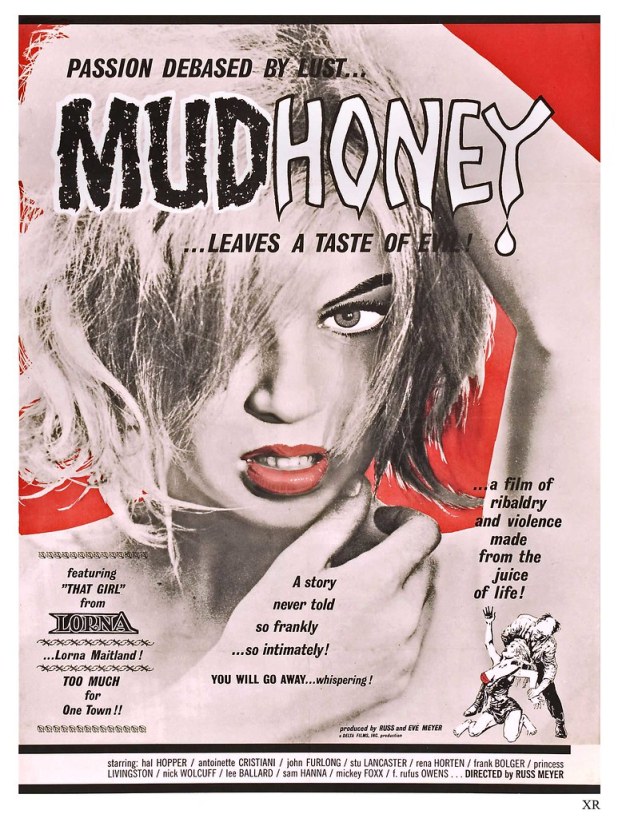
Mudhoney is based on Raymond Friday Locke’s novel Streets Paved With Gold and it’s probably the most serious of any Russ Meyer film I’ve ever seen. The auteur said, “That’s when I thought I was Erskine Caldwell, John Steinbeck and George Stevens all in one.”

The film was a financial failure, Meyer later saying, “I made a gamble with Mudhoney and I failed. The only reason I made Mudhoney was I was in love with a girl named Rena (Rena Horten, who plays Eula) I should have not made the film.”

Collaborator Roger Ebert disagreed, calling it Meyer’s neglected masterpiece and “his most interesting, most ambitious, most complex and longest independent production.”

It’s the Great Depression, Calef McKinney’s (John Furlong, the voice of Meyer if you ever see him in a movie) journey from Michigan to California brings him to small-town Spooner, Missouri. There, Lute Wade (Stuart Lancaster) hires him for odd jobs and he gets involved with Wade’s married niece, Hannah Brenshaw (Antoinette Christiani).

She’s married to the wife-beating Sidney, who plots against McKinney and Wade, along with a preacher named Brother Hanson. McKinney has a past that’s about to catch up to him and a burning love for Hannah. Speaking of burning, before it’s all over, Sidney burns down his farm, frames our hero and even assaults Brother Hanson’s wife before a lynch mob strings him up.

Imagine if the sideshow brought the sights, sounds and, yes, women of exactly what you expect the backwoods to look and feel like. Cross-eyed men, toothless old women, deaf and mute children, ranting preachers and pulchritude of the blonde variety on all sides. It’s pretty amazing that Meyer never tried pure drama again after this, but no one really cared. They just wanted to see if he could fit all those gigantically endowed women into frame, which is a shame really.

Psycho-A-Go-Go (1965)

A while back, we covered Satan’s Sadists, the movie that was Al Adamson’s initial big hit. Psycho-A-Go-Go is where he got started.

Adamson was the son of silent film stars Denver Dixon and Dolores Booth. After working on some of his father’s later films, he started his own production company with Sam Sherman called Independent-International Pictures.

From tinting a Filipino horror movie neon hues and releasing it as a movie shot in Spectrum X — Horror of the Blood Monsters — to filming two movies at Spahn Ranch and making two softcore stewardess movies in one year (1975’s The Naughty Stewardesses and Blazing Stewardesses, which actually had parts written by the elderly Three Stooges who were unable to appear), Adamson’s movies are all over the map. His films Dracula vs. Frankenstein and Carnival Magic are both shockingly inept and amazingly transcendent, sometimes at the very same time. Yeah, I get the incongruity of this statement.

This movie was to be a straight action picture, back when it had the title Echo of Terror. But soon, it turned into a vehicle for Adamson to promote Tacey Robbins’ singing amidst a plot where a murderous jewel thief stalks a woman and her child after jewels are hidden inside the girl’s Christie Minstrel doll. Yes, a singing black baby doll that sings old slave songs, 1965 grindhouse fare ain’t the place to find woke storylines. I’d imagine that this plot point was cribbed from The Night of the Hunter.

Amazingly, Adamson would resurrect this movie numerous times over the next several years, turning it into a veritable zombie of a film. In 1969, it was completely re-edited, with John Carradine as a mad scientist added after the fact, and re-released as The Fiend with the Electronic Brain.

Two years after that, Adamson added even more footage to the film, including scenes with his wife Regina Carrol, and created an entirely new version called Blood of Ghastly Horror. The fact that three different movies are vying for one coherent narrative probably didn’t matter to Adamson. All of this was released one more time as a fourth version of the film, The Man With the Synthetic Brain. I can only imagine the confusion of some viewers who had to be sure they’d seen this movie before, as the main villain’s motivations go from being simply villainous to being experimented on by an evil doctor to dying early in the third and fourth versions of the film before his father brings a zombie to gain revenge on the family of the evil doctor. Imagine a movie being a sequel to itself but never telling you! Talk about confusing!

Adamson would end up with a rough end to his life, with his wife dying from cancer and then being murdered by his live-in contractor and buried in the concrete for his new pool.

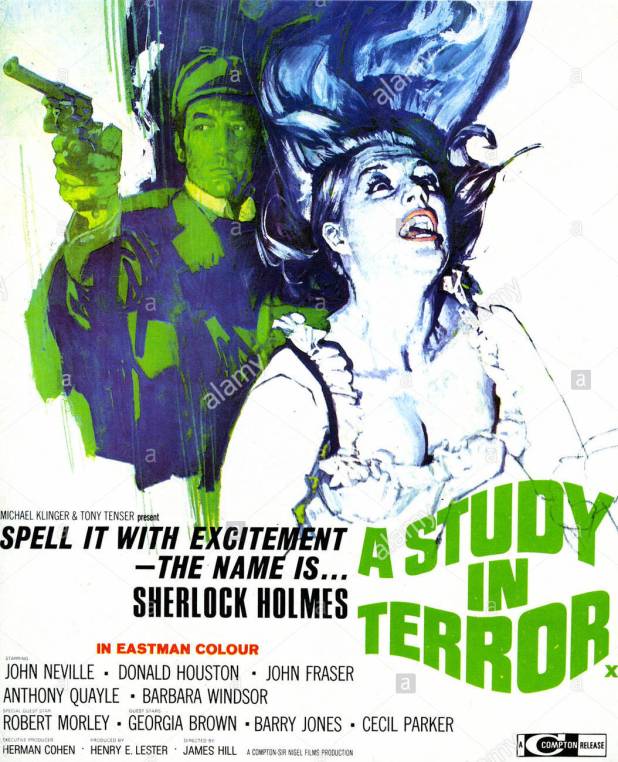
A Study In Terror (1965)

James Hill directed the nature film and family favorite Born Free, but he also found his way to Whitechapel and put Sherlock Holmes and Dr. Watson on the case of Jack the Ripper. It’s also one of the first appearances of Mycroft Holmes on film.

Holmes (John Neville, The Adventures of Baron Munchausen) and Watson (Donald Huston, Tales that Witness Madness) have already been interested in the Whitechapel murders, but then they receive a mysterious package. It’s a case of surgical instruments missing a scalpel with the family crest of the Duke of Shires.

The Duke informs them that his son Michael Osborne dreamed of becoming a doctor, but he’s disappeared. Holmes discovers that the instruments were pawned by Angela Osborne (Adrienne Cori, A Clockwork Orange), who now lives in a soup kitchen run by a Doctor Murray (Anthony Quayle, Holocaust 2000).

Following that trail, they learn that Murray is also a police pathologist who allows them to view the body of the Ripper’s most recent victim. Soon, they learn that Lord Carfax was being blackmailed by Max Steiner, who was about to tell the Duke of Shires that Michael, who was working at Murray’s soup kitchen, was about to marry a prostitute. Look for Dame Judi Dench is an early role as Dr. Murray’s niece Sally.

Meanwhile, the Prime Minister asks Mycroft Holmes (Robert Morley, Theater of Blood) to convince his brother to investigate look into the Ripper case. Of course, he’s been on the case for weeks and almost catches the Ripper when he kills another girl.

It turns out that Michael, who has been missing, was actually crippled both physically and mentally after a brawl with Steiner that also disfigured Angela’s face. Holmes and Watson find Angela hidden away at Steiner’s inn. She’s the one who sent the surgical tools, all to get them involved.

Our heroes think the story is over as they return Michael to his family. However, Carfax is still looking to murder Angela. Holmes catches him in the act, but as Steiner’s bar catches on fix, everyone but Holmes is killed. He decides to keep the secret of Jack the Ripper to himself.

Sure, Sir Arthur Conan Doyle never wrote a story in which Sherlock went after the Ripper. However, the real-life inspiration for Doyle’s hero, Dr. Joseph Bell, was consulted by Scotland Yard. You can see why this makes for an intriguing premise, as this same story was used in 1979’s Murder by Decree.

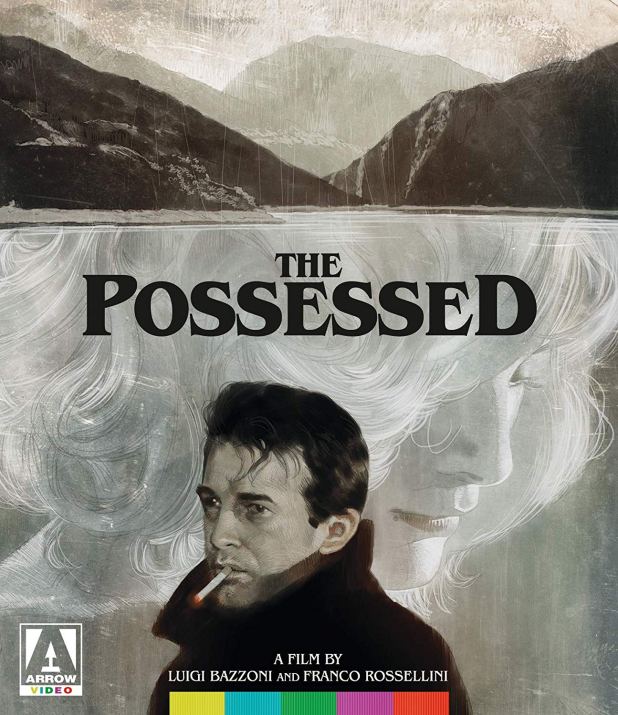
The Possessed (1965)

The Possessed is based on one of Italy’s most notorious crimes, The Alleghe killings, and adapted from the book by acclaimed literary figure Giovanni Comisso. It seems like a giallo, but it’s way closer to a film noir. Or maybe an art film. Often, people say that a movie feels like it’s inside a dream, but so much of this movie feels like one long evening of interconnected night terrors.

Also known as The Lady of the Lake, this films was written by Giulio Questi (Death Laid an Egg) and co-directed by Franco Rossellini (who would later produce Caligula) and  Luigi Bazzoni (The Fifth Cord, Footprints on the Moon).

Bernard (Peter Baldwin) is a novelist who has given up on life, despite his growing fame. Last summer, he fell in love with a maid named Tilde and hasn’t been able to get her out of his mind. As time goes on, despite the friendly way everyone at the inn treats him, he grows more and more worried about the conspiracy within this small town. That’s because while he was gone, Tilde committed suicide. And she may not have been the perfect woman that his creativity made her out to be.

Much like the giallo protagonist — a stranger on a strange who is often an untrustworthy narrator who must now investigate a crime that they themselves are implicated in — Bernard learns more about how his vacation getaway also isn’t the heaven that he dreamed that it was.

Thanks to the recent Arrow Video releases, I’ve done a deep dive on the films Bazzoni and wish that he had made more than the three giallo-esque films on his resume. Each of them subverts the form while working within it, offering challenging narratives and films that refuse to simply be background noise.

Their new release of The Possessed features a brand new 2K restoration from the original camera negative, as well as the original Italian and English soundtracks, titles and credits. Plus, you get the original trailers, audio commentary by writer and critic Tim Lucas, an appreciation of the film by Richard Dyer, an interview with the film’s makeup artist and art director, and actor/director Francesco Barilli discussing the Bazzoni brothers.

I’d never heard of this film before they announced it and am pleased to say that it’s moved up on the list of my favorite films. Consider this my highest recommendation.

You can get this movie directly from Arrow Video or from Diabolik DVD.

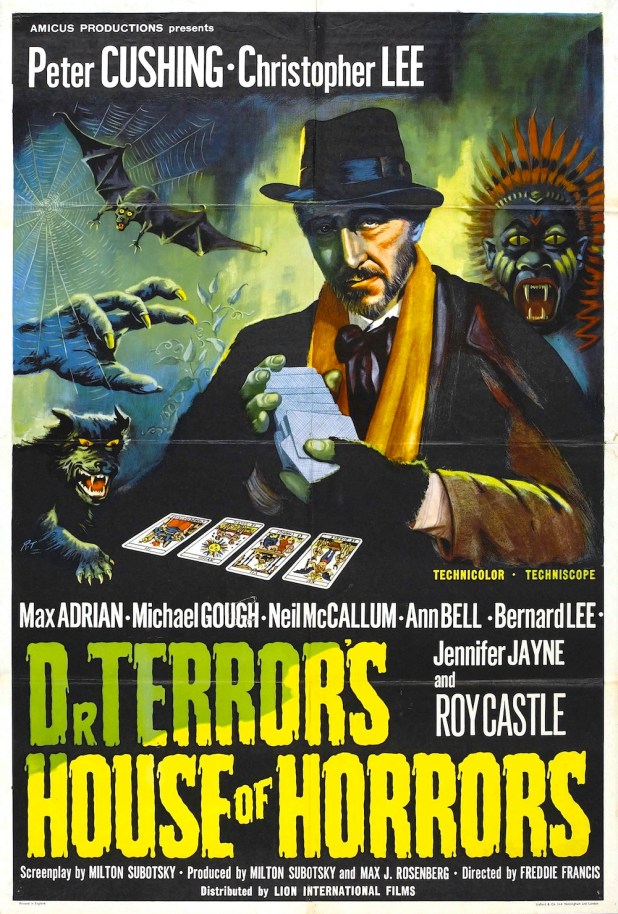
Dr. Terror’s House of Horrors (1965)

Freddie Francis is pretty dependable. Throw in the Amicus name, plus Christopher Lee and Peter Cushing, and things get much better. This is the first official Amicus film, all about five men on a train from London to Bradley who meet the mysterious Doctor Schreck (Cushing), a man with a name that literally means terror. With his Tarot cards, he’ll soon reveal the fates of the men on the train.

Inspired by Dead of Night, Amicus producer Milton Subotsky used this movie as his opportunity to reinvent that film. Once the formula was set, he’d follow it again and again.

In Werewolf, an architect learns that yep, a werewolf lives inside his new home and is already killing people.

Then, in Creeping Vine, Alan Freeman (the host of BBC’s Top of the Pops) plays a man who can’t stop a vine from growing in his garden. Look for Jeremy Kemp, M from the James Bond films, as a Ministry of Defense (spelled Defense, because we’re on England, guvnah) scientist.

Voodoo is all about Bigg Bayley (Roy Castle, who broke nine World Records himself while hosting the show Record Breakers from 192 to 1994. including the world’s fastest tap-dance 1,440 taps per minute, a record that is still unbroken today), a jazz musician who tries to bring a theme he’s heard in a voodoo ritual into his songs. Bad idea.

Disembodied Hand is all about Christoper Lee as an art critic so harsh, he drives Michael Gough (Alfred in the Tim Burton Batman films) to suicide. Then, the man’s hand comes back to life, living up to the title.

Finally, in Vampire (yes, this movie has some literal titles), Donald Sutherland is an American doctor with a new French wife who may or may not be a vampire.

Setting up the Amicus tradition, everyone on the train is already dead and Dr. Schreck is, of course, Death itself.

Also, thanks to IMDB, I have learned that Dr. Schreck’s deck is the 1930 Paul Marteau version of the Marseille Tarot, which was based on the 1760 woodblocks by Nicolas Conver. You can tell this version as industrialized printing eliminated the softer tones of the original deck and replaced them with primary colors.

You can’t really go wrong with these movies. And you can see how Night Train to Terror was inspired by this, too.

Grab a blu ray of this from Olive Films.

DEADLY GAME SHOWS: The 10th Victim (1965)

How do you avoid warfare in the future? The Big Hunt is the answer. It’s the most popular form of entertainment there is, bringing in all types of people who want to be rich and famous. Every competitor has to complete ten rounds of the game — five as a hunter, five as a victim. If you survive, you retire with more wealth than you can even dream of. And if you don’t make it…

Caroline (Ursula Andress, Dr. No, The Mountain of the Cannibal God) is one of those competitors, using a powerful shotgun to hunt her final target. If she gets a perfect kill, right in front of the cameras, she’ll make even more money, thanks to her sponsorship from the Ming Tea Company. And that target? Marcello (Marcello Mastroianni,  La Dolce Vita, ), a man whom she finds herself in love with. The big problem is neither is sure if they have the right target and if you accidentally kill the wrong person, you lose the game.

From the jazzy score by Piero Piccioni to a scene where Andress kills a victim with a bra that has gun barrels inside it, this film is pure 60’s pop spy retro-future perfection. Director Elio Petri (A Quiet Place in the Country) turned Robert Sheckley’s short story into a comic book-looking film with incredibly gorgeous lead actors. Anne Margaret and Sue Lyon (Lolita herself!) were both considered for the role, but no one but Andress would have been right in my opinion.

If you’re watching this and thinking, this movie looks like Austin Powers, that’s no accident. The character of Austin Powers started in a Mike Myers music side project known as…Ming Tea. Yes, the very same Ming Ting from this movie. Featuring The Bangles’ Susanna Hoffs as Gillian Shagwell, Matthew Sweet as Sid Belvedere, Stuart Johnson as Manny Stixman and Christopher Ward as Trevor Aigburth, the band recorded several songs, including two that appeared in Austin Powers films.

The look of those films come directly from this movie and other 60’s pop art films, such as BarbarellaDanger: Diabolik! and Dr. Goldfoot and the Girl Bombs (it’s not an accident that two of Bava’s films are on this list, he had this look down pat). It’s worth mentioning that the film’s costumes were designed by Andre Courreges, one of the most iconic clothing designers of the twentieth century, who is credited with innovating so much of the mod look and is credited with redefining the go-go boot and inventing the mini-skirt (along with Mary Quant).

If you’re looking for this yourself, Shameless Films put out one that works on UK region players that has a lenticular animated cover. For those of us in the US (and elsewhere), Blue Underground has also released this on DVD.