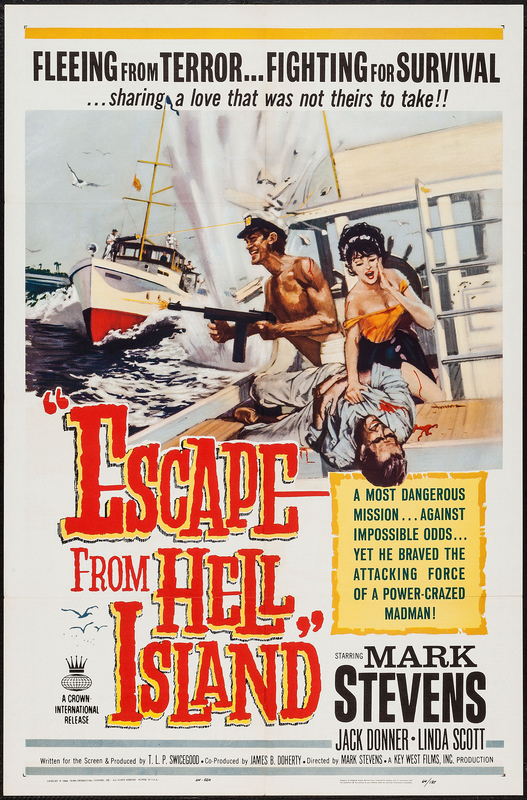
Captain James (Mark Stevens, who also directed this) is a Key West charter boat captain who is helping refugees get off Hell Island, which in this case would be Cuba. Beyond losing his license when one of them dies, he also hooks up with a married woman whose husband wants to kill him.
This is pretty much Hemmingway’s To Have or Have Not and even mentions Hemmingway numerous times and shows off his favorite bar, Sloppy Joe’s, which was in Key West. I’m shocked that polydactyl cats, boxing, cigars and more Hemmingway mentions were not made.
Nothing really happens here, to be honest. My ability to deal with bad movies is pretty legendary and this tested even my ability to be bored. Just imagine.
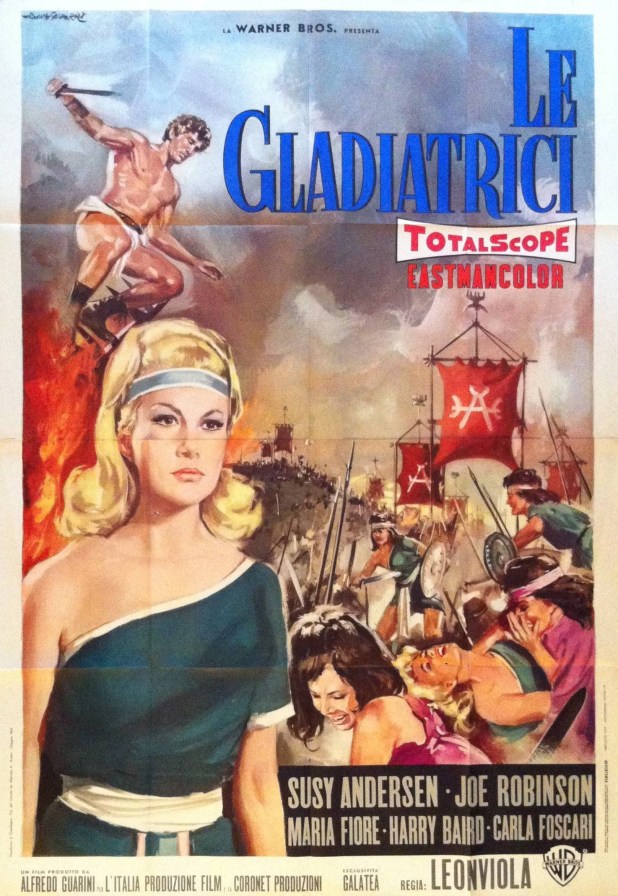
With the Italian title meaning The Female Gladiators, this film was released here as Thor and the Amazon Women. It’s actually a sequel to Taur the Mighty, but I think you’ll be fine with just watching it without seeing that movie.
It comes from Antonio Leonviola, the man who made Atlas in the Land of the Cyclops and Mole Men Against the Son of Hercules.
A civilization of women warriors, lorded over by the evil Black Queen (Janine Hendry, Taur the Mighty) has been decimating the men of their country. Soon, they come up against Tamar (Susy Andersen, Black Sabbath), who is the daughter of a great warrior who teams with Thor (Joe Robinson, who was Taur in that aforementioned movie and I guess may be that character again. Perhaps not. Is it more confusing if Tamar is the daughter of Taur and Robinson is just playing a whole different role? Ah man…), Ubaratutu (Harry Baird, The Four of the Apocalypse) and her younger brother Homolke.
Nera the Black Queen like two things: her cat and gladiator battles between captive women. She must be Italian, because this is one of the prized tropes of my ancestral forebearers. One of the captives, Ghebel (Carla Foscari, Mole Men Against the Sons of Hercules), tells the evil leader about Thor, a strongman who prophecy claims will end the Black One’s evil kingdom. Tamar ends up getting kidnapped and turned into one of the gladiators.
Luckily, the captain of the guard opposes the queen is ready to help our heroes. She tries to lead an uprising but is killed and the Queen orders Tamar and Ghebel to fight to the death. Just then, the rest of our heroes attack. Tamar ends up winning the battle and kills both Ghebel and the Black Queen, deposing her rule and putting her brother on the throne, which seems kind of backward to have a little boy leading everyone when Tamar has more than proved herself.
That’s right. A movie about a female empowered society that does all it can to prove to you that a female empowered society is the worst idea ever. What I’m saying is that if you expect a movie that proves the superiority of female leadership, look elsewhere than a 1963 peblum movie.
By the way Thor and Ubaratutu look at one another, I think Tamar would have been better off keeping Nera in power. If you must watch this, you can find it on Tubi.
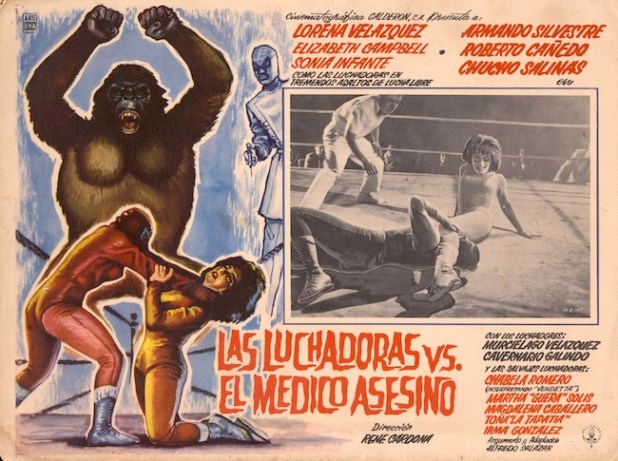
You know, Rene Cardona could have made a million of these wrestling horror movies, K. Gordon Murray could have brought them all to the United States and I would still watch every single one of them over and over again.
Cardona had made this under the Las Luchadoras title* and Murray changed it to Doctor of Doom, re-editing and dubbing it for American audiences.
An evil doctor has an army of gangsters and a man-ape named Gomar (Gerardo Zepeda) that wears a bulletproof vest, but come on, he’s battling the wrestling women and is always going to come up short.
This was an American-International Pictures film that was sold to television, so if you were a kid in the 60’s and 70’s, there’s a great chance you saw it and were incredibly lucky.
The biggest mistake that the mad scientist makes is kidnapping and using the sister of pro wrestler Gloria Venus (Lorena Velazquez), who brings her tag partner Golden Rubi (Elizabeth Campbell) and the police to destroy his schemes.
You know who loved this movie? Rene Cardona, as he spun Lorena Velazque’s character off to star in Las Luchadoras Contra La Momia and Las Lobas Del Ring. Then he remade it with more skin and gore as the even more amazing Night of the Bloody Apes, a film that made the Section 1 video nasties list nearly a decade after it was made, which in my mind is a wonderful accomplishment.
*There’s also another version named Rock ‘n’ Roll Wrestling Women Vs. the Aztec Ape that has a rock ‘n roll soundtrack.
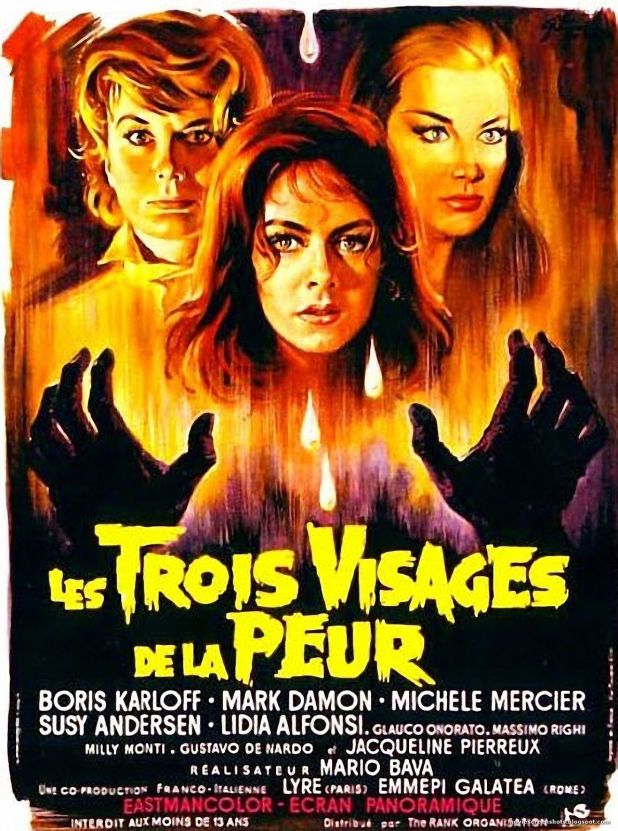
Known in Italy as I tre volti della paura (The Three Faces of Fear), Mario Bava’s seminal film plays differently in other countries of the world. Here in the United States, American-International Pictures suggested changes to Bava during filming so that the film would play better in America, where it underperformed. Those changes include replacing the original dialogue, changing Roberto Nicolosi’s score to music by Les Baxter and censoring much of the film’s violence. The first story, “The Telephone,” was changed the most, as it was given a supernatural element missing from the Italian version and all references to prostitution and lesbianism were exorcised.
Bava wanted to create a story about how terror can strike in different time periods and looked to books for inspiration. The first tale, “The Telephone,” is based on F.G. Snyder’s story and has Bava trying to match the lurid covers of giallo detective books. The whole name giallo had no been codified yet, so this is a take between The Girl Who Knew Too Muchand Blood and Black Lace.
In that story, a French call girl named Rosy (Michèle Mercier) returns home to receive a series of strange phone calls from her pimp Frank, who has just escaped from prison. A prison that she sent him to, no less.
Rosy calls her ex-girlfriend Mary (Lydia Alfonsi) as she is sure that she is the only person who can help her. She gives her a large knife and while Rosy sleeps, Mary writes to confess that she was the one who made the calls, hoping that she could bring their relationship back. As she finishes, Frank (Milo Quesada)really does break in and kills her. Realizing he murdered the wrong woman, he moves to Rosy’s bed, but the knife does end up saving her.
In “The Wurdulak,” Vladimir Durfe (Mark Damon) is a young nobleman who finds a headless corpse with a knife in its heart. Taking the blade, he leaves for a small cottage where a man tells him that the knife belongs to his missing father Gorca (Boris Karloff, who also hosts the movie), who has gone to fight the wurdulak.
Now, however, the old man has become what he was fighting and even transforms their son into another undead creature that demands to feed on humans, predating Salem’s Lot. One by one, the family becomes these creatures, leaving only Vladimir and his love, Sdenka (Susy Andersen).
That story was loosely based on The Family of the Vourdalak by Aleksey Konstantinovich Tolstoy, along with the story “The Wurdulak” from the anthology I vampiri tra noi, Guy de Maupassant’s “Fear” and Bram Stoker’s Dracula.
Finally, “The Drop of Water” was based a Chekov story and “Dalle tre alle tre e mezzo” (“Between Three and Three-thirty”) from an anthology book called Storie di fantasmi (Ghost Stories). Nurse Helen Chester (Jacqueline Pierreux) is called by the maid (Milly Monti) of an elderly medium to prepare her body for burial. She can’t help but steal a ring from the dead woman, which leads to bussing flies, drips of water and even the dead woman coming back for her.
Even the color of this film is different between the American and Italian versions. It may seem crazy to us today, but AIP recut, re-edited and recolored a Mario Bava movie. This would be seen as ridiculous today, but in 1963, horror films were hardly seen as art.
There were additional scenes filmed with Boris Karloff introducing the segments, just like he did on the TV sho Thriller, but AIP decided they were unnecessary and cut them. Karloff went on record saying that these introductions were some of the most fun he’d ever had on a film set, which led to him praising Bava to his contemporaries Christopher Lee and Vincent Price. Plans were made to make an adaption of The Dunwich Horror called Scarlet Friday with Karloff and Lee, but after the failure of Dr. Goldfoot and the Girl Bombs, AIP gave up on Bava.
Mika Mifune once said, “I heard from my father that he was offered the role of Obi Wan Kenobi, but he was concerned about how the film would look and that it would cheapen the image of samurai, on which George Lucas had based a lot of the character and fighting style. At the time, sci-fi movies still looked quite cheap as the effects were not advanced and he had a lot of samurai pride. So then, there was talk about him taking the Darth Vader role as his face would be covered, but in the end he turned that down too.”
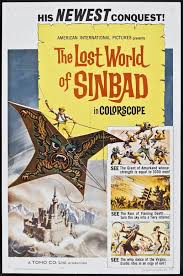
Mifune did not, however, turn down the role of Sukezaemon Naya in Daitōzoku, which means The Great Bandit. It was later released in the U.S. as Samurai Pirate and, finally for the purposes of this article, The Lost World of Sinbad*.
Sukezaemon (Mifune) is a pirate who has been shipwrecked in one of the weirdest corners of the world. He must help restore the king to life and defeat an evil premier by joining with some rebels and a wizard to battles a witch, pirates, the imperial guard and free the kingdom from slavery. Yeah, Lucas watched plenty of Mifune’s movies.
*It played double bills with War of the Zombies, which is a crazy pair.
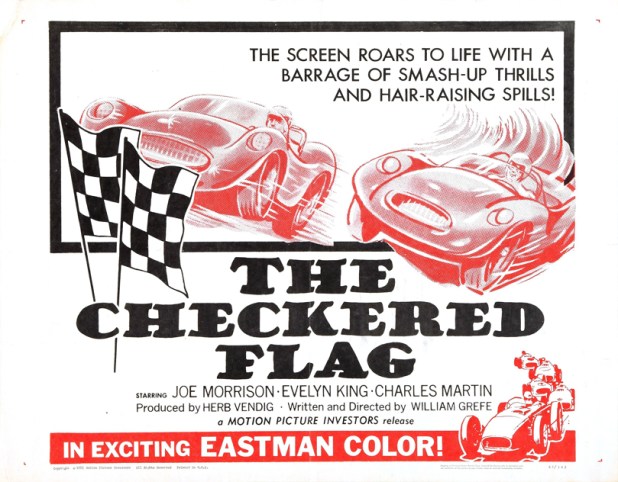
This was William Gréfe’s first script and when the original director got sick, it also became the first movie he’d direct. Shot on weekends, as Gréfe was working a full-time job as a firefighter, this is the tale of a rookie race driver named Bill Garrison being conned into murdering Rutherford, an older and richer rival, thanks to the machinations of an evil wife.
Consider this: there’s plenty of stock footage of races and several musical numbers with the ending kind of, sort of taken from Freaks. It’s not the best car racing movie you’ve ever seen and probably may vie for the worst, but at least it’s the start of Gréfe’s career as one of Florida’s top exploitation directors.
“Miami” Joe Morrison, who plays the young driver, would go on to be in Sting of Death and Racing Fever, while Evelyn King, who played the conniving Bo Rutherford, went on to be in a lost movie called Scream, Evelyn, Scream! As for Rutherford, he was played by Charles G. Martin, who shows up in plenty of Florida productions, such as Flipper and Gentle Ben.
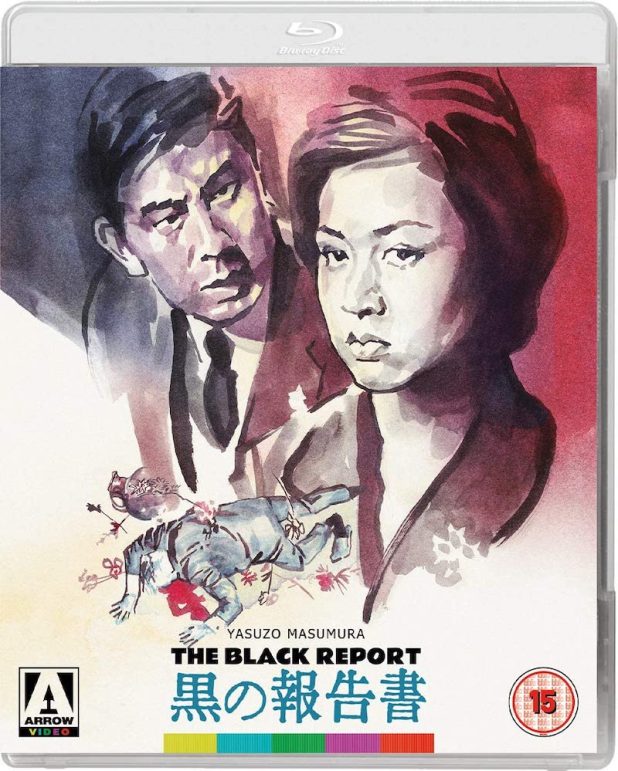
This is the second Yasuzô Masumura movie I’ve watched this week, a director whose work that until now I’d never explored.
The next case of Akira Kido (Ken Utsui) will determine whether or not he has earned a promotion. In this film, unlike American movies, the case within court is all that matters.
With elements of noir, this movie shows the inside of a Japanese court room, where catching the murderer is only part of the tale. The rest is actually getting them convicted.
I love getting Arrow blu rays because I’m so often exposed to films that I would never otherwise watch. Japanese courtroom drama was not on my radar until I watched this.
You can get this blu ray from Diabolik DVD. It comes complete with another Masumura film, Black Test Car.
DISCLAIMER: This film was sent to us by Arrow Video.
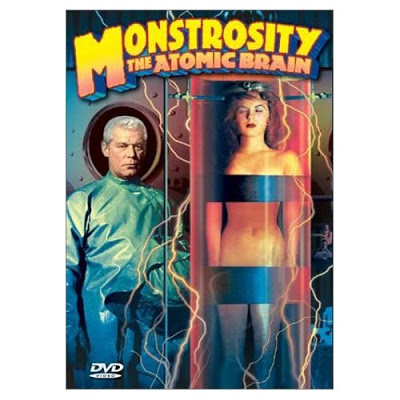
Also known as Monstrosity, this is one of the first movies where decay is given as the reason for the diminished intelligence of zombies. It also features plenty of people better known for other things, like narrator Bradford Dillman, Commerical pitchman Frank Gerstle and Marjorie Eaton, who played the original Emperor in The Empire Strikes Back before the special edition re-imagining.
In just 72 minutes, we learn an old woman who gets her pick of three servants to insert her brain into, thus getting a young body that will extend her lifespan.
This is the last film of Judy Bamber, who is also in A Bucket of Blood and Dragstrip Girl. The budget was so low that she provided Xerxes the cat, who was her housecat.
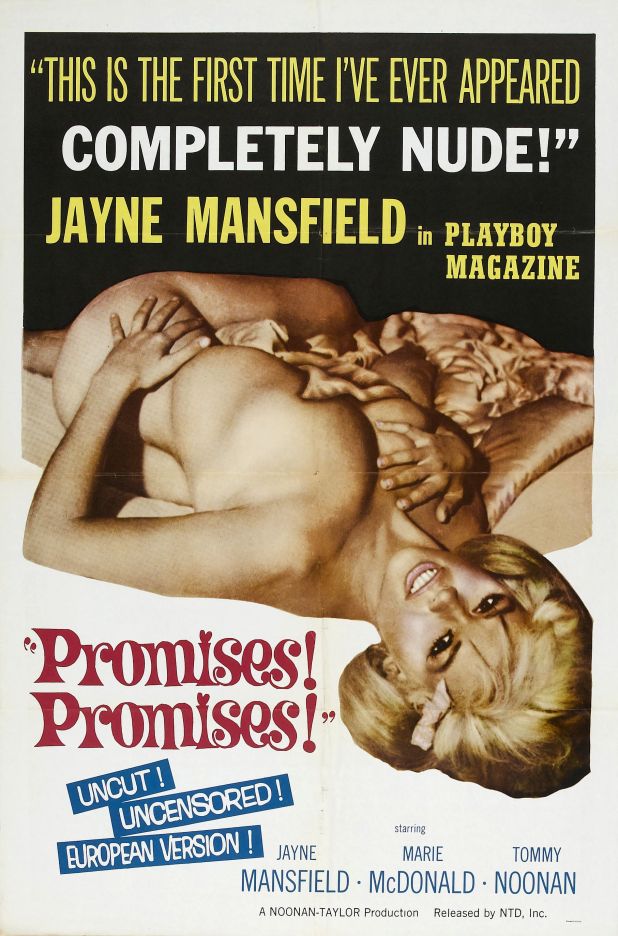
This 1963 movie — released betweeb the end of the Hays Code and the start of the MPAA rating system — was the first Hollywood motion picture release in decades to feature a mainstream star nude. And that star was Jayne Mansfield, bearing Marilyn Monroe in the buff in 1962’s uncompleted Something’s Got to Give.
In case anyone asks you, the first mainstream star to go fully nude was Annette Kellerman in 1916’s A Daughter of the Gods.
The three nude scenes by Mansfield were scandalous. Even more so was the July 1963 issue of Playboy, which was the only obscenity charge every brought against Hugh Hefner. In that issue a pictorial entitled “The Nudest Jayne Mansfield” showed Mansfield topless alongside T.C. Jones, a hairstylist, actor and one of the most famous female impersonators under his stage name Babette.
All the press made the movie a big deal, despite the horrible reviews. Sadly, Mansfield only got offers for more sex comedies. While you could buy stag loops of her scenes in the 60’s, the same scenes would show up in the posthumous The Wild, Wild World of Jayne Mansfield, which also has scenes from Too Hot to Handle, The Loves of Hercules and Primitive Love.
Mansfield was voted one of the top ten box office attractions that year, but Roger Ebert took her to task: “Finally, in Promises, Promises she did what no Hollywood actress ever does except in desperation: she made a nudie. By 1963, that kind of box office appeal was about all she had left.” Of course, this practice is commonplace today.
So what’s it all about? Jayne plays Sandy Brooks, a woman dying to get knocked up yet with a husband played by Tommy Noonan, who produced this and warred with his co-star. In the movie, he’s too stressed out to make love to her, which sounds like a problem no man ever had next to Ms. Mansfield. Meanwhile, after meeting another couple, Claire and King Banner. Claire is played by Marie “The Body” McDonald, who had perhaps an even crazier life than Mansfield, starting as winning the title of The Queen of Coney Island before adding up six marriages, an alleged kidnapping that was never proved to have taken place and a death from an “active drug intoxication due to multiple drugs.” In the aftermath, her husband and father would commit suicide and her children would be raised by third husband (they were married twice, too) Harry Karl and his wife, Debbie Reynolds, who knew something about infamous divorces. She took over the role from Mamie Van Doren. King is played by Mansfield’s husband at the time, Mickey Hargitay.
The couples end up swapping — this had to be scandalous for 1963 — ends up with both women pregnant and unsure who the daddy (or daddies, I guess) are. In between that, Mansfeld sings two songs, “Lullaby of Love” and “Promise Her Anything.”
This movie wasn’t an adult film. It was a major studio picture, directed by King Donovan (husband of Imogene Coca), who beyond acting in Invasion of the Body Snatchers also directed this movie and four episodes of Grind! and one of That Girl. Vidor shows up in plenty of things, with his last role in the 1984 cult movie Nothing Lasts Forever.
You can watch this on Amazon Prime. You won’t get arrested.
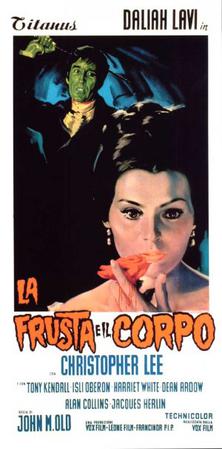
Directed by Mario Bava under the name John M. Old, this film — known as What! and Night Is the Phantom in the U.S. — was removed from Italian theaters due to its BDSM themes, with censors claiming “several sequences refer to degenerations and anomalies of sexual life.”
It was written by Ernesto Gastaldi (billed as Julian Berry), Ugo Guerra (Robert Hugo) and Luciano Martino (Martin Hardy), after Gastaldi was shown The Pit and the Pendulum.
Within an isolated castle, the prodigal son Kurt (Christopher Lee) has returned. He once pledged to marry Nevenka (Daliah Lavi, Some Girls Do), but had an affair with Tania, the daughter of their servant which ended in her suicide. He left in disgrace while his fiancee instead married Cristiano (Tony Kendall, who was in the Kommissar X movies), the younger son of the Menliff family.
Supposedly, Kurt is back to celebrate their marriage, but really he’s just here to take Nevenka to the beach where he whips her. And here’s the part that upset people. She loves it.
Kurt is soon killed by the same knife that his illicit lover used to take her own life. But then his ghost remains, ready to ruin the lives of everyone in the crumbling manor.
Lee had hoped to work with Bava on another movie, but their busy schedules kept them from ever working together again. Upon seeing A Bay of Blood, he was so upset by its gore that he left the theater.
 B&S About Movies