Dr. No (1962)

Two men wanted the rights to the James Bond novels: Harry Saltzman and Albert R. “Cubby” Broccoli. Broccoli wanted to make the films more than Saltzman and while they couldn’t agree on a sale, they would agree to make the films together.

The problem? Many studios felt that the Bond books were too British and too sexual, but United Artists agreed to release their movie, giving it a low budget. As a result, Saltzman and Broccoli created two companies: rightsholding firm Danjaq and Eon Productions, which would actually produce the movies. Their partnership would last until 1975’s The Man With the Golden Gun.

Speaking of bad feelings, the pair wanted to make Thunderball the first Bond film. However, there was an ongoing legal issue between the writer of a screenplay for the film, Kevin McClory, and the book’s author Ian Fleming. Keep this in mind as our Bond Month continues, as while it’s a footnote now, it becomes a major issue later.

The team behind the film decided that Dr. No, the second Bond book, would be the first movie. It made sense — the space race was on.

But first, they needed a director. Several — Guy Green, Val Guest, Guy Hamilton and Ken Hughes — turned down the project before Terence Young came on board. The future director of Inchon and The Klansman realized that in order for the sex and violence of the film to be palatable to a mass audience — and pass the censors — a sense of humor was necessary.

United Artists only gave a million dollars to get the film made, which necessitated plenty of creativity to get all of the bases and special effects into the film.

While original writers Richard Maibaum and Wolf Mankowitz wrote a script that was nowhere near Ian Fleming’s novel — they made Dr. No a monkey — the second draft was better, especially when script doctors Johanna Harwood and thriller writer Berkely Mather entered the project.

So after all that — there was a very important question: who would be James Bond?

Cary Grant was the first choice, but he’d only commit to one movie. Richard Johnson — who would be in plenty of spy movies soon enough — was also considered, as was Parick McGoohan thanks to his performance as Danger Man. Other names bandied about were David Niven (he’d play Bond in 1967’s Casino Royale), Roger Moore (more on him all month long), Stanely Baker, Rex Harrison, James Mason, Steve Reeves and Richard Todd.

There was even a contest to find who Bond would be. A model named Peter Anthony won, but wasn’t up to the task.

Enter Sean Connery, who may have showed up rumpled and unshaved to his interview, but had the right attitude. Director Young would take it upon himself to make Connery into Bond, sending him to his tailor and hairdresser before giving him a crash course in style, manners and the high life.

The visual look of Bond — the stylized title opening, the gun barrel beginning — all start here. It’s a modest film with much bigger goals. This was world-building and sequel making before many even considered what that meant.

The team behind the film also realized that marketing was essential to the film’s success — particularly in America. By late 1961, United Artists sent a boxed set of the books to newspapers, as well as a book explaining the character and, perhaps most importantly, a glamour shot of first Bond girl Ursula Andress.

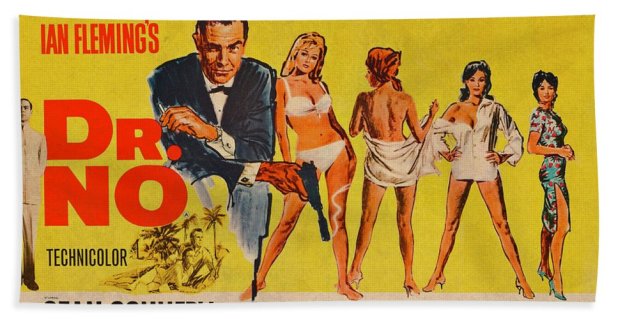
They also made merchandising deals with alcohol, tobacco, automobile and men’s fashion companies, using Fleming’s name and the success of the books to sell the character. And because sex sells, the posters featured Connery surrounded by gorgeous — and near-nude — women.

The results were pretty much an instant success. The films would become a series that nearly 25% of the world’s population has seen. The books became even bigger sellers. And the bikini — which Andress wore so famously — became the swimwear of choice for young women.

James Bond had arrived.

Bond has been called in to learn more about the disappearance of MI6 Jamaican station chief John Strangways and his assistant Mary Trueblood. Signal jamming of Cape Canaveral, the CIA (say hello to Jack Lord as Felix Leiter in the only time he’d play the role) and a bevy of assassins are soon involved.

The series stands out as something different right away, as after Bond escapes a tarantula death trap, he captures, interrogates and cold-bloodedly kills Dr. No’s associate Professor R.J. Dent (Anthony Dawson, who would return as Blofeld in From Russia With Love and Thunderball).

CIA agent Quarrel and Bond make it to the island of Dr. No, which is said to be guarded by a dragon — which is actually a flamethrowing tank. Bond meets Honey West (Andress) and after a battle that takes the life of Quarrel, he and West are taken to meet Dr. No.

As played by Joseph Wiseman (Buck Rogers in the 25th CenturyJaguar Lives!), Dr. Julius No is a Chinese-German supercriminal in the employ of SPECTRE (SPecial Executive for Counter-intelligence, Terrorism, Revenge, and Extortion). Due to radiation poisoning, he’s lost both his hands and has replaced them with robotic versions. He wants Bond to join SPECTRE and help him disrupt an American space launch, but you know exactly what happens next: Bond escapes the last death trap and kills just about everybody so that the free world can remain safe.

Dr. No also sets up Bond’s MI6 team of Miss Moneypenny and Q. Lois Maxwell would play the former role for the first fourteen movies, while Peter Burton would only play Q for this first movie.

Eunice Gayson (The Revenge of Frankenstein) plays Bond’s girlfriend Sylvia Trench, who was supposed to have a much larger role in the films. She was considered lucky by director Young, who cast her.

After seeing the movie for the first time, Ian Fleming summed it up quickly and candidly: “Dreadful. Simply dreadful.”

Luckily, the rest of the world did not agree.
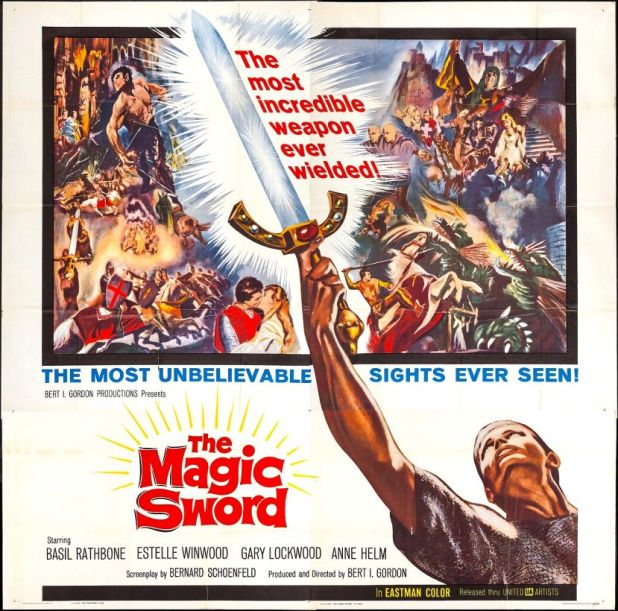
The Magic Sword (1962)

When I was a kid, WKBN-TV 27 in Youngstown aired a daily movie. I remember that quite often, the aspect ratio — I had no idea what that meant when I was young — made the cowboys seem way too tall at the beginning of their movies. And I vividly remember this movie all about St. George and the dragon, even if I couldn’t recall the title for decades.

Well, it’s The Magic Sword. Or perhaps I saw it under one its many other titles, such as St. George and the Dragon, St. George and the Seven Curses or The Seven Curses of Lodac.

Gary Lockwood — first husband of Stephanie Powers and Frank Poole in 2001: A Space Odyssey (and star of the Mad Max rip, Survival Zone) — plays George, raised by an adoptive sorceress mother (Estelle Winwood, who lived nearly a century and had a career that went from the British stage to American television) and destined to battle not only the two-headed dragon, but the seven curses of the evil Lodac (Basil Rathbone).

He’s also in love with Princess Helene (Anne HelmNightmare In Wax) and has six magical knights with which to prove his heroism, which is tested in battles against an ogre, an old hag and a sorceress. The latter two are played by Maila Nurmi, who is much better known Vampira. There’s also the shady side of heroism, exemplified by Sir Branton, who keeps killing off his brother knights left and right.

You can download this movie from The Internet Archive. It’s also available on Amazon Prime. There’s also a Mystery Science Theater 3000 version on Amazon Prime and Tubi, as well as a Rifftrax commentary option on Tubi.

This is a rare movie, in that Tom Servo and Joel had to admit that it was pretty good — for a Bert I. Gordon film.

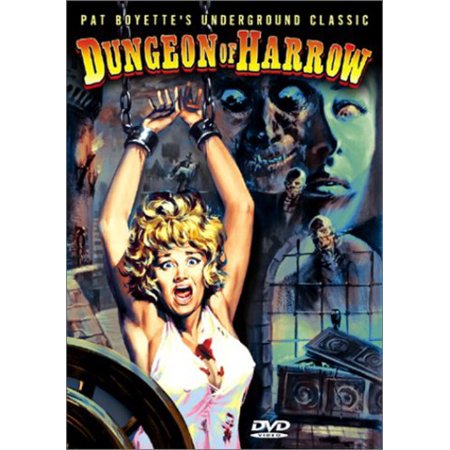
PURE TERROR MONTH: The Dungeon of Harrow (1962)

Imagine this: You’re evil and sadistic count who just happens to live in a waterfront castle with your equally disturbed family. A shipwreck happens and the survivor of the ship soon makes his way to your home. What would you do?

This was pretty much the passion project of Texas news anchor turned comic book creator Pay Boyette, who would also write and direct the movies No Man’s LandThe Girls from Thunder Strip and The Weird Ones. It feels like an AIP movie made in Texas, which is meant in the most kind of associations.

Besides directing, co-writing (with make-up artist/actor Henry Garcia), and composing the score, Boyette also narrates the movie.

Vinegar Syndrome has released a better version of this than the one that’s on the Pure Terror set, but that isn’t a knock on this Mill Creek find. After all, how do you get this many movies from this many countries that all take horror in so many directions for such a low price? I’d advise buying this set to experience the variety for yourself, then pick and choose the boutique release versions of your favorites.

2019 Scarecrow Psychotronic Challenge Day 20: Whatever Happened to Baby Jane? (1962)

DAY 20. SUNDAY DINNER: From exceptional eating scenes to full on foodie fodder. Come hungry!

After a viewing of this movie at a very young age, I decided that I’d never have chaffing dishes in my house. That may never come true just because I doubt I’ll ever have the money to spend on such luxurious accoutrements, but also because the moment where Baby Jane Hudson (Bette Davis) serves her sister Blanche (Joan Crawford) her parakeet — and later a rat — on a silver platter, I was put off on silver serviceware for the rest of my days. This is not a meal fit for Ms. Crawford!

Robert Aldrich had the idea of bringing together two of America’s most enduring screen icons in one film where they’d bring their long-rumored rivalry to the story of two sisters who had been used up by show business.

Baby Jane was once a vaudeville star who held her family under her thumb, using her stardom to get whatever she wanted. That all changed once movies took over and she couldn’t adapt, so by 1935, her sister Blanche is the toast of Tinseltown while she’s a shell of her former self, her movies seen as failures. One night at a party, an accident leaves Blanche paralyzed from the waist down and it’s all blamed on a drunken Jane.

Flash to three decades later, as residuals from Blanche’s films are enough to keep the sisters in house and home, as the two former stars live in the shadows of their past glories. Jane has become a raging alcoholic, trapping her wheelchair-bound sister within their home, denying her even basic sustenance — hence the pet and vermin meal scenes described above.

Although Jane has gone far into middle age, she still wears the pancake make-up and outfits of her Baby past. She’s hired Edwin Flagg (Victor Buono) to play piano for her, preparing an entirely new show to take on the road. And to get there, she’s using her sister’s money.

Only madness and murder can follow, as well as the revelation that Blanche isn’t the innocent victim that she aspires to be. Both sisters have been forced into roles that they’ve played way beyond typecasting. As both sisters find themselves on a beach, with Blanche dehydrated and near-death, Jane’s plaintively sad question “You mean all this time we could have been friends?” cuts through this film, which ends before giving any resolution to the fate of either character.

Whatever Happened to Baby Jane? was a cultural force, changing Hollywood so that older actresses didn’t have to fade into the role of the matron. It’d be followed by other so-called psycho-biddy films like Aldrich’s follow-up Hush…Hush, Sweet Charlotte, as well as movies that also asked questions like What Ever Happened to Aunt Alice?What’s the Matter with Helen? and Whoever Slew Auntie Roo?

The feud between the two actresses — which began years before this movie and would extend to their deaths — is so legendary that books and even an entire FX series was created to document it. From allegations that Crawford backed out of a publicity tour because she didn’t want to share the stage with Davis to Crawford accepting Anne Bancroft’s Best Actress statue for The Miracle Worker in a successful attempt to overshadow her enemy, this war was just like the movie — only 100% reality.

I mean — this is the movie where Bette Davis installed a free Coca-Cola machine on the set for the cast and crew for the sole reason of drawing the ire of Crawford, who was on the board of Pepsi.

There are also plenty of personal touches by both actresses. Davis did all of her own makeup, saying “What I had in mind no professional makeup man would have dared to put on me. I felt Jane never washed her face, just added another layer of makeup each day.” And Crawford, who was an avid collector of Margaret Keane’s “sad eyes” paintings, made sure that the paintings appear in next door neighbor Mrs. Bates’ house, inclduing the famous Big Eyes piece.

While Ingrid Bergman, Susan Hayward, Rita Hayworth, Katharine Hepburn, Jennifer Jones and Ginger Rogers were all rumored for Baby Jane and Tallulah Bankhead, Claudette Colbert, Olivia de Havilland and Marlene Dietrich were all in the running to play Blanche, only Davis and Crawford’s maniac energy — and downright hatred of one another — could make this film work as well as it does.

I truly believe that is Ms. Davis could have served Ms. Crawford a rat on a fancy tray, she would have done so. This is a film I’ve returned to time and time again, even if I’ve made sure to never eat a meal that has a silver cover on it.

Creation of the Humanoids (1962)

It’s unfortunate that Wesley Barry’s honorable director-producer ambitions through his Genie Studios—portraying a post-apocalyptic society that, to save humanity, fuse man with machine to create human-like androids from freshly dead human corpses, then deals with their creations’ development of cyber-theology and a subsequent worker’s revolt—grossly exceeded this film’s restrictive budget.

Ultimately, Creation of the Humanoids, an entry from the first wave of post-apocalyptic films, which predates the ‘70s second wave initiated with the dual-tent poles of The Omega Man and Soylent Green (1971/1973), introduces interesting—and now familiar—concepts regarding racism, the state of marriage, and man’s loss of humanity. So, courtesy of its financial shortcomings, instead of a sci-fi classic (well, it is; in its own, strange way) in the vein of the groundbreaking black-and-white post-apocs Metropolis (1927) and Things to Come (1936), which it seems Barry was attempting to achieve, we’re left with the ambitious, cardboard incompetence of Journey to the Center of Time (1967) and In the Year 2889 (1968). It’s a stale, Aldous Huxley vision of a not-so-Brave New World.

Is Creation of the Humanoids beyond the mediocre to the point of being lifeless? Does the constant “human drama” yakety-yak set against the lack of special effects kill the film’s subtextual sophistication? Is the acting hackneyed to the point of the actors being mere cardboard cutouts against the Irwin Allen-styled ‘60s TV series stage play accouterments of obvious matte paintings, floor-to-ceiling drapes, and black-void backgrounds to nowhere? Do the humanoids look like they’re wearing latex bald-wigs and matching-color rubber gloves? Are those Confederate Army caps left over from the Gone with the Wind costume stockpile? Did Academy Award-winning camera-man Hal Mohr and Universal Pictures’ chief makeup artist (of Frankenstein fame) Jack Pierce do the best they could with the budget they didn’t have?

Director Wesley Barry was a 1920’s child star whose acting career began in the silent film era alongside its biggest stars: Mary Pickford and Gloria Swanson. While he directed eight films, including several ‘50s TV series episodes, and a slew of ‘60s and ‘70s TV series as an assistant director (he even worked on Roger Corman’s The St. Valentine’s Day Massacre)—he’s best known for Creation of the Humanoids, his final feature film as a director. And it’s all thanks to his sci-fi “connection” to the post-apoc masterpiece, Bladerunner.

To deny the similarities of Creation of the Humanoids to Blade Runnerthe 1982 film drew from Philip K. Dick’s Do Androids Dream of Electric Sheep?, which was published six years after Creation and also deals with androids not aware they’re androidsis to deny the narrative similarities of Sam Raimi’s Evil Dead (1981) to Equinox (1970). And we sci-fi buffs remember the infringement and eventual settlement issues between The Terminator (1984) and Harlan Ellison’s ‘60s The Outer Limits episodes “Soldier” and “Demon with a Glass Hand,” don’t we?

It’s sometimes incorrectly reported that Creation of the Humanoid is an adaptation of a 1948 novel, The Humanoids by Jack Williamson. However, as with Ray Milland’s blatant “pinching” of John Christopher’s The Death of Grass for Panic in the Year Zero (1962), officially adapted as No Blade of Grass (1970)the script for this Blade Runner precursor brazenly borrows elements from Williamson’s novel.

In today’s litigious society: lawsuits would fly fast and furious between book publishers, producers, directors, novelists . . . it’s all cinematic déjà vu (just like in the ‘70s submarine romp, The Neptune Factor).

This post-apocalypse tale concerns itself with the themes of racism and man’s loss of humanity against the scornfully referred “Clickers,” a man-made race of bald, blue-gray, synthetic-skinned, silver-eyed humans (read: blacks) whose population is increasing, while humanitywho’ve developed a technological codependency on their robot slavessees their own birth rate decreasing. This triggers the creation of the human-terrorist paranoia-organization (read: the ‘50s “Red Scare”) “The Order of Flesh and Blood” (read: the Klu Klux Klan).

Amid the sociopolitical upheaval, a scientist faces resistance in expanding the “labor force” Clickers’ programming for emotionsgoing as far as to transform them into human replicas (read: Ash from Alien). Dr. Raven, with mad-scientist tenacity, intends to “thalamic transplant” the personality and memories of recently deceased humans into a robot-replica of that person. However, the human-humanoids have one flaw: like their “Clicker” brethren, they must go to “temple” (recharging stations), which also serves as information exchange terminals with the “father-mother” central computer (read: cyber-theology/church).

Of course, all stories need a romance subplot: Captain Cragis, a leader in the Order of the Flesh and Blood resistance, falls in love with Raven’s assistant, Maxine, who opposes the Order’s manifesto. And Cragis is jealous of Maxine’s “love” for her grey-blue skinned concierge. And Cragis and Maxine come to discover they’re both android-replicants. And that the “human” Maxine died in a terrorist attack perpetrated by Cragis.

While Creation occasionally appeared on U.S UHF TV stations beginning in the late ‘60s, the hungry-for-product home video market released the film on Beta/VHS in 1985 (complete with a bogus rendering of ol’ Doc Brown from Back to the Future as a “mad scientist” with a captured babe-in-a test tube; cover), along with the eventual DVDs issued in the early 2000s.

Hey, wait! Where are you going? There’s another (production) plot twist!

Do you remember how wee young pups drooled over Andrea Marcovicci as Chalmersthe hottest android in the Universe (she puts Pamela Gidley’s android in Cherry 2000 to shame)in Spacehunter: Adventures in the Forbidden Zone (1983)? Remember how we drooled, I mean, noticed she was reading a copy of the book, R.U.R, in bed? Remember how, like with Mike’s copy of My Name Is Legion by Roger Zelazny (Damnation Alley) in Phantasm (1979), we, the bullied sci-fi/horror fan and comic book collecting freaks n’ geeks searched out copies of those books?

No? Well, pull up a Chalmers, I mean, a chair.

All of this robot, genetic-biological engineering exposition we’ve enjoyed in Blade Runner and other sci-fi films begins with one man—who really did “create” the humanoids: Nobel Prize-nominated and award-winning, Hungarian-Czech writer, Karel Čapek. His 1920 stage play/book R.U.R (Rossum’s Universal Robots) introduced the word “robot” and many of the concepts used in today’s science fiction. You can read the free eBook online at Gutenberg.org or buy a copy at Amazon, then watch Creation of the Humanoids for free on You Tube.

We discuss the use of A.I in cinema with our “Exploring: The ‘Ancient Future’ of A.I” featurette, in which we also discuss the three, official film versions of R.U.R.

About the Author: You can read the music and film reviews of R.D Francis on Medium and learn more about his work on Facebook.

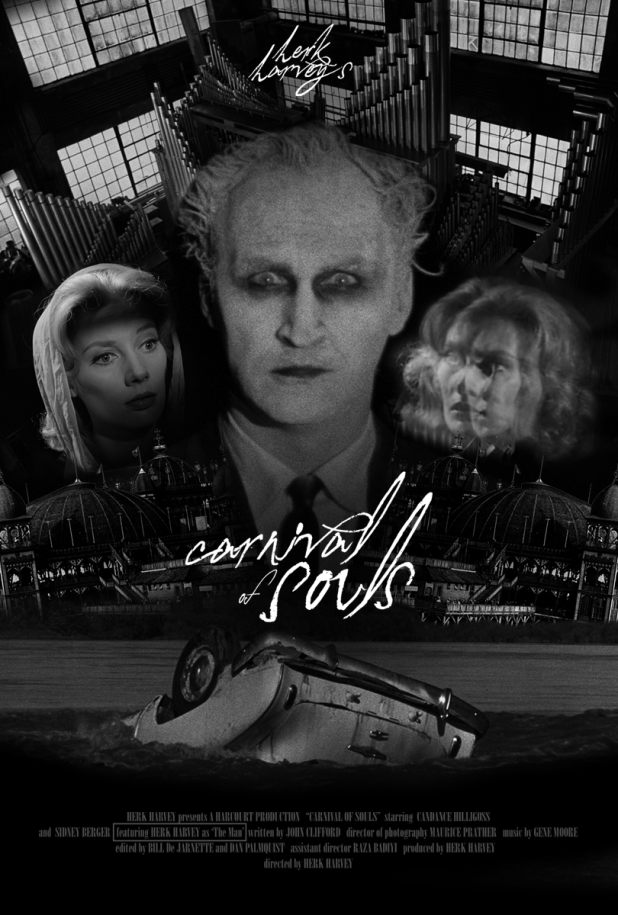
Carnival of Souls (1962)

This 1962 American independent horror film is literally an auteur production: it was written, produced and directed by Herk Harvey, as well as featuring him in the role of the spectral figure that haunts its heroine.

While teaching and directing plays at the University of Kansas, Harvey started working for the Centron Corporation as a film director, writer, and producer on industrial films and commercials. He was lauded for his special effects techniques and ability to work under budget.

After the success of low budget films by Elmer Rhoden Jr. and fellow industrial filmmaker in nearby Kansas City, Harvey secured $33,000 in funding to make his lone film, although he attempted to film several others. Because the company that distributed the film went bankrupt, it wasn’t seen much in initial release but soon gained an audience at drive-ins and via late night showings.

For the rest of his life, Harvey continued creating industrial films and acting, even appearing in the harrowing made-for-TV movie, The Day After. Luckily, he did live to see people recognize this film as a classic. He died weeks after the soundstage at the University of Kansas was renamed the Herk Harvey Sound Stage.

Mary Henry gets involved in a drag race with her car going off the bridge. The police drag the waters for three hours before she rises, unsure how she could have survived.

Our heroine movs to Utah, a place where can’t connect to anyone and can only get organ music on the radio. Her journey to her new home is marked by appearances by “The Man” (Harvey), a spectral figure that comes and goes, and an abandoned pavilion on the Great Salt Lake that begs for her to visit it in the twilight.

Mary begins to disappear from the world, becoming invisible and unheard by everyone around her, as if she weren’t there. And on her first day at her new job as a church organist, when she begins to play an eerie tune, The Man and a group of corpses begin to dance until the minister begins to scream, “Profane! Sacrilege!” Truly, diabolus in musica — those demonic tritones are afoot.

Every attempt to escape the town is stopped by The Man and his dead people, including them taking over an entire bus. Finally, Mary makes her way back to the pavilion, where she watches them dance and notices that a ghoul version of herself is with The Man. She runs, but they catch her. The minister, a doctor and the police try to find Mary, but as they follow her footprints in the sand — is this when God was carrying her? — they end with no trace. Back in Kansas, her car is finally found beneath the water with her dead body still inside.

The US release of Carnival of Souls failed to include the copyright on the prints, automatically placing them in the public domain. That’s how numerous TV stations would show different prints of this movie, cut however they wished to fit its timeslot. Again, it wasn’t until the late 1980’s that this film would be recognized as the arty horror that it is, a precursor to the work of artists like David Lynch and George Romero, who specifically said that it inspired him to make Night of the Living Dead.

In turn, this is a movie inspired by the silent films of the past, with parts where Mary is in one of her altered mental states being tinted cyan while all the scenes of reality appear in black and white. Later, the tinted scenes become distorted in both sound and picture. There’s also an original organ score by composer Gene Moore that makes this movie feel trapped in cinema’s past.

The Church of Satan’s leader Anton LaVey spoke glowingly of this movie: “Carnival of Souls is another richly evocative film that has been completely lost until recently. Producer/director Herk Harvey did industrial films and this was his brilliant excursion into the world of nightmares.”

You can watch this for free on Tubi.

CHILLING CLASSICS MONTH: Hands of a Stranger (1962)

Concert Vernon Paris’ hard work has finally paid off. He’s become the biggest star there is. That’s when his hands are ruined in an auto accident and Dr. Gil Harding amputates them — with no authority — and replaces them with the hands of a murderer, all in the hopes that Paris can play piano again. Sure, the transplant is a success, but Paris becomes unhinged and increasingly violent toward those he blames for him needing his killer new mitts.

Sure, this is based on the 1920 novel Les Mains d’Orlac by French writer Maurice Renard, but the real draw is the absolutely over the top slasher like violence — well, as good as it gets in 1962 — throughout the film. First, Paris argues with his former girlfriend Eileen, who can’t love him as a normal man and craves the limelight that dating him gave her. Her dress catches on fire as they fight and she burns alive. Later, Skeet, the son of the taxi driver who caused the accident, enrages Victor by being able to play the piano when he cannot. He crushes the child’s hands, then smashes his head open.

Keep your eyes peeled for a very young Sally Kellerman and Irish McCalla, who was TV’s Sheena: Queen of the Jungle. This isn’t a great movie, per se, but it’s over the top and filled with brimming menace. It’s also anything but boring!

It’s available on Amazon Prime for free with a subscription.

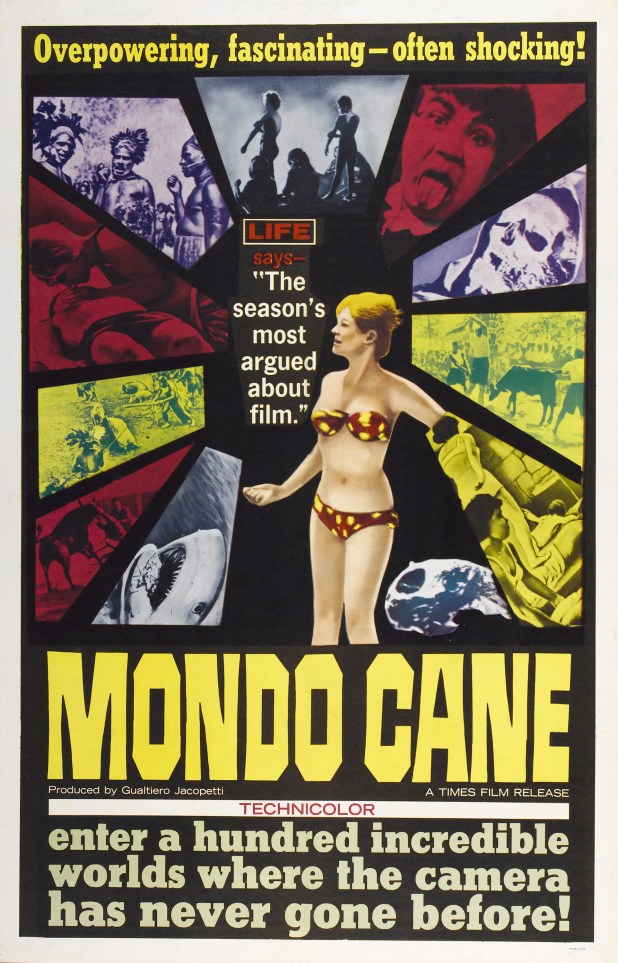
DOCUMENTARY WEEK: Mondo Cane (1962)

I’ve always been afraid of Mondo Cane. It’s the kind of film that is not afraid to manipulate you. So many of its scenes were staged or manipulated. And so much of it lulls you into a stupor as you watch it unfold like a kaleidoscope, then it decides to assault you with moments of pure barbaric intensity. This is a movie out to upset you.

The entire mondo subcategory comes from this film, a documentary written and directed by Italian filmmakers Paolo Cavara, Franco Prosperi, and Gualtiero Jacopetti.

Cavara and Jacopetti came up with the concept, with Prosperi credited as second director. To make this film, Cavara went on a dangerous quest, traveling the planet to obtain the necessary footage. The two men also met in Las Vegas at one point, where they were involved in the crash that ended actress Belinda Lee’s life (a troubled soul whose affair with married lover and papal prince Filippo Orsini led to a dual suicide attempt that cost his family the hereditary title of Prince Assistant to the Papal Throne).

After Mondo Cane’s appearance at the Cannes Festival and worldwide popularity, Jacopetti claimed sole credit. Cavara would leave the team, going   on to challenge himself with different genres and filming styles throughout his career as a director, including The Wild Eye, where a documentary filmmaker has a crisis of conscience as he pushes his crew to new limits of depravity (an obvious comment on how he felt about former associates Jacopetti and Prosperi) and the well-regarded giallo, Black Belly of the Tarantula.

Jacopetti’s life is the kind of tale that could make its own movie. After fighting alongside the Italian Resistance against Mussolini, he co-founded the influential liberal newsweekly Cronache. However, he was forced to shut down the magazine after being charged with pornography for publishing photos of Sophia Loren. Jacopetti was punished with a year-long prison sentence before journeying through a series of careers, finally landing on being a director.

After Mondo Cane (which roughly translates to the Italian curse, a dog’s world), Jacopetti and Prosperi would go on to use discarded footage to make Women of the World (dedicated to the aforementioned Lee, a lover of Jacopetti asked to be buried next to), Mondo Cane 2Africa Blood and Guts and the beyond depraved pseudo-documentary Goodbye Uncle Tom.

As time went on, the mondos had to outshock one another, constantly topping themselves. The entire crew was nearly executed while making Africa Blood and Guts while filming in Zaire. A scene from this film led to Jacopetti being charged with murder in Italy. He was acquitted of the crime after proving that the killing was unstaged.

This all led to Goodbye Uncle Tom, a film that David Duke, former leader of the Ku Klux Klan, claimed was a Jewish conspiracy to incite blacks to violence against whites. Presenting itself as a documentary, the film begins with Jacopetti, Prosperi and crew traveling backward through time! Sure, this may have been intended to be an anti-racist attack on the evils of slavery, but it was made with the full cooperation of Haitian dictator Papa Doc Duvalier. Prosperi may have claimed that his films angered many because “the public was not ready for this kind of truth,” but it’s difficult to defend a movie where hundreds of anonymous Haitian extras re-enact vicious scenes of abuse and torture.

The original ending of the movie occurs in the modern era, where a radical black activist reads William Styron’s The Confessions Of Nat Turner and has a fantasy of breaking into a suburban home and murdering a white baby. This was supposedly Jacopetti and Prosperi’s comment on racism, but when you realize that so much of this film basically used slaves to depict the evils of slavery, it’s kind of understand what they were going for. The American distributors of the film certainly didn’t get it and cut all of this.

I mean, this is a movie that claims to be a documentary about a time-traveling crew of Italians who somehow get to meet Harriet Beecher Stowe and Samuel Cartwright, but somehow there’s also a scene where the narrator takes the virginity of a thirteen-year-old teenage prostitute on camera. A commercial and critical failure, this was the end of Jacopetti’s big run of films, although the duo did work together on a cover version of Candie called Mondo Candido. Jacopetti would move back to the world of print while Prosperi would direct Gunan, King of the Barbarians and The Throne of Fire

But what of Mondo Cane? This film takes your eye on a savage journey, starting with a dog being dragged through the pound as other dogs bark at him. From a statue of Valentino to women tearing off the shirt of actor Rossano Brazzi (Fulci’s Dracula in the Provinces), men being hunted by women becomes the theme, juxtaposing New Guinean tribal rituals with bikini girls on the Riviera.

If you love animals, you can pretty much leave the room now. Because Mondo Cane is going to laugh at those who mourn their pets at a cemetery, going so far to highlight other dogs pissing on their graves. From pigs being slaughtered to dogs being skinned alive in Taiwan, chicks being dyed for Easter and geese being force-fed, the film begins its descent into man’s inhumanity to, well, everyone.

Animals are dying from radiation. Fishermen shove toxic sea urchins down the mouth of a shark. And then people get drunk. More girls in bikinis. Massage parlors. Hulu dances. Skulls, dying, death and cars being smashed.  Bullfights, bull beheadings and soldiers dressed in women’s clothes. My chronology is screwy now, but the film has become a barrage, assaulting my eyes and sense of reason.

The film ends with a cargo cult, a term given to South Pacific based aboriginal religions that would build airplanes and military landing strips as part of rituals hat they hoped would summon the gods that had brought them supplies during World War 2.

Mondo Cane predates and prepares us for the never-ending news cycle that we find ourselves in today. Yet even though it’s nearly sixty years old, it remains a rough testament. It doesn’t just show you the mud and filth, it pushes your face into it and laughs at you as you struggle to maintain your footing in the muck.

Yet this is also a film that was considered for the Palme d’Or at Cannes and was nominated for best song, thanks to “More,” the theme that was written by composers Riz Ortolani and Nino Oliviero. I don’t think that it’s any coincidence that Ortolani would go on to create the theme song to an even more depraved film — Cannibal Holocaust.

Should you watch Mondo Cane? That’s up to you. The voiceover may say, “All the scenes you will see in this film are true and are taken only from life. If often they are shocking, it is because there are many shocking things in this world. Besides, the duty of the chronicler is not to sweeten the truth, but to report it objectively.” But we also know that so much of this was staged or presented from many angles for maximum effectiveness. So what is truth? You’re not going to find it in a film like this that goes right for your jugular. Crash author J.G. Ballard said that mondo films are a place where “Nothing was true, and nothing was untrue.” Are you ready for that?

If so, you can watch Mondo Cane for free with an Amazon Prime subscription.